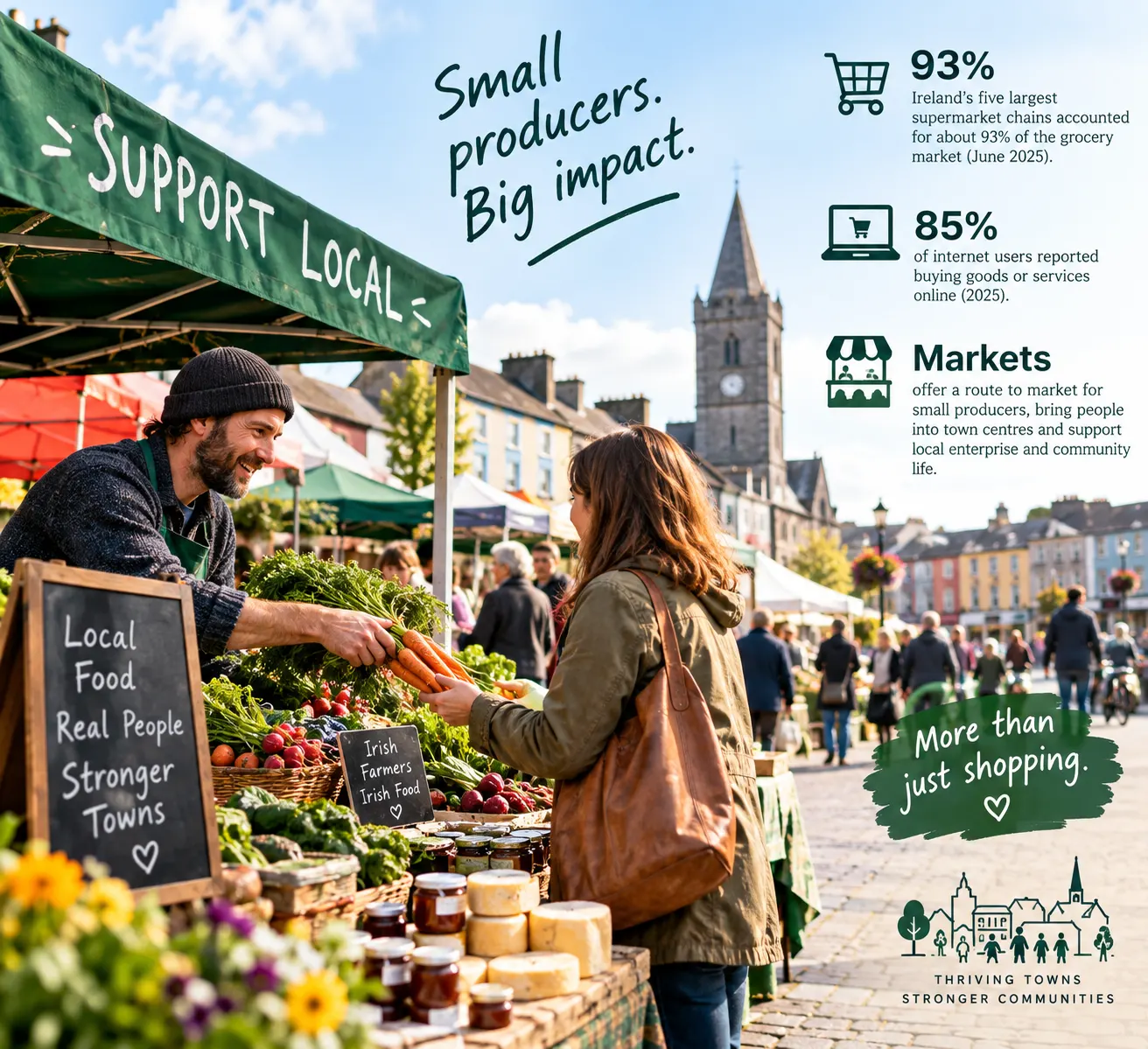
Ireland’s five main nationwide supermarket chains accounted for about 93% of the grocery market in mid-2025, while 85% of internet users reported buying goods or services online. Against those numbers, the traditional weekly market might appear to belong to another economic era. Yet across Ireland farmers, bakers, cheesemakers, growers, fish sellers, craftspeople and prepared-food businesses continue to trade from stalls, while government regeneration schemes increasingly treat town-centre markets not as historical curiosities but as potential generators of footfall, enterprise and community activity.
The important question is not whether markets can reverse decades of structural change in retailing. They cannot compete with supermarkets on opening hours, scale, product range or logistical efficiency, and they cannot by themselves repair vacant buildings or restore a town whose population and employment base have weakened. Their contemporary value lies somewhere else: as a relatively accessible route to market for small producers, a recurring reason for people to enter a town centre and a place where retail, food, tourism and social activity can overlap.
That helps explain why markets have moved from the margins of rural-development policy towards the centre of the regeneration debate. Ireland’s Town Centre First strategy seeks to make town centres places in which people live, work, shop, socialise and run businesses. The Town and Village Renewal Scheme has repeatedly included farmers’ markets, artisan markets, open-air markets and local trader markets among the projects that can be supported.
Weekly markets in a changing retail economy
- Ireland’s five largest nationwide supermarket chains accounted for approximately 93% of the grocery market in June 2025.
- 85% of internet users reported purchasing goods or services online in 2025.
- In July 2026, online sales generated 5.7% of turnover among the domestic retailers covered by the CSO Retail Sales Index.
- For the CSO’s combined food-business category, the online share was 2.9% in July 2026.
- The Town and Village Renewal Scheme has approved more than €210 million for over 1,900 projects since 2016.
- The 2025 scheme explicitly supported farmers’ markets, open-air markets, local trader markets and artisan markets.
- Bord Bia describes food markets as a direct link between shoppers, farmers and small food producers.
Markets Once Helped Define the Town — Then Retail Moved Somewhere Else
For generations, Irish towns were commercial gathering points for their surrounding countryside. Market squares, fairs and trading days brought agricultural producers, households and merchants together at regular intervals. The physical form of many towns still reflects that history in broad squares, market houses and central streets designed around periodic concentrations of trade.
The twentieth century gradually altered the relationship between shopping and place. Permanent shops offered longer opening hours, increasingly sophisticated distribution networks improved availability, private car ownership widened the distance people could travel to shop and supermarkets brought large numbers of products under one roof. Later, larger retail developments and discount chains strengthened competition around price, range and convenience.
This did not make traditional markets disappear, but it changed what they had to offer. A market could no longer rely on being the principal place where households bought basic necessities. To survive, many markets had to become more specialised, more experiential or more closely connected to local production.
Online shopping then added another layer of competition. CSO data show that purchasing online is now a mainstream behaviour rather than a niche activity. A consumer can compare products, order household goods and arrange deliveries without entering a town centre at all, further weakening the automatic relationship between retail spending and the traditional main street.
The Supermarket Did Not Eliminate the Market — It Changed Its Job
The scale difference is considerable. In its 2025 analysis of Irish grocery retailing, the Competition and Consumer Protection Commission reported that Dunnes Stores, Tesco, SuperValu, Lidl and Aldi together represented approximately 93% of the national grocery market, based on June 2025 data. The Commission also found evidence of strong competition between the major retailers and did not identify a competition failure in the sector.
A weekly farmers’ market therefore operates beside an exceptionally developed grocery system. It is unrealistic to expect a collection of small traders to reproduce the supermarket model. Individual producers cannot normally match the purchasing power, distribution infrastructure, year-round assortment, long opening hours or national advertising budgets of large chains.
But a market does not necessarily need to. Its strongest economic proposition is frequently the opposite of standardisation: limited-scale production, recognisable provenance, seasonal availability and direct contact with the person who grew, caught, baked or made the product.
Bord Bia’s current farmers’ market information explicitly emphasises that connection. Its market directory is focused on food markets where producers or members of their teams are present, reinforcing a distinction between a genuine producer-oriented food market and a generic collection of retail stalls.
The Retail Landscape Around Ireland’s Weekly Markets
| Indicator | Latest reference | What it shows |
|---|---|---|
| Five main supermarket chains | Approx. 93% market share | Scale of organised grocery retail |
| People shopping online | 85% of internet users | Digital purchasing is mainstream |
| Domestic retail online turnover | 5.7% | Physical retail still remains substantial |
| Food-business online turnover | 2.9% | Food remains strongly physical |
| Town and Village Renewal | €210m+ since 2016 | State backing for town regeneration |
Sources: Competition and Consumer Protection Commission, Central Statistics Office and Department of Rural and Community Development and the Gaeltacht.
The online figures require careful interpretation. The CSO’s Retail Sales Index covers online turnover generated by the domestic retailers in its sample and excludes non-domestic online retailers, so its 5.7% figure is not a measurement of all Irish consumer spending on the internet. What it does show is that even in a highly digital economy, much retail activity remains tied to physical places.
That distinction creates room for markets. The more routine transactions migrate online, the more physical retail spaces need reasons for people to visit that cannot be replicated by clicking a button. Markets can supply precisely that combination of immediacy, discovery and human contact.
Ireland’s Farmers’ Market Revival Was Already Visible Two Decades Ago
The modern interest in Irish farmers’ markets did not begin with today’s Town Centre First policy. Bord Bia was supporting and advising markets during the 2000s as renewed interest developed in local food, provenance and direct selling. In 2007, the organisation said Ireland had 115 farmers’ markets nationwide.
By 2014, Bord Bia research had identified more than 150 food markets, including farmers’ markets, community markets, weekend city markets, lunchtime markets, co-operatives and country markets. Bord Bia also reported an earlier estimate that food and drink sales through farmers’ markets were worth approximately €27 million annually in 2010.
Those figures are useful evidence of the earlier expansion of the sector, but they should not be presented as a current national count or current market valuation. Markets open, close, relocate and change format, and Ireland does not have a single continuously updated statistical series measuring total turnover across the whole market sector.
What has persisted is the idea of the market as an entry point into the food economy. Bord Bia and Teagasc have continued to describe markets as a route through which smaller producers can reach consumers directly, learn what customers want and develop a commercial identity before attempting wider distribution.
For a Small Producer, a Stall Can Do Something a Supermarket Listing Cannot
Teagasc identifies several reasons farmers and small food businesses may use markets. Direct selling can shorten the commercial chain between producer and consumer, give the seller control over pricing, create immediate customer feedback and provide a setting in which a new product can be tested without the overhead associated with operating a conventional shop.
The feedback function is easy to underestimate. A producer selling preserves, cheese, vegetables, baked goods or prepared food can see which products attract attention, which prices customers resist and which flavours generate repeat purchases. That information arrives before the business commits to much larger production runs, packaging orders or wholesale relationships.
A market stall can also function as a branding platform. Customers do not simply see a product on a shelf; they can speak to the person who made it, understand where ingredients came from and ask how it was produced. For a small enterprise without a large advertising budget, that repeated personal contact can help build recognition and loyalty.
Direct selling does not mean the entire retail margin automatically becomes additional profit for the producer. Market traders must still pay for ingredients, production, transport, insurance, equipment, staffing, certification, payment processing, waste management and sometimes pitch fees. A farmer who spends a full day travelling to and trading at a market is also supplying labour that has an economic cost.
The attraction is therefore not that markets eliminate costs. It is that they provide a different commercial structure in which a producer may retain more control over the relationship with the final customer.
Why a Market Can Generate More Than the Money Spent at Its Stalls
From a town-centre perspective, the most important economic effect may occur outside the market itself. A recurring Saturday or Friday market gives households a reason to arrive in the centre at roughly the same time. Once there, some visitors may also use cafés, pharmacies, pubs, restaurants and other shops, although the scale of that additional spending varies greatly between locations.
This is the concept behind using markets as a footfall generator. A market can concentrate activity into a square or street that might otherwise be quiet and make the town appear busier to residents and visitors. The sensory elements of food, conversation, street trading and seasonal products can make a public space feel occupied in a way that conventional infrastructure investment alone cannot guarantee.
Government regeneration policy now explicitly recognises this mechanism. The 2025 Town and Village Renewal Scheme listed the establishment or regeneration of farmers’ markets, open-air markets, local trader markets and artisan markets among eligible activities. The scheme stated that markets should be highly visible, connected with improved public realm and capable of attracting significant footfall.
That is a notable shift in the way a market is treated. It is not simply an agricultural sales outlet. It is also regarded as part of the physical and economic infrastructure of a town centre.
The State Is Spending Heavily on Town Centres — but Markets Are Only One Piece
Since the Town and Village Renewal Scheme began in 2016, more than €210 million has been approved for over 1,900 projects across Ireland. The programme targets mainly rural towns and villages and forms part of a broader set of interventions intended to address vacancy, dereliction, public spaces and local economic activity.
The Government’s Town Centre First policy, launched in 2022, takes a deliberately broader approach. It argues that successful town centres must function simultaneously as places to live, work, visit, socialise and run businesses. Its 33 actions are intended to combine property reuse, public-realm improvements, local planning and economic development instead of treating vacancy as a problem that can be solved by one grant programme.
In December 2025, €26 million was awarded to 116 projects under the Town and Village Renewal Scheme, with objectives including increased economic activity and footfall, tackling vacancy and dereliction, developing outdoor spaces and supporting tourism. The 2026 programme has continued with a Building and Land Acquisition Measure allowing local authorities to acquire vacant or derelict property or land for future regeneration purposes, while the Department said the main 2026 call would follow later in the year.
Markets fit naturally into that strategy because they can animate improved public space. A regenerated square without regular activity can remain visually attractive but economically quiet. A market gives that space a recurring purpose.
Can Markets Actually Reduce Commercial Vacancy?
The strongest answer is sometimes, indirectly. There is a plausible economic connection between market activity, increased footfall and improved trading conditions for neighbouring businesses. A successful market can also allow very small enterprises to test demand before taking on a permanent premises.
That creates a potential progression from kitchen, farm or small workshop to stall, from stall to repeat customers, and eventually from repeat customers to a shop, café or production unit. Pop-up retail can similarly allow temporary use of otherwise empty property. In the right town, those processes can support occupancy.
But it would be misleading to claim that weekly markets alone reduce vacancy across Ireland. Commercial vacancy can result from poor building condition, fragmented ownership, inheritance disputes, renovation costs, unsuitable floor plans, declining population, changes in traffic patterns, rent expectations, planning constraints and the movement of retail activity to other locations. A busy market does not remove those structural obstacles.
Nor does additional footfall automatically become additional spending in surrounding businesses. Visitors can arrive, buy at the market and leave. The effect is likely to be stronger where the market is physically integrated with existing shops, cafés, parking, public transport, pedestrian routes and other reasons to remain in the centre.
Location Can Matter as Much as the Market Itself
A market held at the edge of a town may be commercially successful for its traders without substantially helping the main street. The same market located around a central square may expose visitors to dozens of permanent businesses as they arrive and leave.
This is why public-realm design matters. Shelter, lighting, accessible toilets, electricity, water, waste facilities, safe pedestrian access and nearby parking or public transport can determine whether an outdoor space works as a serious market venue rather than an occasional event site. Irish weather makes some of those details particularly important.
Consistency matters too. If customers know that a market is present every Saturday morning, it can become part of a household routine. Irregular events may attract large crowds, but a weekly market can create a more predictable pattern for businesses around it.
There is therefore an important difference between funding physical stalls and building a functioning market. Infrastructure is the visible part; management, trader recruitment, scheduling, promotion and maintaining a suitable product mix determine whether people continue to return.
Markets Also Give Town Centres Something Online Retail Cannot Reproduce
Online retail’s great advantage is efficiency. It allows a customer to search a large inventory, compare prices and purchase at any hour. A physical market should not try to beat that system at its own strengths.
Its comparative advantage is experience. Markets allow shoppers to see food, smell it, taste samples, ask questions, meet producers and encounter products they did not search for in advance. They also bring different groups into the same public space without requiring an appointment, ticket or formal social activity.
That has economic significance because modern town centres increasingly compete not only over where people spend money but over whether people visit at all. A town able to combine a market with independent shops, cafés, heritage, cultural events and attractive public spaces creates a reason to spend part of a day there rather than complete a transaction remotely.
Digital technology can even strengthen rather than replace this model. Traders can use social media to announce seasonal products, take advance orders or direct customers towards a market. A producer can build an audience face to face and continue selling to that audience online between market days.
The emerging model is therefore less physical retail versus digital retail than a combination of both.
Farmers’ Markets Are Part of a Much Wider Short-Supply-Chain Debate
Teagasc describes farmers’ markets as one form of short food supply chain: systems in which the number of intermediaries between producer and consumer is reduced. Other examples include farm shops, box schemes, community-supported models and direct online sales.
For producers, shortening the chain can create more control over pricing and customer relationships. It can also allow a farm business to diversify from supplying relatively standardised agricultural commodities into products with greater added value, such as cheese, preserves, baked products or prepared foods.
For consumers, the attraction often lies in traceability and provenance. A buyer can know which farm, bakery or producer supplied the food rather than relying only on packaging and retail branding.
This does not mean short supply chains should replace supermarkets. Large retailers perform functions that small direct-sales businesses would struggle to reproduce efficiently, including national distribution, refrigeration, high-volume purchasing and continuous availability. The two systems can coexist and often do: a successful small producer may sell at markets while simultaneously supplying shops, restaurants or supermarkets.
Markets Can Be Business Incubators — but They Are Not Automatically Cheap Places to Trade
The image of the low-cost market stall can obscure the practical barriers faced by traders. Teagasc advises potential stallholders to calculate production costs, certification, insurance, transport, labour, equipment, promotion and payment charges before deciding whether a market is viable.
There can also be limited capacity. Some established markets operate waiting lists, and an organiser may restrict the number of sellers offering similar products in order to preserve a balanced mix. A new producer can therefore have a good product and still struggle to secure access to the most attractive trading locations.
Weather introduces another risk. Rain or strong winds can reduce customer numbers while the trader has already incurred production and travel costs. Perishable food creates an additional problem because unsold stock cannot always be carried forward to another week.
For that reason, market participation works best when it forms part of a wider sales strategy. A producer able to combine market sales with restaurants, farm-gate sales, online orders, retail distribution or subscription boxes is less dependent on the weather and footfall of a single morning.
Food Markets Are Small Businesses — and Food Law Still Applies
The informality of an outdoor stall does not remove regulatory obligations. The HSE states that a person must notify the relevant authority before operating a food business, and the requirement includes businesses operating from stalls and vehicles. Some businesses dealing with foods of animal origin may require approval rather than registration alone.
The Food Safety Authority of Ireland requires food businesses to comply with hygiene, traceability, allergen and food-safety-management requirements. Its guidance specifically covers market stalls alongside other food businesses.
Trading in public spaces can also be subject to local casual-trading rules. The Casual Trading Act 1995 provides the national framework, but local authorities make bye-laws governing designated trading areas, pitch arrangements, licences and related conditions.
This local dimension can be both useful and complicated. Councils can design markets around the particular requirements of their towns, but traders operating across several counties may encounter different arrangements. Good market policy therefore has to balance low barriers for genuine microbusinesses with food safety, consumer protection and fair access to limited public space.
A Market Is Not Necessarily Cheaper Than a Supermarket
Cost-of-living pressure can make direct selling attractive, particularly where seasonal produce or simple products are competitively priced. But consumers should not assume that every farmers’ market product will cost less.
Large supermarkets have enormous purchasing volumes and efficient logistics, and their price competition can be intense. The CCPC’s 2025 examination of grocery retailing found increased competition and did not identify evidence of excessive pricing caused by an abuse of market dominance.
Small producers face very different economics. Handmade production, lower volumes, higher labour content and premium ingredients can make individual products more expensive. Some consumers accept that difference because they value freshness, production method, local provenance or the direct connection with the producer.
The economic case for markets therefore does not depend on proving that they are Ireland’s cheapest place to shop. Their role is to add another channel to a retail system dominated by large-scale businesses and to give small suppliers direct access to customers.
Local Does Not Automatically Mean Environmentally Better
Farmers’ markets are often associated with sustainability, shorter journeys and reduced packaging. Teagasc includes lower food miles among potential sustainability advantages of direct selling, and government schemes increasingly expect market projects to incorporate sustainability principles.
However, environmental claims require care. Transport distance is only one component of a food product’s environmental footprint. Farming method, energy use, refrigeration, storage, packaging, waste and customer travel can all matter.
A local product does not automatically have lower emissions than an efficiently produced product transported through a larger distribution network. A market to which hundreds of shoppers each drive significant distances can also generate transport emissions of its own.
The stronger sustainability argument is therefore about potential rather than certainty. Shorter chains can reduce some transport and distribution stages, seasonal sales can align supply more closely with local production and direct communication can help producers understand demand. Whether this actually creates a lower environmental footprint depends on how the individual market and supply chain operate.
Food Waste Shows Why Better Connections Along the Chain Matter
Ireland generated an estimated 708,000 tonnes of food waste in 2024, according to the Environmental Protection Agency. Households accounted for about 219,000 tonnes and restaurants and food services for another 181,000 tonnes.
Farmers’ markets are not a solution to that problem on their own. Unsold perishable produce can itself become waste, particularly when weather causes unexpectedly low attendance.
But direct contact can improve information. Producers can see what sells, adjust quantities and build systems for advance ordering or repeat customers. Markets can also provide outlets for products whose appearance, size or seasonality makes them less suited to highly standardised retail presentation, provided normal food-safety requirements are met.
The wider lesson is that shorter supply chains can create flexibility, but only good management turns that flexibility into reduced waste.
The Social Function Is Difficult to Capture in a Turnover Figure
A supermarket can be economically important without functioning as a civic institution. A weekly market is different because buying and social interaction happen in the same space.
People may visit for vegetables and remain for coffee, meet neighbours or browse stalls without purchasing from all of them. Families, older residents and visitors can occupy the same square for different reasons. A market therefore creates a recurring social event without requiring a formal programme.
That characteristic matters in small towns where other informal gathering places have weakened or disappeared. A busy market day can change the atmosphere of a centre even when total market turnover is relatively modest.
The effect should not be romanticised. Poorly managed markets can create litter, traffic problems, conflict over parking or dissatisfaction among permanent retailers. The strongest markets are those integrated into the town rather than imposed on it.
Permanent Shops and Market Traders Do Not Have to Be Rivals
Existing retailers can reasonably worry when publicly supported stalls sell products similar to those available in permanent shops that pay rent, commercial rates and year-round operating costs. Market policy therefore has to consider competition as well as footfall.
A successful market mix can reduce that tension by complementing rather than simply duplicating local businesses. Fresh produce, farm products, crafts, street food and rotating speciality traders can broaden the town’s overall offer and attract customers who then encounter permanent shops.
Market management matters here too. Selecting traders solely to maximise pitch income can produce repetitive stalls and weaken the distinctiveness that attracts visitors in the first place. A curated mix of producers, food businesses and local traders may create greater value for the wider town even if it produces less immediate rental income for the market operator.
This helps explain why government funding criteria emphasise sustainability and longevity rather than merely paying for equipment and hoping activity follows.
Markets Can Connect Food Production With Tourism
Ireland’s tourism strategy is increasingly interested in food as part of the visitor experience. Fáilte Ireland’s Corporate Strategy 2026–2029 includes development of a new Culinary Tourism Strategy intended to strengthen Ireland’s food and drink offering and increase local economic impact.
In March 2026, €310,000 was also announced for a dedicated Food Festival Fund alongside regional festival funding. A weekly market is different from a festival, but both rely on the same basic idea: local food can become part of the identity of a destination rather than merely a product consumed there.
This can be particularly useful for towns outside the largest tourism centres. A visitor who encounters a market selling products associated with the surrounding farms, coastline or food traditions experiences something that is geographically specific. The same collection of national chain stores can be found in many places; a local producer market is harder to reproduce.
For regeneration policy, this matters because visitors provide an additional source of demand. A market supported only by local residents may struggle in a very small population centre, while one that becomes part of a wider tourism, heritage or food offer can draw from a larger catchment.
A Market Can Also Help a Town Discover Which Businesses It Is Missing
Vacant premises and successful stalls can coexist because the financial commitment involved is radically different. Signing a commercial lease requires confidence in long-term demand, while taking a market pitch allows an entrepreneur to test a concept more cautiously.
That makes markets potentially useful as laboratories for town-centre enterprise. If a baker, coffee business, cheesemaker or craft producer repeatedly attracts queues, the market generates information about demand that did not previously exist.
Some traders may remain market businesses permanently, which is a valid model in itself. Others may expand into fixed premises or supply existing shops. The important point is that the market lowers the scale at which commercial experimentation can begin.
This function becomes especially valuable in towns where empty units create uncertainty. New businesses are understandably reluctant to take expensive property risks when pedestrian demand is unknown. Recurring market activity can help reveal whether the town is capable of supporting additional commercial uses.
The Best Markets Are Infrastructure and Event at the Same Time
A conventional infrastructure project is usually static: a pavement, a building, a square or a road. A market combines physical infrastructure with recurring programming. Stalls, power, water and public space matter, but so do traders, customers, atmosphere and regularity.
This dual character is one reason markets appeal to regeneration programmes. A relatively modest public-space investment can support dozens of changing microbusinesses rather than a single tenant. The space can also be used for festivals, community events and other activities outside normal market hours.
But flexibility creates management responsibilities. Somebody must enforce trading rules, maintain quality, promote the market, deal with waste, coordinate utilities and ensure that successful traders are balanced with opportunities for newcomers.
A market without management can deteriorate quickly. A well-managed market can become a long-term institution even though individual stallholders change.
What Markets Cannot Fix Matters Just as Much
Markets are attractive in policy discussions because they are visible. A busy square makes regeneration look immediate. The deeper causes of town-centre decline are usually less photogenic and much harder to solve.
A market cannot renovate an unsafe upper floor, resolve a disputed property title, build housing for workers or make an uneconomic building financially viable. It cannot replace missing public transport, create a large local employment base or reverse demographic change by itself.
Nor can market-day activity substitute for residents. The most resilient centres have people living within walking distance who use shops and services throughout the week. Town Centre First therefore links economic activity with housing, vacancy, public services and the physical condition of buildings rather than treating retail footfall in isolation.
This is why markets should be judged as one intervention within a wider regeneration strategy. Their contribution may be important precisely because they complement other measures rather than because they replace them.
The Next Generation of Irish Markets May Be Partly Digital
The distinction between an old-fashioned market and modern commerce is becoming less useful. A producer can advertise on Instagram, take card payments at a stall, accept an online preorder and hand the product to the customer at Saturday’s market. The physical market becomes one stage in a digital sales relationship.
This model can reduce some of the disadvantages of weekly trading. Advance orders give producers better information about demand, while customers gain the convenience of digital purchasing without requiring home delivery. Social media can keep the market visible during the six days when the stalls are absent.
For small businesses, the combination is particularly powerful. The market provides discovery and trust; digital tools provide continuity. Customers who first encounter a producer in person may later order directly online, while an online follower may visit the market specifically to meet the producer.
The future of the weekly market may therefore depend less on resisting e-commerce than on using it.
Different Irish Towns Need Different Kinds of Market
There is no single market model suitable for every community. Teagasc identifies municipal markets, private markets, traditional traders’ markets, country markets, community or co-operatively operated markets and event markets among the forms available to producers.
A tourist town may support a large weekend food and craft market. A commuter settlement may benefit more from a Friday afternoon market timed around the journey home. A farming town may prioritise fresh produce and regional food, while a larger urban centre can support specialist markets serving particular cuisines or communities.
Population size is only one variable. Catchment area, visitor numbers, parking, public transport, weather protection, local competition and the number of viable traders all influence what can be sustained.
The Town Centre First principle of locally designed regeneration is particularly relevant here. A market copied from another town may fail even if the original is highly successful. The useful question is not whether a town should have a market, but what type of market the town has enough customers and producers to sustain.
Success Should Be Measured Beyond Stall Numbers
A council can count pitches easily, but that reveals little about whether a market is strengthening a town. Better measures would include repeat attendance, trader survival, the proportion of genuinely local producers, changes in pedestrian activity and whether surrounding businesses experience increased trade on market days.
Longer-term indicators could examine whether market traders progress into other sales channels, whether empty premises gain tenants and whether market activity increases the number of visitors spending time elsewhere in the town. Such outcomes are harder to measure but closer to the reason public money is being invested.
It is equally important to distinguish correlation from causation. A successful market may be located in a town that is already economically strong. Rising shop occupancy after a new market begins does not automatically mean the market caused the improvement.
More systematic evaluation would help local authorities identify which combinations of location, infrastructure, frequency and trader mix produce the strongest effects.
Could Every Small Town Have a Successful Weekly Market?
Probably not. A market requires enough producers prepared to trade regularly and enough consumers willing to attend. If either side is too small, public investment in stalls and paving cannot manufacture a viable market indefinitely.
There is also a risk of spreading traders too thinly. A strong regional market that draws people from several surrounding communities may create more economic activity than a collection of weak markets held in every nearby village. Producers themselves have limited time and cannot attend every location.
That means regeneration policy has to resist a simple equation in which more markets automatically mean stronger towns. Sometimes supporting one established market, improving its facilities and connecting it more effectively with nearby businesses will generate more value than creating a new one.
Seasonality can be equally important. Some places may sustain weekly trading throughout the year; others may be better suited to monthly, summer or festival-linked markets. Longevity matters more than the frequency written into an initial funding application.
Why the Idea Has Returned at Exactly This Point in Ireland’s Development
Several trends have converged. The growth of e-commerce has made town centres search for activities that depend on physical presence. Concern about vacancy and dereliction has pushed regeneration towards the centre of rural policy. Interest in provenance and direct producer relationships has given local food an economic identity beyond simple commodity sales.
At the same time, small agricultural and food enterprises need routes to consumers that do not always require immediate access to national distribution. Tourism policy increasingly regards food experiences as part of regional identity, while public-space investment creates more locations capable of supporting outdoor activity.
Markets sit at the intersection of all these developments. They are retail, but also enterprise support. They are food distribution, but also tourism. They occupy public space, but can influence surrounding private businesses.
That multiplicity explains their renewed policy relevance better than nostalgia does.
The Strongest Market Is One That Eventually Matters on Non-Market Days
The real test is what remains after the stalls have been packed away. If a Saturday market merely produces four busy hours before the square becomes empty again, its economic effect is limited. If customers discover permanent shops, producers gain repeat buyers, cafés develop new trade and the town establishes a reputation worth revisiting, the impact becomes more durable.
The same principle applies to producers. A stall that generates one day’s sales is useful; a stall that helps a food business build a customer base, improve its products and develop additional routes to market is more valuable.
For public policy, this is the difference between staging activity and building an economy. Markets are most effective when connected to property regeneration, streetscape investment, tourism, local food networks, enterprise support and a population living in or near the centre.
That also sets realistic limits on what they can achieve. Weekly markets will not restore every struggling Irish main street, and there is no robust national evidence that simply establishing a market causes commercial vacancy to fall. But as one element of a wider town-centre strategy, they offer something unusually difficult to create through construction grants alone: a recurring concentration of people, small businesses and reasons to linger.
The Market Square Still Has an Economic Purpose
The survival of Irish weekly and farmers’ markets in the age of supermarkets and smartphones is not evidence that retail change stopped. It is evidence that the market itself changed.
The old market was often essential because consumers had limited alternatives. The modern market succeeds when it offers an alternative experience: direct connection with producers, local identity, discovery and a reason to occupy the town centre rather than bypass it.
For farmers and small food businesses, it can provide a relatively flexible route into commerce. For councils, it can animate public space. For neighbouring businesses, it can create potential additional footfall. For visitors, it can make one town feel different from another.
None of those benefits is guaranteed, and none removes the structural pressures facing rural retail. But Ireland’s current regeneration policy increasingly recognises that rebuilding town centres requires more than restoring buildings. Places also need recurring activities that persuade people to come back.
In that sense, the weekly market is not returning because Ireland is moving backwards. It is being reconsidered because a very old form of commerce happens to solve several distinctly modern problems at once.
Sources
Bord Bia — Irish Food Markets and Farmers’ Markets
Bord Bia — Guide to Food Markets in Ireland
Teagasc — Selling at a Farmers’ Market
Teagasc — Exploring Farm Diversification: Farmers’ Markets
Government of Ireland — Town Centre First Policy
Department of Rural and Community Development and the Gaeltacht — Town and Village Renewal Scheme
Central Statistics Office — Household Digital Consumer Behaviour 2025
Central Statistics Office — Retail Sales Index July 2026
Health Service Executive — Notify the HSE About Starting a Food Business
Environmental Protection Agency — Food Waste Statistics for Ireland
Source & Transparency
This article is published by Ireland Newspaper for editorial and informational purposes.
Published: 4 September 2026 · Updated: 4 September 2026

Newsroom Ireland Newspaper
Ireland Newspaper editorial team prepares daily news coverage for readers in Ireland and abroad.