Six Teams at the Heart of Irish Rugby in 2026: Ireland’s Leading Professional and Club Sides
Leinster, Munster and Ulster remain three of the great names of Ireland’s professional game, while St Mary’s College, Clontarf and Lansdowne demonstrate why the All-Ireland League remains such an important part of Irish rugby. Their trophies, current players and development pathways tell the story of a sport whose strength extends from international arenas to community club grounds.
Irish rugby has an unusual strength that is easy to overlook when attention is concentrated on the national team. Beneath Ireland’s international side sits a professional provincial structure built around Leinster, Munster, Ulster and Connacht, and beneath that is a club network whose leading national competition, the Energia All-Ireland League, is described by the IRFU as the pinnacle of the club game in Ireland.
The connection between those levels is visible whenever an Ireland squad is announced. Caelan Doris is listed as St Mary’s College and Leinster, Dan Sheehan as Lansdowne and Leinster, Tadhg Furlong as Clontarf and Leinster, Tadhg Beirne as Lansdowne and Munster, and Tom O’Toole as Ballynahinch and Ulster. The club game is therefore not separate from professional Irish rugby: it is part of the pathway that helps produce it.
With the 2026/27 professional and club seasons still ahead, the completed 2025/26 season provides the clearest current benchmark as of August 2026. Leinster ended that campaign as United Rugby Championship champions, Munster finished fifth in the regular-season URC table, and Ulster combined a ninth-place URC finish with a run to the EPCR Challenge Cup final. In the All-Ireland League, St Mary’s College finished first in Division 1A before winning the championship, Clontarf finished second and reached the final, while Lansdowne finished third and again qualified for the play-offs.
There is no official Irish ranking combining league position, European performance, historical honours and squad strength. The professional Top Three below is therefore an editorial selection, with current performance given the greatest weight but major achievements and consistency also considered. Ulster take third position narrowly ahead of Connacht because their journey to the 2026 Challenge Cup final represents an important European achievement, even though Connacht finished one place above them in the URC. For the club section, the ranking closely follows the completed 2025/26 Division 1A season.
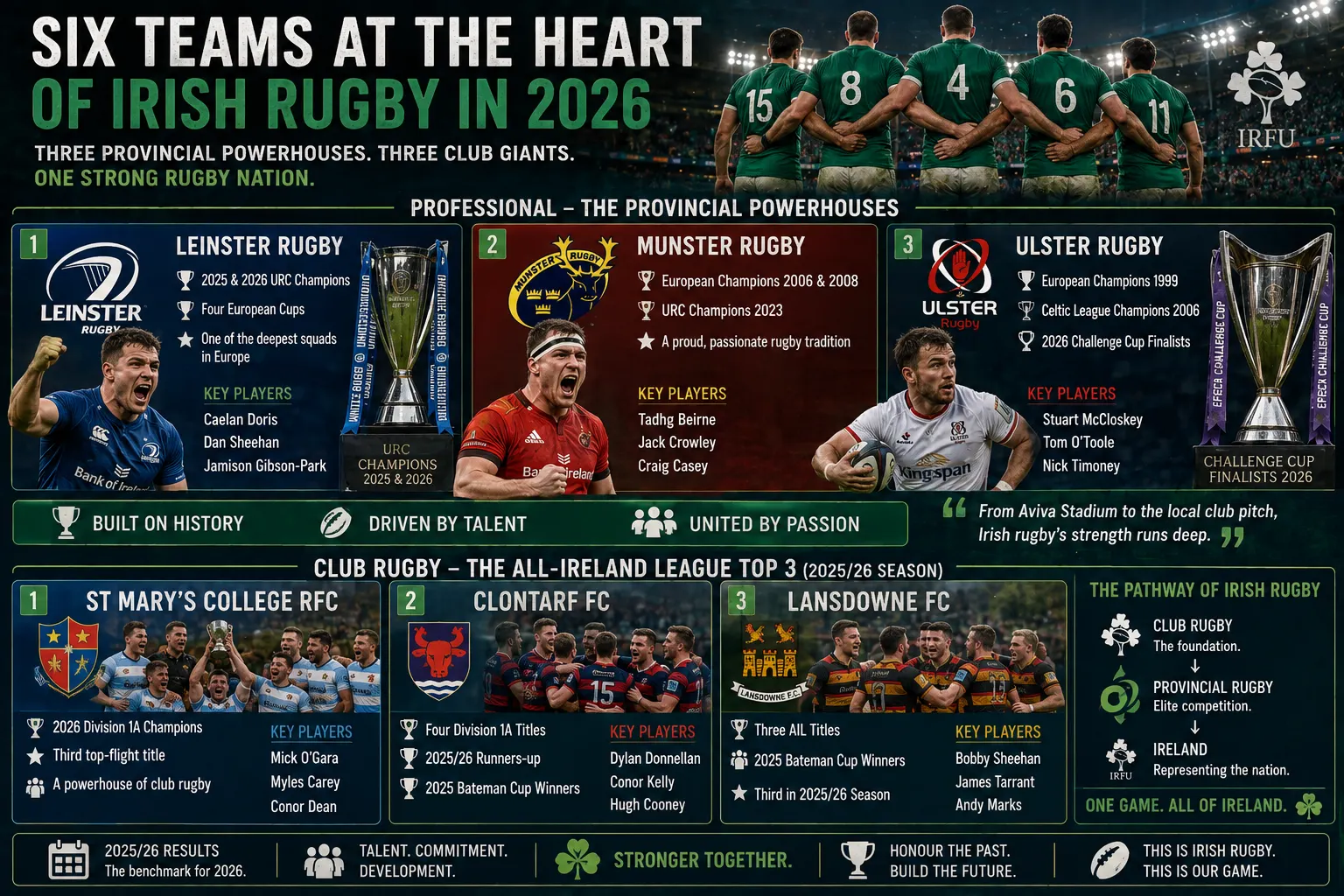
| Rank | Team | Level | Major recent or historic successes | Standout current players |
|---|---|---|---|---|
| 1 | Leinster Rugby | Professional | 2025 & 2026 URC champions; four European Cups | Caelan Doris, Dan Sheehan, Jamison Gibson-Park |
| 2 | Munster Rugby | Professional | European champions 2006 & 2008; URC champions 2023 | Tadhg Beirne, Jack Crowley, Craig Casey |
| 3 | Ulster Rugby | Professional | European champions 1999; Celtic League champions 2006; 2026 Challenge Cup finalists | Stuart McCloskey, Tom O’Toole, Nick Timoney |
| 1 | St Mary’s College RFC | All-Ireland League | 2026 Division 1A champions; third top-flight title | Mick O’Gara, Myles Carey, Conor Dean |
| 2 | Clontarf FC | All-Ireland League | Four Division 1A titles; 2025/26 runners-up; 2025 Bateman Cup champions | Dylan Donnellan, Conor Kelly, Hugh Cooney |
| 3 | Lansdowne FC | All-Ireland League | Three AIL titles; 2025 Bateman Cup winners; third in 2025/26 | Bobby Sheehan, James Tarrant, Andy Marks |
The table tells only part of the story. Each of these six sides represents something different within Irish rugby: Leinster’s extraordinary depth, Munster’s powerful identity, Ulster’s European tradition, St Mary’s resurgence, Clontarf’s remarkable consistency and Lansdowne’s historic connection between the club and international game.
1. Leinster Rugby — Ireland’s Leading Professional Side in 2026
Leinster enter the new season from the strongest position of any Irish professional team. They finished second in the 2025/26 URC regular-season table but went on to win the championship, securing another title in June 2026. It followed their 2024/25 success and gave Leinster consecutive URC championships.
Their strength is not confined to domestic competition. Leinster also reached the 2026 Investec Champions Cup final, once again placing themselves among European rugby’s elite. The province already possesses four European Cup titles, won in 2009, 2011, 2012 and 2018, a sequence that established Leinster as one of the most successful European teams of the professional era.
What distinguishes modern Leinster is depth. The senior squad routinely contains a large number of Ireland internationals, while an academy and schools-and-clubs pathway continues to produce replacements as established players move through their careers.
Leinster’s Standout Players
Caelan Doris remains one of the defining players of the present Leinster generation. The back-row forward was appointed Ireland captain for the 2026 Six Nations and was again named captain of Ireland’s squad for the inaugural Nations Championship southern hemisphere series. His combination of carrying, work rate, defence and leadership makes him central to both province and country.
Dan Sheehan has developed into one of rugby’s most influential attacking hookers. His mobility gives Leinster an additional carrying and attacking threat that is unusual for the position, while his international importance was underlined when he captained Ireland during the 2026 Nations Championship tour in Doris’s absence.
Jamison Gibson-Park remains enormously influential at scrum-half. His tempo, distribution and ability to accelerate an attack have been important features of Leinster and Ireland’s style, and he continued as a central member of Ireland’s team during 2026.
There are many others who could comfortably appear on such a list — including Josh van der Flier, Tadhg Furlong, Garry Ringrose, James Ryan and Joe McCarthy — which itself illustrates Leinster’s greatest competitive advantage. Few European teams can call on such a large group of established internationals while continuing to develop young players behind them.
Four European Cups and a New Generation
Leinster’s modern story has been built over more than one successful cycle. Their first European title arrived in 2009, followed by the celebrated comeback against Northampton Saints in the 2011 final and another championship in 2012. A fourth European crown followed against Racing 92 in Bilbao in 2018.
The important point for 2026 is that Leinster have remained competitive even as the personnel have changed. The Brian O’Driscoll and Johnny Sexton eras belong to history, yet the province continues to reach the closing stages of Europe and has now converted its domestic strength into consecutive URC titles.
That ability to regenerate is arguably as significant as any individual trophy. Leinster’s challenge for the years ahead will be to continue converting squad depth and consistent semi-final and final appearances into silverware, particularly in Europe. On the evidence of 2025/26, they remain Ireland’s benchmark professional team.
2. Munster Rugby — Tradition, Identity and Another Competitive Generation
There are few rugby identities as distinctive as Munster’s. The province’s great European years created some of Irish sport’s most enduring rugby memories, but Munster’s importance in 2026 is not based solely on nostalgia.
The province finished fifth in the 2025/26 URC regular season, comfortably enough to reach the play-offs. That placed Munster behind Leinster among the Irish provinces in the league table but still firmly within the championship’s leading group.
Munster’s historical record remains formidable. They won the European Cup in 2006 and 2008, while league titles arrived in 2003, 2009 and 2011. Most significantly for the modern generation, Munster became URC champions again in 2023, winning the final in Cape Town and ending a 12-year wait for major silverware.
That 2023 championship demonstrated that the province could build a new successful team rather than simply celebrating the achievements of the Ronan O’Gara, Paul O’Connell and Anthony Foley era.
Munster’s Standout Players
Tadhg Beirne has become one of Munster’s most important modern leaders. He was appointed captain for the 2025/26 campaign and passed 100 appearances for the province during the season. He remains equally comfortable operating in the second row or back row and continues to feature at the highest international level for Ireland.
Jack Crowley represents another important part of Munster’s future. The fly-half has already accumulated 83 Munster appearances and 450 points, according to the province’s current squad records, while becoming an established Ireland international. His development gives Munster a locally produced playmaker around whom a back line can continue to evolve.
Craig Casey brings speed, leadership and experience at scrum-half. Munster’s current squad records list him with 115 appearances, and he has become a regular member of Ireland squads. He also captained Munster at Thomond Park during the closing stages of the 2025/26 season.
John Hodnett, Gavin Coombes, Calvin Nash and the emerging Edwin Edogbo add further quality to a squad that increasingly mixes established internationals with players entering their prime years.
Munster’s Greatest Strength Is Bigger Than a Trophy Cabinet
Munster’s two European titles remain fundamental parts of Irish rugby history. The first, against Biarritz in Cardiff in 2006, arrived after earlier final disappointments and became one of the defining moments of the province’s professional era. Two years later, victory over Toulouse delivered a second European crown.
Yet Munster’s wider significance comes from the relationship between the professional team and rugby communities throughout the province. Thomond Park remains one of Irish rugby’s most recognisable venues, but the wider Munster system extends through clubs, schools and counties across the south.
The modern challenge is to turn that identity into sustained competitiveness in an increasingly powerful international club market. With Beirne providing leadership, Crowley developing at fly-half and a growing group of younger forwards emerging, there is plenty for Munster supporters to approach positively.
3. Ulster Rugby — European History and a 2026 Run That Rebuilt Momentum
Selecting Ireland’s third professional team is the closest decision in this ranking. Connacht finished eighth in the 2025/26 URC table and reached the quarter-finals, while Ulster finished ninth. On league performance alone, Connacht would therefore take third position.
Ulster receive the narrow editorial advantage because their European campaign produced something significant: a place in the 2026 EPCR Challenge Cup final in Bilbao. The run included an impressive knockout victory over Stade Rochelais before Ulster reached the final against Montpellier. It was their first Challenge Cup final and provided a major European occasion for the province.
That achievement also connected the current team with a proud European history. Ulster became the first Irish province to win the European Cup in 1999, defeating Colomiers at Lansdowne Road. They subsequently won the Celtic League in the 2005/06 season, adding another major title to the province’s record.
Ulster’s Standout Players
Stuart McCloskey remains one of Ulster’s leading backs. His physical carrying, distribution and ability to create momentum from midfield have made him a long-standing Ireland international, and he was again selected throughout Ireland’s 2026 Six Nations campaign.
Tom O’Toole has become increasingly valuable because of his ability to contribute at international level in the front row. He started for Ireland during both the Six Nations and the Nations Championship programme in 2026 and remains an important part of Ulster’s pack.
Nick Timoney provides athleticism and experience in the back row. He continued to feature in Ireland squads and matchday selections in 2026, reflecting the consistency that has made him an important senior player for Ulster.
Ulster also have exciting attacking options and a younger generation developing beneath their senior internationals. Their 2026 European run provided evidence of what the province can achieve when confidence and performance come together.
Connacht Deserve Recognition Too
Leaving Connacht outside a Top Three should not be interpreted as suggesting a large gap between the provinces. In fact, the 2025/26 URC table shows exactly the opposite. Connacht finished eighth on 54 points, with Ulster just two points behind on 52, and Connacht secured a play-off position.
That competitiveness is healthy for Irish rugby. A system in which the identity of the third-ranked province can genuinely be debated is considerably stronger than one in which the hierarchy never changes. Connacht’s continued player development and growing senior squad mean the western province has every opportunity to move further up such a ranking.
Ireland’s Three Leading Club Sides
The word “amateur” requires some explanation in modern Irish rugby. The Energia All-Ireland League is the country’s leading senior club competition, distinct from the fully professional provincial game. Club sides can nevertheless include academy players and players connected to professional provincial systems. For that reason, “club rugby” is the more precise term, even though it is commonly contrasted with the professional game. The IRFU itself describes the AIL as “the pinnacle of the club game in Ireland.”
And in 2025/26, three Dublin clubs occupied the top three positions in Division 1A: St Mary’s College, Clontarf and Lansdowne.
1. St Mary’s College RFC — The Champions of 2026
No club has a stronger claim to first position in August 2026 than St Mary’s College. They finished top of the Division 1A regular-season standings and then completed the job at the Aviva Stadium, defeating Clontarf 46-31 in the final on 26 April 2026. It was their first top-flight championship since 2012.
The achievement was particularly impressive because of the speed of St Mary’s rise. The club went from Division 1B champions to Division 1A champions within two years, transforming themselves from a promoted team into the strongest side in the national club competition.
The 2026 success gave St Mary’s their third All-Ireland League top-flight title, following previous championships in 2000 and 2012.
St Mary’s Standout Players
Mick O’Gara is the clearest individual choice. The goal-kicking centre played a central role throughout the championship campaign and was subsequently named the 2025/26 Energia All-Ireland League Men’s Division 1A Player of the Year.
Myles Carey produced one of the performances of the season on the biggest club stage. He scored in the final and was named player of the match as St Mary’s captured the title at the Aviva Stadium.
Conor Dean, the club captain, provided leadership at out-half and finished the final memorably with an intercept try during the closing minutes.
The statistics underline that this was not a championship built around one player. Josh Gimblett was among Division 1A’s outstanding defensive performers, while St Mary’s had important contributions from across their pack and back line. Their collective balance was ultimately what turned regular-season leadership into a national title.
2. Clontarf FC — Remarkable Consistency at the Top
If St Mary’s were the outstanding club of 2025/26, Clontarf remain arguably the strongest model of sustained recent success.
The north Dublin club won Division 1A championships in 2014, 2016, 2022 and 2025. In 2026 they reached another final, meaning Clontarf had qualified for eight Division 1A finals in ten years. That level of consistency is exceptional in a competition designed to produce closely matched teams.
Their 2025/26 season also brought another piece of silverware. Clontarf won the Energia Bateman Cup for the first time, defeating Ballynahinch 21-16 in December 2025.
They eventually finished second to St Mary’s in the league, but a season containing a national cup, second place in the regular-season table and another appearance in the AIL final can still be considered highly successful.
Clontarf’s Standout Players
Dylan Donnellan has been one of the most extraordinary try-scoring forwards in Irish club rugby. The Clontarf captain entered the 2026 play-offs as Division 1A’s leading try scorer and scored his 18th try of the season in the semi-final victory over Lansdowne. His ability to finish from close range and at the back of powerful mauls has repeatedly made him one of the division’s most productive players.
Conor Kelly provides much of Clontarf’s control and scoring from out-half. He went into the 2026 semi-final with 138 league points for the campaign and has also represented the Ireland Club XV.
Hugh Cooney adds another level of attacking quality. The Leinster player was part of Clontarf’s 2026 final line-up and scored a notable try in the decider, underlining the important connection that exists between elite club rugby and the provincial pathway.
Clontarf’s larger achievement, however, is cultural. Reaching the national final year after year requires recruitment, coaching, player development and consistency across an entire club rather than simply one exceptional generation.
3. Lansdowne FC — Historic Success with a New Chapter Beginning
Few rugby clubs have a stronger connection to the history of the Irish game than Lansdowne, and the modern club remains highly competitive. Lansdowne finished third in Division 1A in 2025/26, reaching the semi-finals for the third time in four seasons.
Their modern trophy record includes three All-Ireland League championships, won in 2013, 2015 and 2018. The 2018 triumph formed part of a league-and-cup double, one of the strongest seasons in the club’s recent history.
Lansdowne also won the 2025 Bateman Cup, defeating Instonians 38-26, adding another national honour before their third-place league campaign in 2025/26.
Lansdowne’s Standout Players
Bobby Sheehan was Lansdowne’s leading try scorer during the closing stages of the 2025/26 regular season, reaching 10 tries before the semi-final and scoring again against Clontarf. His importance has been further recognised for the new campaign: he has been appointed Lansdowne club captain for 2026/27.
James Tarrant provided an important source of points and consistency. He entered the 2026 play-offs as Lansdowne’s leading points scorer with 67 points and had also recorded an 82% goal-kicking accuracy figure in the published Division 1A statistics.
Andy Marks was another of Lansdowne’s major attacking contributors during the season. He captained the team at various stages and appeared prominently among the division’s line-break and running-metre statistics.
There is also a significant development ahead of 2026/27: former Leinster and Ireland forward Rhys Ruddock has taken over as head coach of Lansdowne’s senior men’s team. Combined with Sheehan’s appointment as captain, it gives an already competitive club a particularly interesting foundation for the new season.
Why Ireland Needs Both Provinces and Clubs
Perhaps the most encouraging feature of Irish rugby is that its professional and club structures are not two separate worlds.
Caelan Doris provides a perfect example. Internationally he captains Ireland; professionally he plays for Leinster; his club affiliation remains St Mary’s College. Tadhg Furlong represents Leinster while carrying the Clontarf affiliation, Dan Sheehan and Rónan Kelleher are associated with Lansdowne while playing professionally for Leinster, and Tadhg Beirne carries the Lansdowne connection while captaining Munster.
That pathway helps explain why club rugby matters even in an era dominated by international Tests, television contracts and professional competitions. Clubs provide coaching, competition, identity and playing opportunities for thousands of people who will never become professional players, while simultaneously forming part of the system through which some of Ireland’s finest players emerge.
The connection works in the other direction as well. Academy and provincial players appearing in club rugby can raise standards, while former professionals increasingly bring their knowledge into coaching and development roles. Lansdowne’s appointment of Rhys Ruddock for 2026/27 is one current example.
Irish Rugby Has More Than One Measure of Success
Leinster’s position at the top of the professional ranking is difficult to dispute after consecutive URC championships and another Champions Cup final appearance. Munster remain one of Europe’s great rugby institutions and continue to possess a squad capable of challenging at the highest level. Ulster’s journey to Bilbao in 2026 showed that the province can still create major European occasions, while Connacht’s play-off qualification ensured genuine competition between Ireland’s professional teams.
At club level, the picture is equally encouraging. St Mary’s spectacular rise culminated in a national championship, Clontarf continued a decade of exceptional consistency, and Lansdowne combined another top-three finish with preparations for a new coaching era. The IRFU has also confirmed a restructured All-Ireland League for 2026/27, with sustainability and competitiveness among the objectives behind the changes.
Irish rugby’s strength therefore cannot be measured solely by the national team or by the number of trophies inside one provincial headquarters. It exists in the connection between the levels: children entering clubs, volunteers maintaining those clubs, senior players competing in the All-Ireland League, academies developing elite talent, provinces turning that talent into professionals and, ultimately, players progressing into the Ireland team.
That is why the six teams in this selection matter for different reasons. Leinster demonstrate what sustained professional excellence can look like. Munster show the power of identity and renewal. Ulster carry a proud European tradition into another generation. St Mary’s prove how rapidly an ambitious club can rise. Clontarf illustrate the value of consistency, and Lansdowne show how history and modern development can coexist.
Together, they represent one of Irish rugby’s greatest advantages in 2026: a game with strong professional teams at the top, but roots that still run deeply through the clubs beneath them.
Source & Transparency
This article is published by Ireland Newspaper for editorial and informational purposes.
Published: 13 August 2026 · Updated: 13 August 2026

Newsroom Ireland Newspaper
Ireland Newspaper editorial team prepares daily news coverage for readers in Ireland and abroad.