Irish Stocks in 2026: Three Companies Showing How Ireland Built Global Businesses from a Small Economy
Kingspan, AIB and Kerry Group operate in very different industries, yet each illustrates a defining strength of modern Irish business: the ability to turn a relatively small domestic base into international scale, strong profitability and long-term shareholder value.
Ireland is one of Europe’s smaller countries.
Its stock market tells a considerably bigger story.
On Euronext Dublin, investors can buy shares in businesses involved in banking, aviation, food technology, building materials, housing, insurance, renewable energy, mining, logistics and agricultural services. The ISEQ 20 includes companies ranging from AIB and Bank of Ireland to Kerry Group, Kingspan, Ryanair, Irish Continental Group and several of the country’s leading property businesses.
The most interesting feature of Irish equities is therefore not simply their size.
It is how little many of Ireland’s leading listed companies ultimately depend on Ireland alone.
Some began as domestic businesses and became European leaders.
Others expanded into North America, Asia and emerging markets.
Several now generate the overwhelming majority of their revenues outside the State while maintaining headquarters, heritage or substantial operations in Ireland.
That internationalisation is one of the central reasons the Irish stock market deserves more attention than its relatively small number of listings might suggest.
Among the companies producing particularly strong operating results in 2026, three stand out for different reasons: Kingspan Group, AIB Group and Kerry Group.
They are not identical businesses and should not be treated as a formal investment ranking. Their success is being measured here through a combination of recent profitability, growth, strategic expansion, market position and the strength of their latest reported financial results.
Together, they offer an unusually clear picture of what successful Irish corporate development can look like.
Ireland’s Stock Market Is More International Than the Irish Economy Looks
A stock exchange is often assumed to represent the domestic economy.
That is only partly true in Ireland.
An Irish-listed company may have its headquarters in Dublin, Cavan or Kerry while selling products across dozens of countries.
That means the value of an Irish share can be influenced by American construction, European interest rates, Asian food demand, data-centre investment, global consumer preferences and international capital markets just as strongly as by conditions inside Ireland.
This makes Euronext Dublin distinctive.
The companies may be Irish.
Their economic geography frequently is not.
Kingspan sells building-envelope and insulation technologies internationally.
Kerry supplies taste, nutrition and biotechnology solutions to food and beverage manufacturers around the world.
AIB is more closely connected to the domestic Irish economy, but its enormous customer base and lending activity make it one of the clearest financial expressions of Ireland’s economic expansion.
Three companies.
Three industries.
Three different routes to scale.
Number One: Kingspan — From County Cavan to a Global Building-Technology Group
Few Irish corporate stories illustrate international expansion as vividly as Kingspan.
The company is headquartered in Kingscourt, County Cavan, yet its commercial reach extends across more than 80 countries.
What began as an Irish building-products company has developed into a global specialist in high-performance insulation, building envelopes and increasingly sophisticated infrastructure associated with modern buildings and data centres.
Kingspan recorded revenue of €9.2 billion in 2025 and trading profit of €955 million.
By August 2026, the numbers had moved higher again.
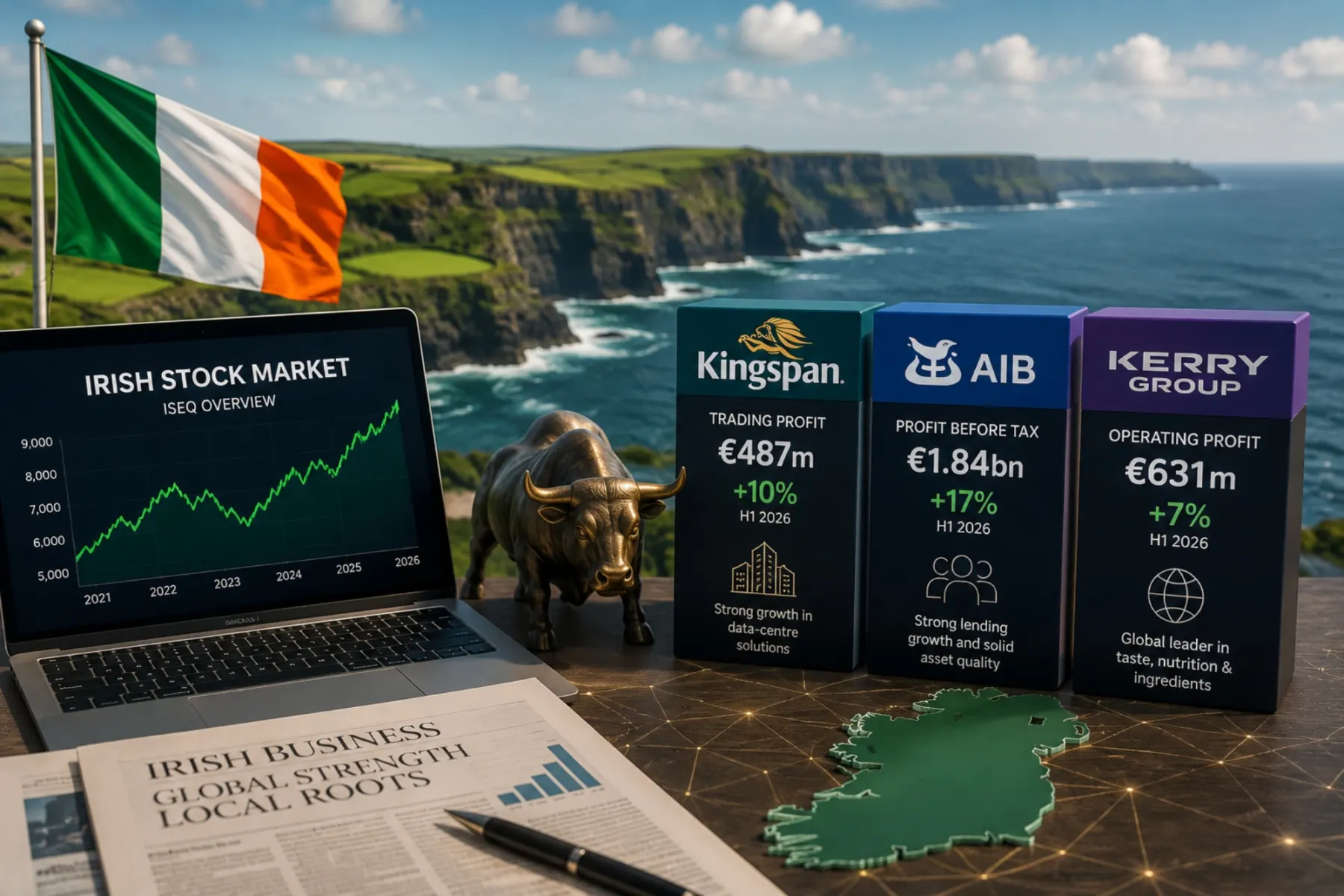
Its first-half trading profit reached €487 million, an increase of 10% year on year. More significantly, the company increased its expectation for full-year trading profit to approximately €1.13 billion, which would represent growth of about 18% compared with 2025.
That would be an important milestone.
For the first time, Kingspan also expects annual revenue to have a realistic opportunity to exceed €10 billion.
For an enterprise that grew out of a relatively small Irish manufacturing base, the scale is remarkable.
The Data-Centre Economy Is Opening a New Growth Engine
One of the most interesting parts of Kingspan’s current development has little to do with the traditional image of insulation panels.
It is data centres.
Modern data centres require enormous amounts of specialised infrastructure.
They need cooling.
They need power-management systems.
They require technically advanced flooring, airflow and thermal-management solutions.
The artificial-intelligence boom has substantially increased investment in precisely this type of infrastructure.
Kingspan’s ADVNSYS business is positioned directly inside that development.
During the first half of 2026, ADVNSYS sales increased 34%, while both order intake and its backlog more than doubled compared with a year earlier.
This is strategically important because data-centre infrastructure creates a second major growth narrative alongside Kingspan’s established energy-efficiency and building-envelope businesses.
The same company that historically benefited from tighter insulation standards and energy-efficient construction is now gaining exposure to one of the largest technology-investment cycles in the global economy.
Kingspan Is Investing in Physical Capacity Around the World
Growth at Kingspan is not occurring solely through accounting figures.
The company invested approximately €233.6 million during the first half of 2026, with much of that expenditure directed towards capital investment and new facilities in markets including the United States, Vietnam and Australia.
That matters because manufacturing companies ultimately require physical capacity.
A software business can theoretically add customers without constructing another factory.
Kingspan sells physical products.
Growth requires plants, machinery, distribution networks and technical expertise.
Its strategy has therefore combined acquisitions with greenfield and brownfield investment across multiple regions.
The company’s 2025 annual reporting showed a global manufacturing network of 278 sites and a commercial presence in more than 80 countries.
That global footprint gives Kingspan something particularly valuable: access to several construction cycles rather than dependence on one national market.
Why Energy Efficiency Remains a Powerful Long-Term Theme
Behind the short-term financial numbers lies a much larger structural trend.
Buildings consume enormous quantities of energy.
Governments across Europe, North America and elsewhere are tightening standards for building performance and attempting to reduce energy consumption and emissions.
Insulation is therefore not merely a conventional construction product.
It increasingly forms part of national energy policy.
A better-insulated building requires less energy to heat or cool.
That economic logic becomes particularly attractive when energy prices are high.
For Kingspan, the long-term commercial opportunity therefore extends beyond simply building more houses or warehouses.
It includes making existing and future buildings perform better.
Add the rapidly expanding technical requirements of data centres and the company now sits at the intersection of several important investment themes simultaneously:
construction;
energy efficiency;
industrial technology;
and digital infrastructure.
That combination helps explain why Kingspan has grown from an Irish manufacturer into one of the most internationally significant companies still listed in Dublin.
The Stock Market Responded to the August Update
Investors responded strongly when Kingspan released its latest outlook on 7 August.
Its shares rose around 13% in early trading after the company increased its full-year profit forecast.
A single day’s share-price movement should never be confused with a long-term company valuation.
But large movements following financial results can reveal how differently investors reassess a business when new information changes expectations about future earnings.
In Kingspan’s case, the important message was not simply that profits had increased.
It was that management believed the company could produce approximately €1.13 billion in trading profit this year and potentially move towards still higher levels thereafter.
That makes Kingspan one of the clearest current examples of an Irish company operating on genuinely global industrial scale.
Number Two: AIB — The Financial Beneficiary of Ireland’s Expanding Economy
If Kingspan represents Ireland’s global industrial reach, AIB represents something very different.
It is deeply connected to Ireland itself.
Banks effectively sit inside the bloodstream of an economy.
When households buy homes, businesses invest, companies borrow, people save and entrepreneurs expand, banks participate in that activity.
AIB’s latest results provide a striking indication of the scale of the current Irish banking market.
For the first six months of 2026, AIB reported profit after tax of €939 million.
That is almost €1 billion in profit in six months.
The importance of the number becomes clearer when viewed beside the underlying lending activity.
AIB reported new lending of €7.5 billion during the half year, an increase of 10% compared with the corresponding period of 2025.
Gross loans reached €74.5 billion, while customer deposits stood at €118.8 billion.
The bank also held approximately a 30% share of Ireland’s mortgage market.
Those are not merely banking statistics.
They provide a window into the scale of financial activity taking place across Irish households and businesses.
AIB Has Become a Major Capital-Return Story
One of the most significant developments for investors has been the amount of capital generated by the bank.
AIB entered 2026 after reporting profit after tax of around €2.1 billion for 2025 and substantial distributions to shareholders.
Its strong capital position has continued into the current year.
The first-half Common Equity Tier 1 ratio was 16.1%, comfortably above the bank’s stated target level, while return on tangible equity reached 23.2%.
The bank announced an interim dividend of approximately €406 million, equivalent to 19.528 cent per share.
That represented an increase of almost 60% in the interim dividend per share compared with the previous year.
For shareholders, this matters because successful banking is ultimately not measured solely through the size of the loan book.
It is measured through the ability to generate sustainable returns from that balance sheet while maintaining sufficient capital.
AIB’s recent numbers show both strong profitability and substantial capacity to distribute capital.
Ireland’s Economic Expansion Is Visible Inside AIB’s Loan Book
The wider Irish economy helps explain the scale of the opportunity.
Population has been growing.
Employment remains high.
Housing demand remains substantial.
Businesses continue investing.
Foreign investment remains strong.
Domestic companies are expanding internationally.
Each of these trends creates financial activity.
A home purchase can create a mortgage.
A growing SME may require working capital.
A commercial development may require project finance.
Infrastructure creates corporate banking opportunities.
Higher household wealth creates demand for savings, investments and wealth-management services.
AIB is therefore not simply benefiting from one isolated banking product.
It is positioned across several areas of economic activity.
The bank said new lending increased across all lending segments during the first half of 2026.
That breadth is important.
A successful bank becomes more resilient when growth is generated across mortgages, businesses and corporate lending rather than relying entirely on one source.
AIB Is Also Becoming More Digital
Banking itself is changing rapidly.
A branch network remains important, but an increasing share of routine banking now takes place through smartphones.
Payments.
Transfers.
Card management.
Savings.
Personal financial information.
Loan applications.
Security.
The quality of a bank’s digital infrastructure has therefore become part of its competitive position.
During 2026 AIB continued the rollout of a new mobile application designed to provide more personalised financial tools and stronger digital services.
The bank has also been developing its wealth-management capabilities and expanding digital payment products.
This is a different type of transformation from Kingspan’s factory investment.
But economically the principle is similar.
Both companies are investing in infrastructure designed to allow a larger business to operate more efficiently.
One is physical.
The other is digital.
AIB’s Scale Makes It an Economic Indicator in Its Own Right
Approximately 3.5 million customers use AIB Group services.
That gives the company a reach extending across a very large share of the Irish population and business sector.
For investors following Ireland, this makes the bank interesting beyond its own financial statements.
Mortgage activity can reveal housing demand.
SME lending can provide signals about business confidence.
Deposit growth can reflect household and corporate liquidity.
Credit quality can provide information about financial stress.
AIB shares therefore represent something close to a listed financial proxy for significant parts of the Irish domestic economy.
That is a very different proposition from Kingspan.
And that difference illustrates the diversity that still exists within the relatively compact Irish stock market.
Number Three: Kerry Group — Ireland’s Food Business Became a Global Technology Business
Kerry Group’s evolution may be the most surprising of the three.
To many consumers, the name still sounds fundamentally agricultural.
That is understandable.
The company grew from Ireland’s dairy and food economy.
But the modern Kerry Group is much more accurately understood as a global taste, nutrition and food-science company.
Its customers include food, beverage and nutrition companies seeking ingredients and technologies that can change flavour, extend shelf life, improve texture, reduce sugar or salt, increase protein, support fermentation or create entirely new products.
That places Kerry inside a huge global innovation market.
In its latest results, released on 29 July, the company reported first-half revenue of €3.3 billion and volume growth of 3.3%.
Its EBITDA margin increased by 60 basis points to 16.7%, while EBITDA reached €558 million.
Adjusted earnings per share rose by 7.9% on a constant-currency basis to 214.1 cent.
Free cash flow reached €262 million.
And the interim dividend increased by 10% to 46.2 cent per share.
Those figures place Kerry firmly among Ireland’s strongest current listed operating businesses.
Kerry’s Real Product Is Expertise
The most interesting aspect of Kerry is that the company increasingly sells knowledge embedded inside ingredients.
Consider something as ordinary as a snack.
A manufacturer may want it to contain less salt without tasting bland.
A dairy company may want a high-protein drink with a particular texture.
A bakery may want bread to remain fresh for longer.
A beverage company may need a natural flavour that remains stable throughout shelf life.
A pharmaceutical manufacturer may require specialist ingredients.
These are technical problems.
Kerry develops ingredients and systems intended to solve them.
That changes the economics of the business.
A commodity food producer often competes heavily on price.
A highly specialised ingredients company competes on intellectual property, formulation knowledge, scientific expertise and the ability to help customers create better products.
That is a much more differentiated position.
Volume Growth Is Particularly Important
Revenue can increase for several reasons.
A company can sell more product.
It can charge higher prices.
It can acquire another company.
Currencies can move.
For Kerry, the 3.3% increase in underlying volumes during the first half is particularly significant because it indicates that more product was actually being sold.
Second-quarter volume growth accelerated to 3.5%.
The company reported growth across all three of its major geographical regions, with especially strong performance in the Americas and continued expansion elsewhere.
That gives Kerry a business model that resembles other highly international Irish success stories.
Ireland remains the corporate home.
The market opportunity is global.
The Margin Story May Be Even More Important Than Revenue
Kerry’s EBITDA margin increased to 16.7% during the first half.
That is strategically important because profitable growth is more valuable than growth achieved simply by adding low-margin turnover.
The company attributes much of the margin improvement to its Accelerate 2.0 programme, which includes greater operational efficiency, optimisation of its manufacturing footprint and increased use of digital technology.
In practical terms, the company is trying to generate more economic value from each euro of sales.
That becomes powerful when combined with organic volume expansion.
A company that increases volumes while simultaneously improving margins can grow earnings faster than revenue.
That is exactly the type of operating leverage investors look for in mature multinational businesses.
Kerry Is Already Looking to 2030
The July results were notable for another reason.
Kerry published updated financial targets extending to 2030.
The group is targeting annual volume growth in the range of 3% to 5% and an EBITDA margin of 20% to 21% by 2030.
These are targets rather than guaranteed outcomes.
That distinction is important.
But they show the scale of management’s strategic ambition.
Kerry is no longer principally trying to become a larger Irish food company.
It is attempting to strengthen its position as one of the international businesses supplying the technologies and ingredients behind the world’s food and nutrition industry.
That is a fundamentally different corporate identity from the co-operative origins from which the business emerged.
Three Companies — Three Different Versions of Irish Success
Viewed together, Kingspan, AIB and Kerry reveal something important about Irish business.
There is no single formula for creating a successful Irish listed company.
Kingspan took manufacturing expertise and expanded globally.
AIB occupies a central position in a rapidly developing domestic financial economy.
Kerry transformed agricultural and food-processing roots into an international science-led ingredients business.
One sells building technology.
One sells financial services.
One sells taste and nutrition expertise.
Yet several characteristics connect them.
All three operate at substantial scale.
All three are investing in technology.
All three generate significant cash.
All three have recently reported strong profitability.
And all three are using their existing market positions to pursue additional growth rather than simply protecting what they already have.
That is what makes them particularly interesting in 2026.
Kingspan Shows the Power of Globalisation
Kingspan demonstrates what can happen when an Irish manufacturing company refuses to remain defined by the size of the Irish market.
Its headquarters may be in County Cavan.
Its economic opportunity extends across continents.
The business now participates in the construction of homes, commercial buildings and increasingly the physical infrastructure behind the digital economy.
A company from a small Irish town is supplying products into one of the largest investment themes in global technology.
That is an unusually powerful illustration of Irish corporate internationalisation.
AIB Shows the Power of a Growing Domestic Economy
AIB demonstrates another possibility.
A company does not need most of its customers to be abroad in order to generate exceptional financial scale.
Ireland itself has become a substantially larger, wealthier and more economically active market than it was several decades ago.
Population growth, housing demand, employment, corporate investment and increasing household wealth have expanded the financial system around the economy.
AIB participates directly in that expansion.
Its latest half-year profit of €939 million and €7.5 billion of new lending demonstrate just how large the domestic financial opportunity has become.
Kerry Shows the Power of Moving Up the Value Chain
Kerry demonstrates a third route.
Ireland has always been good at producing food.
Kerry moved further along the economic chain.
Instead of competing only through agricultural production, the business increasingly competes through science, formulation, technology and intellectual capability.
A kilogram of a highly specialised ingredient can carry a completely different economic value from a kilogram of an agricultural commodity.
That transformation is central to the wider story of advanced economies.
Long-term prosperity increasingly comes not simply from producing more physical material, but from embedding more knowledge and technology into what is produced.
Kerry is one of Ireland’s clearest examples of that transition.
The Irish Stock Market Is Small Enough to Understand
There is also an advantage to the relatively concentrated nature of the Dublin market.
A private investor looking at thousands of American stocks can easily become overwhelmed.
Ireland’s leading listed companies form a much smaller universe.
The ISEQ 20 contains many of the names most closely associated with the country’s listed corporate economy, including AIB, Bank of Ireland, Kerry, Kingspan, Ryanair, Glanbia, FBD, Irish Continental Group, Cairn Homes and Glenveagh Properties.
That means the market can be understood sector by sector.
Banks provide exposure to Irish credit and household finance.
Property companies provide exposure to housing development.
Ryanair provides aviation and European travel exposure.
Kerry and Glanbia connect investors with food, ingredients and nutrition.
Kingspan provides access to global construction, insulation and data-centre infrastructure.
Irish Continental Group connects the market with freight and passenger transport.
The market may be smaller than London, Frankfurt or New York.
It is not economically one-dimensional.
A Share Is Not the Same Thing as a Company
One important distinction remains.
A successful company and a successful investment are not automatically the same thing.
A business can produce excellent profits while its shares are already valued at a level that assumes years of future growth.
Another company can deliver moderate growth while its shares perform strongly because expectations were previously lower.
Stock prices therefore reflect not only what a company is doing now.
They reflect what investors believe it will do next.
That is why operational performance is the best starting point for understanding a company, but not the final step in valuing its shares.
The three businesses highlighted here are being selected for the strength of their recent corporate performance and strategic development, not as predictions of future share-price returns.
The Strongest Irish Companies Have Learned to Think Beyond Ireland
Perhaps the most important common factor is scale of ambition.
Ireland has a domestic population of only a little over five million people.
That places a natural ceiling on the growth of many businesses that remain exclusively domestic.
Successful Irish companies have repeatedly overcome that limitation by treating the home market as a starting point rather than an endpoint.
Kerry sells food technology globally.
Kingspan manufactures across continents.
Ryanair built a pan-European airline.
Glanbia developed international nutrition brands.
Irish Continental expanded its maritime and logistics footprint.
And Ireland’s banks have developed alongside one of Europe’s fastest-growing economies.
This pattern has gradually created a stock market in which many of the most important businesses have economic footprints vastly larger than the country from which they emerged.
The Story Behind the Ticker Symbols
Stock markets can reduce companies to abbreviations and changing numbers.
AIB.
KRX.
KYGA.
Behind those symbols are very different enterprises.
Factories.
Laboratories.
Bank branches.
Mobile applications.
Engineers.
Scientists.
Food technologists.
Construction products.
Mortgages.
International distribution networks.
Millions of customers.
A share price is ultimately the market’s constantly changing attempt to place a value on all of those activities and the profits they may generate in the future.
That is what makes Irish stocks interesting.
They provide a daily financial measurement of companies whose activities stretch from an Irish mortgage application to an American data centre and from a European food factory to a new manufacturing facility in Asia.
Three Businesses That Represent a Bigger Irish Story
Kingspan, AIB and Kerry have not become successful for the same reason.
That is precisely what makes the comparison useful.
Kingspan’s 2026 story is one of international manufacturing expansion and rapidly growing data-centre infrastructure.
AIB’s is one of extraordinary financial scale inside a growing Irish economy.
Kerry’s is one of transforming food-industry heritage into global science, nutrition and technology.
Their latest numbers make the contrast clear.
Kingspan is targeting approximately €1.13 billion in trading profit for 2026 and sees annual revenue moving beyond €10 billion.
AIB generated €939 million of profit after tax in only six months, with new lending increasing 10%.
Kerry generated €3.3 billion of first-half revenue, increased underlying volumes by 3.3%, lifted its EBITDA margin to 16.7% and raised its interim dividend by 10%.
Those are three very different achievements.
Together, they demonstrate the breadth of modern Irish enterprise.
Ireland’s Listed Companies Are Becoming Global Calling Cards
For much of the twentieth century, a successful Irish business was often defined by how dominant it became inside Ireland.
That is no longer a sufficient measure.
The strongest companies increasingly operate according to international standards of scale.
They raise capital globally.
They recruit internationally.
They acquire companies abroad.
They invest in technology.
They sell into multiple currencies and continents.
And they compete against businesses whose home markets may be many times larger than Ireland itself.
Ireland’s stock market therefore tells a story that is larger than the exchange on which its shares trade.
It is the story of a small economy producing companies capable of operating at global scale.
Kingspan shows that an industrial company from County Cavan can move towards €10 billion of annual revenue.
Kerry shows that a business rooted in Irish agriculture can become an international food-technology specialist.
AIB shows how a domestic financial institution can generate almost €1 billion of profit in half a year while financing households and businesses across a rapidly expanding economy.
The individual share prices will continue to move every trading day.
But underneath those movements sits something more enduring.
Ireland has developed a generation of listed businesses whose economic ambitions are no longer constrained by the size of the island itself.
And in 2026, some of the clearest evidence of that success can be found not only in Dublin’s stock-market screens, but in the billions of euro of revenue, profit and investment being generated by the companies behind them.
Source & Transparency
This article is published by Ireland Newspaper for editorial and informational purposes.
Published: 10 August 2026 · Updated: 10 August 2026

Newsroom Ireland Newspaper
Ireland Newspaper editorial team prepares daily news coverage for readers in Ireland and abroad.



Market data, financial news and economy content on Ireland Newspaper are provided for editorial and informational purposes only. They do not constitute financial advice, investment advice, trading advice or a recommendation to buy, sell or hold any financial product. Always verify live prices and consult a qualified professional before making financial decisions.