Ireland’s Farm Grants in 2026: Where the Support Is — and How Farmers Can Actually Access It
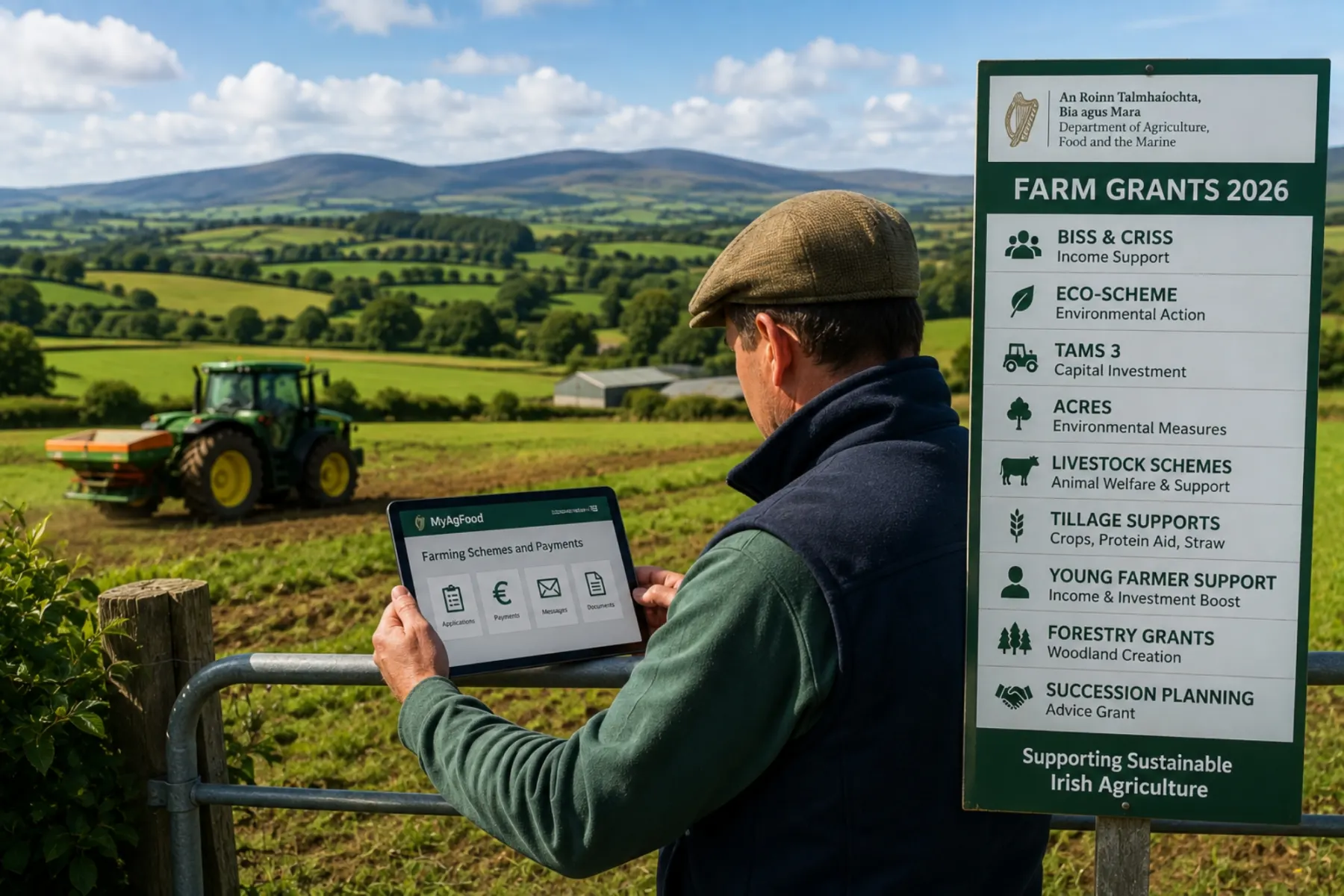
From BISS and the Eco-Scheme to TAMS investment grants, ACRES environmental measures, livestock supports, tillage payments, forestry and succession planning, Irish farming now operates through one of the most extensive support systems in Europe. The difficulty is often not finding a scheme, but knowing which one applies, when it opens and where the application must be made.
For an Irish farmer looking at the economics of 2026, government support is no longer a minor addition to farm income.
For many enterprises, it is part of the financial architecture of the business.
A cattle farmer may receive basic direct payments, redistributive support, an Eco-Scheme payment and an Areas of Natural Constraints payment while also participating in livestock welfare measures.
A tillage farmer can combine direct payments with specific crop supports, Protein Aid and the Straw Incorporation Measure.
A young farmer may qualify for additional income support and enhanced capital grants.
A farmer investing in slurry storage, solar panels, safety equipment or new buildings may be able to obtain substantial assistance through TAMS 3.
An older farmer considering transferring the holding can obtain support towards professional succession advice.
A landowner considering forestry enters an entirely different system of establishment grants and annual premiums.
The number of programmes is impressive.
The administration can be confusing.
That is particularly important in August 2026 because the schemes are not all operating on the same calendar.
The main annual BISS application period has already closed. Several livestock scheme deadlines have passed. Yet TAMS 3 Tranche 13 remains open until 4 September, an ACRES Non-Productive Investment window is open until 14 October, and the 2026 Succession Planning Advice Grant remains available until 30 November. The Collaborative Farming Grant application period also opens on 10 August.
For farmers, the practical lesson is simple:
The value of a grant is zero if the application window is missed.
MyAgFood Has Become the Main Door into Farm Support
The most important place for most farmers to begin is the Department of Agriculture, Food and the Marine’s MyAgFood system.
The Department has been consolidating many of its online farming services through this portal. It is where farmers can access area-based schemes, TAMS applications and numerous livestock and sector-specific supports.
For farmers who are uncomfortable making applications themselves, an approved Farm Advisory System adviser can deal with many schemes on their behalf.
This is particularly useful where land parcels, entitlements, stocking rates or environmental commitments are involved.
A good adviser should not simply ask, “Which scheme do you want to join?”
The better question is:
Which combination of schemes fits the farm without creating commitments that conflict with one another?
That distinction becomes increasingly important as the support system grows more complicated.
BISS Remains the Foundation
The Basic Income Support for Sustainability, or BISS, remains the foundation of Ireland’s CAP direct-payment system.
BISS payments are linked to eligible hectares and payment entitlements. Their value therefore varies between holdings rather than operating as one national flat-rate cheque.
The amount a farmer receives depends on the number and value of eligible entitlements activated against eligible land.
For 2026, the normal application deadline was 15 May.
That deadline has passed.
Farmers who submitted their 2026 application should nevertheless continue checking MyAgFood and correspondence from the Department.
An application submitted in May is not necessarily finished administratively in May.
Mapping queries, eligibility checks, land changes or other issues can delay payment if they are not resolved.
The Department specifically provided an opportunity during June for some farmers to correct identified BISS application issues without penalty.
Where BISS is applied for
BISS applications are made through MyAgFood/agfood.ie, either directly by the farmer or through an authorised adviser.
The Department’s Direct Payments Helpdesk can also assist with scheme queries on 057 8674422.
Practical tip
Do not wait until the following spring to check whether the land map is correct.
Leased parcels, boundary changes, new land, forestry areas and land no longer being farmed can all affect the next application.
The best time to resolve a mapping problem is before the next BISS deadline begins approaching.
CRISS Particularly Benefits Smaller and Medium-Sized Farms
Alongside BISS sits the Complementary Redistributive Income Support for Sustainability, or CRISS.
The principle is deliberately redistributive.
Instead of concentrating all support according to historic entitlement values, CRISS directs additional payment towards the first hectares of a farm.
The payment applies to the first 30 eligible hectares of active farmers.
This makes the measure particularly relevant to Ireland, where a substantial proportion of farms remain relatively modest in scale.
CRISS does not usually require a completely separate annual application process in the way an unrelated grant would.
It forms part of the wider area-based application made through the annual BISS process.
For farmers planning ahead to 2027, that is an important point: when discussing the BISS application with an adviser, the conversation should include all related area-based payments, not BISS in isolation.
The Eco-Scheme Can Be Worth a Significant Amount Across a Whole Farm
The Eco-Scheme is another major annual payment.
Unlike BISS, participation is voluntary, but farmers must undertake qualifying agricultural practices to receive the payment.
The Department’s current CAP calculator estimates that, with very high participation, the 2026 payment could be around €65 per eligible hectare. The eventual rate depends on participation and eligible area and should therefore be treated as an estimate rather than a guaranteed final amount.
That distinction can produce substantial money on larger holdings.
At an illustrative €65 per hectare, 50 eligible hectares would represent around €3,250.
One hundred hectares would represent around €6,500.
The exact payment depends on the final scheme rate and eligibility.
Farmers qualify by adopting specified environmental practices from the Eco-Scheme menu rather than simply receiving the money automatically.
Where to apply
The Eco-Scheme is selected through the annual BISS application on MyAgFood.
For 2026, that application window has already closed.
Practical tip
Do not choose Eco-Scheme measures solely because they appear easiest on the application screen.
Look at what the farm is already doing.
A practice that fits naturally into the existing farming system is usually less risky than selecting something that requires an entirely new management system just to obtain a payment.
ANC Remains Particularly Important in the West and on More Difficult Land
The Areas of Natural Constraints, or ANC, scheme supports farmers operating land where physical or geographical conditions make agriculture more difficult.
This is particularly important in parts of the West, North-West and other areas where soil, topography, rainfall or other natural constraints restrict production.
Payments depend on the eligible land category and area, with scheme rules applying to the number of hectares that can receive payment.
ANC is not simply an environmental programme.
It is also a rural-economic measure.
A farm on difficult land may produce lower commercial output while still maintaining agricultural activity, landscapes and rural populations in areas where farming conditions are inherently more challenging.
Where to apply
ANC is applied for through the annual BISS/MyAgFood application.
Farmers should ensure the ANC option is correctly selected rather than assuming eligibility automatically generates a claim. The Department specifically reminded 2026 applicants to check that they had applied correctly for ANC.
Young Farmers Have Several Different Supports — and They Should Not Be Confused
A young farmer entering agriculture may encounter several schemes with similar-sounding objectives.
They are not the same.
The Complementary Income Support for Young Farmers provides an additional payment to eligible young farmers during the early years after establishment.
Applicants generally need to meet age, agricultural education and control-of-holding requirements. Support can be available for a limited number of years rather than indefinitely.
There is also the National Reserve, which can allocate or increase payment entitlements for qualifying young farmers and new farmers.
For 2026, the application deadline for these area-based measures was also 15 May.
But young farmers also have access to enhanced capital support under TAMS.
That is a different benefit entirely.
Practical tip for a young farmer
Before investing heavily in buildings or machinery, check all three areas:
income support;
entitlements and National Reserve eligibility;
and enhanced TAMS capital support.
Failing to examine one can mean leaving substantial support unused.
TAMS 3 Is Where Some of the Largest Individual Grants Are Found
For farmers planning physical investment, TAMS 3 — the Targeted Agricultural Modernisation Schemes — is one of the most important support programmes in Ireland.
Unlike an annual income payment, TAMS helps finance specified farm capital investment.
It covers different categories of infrastructure and equipment through a series of individual schemes. These include investment associated with animal welfare, nutrient storage, dairy equipment, tillage, farm safety, organic farming, low-emission slurry spreading, pigs and poultry, solar energy, young farmers and women farmers.
The standard grant rate for many eligible investments is 40%.
Some categories receive enhanced rates.
Farm Safety investments can receive 60% grant aid, subject to scheme conditions and the applicable investment ceiling.
The Solar Capital Investment Scheme is also supported at 60%, with its own €90,000 investment ceiling separate from other TAMS categories.
Young Farmer and Women Farmer capital schemes can similarly provide enhanced 60% support where eligibility conditions are satisfied.
Tillage capital investment is normally supported at 40% up to the applicable €90,000 investment ceiling.
TAMS Is Open Now — but the September Deadline Matters
This is one of the most important current opportunities as of 10 August 2026.
TAMS 3 Tranche 13 closes on 4 September 2026.
A further Tranche 14 is scheduled to close on 4 December.
That means farmers considering eligible investment should not wait until winter automatically.
Submitting into the September tranche can move the project into the assessment system months earlier.
Where to apply
TAMS applications are made through the farmer’s MyAgFood/agfood.ie account.
For TAMS-specific queries, the Department lists tams@agriculture.gov.ie as a contact for scheme assistance.
The most important TAMS rule
Do not assume that because an investment is eligible, the farmer can purchase it first and obtain the grant afterwards.
TAMS is an approval-based investment scheme.
Starting work, purchasing equipment or committing expenditure at the wrong stage can jeopardise grant eligibility.
For any major project, obtain the approval first and follow the scheme conditions precisely.
TAMS Reference Costs Can Matter More Than the Invoice
Farmers sometimes assume that a 40% grant means the State will automatically pay 40% of whatever the contractor charges.
That is not necessarily how TAMS works.
Eligible aid is calculated within the scheme’s reference-cost and eligibility rules.
If a project costs considerably more than the recognised eligible amount, the farmer can still be responsible for the difference.
This is why quotations should be compared not only with each other but with the TAMS specifications and current reference costs.
The Department updated TAMS reference costs in 2025, affecting applications in subsequent tranches.
Practical tip
Before signing a building contract, ask:
What is the actual estimated project cost?
What amount does TAMS recognise?
What percentage applies?
What VAT or non-eligible cost remains?
How much cash has to be funded before the grant is received?
A nominal 60% grant does not necessarily mean the farmer needs to finance only 40% of the contractor’s final invoice.
Farm Safety Grants Can Be Particularly Valuable
Farm safety is one of the areas where TAMS provides enhanced support.
The Farm Safety Capital Investment Scheme offers 60% grant aid, subject to the programme’s eligibility rules and investment ceiling.
Eligible safety investments can include specified equipment or infrastructure intended to reduce accidents around livestock, machinery and farm operations.
The Government has also been prioritising farm-safety applications when applying TAMS ranking and selection rules.
For older farmyards in particular, this can make the scheme worth reviewing even where no major expansion is planned.
A farmer does not have to be building an entirely new enterprise to find a TAMS-supported safety investment that improves daily work.
Solar Is One of the Most Generously Supported TAMS Categories
The Solar Capital Investment Scheme deserves separate attention because it has a 60% grant rate and its own €90,000 ceiling.
For farms with substantial daytime electricity use — dairy farms are an obvious example — solar can reduce purchased electricity as well as provide a capital asset.
But the economics differ significantly between farms.
A farm using substantial electricity during daylight hours can consume much of the power as it is generated.
A farm with very low daytime consumption may have a different payback calculation.
Practical tip
Do not start with the question:
“How large a solar system can I get a grant for?”
Start with:
“How much electricity does this farm actually use, and when is it used?”
The correct system should be designed around farm demand, not around the maximum available grant.
ACRES Is Much More Than an Annual Payment
The Agri-Climate Rural Environment Scheme — ACRES — is Ireland’s principal CAP agri-environment programme.
ACRES General can provide payments of up to €7,311 a year depending on the actions undertaken.
Under the Co-operation approach, potential annual support is higher, with payments linked partly to environmental results and additional non-productive or landscape investments.
The programme differs from BISS because it involves multi-year environmental commitments.
Farmers agree to manage land or undertake actions in specified ways.
That can involve grassland management, biodiversity, water protection, hedgerows, tree planting or other environmental actions depending on the farm and scheme route.
For existing participants, compliance matters every year.
Joining the scheme was not simply a one-time application followed by automatic annual payments.
An Important ACRES Window Is Open Right Now
As of August 2026, an ACRES Non-Productive Investment application window is open from 1 July until 14 October 2026.
These applications are made by ACRES advisers for qualifying participating farmers.
That is a crucial distinction.
This is not a general invitation for every farmer in Ireland to join ACRES from scratch.
It is an investment opportunity within the ACRES framework for eligible participants.
Where to apply
For ACRES investment opportunities, the farmer should speak first to their approved ACRES adviser.
The adviser submits the relevant NPI application.
Practical tip
If already in ACRES, do not treat the scheme as something that is reviewed only when the annual payment arrives.
Ask the adviser periodically whether additional NPI or landscape-action opportunities are available.
The programme contains investment windows that can open and close independently of the original ACRES contract.
Organic Farming Offers Income Support — but Entry Is Not Permanently Open
Ireland’s Organic Farming Scheme supports farmers converting to, or continuing with, certified organic production.
The number of participating farmers has risen substantially, reaching around 5,500 by the end of 2025. Budget 2026 allocated €58.6 million to continue supporting the sector.
The most recent entry window opened in November 2025 and closed on 12 December 2025, with particular priority given to tillage applicants.
Farmers cannot therefore assume that the Organic Farming Scheme is continuously open to new entrants.
Future reopening announcements need to be monitored.
Successful participants must meet organic certification requirements and other scheme conditions.
Where to begin if considering organic farming
The first call should generally not be to a machinery dealer.
Speak to:
an organic certification body;
a Teagasc or suitably experienced agricultural adviser;
and potential buyers for the intended product.
Organic farming is both a production system and a market decision.
A grant can support conversion.
It cannot create a profitable market where one does not exist.
Organic Farmers Can Also Use TAMS Capital Support
Organic farming income support should not be confused with the Organic Capital Investment Scheme under TAMS 3.
That capital scheme remains available for eligible investments and applications are submitted through agfood.ie.
This means an organic farmer may potentially have one support mechanism for the farming system and another for eligible capital investment.
Again, eligibility rules have to be checked separately.
Tillage Farmers Have an Entire Layer of Additional Supports
Tillage is one of the sectors where several specialist schemes can sit on top of ordinary CAP payments.
The Protein Aid Scheme supports the production of crops such as beans, peas and lupins.
The Straw Incorporation Measure, or SIM, supports growers who chop and incorporate eligible straw rather than removing it.
For 2026, the payment rate for eligible wheat, oats, barley and rye under SIM is €250 per hectare.
In July, the Department announced that all eligible 2026 SIM applicants had been accepted into the scheme.
The Government also introduced a Tillage Sustainability Support Payment for 2026.
Rates were structured according to eligible area, beginning at a maximum €110 per hectare and reducing at larger area bands. Applications closed in March, and approximately €29.1 million was subsequently issued to participating tillage farmers.
Where tillage schemes are generally applied for
Area-based crop supports are usually linked to MyAgFood and the annual BISS/land declaration system.
The Department’s specialist tillage contact is also useful where eligibility or payment problems arise. It lists Tillage@agriculture.gov.ie and the Direct Payments Helpline on 057 8674422 for relevant scheme queries.
Practical tip for growers
Crop codes matter.
A field that is physically planted correctly but declared incorrectly can create a payment problem.
Check the crop declaration before the annual BISS deadline rather than discovering the error after harvest.
Beef Farmers Should Watch MyAgFood Closely This Month
A particularly important scheme for suckler farmers is due to appear shortly.
The Department announced earlier in 2026 that the 2026 Beef Welfare Scheme would be launched in mid-August, using the same broad structure and actions as the 2025 scheme, with additional vaccination options including bluetongue vaccination.
As of 10 August, farmers should therefore monitor MyAgFood and the Department’s Farming News announcements rather than assuming the application window has already passed.
This is an example of why farming support cannot be managed solely through one annual May deadline.
Some livestock schemes open later in the year.
Practical tip for suckler farmers
Log in to MyAgFood regularly during August rather than relying entirely on word of mouth.
Once the scheme opens, read the required actions before applying.
A welfare payment is usually tied to actions that must subsequently be completed and recorded correctly.
Applying is only the first step.
Dairy-Beef Support Is Becoming More Structured
Farmers rearing calves originating from the dairy herd have several targeted measures.
The CAP Strategic Plan Dairy Beef Welfare Scheme reopened to new applicants during spring 2026. Existing participants from earlier scheme years can continue subject to the programme rules, while new entrants had an application window through May.
The separate National Dairy Beef Weighing Scheme 2026 also opened in April, with applications through MyAgFood and a deadline of 15 May.
These schemes illustrate an important principle.
Two programmes can relate to the same animals without being identical.
Farmers should check whether they are enrolled in:
a welfare programme;
a weighing programme;
or both.
Never assume participation in one automatically constitutes participation in another.
Sheep Farmers Also Have Multiple Programmes
The 2026 National Sheep Welfare Scheme opened earlier in the year, with the standard application deadline on 15 May and a late-application period running to 9 June.
There is also the multi-annual Sheep Improvement Scheme, which provides support for eligible flock welfare and improvement measures.
For farmers already participating, the focus in August should therefore be on completing the required actions and retaining whatever records the schemes demand rather than searching for a new standard 2026 application window.
Practical tip
A livestock welfare scheme payment can be lost long after the application was successfully submitted if the required action was not completed or cannot be demonstrated.
Keep scheme records separately from ordinary farm paperwork.
Forestry Grants Operate Through a Different System
Farmers considering converting part of a holding to forestry should not expect the application process to operate like BISS or TAMS.
Ireland’s Forestry Programme provides establishment grants and annual premiums across a range of forest types.
The Afforestation Scheme includes different forest categories, including agroforestry.
Applications normally involve an approved Registered Forester, who prepares and submits the relevant forestry application through the Department’s forestry system.
This is important because forestry is a long-term land-use decision.
The attractive annual premium is only one part of the calculation.
Farmers also need to understand:
how long the land is committed;
what future management is required;
how forestry interacts with BISS eligibility;
tax treatment;
future timber value;
access;
family succession;
and whether the particular land is appropriate for planting.
Where to apply
Begin by contacting a DAFM Registered Forester.
The Department maintains information on approved forestry professionals and current grant schemes.
Practical tip
Do not sign a long-term forestry agreement simply because the annual premium looks attractive.
Ask the adviser to show the expected financial position over the entire lifetime of the forest.
Traditional Farm Buildings Have Their Own Heritage Grant
Owners of historic agricultural buildings have another funding route entirely.
The Traditional Farm Buildings Grant Scheme is administered by the Heritage Council in partnership with the Department of Agriculture.
For 2026, grants ranged from €4,000 to €30,000, with support of up to 75% of eligible conservation costs.
The 2026 application deadline was 18 May, so the programme is currently closed for this year.
Applications are made through the Heritage Council’s online grants system, not through the normal BISS process.
For farmers with stone sheds, historic barns, traditional roofs, walls or other qualifying structures, it is worth monitoring the Heritage Council early in the year because the scheme generally has a relatively short application period.
Succession Planning Support Is Open Now
Not every agricultural grant is about producing more food or constructing a building.
One of the most useful programmes for an older farmer may be the Succession Planning Advice Grant.
The scheme helps farmers aged 60 and over obtain professional legal, accounting and advisory advice about transferring the farm to the next generation.
It can cover 50% of qualifying professional advice costs up to a maximum payment of €1,500, subject to eligibility.
For 2026, applications remain open until 30 November.
Where to apply
The Department lists the dedicated email address:
SPAGApplications@agriculture.gov.ie
and dedicated contact numbers for the scheme.
Practical tip
Use the grant to obtain advice before deciding how the farm will be transferred.
Succession can involve Capital Gains Tax, Capital Acquisitions Tax, Stamp Duty, agricultural reliefs, retirement relief, wills, land ownership and business structure.
The cheapest transfer in tax terms is not automatically the best arrangement for the family or farming business.
Farm Partnership Support Opens Today
Registered Farm Partnerships are another important part of the generational-renewal system.
They can allow farmers to combine land, labour, expertise or ownership arrangements while maintaining a recognised agricultural business structure.
The Collaborative Farming Grant helps with some of the professional costs associated with establishing qualifying farm partnerships.
For 2026, the application period runs from 10 August to 30 September.
Completed applications and supporting documentation are submitted to the Department at:
Collaborativegrant@agriculture.gov.ie.
Applications for registration of a farm partnership itself are handled separately, with the Department accepting partnership registration applications throughout the year.
Practical tip
Do not create a partnership simply to obtain a grant.
First decide whether the partnership makes commercial, tax, succession and practical sense.
Then use the available support to implement a structure that already makes sense for the farm.
The Biggest Mistake Is Buying First and Asking About Grants Later
This is particularly common with capital schemes.
A farmer decides a slurry tank, solar system, handling unit or piece of equipment is required.
A supplier offers an attractive deal.
The order is placed.
Only afterwards does somebody mention that grant support may have been available.
By that point it may be too late.
Many capital-support programmes require an application and approval before eligible work begins.
The correct order is normally:
identify the investment;
check scheme eligibility;
obtain the required quotations, permissions and specifications;
submit the application;
receive approval;
then undertake the eligible investment according to the conditions.
The grant should be considered during project design, not after the invoice arrives.
Planning Permission Can Be a Hidden Grant Issue
Farmers contemplating large TAMS building projects should also investigate planning requirements early.
A project can qualify technically under an agricultural grant while still requiring planning permission or an exemption under the planning system.
Grant approval does not automatically replace planning approval.
Nor does planning permission guarantee grant approval.
They are separate systems.
The same applies to environmental permissions, nutrient-storage requirements and building specifications.
A farmer who has a TAMS closing date approaching but has not resolved the underlying planning position can find the project delayed before it has properly begun.
Tax Clearance Should Not Be an Afterthought
Government grant schemes frequently involve tax-compliance requirements.
Before making a substantial application, check that Revenue details and tax clearance are in order.
The same principle applies to bank information held by the Department.
A grant worth tens of thousands of euro should not be delayed because an administrative detail that could have been corrected months earlier remains unresolved.
Farmers Should Build a Scheme Calendar Just Like a Farming Calendar
Agricultural management is organised around dates.
Calving.
Breeding.
Silage.
Harvest.
Housing.
Slurry.
Grant administration should be treated in the same way.
A useful annual scheme calendar might include:
January–February: review eligibility, land changes, entitlements and upcoming schemes.
February–May: prepare and submit BISS, Eco-Scheme, ANC and related annual area claims.
Spring: monitor livestock, tillage and heritage scheme openings.
Throughout the year: examine TAMS tranches before committing to capital expenditure.
Summer and autumn: complete environmental and welfare actions and monitor specialist application windows.
Autumn: review payment statements and resolve outstanding queries.
Winter: plan investments and succession before the following scheme year.
Missing a fertiliser application by a week can affect a crop.
Missing a grant deadline by one day can remove the payment entirely.
A Good Adviser Can Pay for Themselves
Farmers sometimes look at advisory fees only as an expense.
With the complexity of the modern scheme system, that can be a false economy.
An experienced adviser can identify overlapping schemes, prevent mapping problems, ensure actions are compatible and highlight deadlines that a farmer may otherwise miss.
But advisers should also be questioned.
Ask why a scheme suits the farm.
Ask what commitments continue after payment.
Ask what happens if land is leased out or sold.
Ask whether livestock numbers must be maintained.
Ask what records inspections require.
Ask what happens during drought, illness or another force-majeure event.
The purpose of advice is not simply to maximise grants.
It is to maximise useful grants without creating unmanageable obligations.
Never Treat the Maximum Grant as Free Money
A €90,000 TAMS investment ceiling does not mean the farmer receives €90,000.
An investment ceiling is the amount against which the applicable rate is calculated, subject to scheme rules.
At a 40% rate, a fully eligible €90,000 investment would imply maximum grant aid of €36,000.
At 60%, it would imply €54,000.
The farmer still has to finance the remainder, together with any non-eligible expenditure and other project costs.
A grant can make a good investment better.
It cannot automatically make a bad investment profitable.
Cash Flow Matters Because Grants Usually Arrive After Spending
This is another practical point that can be overlooked.
Many capital schemes are reimbursement-based.
The farmer may have to finance construction or equipment before receiving the grant payment.
That means grant planning and finance planning should happen together.
A €100,000 project with substantial grant aid can still produce serious short-term cash-flow pressure if the farmer does not have sufficient working capital or borrowing facilities to bridge the payment period.
Speak to the lender before committing, not halfway through construction.
Scheme Payments Should Be Checked, Not Merely Received
The Department publishes regular information on the progress of agricultural scheme payments.
As of early August 2026, the Department’s Scheme Payments Update continues to track payments across major programmes.
Farmers should compare money arriving in the bank with what was expected.
A lower payment can result from:
an unresolved eligibility issue;
an area discrepancy;
a scheme action not yet cleared;
an inspection;
a changed entitlement value;
or another administrative matter.
Do not assume the missing amount will automatically appear later.
Check the payment statement.
The Direct Payments Helpdesk Is More Useful Than Many Farmers Realise
For a wide range of Department area-payment questions, the Direct Payments Helpdesk — 057 8674422 — is the central contact.
Specialist schemes also have dedicated contacts.
Examples include:
TAMS: tams@agriculture.gov.ie.
Tillage: Tillage@agriculture.gov.ie.
Succession Planning Advice Grant: SPAGApplications@agriculture.gov.ie.
Registered Farm Partnerships: RFPApplications@agriculture.gov.ie.
Collaborative Farming Grant: Collaborativegrant@agriculture.gov.ie.
For ACRES investment measures, the relevant ACRES adviser is generally the appropriate first contact.
For forestry, engage a Department-registered forester.
For the Traditional Farm Buildings Grant, the Heritage Council administers the application process.
Do Not Rely on Last Year’s Scheme Rules
Perhaps the simplest advice is also the most important.
Never assume that because a scheme operated one way in 2025, it operates identically in 2026.
Rates change.
Eligible investments change.
Reference costs change.
Deadlines change.
Ranking rules change.
Environmental conditions change.
New schemes appear.
Others close.
The Department explicitly updates terms and conditions annually for major programmes.
A farmer who remembers the rules from three years ago may be more dangerous administratively than one who knows nothing and checks everything.
The Farm Grant System Is Becoming a Form of Business Management
There is a broader change underneath all of these programmes.
Thirty years ago, agricultural support could often be viewed mainly as an annual payment attached to land or production.
In 2026, the system is far more sophisticated.
Different payments encourage different outcomes.
BISS supports basic farm income.
CRISS redistributes support towards the first hectares.
The Eco-Scheme pays for environmental practices.
ANC recognises natural constraints.
ACRES purchases environmental management and results.
Livestock programmes support welfare and performance.
Tillage schemes support strategically useful crop production.
TAMS helps finance capital modernisation.
Organic schemes support a different production model.
Forestry pays for long-term land-use change.
Young Farmer measures encourage generational renewal.
Succession grants help farms plan transfers between generations.
The result is effectively a second management system operating alongside the agricultural business itself.
Understanding it can materially alter farm income.
Ignoring it can be expensive.
The Best Grant Strategy Begins With the Farm, Not the Grant
The temptation with any subsidy system is to ask:
“What money can I get?”
For a farm business, the better starting point is:
“What does this farm actually need?”
If the problem is dangerous livestock handling, investigate Farm Safety TAMS support.
If electricity expenditure is large, examine solar.
If slurry storage is inadequate, investigate nutrient-storage investment.
If the farmer is approaching retirement, examine succession advice before making irreversible decisions.
If a young person is taking control of a farm, investigate National Reserve, young-farmer income support and enhanced TAMS assistance together.
If land is environmentally sensitive, assess whether existing ACRES measures can create both environmental and economic value.
If a tillage grower already chops straw, SIM may reward an agronomic action that fits the system.
The support should follow the business decision.
The business should not exist merely to follow the support.
What Is Still Worth Checking in August 2026
For farmers reviewing their position now, several dates deserve immediate attention.
TAMS 3 Tranche 13: open, closing 4 September 2026.
ACRES Non-Productive Investments: open for eligible participants, closing 14 October 2026; applications through ACRES advisers.
Succession Planning Advice Grant: open until 30 November 2026.
Collaborative Farming Grant: the 2026 application period runs from 10 August to 30 September.
Beef Welfare Scheme 2026: expected to open in mid-August; suckler farmers should monitor MyAgFood and Department announcements closely.
TAMS Tranche 14: scheduled to close on 4 December 2026, giving farmers who cannot prepare a suitable September application another planned opportunity later in the year.
Meanwhile, the principal 2026 BISS, Eco-Scheme, ANC and Young Farmer application deadlines have passed, as have the standard 2026 application periods for a number of spring livestock and tillage measures.
That distinction is important.
A list describing every scheme as “available in 2026” can be technically true but practically useless if the application deadline has already passed.
The Real Value Is Knowing What Applies Before the Deadline Arrives
Ireland’s farmers do not lack support programmes.
If anything, the difficulty is the opposite.
There are enough schemes, sub-schemes, tranches, annual claims, capital grants and environmental measures that an individual farmer can reasonably struggle to keep track of them all while simultaneously running a working farm.
That complexity is unlikely to disappear.
Agricultural policy is increasingly being asked to achieve several objectives simultaneously: support farm income, protect food production, improve animal welfare, reduce emissions, protect water, restore biodiversity, modernise infrastructure and encourage another generation to remain in farming.
Different objectives create different schemes.
For farmers, the response has to be practical rather than political.
Maintain access to MyAgFood.
Keep maps and land declarations current.
Know which adviser handles which programme.
Check TAMS before buying capital equipment.
Monitor specialist livestock and tillage announcements.
Keep scheme paperwork after the application has been submitted.
And build grant deadlines into the farming calendar just as seriously as breeding, silage and harvest dates.
A support programme can sometimes be worth a few hundred euro.
In other cases it can alter the economics of a €100,000 investment.
The difference between receiving that support and missing it may be nothing more dramatic than knowing where to apply — and doing so before midnight on the correct day.
Source & Transparency
This article is published by Ireland Newspaper for editorial and informational purposes.
Published: 10 August 2026 · Updated: 10 August 2026

Newsroom Ireland Newspaper
Ireland Newspaper editorial team prepares daily news coverage for readers in Ireland and abroad.