
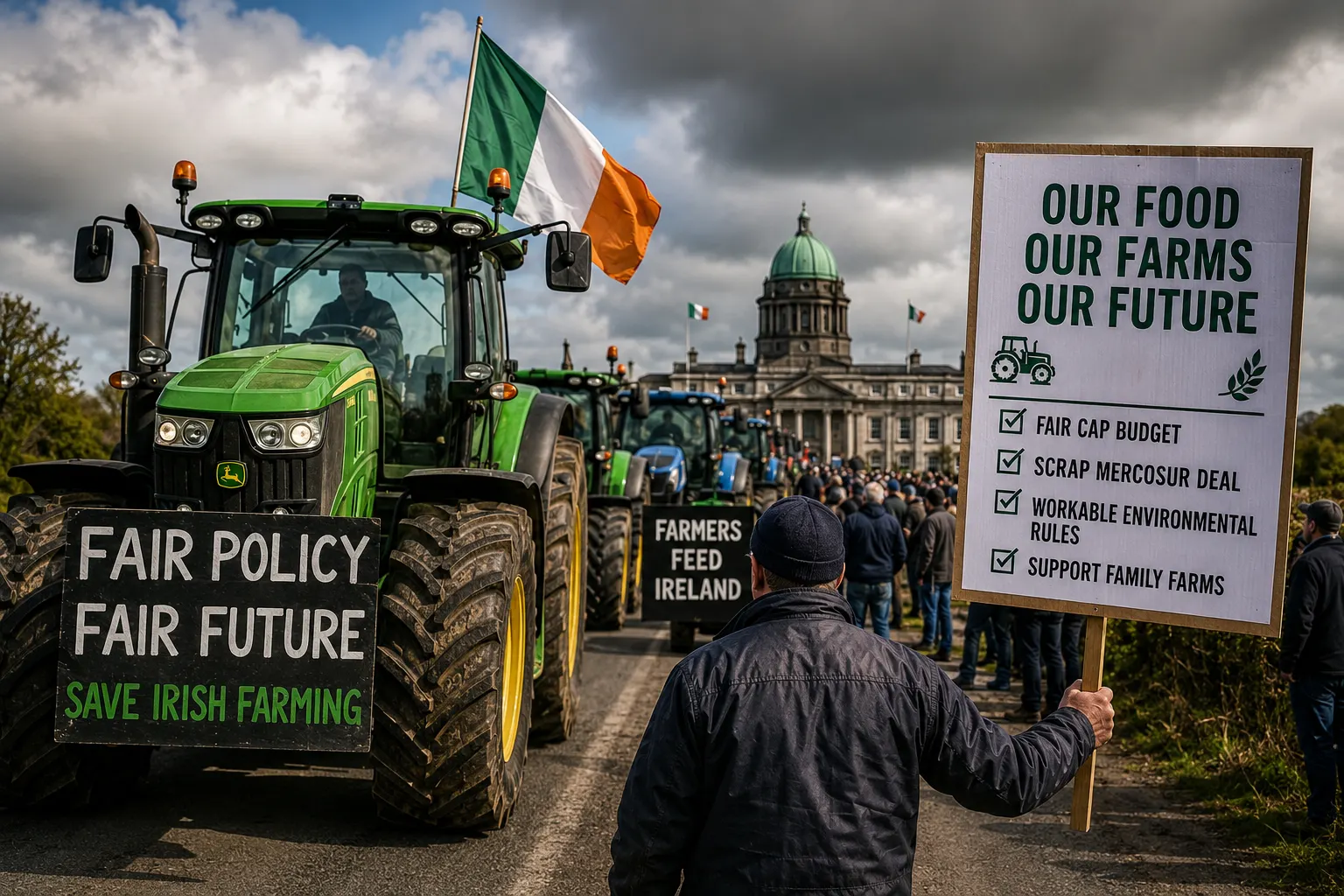
Ireland’s Farm Policy Battle: Why 2026 Has Become a Defining Year for Agriculture
A new EU farm budget, the Mercosur trade deal, stricter water rules, nature restoration, climate targets and sharply higher input pressures are converging just as Teagasc forecasts average Irish family farm income to fall 38 per cent this year. Farmers are responding with tractor protests, lobbying in Brussels, consultation campaigns and demands that environmental obligations be matched by workable rules and adequate funding.
The difficulty facing Irish farming in August 2026 is not one policy.
It is the number of major decisions arriving at almost the same time.
The future of the Common Agricultural Policy after 2027 is being negotiated. The EU-Mercosur trade agreement has begun provisional application. Ireland is operating under a new Nitrates Action Programme. A national Nature Restoration Plan is approaching a critical European deadline. Agriculture remains committed to a 25 per cent emissions reduction by 2030. Fertiliser costs have risen, and parts of the country are now experiencing serious summer grass shortages.
Meanwhile, the financial position that looked unusually strong only months ago has changed quickly.
Teagasc estimates that average Family Farm Income reached about €53,800 in 2025, an exceptional increase on the previous year. Its updated July 2026 forecast now expects that average to fall to approximately €33,600 this year — a decline of 38 per cent. Dairy income is forecast to fall particularly sharply, from €153,300 to about €78,000, while cattle-finishing, suckler and tillage incomes are also expected to decline.
That reversal helps explain why arguments about agricultural policy are becoming more intense.
For a farmer, a new environmental obligation may arrive as a slurry-storage investment.
A trade agreement may appear as greater competition in the beef market.
A CAP budget decision may determine thousands of euro of annual support.
A carbon rule may affect decisions about livestock or fertiliser.
A drought may turn stored winter silage into summer feed.
Each issue is different.
But they all eventually arrive at the same place: the farm accounts.
This Is Not One Farmer Revolt Against One Government
It would be misleading to portray the current dispute as Irish farmers simply fighting the Irish Government.
Several layers of government are involved.
Some rules originate in Dublin.
Others originate in EU legislation.
Some policies are negotiated between all 27 EU states.
Trade agreements involve the European Commission, Council and Parliament.
Environmental obligations arise from legislation that Ireland is legally required to implement.
And on important issues such as Mercosur, the Irish Government itself has opposed the final EU position.
Nor do all Irish farmers hold identical views.
A large dairy farm in Cork faces different pressures from a hill sheep farm in Mayo, a tillage business in Wexford, a suckler farm in Clare or a vegetable producer supplying supermarkets.
The Irish Farmers’ Association, Irish Creamery Milk Suppliers Association, Irish Cattle and Sheep Farmers’ Association, Macra and other organisations also differ in emphasis and tactics.
What has emerged, however, is a broad concern across organised farming that policy obligations are accumulating faster than income certainty.
That is the central tension in Irish agriculture in 2026.
The Biggest Battle Is the Future of CAP
No current agricultural policy issue has greater long-term financial significance than the Common Agricultural Policy.
Ireland’s existing CAP Strategic Plan for 2023–2027 is worth €9.8 billion over five years, including €2.28 billion of national funding. It supports direct farm payments as well as environmental programmes, rural development, young farmers and investment measures.
What replaces that system from 2028 is now being negotiated as part of the EU’s next seven-year budget.
The European Commission says its post-2027 proposal protects at least €300 billion EU-wide for farm income and crisis support, including at least €293.7 billion for income support and a €6.3 billion safety net for market disturbances.
Farmer organisations see the proposal differently.
The IFA calculates that the proposed structure represents an effective 24 per cent reduction relative to what it believes agriculture requires and argues that inflation has already eroded the real value of farm payments. It is demanding a larger, dedicated CAP budget rather than farming support being exposed to competition from other national and European priorities.
That 24 per cent figure is an IFA assessment, not an uncontested official measurement.
The disagreement reflects different ways of comparing the proposed future structure, present funding and inflation.
But the political dispute itself is very real.
Why Farmers Care About CAP Even When Commodity Prices Are High
Direct payments are sometimes portrayed as supplementary income that matters only in a bad year.
For many Irish family farms, that is too simplistic.
Cattle, sheep and other extensive farms frequently operate with relatively low market margins even when livestock prices are strong. CAP payments can therefore represent a substantial part of the income remaining after production costs.
Teagasc’s latest forecast illustrates the disparity between agricultural systems.
Average dairy farm income is forecast at around €78,000 in 2026.
Average Cattle Rearing income is forecast at just €19,000, Cattle Other at about €21,000, Sheep at €26,500 and Tillage at approximately €44,000. These figures include support payments.
For a farm earning €19,000, losing several thousand euro of support is not a minor accounting adjustment.
It can determine whether the enterprise generates a viable household income.
That is why the post-2027 CAP debate is not an abstract Brussels negotiation for Irish farming.
It is a farm-income negotiation.
Farmers Are Taking the CAP Fight Directly to Brussels
Irish farm organisations are not limiting their response to press statements.
IFA representatives have participated in farmer demonstrations in Brussels and Luxembourg, working through COPA, the umbrella organisation representing European farming interests. Its national leadership has also met European Commissioners, MEPs and Council representatives directly.
The campaign is particularly significant because Ireland currently holds the Presidency of the Council of the European Union from 1 July to 31 December 2026.
The Irish Presidency is tasked with advancing negotiations on the next EU budget, with European leaders seeking sufficient progress by the end of the year.
That gives Irish agriculture unusual political visibility.
But it should not be misunderstood.
Holding the Council Presidency does not allow Ireland to dictate the EU budget. The Presidency is expected to broker compromise among 27 member states.
Farm organisations nevertheless believe the six-month period gives the Irish Government an opportunity — and responsibility — to ensure agriculture remains high on the European agenda.
The July Agriculture and Fisheries Council under the Irish Presidency explicitly identified farm incomes, competitiveness, sustainability, food security, simplification and generational renewal among its priorities.
The coming months will show how much of that political language becomes budgetary reality.
Mercosur Has Already Brought Tractors Onto Irish Roads
The second major confrontation is trade.
In January, thousands of farmers travelled to Athlone, many by tractor, to protest against the EU-Mercosur agreement.
The protesters’ central concern was beef.
Irish cattle farmers argue that allowing additional preferential access for South American beef produced under different cost structures could put downward pressure on European beef markets and create competition they consider unequal.
The issue is especially sensitive because Ireland is a major beef exporter and much of the country’s cattle production is located on family farms where margins have historically been relatively modest.
The opposition was not confined to farmer organisations.
The Irish Government ultimately said it could not support the overall Mercosur agreement, while acknowledging potential opportunities for Irish exports such as dairy products and spirits.
That makes Mercosur unusual in the current farm-policy debate: on the central political decision, organised farmers and the Irish Government were substantially aligned.
The Mercosur Deal Is Now Provisionally Operating
The political campaign did not stop the trade agreement.
The EU-Mercosur Interim Trade Agreement entered into provisional application on 1 May 2026.
That changes the farmers’ battle.
Before May, the objective was primarily to stop or delay the agreement.
Now attention increasingly turns to monitoring imports, enforcing production and traceability requirements and activating safeguards if EU agricultural markets suffer serious disruption.
The agreement contains limited tariff-rate quotas and safeguard mechanisms for sensitive agricultural products. The European Parliament has strengthened provisions allowing intervention where imports of products such as beef, poultry, eggs, citrus and sugar cause or threaten serious harm.
Supporters of the agreement point to wider export opportunities and argue that safeguards limit agricultural disruption.
Farm groups remain unconvinced that those protections will prove fast or strong enough.
That disagreement will now be tested by actual trade flows rather than theoretical projections.
Water Quality May Be the Hardest Domestic Policy Conflict
If CAP is the biggest financial argument and Mercosur the most visible trade dispute, nitrates may be the most difficult environmental issue.
Ireland’s grass-based livestock system depends heavily on productive pasture.
In intensive dairy regions, that means substantial nutrient use and large quantities of organic manure.
The environmental concern is not invented.
EPA monitoring found that average nitrogen concentrations across 20 representative Irish rivers rose by 10 per cent in 2025. The highest concentrations remain concentrated across the south-eastern half of the country, and the EPA identifies agriculture as the primary source of nitrogen entering rivers in those high-risk agricultural catchments.
The EPA’s wider assessment found little overall improvement in Irish water quality during 2025, with only slightly more than half of rivers and lakes achieving good or better biological quality.
This is therefore an area where a credible agricultural debate cannot simply argue that regulation is unnecessary.
There is an environmental problem to solve.
The dispute is over how quickly, where and at whose cost.
Ireland Kept Its Nitrates Derogation — but With Conditions
At the end of 2025, Ireland secured another extension of its nitrates derogation through 2026–2028.
The derogation allows qualifying grassland farms to apply livestock manure above the standard EU limit, potentially up to 250 kilograms of nitrogen per hectare, subject to conditions and lower limits in affected areas.
For intensive dairy farms, retaining the derogation was economically important.
But the extension came with additional environmental requirements.
Ireland’s Sixth Nitrates Action Programme brings tighter nutrient management, new obligations for some fragmented dairy holdings and additional storage requirements. From 2028, further restrictions are due in the Slaney, Barrow, Nore and Blackwater catchments, where water-quality concerns are particularly significant.
For the farmer, this can translate into concrete capital spending.
More slurry storage.
Different manure distribution.
Wider buffer zones.
Reduced chemical fertiliser allowances.
Training.
Nutrient accounting.
Record keeping.
The environmental objective is measurable.
So is the bill.
Farmers’ Response: ‘If the State Requires the Investment, Help Fund It’
This is where farmer resistance is becoming more practical than ideological.
IFA is not currently campaigning simply to abolish nutrient-management rules.
It is demanding greater financial support to allow farms to comply.
The organisation wants a standalone nutrient-storage investment scheme within TAMS, arguing that farmers facing additional storage requirements need sufficient grants and predictable access to funding. Changes announced in 2026 have already increased priority for nutrient-storage applications, but the IFA says a dedicated scheme would provide greater certainty.
There is also an enforcement issue.
Local authorities inspected 4,315 farms in 2025 under a programme targeted towards higher-risk areas. Some 43 per cent of those inspected farms were found non-compliant with relevant requirements. The EPA identified problems involving soiled water, silage effluent, separation of clean and dirty water, slurry storage and spreading practices.
That 43 per cent figure should not be interpreted as meaning 43 per cent of every Irish farm is non-compliant.
The inspections are deliberately risk-based.
But the result shows why regulators are demanding improved practice and why compliance investment is likely to remain central to agriculture policy.
Nature Restoration Is the Next Land-Use Argument
Another major deadline is approaching in only weeks.
Ireland must submit its draft National Nature Restoration Plan to the European Commission by 1 September 2026.
The plan will set out how Ireland intends to implement the EU Nature Restoration Regulation through 2030, 2040 and 2050. After submission, Ireland enters a 12-month dialogue with the Commission before a final plan is due in September 2027.
For agriculture, the concern centres particularly on land use, peat soils, designated land, biodiversity management and potential rewetting.
This is an area where language matters.
The plan is still being developed.
A proposal discussed during consultation is not automatically a legal obligation on an individual farm.
Farmer organisations are therefore trying to influence the design before implementation rules become fixed.
Farmers Are Using the Consultation Process, Not Only Protests
IFA held regional Nature Restoration meetings in Kerry, Leitrim and Tullamore during the consultation period, allowing farmers to raise concerns directly.
Among the issues farmers have raised are:
long-term funding;
compensation for land-management changes;
legal certainty;
the effect of rewetting on neighbouring land;
treatment of existing designated land;
maintenance of drainage;
and whether participation in restoration measures on private agricultural land will remain genuinely voluntary.
This illustrates an important difference between the public image of agricultural protest and the everyday reality of agricultural lobbying.
A tractor protest attracts television cameras.
Much of the actual policy battle takes place through consultation submissions, technical committees, meetings with civil servants, MEPs, ministers and European officials.
Farm organisations are using both.
The Question Farmers Keep Asking: Who Pays for Public Environmental Benefits?
Nature restoration, carbon storage, cleaner water and biodiversity can produce benefits far beyond the farm boundary.
The policy problem is how those benefits are financed.
If a farmer gives up productive use of land, maintains a wetland, creates habitat or manages land under restrictions, the economic value may accrue to society while the opportunity cost remains with the individual farm.
Farmer organisations therefore argue that environmental policy has to become a source of income rather than simply another compliance cost.
That principle is also appearing in Ireland’s developing Carbon Farming Framework.
The Government describes carbon farming as an opportunity to create new revenue for farmers and land managers by rewarding measurable climate benefits.
IFA says it is willing to engage but wants participation to remain voluntary, commercially worthwhile and designed so that farmers who have already adopted climate-friendly practices are not penalised. It also argues that carbon-farming funding should not simply be taken from existing CAP payments.
That may become one of the defining agricultural policy debates of the next decade:
should farmers mainly be regulated to deliver environmental outcomes, or paid to produce them?
In practice, future policy will probably contain both.
The 2030 Climate Target Is Getting Closer
Agriculture also faces a legally established national emissions pathway.
Ireland’s sectoral emissions ceiling requires agriculture to reduce greenhouse-gas emissions by 25 per cent by 2030 compared with 2018.
The policy does not automatically require a specific percentage reduction in cattle numbers.
Government plans include measures involving protected urea, improved livestock performance, better genetics, animal health, clover, nutrient efficiency, methane-reducing technologies and other changes designed to lower emissions intensity.
That distinction is important because herd reduction has become politically sensitive.
Farm organisations generally accept that agriculture must reduce emissions but resist policies that they believe could make livestock contraction the default solution.
The IFA’s current position is that further emissions reductions should be achieved by accelerating practical technologies and rewarding farmers for adopting them while protecting food production.
The disagreement is therefore less about whether emissions must fall than about which measures carry the burden and how farmers are compensated for the transition.
Fertiliser Has Become an Economic and Policy Problem at the Same Time
Input costs add another layer.
Teagasc had already forecast fertiliser prices to rise by about 10 per cent in 2026, partly reflecting the introduction of the EU Carbon Border Adjustment Mechanism on carbon-intensive imports.
Geopolitical disruption has since added further uncertainty to European fertiliser and energy markets.
In July, EU member states approved a €540 million European support package for farmers affected by fertiliser and energy disruption linked to the Middle East crisis.
Irish farm organisations are now pressing the Government for clarity on Ireland’s allocation, possible national co-financing and how quickly money can reach affected farmers. IFA, ICMSA and other farm bodies have jointly sought engagement on the design of the support.
This shows how environmental and economic policy can collide.
CBAM is intended to prevent carbon-intensive imported products from gaining an unfair advantage over EU production.
For a farmer buying nitrogen fertiliser, however, any increase in the price of the bag is an immediate production cost.
A policy designed around industrial carbon leakage can therefore appear on a dairy or tillage farm as a higher fertiliser invoice.
The Weather Has Added a New Pressure in August
Policy disputes are unfolding against difficult growing conditions in parts of Ireland.
On 12 August, the IFA reported severe grass shortages on some suckler and beef farms, with farmers in affected areas already housing cattle, feeding concentrates or using silage intended for winter. The association has asked the Minister for Agriculture to reconvene the Fodder Crisis Committee.
This should not be interpreted as evidence of a nationwide fodder shortage.
Conditions vary substantially by region.
But the situation demonstrates why agricultural policy can become politically volatile so quickly.
A regulation or input price that appeared manageable during strong grass growth can feel very different once cattle need supplementary feed in August.
Weather magnifies every other weakness in the farm business.
Dairy: Still Strong, but Experiencing the Sharpest Income Correction
Dairy remains one of Ireland’s most productive agricultural sectors, but 2026 is demonstrating its exposure to global commodity prices.
Teagasc’s July estimate puts average dairy Family Farm Income at approximately €78,000 this year, almost half the €153,300 recorded in 2025.
That remains considerably above average cattle and sheep incomes.
But dairy farmers also carry some of the largest capital requirements in agriculture: land, milking equipment, slurry storage, winter housing, fertiliser, machinery and often significant borrowing.
They are also most directly affected by the nitrates derogation and intensive stocking rules.
For this group, the main policy problems are increasingly interconnected:
milk-price volatility,
nitrates,
water quality,
emissions,
fertiliser,
capital investment,
and uncertainty over future CAP rules.
A financially strong dairy business can adapt.
A highly borrowed business experiencing a sudden milk-price fall has much less room.
Beef and Suckler Farming: Market Prices Cannot Hide the Income Problem
Cattle prices remain historically strong by longer-term standards, but Teagasc expects 2026 prices to fall below the exceptional levels reached during 2025.
Average Cattle Rearing income is forecast at only €19,000, while the Cattle Other category is expected to average approximately €21,000.
That explains why beef producers are particularly sensitive to Mercosur and CAP.
They operate in a sector where relatively small changes in cattle prices or support payments can have a disproportionate effect on final household income.
For these farmers, international trade policy is not distant diplomacy.
An additional movement in European beef prices can matter directly.
Tillage: A Strong 2025 Does Not Guarantee a Profitable Harvest in 2026
Tillage farms face a different problem.
Their environmental footprint and policy exposure differ from intensive dairy, but they are highly exposed to international grain markets, fertiliser and weather.
Teagasc currently forecasts average tillage farm income at roughly €44,000 in 2026, below the approximately €54,900 achieved in 2025.
Grain producers cannot simply raise prices because fertiliser becomes more expensive.
Irish cereal prices are heavily influenced by European and global supply.
That leaves growers squeezed between internationally determined output prices and locally incurred costs.
For tillage farmers, fertiliser support, CAP payments and access to workable environmental schemes can therefore matter as much as livestock policy does elsewhere.
Smaller and Extensive Farms Face a Different Kind of Risk
The public agriculture debate frequently concentrates on dairy expansion, nitrates and emissions.
That can obscure the situation of smaller suckler, sheep and hill farms.
Many of these holdings already operate at low stocking densities and provide landscapes with high environmental value.
Their challenge is not necessarily being forced to reduce production intensity.
It is whether income remains high enough for anyone to continue farming them.
This is where CAP funding, Areas of Natural Constraint payments, environmental schemes and succession policy become central.
A nature-restoration policy that offers meaningful payments may create an additional income source.
A policy that imposes obligations without adequate compensation can accelerate abandonment.
That difference is fundamental.
Generational Renewal Is Becoming Part of Every Other Debate
Ireland and the EU increasingly speak about attracting younger farmers.
But succession cannot be separated from profitability and regulation.
A young person considering taking over a farm is not simply inheriting land and livestock.
They are inheriting:
future CAP uncertainty;
environmental obligations;
building requirements;
machinery costs;
climate targets;
animal-health rules;
and exposure to volatile international markets.
The next CAP is expected to place greater emphasis on young farmers and generational renewal, and the Irish EU Presidency has made the issue one of its agricultural priorities.
The policy challenge is obvious.
It is difficult to persuade the next generation to invest hundreds of thousands of euro into farming if the income stream and regulatory framework beyond 2027 remain uncertain.
Bureaucracy Has Become a Political Issue in Its Own Right
Not every farmer objection concerns the objective of a regulation.
Sometimes it concerns the way compliance is administered.
The modern Irish farmer may have to deal with:
CAP applications;
animal movement records;
nitrates calculations;
environmental schemes;
quality-assurance inspections;
veterinary requirements;
carbon data;
slurry records;
land eligibility;
and increasingly digital reporting systems.
Each requirement may have a rational purpose.
Accumulated together, they create time and administrative costs that are especially visible on smaller family farms without office staff.
The EU has recognised the wider political issue and has already introduced simplification measures in response to farmer concerns across Europe. The Irish Presidency has also placed regulatory simplification among its stated priorities.
The argument is not that agriculture can operate without records.
Food safety, public spending and environmental regulation all require evidence.
The challenge is to prevent verification from becoming an industry of its own.
Bovine TB Adds Another Layer of Regulation and Financial Risk
Animal health is another source of frustration.
Ireland launched a new Bovine TB Action Plan in 2025, with additional measures continuing through 2026, including biosecurity support and changes affecting cattle movement and risk management.
ICMSA has raised concerns about the clarity of some new movement rules and certificates, arguing that farmers have struggled to understand how particular TB-risk designations affect cattle sales.
This is an example of a problem that cannot be solved simply by opposing regulation.
Bovine TB causes serious economic and animal-health damage.
The State has to control it.
But rules affecting whether cattle can move or be sold can immediately alter the value and cash flow of an individual farm.
For farmers, implementation and communication therefore matter almost as much as the policy itself.
How Irish Farmers Are Actually ‘Fighting Back’
The phrase “farmers fighting back” can suggest one national protest movement.
What is happening is more sophisticated.
Tractor protests
The most visible example was the January Mercosur demonstration in Athlone, when thousands of farmers protested and tractors formed part of the mobilisation.
European demonstrations
IFA representatives have joined broader European farmer actions in Brussels and Luxembourg over CAP funding and agricultural policy.
Direct lobbying
Farmer representatives are meeting Irish ministers, European Commissioners, MEPs and Council officials. The current Irish Presidency makes this route especially important during the second half of 2026.
Consultation campaigns
Nature restoration, carbon farming and nitrates are being challenged and shaped through formal submissions, regional meetings and technical engagement rather than only street protest.
Demands for compensation and investment support
On nutrient storage, fertiliser and environmental measures, farm organisations are increasingly arguing that the practical response should be grants and income mechanisms rather than simply rejection of the objective.
This matters because agricultural politics is changing.
The strongest farmer argument is increasingly not:
“Do not ask us to change.”
It is:
“If society requires change, make the economics of that change workable.”
Where the Biggest Problems Are Right Now
There is no single ranking that applies to every Irish farm, but five areas currently stand out.
1. Income volatility
The fall from an average €53,800 farm income in 2025 to a forecast €33,600 in 2026 demonstrates how quickly conditions can reverse.
A policy that looks affordable in a record year can become burdensome one season later.
2. CAP uncertainty
The post-2027 budget will influence farm incomes for most of the next decade. The difference between a strongly funded dedicated CAP and a weaker real-terms support structure would be particularly significant for lower-margin cattle and sheep farms.
3. Water quality and nitrates
The environmental evidence is strongest in parts of the south and south-east, while the economic exposure is greatest among intensive livestock farms. This is where Ireland has to reconcile dairy production with measurable water-quality requirements.
4. Trade and market exposure
Mercosur is now operating provisionally, moving the debate from whether the agreement will happen to whether safeguards will work if sensitive agricultural markets come under pressure.
5. The cost of transition
Fertiliser, nutrient storage, low-emission technologies, biodiversity measures and new infrastructure all require money. The argument increasingly revolves around whether public policy provides enough support to make those investments financially rational.
What the Government and EU Would Say in Response
A serious assessment also has to acknowledge the purpose behind the disputed policies.
CAP is not being abolished. The Commission says at least €300 billion will remain ring-fenced for farm income and crisis support.
Nitrates measures are responding to documented water-quality problems, particularly in intensively farmed south-eastern catchments.
Nature restoration is implementing an EU regulation already in force and is still passing through national consultation and planning.
Agricultural emissions targets form part of Ireland’s legally established national climate framework rather than an isolated policy imposed solely on farmers.
Mercosur contains agricultural safeguards and also creates export opportunities for some European and Irish products.
The policy debate is therefore not between one side wanting agriculture to survive and another wanting it to disappear.
It is a dispute over how competing legitimate objectives should be balanced.
Food production.
Farm income.
Trade.
Water.
Climate.
Nature.
Rural communities.
Consumer prices.
None can simply be deleted from the equation.
The Rest of 2026 Will Be Critical
Several major decisions will come into sharper focus before the year ends.
Ireland’s draft Nature Restoration Plan is due to reach the European Commission by 1 September.
The Irish Presidency will continue negotiations over the EU’s 2028–2034 budget during the autumn, with the next CAP among agriculture’s largest strategic interests.
The EU fertiliser-support package must be translated into national assistance.
Farmers will also be watching autumn grass growth and winter fodder availability after the current dry conditions in affected regions.
And the provisional operation of Mercosur will increasingly produce actual import and market data against which its safeguards can be judged.
This makes the second half of 2026 unusually consequential.
2027 Could Be the Year When Today’s Arguments Become Rules
The next year is likely to move several debates from negotiation into implementation.
A final Irish Nature Restoration Plan is scheduled for September 2027.
Post-2027 CAP legislation will need to advance if the new funding period is to begin smoothly in January 2028.
Carbon-farming structures may move from policy design towards practical schemes.
Mercosur safeguards will have more trading history behind them.
And the deadline for Ireland’s 2030 agricultural emissions target will be only three years away.
That will reduce the amount of room available for postponement.
The political question will increasingly shift from what should happen to how quickly farms can afford to make it happen.
2028 Is an Even More Important Date for Intensive Farming
January 2028 marks the start of the next EU budget period if negotiations proceed as intended.
It also brings additional nitrates measures for certain high-risk Irish catchments under the current derogation framework.
For a dairy farmer considering a major building, slurry-storage or land investment today, 2028 is therefore not distant.
The investment decision is being made now.
That is one reason regulatory certainty is so important.
Agriculture cannot adapt efficiently when farmers do not know the long-term rules under which a 20-year asset will operate.
Irish Farmers Are Not Rejecting Every Environmental Change
The loudest rhetoric can obscure something important.
Thousands of Irish farms are already participating in environmental schemes.
Farmers have adopted low-emission slurry spreading, protected urea, clover, improved breeding, water-protection measures, organic systems and biodiversity actions.
IFA itself says farmers remain committed to further emissions reductions but wants investment and incentives to accompany the next phase.
This complicates the idea of a simple conflict between “farmers” and “environmental policy”.
The deeper conflict concerns the distribution of cost and risk.
Who pays for the slurry tank?
Who absorbs the loss if productive land is rewetted?
Who carries the market risk when production standards differ between trading partners?
Who finances carbon measurement and verification?
Who compensates a farmer if a public environmental objective reduces the productive value of land?
These are economic questions as much as environmental ones.
There Is Also an Opportunity Hidden Inside the Conflict
Some of the policy changes farmers fear could create new income streams if designed successfully.
Carbon farming could pay for measurable sequestration.
Nature restoration could create long-term management payments.
Renewable energy can provide lease or generation income.
Better nutrient management can reduce purchased fertiliser where nutrients are used more efficiently.
Improved genetics and animal health can reduce emissions per kilogram of food while increasing productivity.
CAP environmental schemes can support income on farms where market returns alone are weak.
None of those outcomes is automatic.
Poorly designed schemes can produce paperwork without sufficient financial return.
But the policy debate should not assume that every environmental measure necessarily reduces farm income.
The critical variable is design.
The Real Battle Is Over the Future Business Model of the Family Farm
Ireland’s agricultural arguments in 2026 can appear disconnected.
Mercosur in January.
CAP negotiations in Brussels.
A slurry-storage grant.
A carbon-farming consultation.
A Nature Restoration meeting in Leitrim.
Nitrogen readings in a river in the south-east.
Fertiliser prices.
Drought in August.
They are actually part of the same larger question.
What will an economically viable Irish family farm look like in the 2030s?
Will cattle and sheep farms receive enough support to survive when market margins are weak?
Can dairy retain its grass-based competitive advantage while meeting water and climate limits?
Can tillage farms compete with imported grain while input costs rise?
Will farmers be paid adequately for environmental services?
Can a young person take over a farm with enough certainty to invest?
And can Ireland maintain food production while meeting environmental obligations that are themselves becoming increasingly difficult to postpone?
Those questions cannot be answered by one protest or one government scheme.
Farmers Have More Leverage Than Usual — but Not Unlimited Leverage
Irish agriculture enters this debate with several political advantages.
Farm organisations remain influential.
Food production has acquired renewed strategic importance after pandemic disruption, war and supply-chain shocks.
Ireland currently chairs the Council of the European Union.
The Government itself shares some of the sector’s concerns about CAP funding and Mercosur.
And European institutions have already shown greater willingness to discuss simplification and farmer competitiveness.
But there are also hard limits.
Ireland cannot unilaterally cancel European environmental law.
It cannot ignore deteriorating water-quality evidence.
It cannot set the entire EU budget.
It cannot permanently insulate farming from international markets.
And it cannot avoid its national climate obligations simply because achieving them is difficult.
Farmer organisations know this.
That is why much of their current campaign is moving from straightforward opposition towards negotiation over funding, flexibility, timing and proportionality.
The Outcome Will Be Decided by Economics
A regulation can be technically achievable and still fail politically if thousands of farms cannot afford it.
An environmental scheme can have ambitious targets and still attract few participants if payments do not cover the income forgone.
A CAP can contain sophisticated climate measures but struggle to deliver them if its real purchasing power declines.
A trade safeguard can look strong in legislation but prove ineffective if intervention comes only after farm prices have already collapsed.
This is why economics sits at the centre of the 2026 agricultural policy dispute.
The Teagasc forecast of a 38 per cent decline in average Family Farm Income this year provides the clearest reminder that farming conditions can change far faster than multi-year policy frameworks.
A Defining Year for Irish Agriculture
Irish farmers are not facing one crisis and they are not fighting one opponent.
They are confronting a convergence.
The post-2027 CAP will determine how much financial protection agriculture carries into the next decade.
Mercosur will test whether European trade liberalisation can coexist with sensitive domestic food sectors.
The Nitrates Action Programme will test whether intensive livestock agriculture can improve water quality while remaining commercially viable.
Nature restoration will test whether environmental recovery can be delivered with farmers rather than simply on their land.
Climate policy will test whether emissions can fall substantially without undermining food production.
And the current squeeze on income, fertiliser, feed and weather resilience will determine how much financial capacity farmers actually possess to make all those changes.
The response from farm organisations is already clear: protests will continue where they believe political pressure is necessary, Brussels lobbying will intensify, consultations will be contested line by line, and demands for investment support will accompany almost every new environmental obligation.
That does not mean every farmer demand will be accepted.
Nor should every environmental regulation be dismissed simply because it carries a cost.
The evidence on water quality, climate and biodiversity creates genuine policy obligations that Ireland cannot responsibly ignore.
But environmental ambition and agricultural viability are ultimately dependent on each other.
A farm that cannot make an income will not have the capital to invest in slurry storage, emissions technology or habitat management.
And an agricultural system that damages the natural resources on which it depends cannot remain economically sustainable indefinitely.
That is why the decisive question for Irish agriculture is no longer whether farming must change.
It is whether Ireland and the European Union can design that change so that the family farms being asked to deliver it are still economically strong enough to be there when the transition is complete.
Source & Transparency
This article is published by Ireland Newspaper for editorial and informational purposes.
Published: 12 August 2026 · Updated: 12 August 2026

Newsroom Ireland Newspaper
Ireland Newspaper editorial team prepares daily news coverage for readers in Ireland and abroad.