
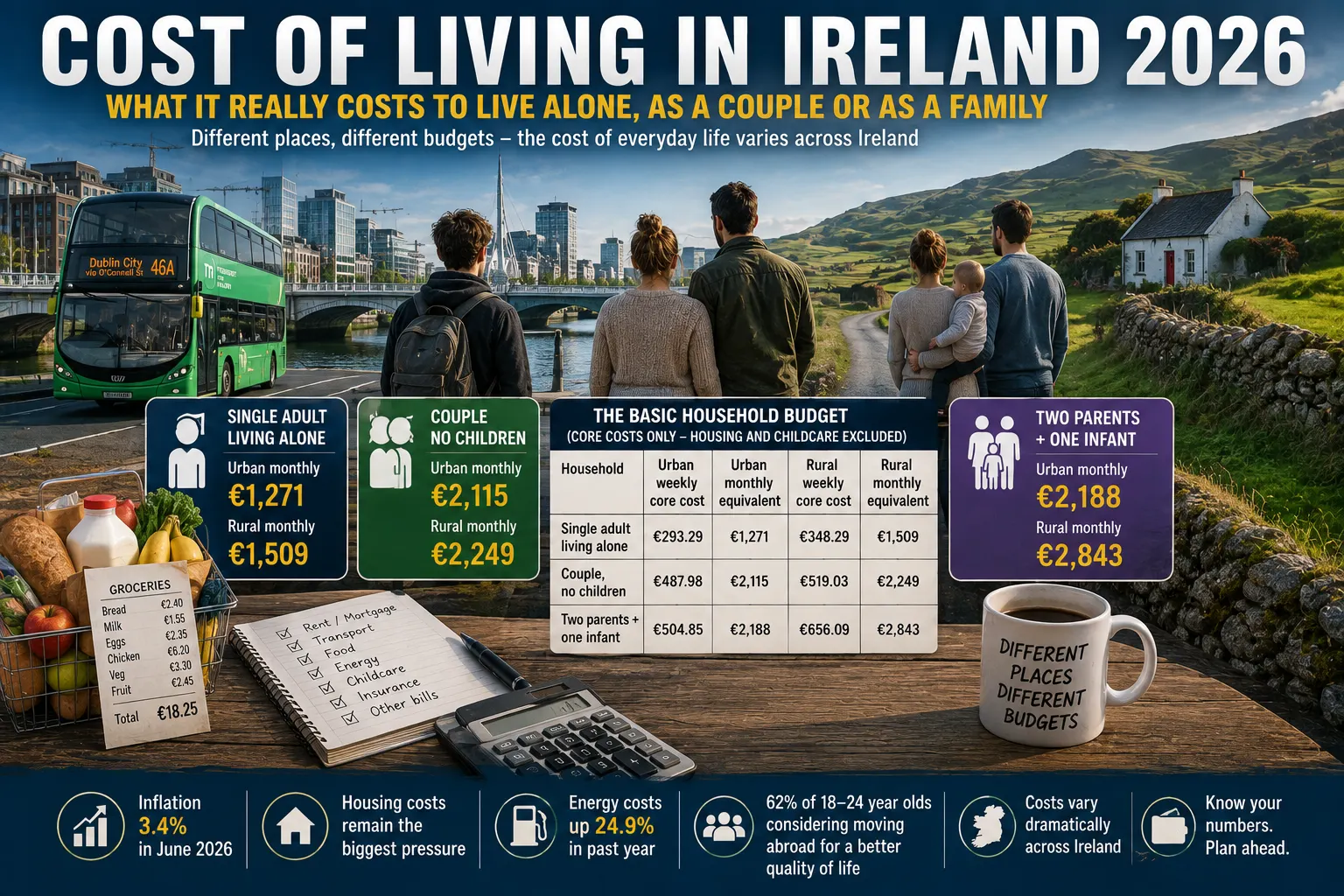
A monthly income that provides a comfortable life in one part of Ireland can feel remarkably tight in another. The reason is not that a loaf of bread suddenly becomes twice as expensive when someone crosses a county boundary. Ireland’s cost-of-living geography is instead shaped by several large expenses that interact with each other: rent, transport, home energy, childcare and the number of incomes supporting a household . That distinction has become particularly important in 2026. Consumer prices were
3.4% higher in June 2026 than a year earlier . Education services were up 8.9%, housing, water, electricity, gas and other fuels by 7.3%, clothing and footwear by 7.0%, and insurance and financial services by 5.7%. Yet a falling inflation rate does not mean the cost of living has returned to where it was several years ago. The Vincentian Minimum Essential Standard of Living Research Centre estimates that the cost of its minimum-needs basket rose another 3.8% in the year to March 2026 and is now 23.6% above its 2020 level . Home-energy costs in that benchmark increased by 24.9% in the latest year, while food costs rose by 2.7%. Ireland’s cost-of-living debate in 2026 is therefore less about one sudden price shock and increasingly about something more persistent:
the cumulative cost of several years of higher prices, combined with a housing market in which the amount a household pays can vary by well over €1,000 a month depending on location and circumstances.
Inflation has slowed — prices have not gone back down
This distinction is easy to misunderstand. If inflation falls from 8% to 3%, prices have not generally fallen by 5%. They are simply rising more slowly than before. That is why many households can hear that inflation has moderated while simultaneously feeling that their finances remain stretched. The MESL benchmark is useful because it approaches household costs differently from a conventional inflation index. Rather than measuring the average movement of thousands of prices, it establishes a basket of goods and services that members of the public regard as necessary for a
minimum socially acceptable standard of living — needs rather than wants. The 2026 review involved deliberative work with members of the public and includes food, clothing, health, communications, transport, household energy, basic social participation, insurance and a modest allowance for contingencies. It should not be mistaken for the spending of the “average Irish household”. It is a benchmark for what different household types need to reach a minimum acceptable standard. That makes it particularly useful for answering a deceptively simple question:
How much does it actually take to run a household in Ireland in 2026?
The basic household budget before rent
The 2026 MESL figures show how much household structure matters even before rent and childcare enter the calculation. For comparison, the following figures use three household types:
- one working-age adult living alone;
- a working-age couple with no dependent children;
- and two parents with one infant.
The monthly figures below are conversions of the official weekly MESL values, using 52 weeks divided by 12 months. Housing and childcare are excluded at this stage.
2026 Minimum Core Household Budget — Urban
| Household | Urban weekly core cost | Urban monthly equivalent |
|---|---|---|
| Single adult living alone | €293.29 | €1,271 |
| Couple, no children | €487.98 | €2,115 |
| Two parents + one infant | €504.85 | €2,188 |
2026 Minimum Core Household Budget — Rural
| Household | Rural weekly core cost | Rural monthly equivalent |
|---|---|---|
| Single adult living alone | €348.29 | €1,509 |
| Couple, no children | €519.03 | €2,249 |
| Two parents + one infant | €656.09 | €2,843 |
These figures immediately reveal two important features of household economics. First, two people do not need twice as much money as one person. Couples share heating, internet, household equipment and many other fixed costs. Second, rural living is not automatically cheaper once housing is removed from the equation . A rural single-person household has a minimum core budget about €238 a month higher than the urban equivalent. For the two-parent household with an infant, the difference is approximately €655 a month. Why? Transport is one of the largest explanations. The urban MESL budget for the two-parent, one-infant household allocates
€48 a week to transport . The comparable rural figure is €172.03 . Household-energy costs are €51.49 a week in the urban model and €66.59 in the rural model. That is a useful warning against viewing Ireland through rent alone. A household can save €400 a month by moving further from a major city but spend a significant part of that saving running one or two cars, buying fuel and heating a less energy-efficient home.
Housing changes almost everything
If there is one expense that transforms Ireland’s cost-of-living calculation, it is rent. The latest full RTB/ESRI county-level Rent Index available by August 2026 covers the fourth quarter of 2025 . It is based on registered tenancy data rather than advertised asking rents and distinguishes between people beginning a new tenancy and those already in an existing one. The national standardised average was €1,755 a month for a new tenancy and €1,503 for an existing tenancy . That €252 national difference matters. Two families living in similar areas can have very different monthly housing costs simply because one has occupied its home for some time while the other is entering the rental market today. But the national figure conceals an even larger geographical divide.
Ireland’s county-by-county rental cost
The table below ranks all 26 counties from the highest to the lowest standardised average rent for a new tenancy in Q4 2025 . The figures cover all property types, so they should not be interpreted as the advertised price of a particular one-bedroom apartment or three-bedroom house. They are best used to compare broad rental pressure between counties.
County Rental Costs for New and Existing Tenancies
| County | New tenancy | Existing tenancy | New-tenancy premium |
|---|---|---|---|
| Dublin | €2,232 | €1,939 | €293 |
| Kildare | €1,785 | €1,471 | €314 |
| Wicklow | €1,758 | €1,469 | €289 |
| Limerick | €1,666 | €1,155 | €511 |
| Galway | €1,655 | €1,298 | €357 |
| Meath | €1,608 | €1,381 | €227 |
| Cork | €1,568 | €1,259 | €309 |
| Louth | €1,524 | €1,252 | €272 |
| Laois | €1,376 | €1,082 | €294 |
| Westmeath | €1,340 | €990 | €350 |
| Carlow | €1,319 | €1,047 | €272 |
| Waterford | €1,311 | €991 | €320 |
| Kilkenny | €1,303 | €1,098 | €205 |
| Wexford | €1,285 | €1,033 | €252 |
| Clare | €1,249 | €1,027 | €222 |
| Sligo | €1,247 | €927 | €320 |
| Kerry | €1,241 | €1,022 | €219 |
| Offaly | €1,221 | €997 | €224 |
| Cavan | €1,216 | €990 | €226 |
| Roscommon | €1,187 | €1,013 | €174 |
| Mayo | €1,175 | €1,013 | €162 |
| Longford | €1,153 | €1,004 | €149 |
| Tipperary | €1,141 | €927 | €214 |
| Monaghan | €1,138 | €910 | €228 |
| Donegal | €1,041 | €854 | €187 |
| Leitrim | €1,006 | €849 | €157 |
The difference between the highest and lowest county average for somebody entering a new tenancy is €1,226 every month . Over twelve months, that becomes approximately €14,712 . Dublin’s €2,232 figure is more than twice Leitrim’s €1,006. But that does not make Leitrim automatically Ireland’s cheapest place to live. The RTB itself cautions that smaller rental markets can fluctuate significantly: Leitrim’s Q4 2025 new-tenancy figure was based on only 43 observations. More fundamentally, housing represents only part of the household budget.
Dublin: expensive housing dominates the calculation
For households moving into Dublin, rent is the major difference. The RTB’s more detailed property data put the standardised average new-tenancy rent for a one-bedroom Dublin apartment at €1,865 a month in Q4 2025. A two-bedroom apartment averaged €2,315 . That enables a more realistic example.
Example 1: A single person renting alone in Dublin
Suppose a working-age single person wants to live alone rather than share accommodation. The 2026 urban MESL core budget is approximately: €1,271 per month Add the RTB new-tenancy benchmark for a one-bedroom Dublin apartment: €1,865 That creates an illustrative monthly requirement of approximately:
This is not a claim that every single person in Dublin “needs exactly €3,136”. The rent could be higher or lower. Someone sharing a house would spend considerably less. A person with debt, expensive medical requirements or a car could spend more. But the calculation illustrates why living alone has become financially difficult even for many people in steady employment. Housing alone accounts for almost 60% of this illustrative budget. And one person has to finance the entire amount.
The single-person penalty
Living alone creates a particular financial problem because many costs do not halve simply because only one person uses them. A refrigerator costs broadly the same whether one or two people live in the home. Broadband does not become half price. The home still needs heating. The same television licence, many insurance costs and basic household products are spread across one income rather than two. The MESL income analysis demonstrates the effect clearly. In its 2026 urban private-rental scenario, a single full-time worker earning the National Minimum Wage had weekly net salary of €483.26 against modeled minimum expenditure of €629.08, leaving a
€145.81 weekly shortfall . By contrast, a childless couple with two full-time minimum-wage incomes had modeled income €116.22 above their minimum expenditure requirement. The same pattern appears in the rural model. A single minimum-wage private renter had a weekly modeled shortfall of €89.25, while the two-earner couple showed an adequate income with €212.19 remaining above the MESL expenditure benchmark. These are modelled scenarios rather than predictions for every worker, but they demonstrate an important structural fact:
two moderate incomes can be substantially more resilient than one because the household does not double its fixed costs when the second income arrives.
Example 2: A couple living in Dublin
Consider two adults sharing a one-bedroom apartment and having no dependent children. Their urban MESL core budget is approximately: €2,115 per month The same one-bedroom Dublin apartment benchmark is: €1,865 Together:
That is €844 more than the single person’s illustrative household budget — not €3,136 more. The couple therefore has considerable economies of scale. If both adults earn, the housing cost can also be spread across two incomes. This does not mean every couple is financially secure. Income distribution between partners, employment stability, commuting, debt and medical costs all matter. But it helps explain why housing pressure is especially acute for
single adults and one-income households .
Example 3: Two parents and an infant in Dublin
Children change the budget again. For a two-parent household with one infant, the urban core MESL requirement is approximately: €2,188 per month before housing and childcare. A new two-bedroom apartment in Dublin had a standardised average rent of: €2,315 per month. For an infant requiring full-time childcare, the MESL child-age budget puts the childcare element at €135.22 per week in its urban model after the universal National Childcare Scheme subsidy , equivalent to roughly €586 per month . That gives an illustrative monthly total of:
Illustrative Monthly Budget: Dublin Family With One Infant
| Dublin family with one infant | Approx. monthly amount |
|---|---|
| Core household needs | €2,188 |
| Two-bedroom apartment | €2,315 |
| Full-time infant childcare benchmark | €586 |
| Illustrative total | €5,089 |
The number should not be interpreted as the universal cost of raising a family in Dublin. Childcare charges vary substantially between providers, households can qualify for higher income-assessed subsidies, and many families have grandparents, part-time arrangements or other forms of care. But it shows why a household can have two salaries and still feel that relatively little income is genuinely discretionary . Housing and childcare alone in this example amount to approximately €2,901 every month.
Childcare is the second great variable for families
Ireland’s National Childcare Scheme substantially changes the cost for many families. The universal NCS subsidy currently provides €2.14 per hour for up to 45 hours per week for eligible children using registered childcare. Families may receive a larger means-tested subsidy depending on income and circumstances. A further change takes effect on 31 August 2026 : the lower income threshold for the income-assessed scheme increases from €26,000 to €34,000, while the upper threshold rises from €60,000 to €68,000. Multiple-child discounts also become more generous. That means two apparently identical families paying the same provider can ultimately face different net childcare costs. It also makes childcare an area where gross advertised prices provide only part of the story. For a family deciding whether a second parent should return to full-time work, the relevant calculation is not simply salary versus nursery fee. It also includes tax, commuting, the applicable NCS subsidy, pension contributions and the long-term career effects of leaving or reducing paid employment.
Dublin is expensive — but the commuter counties are no longer cheap substitutes
Moving beyond the Dublin boundary can reduce housing costs, but the commuter belt now has substantial rental pressure of its own. Kildare’s standardised new-tenancy average reached €1,785 , Wicklow €1,758 and Meath €1,608 in Q4 2025. For apartment renters, the broader Greater Dublin Area — Kildare, Meath and Wicklow outside Dublin — had an average new-tenancy rent of €1,348 for a one-bedroom apartment and €1,649 for a two-bedroom apartment . This creates another useful comparison.
Single adult in the Greater Dublin Area
Urban core needs: €1,271 One-bedroom GDA apartment: €1,348 Illustrative total:
That is roughly €517 a month below the equivalent Dublin example. But the saving can narrow if the person works in Dublin and needs a car, regular rail travel or substantial commuting time. The county boundary therefore does not automatically mark the boundary between “expensive” and “affordable”.
Couple in the Greater Dublin Area
Urban couple core: €2,115 One-bedroom GDA apartment: €1,348 Illustrative total:
Again the amount is meaningfully below Dublin’s €3,980 example. For a two-income household, the commuter counties can therefore still reduce the housing burden. The trade-off is transport. A household whose two adults travel into Dublin five days a week can convert part of its housing saving into fares, fuel, parking, vehicle depreciation and additional time. Hybrid working can change that equation dramatically. That is why the same house in Kildare can be financially attractive to one household and much less so to another.
Family in the Greater Dublin Area
Using the same two-parent, one-infant urban core: €2,188 Two-bedroom GDA apartment: €1,649 Urban full-time infant childcare benchmark: approximately €586 Total:
That is about €666 below the equivalent Dublin calculation. For a family, a €666 monthly difference is substantial — nearly €8,000 annually. But whether the family really saves that amount depends on work location, childcare availability and transport. A cheaper home that requires two cars can produce a very different result from a home beside a railway station and childcare provider.
Cork: city and county are two different markets
County averages can themselves be misleading because major Irish counties contain very different housing markets. Cork is an excellent example. In Q4 2025, the standardised new-tenancy rent was €1,756 in Cork City , compared with €1,346 in Cork County outside the city — a difference of €410 a month. Existing-tenancy averages showed a similar gap, at €1,413 in the city and €1,074 in the county. That is why simply saying “rent in Cork is €1,568” does not describe the experience of every Cork household. A person living close to the city centre faces one market. A household in north or west Cork faces another. But distance from the city can add transport and heating costs. The cheaper housing therefore comes with its own economic geography.
Galway shows the same divide
Galway’s countywide new-tenancy average was €1,655, making it one of Ireland’s more expensive rental counties. Within that figure, however, Galway City averaged €1,834 for new tenancies while Galway County outside the city averaged €1,451 . Existing-tenancy figures were €1,409 and €1,135 respectively. A difference approaching €400 a month can make moving outside the city attractive. But somebody commuting into Galway daily must consider whether that reduction survives after transport is included. This is a recurring pattern around Ireland’s growth centres:
housing becomes cheaper with distance, while mobility becomes more expensive.
Limerick presents a different problem: the new-renter gap
Limerick had one of the most striking divides between established and new tenants. The county’s standardised new-tenancy rent was €1,666 , while the existing-tenancy figure was €1,155 — a difference of €511 per month or 44.3% . That means a long-standing renter and a household newly entering the market can experience Limerick’s cost of living very differently. It also demonstrates why national conversations about “the average rent” can obscure the practical problem faced by people who have to move. A worker relocating for a new job, a couple separating, a family whose previous tenancy has ended or a young adult leaving the family home all enter the
new-tenancy market , not the average historic tenancy.
Waterford, Kilkenny, Wexford and the south-east
The south-east presents a more moderate rental picture than Dublin or Galway but is far from uniformly inexpensive. New-tenancy county averages stood at: Carlow €1,319 Waterford €1,311 Kilkenny €1,303 Wexford €1,285 in Q4 2025. For households able to secure employment locally, these rents can produce a significantly lower total cost than Dublin. But wages and career opportunities differ by occupation and sector. A lower rent is economically valuable only if a household can maintain sufficient income without creating a very expensive commute.
Donegal and Leitrim: lowest rents, but not necessarily lowest living costs
At the opposite end of the table, Donegal’s new-tenancy average was €1,041 and Leitrim’s €1,006. Those figures are compelling when compared with Dublin. But rural Ireland has costs that a rent table does not show. The 2026 MESL research assumes home-heating oil for its rural household basket. The price of that oil in the MESL basket was
72.4% higher than a year earlier and 186.8% above its 2020 level . Electricity in the benchmark was 25.6% higher over the year and 77.7% above 2020. Transport is equally important. For the two-parent, one-infant household, the rural MESL transport budget of €172.03 a week is more than three and a half times the urban €48 allocation. That means a household moving from Dublin to rural Donegal might save well over €1,000 in rent but should not assume that all of that becomes disposable income. Some will. Others will need two cars, substantially more fuel and more expensive home heating. Ireland therefore has
cheap-rent counties , but identifying the universally “cheapest county to live in” is much harder.
A rural-style single-person budget
The difference can be illustrated with the regional apartment figures. Outside the Greater Dublin Area, the RTB’s standardised average new-tenancy rent for a one-bedroom apartment was €1,058 in Q4 2025. Combine that with the rural single-person MESL core: €1,509 per month and the illustrative total becomes approximately:
That is roughly €569 below the Dublin single-person example. Notice, however, what has happened. The rent is €807 lower. But the total household saving is smaller because the rural core budget is higher. This is precisely why comparing counties only through property prices can be misleading.
A rural-style couple budget
For a couple without children: Rural core MESL: €2,249 per month Outside-GDA one-bedroom apartment benchmark: €1,058 Illustrative total:
That is around €673 below the Dublin couple example. Again, the largest saving comes through housing.
A rural family can produce a surprising result
Now consider two parents with one infant using a rural-style budget. Rural core needs: €2,843 per month Outside-GDA two-bedroom apartment: €1,368 Rural full-time infant childcare benchmark, net of the universal NCS subsidy: approximately €466 per month . Illustrative total:
That is below the Dublin family example of about €5,089, but it is higher than the GDA illustration of approximately €4,423 . This does not mean a family literally spends more in Leitrim than in Kildare. The Outside-GDA rent figure covers a broad mixture of places, while the MESL rural basket models particular transport and energy needs. But the example makes an important economic point: lower rent and lower total living costs are not always the same thing.
For a family needing two cars and oil heating, an ostensibly inexpensive rural location can lose much of its housing advantage.
The three household types compared
The illustrative calculations can be summarised like this:
Illustrative Monthly Household Budgets by Location
| Household example | Dublin | Greater Dublin Area | Rural / Outside-GDA illustration |
|---|---|---|---|
| Single adult, one-bed apartment | €3,136 | €2,619 | €2,567 |
| Couple, one-bed apartment | €3,980 | €3,463 | €3,307 |
| Two parents + infant, two-bed apartment + childcare | €5,089 | €4,423 | €4,677 |
These are illustrative minimum-style budgets, not official average household spending figures . They combine 2026 MESL minimum-needs budgets with the latest detailed RTB regional new-tenancy benchmarks and, for the family examples, the MESL infant childcare benchmark. Actual households can spend significantly more or less. A family renting an existing home may pay less. Someone sharing accommodation may pay much less. A homeowner with a small mortgage may have an entirely different cost structure. A household financing two cars or servicing substantial debt may spend considerably more. The point is not to prescribe one correct monthly budget. It is to show how the major pieces interact.
What is actually inside the €1,271 single-person budget?
A minimum budget is more than food and electricity. For an urban single adult, the weekly 2026 MESL core includes approximately:
- €60.19 for food;
- €15.75 for clothing;
- €17.54 for personal care;
- €11.04 for health;
- €11.13 for household goods;
- €5.13 for household services;
- €12.50 for communications;
- €55.77 for social inclusion and participation;
- €33.32 for transport;
- €33.45 for household energy;
- €18.42 for insurance;
- €10 for savings and contingencies;
- plus other personal costs.
Together they produce the €293.29 weekly core. The inclusion of social participation is deliberate. A minimum socially acceptable life is not defined as surviving on calories and heating alone. It includes the ability to maintain relationships, participate in society and cope with occasional unexpected costs. This is important when evaluating claims that a household “should be able to live on less”. It may be mathematically possible to reduce expenditure temporarily by eliminating clothing replacement, insurance, savings, social activity or non-emergency household maintenance. But that is different from demonstrating that such a budget is sustainable over years.
Families with older children face a different calculation
The infant household used in the examples is only one family type. Children’s costs change substantially with age. The MESL’s direct urban child budget before childcare rises from €82.80 a week for an infant to €103.18 for a primary-school child and €166.84 for a secondary-school child . The change reflects different food, clothing, education, communication, transport and social-participation requirements. Childcare can move in the opposite direction. An infant may require expensive full-time care, while a secondary-school student generally does not. A family therefore does not simply add “the cost of one child” to its budget. The expenditure profile changes as the child grows. For parents, this can create a progression from heavy childcare expenditure in the early years to higher food, clothing, school and social costs in adolescence.
Wages are rising — but income alone does not describe affordability
Average weekly earnings reached €1,075.58 in the first quarter of 2026 , 4.4% higher than a year earlier. Average hourly earnings increased 4.0% to €33.14. The National Minimum Wage also increased to €14.15 an hour from 1 January 2026 . Both developments support household purchasing power. But an economy-wide average wage should not be mistaken for the pay received by the typical individual worker. It is also a
gross earnings measure, whereas households pay rent and groceries from income after tax and deductions. More importantly, affordability depends on household structure. One employee earning €45,000 and living alone does not have the same economic position as two people each earning €35,000 and sharing housing costs. Likewise, a couple earning high salaries but paying €2,500 in rent and €1,500 for childcare can have less discretionary income than headline salaries suggest. The correct unit of analysis is therefore frequently the
household , not the individual salary.
Renters experience the cost-of-living problem differently from homeowners
The CSO’s 2025 Survey on Income and Living Conditions illustrates the extent to which housing tenure shapes financial pressure. People living in rented or rent-free accommodation had an at-risk-of-poverty rate of 24.2% , compared with 7.4% among owner-occupiers. When the CSO performed an additional calculation deducting rent and mortgage interest from disposable income, 45.2% of people in rented or rent-free accommodation would have fallen below the standard at-risk-of-poverty threshold . That statistic does not mean 45.2% of renters are officially classified as poor. It is a specific analytical measure designed to show the effect housing costs have on disposable resources. But it demonstrates why two households with identical salaries can experience Irish living costs very differently. A homeowner who purchased years ago and has a modest remaining mortgage may devote a relatively small share of income to housing. A new private renter in the same neighbourhood may pay several times as much.
Why existing tenants can feel better off than people who have to move
The RTB national figures provide a particularly clear example. Average new tenancy: €1,755 Average existing tenancy: €1,503 Difference: €252 per month , or more than €3,000 over a year. In some counties the difference is substantially larger. Limerick’s gap was €511. Westmeath’s was €350. Sligo’s was €320. Waterford’s was €320. Kildare’s was €314. This creates an unusual form of household risk. A person’s living costs can remain manageable while they retain an existing tenancy, then increase abruptly after a relationship breakdown, relocation, landlord sale or other event forces them back into the market. The cost-of-living problem is therefore partly a question of prices and partly a question of
exposure to new prices .
Why Ireland cannot be divided simply into “expensive east” and “cheap west”
The county table shows a broad pattern, but it is not a simple east-west divide. Dublin, Kildare and Wicklow are among the most expensive counties, as expected. But Limerick and Galway also sit close to the top. Cork and Louth exceed €1,500 for new tenancies. Laois and Westmeath are well above several coastal counties. Meanwhile, Donegal and Leitrim record the lowest new-tenancy averages but can expose households to different transport and heating costs. Regional affordability is therefore better understood through three questions:
What does housing cost? What does it cost to get from that housing to work, school, childcare and services? What income opportunities are available within reasonable travelling distance? A cheap house far from employment is not necessarily cheap living.
Transport is Ireland’s hidden regional cost
Transport rarely receives the same attention as rent because households do not normally receive one giant “transport bill” each month. Instead, the expense is fragmented: fuel, insurance, motor tax, maintenance, tyres, NCT, repairs, depreciation, finance payments and parking. For urban households, public transport can replace some or all of those costs. For many rural households it cannot. That is why the MESL rural transport assumptions are so much higher for families. For the two-parent infant household:
Urban transport: €48.00 a week Rural transport: €172.03 a week For a single adult: Urban: €33.32 Rural: €58.27 The rural budget also carries higher insurance costs in the MESL model. This explains why a household considering relocation should calculate housing plus mobility , not rent alone.
Energy is the other hidden geographical variable
Housing type matters almost as much as location. A compact new apartment with a high energy rating has a very different heating requirement from a large detached rural home. The 2026 MESL work found that energy represented the greatest upward pressure on its minimum-needs budgets. Its rural model was particularly affected by the surge in heating-oil prices. This means the question “How much does it cost to live in County Mayo?” cannot be answered solely by using Mayo’s €1,175 new-tenancy rent figure. A modern apartment in Castlebar and an older detached house in a rural location can have very different energy and transport profiles. County averages are useful starting points. They are not personal budgets.
Food still matters — even when housing dominates
Because rent is so large, food increases can appear relatively modest by comparison. But food is a recurring expenditure that households cannot simply remove. The 2026 MESL research found its minimum food basket was 2.7% more expensive than a year earlier and around one-fifth more expensive than in 2020 . For the two-parent, one-infant household, the core food budget is approximately €120 a week. For a couple without children it is about €113. For a single adult it is about €60. Larger families naturally face larger totals, particularly as children move into adolescence. Unlike rent, food does provide households with some ability to substitute brands, retailers and meal choices. But there is a limit to how far a basic nutritional budget can be compressed.
The biggest protection a household can have is often a second income
Ireland’s cost-of-living discussion frequently focuses on the level of wages, but the number of earners can be equally important. The CSO’s poverty data show a strong relationship between employment within households and financial resilience. In SILC 2025, consistent poverty was 14.2% among people in households where nobody was working, 5.8% where one person was working and 1.6% in households with two people in employment. That does not mean every two-income household is comfortable. Childcare can absorb a substantial share of the second income. But it reinforces what the MESL examples show: fixed household costs become easier to carry when they are supported by more than one wage. The difficulty is that not every household can have two earners. Single people cannot. Lone parents face particular constraints. Some couples have caring responsibilities, illness or unemployment. That is why the cost-of-living problem can affect households with superficially similar annual incomes very differently.
What does a household really need to calculate?
A useful personal cost-of-living budget should not begin with Ireland’s national inflation rate. It should begin with the household itself. The largest questions are: Housing: What is the actual rent or mortgage, and is the household entering a new tenancy? Transport: Is one car needed, two cars, or none? What is the real annual cost including insurance and maintenance?
Energy: What type of property is it, what is its energy rating and what fuel does it use? Food: How many adults and children are being supported? Childcare: What are the provider’s fees after the household’s actual NCS entitlement? Health: Are there recurring medicines, insurance or medical expenses?
Debt: Are there car loans, credit cards or personal loans? Work: How many earners are there, and how secure are those incomes? Location: Is cheaper housing creating greater commuting costs? Only after those elements are known does a national “average cost of living” become meaningful.
Which counties offer the best cost equation?
On rent alone, the current official data put Leitrim and Donegal at the bottom of the cost table , followed by Monaghan, Tipperary, Longford, Mayo and Roscommon. For someone who works remotely, needs only one car and can secure an energy-efficient property, those counties can offer a compelling financial advantage. For somebody whose career requires five days a week in Dublin, the calculation is entirely different. Kildare, Meath and Wicklow cost considerably more in rent but can provide access to the capital’s labour market without Dublin-level housing costs. Cork, Galway and Limerick offer large regional employment centres but increasingly carry metropolitan housing prices of their own. Waterford and parts of the south-east occupy a middle position, with rents substantially below Dublin but above the least expensive western and border counties. There is therefore no single cheapest county for every household. There is a
cheapest practical location for a particular combination of employment, housing, transport and family circumstances .
Why moving to save money can work — and when it does not
Consider a person paying €1,865 for a Dublin one-bedroom apartment. Moving to a one-bedroom apartment outside the GDA at the RTB’s €1,058 regional benchmark would appear to save: €807 per month, or €9,684 annually. That is significant. If the person works remotely, the financial case can be strong. But suppose relocation makes a car essential. The saving must then absorb insurance, fuel, maintenance, tax and depreciation. If the person still travels to Dublin frequently, the gap narrows further. If the new home also relies on heating oil, energy can eat into the difference. The move can still be financially worthwhile. It is simply not a €9,684 pure saving.
Families face the most complicated calculation
For families, county comparisons require even more caution because housing, childcare and employment have to line up geographically . A house may be affordable but far from childcare. Childcare may be available but not align with working hours. One parent may have a strong local job while the other has to commute. A larger property may save rent but cost more to heat. A family with grandparents nearby may have childcare support unavailable elsewhere. These relationships are difficult to capture in national statistics but can determine whether a location works financially. The family budget is therefore more than a sum of prices. It is a system.
2026 is not simply a story of households getting poorer
It would be misleading to describe every current development negatively. Average earnings have been rising faster than the headline CPI over the latest annual comparison available: average weekly earnings grew 4.4% in Q1 2026, while the CSO recorded annual CPI inflation of 3.0% over that particular Q1 comparison period. The minimum wage has risen. Childcare subsidies are being expanded. Ireland’s labour market remains capable of supporting high levels of employment. Those developments matter. For households whose income grows while housing costs remain stable, purchasing power can improve. The problem is that the benefits are uneven. A person with an established tenancy experiences a different economy from someone searching for a new home. A mortgage-free homeowner experiences a different economy from a private renter. A remote worker in a lower-cost county experiences a different economy from an employee required to live close to central Dublin. The national inflation number cannot describe all of them equally well.
Why a quick solution is difficult
Ireland’s cost of living is not generated by one price and therefore cannot be resolved by one policy. Food prices reflect domestic and international supply chains. Energy is influenced by global fuel and electricity markets, infrastructure and the energy efficiency of homes. Housing costs reflect supply, population growth, construction, finance, planning, land, infrastructure and where employment is concentrated. Childcare depends on wages, staffing, regulation, subsidies and provider capacity. Transport differs according to settlement patterns and public-transport infrastructure. Wages are shaped by productivity, sectors, skills and labour-market conditions. These factors overlap. Building more housing can eventually moderate pressure on rent, but homes take time to plan and construct. Increasing household incomes helps affordability, but if supply remains constrained some additional purchasing power can compete for the same limited goods and services. Reducing childcare costs can make employment more viable for parents but also requires sufficient childcare places and workers. Cost-of-living policy is therefore a balancing problem rather than a single lever.
What to watch through the remainder of 2026
Several variables will determine whether household pressure eases or persists. The first is housing . New renters will remain particularly exposed while the gap between new and existing tenancy costs remains large. The second is energy . Rural households reliant on heating oil have experienced particularly severe cost increases in the latest MESL analysis. The third is
wage growth . If earnings continue growing faster than consumer prices, households whose housing costs are stable can gradually regain purchasing power. The fourth is childcare support . The expanded NCS income thresholds taking effect on 31 August should improve subsidies for some families, although the exact benefit depends on individual circumstances. And the fifth is location itself. Remote and hybrid working, better transport and additional regional employment can alter the economic value of counties where housing is currently cheaper.
Ireland does not have one cost of living
Perhaps the most important conclusion is that there is no single figure that describes what it costs to live in Ireland in 2026. For a single person renting alone in Dublin, an illustrative minimum-style budget can exceed €3,100 a month . A couple sharing the same type of home may require around €4,000 , but can potentially support that cost from two incomes. A Dublin family with one infant, a two-bedroom apartment and full-time childcare can move beyond €5,000 a month before discretionary luxuries enter the picture. Move outside Dublin and housing becomes considerably cheaper — but transport and energy can rise. Move into rural Ireland and rent may fall further, yet the household may become dependent on cars and oil heating. Stay in an existing tenancy and the cost may be hundreds of euro below what a new neighbour pays. Own a home purchased years earlier and the entire calculation changes again. That is why Ireland’s cost-of-living debate cannot be reduced to the price of groceries, the inflation rate or the average salary. The real question is the relationship between
income and the unavoidable costs attached to a particular household in a particular place . For some households, Ireland’s strong labour market and rising earnings provide enough room to absorb those costs. For others — especially single renters, newly forming households and families facing simultaneous rent and childcare bills — the margin remains narrow. And that is the defining feature of the Irish cost-of-living challenge in 2026: not that every part of the country is equally expensive, but that the route to an affordable life depends increasingly on where someone lives, whether they rent or own, how many incomes enter the household, and what it costs simply to get from home to the rest of daily life.
Source & Transparency
This article is published by Ireland Newspaper for editorial and informational purposes.
Published: 12 August 2026 · Updated: 14 August 2026

Newsroom Ireland Newspaper
Ireland Newspaper editorial team prepares daily news coverage for readers in Ireland and abroad.