From 170 Kilometres to 600-Plus: How Electric Cars Changed in a Decade
Ten years ago, an electric car in Ireland was still a specialist choice, long journeys required careful planning and diesel dominated new-car sales. In 2026, one in four newly licensed private cars is fully electric, mainstream family EVs can deliver around 400 kilometres of realistic mixed-driving range, and the latest generation can travel beyond 600 kilometres in representative real-world estimates. The technology has changed dramatically — but the economics still depend heavily on where the car is charged.
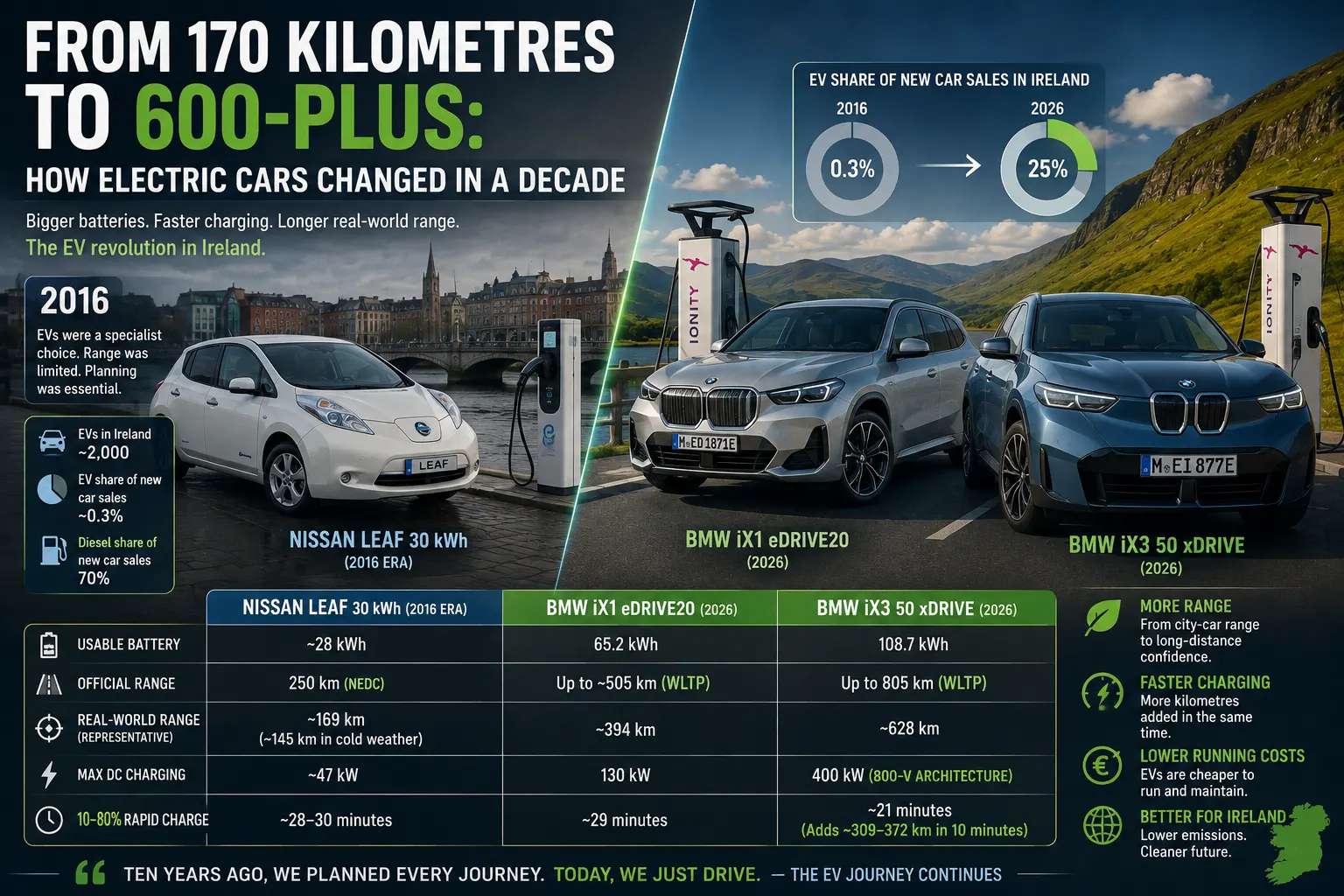
In 2016, buying an electric car in Ireland required a degree of commitment. The country had only around 2,000 battery-electric vehicles, while battery-only cars accounted for approximately 0.3% of new-car sales. Diesel, by contrast, was the default choice for much of the market: Central Statistics Office figures show that 70% of new private cars registered that year were diesel, 28% petrol and roughly 2% electric or hybrid combined.
A representative electric car of that period was the 30 kWh Nissan Leaf. Nissan advertised an official 250 km NEDC range, but an independent EV Database estimate puts representative real-world range at only about 169 km, falling towards approximately 145 km in its cold-weather combined scenario. Its usable battery capacity was around 28 kWh and rapid charging peaked at approximately 47 kW. Even with a rapid charger available, a 10–80% session took around half an hour and restored far less driving distance than a modern high-range EV can add today.
Fast-forward ten years and the comparison is almost difficult to believe. A current BMW iX1 eDrive20 — a family-sized compact SUV rather than an experimental city car — carries a 65.2 kWh usable battery, has an official WLTP range reaching approximately 505 km depending on specification and can recharge from 10% to 80% in around 29 minutes at a suitable 130 kW DC charger. Independent estimates put its representative real-world range at roughly 394 km.
At the technological frontier, the change is greater still. BMW’s latest iX3 50 xDrive combines a 108.7 kWh battery with an 800-volt electrical architecture, a maximum 400 kW DC charging rate and an official WLTP range of as much as 805 km. EV Database estimates approximately 628 km of representative real-world range, while BMW says optimal high-power charging can add roughly 309–372 km of WLTP-rated range in just ten minutes.
The electric car has therefore not merely gained a bigger battery over the past decade. It has become a fundamentally more capable machine.
2016 Versus 2026: The Scale of the Change
The technological shift becomes clearer when vehicles from the two eras are placed alongside one another. Official range standards have changed — the older Leaf figure used the more optimistic NEDC system while modern cars are rated under WLTP — so independent real-world estimates provide a more useful indication of what has actually happened.
| Example | Battery | Official range | Representative real-world range | Maximum DC charging | 10–80% rapid charge |
|---|---|---|---|---|---|
| Nissan Leaf 30 kWh, 2016 era | 30 kWh nominal / ~28 kWh usable | 250 km NEDC | ~169 km | ~47 kW | ~28–30 min |
| BMW iX1 eDrive20, 2026 | 65.2 kWh usable | Up to ~505 km WLTP | ~394 km | 130 kW | ~29 min |
| BMW iX3 50 xDrive, 2026 | 108.7 kWh usable | Up to 805 km WLTP | ~628 km | 400 kW | ~21 min |
The underlying data illustrate something important: charging time measured in minutes has not necessarily fallen as dramatically as battery capacity has increased. What has changed is how much energy — and therefore how much driving range — can be put into the car during those minutes. The 2016 Leaf could accept roughly 45–47 kW during rapid charging. The latest iX3 can peak at 400 kW, while even a much less expensive iX1 can accept 130 kW.
That is one of the reasons a 20- or 30-minute stop means something very different in 2026.
The Battery Became Bigger — but Efficiency Became More Important Too
Early electric-car development often focused on adding battery capacity. That remains important, but modern engineering increasingly concentrates on how efficiently every kilowatt-hour can be used.
The latest EVs combine improved cell chemistry, sophisticated battery cooling and heating, heat pumps, more efficient motors, lower electrical losses and increasingly sophisticated aerodynamics. High-voltage architectures can also reduce current for a given amount of charging power, helping manufacturers achieve much faster charging without simply pushing ever-greater current through cables and battery cells.
The new iX3 provides a useful illustration of how far this approach has developed. Its sixth-generation battery system operates at 800 volts, and BMW quotes combined WLTP consumption as low as roughly 15.1 kWh/100 km in the most favourable configuration despite the vehicle being a sizeable all-wheel-drive SUV. Its battery is also automatically preconditioned when a suitable charging station is selected through the navigation system, helping it arrive at the charger at a temperature that allows high charging rates.
Battery preconditioning sounds like a minor technical detail, but it addresses one of the frustrations of earlier EV ownership. A battery that is too cold or too hot cannot necessarily accept its advertised maximum charging power. Modern cars increasingly manage the thermal preparation automatically rather than leaving the driver to understand battery chemistry.
Navigation has undergone a similar transformation. A modern EV can calculate charging stops as part of a route, consider available chargers and, in increasingly sophisticated systems, take charging prices and driver preferences into account. The driver is no longer necessarily required to calculate remaining range, identify a charger and work out independently whether the car can reach it.
What Does “Real Range” Actually Mean?
Perhaps no electric-car number causes more misunderstanding than range.
The WLTP figure is useful because every manufacturer has to test vehicles according to a common procedure. It allows one car to be compared with another. What it does not promise is that every driver will travel exactly that distance from a full battery.
An EV can be exceptionally efficient in urban traffic because regenerative braking returns some energy to the battery and lower speeds dramatically reduce aerodynamic resistance. Sustained motorway driving produces the opposite effect. Cold weather increases energy consumption through cabin and battery heating, while roof boxes, trailers, strong headwinds, heavy loads, large wheels and aggressive driving can reduce range further.
The current BMW iX1 eDrive20 demonstrates the scale of that variation. EV Database estimates an average real-world range of around 394 km, but its scenario modelling ranges from approximately 282 km during cold-weather motorway driving to around 459 km in mild mixed conditions and approximately 587 km during low-speed mild-weather urban driving. The latter is not a realistic expectation for an Irish motorway journey; it demonstrates how strongly speed and conditions change EV efficiency.
For the substantially larger-battery BMW iX3 50 xDrive, the estimated representative real-world figure is approximately 628 km. EV Database models about 459 km for sustained cold-weather motorway driving, approximately 587 km for mild-weather motorway operation, 531 km in combined cold conditions and roughly 724 km in combined mild conditions.
Those figures are more useful than simply saying that a modern electric vehicle can “do 800 kilometres”. Some can achieve extraordinary distances under favourable official test conditions, but a sensible driver planning a long journey should retain a reserve and think in terms of weather, speed and charging opportunities rather than treating the maximum WLTP number as a guarantee.
A 400-Kilometre EV Has Changed Everyday Irish Driving
For Ireland specifically, the move from roughly 150–200 km of practical early-EV range to around 350–450 km in many modern family EVs changes the ownership equation.
A decade ago, a relatively ordinary inter-urban journey could force an early Leaf driver to think seriously about the location and availability of a rapid charger before leaving. Today, a vehicle with approximately 400 km of representative range can complete a very substantial Irish journey without charging at all, while a high-range EV can cover several hours of motorway driving before requiring a stop.
That does not make charging infrastructure irrelevant. It changes its function. Instead of charging because the car cannot complete a fairly ordinary journey, many drivers now charge during the natural break they would have taken anyway.
At the top end of the market, charging performance is beginning to approach the point where the human break can be longer than the car requires. BMW quotes a 21-minute 10–80% charging time for the iX3 50 xDrive under optimal conditions, while a ten-minute session can add more than 300 km of WLTP range when the charger, battery temperature and state of charge allow the maximum performance.
That performance is not universal. Plenty of current EVs charge at 100–150 kW rather than 300–400 kW, and the charging station has to be capable of supplying what the vehicle can accept. Nevertheless, the technological direction is clear.
Ireland’s EV Market Has Changed Almost as Much as the Cars
The vehicles improved while Ireland’s market changed around them.
The approximately 2,000 battery-only EVs recorded at the end of 2016 have grown into a battery-electric fleet of 134,475 vehicles by June 2026, according to the CSO. Electric vehicles represented 4% of Ireland’s entire licensed vehicle fleet at that point. The low percentage of the total fleet reflects how long cars remain on the road: petrol and diesel still accounted for 85.3% of all licensed vehicles in June.
New-car sales tell a much faster-moving story. During the first seven months of 2026, 26,796 new private battery-electric cars were licensed, 57% more than during the same period of 2025. Fully electric cars represented 26% of all new private cars registered between January and July, compared with 17% a year earlier. Petrol and diesel combined fell from 44% of new-car registrations in the corresponding 2025 period to 33% in 2026.
Compare that with 2016, when 70% of new private cars were diesel, and the structural change becomes obvious. Ireland has not become an electric-car country overnight, but the centre of the new-car market is moving rapidly away from the near-monopoly enjoyed by combustion engines a decade ago.
Public Charging Is Growing — but Home Charging Still Changes Everything
Ireland had 3,428 public charging points across 1,150 public locations as of June 2026, according to Zero Emission Vehicles Ireland. A further €20 million is being invested through 2026 and early 2027 in 266 new high-power recharging stations across motorways and national and regional roads.
Yet public charging is only one half of the EV story. ZEVI expects between 80% and 90% of EV owners’ charging to take place at home. That matters because the cost difference between charging at home overnight and relying on high-power public infrastructure is enormous.
It is here that one of the biggest misconceptions about EV running costs appears. Electricity is not one product at one price.
An owner who plugs in at home on an appropriate night tariff can travel extremely cheaply. Someone without off-street parking who depends heavily on public rapid chargers can pay considerably more for the same kilometres.
The economics of an EV therefore depend less on the abstract question “Is electricity cheaper than diesel?” and more on which electricity the driver can access.
Electric Versus Petrol Versus Diesel: A Like-for-Like Irish Comparison
A useful way to examine the question is to compare vehicles from the same family rather than putting a small electric hatchback against a large diesel SUV.
BMW’s X1 range provides an unusually useful case. The BMW X1 sDrive20i Sport uses a petrol mild-hybrid powertrain, the X1 sDrive18d Sport is diesel and the closely related iX1 eDrive20 Sport is fully electric. They share the same basic compact-SUV family and dimensions, although power output, weight, boot configuration and some equipment differ.
BMW Ireland currently lists the petrol X1 sDrive20i Sport from €50,555 and the iX1 eDrive20 Sport from €52,475. BMW’s 2026 Irish master price list published the X1 sDrive18d Sport at approximately €52,570 at the applicable CO₂ rate. These are indicative published prices rather than quotations from a dealer, and options or subsequent pricing changes can alter the final figure.
The electric version is therefore not dramatically more expensive in this particular comparison. Its advertised entry price is around €1,920 above the petrol X1 and essentially level with the published diesel Sport price.
That would have been a far less common price relationship ten years ago.
A Realistic Running-Cost Model
For fuel use, BMW quotes approximately 5.8–6.1 litres/100 km for the petrol sDrive20i Sport and around 5.0–5.2 litres/100 km for the diesel sDrive18d Sport. For a simple comparison, the calculation below uses 6.0 L/100 km for petrol and 5.1 L/100 km for diesel. These are WLTP-based figures rather than guarantees of real-life consumption; actual use can be higher or lower depending on the journey.
For the electric iX1, the calculation uses EV Database’s independent representative estimate of 266 Wh per mile, equivalent to approximately 16.5 kWh/100 km at the battery, rather than BMW’s more favourable official figure. A further 10% is added as an explicit model assumption for charging losses, producing approximately 18.2 kWh purchased from the electricity supply for every 100 km driven. Charging losses vary by vehicle, charger, temperature and charging method, so this should be treated as a model rather than a universal figure.
For energy prices, the calculation uses AA Ireland’s August 2026 national averages of €1.8366 per litre for petrol and €1.9156 for diesel. For home electricity it uses Electric Ireland’s published July 2026 EnergySaver rates of 20.03 cent/kWh at night and 38.04 cent/kWh on a 24-hour tariff. As an example of public fast charging, ESB ecars currently charges €0.72/kWh for PAYG DC fast and high-power charging in the Republic.
| Power source | Assumed consumption | Current price used | Energy cost per 100 km | Energy cost at 15,000 km/year |
|---|---|---|---|---|
| BMW X1 petrol | 6.0 L/100 km | €1.8366/L | €11.02 | €1,653 |
| BMW X1 diesel | 5.1 L/100 km | €1.9156/L | €9.77 | €1,465 |
| BMW iX1 — home night charging | ~18.2 kWh from grid/100 km* | €0.2003/kWh | €3.64 | €546 |
| BMW iX1 — standard home tariff | ~18.2 kWh from grid/100 km* | €0.3804/kWh | €6.92 | €1,038 |
| BMW iX1 — public rapid PAYG | ~18.2 kWh from charger/100 km* | €0.72/kWh | €13.10 | €1,964 |
*The electricity calculations are a model using an independent estimated real-world vehicle consumption plus a 10% allowance for charging losses. Standing charges, subscriptions, parking charges and charger overstay fees are excluded.
The result is revealing.
At the night rate used in the example, the electric iX1 costs only about one third as much as the petrol X1 in energy per kilometre and comfortably less than half as much as the diesel. Even at the standard home electricity rate, the EV retains a substantial running-cost advantage.
But charge almost exclusively at an expensive public rapid charger and the picture reverses: the EV’s energy cost can exceed both petrol and diesel.
That is why two owners of exactly the same electric car can reach completely different conclusions about whether an EV is inexpensive to run.
Home Charging Can Recover the Purchase-Price Difference Surprisingly Quickly
Using the same model, an iX1 owner driving 15,000 km per year and charging predominantly at the illustrated night rate would spend around €546 a year on electricity, compared with approximately €1,653 for the petrol version.
That is a difference of roughly €1,100 per year in energy alone.
Against the current advertised €1,920 price difference between the petrol X1 Sport and electric iX1 Sport, the energy saving would theoretically recover that initial gap in less than two years under the assumptions above. At the standard home tariff, the annual energy advantage falls to around €615, extending the simple energy-price payback to a little over three years.
This is deliberately not a total-cost-of-ownership calculation. Depreciation, finance rates, insurance, tyres, servicing, repair costs, motor tax, charger installation and future changes in fuel or electricity prices can all materially alter the result. It simply shows how important the charging location is.
The current fuel price snapshot is particularly volatile. AA Ireland’s August data show significant month-on-month increases, and the organisation says a phased restoration of excise from 1 September 2026 is scheduled to add a further nine cents per litre to petrol and ten cents to diesel in the first stage if other components of pump prices remain unchanged.
Electricity prices can change as well. No five-year ownership calculation should assume that August 2026 energy prices will remain frozen for five years.
The Public-Charging Paradox
The table exposes an issue that is likely to become increasingly important as electric cars move beyond households with private driveways.
An EV can be exceptionally cheap to run when charged overnight at home, yet relatively expensive when used almost entirely through rapid public infrastructure.
That creates a practical divide between households.
Someone living in a detached or semi-detached home with private parking can arrive home, connect the car and schedule charging for the cheapest hours. The car can effectively begin every morning with the equivalent of a full or nearly full “tank”.
A driver living in an apartment or terraced property without dedicated parking may have a different experience. That person can depend more heavily on destination, kerbside or public rapid charging, where electricity prices are substantially higher.
Ireland’s infrastructure strategy increasingly recognises that challenge. There are grants for apartment and multi-unit charging infrastructure, while ZEVI’s network planning covers neighbourhood, destination and en-route charging rather than treating motorway chargers as the complete solution.
The next stage of Ireland’s EV transition may therefore depend as much on where people live as on how good electric cars become.
Government Support Still Matters — but It Has Changed
Ireland continues to subsidise the transition, although the structure of support has become more targeted.
Private purchasers of qualifying new M1 battery-electric cars can currently receive a maximum SEAI grant of €3,500, but vehicles with a full price above €50,000 do not qualify. The current iX1 example, at a listed €52,475, therefore sits above that purchase-grant ceiling based on its advertised price.
A separate home-charger grant can provide up to €300 towards purchasing and installing an eligible charger using a Safe Electric registered contractor.
Ireland also introduced the ICE2EV pilot scrappage programme in 2026, offering additional support to eligible drivers replacing an older combustion vehicle, but demand exhausted the pilot allocation. SEAI states that the scheme has reached its target of 2,000 applications and is now closed to new applicants, while the standard €3,500 qualifying EV grant remains available.
That rapid uptake provides another indication that the question facing the Irish EV market has changed. A decade ago, government support was attempting to create demand for a technology many buyers considered impractical. Today, incentive design is increasingly about managing the transition, targeting support and expanding infrastructure.
Electric Cars Can Now Do Things Early EVs Simply Could Not
Range and running cost tell only part of the technological story.
Modern EVs are increasingly capable of performing duties once regarded as difficult for battery-powered cars. The new BMW iX3, for example, can be configured to tow up to 2,000 kg braked, has all-wheel drive, produces 345 kW in 50 xDrive form and accelerates from 0–100 km/h in 4.9 seconds. Yet it combines that performance with a maximum official range of 805 km.
This combination would have sounded contradictory in the early EV era. Long range once required conserving every possible watt-hour; high performance, towing and a large SUV body seemed fundamentally incompatible with electric efficiency.
Software capabilities have advanced just as quickly. Modern systems can plan charging stops, precondition batteries automatically and authenticate at compatible chargers through technologies such as Plug & Charge. The vehicle is becoming part of a broader energy system rather than merely something that consumes electricity.
Bidirectional charging is the next stage. BMW says the iX3 has been prepared for future bidirectional functionality, potentially allowing compatible versions and home-energy systems to use the vehicle battery as household energy storage or as a mobile source of electricity. Availability depends on compatible equipment, market support and energy-management systems, so this should not yet be considered a universal EV feature.
Nevertheless, the concept demonstrates how far the technology has moved from the simple proposition of replacing a petrol engine with an electric motor.
What Electric Cars Still Do Not Solve
The rapid progress should not disguise the remaining limitations.
A petrol or diesel car can still restore hundreds of kilometres of range in a few minutes at almost any filling station. Even a 400 kW EV can only achieve its headline charging speed when connected to sufficiently powerful infrastructure and when its battery is within the correct temperature and state-of-charge window. Charging speed also falls as the battery fills, which is why long-distance EV drivers typically charge rapidly to around 80% rather than waiting for 100%.
Range also remains more sensitive to cold weather and sustained high speed than many combustion-car drivers are accustomed to. Towing a heavy caravan or trailer can reduce EV range substantially, even where the vehicle is technically capable of towing it.
Battery-electric cars are also generally heavier than equivalent combustion models. The iX1 eDrive20 is listed at approximately 1,940 kg in EV Database’s current specification, compared with BMW’s roughly 1,625 kg for the petrol X1 sDrive20i and around 1,650 kg for the diesel sDrive18d.
And while modern battery warranties, thermal management and chemistry have reduced fears around degradation, a used EV buyer still needs to consider battery health just as a used diesel buyer should consider the condition of the engine, emissions system, gearbox and other mechanical components.
The technology is mature, but it has not abolished trade-offs.
The Biggest Change Is That an EV No Longer Requires a Special Lifestyle
This may be the most important development of the past ten years.
The 2016 electric-car owner often had to adapt journeys to the limitations of the vehicle. Range was short, the number of available models was small and rapid charging could be essential rather than optional.
In 2026, the relationship is increasingly reversed. For a household with home charging and predictable daily driving, the car can fit almost invisibly into ordinary life. Plug it in after arriving home, allow it to charge automatically when electricity is cheaper and begin the next day without visiting a filling station.
Long-distance travel still requires more planning than filling a diesel tank, but modern range, increasingly powerful chargers and automatic route planning have dramatically reduced the burden.
Ireland’s statistics show that consumers are responding. Moving from around 2,000 battery cars in 2016 to 134,475 by June 2026 is substantial in itself; reaching a 26% share of new private-car registrations during the first seven months of 2026 shows that electrification is no longer confined to a niche group of early adopters.
The Electric-Car Question Has Changed
Ten years ago, the obvious question was: Can an electric car travel far enough to replace a conventional car?
In 2026, for a large proportion of Irish motorists, the answer is increasingly yes.
A mainstream electric family SUV can realistically travel around 400 km between charges under representative conditions. At the upper end of present technology, independent estimates around 600 km or more are now achievable, while high-power charging can restore several hundred kilometres during a short stop.
The more relevant questions have therefore become different ones.
Can the owner charge at home? How much will that electricity cost? How often will the car undertake long motorway journeys? Is there convenient charging at the destination? Does the owner tow regularly? And how do purchase price, depreciation, insurance and finance compare with the equivalent petrol or diesel vehicle?
For an Irish driver able to charge at home overnight, the financial case can already be compelling. In the BMW X1 example, the electric and combustion versions now occupy approximately the same purchase-price territory, while night-rate electricity can reduce energy costs by roughly two thirds compared with petrol at current August 2026 prices.
For someone dependent almost entirely on expensive rapid public charging, the calculation can be much less attractive.
That may be the clearest indication of how mature electric-car technology has become. The central question is no longer whether the car itself is capable enough. Increasingly, it is whether the charging environment around the owner allows the technology to deliver its full advantage.
Over the past decade, electric mobility has moved from a 30 kWh hatchback with roughly 170 km of representative real-world range to family cars capable of around 400 km and high-end vehicles capable of well over 600 km in representative conditions. Batteries became larger, motors more efficient, software smarter and charging dramatically more powerful.
Ireland’s next challenge is consequently different from the one it faced in 2016. The cars have largely proven that electric mobility can work. The question now is whether affordable charging, housing, infrastructure and market economics can make those capabilities equally practical for drivers everywhere in the country.
Source & Transparency
This article is published by Ireland Newspaper for editorial and informational purposes.
Published: 13 August 2026 · Updated: 13 August 2026

Newsroom Ireland Newspaper
Ireland Newspaper editorial team prepares daily news coverage for readers in Ireland and abroad.