
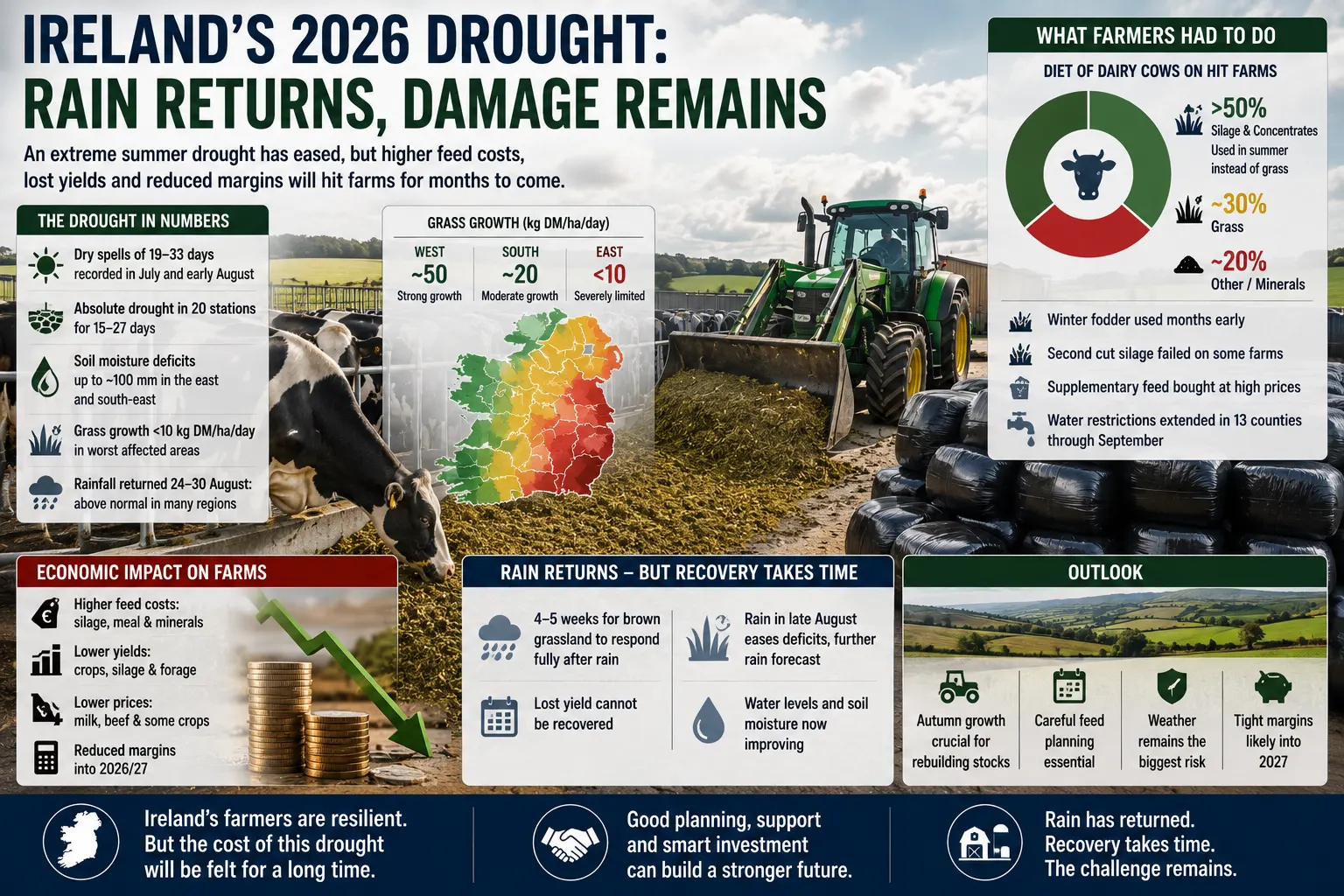
By the middle of August, dairy cows on some of Ireland’s worst drought-affected farms were receiving more than half their diet from silage and concentrates — feed normally associated with winter rather than high summer. Grass growth had almost stopped across parts of the east and south-east, soil-moisture deficits were approaching 100 millimetres, second-cut silage had failed on some farms and winter fodder stores were being opened months before housing would normally begin. Rain has since returned, but for many farmers the economic consequences of the 2026 drought will extend well beyond the end of the dry weather.
The situation has changed rapidly during the final days of August. Met Éireann reported that rainfall between 24 and 30 August was above normal across Leinster, Munster and much of Connacht, with Johnstown Castle in County Wexford recording 60.7 millimetres during the week. Further heavy rain was forecast into early September, and soil-moisture deficits were expected to decline substantially. The meteorological drought is therefore easing across many of the regions that suffered most severely.
A recovery in rainfall, however, is not the same as an immediate recovery in farming conditions. Teagasc says severely browned grassland can take four to five weeks after rain before reaching its strongest growth response. Silage consumed in July and August cannot be replaced instantly, crops that lost yield cannot recover after harvest, and supplementary feed already purchased remains a cost on the farm accounts. Water supplies in parts of the east, south and midlands also remain sufficiently stressed that Uisce Éireann has extended its Water Conservation Order through September in 13 counties.
The drought has therefore developed into a broader farm-business problem. Weather reduced Ireland’s cheapest livestock feed — grazed grass — precisely when farmers were already facing higher fuel, fertiliser and other input costs and lower prices for several important agricultural outputs. The effect differs sharply by region and enterprise, but the combination has left many farms confronting a weaker autumn balance sheet and a smaller margin for error during the winter and spring of 2027.
The Dry Spell Was Most Severe in the Midlands, East and South
July 2026 produced an unusually persistent absence of rainfall across large parts of Ireland. Met Éireann recorded dry spells lasting between 19 and 33 days at 25 stations through July and into early August. Twenty stations, mostly in the Midlands, south and east, met the meteorological definition of an absolute drought for periods lasting between 15 and 27 days, while 15 stations experienced longer partial drought periods extending for as many as 45 days.
The regional pattern is important because agriculture in eastern and south-eastern counties differs from farming farther west. Carlow, Kilkenny, Kildare, Laois, Wexford, Wicklow, Waterford and Tipperary contain substantial dairy, beef, tillage and horticultural production. These systems require water in different ways but can all become vulnerable when rainfall disappears during the growing season.
By 12 August, Teagasc reported soil-moisture deficits above 70 millimetres across much of the eastern half of the country. Grass-growth rates in the worst affected areas had fallen below 10 kilograms of dry matter per hectare per day, compared with approximately 20 kilograms in the south and 50 kilograms in western areas where rainfall had been considerably better. Some eastern locations approached a 100-millimetre deficit.
This extreme regional difference helps explain why there was no uniform national fodder crisis even at the height of the drought. Farmers in parts of Connacht and the north continued to experience relatively normal or strong grass growth while farms several counties away were effectively operating winter feeding systems during July and August. National averages therefore understated the severity experienced by individual farms in the east and south-east.
Ireland Entered the Drought With More Grass Than the Headline Suggested
The timing of the drought created another apparent contradiction. Grass production for 2026 had actually performed comparatively well before the dry spell became severe. Teagasc said accumulated grass growth was around 5 per cent above the five-year average up to the end of July, while PastureBase farms had produced around 8.2 tonnes of dry matter per hectare by mid-August, broadly comparable with the five-year average.
That early-season performance provided some protection. Farms that had produced strong first-cut silage or maintained larger reserves entered July with more feed available than they otherwise would have had. But good annual production does not remove the importance of when grass grows. A dairy cow requiring fresh grass in August cannot consume grass that grew in May and was already conserved for January.
This timing problem is becoming increasingly important in Irish grass-based agriculture. The economic advantage of the Irish livestock system depends heavily on producing milk and meat from relatively inexpensive grazed grass for as much of the year as possible. When summer grass growth collapses, farmers replace a low-cost feed with silage and concentrates whose production or purchase costs are substantially higher.
The result is that annual grass tonnage can remain respectable while farm profitability deteriorates. The issue is not only how much grass a farm grows during a year, but whether production occurs when the herd needs it.
In the Worst Areas, Half of Dairy Diets Had Become Supplementary Feed
PastureBase data presented to the National Fodder and Food Security Committee showed how dramatically feeding systems had changed by 16 August. Across Munster, silage and concentrates accounted for about 47 per cent of the typical dairy diet measured in the dataset. In Leinster the share was approximately 46 per cent.
The counties most affected by the drought were even more dependent on supplementary feed. Across Carlow, Kilkenny, Laois, Kildare, Wicklow and Wexford, dairy cows were receiving an average of approximately five kilograms of dry matter from concentrate and another five kilograms from silage each day. Grass supplied around nine kilograms. Supplementary feed therefore represented roughly 53 per cent of the diet.
Under more normal mid-August conditions, Teagasc uses an indicative feeding pattern of around 16 kilograms of grass dry matter plus three kilograms of concentrate. Replacing grass with additional silage and meal increased feed costs by approximately €1.90 per cow per day on affected farms, according to Teagasc. For a 100-cow herd that equates to about €1,330 a week. The worst affected farms were estimated to be experiencing additional costs of approximately €3 to €3.50 per cow per day.
Actual costs vary considerably depending on herd size, existing feed stocks, feed quality, purchase contracts and whether the silage being consumed was grown on the farm. But even home-produced silage is not free. Using it in August means it is no longer available for winter, creating either a requirement to produce replacement forage in autumn, purchase it elsewhere or reduce livestock demand.
Dairy Feeding During the August Drought
| Region | Grass DM / Cow | Diet From Supplement |
|---|---|---|
| Munster | 9.5 kg/day | 47% |
| Leinster | 10.5 kg/day | 46% |
| Worst affected eastern counties | 9.0 kg/day | 53% |
| Connacht / Ulster | 14.0 kg/day | 30% |
Source: Teagasc and PastureBase Ireland data presented on 18 August 2026. Supplement includes silage and concentrate.
The Immediate Drought Has Become a Winter Fodder Problem
The critical issue entering September is not whether Ireland has literally run out of fodder. It has not. The National Fodder and Food Security Committee was told in August that feed remained available nationally. The concern is distribution and the number of individual farms whose reserves are inadequate after weeks of feeding material originally conserved for winter.
The Teagasc national fodder survey collected farm budgets in early August, after most planned second silage cuts should normally have been completed. Some of those second cuts did not materialise because grass growth had collapsed. Nationally, 11 per cent of surveyed farms reported surplus fodder and 31 per cent were on target, meaning around 42 per cent had adequate supplies at that point. Another 27 per cent were within 10 per cent of their target.
More concerning were the remaining farms. Nineteen per cent reported winter forage deficits of between 10 and 20 per cent, while 12 per cent were more than 20 per cent short. Taken together, almost one farm in three was either already facing a material deficit or considered at substantial risk of one.
The south-east was in the weakest position. Only 6 per cent of surveyed farms had surplus forage and 23 per cent were on target. Thirty-one per cent were less than 10 per cent short, while 24 per cent had deficits between 10 and 20 per cent and 16 per cent were more than 20 per cent below requirements. Around 40 per cent of surveyed south-eastern farms were therefore at least 10 per cent short of their calculated winter needs.
Winter Fodder Position by Region, August 2026
| Region | Adequate or Surplus | Deficit of 10% or More |
|---|---|---|
| Midlands / North East | 51% | 24% |
| South East | 29% | 40% |
| North West | 46% | 27% |
| South West | 43% | 34% |
| Overall | 42% | 31% |
Source: Teagasc Fodder Survey, 21 August 2026. Adequate or surplus combines the survey’s Surplus and On Target categories; deficit of 10% or more combines its two higher-deficit categories.
Rain Helps Grass Recover, but the Calendar Is Now Working Against Farmers
The return of rain during the final week of August is clearly positive. Met Éireann reported rainfall totals between approximately 120 and 355 per cent of average across Leinster, Munster and much of Connacht in the seven days to 30 August. Johnstown Castle in Wexford received 60.7 millimetres, while Dublin Airport recorded more than twice its normal weekly rainfall.
Soil-moisture deficits are consequently falling. Met Éireann expected the unsettled conditions continuing into early September to reduce deficits substantially across the country. In meteorological terms, the most severe part of the drought is therefore ending in many areas.
Grassland recovery is slower. Teagasc advises that pasture which remained green during the dry spell may recover meaningfully within around two weeks once moisture returns, provided it was not badly overgrazed. Severely browned swards can take four to five weeks before reaching peak post-drought growth.
That timing matters because September naturally brings shorter days, lower solar radiation and declining grass-growth potential. A paddock recovering strongly in May has months of productive growth ahead. A paddock requiring several weeks to recover from an August drought reaches its strongest response as normal seasonal growth is already declining.
Farmers therefore cannot assume that heavy rain automatically replaces the grass missed in July and August. The opportunity exists to rebuild some autumn cover and potentially conserve additional forage, but the quantity will depend on soil type, sward damage, fertiliser management and weather through September and October.
Too Much Rain Could Become the Next Management Problem
Irish agriculture is unusually familiar with moving rapidly from one weather problem to another. The rain needed to restart grass growth can make soils difficult to graze if it continues for too long. Met Éireann’s latest farming forecast expects very wet conditions during the opening week of September, with rainfall reaching several times normal amounts in some locations.
Western farms that escaped the drought may therefore encounter saturated or waterlogged soils while eastern farms are still attempting to rebuild grass supply. This illustrates why national agricultural conditions can diverge sharply even within a relatively small country.
Heavy autumn rain can also restrict machinery access, delay slurry spreading and damage fields through poaching if livestock remain outdoors on saturated land. Farmers must consequently balance the desire to extend grazing against the risk of damaging soil and pasture that will be required next spring.
The recovery from drought is therefore not simply a question of maximising grass growth. It requires rebuilding pasture covers without creating another problem through excessive grazing pressure or badly timed field operations.
Water Supplies Remain Under Pressure Despite the Rain
The drought also exposed weaknesses in water supply. Uisce Éireann introduced a nationwide Water Conservation Order in July after prolonged dry weather, high consumption and falling raw-water availability placed pressure on reservoirs and treatment plants.
Improved rainfall allowed the order to be lifted across 13 counties from 26 August. It has nevertheless been extended until 30 September in Carlow, Cork, Dublin, Kildare, Kilkenny, Laois, Limerick, Meath, Offaly, Tipperary, Waterford, Wexford and Wicklow — a list overlapping strongly with the agricultural regions most affected by drought.
The order is aimed primarily at restricting non-essential use of public drinking water rather than preventing animals being supplied with water. Uisce Éireann identifies farms among the essential users whose supplies must be protected. The need for continued restrictions nevertheless illustrates how slowly reservoirs and water sources can recover even after rain returns.
Farm water systems themselves can also become a bottleneck. A dairy cow’s daily water demand rises substantially during hot weather, and large herds require high flow rates at troughs. Teagasc has advised farms that experienced supply problems to examine wells, pumps, pipe diameter and trough capacity rather than assuming the problem was solely a temporary consequence of 2026.
This becomes an adaptation issue. A farm capable of supplying adequate water during a conventional Irish summer may not have enough pumping or storage capacity during a prolonged hot period when both animals and households use much more water.
The Drought Arrived During an Already Difficult Cost Year
Weather pressure would be easier to absorb if farmers were enjoying unusually strong margins. In 2026 the opposite is true for many enterprises. Central Statistics Office data for June show agricultural output prices 15.3 per cent lower than a year earlier while input prices were 7.5 per cent higher. The agricultural terms-of-trade index — a broad comparison between what farmers receive and what they pay — had fallen by 21.2 per cent from June 2025.
The underlying figures show why drought-related supplementary feeding is particularly painful. Motor-fuel prices were 26.5 per cent higher than a year earlier and fertiliser prices 23.6 per cent higher. The overall energy input index was up 19 per cent. These increases partly reflect the global energy shock associated with the Middle East conflict.
At the same time, output prices weakened in important livestock sectors. The CSO recorded milk prices 23.9 per cent below June 2025 and cattle prices 12.2 per cent lower. Sheep prices were an exception, rising 12.4 per cent year on year.
This means many farms entered the drought with both sides of the margin moving unfavourably: the price received for production was lower while the cost of producing it was higher. Buying additional feed because grass had disappeared amplified rather than created that financial pressure.
The Cost and Price Squeeze Before the Worst of the Drought
| Measure | Annual Change | June 2026 vs June 2025 |
|---|---|---|
| Agricultural output prices | -15.3% | Lower farm-gate returns overall |
| Agricultural input prices | +7.5% | Higher production costs |
| Milk prices | -23.9% | Major pressure on dairy margins |
| Cattle prices | -12.2% | Lower than exceptional 2025 levels |
| Motor fuels | +26.5% | Higher machinery and transport costs |
| Fertilisers | +23.6% | Higher grass and crop-production costs |
Source: Central Statistics Office, Agricultural Price Indices, June 2026.
Farm Income Was Already Forecast to Fall Sharply Before August’s Full Damage Was Known
Teagasc’s mid-year economic outlook, published on 20 July before the full severity of the later drought had become clear, forecast average family farm income across the main systems at approximately €33,600 for 2026. That would represent a decline of about 38 per cent from the €53,800 average recorded in 2025.
Dairy was expected to experience the largest absolute fall. Teagasc forecast average dairy family farm income at about €78,000, down from approximately €153,300 in 2025. The forecast assumed an average milk price approximately 20 per cent below the previous year and higher production costs.
Cattle-rearing income was projected at around €19,000, down 21 per cent, while cattle-finishing farms were forecast to average approximately €21,000, a decline of 36 per cent. Average sheep income was projected to decline around 10 per cent to €26,500, and tillage income by around 20 per cent to €44,000.
These are national averages and forecasts, not estimates of the eventual losses caused by drought. The timing is important: Teagasc’s July calculation largely preceded the period when grass growth collapsed most severely across Leinster and the south-east. Individual farms forced to purchase substantial quantities of feed, sell livestock early or lose crop yield may therefore experience materially different results.
Equally, not every farm will suffer a large income decline. Western farms with better grass growth can avoid many of the drought costs. Livestock farms holding substantial fodder reserves may absorb the shock more easily. Direct payments also stabilise incomes particularly strongly on drystock farms.
Government Fuel Support Softens One Cost but Does Not Remove the Drought Loss
The Government introduced a €100 million fuel-support package earlier in 2026 after the Middle East conflict caused the price of marked gas oil, commonly known as green diesel, to rise sharply. The farmer and agricultural-contractor element was designed around payments equivalent to approximately 20 cent per litre of eligible historical usage, subject to final scheme calculations.
The support covered the period from March through July and was linked to 2025 fuel consumption. The Government also reduced excise on marked gas oil as part of a wider energy-support package.
These measures provide meaningful assistance against the energy-price shock, but they were created because of fuel costs rather than the summer drought. They do not compensate directly for silage already consumed, lower grass utilisation, lost crop yield or additional concentrates purchased during August.
The drought response itself has so far centred on monitoring feed availability, reconvening the National Fodder and Food Security Committee, farm-level fodder budgeting and targeted Teagasc advisory clinics in badly affected counties. The purpose is to identify shortages early enough for farmers to buy, grow or redistribute feed before winter rather than waiting until supplies become critical.
Dairy Farms Are Exposed Because Their Low-Cost Model Depends on Grass
Ireland’s dairy sector developed around the competitive advantage of producing a large share of milk from grazed pasture. Compared with permanently housed systems dependent on purchased feed, this can provide relatively low feeding costs and allows Ireland to produce milk using a system suited to its normally mild and moist climate.
Drought temporarily reverses that advantage. The cow continues to require energy whether the paddock grows or not. The farmer must therefore supply concentrate, silage or other forage, turning a grass-based system towards a more expensive indoor-style diet even when cows remain physically outside.
The financial impact is amplified when milk prices are falling. Each additional kilogram of concentrate must be justified against the value of the milk it helps produce. Farmers can eventually respond by drying cows off earlier, selling surplus animals or reducing milk production, but those decisions also affect revenue.
Some farmers in the worst affected counties have already reported culling cows or selling livestock earlier than planned to reduce feed demand. These are rational management responses when forage becomes scarce, but they can change the productive structure of the farm well beyond one summer.
Beef and Sheep Farms Have More Options, but Less Financial Cushion
Beef and sheep systems generally have greater flexibility over short-term feeding than high-output dairy herds. Stores can be sold earlier, calves can be weaned, selected animals can be housed and livestock demand can be reduced before winter. Teagasc advised drystock farmers during the drought to consider precisely those options where grass supply was falling rapidly.
But many drystock farms operate on considerably lower absolute incomes than dairy farms. An additional feed bill that appears relatively modest in comparison with the turnover of a large dairy enterprise can represent a much larger proportion of annual family farm income on a small suckler or sheep holding.
Direct payments provide an important stabilising effect, particularly in cattle and sheep systems. They are largely unaffected by short-term livestock prices and weather, reducing year-to-year income volatility. They do not eliminate the cash-flow problem created by purchasing feed months earlier than expected.
Early livestock sales can also affect market dynamics. If many farmers reduce herds simultaneously because fodder is scarce, additional animals can reach the market within a relatively short period. The price effect depends on national supply, export demand and the type of livestock being sold, so drought does not automatically produce lower cattle prices, but concentrated selling can add local pressure.
Tillage Farms Faced a Different Version of the Same Weather Shock
The drought was not exclusively a grassland problem. Ireland’s principal tillage counties overlap closely with the areas experiencing the largest soil-moisture deficits. By 20 August, Teagasc estimated the 2026 cereal harvest to be roughly 90 per cent complete, with total grain production likely to finish below two million tonnes.
Yields were described as somewhat disappointing and quality variable. Straw yields were estimated at only 80 to 90 per cent of normal, potentially tightening the market for a product important both to tillage incomes and livestock bedding.
The timing created mixed consequences. Dry weather allowed combines to operate relatively easily and reduced the delays that wet harvests can cause. But a smooth harvest cannot compensate for yield lost earlier through inadequate moisture.
Farmers attempting to establish winter oilseed rape and cover crops then faced the opposite challenge: extremely dry soils made crop establishment difficult in parts of the east and south-east. Rain at the end of August improves prospects, but later establishment can change crop development and management requirements.
Tillage margins were already under pressure from higher fertiliser and fuel costs and relatively weak grain prices. Drought therefore affects the sector through yield while global markets determine the price received for that smaller harvest.
Potato and Vegetable Growers Faced Some of the Most Direct Water Pressure
Potatoes and field vegetables are particularly sensitive because commercial yield and quality depend on sufficient soil moisture during critical growth stages. Teagasc described growers as being under significant pressure during August as soil-moisture deficits approached 100 millimetres in important eastern and south-eastern production areas.
Irrigation can protect yield, but it is not a cost-free solution. Equipment requires capital and labour, water must be available and pumping requires energy. Irrigated production can therefore survive dry weather more effectively while experiencing substantially higher production costs.
Potatoes illustrate the scale of water required. Teagasc guidance indicates that maincrop potatoes can require around 25 millimetres of moisture a week during July and August for optimum growth, whether supplied naturally by rainfall or through irrigation. Several millimetres of rainfall across an entire hectare represents tens of thousands of litres of water.
Water restrictions on public supplies are designed to protect drinking water and essential agricultural use, but they also demonstrate the broader competition for water during drought. Future expansion of irrigation therefore raises questions about farm reservoirs, groundwater, abstraction, storage and how agricultural water demand should be managed during increasingly dry summers.
The 2018 Drought Remains the Obvious Comparison
Ireland experienced a severe drought in 2018 that similarly reduced grass growth, forced livestock farmers to feed winter forage during summer and generated concern about feed availability. The Government and agricultural sector responded through fodder planning, industry coordination and later measures intended to facilitate the movement of forage.
The comparison is useful but should not imply that every drought produces identical consequences. Farms entered 2026 with different feed stocks, livestock numbers, debt levels and input prices. The 2026 drought is also strongly regional rather than uniformly severe nationwide.
One lesson from 2018 has nevertheless become embedded in agricultural planning: fodder shortages are easier and cheaper to manage months before winter than after sheds are full and feed is nearly exhausted. This explains the emphasis in August 2026 on completing individual feed budgets rather than waiting for a national shortage to become visible.
Another lesson is that weather extremes can occur in both directions. Ireland has experienced exceptionally wet periods as well as drought. Building a system resilient only to dry weather can create problems during saturated winters and springs. Adaptation therefore requires flexibility rather than permanent conversion towards a more intensively housed or irrigated model.
The rain arriving at the end of August solves the immediate moisture shortage, not the economic consequences already accumulated. Winter silage has been consumed, supplementary feed purchased, crop yields reduced and some farms have adjusted livestock numbers. The next challenge is rebuilding reserves before the normal winter feeding period begins.
The Fodder Problem Is Really a Timing and Distribution Problem
Nationally, Ireland can produce substantial quantities of grass and forage. The difficulty is that feed is not always located where shortages occur. Farms in western and northern counties can hold surpluses while south-eastern farms have deficits, but moving bulky silage or hay over long distances is expensive.
Silage contains large quantities of water, making transport inefficient compared with concentrated feed. A tonne of silage delivers much less nutritional dry matter than a tonne of grain or concentrate, yet both require a truck journey. The cost of moving forage therefore rises rapidly with distance.
This was the rationale behind Ireland’s 2024 Fodder Transport Support Measure during a different period of adverse weather. That scheme contributed towards the cost of moving fodder where farms faced shortages. Its existence provides a precedent for the type of intervention available if regional feed imbalances become severe, although any new 2026 measure would require a separate government decision.
Co-operatives, merchants and contractors therefore become important before government support is considered. They possess information on where silage, hay, straw and feed are available and can facilitate transfers between regions. Early identification of shortages reduces the likelihood that farmers are all competing for the same limited material during winter.
The Biggest Decision Is How Much Feed a Farm Really Needs
A fodder budget begins with a relatively simple question: how many animals will be housed, for how long, and how much will each consume? The difficult part is that every element can change. Winter may arrive early, spring turnout may be late, silage quality can vary and livestock numbers may change.
Teagasc’s current advice is therefore to build a buffer rather than budget only for an average winter. Farms that have already consumed significant quantities of conserved feed during summer require an even larger margin because they have lost part of the buffer accumulated earlier in the year.
The most economical response may differ between farms. One farmer may be able to grow additional grass or forage during autumn. Another may purchase silage while supplies are available. A third may reduce stock numbers. Concentrate can replace some forage, but the ration must still meet animal-health and nutritional requirements.
The choice is partly biological and partly financial. Holding an animal only makes economic sense if the expected value of future production exceeds the cost of feeding and maintaining it. High feed costs can therefore make early sale the least damaging option even when a farmer would normally retain the animal.
Fertiliser Presents an Unusual Post-Drought Problem
Farmers might assume that the quickest route to replacing lost grass is to apply large quantities of nitrogen immediately after rain. Teagasc has advised a more measured approach. Drought-stressed plants need time to recover, and soil mineralisation can release nitrogen once moisture returns.
During the drought, Teagasc advised against applying chemical nitrogen where grass-growth rates had fallen below approximately 35 kilograms of dry matter per hectare per day. Applying fertiliser to severely moisture-stressed pasture offers poor economic value because the plant cannot use it efficiently.
After rainfall, the appropriate strategy varies between paddocks. Some fields remain badly damaged while others respond quickly. Slurry may supply part of the nutrient requirement, while remaining chemical fertiliser allowances must also be managed within environmental regulations and seasonal deadlines.
This matters particularly in 2026 because fertiliser is approximately one quarter more expensive than a year ago. Applying an expensive input where the crop cannot use it is both an environmental risk and a direct financial loss.
A Grass-Based System Remains Competitive — but It Needs More Weather Resilience
The drought does not demonstrate that Ireland’s pasture-based livestock model is obsolete. Ireland’s climate still provides a substantial structural advantage for growing grass over much of the year, and grazed grass remains one of the lowest-cost feeds available to livestock producers.
The more important question is whether farming systems can retain that advantage while becoming better able to absorb extreme interruptions. Teagasc’s current resilience advice includes larger high-quality silage reserves, appropriate stocking rates, more robust on-farm water systems and continued grass measurement so that supplementary feeding begins before pasture covers collapse.
Stocking rate is particularly important. A farm operating close to the maximum feed demand supported by its land during an average year can become heavily dependent on purchased feed when grass production falls. Carrying slightly less demand or maintaining larger forage reserves can reduce drought exposure but may also reduce output during favourable years.
Resilience therefore has an opportunity cost. Maintaining an extra month of silage in reserve ties up land, machinery, storage and capital. Water infrastructure and irrigation equipment require investment even during years when they are barely used. The economic question is whether increasingly frequent weather disruption makes those costs worthwhile.
Climate Projections Suggest Dry Summers Deserve More Attention
No individual Irish drought can be attributed solely to long-term climate change without specific analysis. Natural weather variability remains large, and Ireland will continue to experience wet summers as well as dry ones. The beginning of 2026 itself demonstrated that contrast, with farmers in some regions dealing with excessive rainfall before later drought developed.
Long-term projections nevertheless point towards warmer conditions and greater seasonal differences in rainfall. Climate Ireland reports projected reductions in spring and summer precipitation alongside increases in winter rainfall, although rainfall projections contain substantially more uncertainty than temperature projections.
Teagasc modelling using Met Éireann climate scenarios suggests that total annual grass growth could rise in a warmer climate because of stronger winter and spring growth while summer grass production declines, especially in the eastern half of the country. The implication is not necessarily less grass overall, but a redistribution of when that grass is available.
Some Teagasc research has indicated that severe summer droughts currently treated as relatively infrequent could occur considerably more often under future climate scenarios. The precise frequency depends on the emissions pathway, location and model, but the direction creates an increasingly strong case for adaptation.
This is particularly relevant to the east and south-east because those areas already receive less rainfall than western Ireland. A modest shift towards drier summers can therefore have a larger agricultural effect where the existing margin between rainfall supply and crop water demand is smaller.
Future Grass Growth Could Shift Towards Spring and Winter
A warmer Irish climate may extend the biological growing season. Grass can begin growing earlier during mild winters and accelerate more quickly in spring. On suitable soils, this could provide additional grazing opportunities and reduce housing periods during favourable years.
But using that extra grass requires infrastructure. Early spring grazing is only valuable if fields are sufficiently trafficable and animals can reach them without damaging soils. Wetter winters projected under some climate scenarios can work against the benefit of warmer temperatures.
Farm roads, drainage, paddock layout and on-off grazing strategies therefore become part of climate adaptation. Farmers may need to capture additional grass when conditions permit and conserve more of it for summer rather than assuming that the conventional Irish grass-growth curve remains unchanged.
The future model could consequently involve shifting part of forage conservation earlier in the year, maintaining larger reserves and treating summer drought as a planned risk rather than an exceptional surprise.
Multispecies Swards and Deeper Roots Offer Potential, Not a Complete Solution
Research into grass and forage resilience increasingly examines species with different rooting structures. Mixtures containing grasses, clovers and herbs such as plantain or chicory can sometimes access water from different soil depths and maintain production better than shallow-rooted swards under moderate moisture stress.
This does not make them drought-proof. Severe soil-moisture deficits eventually restrict almost all pasture production, and the performance of multispecies swards varies by soil, management and species composition.
They can nevertheless form one component of a more resilient system alongside better soil structure, reduced compaction and appropriate grazing management. Deep rooting becomes particularly important when surface soil dries but moisture remains available farther down.
The same principle applies in crop farming. Soil capable of absorbing winter rainfall and allowing deep root development provides greater resilience during dry periods than compacted soil with restricted rooting depth. Climate adaptation therefore overlaps with conventional agronomy rather than existing as a completely separate set of practices.
Irrigation Is Likely to Become a Bigger Debate in Eastern Agriculture
For high-value crops, irrigation can protect both yield and quality during dry summers. If drought frequency increases, the financial case for irrigation becomes stronger. The constraints are water supply, capital cost and regulation.
Large-scale irrigation requires more than purchasing a reel and pump. Farms need a dependable source of water during the exact periods when rivers, reservoirs and public systems may themselves be under pressure. Storage reservoirs can capture winter rainfall for summer use but require land, planning, engineering and investment.
The question becomes particularly sensitive because Ireland is projected to experience greater seasonal differences: more water may arrive during winter while agriculture needs more stored water during summer. Infrastructure capable of moving water through time rather than simply increasing annual abstraction may therefore become increasingly valuable.
Irrigation will not be economically appropriate for every farm. Using large volumes of water to maintain pasture for relatively low-value livestock production can be difficult to justify compared with using the same water on potatoes or vegetables. This means adaptation is likely to remain strongly enterprise-specific.
The Drought Also Exposes the Importance of Farm Cash Flow
Annual farm-income figures can obscure timing. A farmer may eventually finish the year profitable but still encounter acute cash pressure when feed, fertiliser and fuel bills arrive before livestock or milk revenue. Drought accelerates expenditure precisely because winter costs are brought forward into summer.
A farm consuming silage in August has already paid to produce it, but the financial impact returns later when replacement feed must be purchased or additional land and contractor work are required. Concentrates generate a more immediate merchant bill. Selling livestock early can improve cash flow but reduce future productive income.
Higher interest rates and finance costs can magnify the problem for highly indebted farms. Working-capital facilities become more important during weather shocks even when the underlying business remains viable over the longer term.
This is one reason weather resilience is increasingly becoming a financial-management issue rather than simply an agronomic one. Farms with stronger balance sheets and larger feed buffers can wait for conditions to improve. Farms operating with little spare cash or fodder are forced to make decisions earlier.
The Impact on Food Prices Is Likely to Be Limited but Uneven
A severe drought can raise consumer food prices, but the relationship is not immediate or automatic. Irish supermarkets buy food through national and international supply chains, and the farm-gate value of a product represents only part of the final retail price.
Lower Irish grain, vegetable or potato yields can tighten domestic supply, but imports can offset shortages. Additional feed costs can reduce farmer margins without necessarily being passed directly into meat or milk prices, particularly when international commodity markets determine what processors can pay.
The more likely short-term effect of the 2026 drought is therefore on farm profitability rather than a dramatic nationwide food-price spike. Individual products with particularly tight domestic supply could experience stronger price movements.
A different picture would emerge if drought affected several major European agricultural regions simultaneously. Weather conditions across central Europe have also been difficult during 2026, and international grain, feed and livestock markets can transmit shortages between countries. Irish farmers are therefore exposed not only to domestic weather but also to the price consequences of weather abroad.
The Rest of September Will Determine How Much Winter Risk Remains
The first variable to watch is grass recovery. If rainfall remains adequate without creating prolonged waterlogging, pasture can recover sufficiently to rebuild autumn covers and reduce dependence on silage. Farms where swards stayed green should respond more quickly than those where vegetation was severely browned.
The second is how much additional forage can realistically be conserved. Late silage or surplus grass can repair part of the winter deficit, but yield and quality normally decline as the season progresses. Farmers cannot assume a late cut will replace every tonne used during the drought.
The third is livestock numbers. Farmers with unresolved deficits will need to decide whether purchasing feed or reducing stock offers the stronger economic outcome. Delaying that decision until winter generally removes options and can increase costs.
The fourth is water recovery. Continued conservation measures across 13 counties indicate that raw-water sources remain vulnerable despite recent rainfall. Reservoir and groundwater recovery can lag significantly behind surface conditions.
Finally, autumn weather itself matters. A prolonged wet period could restrict grazing and create another round of early housing, increasing feed demand again. Ireland’s immediate agricultural outlook has therefore shifted from needing rain urgently to needing a reasonably balanced autumn.
Three Possible Paths Into Winter 2026–27
| Scenario | Autumn Conditions | Likely Farm Effect |
|---|---|---|
| Strong recovery | Regular rain with good trafficability | Grass rebuilds and some fodder deficit is recovered |
| Partial recovery | Variable grass growth and intermittent wet spells | Feed purchases and stock adjustments remain necessary |
| Wet autumn | Persistent rainfall and difficult soils | Early housing increases winter fodder pressure again |
Scenario analysis, not a weather forecast. Actual outcomes depend on rainfall, soil conditions, grass recovery, feed stocks and individual farm management.
The Longer-Term Question Is How Much Resilience Farmers Can Afford
Every resilience measure carries a cost. Holding additional silage requires storage and production. Increasing water capacity requires pipes, wells, tanks or reservoirs. Lower stocking rates reduce exposure during drought but can also reduce income during favourable years. More diversified swards require different management.
Farmers therefore face an optimisation problem rather than a simple instruction to become more resilient. Preparing for the worst possible drought every year would leave expensive infrastructure underused during normal seasons. Preparing only for average weather can leave a business highly exposed when extremes occur.
This is where research, forecasting and insurance become increasingly important. Better prediction of grass growth, soil moisture and drought risk allows farmers to act earlier and avoid some of the cost of permanent over-preparation. PastureBase and Teagasc’s developing AgriAdapt tools are intended to improve this kind of farm-level decision-making.
Government policy will also influence the economics. Capital grants can alter whether water storage, slurry capacity, grazing infrastructure or other adaptation investments are affordable. Environmental rules governing water, fertiliser and land use will shape which adaptations are practical.
The policy challenge is to avoid treating every difficult season as an isolated emergency while also avoiding the assumption that one national solution suits every farm. The difference between Wexford and Mayo during August 2026 demonstrates why resilience will have to be regional and enterprise-specific.
Ireland’s Competitive Advantage Is Climate — and Climate Variability Is Becoming Part of the Cost
Irish farming has long benefited from conditions that allow grass to grow for much of the year. That natural advantage remains real. It supports dairy and livestock production and differentiates Ireland from agricultural regions that rely much more heavily on irrigated crops or permanently housed cattle.
The 2026 drought demonstrates that the same dependence creates vulnerability when rainfall fails. A livestock system built around cheap grazed grass is highly efficient when grass grows and suddenly more expensive when it does not. Farmers then have to import energy into the system through concentrates and conserved forage.
Climate adaptation therefore does not necessarily mean abandoning grass-based farming. It means recognising that the cheapest production system in an average year may need additional buffers to remain the cheapest system across a decade containing more extremes.
That may involve carrying more silage than once appeared economically necessary, improving water infrastructure, using grass varieties and swards that recover more effectively, adjusting livestock demand rapidly and exploiting additional grass growth during warmer springs where soil conditions allow.
The Rain Has Arrived, but the Bill Has Not Finished Arriving
As September begins, Ireland is no longer in the same meteorological position it occupied at the height of August’s drought. Significant rain has reached much of Leinster and Munster, further wet weather is expected and soil-moisture deficits are falling. For grassland farms, that is the first requirement for recovery.
The economic effects will last longer. South-eastern farms entered late August with the weakest fodder position in Teagasc’s national survey. Some dairy herds had been receiving approximately half their diet from silage and concentrates. Crop yields had already been reduced, and the prices of fuel and fertiliser were substantially above the previous year’s levels.
Those pressures arrived during a year when Teagasc was already forecasting a 38 per cent decline in average family farm income across the main agricultural systems. The drought will not affect every enterprise equally and should not be assumed to produce the same percentage loss nationally. But for farmers forced to feed through the summer or harvest significantly reduced crops, it adds another cost to an already difficult year.
The immediate task is to restore grass, calculate winter feed accurately and act before shortages become emergencies. The wider question is more strategic. If warmer and drier summers become a more frequent feature of Irish agriculture, maintaining larger buffers may cease to be an exceptional response and become an ordinary cost of farming.
For Ireland’s east and south-east, the drought of 2026 may therefore matter beyond one difficult summer. It is a practical test of whether a farming system built around a famously mild and wet climate can preserve its grass-based economic advantage while preparing for periods when the weather behaves very differently.
Sources
Met Éireann — Climate Statement for July 2026
Met Éireann — Farming Commentary, 31 August 2026
Met Éireann — Agricultural Meteorology Data, 24–30 August 2026
Teagasc and Department of Agriculture — Drought and Grass Growth Update, 12 August 2026
Teagasc — Supplementary Feeding and Grass Growth Data, 20 August 2026
Teagasc — National Fodder Survey, 21 August 2026
Teagasc — Impact of the 2026 Drought on Grass, Fodder, Crops and Vegetables
Teagasc — Potato, Vegetable and Tillage Conditions, 20 August 2026
Teagasc — Grass Recovery and Fertiliser Management After the Drought, 28 August 2026
Teagasc — Current Grassland Management and PastureBase Growth Outlook
Teagasc — Building Resilience Into Irish Farming Systems, August 2026
Teagasc — Climate Adaptation and Future Irish Grass-Growth Patterns
Teagasc — AgriAdapt Climate Adaptation Research Programme
EPA Climate Ireland — Future Precipitation in Ireland
Central Statistics Office — Agricultural Price Indices, June 2026
Teagasc — Mid-Year Farm Income Outlook 2026
Teagasc — Mid-Year Situation and Outlook for Irish Agriculture, July 2026
Department of Agriculture, Food and the Marine — Fuel Income Support Scheme 2026
Department of Agriculture — €100 Million Fuel Support Package, April 2026
Uisce Éireann — Water Conservation Order Update, 24 August 2026
Uisce Éireann — Water Conservation Order and Supply Conditions
RTÉ News — Farm-Level Effects of the 2026 Dry Spell, 13 August 2026
Source & Transparency
This article is published by Ireland Newspaper for editorial and informational purposes.
Published: 1 September 2026 · Updated: 1 September 2026

Newsroom Ireland Newspaper
Ireland Newspaper editorial team prepares daily news coverage for readers in Ireland and abroad.