Ireland’s Tillage Sector in 2026: The Crops That Feed a Livestock Nation Are Fighting for Their Place
Barley, wheat, oats, oilseed rape and protein crops occupy only a fraction of Irish farmland, yet they are strategically important to animal feed, food production, crop rotation and agricultural emissions. After an excellent 2025 harvest, weaker yield prospects, stubbornly low grain prices and higher costs are making 2026 a much more difficult test of whether tillage can remain competitive for land.
Ireland is internationally associated with green fields, dairy cows and beef cattle.
That image is accurate, but incomplete.
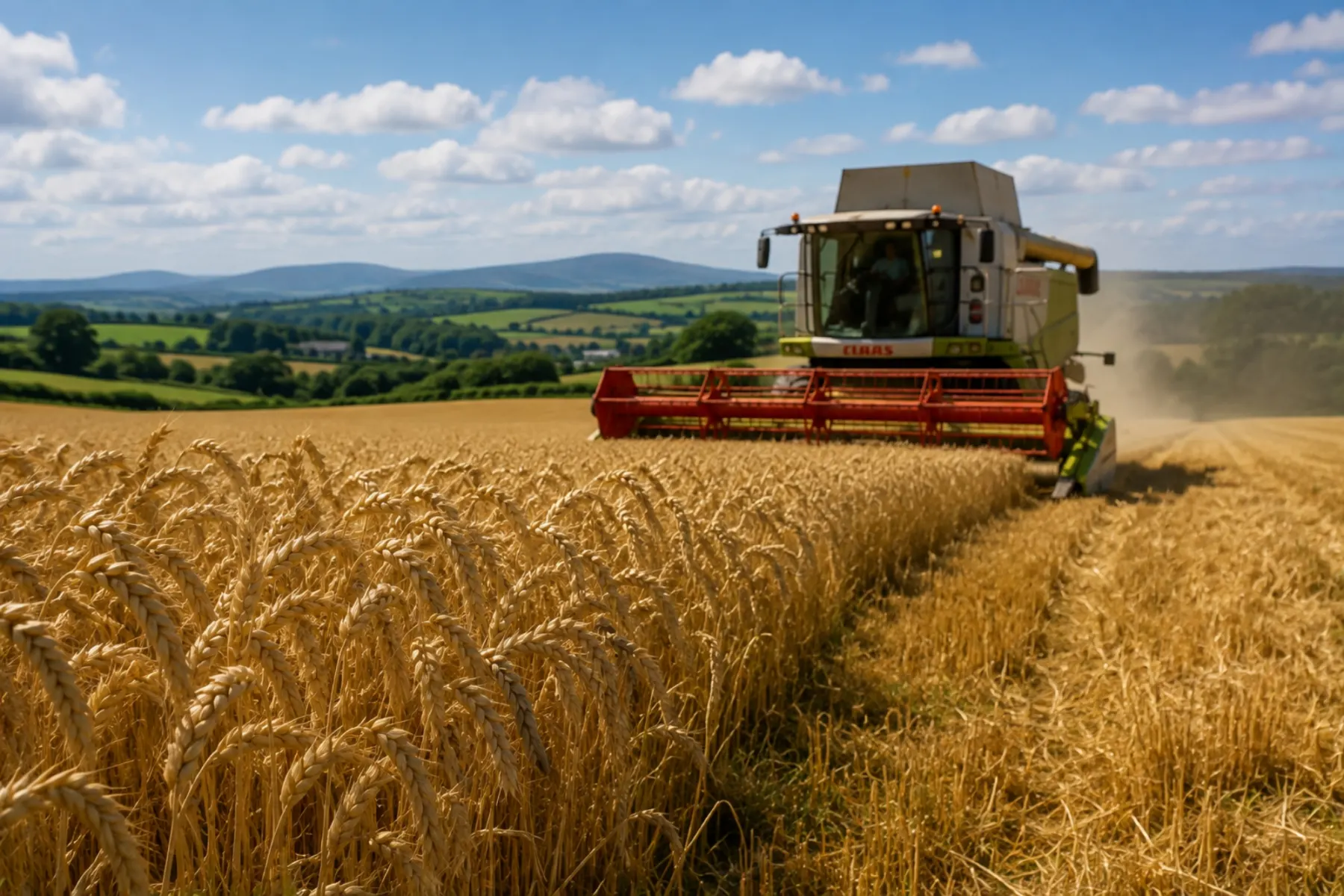
Across the east and south-east in particular, another Irish agricultural economy operates to a different rhythm. Fields are drilled in autumn or spring. Crops are monitored for disease, weeds and nutrient deficiencies. Grain markets thousands of kilometres away influence decisions made on individual farms. Then, during a relatively short summer window, combines move through wheat, barley and oats whose final profitability may depend on a difference of half a tonne per hectare, a few euro per tonne or a change in weather during one critical week.
This is Ireland’s tillage sector.
It is much smaller in land area than grass-based agriculture, but its importance is greater than its size suggests.
Irish-grown grain feeds cattle, pigs and poultry. Barley supports the brewing, distilling and malting industries. Oats supply expanding food markets. Wheat is used for feed and specialist food purposes. Oilseed rape produces oil and protein-rich meal while acting as an important break crop. Beans and peas contribute domestically produced protein. Straw becomes animal bedding, feed, soil organic matter or an energy resource.
And increasingly, Irish tillage has another strategic value: domestically produced grain can reduce dependence on imported feed ingredients while carrying a comparatively low carbon footprint.
Yet in 2026, the economics are becoming uncomfortable.
Teagasc’s latest mid-year assessment expects total cereal production to fall from last year’s strong harvest. Grain prices are expected to remain broadly similar to 2025, while production costs are rising. Average tillage farm income is now forecast at approximately €44,000 in 2026, around 20% below the €54,900 recorded in 2025.
This is what makes the current season so important.
The challenge facing Irish tillage is not simply producing enough grain.
It is producing grain profitably enough that farmers continue choosing crops rather than another use for the land.
A Small Sector With an Outsized Role
Ireland is overwhelmingly a grassland farming country.
That climatic advantage supports dairy, beef and sheep production and has shaped agricultural development for generations.
Tillage occupies a much smaller area.
In 2025, wheat, oats and barley covered approximately 270,800 hectares. Barley remained by far the largest cereal crop, accounting for 172,600 hectares, followed by wheat at 64,400 hectares and oats at 33,800 hectares. A further 14,700 hectares were planted with beans and peas, 11,800 hectares with oilseed rape and 8,900 hectares with potatoes.
Those numbers are modest beside Ireland’s vast grassland area.
But comparing hectares alone misses the function of the crops.
A hectare of barley can become animal feed, malting grain and straw.
Wheat can contribute both grain and bedding material.
Beans can replace part of the imported protein used in livestock rations.
Oilseed rape can provide a cash crop while improving the agronomic performance of the cereal crop planted after it.
The tillage sector therefore connects with farming systems far beyond specialist cereal farms.
A dairy or beef farmer buying compound feed is indirectly connected to the grain market.
A pig producer is highly exposed to cereal and protein-feed costs.
Livestock farmers buying straw depend partly on arable production.
Ireland’s tillage economy consequently cannot be viewed in isolation from its livestock economy.
2025 Showed What Irish Crops Can Produce
The previous harvest demonstrated the productive capability of Irish arable land when weather, crop establishment and agronomy align.
Total production of wheat, barley and oats reached 2.31 million tonnes in 2025, almost 300,000 tonnes more than in 2024.
The increase was driven overwhelmingly by winter cereals.
Winter wheat production surged from 360,000 tonnes in 2024 to almost 629,000 tonnes in 2025. Winter barley production rose from 351,400 tonnes to 525,300 tonnes, while winter oat production more than doubled to 163,200 tonnes.
The yield figures were equally impressive.
Average winter wheat yield reached 10.5 tonnes per hectare, up from 8.9 tonnes in 2024.
Winter barley averaged 9.2 tonnes per hectare.
Winter oats averaged 9.1 tonnes.
Across wheat, barley and oats combined, cereal yield averaged 8.5 tonnes per hectare, almost 10% higher than the previous year.
Ireland therefore does not suffer from an inherent inability to grow competitive grain.
On suitable land, with favourable weather and good crop management, yields can be extremely strong.
The difficulty is what happens after the grain leaves the combine.
A Good Harvest Does Not Guarantee a Good Financial Year
Tillage economics are governed by a deceptively simple equation.
Yield multiplied by price gives crop output.
Then costs have to be removed.
That means a farmer can harvest an excellent crop and still be disappointed financially.
This became evident in 2025.
Cereal production recovered strongly, but harvest grain prices were around 10% lower than the previous year. Teagasc estimated that direct production costs also edged upwards.
The result differed significantly between crops.
Strong winter wheat performance improved margins.
Spring barley did less well.
For specialist cereal, oilseed and protein-crop enterprises, Teagasc estimated an average net margin of around €270 per hectare in 2025 when relevant tillage payments and the Straw Incorporation Measure were included.
That number also conceals enormous variation.
A high-yielding farm with good soil, strong machinery utilisation and disciplined input use can achieve a dramatically different result from a lower-yielding farm carrying expensive machinery or rented land.
This is one of the defining characteristics of tillage.
Small differences in technical performance can produce large differences in profit.
2026 Has Changed the Equation Again
At the beginning of the season, the broad economic expectation for 2026 was relatively straightforward.
Grain prices were unlikely to improve significantly because international stocks remained high.
Production costs were expected to rise slightly.
If Ireland achieved normal crop yields, margins would weaken modestly.
The growing season has made the picture less comfortable.
Teagasc’s July update now expects the Irish tillage area to be lower and says early yield indications point towards a decline compared with the strong 2025 harvest. Total cereal production is therefore expected to fall.
At the same time, grain prices are still expected to remain broadly similar to those received in 2025.
This is the combination growers fear most.
A lower yield can be manageable if grain prices rise enough to compensate.
A low grain price can be manageable if yields are exceptional.
When yield falls while price remains weak and input costs rise, the margin becomes compressed from several directions simultaneously.
The World Grain Market Sets the Price in an Irish Field
Irish farmers do not determine what wheat or barley is worth.
Neither does Ireland as a whole.
Cereal markets are global.
Wheat produced in Ireland competes indirectly with grain from France, Britain, Germany, Ukraine, North America, South America, the Black Sea region and elsewhere.
International production forecasts, crop conditions, trade routes, currency movements and global stocks can therefore affect the value of grain harvested in Carlow or Wexford.
That exposure is particularly important in 2026.
Teagasc entered the season expecting large international opening stocks to limit the potential for substantial grain-price increases even if European production declined. Its forecast was for harvest wheat prices to remain broadly comparable with 2025.
This creates a fundamental difference between tillage and many other Irish farm systems.
A cereal farmer can execute almost every technical aspect of a crop correctly and still see profitability undermined by a global grain market over which the farm has no influence.
The crop is local.
The price is international.
Barley Is Still the Centre of Irish Tillage
No crop illustrates the particular structure of Irish arable farming better than barley.
It remains Ireland’s dominant cereal.
In 2025, approximately 172,600 hectares were grown, producing about 1.37 million tonnes of grain.
But even within barley there are two quite different production systems.
Winter barley is planted in autumn and harvested early in summer.
Spring barley is planted after winter and harvested later.
The choice between them is influenced by crop rotation, soil type, autumn weather, disease risk, workload and the intended market.
In 2025, winter barley area increased sharply to 57,300 hectares, while spring barley fell to 115,300 hectares. The change largely reflected a much better autumn planting opportunity after difficult conditions had restricted winter cropping the previous year.
That shift demonstrates how weather can alter the structure of Irish tillage before the growing season has even properly begun.
A wet autumn can prevent winter planting and force farmers towards spring crops.
A favourable autumn allows more winter wheat and barley to be established.
The following harvest can therefore be partly determined nine or ten months before the combine enters the field.
Why Winter Crops Can Be So Valuable
Winter cereals generally have a longer growing season and can exploit available light, moisture and soil fertility differently from spring crops.
Their yield potential is therefore often greater.
The 2025 numbers illustrate the difference.
Winter barley averaged 9.2 tonnes per hectare compared with 7.3 tonnes for spring barley.
Winter wheat averaged 10.5 tonnes compared with 7.4 tonnes for spring wheat.
Winter oats averaged 9.1 tonnes compared with 7.5 tonnes for spring oats.
Those yield advantages do not make winter cropping automatically superior.
The crops occupy land for longer.
They face autumn and winter disease and pest risks.
Earlier establishment can expose cereals to aphids carrying barley yellow dwarf virus.
Some crops require more intensive disease control.
Wet winters can damage plant populations.
Grass weeds can become more difficult to manage.
The correct crop is therefore not simply the one with the highest theoretical yield.
It is the crop that fits the field, rotation, disease pressure, market and farm system.
The 2026 Harvest Began With a Warning About Yield
Harvest 2026 began unusually early on some farms.
Teagasc’s Signpost programme reported winter barley being harvested on one Cork farm from 3 July, with winter oats following a week later. That particular farm recorded strong yields, but Teagasc’s national mid-year assessment has been more cautious and expects overall cereal yields to be lower than in 2025.
This contrast is important.
There is no single Irish harvest.
Two fields a relatively short distance apart can perform very differently.
Soil depth matters.
Moisture retention matters.
Drilling date matters.
Disease pressure matters.
Crop rotation matters.
Local rainfall matters.
A lighter soil can suffer badly during prolonged dry conditions while a heavier field retains enough moisture to continue filling grain.
National yield statistics emerge only after thousands of these individual outcomes are combined.
That is why early harvest reports have to be treated carefully.
One exceptional field is not a national harvest.
One disappointing field is not one either.
Disease Has Become More Technically Demanding
Modern tillage farming is increasingly a race between crop genetics, agronomy and evolving pests and diseases.
During the 2026 season, Teagasc identified barley yellow dwarf virus, or BYDV, as one of the important issues visible in winter wheat and spring barley.
BYDV is transmitted by aphids and can reduce crop performance through stunting and disrupted grain development.
Its management illustrates how agricultural regulation, plant breeding and climate interact.
Growers can alter sowing dates.
They can monitor aphid pressure.
They can use appropriate crop protection where permitted and agronomically justified.
Increasingly, they can also choose varieties bred for greater tolerance.
Ireland’s 2026 recommended winter-barley list includes several BYDV-tolerant varieties, demonstrating how plant breeding is becoming part of the disease-management system rather than relying exclusively on crop-protection chemistry.
That development may become increasingly important as the range of approved plant-protection products changes.
Yellow Rust Returned to the Wheat Conversation
Wheat growers have faced another challenge.
Teagasc reported yellow rust in some winter-wheat crops during the 2026 season, particularly where earlier protection had been insufficient.
Yellow rust is important because cereal diseases do not merely affect whether a field looks healthy.
They affect the plant’s ability to maintain green leaf area and fill grain.
The top leaves of a wheat plant are effectively solar panels.
If disease destroys too much green tissue during grain filling, potential yield can fall.
This is why disease resistance has become an increasingly significant characteristic when farmers choose varieties.
The highest-yielding crop on an official trial sheet is not necessarily the most profitable choice on every farm.
A slightly lower theoretical yield combined with stronger disease resistance can sometimes reduce risk and crop-protection expenditure.
Modern variety selection is therefore increasingly an exercise in risk management rather than simply chasing maximum output.
Spring Barley Faces Its Own Disease Challenge
Spring barley remains central to Irish tillage, especially where it supplies feed and malting markets.
But the crop can be technically unforgiving.
During June, Teagasc highlighted the risk of ramularia alongside diseases including rhynchosporium and net blotch. Unusual temperature and weather conditions during May increased concern around late-season crop stress.
Spring barley also has less time than winter crops to compensate for poor establishment or weather stress.
A delayed spring sowing can shorten the growing season.
Dry weather during establishment can reduce tillering.
Heat and drought during grain filling can accelerate maturity before the crop has fully converted its yield potential into grain.
This helps explain why spring barley can vary dramatically between seasons even on highly experienced farms.
For malting barley, there is another layer.
The crop does not merely have to yield.
It must meet quality specifications.
A field producing a large tonnage can still fail to achieve the premium market if grain quality falls outside the required parameters.
Quantity and quality therefore have to be managed simultaneously.
Oilseed Rape Is More Important Than Its Hectares Suggest
Oilseed rape occupies a comparatively small area of Ireland, but its agronomic importance is much larger.
The crop covered approximately 11,800 hectares in 2025, down sharply from 16,100 hectares in 2024 and 21,600 hectares in 2023.
Despite the smaller area, average yield reached an exceptional 5.0 tonnes per hectare in 2025.
Its value, however, is not confined to the harvested oilseed.
Oilseed rape is a genuine break crop.
Repeatedly growing cereals on the same land increases pressure from diseases, weeds and soil-related problems.
Introducing a crop from a completely different botanical family interrupts those cycles.
Teagasc research has found winter wheat grown after oilseed rape yielding around 0.5 to 1.5 tonnes per hectare more than second or continuous wheat, with some research results showing gains of up to one fifth.
That changes how crop profitability should be calculated.
Judging oilseed rape solely by the margin earned in the year it is harvested can undervalue it.
Part of its economic return may appear in the following wheat crop.
Rotation Is Really a Multi-Year Business Plan
This is one of the most technically important aspects of tillage farming.
A livestock enterprise can often be discussed in annual terms.
Crop farming increasingly has to be understood across a rotation.
Consider a sequence involving oilseed rape, winter wheat, barley and beans.
The oilseed rape can break cereal disease cycles.
The following wheat may exploit that break and achieve a higher yield.
Beans can introduce a legume into the system and reduce dependence on manufactured nitrogen for that particular crop while supplying protein.
Different drilling and harvesting dates spread machinery and labour demand.
Different herbicide options can help manage difficult grass weeds.
Root systems vary, changing the way crops interact with the soil.
The highest-margin crop in isolation may therefore not create the highest-margin farm rotation.
This is why sophisticated tillage management increasingly focuses on margin across the rotation, not simply margin on one field in one year.
Beans and Peas Have a Strategic Role Ireland Has Not Fully Captured
Ireland remains dependent on imported protein ingredients for animal feed.
That makes home-grown beans and peas strategically interesting.
Yet their area fell substantially in 2025.
Beans and peas occupied about 14,700 hectares, 22.2% less than in 2024. Production declined by 19.3% to 77,600 tonnes.
These crops cannot simply replace all imported protein.
Their nutritional characteristics, yield, agronomic requirements and economics differ from internationally traded soybean meal and other ingredients.
But they can provide part of the solution.
A domestically produced protein crop reduces exposure to some international supply chains.
Legumes also fix atmospheric nitrogen biologically, creating agronomic advantages within rotations.
The challenge is profitability.
Farmers will not maintain protein crops at scale simply because they are strategically desirable.
The financial return has to compete with alternative crops and alternative uses of the land.
That is why agricultural support mechanisms for protein crops are not merely environmental programmes.
They are also attempts to correct an economic disadvantage affecting a crop with wider system benefits.
Grain Price Is Only Half the Profit Equation
The current financial pressure on tillage farms cannot be understood through grain prices alone.
Production costs matter just as much.
Teagasc entered 2026 forecasting approximately a 3% increase in direct costs per hectare, including a 10% rise in fertiliser prices and a smaller increase in crop-protection expenditure.
Its July farm-income update subsequently confirmed that agricultural input markets had come under renewed pressure during 2026, particularly from energy and fertiliser costs.
A cereal farmer typically commits much of the production cost before knowing the final selling price.
Seed is purchased.
Land is cultivated.
Fertiliser is applied.
Crop protection is used.
Machinery consumes fuel.
Contractors may be hired.
Rent may be due.
Finance costs accumulate.
Only later does the combine reveal the yield.
And only then does the exact relationship between yield, quality and market price become clear.
Tillage therefore requires considerable working capital before revenue is known.
Machinery Makes Scale Matter
A modern combine harvester is an extraordinarily productive machine.
It is also expensive.
So are tractors, sprayers, cultivators, drills, grain trailers and drying equipment.
That creates another central economic feature of tillage farming: fixed costs have to be spread over enough hectares and enough tonnes.
A combine working across a large area can allocate its annual ownership cost across many tonnes of grain.
The same machine working a much smaller area produces a higher machinery cost per hectare unless contracting income or machinery-sharing arrangements offset it.
This is one reason cooperation and contracting are so important within the sector.
Not every farmer needs to own every machine.
But somebody needs to have the equipment available during a weather-sensitive harvest window.
The economics therefore reward efficiency of utilisation as much as sheer ownership.
Harvest Weather Can Transform Profit in Days
Few industries expose accumulated investment to the weather as suddenly as cereal farming.
A crop may take ten months to grow.
The commercially critical period can then be a few days.
Grain ideally needs to be harvested at suitable moisture.
If persistent rain arrives, quality can deteriorate.
Harvesting becomes difficult.
Grain may require additional drying.
Straw can become harder to save.
Wheat can sprout in the ear.
Malting specifications can be lost.
Combines may sit idle while finance, depreciation and labour costs continue.
Ireland’s climate provides advantages through relatively good crop-growing conditions.
It also creates harvest risk.
This is why an apparently minor improvement in forecast accuracy, grain drying, machinery capacity or logistics can have significant economic value.
On a tillage farm, timing is part of productivity.
Straw Is Not a Waste Product
A cereal field produces two major outputs.
Grain is the obvious one.
The other is straw.
Ireland’s large livestock sector gives straw particular value as bedding and, in some systems, feed.
But straw can also be returned to the soil.
The Straw Incorporation Measure compensates participating farmers for chopping and incorporating eligible straw, recognising benefits including organic-matter return and nutrient recycling.
For 2026, the payment rate for eligible wheat, barley, oats and rye under the measure is €250 per hectare.
The agronomy is more sophisticated than simply deciding whether a bale is worth more than chopped straw.
Teagasc estimates that straw can return significant potassium to the soil. For example, a representative 11-tonne winter-wheat crop can return around 56kg of potassium per hectare through incorporated straw, while winter oats can return still more.
The decision therefore involves livestock demand, straw price, nutrient value, soil organic matter and the requirements of the following crop.
What appears to be a by-product is actually part of the nutrient and carbon cycle of the farm.
Irish Grain May Have an Environmental Advantage That Is Not Yet Fully Valued
Perhaps the most strategically interesting development in Irish tillage is emerging from carbon accounting.
Teagasc research presented in 2026 estimated the carbon footprint of Irish wheat, barley and oats at approximately 200 to 250 kilograms of CO₂-equivalent per tonne.
Comparable imported grain reference values were estimated at around 330 to 400 kilograms per tonne.
On that analysis, Irish grain carried a carbon footprint roughly 30% below comparable imported grain.
The implications could be significant.
Ireland’s livestock industries increasingly have to account not only for direct farm emissions but also for the carbon footprint associated with purchased inputs.
Feed is one of those inputs.
If an Irish dairy, beef or pig system can replace part of an imported feed ingredient with lower-carbon domestic grain without compromising animal performance or economics, the environmental value of the tillage sector extends beyond the crop farm itself.
Teagasc modelling presented in June suggested that using a concentrate containing 64% native grain instead of all-imported ingredients could materially reduce the feed component of dairy emissions.
This creates the possibility of a new economic argument for Irish grain.
Not simply local grain.
Not simply traceable grain.
Lower-carbon grain.
The Critical Question Is Whether the Market Will Pay for That Advantage
Environmental value does not automatically become farm income.
That is the next challenge.
If Irish grain demonstrably carries a lower carbon footprint than imported alternatives, somebody within the supply chain must place a value on that difference for it to change farmer behaviour.
A livestock producer may prefer Irish grain but still have to manage feed costs.
A feed mill needs reliable supplies, consistent quality and competitive pricing.
A distiller or food producer may value provenance more highly.
Premium markets may develop for grain with verified sustainability credentials.
Digital tools such as AgNav are being developed to quantify those characteristics more accurately.
But unless environmental performance ultimately influences purchasing contracts, premiums, market access or farm support, the grower still has to make the planting decision primarily on conventional economics.
That is the gap between proving sustainability and monetising it.
Ireland may already possess a low-carbon grain advantage.
The commercial system for rewarding it is less developed.
Government Support Shows How Serious the Margin Problem Has Become
Public policy has increasingly recognised the economic pressure facing arable growers.
Budget 2026 allocated €30 million for a new National Tillage Sustainability Support Scheme.
Eligible crops included wheat, barley, oats, rye, triticale and oilseed rape, with support rates declining as eligible area increased. The rate was €110 per hectare on eligible area up to 100 hectares, then progressively lower on additional area.
The Government’s latest scheme-payment data records approximately €29.21 million paid to 8,605 farmers under the 2026 Tillage Sustainability Support Payment.
Such payments can materially improve farm margins.
They also reveal something uncomfortable.
If a strategically useful agricultural sector repeatedly requires exceptional support simply to remain competitive for land, the underlying market economics deserve attention.
Support can stabilise a sector.
It cannot permanently substitute for commercial viability.
Tillage Is Competing With Livestock for the Same Hectare
Land does not have to remain in tillage.
That fact shapes the entire sector.
A grower looking at weak grain prices, high machinery costs and uncertain weather can consider leasing land to another farmer.
Some land can return to grass.
In areas of strong dairy demand, rental values may reflect what a profitable livestock enterprise can afford rather than what cereal production alone can justify.
The tillage farmer is therefore competing not only with another grain producer.
The crop enterprise is competing with alternative agricultural uses of the land.
That competition becomes particularly significant when commodity cycles diverge.
If livestock margins improve while cereal margins weaken, land can move away from crops.
Rebuilding that capacity later is not always simple.
Specialist equipment may be sold.
Storage may disappear.
Skills may move elsewhere.
Rotations change.
A shrinking tillage sector can therefore become self-reinforcing if the infrastructure supporting it also contracts.
Potatoes Show How Different One Tillage Crop Can Be
Potatoes occupy a relatively small area but demonstrate another side of crop production.
Ireland planted about 8,900 hectares of potatoes in 2025, 4% less than the previous year.
Yet improved yield pushed total production to approximately 384,900 tonnes, 4.5% higher than in 2024. Average yield reached 43.1 tonnes per hectare.
The economics of potatoes differ radically from feed barley.
Production costs are much higher.
Storage matters enormously.
Quality requirements are different.
The market is more directly connected to household food consumption and foodservice demand.
A potato field therefore cannot simply be grouped with cereals because both happen to be cultivated.
This illustrates the diversity hidden inside the word “tillage”.
Irish crop farming ranges from bulk feed grain to premium malting barley, milling oats, oilseeds, protein crops and fresh food.
Each has a different market.
The Sector’s Future May Depend on Producing More Value, Not Simply More Tonnes
For decades, agricultural performance was often judged through physical production.
More tonnes represented progress.
That measure is becoming less sufficient.
For Irish tillage, the better question is increasingly:
How much value can be generated from each tonne and each hectare?
Malting barley can be worth more than ordinary feed grain if specifications are achieved.
Food-grade oats can access a different market from feed oats.
Seed production creates another value chain.
Specialist wheats can have different destinations.
Oilseed rape creates both current crop value and rotation value.
Protein crops provide strategic feed benefits.
Low-carbon certification may eventually create additional value.
The sector may therefore have more opportunity in differentiation than in attempting to compete purely as a bulk commodity producer against some of the world’s largest grain-growing regions.
Ireland will never beat the Black Sea or North American plains through scale.
Its advantage has to come from productivity, quality, traceability, proximity to domestic users and increasingly sustainability.
2026 Is Also a Test of Agronomic Resilience
Economics will dominate the conversation after harvest.
Agronomy may determine who has something profitable to sell.
The season has already illustrated several important technical themes.
BYDV has tested cereal crops.
Yellow rust has reminded wheat growers that varietal resistance cannot be taken for granted.
Ramularia remains an important barley risk.
Dry conditions have exposed differences in soil moisture retention.
Early maturity has changed harvest timing.
And individual farms with strong rotations and high soil fertility have demonstrated how soil management can protect yield even during a challenging season.
These are not separate issues.
They interact.
A resilient crop begins before drilling.
Soil structure affects rooting.
Rotation affects disease.
Variety affects disease resistance.
Sowing date affects pest exposure.
Nutrition affects canopy development.
Crop protection preserves yield potential.
Harvest timing protects quality.
The combine merely reveals the result of decisions made throughout the year.
Why Soil May Become the Most Valuable Asset on the Farm
A tillage farmer does not really farm wheat or barley.
The farmer manages soil and uses crops to convert its productive capacity into income.
That distinction is becoming increasingly important.
Repeated cultivation can damage soil structure if poorly managed.
Heavy machinery can cause compaction.
Removing straw exports nutrients and organic material.
Continuous cereals can increase disease pressure.
Conversely, rotations, organic manures, cover crops, reduced cultivation where appropriate and straw incorporation can improve soil resilience.
The value may not appear immediately in the accounts.
Better soil can improve water infiltration during wet periods.
It can retain more moisture during dry periods.
Roots can explore a greater volume of soil.
Nutrient use can become more efficient.
Yield variability may decline.
In an era of more volatile weather and expensive fertiliser, those properties increasingly have financial value.
Soil health is gradually moving from an environmental discussion into the centre of farm economics.
Why Ireland Still Needs a Domestic Grain Sector
There is an obvious argument against worrying about the size of Irish tillage.
If imported grain is available cheaply, why not buy it?
The answer is the same one confronting many industries after years of supply-chain disruption.
Price is not the only measure of value.
Domestic production provides resilience.
It provides traceability.
It creates economic activity in rural communities.
It supplies straw.
It gives Ireland a local source of feed grain.
It creates rotations and biodiversity different from an agricultural landscape dominated completely by grass.
And current research suggests that Irish grain can have environmental advantages over imported equivalents.
None of this means Ireland should attempt to produce every tonne of grain it consumes.
International trade remains essential.
It means there is strategic value in retaining meaningful domestic production alongside imports.
Efficiency and resilience are not always the same thing.
The cheapest supply chain in a normal year may not be the most secure one during disruption.
What Happens After Harvest 2026 Will Matter as Much as the Harvest Itself
Once combines finish, the decisions begin again.
Growers will examine field yields.
They will calculate grain quality.
They will compare variety performance.
Disease pressure will be assessed.
Machinery costs will be allocated.
Straw income will be counted.
Then they will decide what deserves to be planted for 2027.
Those decisions determine the future crop area long before national statistics reveal it.
A farmer disappointed with spring barley may increase winter wheat.
Another may return land to grass.
A grower encouraged by oilseed rape may expand the crop.
Poor experience with disease may change variety choice.
Strong livestock demand may make leasing land more attractive than planting it.
This is how an agricultural sector changes.
Not through one national decision, but through thousands of individual field-by-field calculations.
The Real Question Is Whether Tillage Can Compete for the Next Hectare
Ireland’s tillage sector is not facing a crisis because the country has forgotten how to grow crops.
The evidence says the opposite.
The 2025 harvest demonstrated extraordinary winter-cereal performance, with more than 2.3 million tonnes of wheat, barley and oats produced and winter wheat averaging 10.5 tonnes per hectare.
The pressure lies in economics.
The latest 2026 outlook combines lower expected cereal production, broadly unchanged grain prices and higher costs. Teagasc consequently expects average tillage income to fall by about one fifth this year.
That matters far beyond the farms concerned.
A country with a major livestock industry requires feed.
A country seeking lower agricultural emissions needs to understand the carbon cost of that feed.
A country concerned about food and supply-chain resilience has an interest in maintaining domestic agricultural production across more than one farming system.
And a country with sophisticated brewing, distilling, food and animal-feed industries has reason to value high-quality grain produced close to where it is used.
The strategic case for Irish tillage is therefore becoming stronger at precisely the moment when the commercial case for some growers is becoming harder.
That is the contradiction 2026 has exposed.
Ireland can grow excellent crops.
Its farmers can achieve internationally competitive yields.
Research increasingly shows that native grain can deliver wider environmental benefits.
The unresolved question is whether the market, agricultural policy and the wider food system will place enough value on those advantages to keep land under crops.
Ultimately, the future of Irish tillage will not be decided by whether wheat can grow in Wexford or barley can yield in Carlow.
That has already been proven.
It will be decided by something much more unforgiving:
whether, after paying for seed, fertiliser, machinery, land, fuel, crop protection and risk, the crop leaves enough money behind for the farmer to plant another one next year.
Source & Transparency
This article is published by Ireland Newspaper for editorial and informational purposes.
Published: 10 August 2026 · Updated: 10 August 2026

Newsroom Ireland Newspaper
Ireland Newspaper editorial team prepares daily news coverage for readers in Ireland and abroad.