ICE in America: How a Post-9/11 Agency Became the Centre of a National Conflict Over Immigration
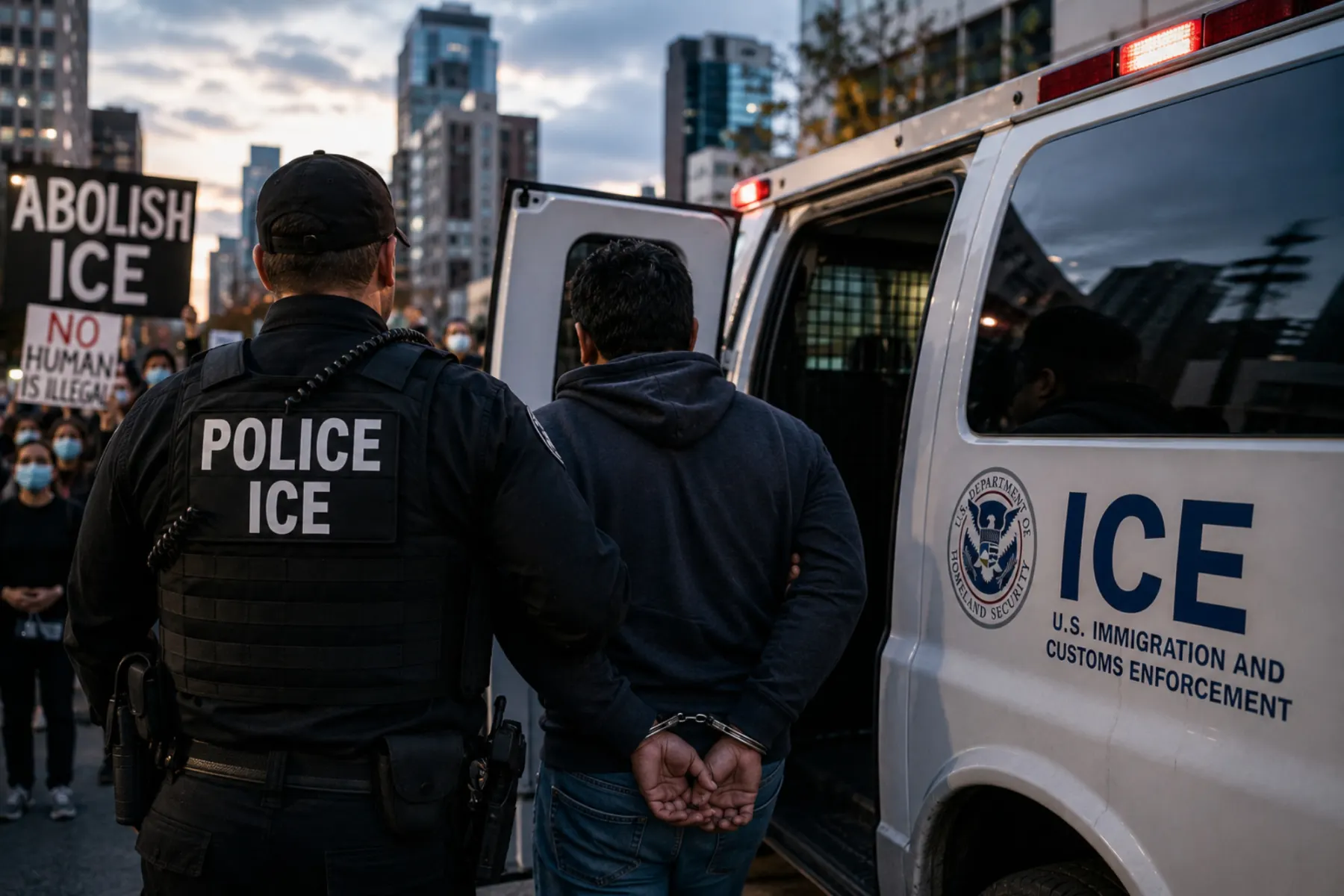
U.S. Immigration and Customs Enforcement was created in 2003 to enforce immigration and customs laws inside the United States and investigate cross-border crime. More than two decades later, ICE has become one of the most controversial federal agencies in America. Since the beginning of Donald Trump’s second presidency in January 2025, arrests and detention capacity have expanded sharply, courthouse and workplace operations have returned, major raids have triggered protests, federal judges have repeatedly challenged detention practices, and several fatal encounters have intensified demands for greater accountability. At the same time, the administration argues that aggressive enforcement is necessary to remove people who have no legal right to remain in the country and to protect public safety.
There are few three-letter combinations in contemporary American politics capable of producing reactions as different as ICE.
To supporters of strict immigration enforcement, U.S. Immigration and Customs Enforcement is a federal law-enforcement agency carrying out laws enacted by Congress and removing people whom the government says have no lawful right to remain in the United States.
To its critics, ICE has become the visible instrument of an immigration-enforcement system they say increasingly relies on mass detention, aggressive arrests and tactics that can sweep up people without criminal convictions, asylum seekers and, in some incidents, U.S. citizens caught in enforcement operations.
Both descriptions contain part of the current reality.
Understanding what has happened requires separating several issues that are frequently mixed together.
ICE is not the Border Patrol.
ICE does not decide immigration law.
It does not independently establish the president’s immigration policy.
And not every controversial immigration operation reported in the United States is carried out by ICE.
Yet ICE is the principal federal agency responsible for much of the interior enforcement, detention and deportation system, which means changes in presidential policy are often felt directly through its officers, detention centres and removal operations.
Since January 2025, the scale of those operations has changed dramatically.
What ICE Actually Is
ICE was created in 2003 as part of the enormous federal reorganisation that followed the September 11, 2001 terrorist attacks.
The new Department of Homeland Security absorbed functions previously divided among agencies including the former Immigration and Naturalization Service and U.S. Customs Service. ICE combined investigative and interior immigration-enforcement responsibilities from those organisations.
Two branches are particularly important.
Enforcement and Removal Operations, or ERO, identifies, arrests, detains and removes non-citizens whom the government considers subject to deportation.
Homeland Security Investigations, or HSI, is a major criminal investigative organisation dealing with crimes such as human trafficking, child exploitation, drug smuggling, money laundering, export violations and other transnational offences.
This distinction matters.
An HSI investigation into a drug-trafficking organisation is very different from an ERO officer arresting somebody for an immigration violation.
Public discussion nevertheless tends to use the single term “ICE” for both.
There is another important distinction.
U.S. Customs and Border Protection, including the Border Patrol, is a separate agency.
CBP predominantly controls ports of entry and borders. ICE predominantly operates inside the country after entry.
That distinction has become particularly important during recent protests, where ICE, Border Patrol officers, HSI agents and other federal personnel have sometimes operated in the same cities.
ICE Has Been Controversial Under Both Democratic and Republican Governments
The current confrontation did not begin in 2025.
Immigration enforcement expanded substantially during earlier administrations.
Beginning in 2008, the Secure Communities programme increasingly connected local fingerprint records with federal immigration databases, allowing ICE to identify potentially removable non-citizens after encounters with local law enforcement.
The programme expanded under President Barack Obama before being replaced with a narrower model in 2014. President Trump reactivated Secure Communities after taking office in 2017.
Obama’s administration itself removed hundreds of thousands of people annually during parts of his presidency, although enforcement priorities changed over time to concentrate increasingly on recent border crossers, people with criminal convictions and specified security threats.
ICE therefore did not become a major deportation agency under Donald Trump.
What changed under Trump was the scope and political philosophy of interior enforcement.
The First Trump Presidency Broadens the Target
After entering office in January 2017, Trump issued orders substantially broadening immigration-enforcement priorities.
ICE increasingly sought agreements with state and local authorities under the federal 287(g) programme, through which selected local law-enforcement personnel can perform particular immigration-enforcement functions under ICE supervision.
GAO reported that ICE approved 46 additional 287(g) agreements between February 2017 and March 2018, bringing the programme at that point to 76 participating agencies across 20 states.
Workplace enforcement also returned as a highly visible tool.
One of the largest operations occurred in Mississippi on 7 August 2019, when federal agents executed warrants at several food-processing facilities and detained approximately 680 workers considered removable under immigration law.
ICE later described it as the largest single-state immigration worksite enforcement operation in U.S. history at the time.
The operation became controversial not simply because of its size, but because hundreds of families were suddenly affected when parents did not return from work.
For supporters, the raids demonstrated that immigration and employment laws were being enforced.
For critics, they demonstrated how workplace operations can disrupt entire communities while often targeting workers more visibly than the employers who hired them.
The 2018 Family-Separation Crisis Requires an Important Correction
One of the most controversial immigration episodes of the first Trump presidency is frequently described simply as an “ICE policy”.
That is not technically accurate.
During the administration’s zero-tolerance policy in 2018, most initial family separations occurred under Customs and Border Protection, particularly the Border Patrol, after adults crossing the border were referred for criminal prosecution.
GAO found that CBP separated at least 2,700 children from parents between April 2018 and March 2019. Children were generally transferred to the Department of Health and Human Services.
ICE was nevertheless part of the wider detention and reunification system.
A later DHS Inspector General review found that ICE’s systems for helping track separated families were not fully upgraded until August 2018 — after the zero-tolerance policy had ended.
This distinction illustrates why precise reporting matters.
The U.S. immigration system involves several agencies.
Calling every action “ICE” may be rhetorically convenient, but it can obscure which agency actually made the arrest, separated the family, operated the detention facility or conducted the investigation.
The Biden Years Shift Priorities Again
When President Joe Biden took office in January 2021, his administration attempted to narrow civil immigration-enforcement priorities.
Rather than treating every removable non-citizen as an equivalent enforcement target, policy focused more heavily on national-security threats, public-safety cases and people who had recently entered the United States.
The change did not abolish ICE.
Deportations continued.
Detention continued.
Immigration arrests continued.
But the philosophy of interior enforcement was more selective.
That difference would become enormous when Donald Trump returned to the White House in January 2025.
January 20, 2025: The Policy Changes Immediately
On his first day back in office, Trump signed a series of immigration orders.
One instructed federal agencies to enforce immigration law against all inadmissible and removable non-citizens, while stating that those presenting public-safety or national-security concerns should receive particular attention.
The order revoked Biden-era policies establishing narrower enforcement priorities.
Another directed Homeland Security to detain people apprehended for immigration violations “to the fullest extent permitted by law” until removal, while seeking to end policies under which many migrants had been released while proceedings continued.
The practical effect was profound.
ICE officers no longer operated within the same priority structure used during the previous administration.
A person did not necessarily need a serious criminal conviction to become an enforcement target.
Immigration status itself could be sufficient.
The Number of People in ICE Detention Surges
The clearest measurement of that shift is detention.
According to ICE data reviewed by the U.S. Government Accountability Office, the agency’s average daily detained population increased from 39,314 people on 20 January 2025 to 67,204 on 1 April 2026.
That is an increase of approximately 71 per cent.
Over the same period, the number of authorised ICE detention facilities increased from 134 to 239, a rise of 78 per cent.
This is not merely an increase in deportations.
It represents a major expansion of the physical infrastructure required to hold people while immigration proceedings, removal arrangements or legal challenges continue.
Congressional funding has made further expansion possible.
GAO reported that legislation adopted in July 2025 provided ICE with about $75 billion through fiscal year 2029, including approximately $45 billion for detention capacity. ICE has also planned a multibillion-dollar expansion strategy involving additional detention facilities.
The United States is therefore building an immigration-enforcement system intended to operate on a substantially larger scale than before 2025.
The Administration Says Criminals Remain a Central Target
The Trump administration has repeatedly highlighted arrests of people convicted of murder, sexual offences, gang activity, drug trafficking and other serious crimes.
DHS argues that intensified enforcement removes dangerous offenders who should not remain in the United States and says public-safety cases are among the government’s central priorities.
There is no dispute that ICE arrests and removes people with serious criminal records.
The disagreement concerns how much of the rapidly expanded operation is actually focused on that group.
Government data reviewed by Reuters in June 2025 showed a sharp increase in detention of people without other criminal charges or convictions.
The number of ICE detainees arrested by the agency whose cases involved only immigration violations rose from roughly 860 in January to about 7,800 in June — more than an eightfold increase.
Arrests of people with criminal charges or convictions also increased, but much less rapidly.
This provides one of the most important facts for understanding the current debate.
The administration’s enforcement campaign includes dangerous convicted offenders.
It also increasingly includes people whose primary violation is immigration status.
Both statements can simultaneously be true.
Arrest Targets Change the Way ICE Operates
Another major change occurred during the spring of 2025.
Reuters reported that White House deputy chief of staff Stephen Miller pushed ICE leadership to dramatically increase the agency’s arrest numbers, with a target of approximately 3,000 arrests per day discussed after an earlier target of around 1,000.
Operations subsequently intensified at locations where potentially undocumented workers could be found, including day-labour gathering points and businesses.
The consequence of numerical targets is important.
If officers are expected primarily to locate specific people convicted of serious crimes, enforcement is heavily investigative and targeted.
If the objective is several thousand arrests every day, officers need a much larger pool of potential detainees.
That can push enforcement towards workplaces, streets, routine immigration appointments and courthouses.
And that is what began happening.
Courthouse Arrests Become a New Flashpoint
In May 2025, ICE officers began arresting migrants immediately after immigration-court hearings in several major cities.
Operations were documented in New York, Phoenix, Los Angeles and Seattle.
In some cases, immigration judges had just dismissed active proceedings. Federal authorities could then potentially place the individual into a faster deportation mechanism known as expedited removal.
DHS defended the strategy.
The administration argued that people who did not have a lawful basis to remain should not receive lengthy opportunities to delay removal.
Immigration attorneys and advocates raised a different concern.
If people believe appearing at a scheduled court hearing could lead directly to arrest, some may become reluctant to engage with the immigration system at all.
The disagreement goes to the heart of the current policy divide.
The government views courthouse arrests as efficient enforcement.
Critics view courthouses as places where people should be able to pursue legal claims without fearing immediate detention merely for appearing as required.
People Were Also Arrested at ICE Check-Ins
Another controversial practice involved people already complying with immigration supervision.
In Ohio, for example, a 19-year-old who had regularly participated in an ICE alternatives-to-detention programme was instructed to report for an appointment and detained when he arrived.
DHS noted that he was subject to a final removal order and argued that such orders should be enforced.
His family emphasised that he had lived in the United States since childhood, had been complying with ICE and had another immigration application pending.
This type of case illustrates why the current argument cannot be reduced to “criminals versus non-criminals”.
Immigration cases can involve asylum applications, rejected claims, final removal orders, pending visa petitions, work permits and years of residence simultaneously.
A person may be legally required to leave while also having no significant criminal record.
Whether such people should be aggressively prioritised is ultimately a political policy question.
Los Angeles Becomes the First Great Confrontation of the New Enforcement Era
In June 2025, immigration operations in Los Angeles triggered one of the largest public confrontations of Trump’s second presidency.
Federal agents made arrests at places including Home Depot locations, a garment factory and a warehouse.
Protests followed.
Some demonstrations remained peaceful.
Other confrontations involved property damage, burning vehicles and clashes with police and federal officers.
The administration responded by deploying National Guard troops.
Trump initially ordered 2,000 Guard personnel, and the federal deployment later expanded to thousands of Guard members and hundreds of Marines assigned to protect federal personnel and property.
California’s state government opposed the federalisation of its National Guard and challenged the move in court.
This marked a major escalation.
Immigration enforcement had moved beyond the question of individual arrests and become a confrontation involving:
federal authority,
state authority,
street protest,
military deployment,
and the limits of presidential power.
The Los Angeles Events Reveal a Crucial Distinction
ICE was the catalyst for the demonstrations.
ICE was not responsible for every act that followed.
Local police confronted protesters.
National Guard troops were sent by the president.
Marines came under Department of Defense authority.
Some protesters committed acts of violence or property destruction.
Many others protested peacefully.
That distinction matters because political debate frequently collapses all these events into a simple story of “ICE versus protesters”.
The real situation involved several institutions exercising different powers at the same time.
Delaney Hall Becomes Another National Symbol
A second major controversy developed around Delaney Hall, a privately operated ICE detention centre in Newark, New Jersey.
The 1,000-bed facility became the site of repeated demonstrations over alleged poor conditions.
In May 2025, Newark Mayor Ras Baraka was arrested outside the facility during a confrontation involving federal authorities and political officials.
U.S. Representative LaMonica McIver was later indicted on charges alleging that she forcibly impeded and interfered with federal officers during the incident. She denied wrongdoing.
The episode became politically explosive because elected officials argued they were conducting legitimate oversight, while federal authorities said they had interfered with officers performing lawful duties.
The controversy did not end with those arrests.
In August 2026, New Jersey Opens a Civil-Rights Investigation
Delaney Hall is again at the centre of national attention today.
On 7 August 2026, New Jersey’s attorney general announced a civil-rights investigation into treatment at the privately operated detention facility.
The investigation followed the death of Salvadoran detainee Edwin Lopez-Cornejo, who suffered a medical emergency while in custody.
His family alleged that he had not received adequate medical treatment for serious chronic conditions.
ICE said he had received appropriate medical care.
No final determination has established responsibility for his death, and the state investigation remains ongoing.
Complaints about Delaney Hall have included allegations involving sanitation, food, ventilation and medical services.
The investigation will examine whether actions or failures by employees of private prison operator GEO Group violated detainees’ civil rights.
This is an important legal distinction:
an investigation is not a finding of guilt.
Detention Conditions Have Become a Federal Oversight Problem
Concerns are not confined to New Jersey.
GAO’s 2026 examination of Camp East Montana, a massive ICE facility at Fort Bliss in Texas, identified serious operational problems.
The facility opened in August 2025 as ICE’s largest detention centre to date.
GAO found that it had begun housing people without first meeting several ICE detention standards.
At opening, shortcomings included a lack of perimeter security cameras, outdoor recreation space and adequate areas for attorney and family visits.
Afterwards, ICE itself reported additional problems including gaps in medical services, unsanitary conditions and the loss of a loaded firearm.
GAO also identified substantial financial waste in the rapidly constructed facility, including payments for meals and services that were not needed.
DHS agreed with several recommendations intended to improve oversight and contracting.
The finding illustrates a recurring challenge of rapidly expanding detention.
Increasing beds quickly is easier than simultaneously increasing qualified medical staff, inspections, legal-access facilities and operational oversight.
Deaths in ICE Custody Have Increased
The expansion has also brought increased scrutiny of deaths occurring while people are detained.
Reuters reported that at least 30 people died in ICE custody during 2025, the highest annual number in approximately two decades. By early April 2026, at least another 17 deaths had been recorded.
By early August 2026, Reuters reported that more than 50 people had died in ICE custody since Trump returned to office in January 2025.
A death in custody does not automatically mean ICE caused the death or committed misconduct.
Detainees can die from illness or other medical causes.
But every death in government custody raises an obvious responsibility to determine whether medical care, supervision and detention conditions met applicable standards.
That question has become increasingly significant as the detained population has grown.
Minneapolis Marks a New and More Dangerous Stage
The confrontation intensified again during winter 2025–26.
A large federal immigration-enforcement operation was deployed to the Minneapolis–Saint Paul region.
On 7 January 2026, ICE officer Jonathan Ross fatally shot Renée Good, a 37-year-old U.S. citizen, while she was inside her vehicle in Minneapolis.
Federal officials said the officer acted in self-defence.
Video of the confrontation prompted intense dispute over that account, and Good’s death triggered protests across Minnesota and elsewhere in the country.
Because Good was an American citizen rather than somebody facing deportation, the incident sharply expanded the debate.
The question was no longer only how aggressively ICE should arrest undocumented immigrants.
It became how federal immigration officers interact with citizens observing or protesting their operations.
Investigations and litigation surrounding the incident have continued.
A Five-Year-Old Is Detained With His Father
Less than two weeks later, another Minneapolis case attracted national attention.
On 20 January 2026, ICE officers detained five-year-old Liam Conejo Ramos and his father as they returned home from preschool.
Reuters reported that father and son were Ecuadorian asylum applicants who had entered the United States legally.
They were transferred to a family detention facility in Texas.
Several other children from the same school district were taken into immigration custody during the same week.
The administration maintained that immigration laws were being enforced against families whose legal status did not entitle them indefinitely to remain.
Critics argued that detaining young children while their cases remained within the immigration system demonstrated the excessive breadth of the enforcement campaign.
Cases involving children have particular political impact because immigration status belongs to the legal system, while the practical consequences are experienced inside families.
Another Minneapolis Death Was Not ICE — and That Matters
On 24 January 2026, Alex Pretti, an intensive-care nurse and U.S. citizen, was killed during another confrontation with federal immigration officers in Minneapolis.
This became closely associated with the anti-ICE protests.
But Pretti was killed by Customs and Border Protection officers, not ICE.
Reuters-verified video raised questions about the circumstances of the shooting, and the incident contributed to the political crisis surrounding the federal immigration surge.
The distinction is not minor.
If an article is specifically documenting ICE, a death caused by CBP cannot responsibly be described as an ICE shooting simply because the agencies were participating in the same wider enforcement campaign.
Thousands Take to the Streets
The Minneapolis operation produced enormous demonstrations.
On 11 January 2026, tens of thousands of protesters marched in Minneapolis and demonstrations occurred across other U.S. cities.
Minnesota subsequently sued the federal government in an effort to stop or constrain the enforcement surge, alleging racial profiling and unconstitutional conduct.
The administration rejected those allegations and argued that federal immigration law must be enforced regardless of whether state or local governments support the operation.
The federal-state conflict reflects one of the deepest constitutional tensions within American immigration policy.
Immigration law is primarily federal.
Policing streets, communities and most ordinary crime is primarily state and local.
When the two systems disagree over cooperation, the resulting friction can become enormous.
The Courts Have Become a Second Front
The most consequential challenge to the current enforcement campaign may not be occurring in the streets.
It is occurring in federal courtrooms.
A Reuters review published in February 2026 found that more than 400 federal judges had ruled in at least 4,421 cases since the previous October that ICE was holding people unlawfully.
The cases largely concerned the administration’s interpretation of federal detention law and whether immigrants already living inside the country must remain detained without the possibility of bond while immigration proceedings continue.
More than 20,000 habeas corpus lawsuits seeking release had been filed since Trump returned to office.
The administration argues that federal statutes authorise broader mandatory detention than previous administrations exercised.
Numerous district judges have disagreed.
Some appellate courts, however, have supported portions of the administration’s interpretation.
This is therefore not a settled legal question.
The issue is moving through the federal appellate system and may ultimately require further Supreme Court intervention.
Why “Illegal Detention” Does Not Mean Every ICE Arrest Is Illegal
The thousands of court rulings require careful interpretation.
They do not mean that judges have declared the entire ICE enforcement programme illegal.
Nor do they mean the individuals involved necessarily possess a permanent legal right to remain in the United States.
A person can be legally subject to immigration proceedings while being unlawfully detained without access to a bond hearing.
Those are different questions.
Many of the judicial rulings concern how long or under what legal authority somebody may be imprisoned while their immigration case continues, not whether the government may eventually deport them.
That distinction is central to understanding American due-process law.
July 2026: Two Fatal ICE Vehicle Encounters Change Tactics
The most recent major operational controversy emerged in July.
On 7 July, an ICE officer in Houston fatally shot Lorenzo Salgado Araujo, a Mexican national, during an attempted vehicle stop.
Six days later, an ICE officer fatally shot Colombian national Johan Sebastian Duran Guerrero in Biddeford, Maine.
DHS said the officers feared for their safety or public safety during attempts by vehicles to leave the scene.
In both incidents, federal officials later acknowledged that the people killed were not the intended targets of the immigration operations.
Witness accounts and available evidence led to public questions about the federal explanations, and investigations remain ongoing.
No final judicial determination has established whether either shooting was legally justified.
That uncertainty is important.
The facts remain under investigation.
ICE Temporarily Suspends Most Vehicle Stops
The shootings produced an immediate operational response.
On 14 July 2026, ICE temporarily suspended most vehicle stops nationwide while tactics were reviewed.
White House border adviser Tom Homan described the move as a short-term pause rather than a permanent policy reversal.
ICE’s own deadly-force policy permits lethal force only where an officer reasonably believes there is imminent danger of death or serious bodily injury; it does not permit deadly force solely to prevent a person from escaping.
The July incidents therefore became a direct test of whether field operations were being conducted consistently with that standard.
Body Cameras Are Now Being Rolled Out Nationwide
One of the most significant changes underway in August 2026 is the rapid expansion of body-worn cameras.
ICE has experimented with cameras for several years, but the dramatic increase in street enforcement and several fatal encounters created renewed pressure for universal deployment.
Acting ICE Director David Venturella said this month that the agency expects to equip its field officers and agents nationwide with body cameras by the end of August 2026.
The cameras could become important evidence in disputes over arrests and use of force.
But another controversy has already appeared.
ICE policy gives agency leadership considerable discretion over whether footage from shootings or incidents involving serious injury is promptly made public.
AP reported that footage can be withheld when ICE determines release is not in the agency’s interests or where leadership finds compelling circumstances justify delay.
Supporters of the programme argue that body cameras can protect officers against false accusations as well as document misconduct.
Critics argue that cameras provide limited public accountability if the agency controls whether recordings are released.
Both arguments are plausible.
The true value of the programme will depend heavily on how the footage is preserved, reviewed and disclosed.
Why ICE Officers Increasingly Wear Masks
Another visual characteristic of current operations has contributed to public controversy: officers conducting arrests while wearing face coverings.
Federal officials have said personnel face threats, harassment and attempts to identify officers or their families and therefore require protection.
Critics argue that masked officers operating in unmarked vehicles can make it difficult for civilians to distinguish legitimate federal agents from impersonators and reduce accountability.
Several states have attempted to impose identification or anti-mask requirements on federal immigration officers.
The federal government has challenged some of those laws, arguing that states cannot dictate how federal officers carry out federal duties.
The dispute again illustrates the broader constitutional conflict between state regulation and federal supremacy.
Administrative Warrants Create Public Confusion
Another source of confrontation is the difference between a judicial warrant and an ICE administrative warrant.
ICE can issue administrative immigration warrants internally.
They are legitimate documents within federal immigration enforcement.
But they are not signed by an independent federal judge.
That distinction can become important when officers seek entry into private homes or other areas where the Fourth Amendment provides heightened protection.
An administrative warrant does not automatically provide the same authority as a judicial search or arrest warrant in every setting.
The result is a legal environment difficult for ordinary citizens to understand in real time.
An officer may lawfully arrest somebody in one location while lacking authority to force entry through a private front door.
Much of the public conflict surrounding ICE operations therefore concerns not simply whether immigration law exists, but where, when and how officers may enforce it.
Local Police Cooperation Varies Dramatically
ICE also depends heavily on relationships with state and local authorities.
Some jurisdictions actively cooperate with federal immigration enforcement.
Others — often called sanctuary jurisdictions — restrict when local police or jails can assist ICE beyond what federal law requires.
Supporters of cooperation argue that local jails provide the safest place for ICE to arrest people who are already in custody, particularly offenders with criminal convictions.
Supporters of sanctuary policies argue that local police need immigrant communities to report crimes and cooperate with investigations without fearing that any contact with police will lead to deportation.
This disagreement produces very different enforcement environments across the United States.
An immigration arrest that is relatively straightforward in one county may require a street operation in another.
That geographic variation helps explain why some cities experience far more visible ICE activity than others.
The Economic Effects Are Becoming Visible
Large-scale immigration enforcement can also affect local economies.
After the 2026 federal surge in Minneapolis, Mayor Jacob Frey estimated that economic losses connected with the operation during January alone reached approximately $203 million, including disruption associated with residents staying home and businesses reducing activity.
That is an estimate from the city rather than a national economic assessment, and the federal government disputes the broader political characterisation of the operation.
But there is little doubt that fear of immigration enforcement can change economic behaviour.
Workers may stay home.
Customers may avoid businesses.
Construction, hospitality and agricultural employers may experience labour shortages.
Families may stop spending because they are uncertain whether a wage earner will remain in the country.
The opposite economic argument also exists.
Supporters of stricter enforcement argue that reducing unauthorised employment can improve opportunities for legally authorised workers and reduce public costs associated with illegal immigration.
Determining the overall economic effect requires separating national labour-market effects from the immediate disruption of individual raids.
What Supporters of ICE Enforcement Argue
A fair assessment of the current situation must explain why the administration has political support for what it is doing.
The argument begins with the rule of law.
The United States has immigration statutes specifying who may enter, remain and work.
Federal courts issue removal orders.
Congress has authorised detention and deportation mechanisms.
From that perspective, allowing millions of people to remain after they have lost legal claims or violated immigration law can itself undermine the credibility of the legal system.
The administration also points to cases in which ICE has removed convicted murderers, sex offenders, gang members and people linked to serious organised crime.
Trump’s 2025 executive order explicitly described immigration enforcement as a public-safety and national-security priority.
There is also an operational argument.
Arresting a removable non-citizen in a local jail may be safer than sending officers into a neighbourhood later.
This is why the federal government has aggressively promoted cooperation through local-federal programmes.
For voters who supported Trump partly because of immigration, the 2025–26 enforcement increase represents implementation of an electoral promise rather than an unexpected policy shift.
What Critics Argue
Critics do not generally dispute that the federal government possesses legal authority to deport many people.
Their objections concern scope, tactics and due process.
The dramatic increase in arrests of people without criminal convictions has weakened the claim that enforcement is confined primarily to dangerous offenders.
Courthouse arrests create fears that migrants will avoid legal proceedings.
Arrests at scheduled ICE appointments can punish people precisely for complying with supervision requirements.
Broad street operations increase the possibility of mistaken identity and confrontations with citizens.
Rapid detention expansion creates pressure on medical services and facility standards.
The thousands of federal rulings against detention practices demonstrate that courts have identified real legal problems rather than merely political disagreement.
Fatal encounters involving people who were not the targets of enforcement have intensified the argument that the current operational tempo carries unacceptable risks.
Neither Side of the Debate Can Be Reduced to a Slogan
“Abolish ICE” does not answer how the United States would enforce final removal orders, investigate trafficking or remove non-citizens convicted of serious crimes.
“Enforce the law” does not answer whether every enforcement tactic is constitutional or proportionate.
A democratic state can possess the legal right to deport somebody while still being constrained in how it arrests and detains them.
An immigrant can have no lawful right to remain while still possessing constitutional and statutory protections during detention.
An ICE officer can be carrying out legitimate federal duties while still being individually accountable if force is used unlawfully.
A protest against ICE can be constitutionally protected while violence or obstruction occurring during that protest can still be prosecuted.
Those distinctions are uncomfortable precisely because they prevent the issue from being reduced to one political narrative.
Where the United States Stands in August 2026
As of 11 August 2026, several facts define the current situation.
ICE’s detention system is dramatically larger than it was when Trump returned to office.
The detained population had risen by around 71 per cent by April, and the number of authorised detention facilities had increased by nearly 80 per cent.
Congress has provided enormous multiyear funding capable of sustaining and expanding enforcement.
Arrests are no longer concentrated only on people convicted of serious crimes; enforcement has expanded substantially to people whose principal issue is immigration status.
Federal judges are actively challenging parts of the administration’s detention interpretation, while appellate courts continue deciding how far federal authority extends.
Detention conditions remain under federal and state scrutiny.
New Jersey has just opened a civil-rights investigation into Delaney Hall.
Fatal ICE vehicle encounters in Texas and Maine prompted a temporary nationwide tactical review.
And the agency is now racing to equip field personnel with body cameras.
This is not a temporary burst of enforcement likely to disappear within several weeks.
The funding and institutional expansion suggest a multiyear strategy.
What Is Likely to Happen Next
Several developments are already foreseeable.
Enforcement will probably remain historically high
The administration has made mass immigration enforcement one of its central domestic priorities, and Congress has supplied the money required to increase detention and personnel.
A major voluntary reduction in ICE activity therefore appears unlikely while current policy remains in force.
More legal battles are inevitable
The enormous number of detention challenges virtually guarantees continuing appellate litigation.
Courts will have to determine how broadly mandatory detention statutes can be interpreted, when bond hearings are required and how enforcement interacts with constitutional protections.
Some administration policies may survive.
Others may be narrowed or struck down.
Detention oversight will become increasingly important
A system holding tens of thousands more people requires more medical care, inspections, legal access, food, transport and trained staff.
GAO’s findings at Camp East Montana demonstrate what can happen when physical capacity expands more rapidly than oversight systems.
Body-camera evidence could change public debate
If cameras operate consistently, future controversial encounters may be much easier to reconstruct.
But that requires recordings to be preserved and made available to investigators and courts.
Whether footage is also released quickly to the public remains a separate question.
State-federal conflict will continue
Immigration remains primarily a federal power.
Yet ICE operations occur inside states and cities whose political leaders may strongly oppose federal policy.
Arguments over local cooperation, masks, identification requirements, detention centres and access to state facilities are therefore likely to continue.
The Central Question Is No Longer Whether ICE Will Enforce Immigration Law
That question has been answered.
ICE is enforcing it aggressively.
The more difficult question is what limits should apply when enforcement expands from targeted arrests into a national mass-removal programme.
The United States is attempting to enforce immigration law on a scale substantially greater than it did only two years ago.
That requires more officers.
More detention centres.
More transport.
More court proceedings.
More local cooperation.
More money.
And inevitably more encounters between federal officers and people who do not want themselves, their relatives or their neighbours arrested.
The controversies since 2025 — courthouse arrests, workplace operations, Los Angeles protests, Minneapolis confrontations, disputed detention practices, fatal shootings and rapidly expanding detention centres — are not isolated events.
They are consequences of that change in scale.
ICE Has Become a Test of American Institutions
For the federal government, the test is whether immigration law can be enforced effectively.
For ICE, it is whether officers can conduct a vastly expanded mission lawfully, safely and professionally.
For courts, it is whether executive power remains within the limits established by Congress and the Constitution.
For state and local governments, it is how far they can resist or decline to assist federal enforcement without obstructing federal law.
For protesters, it is whether opposition remains within the protections of peaceful political expression.
For immigrant communities, the consequences are immediate and deeply personal.
And for the United States as a whole, the issue ultimately reaches beyond immigration.
A democratic state has the authority to enforce its borders and immigration laws.
It also has an obligation to exercise that authority within legal constraints.
Those principles are not opposites.
They have to coexist.
The current controversy surrounding ICE exists because the United States is testing just how difficult that coexistence becomes when immigration enforcement is expanded from tens of thousands of targeted cases into a national operation expected to produce arrests on an entirely different scale.
Twenty-three years after ICE was created, the agency is more powerful, more heavily funded and more visible than at almost any point in its history.
It is also under extraordinary scrutiny.
The next chapter will therefore be determined not simply by how many people ICE arrests or removes.
It will be determined by whether the federal government can demonstrate that an enforcement system built for unprecedented scale can also meet the standards expected of American law enforcement:
lawful arrests, due process, humane detention, proportionate use of force and meaningful accountability when something goes wrong.
That is the unresolved question at the centre of America’s ICE debate in 2026.
Source & Transparency
This article is published by Ireland Newspaper for editorial and informational purposes.
Published: 11 August 2026 · Updated: 11 August 2026

Newsroom Ireland Newspaper
Ireland Newspaper editorial team prepares daily news coverage for readers in Ireland and abroad.