Currency Markets in 2026: Dollar Dominance Meets a More Fragmented Financial World
The US dollar remains the undisputed centre of global foreign exchange, but the balance around it is changing. The euro is trading near recent highs, sterling has strengthened, China is pushing wider use of the renminbi, Japan has intervened to defend the yen and Switzerland is trying to prevent excessive franc appreciation. Behind the moves lies a common force: central banks, energy shocks, trade tensions and geopolitics are pulling the world’s major currencies in increasingly different directions.
The global currency market entered Monday, 10 August 2026, in an unusually delicate position.
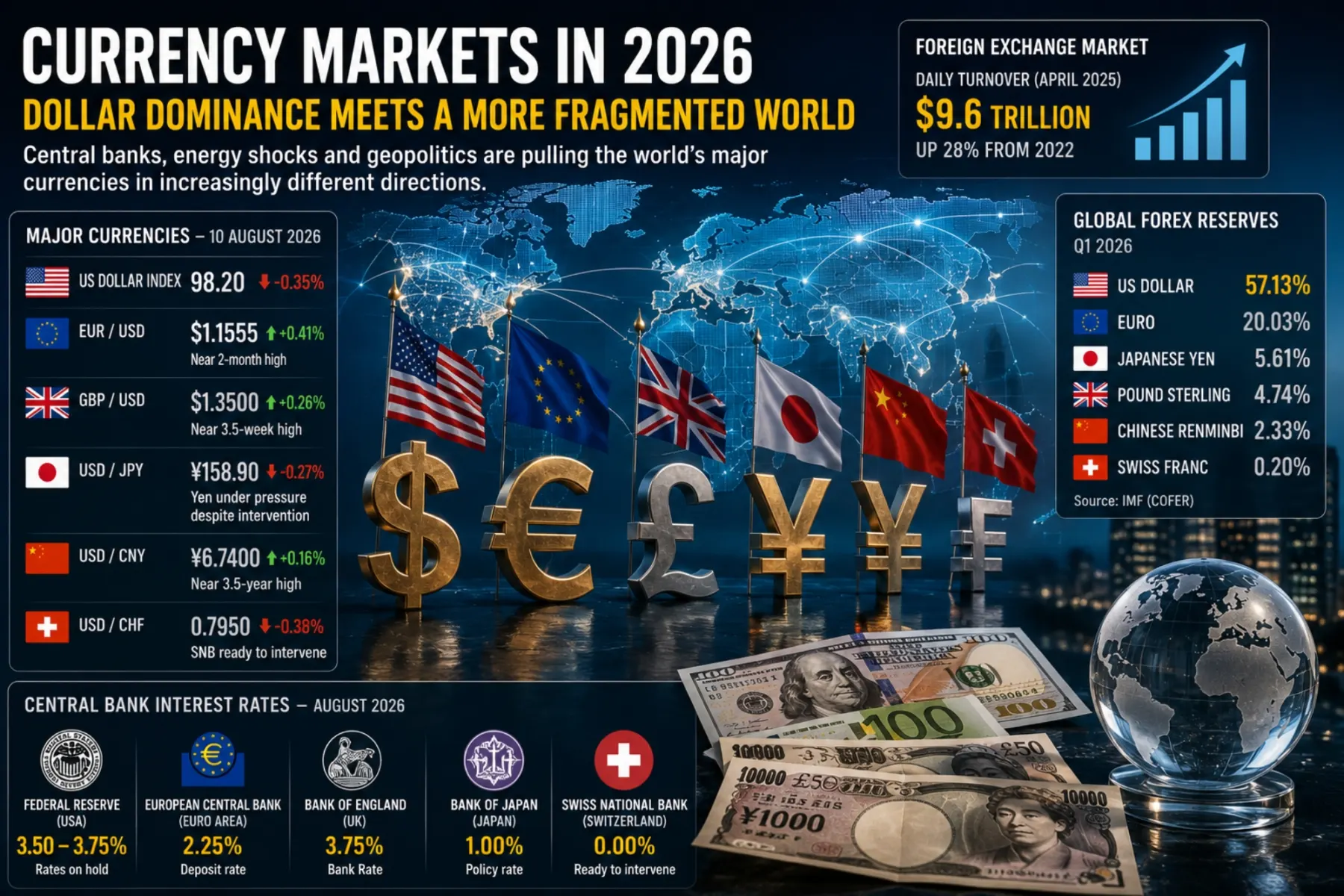
The US dollar is close to its weakest level in almost two months after disappointing American employment data reduced expectations for another near-term Federal Reserve interest-rate increase.
The euro is trading around $1.1555, close to its strongest level since the middle of June.
Sterling is near $1.35, close to a three-and-a-half-week high.
The Japanese yen, despite extraordinary official efforts to support it, weakened again on Monday to around ¥158.9 per dollar.
China’s renminbi is near 6.74 yuan per dollar, close to its strongest level in roughly three and a half years.
Those numbers can move within minutes.
The more important story is what lies behind them.
The world’s leading central banks are no longer moving in the same direction.
The Federal Reserve is holding rates at 3.5%–3.75%.
The European Central Bank raised rates earlier this summer and currently maintains a 2.25% deposit rate.
The Bank of England has Bank Rate at 3.75%.
The Bank of Japan has moved its policy rate to around 1%.
The Swiss National Bank remains at 0% and has explicitly signalled a greater willingness to intervene if the franc strengthens excessively.
Currencies are therefore being pulled by different combinations of inflation, growth, interest rates, energy prices, trade flows and political risk.
That divergence could define the next stage of the foreign-exchange market.
The Currency Market Is Bigger Than Most People Realise
Foreign exchange is not a specialist corner of finance.
It is one of the largest markets on Earth.
The Bank for International Settlements estimates that global over-the-counter foreign-exchange trading reached $9.6 trillion per day in April 2025, up 28% from $7.5 trillion three years earlier.
That is daily turnover.
Currencies move continually because international trade, investment, debt, tourism, central-bank reserves, commodity purchases and financial markets all require one form of money to be exchanged for another.
The hierarchy is also remarkably concentrated.
The US dollar was on one side of 89.2% of all foreign-exchange transactions measured by the BIS.
The euro appeared in 28.9%.
The Japanese yen in 16.8%.
Sterling in 10.2%.
The Chinese renminbi in 8.5%.
And the Swiss franc in 6.4%.
Because every currency trade contains two currencies, those percentages add to more than 100%.
But the message is unmistakable.
The world may be discussing alternatives to the dollar.
The foreign-exchange system remains overwhelmingly dollar-centred.
The US Dollar: Still the Currency the World Revolves Around
No currency currently comes close to matching the dollar’s combination of roles.
It is used to price international commodities.
Companies borrow in it.
Governments issue debt in it.
Banks fund themselves through it.
Central banks hold it.
Investors seek it during some periods of financial stress.
And it sits at the centre of most global currency trading.
The latest International Monetary Fund reserve data show the dollar accounting for 57.13% of allocated global foreign-exchange reserves in the first quarter of 2026.
The euro was a distant second at 20.03%.
That reserve share is lower than the dollar commanded decades ago, but it remains enormous.
The idea that the dollar is about to disappear as the world’s principal reserve currency is therefore difficult to reconcile with current market structure.
A gradual diversification of reserves is real.
An imminent replacement of the dollar is not visible in the data.
The Dollar’s Immediate Problem Is the US Economy
The current pressure on the dollar comes partly from a shift in expectations around American interest rates.
US employment data released before the weekend showed an unexpected decline in jobs during July together with sizeable downward revisions to earlier months.
That caused traders to reduce the probability they assigned to a Federal Reserve rate increase in September.
The dollar subsequently remained near a two-month low on Monday.
This demonstrates one of the most important rules of currency markets.
A strong economy does not automatically produce a strong currency.
Markets trade expectations.
If investors expect American interest rates to rise, holding dollar-denominated assets may become more attractive.
If they believe the Federal Reserve is finished raising rates — or could eventually cut them — that interest-rate advantage may weaken.
The currency can therefore fall even while the economy remains comparatively large and resilient.
Wednesday Could Be the Dollar’s Most Important Day of the Week
The next major test is US inflation.
Markets are awaiting July consumer-price data on Wednesday.
The Federal Reserve held its target rate at 3.5% to 3.75% on 29 July, maintaining the level it has kept since the beginning of the year.
A softer inflation number would strengthen the argument that the Fed can remain on hold.
That could place additional downward pressure on the dollar.
A stronger-than-expected inflation reading could do the opposite by reviving expectations for another rate increase.
The outcome is therefore not predetermined.
The dollar’s short-term direction is tied increasingly to one question:
Is inflation still strong enough to require higher US interest rates despite signs of a softer labour market?
Dollar Risk Number One: Monetary Policy
Interest-rate expectations remain the most obvious short-term risk.
A higher Fed rate path could attract capital towards US assets and support the dollar.
A weaker economy accompanied by cooling inflation could reduce that advantage.
The difficulty is that the Federal Reserve is facing two opposing risks.
Tighten too much and economic activity could weaken further.
Ease too quickly and inflation could become persistent.
That tension is likely to keep the dollar highly sensitive to monthly employment and inflation releases.
Dollar Risk Number Two: Geopolitics Can Strengthen It — or Challenge It
The dollar has historically attracted capital during many periods of global uncertainty.
That reflects the depth of US financial markets and the enormous stock of dollar-denominated assets available to international investors.
But geopolitics also creates longer-term questions.
Countries concerned about sanctions or financial dependence on the United States have explored greater use of local currencies, gold and alternative payment arrangements.
This is sometimes described as “de-dollarisation”.
The development should not be dismissed.
But its scale should not be exaggerated either.
The dollar still accounts for more than 57% of reported global foreign reserves and almost 90% of global FX transactions involve it.
Diversification can occur without the dollar losing its dominant position.
The Euro: The World’s Clear Number Two
The euro remains the only currency currently operating at anything close to the dollar’s international scale.
It represented 20.03% of global official foreign-exchange reserves in Q1 2026 and appeared on one side of 28.9% of global foreign-exchange turnover in the latest BIS survey.
On Monday, the euro was trading around $1.1555, near its strongest level since mid-June.
The recent resilience reflects several forces.
The European economy has avoided the deeper downturn some investors feared.
The ECB increased interest rates in June.
And expectations for additional Federal Reserve tightening have recently weakened.
That combination has narrowed part of the monetary-policy advantage that previously supported the dollar.
The ECB Has Changed the Euro’s Interest-Rate Story
The European Central Bank raised its main rates by 25 basis points in June.
At its latest meeting on 23 July, it left them unchanged.
The deposit facility remains at 2.25%, the main refinancing rate at 2.40% and the marginal lending rate at 2.65%.
The ECB has not committed itself to a predetermined future rate path.
It is making decisions meeting by meeting, largely according to inflation and economic data.
That creates a potentially supportive environment for the euro if European inflation remains persistent enough to keep rates elevated while the Federal Reserve becomes more cautious.
But it also contains substantial risk.
The Euro’s Biggest External Risk Is Energy
Europe remains a major energy importer.
The current Middle East conflict has once again demonstrated how quickly oil and gas prices can affect European inflation.
If energy prices rise sharply, the ECB faces an uncomfortable choice.
Higher energy costs can weaken household purchasing power and economic growth.
At the same time, they can raise inflation.
That combination makes monetary policy difficult.
A euro supported by higher interest rates can therefore coexist with an economy damaged by the very inflation requiring those rates.
Currency strength is not necessarily evidence that households or businesses are better off.
A Strong Euro Has Winners and Losers
For European households and companies buying goods priced in dollars, a stronger euro can be helpful.
Oil and many other commodities are commonly priced internationally in dollars.
If the euro strengthens, the local-currency cost of those imports can fall, all else being equal.
European tourists travelling to dollar-based destinations also benefit.
Exporters face the opposite effect.
A stronger euro makes euro-denominated production more expensive for overseas customers and reduces the euro value of some foreign earnings when they are translated back.
Large European industrial companies can therefore view a rising euro very differently from households buying imported energy.
The Euro’s Long-Term Opportunity Is Bigger Than Its Current Share
The euro is the most obvious potential beneficiary of gradual reserve diversification away from the dollar because it already possesses a large international financial system.
But structural constraints remain.
The euro area does not have one unified government bond equivalent in scale and structure to the US Treasury market.
Fiscal policy remains national.
Government debt is issued by individual member states.
Economic performance varies significantly between countries.
Those structural differences make the euro less straightforward as a global reserve asset than a simple comparison with the US economy might imply.
For the euro to gain substantially more international influence, Europe will probably need deeper capital markets and greater financial integration in addition to a stable currency.
Sterling: Stronger Than Its Economic Size Might Suggest
The British pound remains one of the world’s important international currencies despite the United Kingdom representing a much smaller share of global output than the United States, euro area or China.
Sterling appeared in 10.2% of global foreign-exchange transactions in the 2025 BIS survey.
On Monday it traded near $1.35, close to a three-and-a-half-week high.
London’s position as the world’s largest foreign-exchange trading centre is an important part of that story.
The BIS estimates that UK trading desks handled approximately 38% of global FX activity in 2025.
The pound therefore retains a financial importance greater than Britain’s share of world GDP alone would suggest.
The Bank of England Is Holding Rates at 3.75%
The Bank of England maintained Bank Rate at 3.75% on 30 July.
UK inflation had fallen to 2.6%, but the Bank continues to expect renewed pressure as higher energy prices associated with the Middle East conflict feed into household and business costs.
That leaves sterling caught between two forces.
Relatively high UK rates can support the currency.
But maintaining those rates for too long can weaken borrowing, investment and consumer spending.
If markets conclude that the Bank of England will need to keep rates high for longer than other central banks, sterling could remain supported.
If weakening economic activity forces expectations towards lower rates, that support could fade.
Sterling’s Risk Is a Narrow Monetary Path
Britain therefore faces a delicate balance.
Persistent inflation would make rapid rate reductions difficult.
Weak economic growth would make high rates painful.
A renewed energy shock could worsen both problems simultaneously.
Sterling’s current strength should consequently not be interpreted as a guarantee of continued appreciation.
Its future is unusually dependent on whether British inflation can return towards target without requiring a significant economic slowdown.
The Japanese Yen: The Most Dramatic Major-Currency Story
No major currency currently illustrates the tension between markets and policymakers more clearly than the Japanese yen.
The yen weakened to a multi-decade low near ¥164 per dollar in July.
Japanese and US authorities subsequently carried out coordinated action intended to strengthen the currency.
The yen rallied sharply afterwards, but by Monday had weakened again to around ¥158.9 per dollar.
The intervention was extraordinary.
Currency interventions normally involve a country’s own authorities.
The involvement of the United States underlined how serious the yen’s decline had become.
Why the Yen Became So Weak
The basic mechanism is largely financial.
For years, Japanese interest rates were dramatically lower than those in the United States and many other advanced economies.
Investors could borrow or fund themselves cheaply in yen and invest in higher-yielding assets elsewhere.
That strategy forms part of what is commonly known as the carry trade.
Large interest-rate gaps can therefore produce persistent selling pressure on a low-yielding currency.
Japan has gradually changed policy.
The Bank of Japan now guides the overnight call rate at around 1%, far above the negative and near-zero rates that characterised previous years.
But US rates remain substantially higher.
The interest-rate differential has narrowed without disappearing.
Currency Intervention Can Move the Yen — but Economics Must Eventually Support It
Official intervention can be powerful.
A government or central bank can buy its currency directly in the market.
Traders may also become reluctant to bet against a currency when they fear further intervention.
That can generate dramatic short-term movements.
The harder question is sustainability.
If the interest-rate structure and economic fundamentals continue encouraging capital to leave the yen, intervention alone may struggle to create a permanent trend reversal.
That explains why investors watch the Bank of Japan almost as closely as the Ministry of Finance.
A stronger yen ultimately becomes easier to sustain if monetary policy supports it.
The Yen Remains Globally Important Despite Its Weakness
Weak exchange rates should not be confused with unimportant currencies.
The yen accounted for 16.8% of global FX trading in the BIS survey and 5.44% of official global foreign-exchange reserves in Q1 2026.
It therefore remains the third major global trading currency behind the dollar and euro.
Japan also possesses one of the world’s largest pools of savings and financial assets.
The yen’s current weakness is consequently a monetary and market issue rather than evidence that Japan has ceased to matter financially.
Yen Risk: Sudden Reversals Can Be as Dangerous as Weakness
The yen presents an unusual risk.
Investors often focus on further depreciation.
But a sharp appreciation can also destabilise markets.
If traders have borrowed heavily in yen to purchase higher-yielding assets elsewhere, a rapidly strengthening yen can force them to unwind those trades.
That means selling other assets and buying yen.
The process can then reinforce itself.
A disorderly reversal of the yen carry trade can therefore affect equities and bonds far outside Japan.
This is one reason global investors pay so much attention to relatively small changes in Japanese monetary policy.
China’s Renminbi Is Becoming More Important — Slowly
China presents a completely different currency model.
The renminbi is neither freely floating in the same way as the dollar, euro or sterling nor fixed permanently at one level.
The People’s Bank of China manages the exchange-rate framework and guides market expectations.
On Monday the yuan was trading around 6.744 per dollar, close to its strongest level in approximately three and a half years.
The PBOC also used Monday to reiterate its ambition to maintain broad exchange-rate stability while increasing the renminbi’s role in international trade and investment.
That ambition is already visible in foreign-exchange trading.
The Renminbi Has Become the Fifth Most Traded Major Currency
The renminbi’s share of global FX activity reached 8.5% in the 2025 BIS survey, continuing a long-term increase.
Trading in the USD/CNY pair rose particularly strongly.
That reflects China’s enormous role in global trade.
Companies around the world buy Chinese goods.
Chinese companies purchase commodities.
International investors hold Chinese assets.
Chinese companies invest abroad.
All of that creates demand for currency transactions.
The renminbi’s position as a trading currency is therefore becoming increasingly significant.
Its position as a reserve currency remains much smaller.
Only About 2% of Global Reserves Are Held in Renminbi
The IMF reports that the Chinese currency represented 1.99% of allocated global foreign-exchange reserves in Q1 2026.
That creates an important contrast.
China is the world’s second-largest national economy and one of its largest trading powers.
Yet the renminbi accounts for only a small fraction of central-bank reserves.
The reason is not simply history.
International reserve managers generally place great value on deep financial markets, convertibility, liquidity and the ability to move capital easily.
China retains significant controls over capital flows and manages its exchange-rate system more actively than Western reserve-currency economies.
The BIS has identified such financial and capital-account restrictions as factors limiting the internationalisation of emerging-market currencies even as their trading volumes increase.
China’s Long-Term Currency Strategy May Be About Trade Before Reserves
The renminbi does not need to replace the dollar globally to become much more influential.
A more plausible path is incremental.
More Chinese exports invoiced in renminbi.
More energy and commodity contracts settled in renminbi.
More bilateral currency swap agreements.
More overseas borrowing in Chinese currency.
More renminbi holdings among companies trading heavily with China.
China has continued expanding currency-swap relationships with foreign central banks, including renewed agreements announced in August 2026.
That can gradually widen international use without requiring the renminbi immediately to become a fully open global reserve currency.
The Swiss Franc: Small Country, Enormous Safe-Haven Role
Switzerland represents almost the opposite case.
Its economy is far smaller than China’s.
Yet the Swiss franc is one of the most actively traded currencies in the world.
Its share of global FX turnover increased to 6.4% in 2025, making it the sixth most traded currency in the BIS survey.
The reason is not trade volume alone.
The franc has a long-standing reputation as a safe-haven asset.
During periods of geopolitical or financial stress, global investors frequently seek Swiss assets and the Swiss currency.
That behaviour has become particularly visible during the current geopolitical uncertainty.
Switzerland’s Problem Is Sometimes That Its Currency Is Too Strong
Most central banks worry about their currencies becoming too weak.
The Swiss National Bank frequently faces the opposite problem.
A rapid appreciation of the franc can reduce imported inflation — useful when prices are rising — but can also place pressure on Swiss exporters and push inflation too low.
The SNB kept its policy rate at 0% in June and explicitly stated that it has increased its willingness to intervene in foreign-exchange markets if necessary to prevent a rapid and excessive appreciation of the franc.
This is a striking example of how currency strength can become an economic problem rather than an automatic advantage.
The Franc Is a Barometer of Fear
The Swiss franc often becomes stronger when investors become more nervous about the world.
That means developments in Ukraine, the Middle East, European financial markets or global banking can affect Switzerland even when the Swiss domestic economy itself has changed relatively little.
The SNB has explicitly identified geopolitical uncertainty as a source of appreciation pressure.
A reduction in global tensions could therefore weaken some of the franc’s safe-haven demand.
A new geopolitical or financial shock could strengthen it rapidly.
The Australian and Canadian Dollars: Commodity Currencies Still Matter
The Australian and Canadian dollars occupy a second tier of major global currencies.
Both accounted for roughly 6% of global foreign-exchange activity in the latest BIS survey.
Their economic structures give them particular sensitivity to commodities.
Australia is closely connected to Asian demand for raw materials.
Canada is a major oil and commodity producer closely integrated with the United States.
Movements in energy, metals, Chinese growth and global risk appetite can therefore have unusually strong effects on these currencies.
The Australian dollar was trading around $0.7065 on Monday ahead of the Reserve Bank of Australia’s next policy decision.
Canada’s central bank kept its policy rate at 2.25% in July, describing the Canadian economy as weak but showing signs of improvement.
These currencies are important precisely because they often provide a window into expectations for global trade and commodities.
There Is No Single ‘Strongest Currency’
Currency discussions often become confused because people ask which currency is strongest.
That question can mean several completely different things.
Highest exchange rate against the dollar?
Most widely used?
Largest share of reserves?
Most stable?
Best protection during crises?
Strongest economy behind it?
Those measurements produce different answers.
One British pound buys more than one US dollar.
That does not make sterling more globally important than the dollar.
The Swiss franc can appreciate during a crisis.
That does not make Switzerland’s economy larger than the euro area.
The renminbi represents the currency of an economic superpower but remains only a small share of global reserves.
Currency value and currency importance are different concepts.
The Dollar Still Wins on Network Effects
The dollar’s greatest advantage may be something that cannot be created quickly by government decree.
Everybody already uses it.
Oil contracts are priced in dollars partly because other participants already use dollars.
Banks hold dollar liquidity because customers require dollars.
Central banks hold dollar reserves because international obligations are frequently denominated in dollars.
Investors buy US Treasury securities because the market is enormous and liquid.
Companies borrow in dollars because global lenders understand the market.
Each use reinforces the others.
Economists describe this as a network effect.
Replacing a dominant currency therefore requires more than creating a rival currency.
The rival also needs a financial ecosystem large enough that millions of participants voluntarily choose to use it.
‘De-Dollarisation’ Is Real — but Frequently Misunderstood
There is genuine evidence of greater currency diversification.
Central banks hold gold.
Some governments want to reduce dependence on dollar-based financial infrastructure.
China is promoting the renminbi.
Regional payment systems are expanding.
The share of reserves held in currencies outside the traditional leaders has increased over time.
But diversification and replacement are very different processes.
In the first quarter of 2026, the dollar share of reserves actually rose to 57.13% from 56.42% in the previous quarter, although part of that movement reflected valuation effects.
Meanwhile, the dollar’s share of foreign-exchange transactions increased slightly between the 2022 and 2025 BIS surveys.
The current evidence therefore suggests a more diversified currency system developing around a still-dominant dollar rather than a post-dollar world.
The Euro Is the Closest Existing Alternative — but Not a Replacement
The euro possesses several qualities required of an international reserve currency.
A large economy.
An independent central bank.
Deep financial markets.
Convertibility.
A significant international banking system.
And widespread use in trade.
It already holds one-fifth of reported global reserves.
But the gap to the dollar remains large.
The dollar accounts for almost three times the euro’s reserve share and appears in more than three times as many foreign-exchange transactions.
The most plausible currency future may therefore be increasingly multipolar without becoming evenly distributed.
Geopolitical Risk Has Become a Currency Variable Again
The conflicts affecting Europe and the Middle East are changing currency markets through several channels.
Higher oil prices can increase inflation.
Inflation changes interest-rate expectations.
Interest rates affect currencies.
Wars can cause investors to seek safe havens.
Trade sanctions can alter payment patterns.
Government borrowing can increase.
Supply chains can move.
Energy-importing currencies can respond differently from currencies backed by major commodity exporters.
There is therefore no universal rule saying war strengthens or weakens one particular currency.
The effect depends on the nature and location of the conflict.
Oil Can Move Currencies Without Touching Their Central Banks
The current Strait of Hormuz uncertainty is a good example.
Brent crude rose above roughly $85 per barrel on Monday as markets continued assessing the prospect of changes to shipping arrangements.
For major oil-importing economies, higher crude prices can increase inflation and weaken trade balances.
For major oil exporters, higher prices can improve export revenues.
The resulting currency effects vary.
The euro, yen and sterling therefore respond to Middle Eastern energy events partly because Europe, Japan and Britain have different levels and forms of energy exposure.
Currencies are economic shock absorbers.
Central Banks Are No Longer Moving Together
Perhaps the most important structural feature of the 2026 currency market is monetary-policy divergence.
The Federal Reserve: 3.5%–3.75%.
The Bank of England: 3.75%.
The ECB deposit rate: 2.25%.
The Bank of Japan: around 1%.
The Swiss National Bank: 0%.
Those differences create financial incentives.
Money naturally searches for the best return after accounting for risk and expected currency movements.
If one country offers significantly higher interest rates than another, investors may move capital towards it.
But the relationship is not mechanical.
A high interest rate may indicate strong economic growth.
Or it may indicate serious inflation.
Investors care about why the rate is high.
Interest Rates Can Reverse Currency Trends Very Quickly
A currency market can change direction without the central bank actually changing rates.
Only expectations need to move.
If investors suddenly believe the Federal Reserve will cut six months earlier than previously expected, the dollar can move immediately.
If they conclude the ECB will need another increase, the euro can strengthen before Frankfurt takes any action.
This explains why inflation reports, employment figures and speeches from central bankers can move currencies so sharply.
Markets trade the future.
The policy announcement often arrives after the currency has already reacted.
The Next Great Currency Risk Is Policy Error
Every major central bank faces a version of the same problem.
Raise rates too far and weaken the economy.
Keep them too low and risk persistent inflation.
Cut too early and the currency may fall.
Wait too long and economic weakness may intensify.
The differences between economies make that balancing act particularly difficult in 2026.
The United States is seeing weaker labour-market signals.
Europe remains exposed to energy inflation.
Britain faces elevated energy costs.
Japan is attempting to normalise monetary policy after decades of exceptionally low rates.
Switzerland is trying to prevent excessive currency appreciation.
China is balancing domestic economic support with exchange-rate stability.
There is no single global monetary cycle anymore.
Government Debt Is Becoming More Relevant to Currency Markets
Currencies ultimately represent claims on economies and financial systems.
Large government deficits do not automatically weaken a currency.
The United States has demonstrated that a country can run substantial deficits while maintaining the world’s dominant reserve currency.
But investors increasingly monitor fiscal sustainability because government borrowing affects bond yields, inflation expectations and confidence.
The issue becomes particularly important when a government’s fiscal policy works against its central bank.
A central bank may attempt to restrain inflation while government spending stimulates demand.
Currency markets then have to assess which force will dominate.
Fiscal credibility is therefore likely to become a larger part of currency valuation during the coming years.
Trade Wars Can Become Currency Wars Without Anyone Officially Declaring One
Exchange rates strongly influence international competitiveness.
A weaker currency can make exports cheaper for foreign buyers.
A stronger currency makes imports cheaper domestically.
That creates political sensitivity.
Governments sometimes accuse trading partners of deliberately suppressing their currencies.
China’s exchange-rate policy has repeatedly been the subject of such disputes.
The euro’s value can influence European manufacturing competitiveness.
A very weak yen can benefit some Japanese exporters while raising import costs for Japanese households.
Trade policy and currency policy therefore interact constantly.
As global trade becomes more fragmented, the temptation to view exchange rates through a competitive lens could increase.
China Is the Currency to Watch Over the Longer Term
The most interesting long-term challenge to the existing currency order probably comes from China.
Not because the renminbi is about to replace the dollar.
The current reserve data make that extremely unlikely in the near term.
But because China possesses something most alternative currencies do not:
scale.
It is one of the world’s largest economies.
One of its largest exporters.
One of its largest importers.
A huge buyer of commodities.
A major lender and investor.
And an increasingly important financial power.
If a larger proportion of China’s trade becomes denominated directly in renminbi, international demand for the currency could continue increasing even without full capital-account liberalisation.
That would make the global system more multipolar.
The Yen Is the Currency to Watch for Sudden Market Stress
China may matter most structurally.
The yen may matter most tactically.
The combination of intervention, changing Bank of Japan policy, large interest-rate differentials and carry trades makes Japan capable of producing sudden global market movements.
A rapid yen rally could force investors to unwind leveraged positions elsewhere.
A renewed collapse in the currency could provoke further official intervention.
Both outcomes carry risks.
The yen may therefore remain one of the most volatile policy stories among major currencies through the remainder of 2026.
The Franc Remains the Currency to Watch When Fear Rises
The Swiss franc performs another role.
When global risk intensifies, it frequently attracts capital.
That means the franc can provide useful information about investor anxiety.
Strong franc appreciation during geopolitical stress is not proof that a crisis will worsen.
It is evidence that investors are seeking defensive assets.
The SNB’s increased willingness to intervene demonstrates that even a traditional safe-haven currency can become too successful for the domestic economy.
The Dollar Is the Currency to Watch for Everything Else
Despite all the alternatives, the dollar remains the transmission mechanism connecting most global markets.
A change in Federal Reserve expectations can move:
the euro;
yen;
sterling;
renminbi;
emerging-market currencies;
commodities;
global bonds;
and international equities.
The dollar is still on one side of almost nine out of every ten FX transactions.
That dominance gives US monetary policy an influence far beyond American borders.
When the Fed moves, much of the financial world feels it.
What Could Happen Next: A Stronger-Dollar Scenario
One plausible scenario would see US inflation remain persistent.
The Federal Reserve could then maintain restrictive policy or potentially tighten further.
Higher US yields might attract capital.
Geopolitical risk could add safe-haven demand.
Under those conditions, the dollar could strengthen again.
That would place renewed pressure on currencies such as the yen and some emerging-market units.
But it is a scenario, not a forecast.
A Weaker-Dollar Scenario Is Equally Plausible
If US employment continues weakening and inflation falls more rapidly than expected, markets could conclude that the Fed has finished tightening.
Expectations might eventually shift towards lower interest rates.
The euro and sterling could gain relative support.
Emerging-market currencies could benefit from easier dollar financing conditions.
The yen might strengthen if US-Japanese interest-rate differences continue narrowing.
Again, the outcome would depend on multiple variables acting together.
The Euro Could Have a Stronger Second Half — With Conditions
The euro could benefit if euro-area economic activity remains resilient while the ECB keeps rates comparatively firm.
Further reserve diversification could also provide structural support over time.
But a prolonged energy shock remains a significant risk.
Europe’s currency cannot be separated from Europe’s dependence on imported energy.
If oil and gas prices rise sharply again, the euro may face the difficult combination of higher inflation and weaker growth.
Its outlook is therefore constructive only under the condition that the energy situation does not deteriorate materially.
Sterling’s Future Depends on Whether Britain Can Avoid Stagflation
Sterling faces a similar but more concentrated risk.
The Bank of England expects energy prices to push inflation higher again even though inflation recently fell to 2.6%.
If the British economy remains resilient while inflation gradually normalises, sterling could retain support.
If energy costs rise and growth deteriorates simultaneously, the Bank of England would face a much more difficult policy environment.
That is the classic stagflation problem:
weak growth and high inflation at the same time.
The Renminbi Could Gain Influence Without Becoming Fully Free-Floating
China’s currency could continue increasing its role in trade even if its exchange-rate regime remains managed.
The BIS data already show rising global trading activity in renminbi.
China is openly pursuing wider international use.
The key long-term question is how far Beijing is prepared to open its financial system.
Greater convertibility could increase international demand.
It could also reduce the authorities’ ability to control capital flows and exchange-rate volatility.
That trade-off will shape the renminbi’s global role for years.
Currency Risk Is Ultimately Purchasing-Power Risk
Exchange rates can sound abstract until they reach ordinary households.
A weaker euro can make imported fuel more expensive.
A stronger euro can make a holiday in the United States cheaper.
A weak yen raises the Japanese cost of imported energy.
A strong franc can make Swiss exports more expensive abroad.
A weaker pound can increase British import prices.
A stronger dollar can raise the cost of dollar-denominated debt across emerging markets.
Currency movements redistribute purchasing power between countries.
That is why governments and central banks watch them so closely.
Businesses Face an Even Larger Currency Problem
A company can be profitable operationally and still suffer from exchange-rate movements.
Consider a European manufacturer selling extensively in the United States.
It earns dollars.
When the dollar weakens against the euro, those revenues convert into fewer euros.
An importer faces the opposite relationship.
International companies therefore spend enormous amounts of time and money hedging currency exposures.
The BIS reports that outright forward foreign-exchange turnover reached $1.8 trillion per day in 2025, while FX swaps remained the largest individual instrument at approximately $4 trillion per day.
A large part of the currency market is not speculation.
It is companies and financial institutions trying to avoid surprises.
The Currency World Is Becoming More Multipolar — but Slowly
The long-term direction is easier to identify than the eventual destination.
The dollar remains dominant.
The euro remains the principal alternative.
The yen and sterling remain important established currencies.
The renminbi is becoming more significant.
The Swiss franc retains an outsized safe-haven role.
The Australian and Canadian dollars remain important commodity and investment currencies.
Other currencies are gradually appearing in global reserve portfolios.
The IMF says currencies outside its individually identified major categories now account for more than 6% of global allocated reserves.
That suggests diversification.
It does not yet suggest revolution.
The Biggest Currency Risk in 2026 Is Not One Currency
The greatest risk is divergence.
Different inflation rates.
Different central-bank policies.
Different energy exposures.
Different fiscal positions.
Different geopolitical relationships.
Different trade strategies.
That creates larger potential exchange-rate movements.
For businesses, it means greater hedging requirements.
For investors, it creates opportunities and risks.
For governments, it complicates economic policy.
And for households, it means changes in distant financial markets can appear rapidly in travel costs, fuel prices and imported goods.
A Week That Could Reset Expectations
This week has the potential to alter several important currency narratives.
US inflation on Wednesday could reshape expectations for the Federal Reserve.
Further developments around the Strait of Hormuz could move oil prices and inflation expectations globally.
UK economic data will influence sterling.
Japanese authorities remain alert after their intervention to support the yen.
China is simultaneously guiding exchange-rate stability and promoting wider renminbi use.
The individual exchange-rate movements may look small.
The policy implications are not.
The Dollar Has Rivals, but No Replacement
The most important conclusion from the global currency market in 2026 is therefore one of gradual change rather than dramatic upheaval.
The dollar is no longer the only currency countries want to hold.
It was never literally the only one.
Central banks are diversifying.
China wants a larger international role for the renminbi.
Europe wants stronger capital markets and greater monetary sovereignty.
Geopolitical tensions are encouraging governments to think more carefully about the currencies and payment systems on which they depend.
Yet the existing hierarchy remains remarkably strong.
The dollar represents 57.13% of allocated foreign reserves and is involved in 89.2% of global FX transactions.
The euro remains the distant but substantial second currency.
The yen, sterling, renminbi and franc each perform important but more specialised roles.
The next global monetary system may therefore not be defined by one currency defeating another.
It may be defined by a slow redistribution of influence around a dollar that remains at the centre.
For the remainder of 2026, the decisive question is less whether the world is abandoning the dollar than whether interest rates, wars, energy prices and trade tensions make the major currencies diverge even further.
In a foreign-exchange market already turning over almost $10 trillion every day, even a small change in those expectations can move enormous amounts of money.
Currencies rarely announce turning points in advance.
They simply begin moving — and the rest of the economy eventually discovers why.
Source & Transparency
This article is published by Ireland Newspaper for editorial and informational purposes.
Published: 10 August 2026 · Updated: 10 August 2026

Newsroom Ireland Newspaper
Ireland Newspaper editorial team prepares daily news coverage for readers in Ireland and abroad.




Market data, financial news and economy content on Ireland Newspaper are provided for editorial and informational purposes only. They do not constitute financial advice, investment advice, trading advice or a recommendation to buy, sell or hold any financial product. Always verify live prices and consult a qualified professional before making financial decisions.