
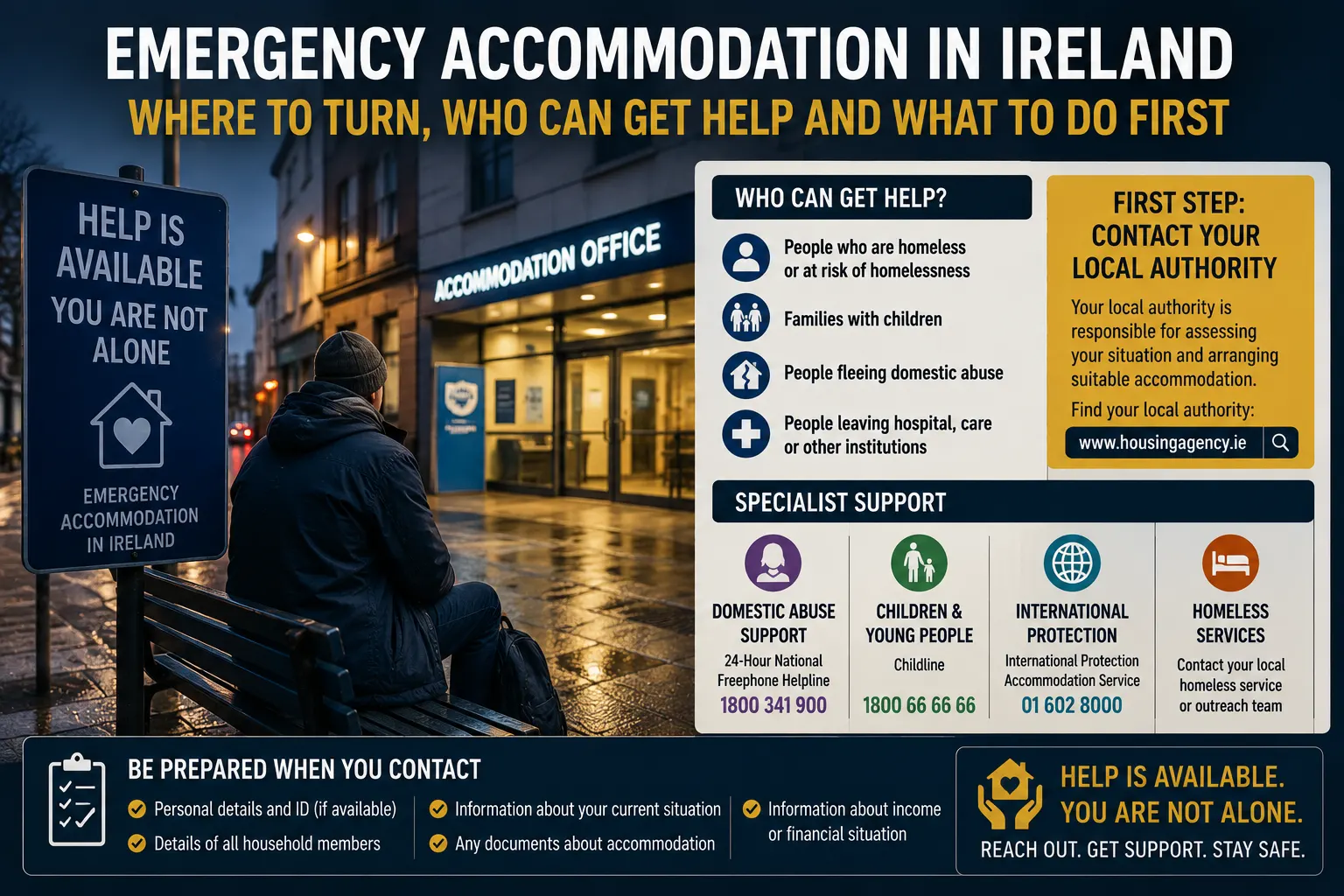
Losing somewhere to live can happen gradually or almost overnight. A tenancy ends. A relationship breaks down. A family can no longer stay with relatives. A person leaves hospital, care or another institution without suitable accommodation. Domestic abuse can make remaining at home unsafe. For others, months of financial pressure and an increasingly difficult search for affordable housing eventually leave nowhere reasonable to go. Ireland’s emergency accommodation system exists as a safety net for people in these circumstances, but it is not a single national reception centre or one telephone number covering every situation. Local authorities are central to the mainstream homelessness system, while specialist arrangements apply in circumstances such as domestic abuse, homelessness among children and international protection.
Understanding which door to approach can therefore make an important difference. The scale of the need is substantial. According to the Department of Housing’s latest official monthly dataset, 17,482 people were in State-funded emergency homeless accommodation in June 2026 , comprising 11,862 adults and 5,620 children. There were 2,706 families in emergency accommodation. The total was almost 10 per cent higher than in June 2025. Those figures are important, but they do not describe every form of homelessness. People sleeping rough, staying temporarily on somebody’s sofa, living in cars or other insecure situations, some people in domestic-violence refuges and people accommodated through the international-protection system are not necessarily represented in the monthly mainstream emergency-accommodation total. The true number of people without a secure home is therefore broader than the headline figure alone suggests.
What does “emergency accommodation” actually mean?
Emergency accommodation is temporary accommodation arranged for people who have been assessed as homeless and who cannot provide suitable accommodation from their own resources. It can take different forms. The Department of Housing’s homelessness statistics distinguish between supported temporary accommodation, temporary emergency accommodation and private emergency accommodation. In practice, that can include hostels, family hubs, other supported facilities and privately provided accommodation such as hotels or B&Bs. The important word is temporary
. Emergency accommodation is intended to provide somewhere to stay while a longer-term housing solution is pursued. It is not the same as receiving a permanent council home, and entering emergency accommodation does not mean that permanent housing will immediately become available. That distinction helps explain one of the most difficult features of Ireland’s current homelessness problem: preventing somebody from sleeping on the street tonight and finding that person a secure long-term home are related, but very different, challenges.
Who is considered homeless in Ireland?
The legal starting point remains Section 2 of the Housing Act 1988. Broadly, the Act provides that a person can be regarded as homeless where there is no accommodation available that the housing authority considers the person and their household could reasonably occupy or remain in , or where the person is staying in certain institutions or shelters because no such accommodation is available, and the authority considers that the person cannot provide accommodation from their own resources. This means homelessness is not limited to someone visibly sleeping on a street. A household approaching the end of a tenancy with nowhere reasonable to move to may need assistance. A person temporarily staying with friends or relatives can also have a serious housing problem if that arrangement is no longer genuinely available. Families, couples and single adults can all require assessment. The important point, however, is that emergency accommodation is assessment-based
. Under Section 10 of the Housing Act, a request for accommodation can be made to a housing authority by a homeless person or on that person’s behalf, and the authority has statutory powers to provide or arrange accommodation and other assistance. It should therefore not be assumed that simply requesting a hotel room or hostel bed creates an automatic entitlement to a particular form of accommodation. The authority assesses the household’s circumstances, available accommodation and resources, along with the eligibility rules applying to the case.
Important changes to the rules in 2026
This area of law is also changing. The Housing and Residential Tenancies (Miscellaneous Provisions) Act 2026 , signed into law on 22 July 2026, provides for additional residency-related eligibility criteria affecting certain homeless services under Section 10 of the Housing Act 1988, alongside changes to social-housing eligibility and appeal arrangements. The legislation provides for lawful- and habitual-residence requirements in specified circumstances. Because different provisions of the Act can be commenced by ministerial order, anyone whose immigration or residency position could affect eligibility should not rely on an old online guide or assume that rules applying to somebody else will necessarily apply to them . The safest course is to ask the relevant local authority or Citizens Information which provisions are currently in force and how they apply to the particular household. A commencement order for the 2026 legislation has been made, while the Act itself allows different provisions to commence at different times.
The first rule: do not wait until you are on the street
One of the most useful things a person can do is contact services before the final night of accommodation , where that is possible. Someone who has received a Notice of Termination, knows a temporary arrangement with relatives is ending, faces an unaffordable tenancy or believes that their housing situation is about to collapse should begin seeking advice immediately. For private renters, Threshold operates a national Freephone service on 1800 454 454, Monday to Friday from 9am to 9pm . Threshold advises tenants on tenancy rights and homelessness prevention and reported supporting more than 10,000 households with rental concerns during the first quarter of 2026. Early intervention matters because the available solution may not be emergency accommodation at all. Depending on circumstances and eligibility, a household may instead be helped to maintain a tenancy, challenge an invalid termination, access Housing Assistance Payment, secure help with a deposit or find another housing pathway. Citizens Information notes that local authorities can, in appropriate circumstances, assist with deposits or advance rent connected with HAP. Once accommodation has already been lost, the range of practical options can become narrower.
Emergency Accommodation Directory: Where to Contact
1. If you are homeless or about to become homeless outside Dublin
Contact the Housing or Homeless Services section of your local authority. Ireland’s homelessness services are administered regionally through local authorities. A housing officer can assess the situation and determine what homeless and housing supports may be available. Citizens Information maintains contact information for agencies and local-authority homelessness services around the country. If you do not know which council or service to contact, the Citizens Information Phone Service
is a useful national starting point: 0818 07 4000 Monday to Friday, 9am–8pm The service provides nationwide information and can help identify the appropriate public service or local authority for a person’s circumstances. Because telephone numbers and out-of-hours arrangements can differ between counties, people outside Dublin should check the current arrangements for their own local authority rather than assuming Dublin’s emergency number applies nationally.
2. If you are homeless in Dublin
The four Dublin local authorities operate homelessness services through the Dublin Region Homeless Executive . For emergency accommodation and out-of-hours access in the Dublin region, the principal number is: Homeless Freephone: 1800 707 707 10am–10pm, seven days a week For people presenting for the first time in the Dublin City Council area, the Central Placement Service assesses circumstances and available options. Dublin City Council currently lists separate weekday contacts for singles and couples and for families, as well as the regional Freephone service. Dublin Central Placement Service – singles and couples: 01 222 6944 Monday–Friday, 10am–4pm Dublin Central Placement Service – families: 01 222 6977 Monday–Friday, 10am–4pm The regional Freephone remains the important route for extended-hours access. Someone living in Fingal, South Dublin or Dún Laoghaire-Rathdown should also contact their own council’s homelessness service during normal office hours where possible; the Dublin regional system coordinates emergency provision across all four authorities.
3. If you are sleeping rough
A person sleeping outside should still seek a formal homelessness assessment rather than assuming that rough sleeping itself automatically places them into accommodation. In Dublin, outreach teams work directly with people sleeping rough. The Dublin homelessness system lists the Dublin Street Outreach Service on 01 872 0185 . Outreach teams can engage with people on the street and help connect them with accommodation and support services. Outside Dublin, contact the relevant local authority’s homelessness team or ask Citizens Information on 0818 07 4000
for the appropriate local service. If somebody is in immediate physical danger or facing a medical emergency, emergency services should be contacted through 112 or 999 .
4. If domestic abuse makes home unsafe
A housing emergency caused by domestic violence should not be treated simply as an ordinary landlord-and-tenant problem. Specialist domestic-abuse services can help with safety planning, refuge accommodation, legal information and contact with local services. Women’s Aid National Freephone Helpline: 1800 341 900 24 hours a day, seven days a week Women’s Aid describes the service as free and confidential and can provide information about safe accommodation and local domestic-violence services. Interpretation support is also available for callers who need to communicate in another language. For male victims, the National Male Advice Line is 1800 816 588
. If there is immediate danger, call 112 or 999 or contact An Garda Síochána. The crucial point is that nobody should feel they must remain in a dangerous home simply because they have not yet worked out the ordinary local-authority homelessness process.
5. If the person is under 18
Homelessness involving an unaccompanied child is treated differently from adult homelessness. Tusla, the Child and Family Agency, has responsibilities for children who are homeless , including children separated from their families. A person under 18 who has nowhere safe to stay should therefore seek assistance through Tusla rather than trying to navigate the adult emergency-accommodation system alone. Where a child is in immediate danger, contact An Garda Síochána or 112/999 .
6. If you are seeking international protection
International-protection applicants generally follow a separate accommodation system rather than the ordinary local-authority homeless-placement route. The International Protection Accommodation Service, or IPAS , is responsible for accommodation within that system. The International Protection Office and IPAS should therefore be consulted for the current application and accommodation process. Official guidance was updated during 2026, making it particularly important not to rely on an old address or old instructions. For existing IPAS accommodation-related cases, Government guidance lists ipasinbox@justice.ie
as a contact for accommodation matters.
How to ask for emergency accommodation
For somebody facing an immediate housing emergency, bureaucracy can be intimidating. It helps to make the situation clear from the beginning. A useful opening is: “I have nowhere that I can reasonably stay tonight. I need to be assessed as homeless and I need to know what emergency accommodation or other assistance is available.”
If the problem begins on a future date, say that clearly: “My accommodation ends on 18 August and I have nowhere else available after that date. I am asking for help before I become homeless.” The distinction matters. A housing officer needs to understand not simply that the current arrangement is difficult, but when it ends, why it cannot reasonably continue and what alternatives have already been explored .
Information to give the housing officer
Be ready to explain:
- who needs accommodation;
- whether there are children in the household;
- where everyone stayed the previous night;
- why that accommodation is no longer available;
- when a tenancy or temporary arrangement ends;
- whether there is any alternative accommodation available;
- what income or financial resources the household has;
- whether anyone is pregnant, elderly, disabled or has a serious medical need;
- whether there is a safety issue, including domestic abuse;
- and any information requested about residency or immigration status.
Accuracy is more useful than trying to make a situation sound more dramatic. A clear timeline and supporting documents can help the authority understand what has happened.
Documents worth having ready
Where available, keep photographs or copies of important documents on a phone as well as the originals. These can include:
- photo identification;
- PPS numbers;
- proof of income or social-welfare payments;
- a tenancy agreement;
- a Notice of Termination or other documentation showing when accommodation ends;
- evidence of the address or temporary accommodation where you have been staying;
- documents relating to children or dependants;
- immigration or residency documentation where relevant;
- and medical documentation where a health condition affects accommodation needs.
Do not assume, however, that having one document missing means there is no point in asking for help. If the situation is urgent, make contact and ask which evidence is essential immediately and which material can be supplied afterwards.
Keep a record of every contact
When dealing with several agencies under stressful circumstances, details can easily be lost. Write down: the date and time of contact, the number called, the name or section of the person spoken to, any reference number given, what was requested and what the service said would happen next. If a local authority decides that emergency accommodation or another homelessness service cannot be provided, ask: “Can I have the decision and the reasons in writing, and can you tell me what review or appeal procedure applies?” That question does not guarantee a different outcome, but it creates a clearer record and allows the person to seek independent advice about the decision. Citizens Information can explain public-service procedures, while housing organisations and legal-advice services may be able to assist in more complicated disputes.
Being refused one option does not mean doing nothing
A person may approach a service expecting one particular solution — for example, a hotel room — when the authority identifies a different option. Emergency assistance can take several forms under the Housing Act, and the precise response depends upon the circumstances and the services available. If a requested placement is not offered, the immediate questions should therefore be: What assistance can be provided instead? Where am I expected to stay tonight?
What is the next step in my homelessness assessment? Who should I contact if my circumstances change? Can the decision and reasons be provided in writing? For someone already without accommodation, these questions are often more useful than ending the conversation after the first “no”.
If you are still renting, prevention should come first
Emergency accommodation is an essential safety net, but avoiding homelessness in the first place is usually better for the household and less disruptive for children, employment, education and health. Threshold reported in July 2026 that it had helped keep more than 1,100 households out of homelessness during the second quarter of the year. Its national helpline remains available to private renters on 1800 454 454, Monday to Friday from 9am to 9pm . Anyone receiving a Notice of Termination should therefore consider getting advice before moving out or surrendering a tenancy , particularly if there is uncertainty about whether the notice is valid. Local authorities may also assess eligibility for housing supports such as HAP and other homelessness-prevention measures. The appropriate solution varies by household and cannot be determined from the fact that a person is struggling with rent alone.
Why Ireland’s emergency system is under such pressure
The growing demand for emergency accommodation cannot be separated from the wider housing market. Ireland entered June 2026 with 17,482 people recorded in State-funded emergency accommodation , almost 1,600 more than one year earlier. The number of children had risen to 5,620 and the number of families to 2,706. Emergency accommodation therefore performs two jobs at once. It must respond to new households losing their homes while also accommodating people who have not yet been able to move into permanent housing. That creates a bottleneck. Adding an emergency bed can solve tonight’s immediate problem, but it does not by itself create the permanent home needed to allow somebody already in emergency accommodation to leave the system. This is why homelessness cannot be understood solely as a question of how many hostel or hotel places exist. The exit side of the system matters just as much: social housing availability, private rental supply, affordability, suitable homes for families, supported accommodation and the speed at which households can move from emergency provision into secure housing.
What is being changed
Several policy measures are intended to increase the number of routes out of homelessness rather than simply expanding temporary accommodation. For 2026, the Government allocated more than €570 million for Housing Assistance Payment and related private-rental supports . It also provided €100 million to acquire second-hand homes specifically aimed at helping families who have spent the longest periods in emergency accommodation . Longer-term social-housing construction is also important. At the end of the first quarter of 2026, Department of Housing data showed 9,935 social homes under construction and another 13,322 at design or tender stage
. Those homes will not all become available immediately or necessarily go to households currently in emergency accommodation, but the pipeline illustrates the scale of supply activity intended to expand permanent housing capacity. For people with histories of rough sleeping or long-term homelessness and complex support needs, Housing First follows a different model: placing people into permanent housing with ongoing supports rather than requiring them to progress through repeated stages of temporary accommodation. Ireland’s implementation plan set a target of 1,319 additional supported Housing First tenancies over the 2022–2026 period. None of these measures provides an instant answer to the current emergency-accommodation numbers. Homes require land, finance, construction capacity, infrastructure and time, while many households need housing in particular locations or with particular sizes and supports.
What could happen next
The immediate challenge through the remainder of 2026 is likely to remain two-sided. Ireland must maintain sufficient emergency capacity for people who have nowhere reasonable to stay, while simultaneously increasing the number of households leaving emergency accommodation for permanent homes. If housing delivery increases and prevention programmes successfully keep more households in their existing homes, pressure on emergency services could gradually ease. If inflows into homelessness continue to exceed the number of households securing permanent housing, emergency accommodation is likely to remain heavily stretched. The 2026 legislative changes may also alter how some applications are assessed, particularly where residency and eligibility questions arise. Their practical effect will become clearer as the relevant provisions are implemented and interpreted by local authorities. For an individual facing homelessness, however, the most important lesson is much simpler. Contact services early. Ask explicitly for a homelessness assessment. Explain clearly where you can stay tonight and when any existing accommodation ends. Bring evidence where you have it. Tell the service about children, health conditions and safety risks. Keep a record of conversations. And if assistance is refused, ask for the decision, the reason and the next available route in writing.
Ireland’s homelessness system is complex because homelessness itself is not one single circumstance. A family whose tenancy has ended, a person sleeping rough, a teenager without a safe home, somebody fleeing abuse and an international-protection applicant may all urgently need shelter, but they do not necessarily enter the system through the same door. The purpose of an effective emergency-accommodation directory is therefore not merely to provide a list of telephone numbers. It is to help people find the correct door before a housing emergency becomes even more dangerous . Emergency accommodation remains a safety net rather than a permanent solution. Ireland’s longer-term test is whether prevention, rental support, social housing and permanent supported housing can expand quickly enough that fewer people need that safety net — and that those who do need it can move through it towards a secure home rather than remaining there indefinitely.
Source & Transparency
This article is published by Ireland Newspaper for editorial and informational purposes.
Published: 12 August 2026 · Updated: 14 August 2026

Newsroom Ireland Newspaper
Ireland Newspaper editorial team prepares daily news coverage for readers in Ireland and abroad.