Along rural roads in Ireland, the sight is familiar. A small stone cottage with an overgrown garden. An old farmhouse whose roof has begun to deteriorate. A former family home standing empty beside a road where neighbouring houses sell for several hundred thousand euro. At the same time, younger households can struggle to find an affordable home. The obvious question follows:
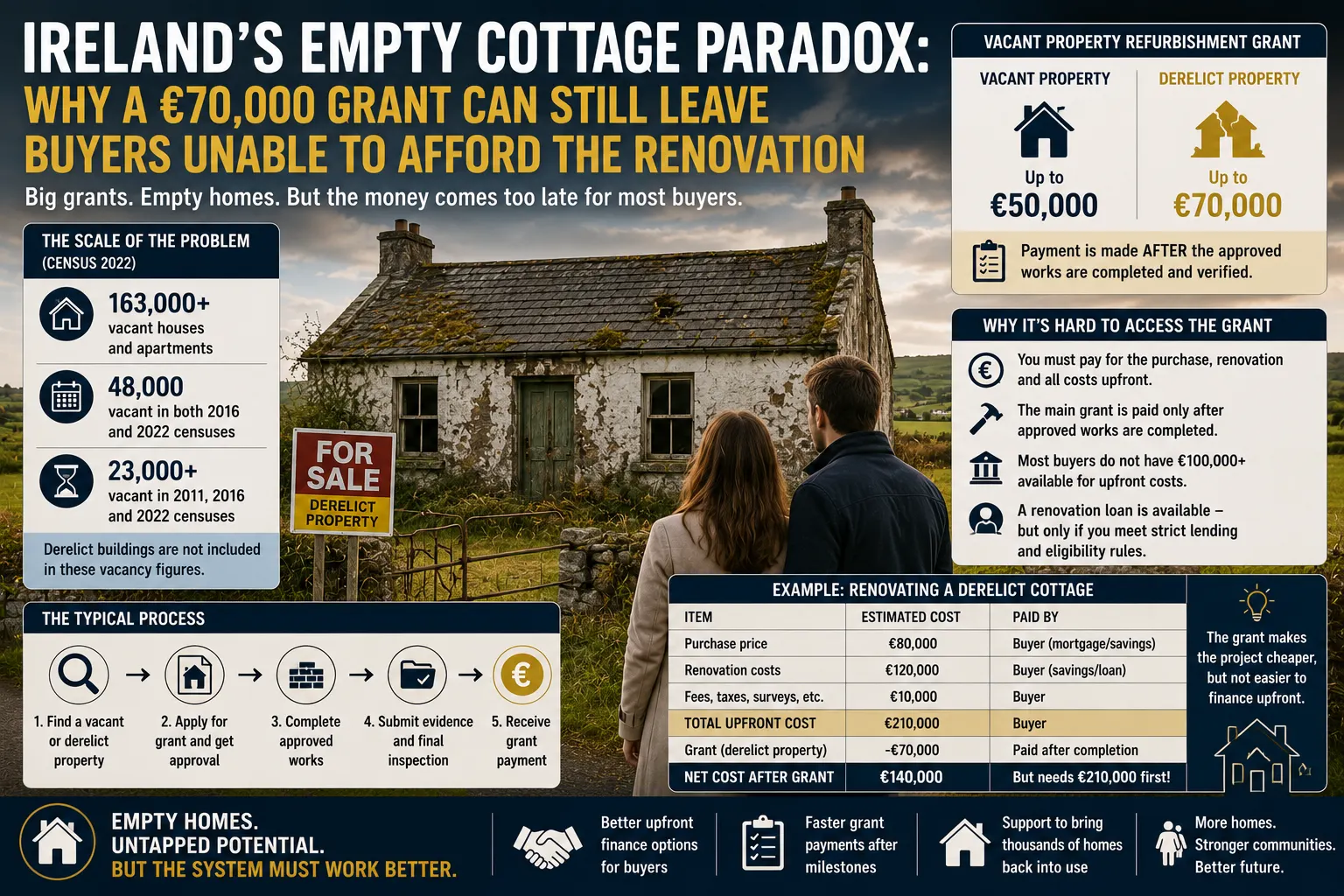
Why does somebody not simply buy the old house, receive the refurbishment grant and turn it back into a home? The answer exposes one of the more complicated contradictions in Ireland’s housing market. The State now offers substantial financial assistance for bringing vacant property back into use. The Vacant Property Refurbishment Grant provides up to €50,000 for a qualifying vacant property and up to €70,000 where the building is considered derelict. Yet the grant is primarily a reimbursement mechanism rather than cash handed to a buyer at the beginning of the renovation. Approved works generally have to be completed and the required evidence submitted before the payment is issued. For a household with substantial savings or sufficient finance, that arrangement can work extremely well. For somebody who has enough income to pay a mortgage but does not have €100,000 or more of additional renovation finance available, the same property can remain effectively inaccessible. That is the central problem.
A grant can make a project cheaper without necessarily making it financeable.
Ireland Does Have a Significant Stock of Empty Homes
The scale of vacancy requires some care because different statistics measure different things. Census 2022 identified more than 163,000 vacant houses and apartments. Holiday homes were counted separately, while derelict buildings that were no longer considered habitable were not included in that vacancy figure. Not every property recorded as vacant is a long-term abandoned home. Some may temporarily be empty because they are for sale, between tenants, being renovated or affected by other circumstances. The longer-term figures are more revealing. Almost 48,000 dwellings were recorded as vacant in both the 2016 and 2022 censuses, while more than 23,000 had been vacant across the 2011, 2016 and 2022 censuses. These figures provide a stronger indication of persistent vacancy. And because genuinely derelict buildings are excluded from the Census vacant-dwelling count, the overall number of unused buildings that might potentially return to residential use cannot simply be read from one headline statistic. The potential is real. So are the obstacles.
The €50,000 and €70,000 Grants Are Substantial
Ireland’s Vacant Property Refurbishment Grant has become one of the main policy tools for returning older buildings to residential use. A qualifying property can receive up to:
| Property Type | Maximum Grant |
|---|---|
| Vacant property | €50,000 |
| Derelict property | €70,000 |
The €70,000 maximum consists of the standard €50,000 grant plus a derelict-property top-up of up to €20,000. The actual payment depends on eligible expenditure, limits applying to different categories of work and the local authority’s assessment of reasonable costs. For the normal scheme, a property must generally have been vacant for at least two years and have been built before 2008. Applicants can provide proof of ownership or evidence that they are actively negotiating to purchase the property. This means somebody does not necessarily have to complete the purchase before beginning the grant application process. Grant approval must, however, be obtained before grant-funded works begin. This is an important distinction. The difficulty is not simply that somebody has to buy the house before knowing whether assistance may be available. The greater problem comes later.
Approval Is Not the Same as Receiving €70,000 in the Bank
A successful applicant may receive approval for substantial grant assistance. That still does not normally mean the local authority transfers the full grant into the applicant’s account before builders begin. Payment is generally made after the approved work has been completed and the required documentation has been submitted and checked. By the end of the second quarter of 2026, more than 14,000 applications had been approved under the scheme and more than 6,300 completed properties had reached payment stage. The difference does not mean that the remaining projects have failed. Many are simply somewhere between approval and completion. But it demonstrates the basic mechanics:
Approval comes first. Construction follows. Payment comes later. For cash-rich households, that order can be manageable. For cash-constrained buyers, it can become the main obstacle.
A €70,000 Grant Does Not Eliminate a €130,000 Renovation Bill
Consider an old cottage requiring substantial work. The roof may need replacement. Windows and doors may be beyond repair. Electrical wiring may be obsolete. Plumbing and heating may need complete renewal. Insulation may be inadequate. Floors can suffer from damp. A septic tank or wastewater system may require upgrading. Bathrooms and kitchens may need full replacement. Structural defects can emerge only once the building is opened. Older traditional houses can also require specialist approaches rather than simply applying modern materials and techniques. The €70,000 maximum grant therefore has to be considered against the total renovation bill. If renovation costs €130,000 and the full €70,000 grant is ultimately paid, the homeowner still has to carry €60,000 of renovation expenditure permanently. That can still represent excellent assistance. But the contractor cannot normally be expected to wait until the State grant is eventually paid.
A Practical Example: The €120,000 Cottage
Consider a hypothetical couple who find an old derelict cottage in rural Ireland. The property has been vacant for many years and qualifies for the maximum derelict-property grant.
Purchase price
€120,000
Renovation budget
A professional assessment estimates that bringing the cottage to a proper habitable standard will cost: €130,000 This includes structural repairs, roof work, windows, electrical and plumbing work, heating, insulation, internal finishes and other refurbishment expenditure.
Purchase and project costs
Allow another: €12,000 for stamp duty, legal work, valuation, engineering or architectural services, surveys and a modest contingency for associated project expenses. Residential stamp duty on a €120,000 purchase would normally be approximately €1,200 under the current rate applying at that price level. The project now looks like this:
| Project Component | Amount |
|---|---|
| Purchase price | €120,000 |
| Renovation | €130,000 |
| Legal, tax, professional and project costs | €12,000 |
| Total initial project cost | €262,000 |
| Potential derelict-property grant | −€70,000 |
| Final net project cost after grant | €192,000 |
On paper, this looks highly attractive. A renovated home for a net project cost of around €192,000 could represent very good value if the completed property is worth comfortably more and suits the household. But that table hides the real problem.
The Household May Need €262,000 Before Receiving the €70,000
Before the grant is paid, the buyers may have to finance: €120,000 for the purchase plus €130,000 for renovation plus €12,000 in associated costs Total:
Only after the work has been completed and verified does the potential €70,000 grant reduce the long-term project cost to approximately:
That creates a temporary financing requirement of:
This is the difference between affordability and liquidity. The project may ultimately be affordable. The buyer may nevertheless be unable to finance the period before the grant arrives.
Imagine the Buyers Have €40,000 in Savings
Suppose the couple has accumulated: €40,000 in savings. That is a considerable amount for many households. But against a €262,000 acquisition-and-restoration project, it can disappear very quickly. Even if a lender financed 90% of the €120,000 purchase price, the couple would still need: €12,000 for the deposit before accounting for legal fees, surveys, professional costs and other expenses. A significant part of the €40,000 could therefore be committed before major construction even begins. The couple might then face a renovation budget approaching €130,000. The State may eventually reimburse as much as €70,000. But contractors and suppliers require payment during construction. Somebody has to provide that money first. A household can therefore be capable of supporting the
final €192,000 project cost while being completely incapable of supporting the €262,000 cash flow required before reimbursement . That is the financing trap.
Why an Ordinary Mortgage May Not Solve the Problem
Conventional mortgage lending works most easily when the asset being purchased is already a habitable house. A badly derelict cottage presents a different lending risk. The property securing the loan may initially be worth substantially less than the completed home. There is construction risk. Renovation budgets can overrun. Planning or building-control issues may appear. The borrower may have to continue paying rent elsewhere while the building is restored. And an unfinished property is not equivalent collateral to a completed residential home. This explains why financing derelict property can be considerably more difficult than financing an ordinary house.
The Local Authority Purchase and Renovation Loan Changes the Picture
There is an important qualification to criticism of the grant’s reimbursement structure. Ireland now has a mechanism specifically intended to address part of this financing gap. The Local Authority Purchase and Renovation Loan is a State-backed mortgage and renovation loan aimed at eligible people purchasing and refurbishing vacant, derelict or non-habitable homes that qualify for the Vacant Property Refurbishment Grant. The financing structure can include two components. One is the longer-term mortgage and renovation loan. The other is a bridging component linked to the amount of the refurbishment grant. This bridge can provide temporary finance while renovation takes place and can then be repaid when the refurbishment grant is eventually received. That is important because it directly addresses the main weakness of a reimbursement-style grant.
What the Bridging Loan Changes
Return to the €70,000 grant. Without bridging finance, the household may have to find the €70,000 itself temporarily. With an eligible grant-linked bridge, that amount can instead be financed until the local authority pays the grant. At an illustrative interest rate of 3.5%, borrowing €70,000 would produce approximately: €2,450 in simple interest over one year or roughly: €3,675 over 18 months before considering the precise timing and repayment structure of the individual loan. Instead of requiring €70,000 in additional savings, the household may therefore have to absorb several thousand euro in financing costs. That is a fundamentally different proposition. But there is another important limitation.
Not Every Buyer Qualifies
The Local Authority Purchase and Renovation Loan is not a universal renovation mortgage available to everyone. It is intended principally for people who cannot obtain sufficient finance from commercial lenders and who meet the programme’s eligibility requirements. Applicants have to satisfy income, creditworthiness and project-viability tests. There are also conditions relating to first-time buyers and the Fresh Start principle, with specific rules applying in particular circumstances. The project itself must also be viable. Applicants need to demonstrate that renovation can be completed, that the finished property can comply with relevant building requirements and that the completed value supports the proposed financing. The State-backed loan therefore provides an important solution for some households. It does not eliminate the wider financing problem for everybody.
The Deposit Requirement Does Not Disappear
Even where specialised renovation finance is available, buyers usually still need their own money. Financing may cover a high percentage of eligible purchase and renovation costs, but lending rules still require an applicant contribution and impose limits based on the finished value of the property. This is sensible from a lending perspective. It also means that a person with almost no savings cannot necessarily convert a €70,000 grant into an immediate ability to buy and restore a cottage.
Three Major Costs Can Arrive at the Same Time
The buyer of a normal habitable house has one primary financing challenge: How do I finance the purchase? The buyer of a derelict cottage can face three simultaneously.
1. Purchase
The seller has to be paid.
2. Renovation
Builders and suppliers have to be paid while work is taking place.
3. Existing accommodation
Unless the cottage is habitable during construction, the buyer may continue paying rent or another mortgage somewhere else. That third cost is frequently underestimated. Suppose our couple pays: €1,600 per month in rent during an 18-month renovation. That equals:
in temporary housing costs while they are simultaneously financing a property they cannot yet occupy. The refurbishment grant does not normally reimburse that rent. For many households, this period of paying for two housing situations can become one of the largest financial obstacles of the entire project.
The €192,000 Cottage Can Behave Like a €225,000 Project
Return to the example. The net property-and-renovation cost after the maximum grant was: €192,000 Now include 18 months of temporary rent: €28,800 Add an illustrative 18 months of interest on a €70,000 bridge: €3,675 The wider cost becomes:
| Cost | Amount |
|---|---|
| Net purchase and renovation after grant | €192,000 |
| 18 months of temporary rent | €28,800 |
| Illustrative bridging interest | €3,675 |
| Broader effective cost | €224,475 |
And that calculation assumes the renovation remains exactly on budget. If the €130,000 renovation runs 10% over budget, another: €13,000 has to be found. The project then moves towards:
The cottage advertised for €120,000 has therefore become a financial commitment approaching a quarter of a million euro. That does not make it a bad purchase. It means the advertised purchase price is only one part of the real cost.
A €100,000 Ruin Is Not Necessarily a Cheap House
This is one of the biggest misconceptions surrounding vacant homes. Property advertisements naturally highlight the purchase price. With a derelict property, that may be the least important number. A €100,000 cottage requiring €150,000 of renovation can ultimately cost more than a habitable €220,000 property. And the derelict building carries greater uncertainty. A buyer may not know the condition of foundations, drainage, chimneys, floors, timber or internal wall structures until work begins. Traditional stone buildings may require specialist moisture and insulation strategies. Rural houses may depend on private wells and wastewater systems. The cheapest-looking purchase can therefore carry the largest construction risk.
“Up to €70,000” Does Not Mean Every Buyer Receives €70,000
Another important distinction concerns the words: up to. A derelict property can qualify for assistance of up to €70,000. That does not mean every approved derelict cottage automatically results in a €70,000 payment. The amount depends on eligible works, actual expenditure, scheme limits and the local authority’s assessment. Suppose the cottage in our example ultimately qualifies for:
€58,000 rather than €70,000. The calculation immediately changes. Total initial project: €262,000 Grant: €58,000 Final cost:
The household now needs another €12,000 of permanent capital compared with the original assumption. Buyers should therefore never agree a purchase price on the assumption that the maximum grant is guaranteed.
The Scheme Is Still Returning Thousands of Homes to Use
The financing problem should not obscure the fact that the refurbishment grant is delivering real housing. By the middle of 2026, more than 6,300 vacant and derelict homes had completed works and received payments under the programme, while more than 14,000 applications had been approved. That represents thousands of properties that have returned, or are in the process of returning, to residential use. The programme can clearly make restoration viable. The more precise issue is that reimbursement-style support naturally works most easily for households capable of financing the period between approval and final payment. Without accessible bridging finance, people with substantial savings have an advantage over otherwise creditworthy households whose wealth is tied mainly to future salary income.
Why Not Pay the Grant Before Construction?
There is an obvious question. If the financing gap is such a problem, why does the State not simply pay €50,000 or €70,000 when approval is granted? The answer is largely financial control. A public authority needs evidence that public money has actually been used for the work for which it was approved. Payment after completion reduces the risk of grants being paid for projects that are never completed or that differ substantially from the approved works. It also allows expenditure and construction to be verified. From a public-finance perspective, the logic is understandable. From the buyer’s perspective, the same system produces the need for temporary capital. Both realities can exist simultaneously. The better question is therefore not simply whether grants should be paid earlier. It is whether buyers have adequate access to
affordable bridging finance between approval and reimbursement .
Completed Value Can Make or Break the Project
Another crucial issue is the value of the property after renovation. Suppose our €120,000 cottage requires €130,000 of construction work. Purchase plus renovation: €250,000 Add €12,000 in associated costs: €262,000 After the maximum €70,000 grant: €192,000 Now imagine a professional valuer estimates that the completed cottage will be worth: €280,000 The project may make very good economic sense. But imagine the house is located in a remote area and its finished market value is only: €205,000 The calculation becomes much tighter. The buyer can pass €262,000 through the project before reimbursement, carry substantial construction risk and eventually own a property worth only modestly more than the net investment. If costs rise unexpectedly, the owner can even spend more than the finished property is worth. That is another reason some rural cottages remain empty despite apparently low asking prices.
Renovation Costs and Property Values Do Not Move Together
This is particularly important in lower-priced rural areas. A new roof does not necessarily cost half as much in a county where houses sell for half the price. Electricians, plumbers, builders, heating systems, windows and construction materials are not priced directly according to local house values. A cottage in an expensive commuter location may support a €150,000 renovation because its finished market value is high. An almost identical cottage in a remote area can cost broadly the same amount to repair but be worth substantially less once complete. This creates a fundamental viability gap.
Renovation costs are construction-market costs. Finished value is property-market value. The two do not always move together.
Traditional Cottages Can Require Specialist Work
Ireland’s older cottages are not simply small modern houses. Traditional solid stone walls were often constructed to manage moisture differently from modern cavity-wall buildings. Old lime mortars, timber, chimneys, roofs and natural ventilation systems can require appropriate conservation methods. Applying inappropriate modern materials can sometimes create rather than solve moisture problems. That means specialist professional advice can be important. It adds cost at the beginning. But incorrect work can create far greater expense later.
Ownership Problems Can Keep Houses Empty
Finance and construction are not the only reasons apparently usable properties remain vacant. Some homes are not straightforwardly available for sale. Ownership may have passed through estates. Probate may be unresolved. Several relatives may have inherited different interests. Title or boundaries may require clarification. An owner may have no wish to sell. A house can look abandoned to everybody passing it while still having a complicated legal ownership structure. Vacant-house statistics therefore do not represent a ready-made catalogue of properties that could immediately be sold to first-time buyers.
Renovating Existing Houses Still Has Major Advantages
Despite these difficulties, bringing old housing back into use can make considerable economic and social sense. Existing houses frequently stand in places where roads, electricity and community infrastructure already exist. Village properties can bring residents back into established centres. Rural cottages preserve buildings that form part of Ireland’s landscape and heritage. Renovation can also make use of structures and infrastructure that already exist rather than requiring an entirely new home and site. That is why vacant-property restoration remains an important part of Ireland’s housing strategy. The question is not whether Ireland should restore old houses. It is how to make more of them financially accessible to ordinary buyers.
The Financing Problem in One Table
Our hypothetical cottage shows the issue clearly.
| Stage | Amount |
|---|---|
| Cottage purchase | €120,000 |
| Renovation | €130,000 |
| Associated and professional costs | €12,000 |
| Money passing through project before reimbursement | €262,000 |
| Maximum derelict-property grant | −€70,000 |
| Net project cost after grant | €192,000 |
| 18 months illustrative rent during works | +€28,800 |
| Illustrative grant-bridge interest | +€3,675 |
| Broader effective cost before overruns | €224,475 |
The key figure for the buyer is therefore not only: €192,000 They also need to understand: €262,000 The first describes the approximate final property-and-renovation cost after the grant. The second describes how much money may have to move through the project before reimbursement if sufficient bridging finance is not available. That difference explains how a generous €70,000 grant can coexist with a serious affordability problem.
What Buyers Should Calculate Before Purchasing an Old Cottage
Anyone considering a vacant property should almost reverse the usual house-buying process. Do not begin with the asking price. Begin with the finished project . Establish the likely renovation cost. Commission appropriate structural and technical inspections. Determine whether there are planning or building-control issues. Check water and wastewater systems. Check title and boundaries. Establish whether the property appears to qualify for the refurbishment grant. Determine what level of grant is realistically likely rather than automatically assuming the maximum. Obtain grant approval before beginning eligible works. Then establish financing. The most important question is not merely:
“Can I get a mortgage to buy this house?” It is: “Can I finance every stage from purchase until the refurbishment grant is actually paid?” For buyers who satisfy the relevant conditions and cannot obtain sufficient commercial financing, the Local Authority Purchase and Renovation Loan can be particularly important because its grant-linked bridging component is designed to address precisely this problem.
The Real Price Is the Finished Price
Ireland’s empty cottages create a powerful visual contradiction. They look like unused housing in a country that urgently needs homes. In one sense, that is exactly what they are. But an abandoned building is not yet a functioning home. Between the two lie ownership, financing, surveys, construction, regulation, utilities, labour, time and risk. The Vacant Property Refurbishment Grant has significantly improved the economics of crossing that gap. Thousands of properties have already returned to use because of it. Yet the grant cannot be judged solely by its headline maximum of €50,000 or €70,000. A €70,000 payment received after renovation is economically very different from €70,000 available on the day building work begins. For households with substantial savings, the difference may be manageable. For households living from salaries, paying rent and relying on borrowing, it can determine whether the project happens at all. The introduction of a grant-linked bridging mechanism through the Local Authority Purchase and Renovation Loan therefore addresses one of the most important weaknesses of the original financing model. But eligibility rules and normal lending requirements mean it cannot solve every case. Ireland consequently faces a broader challenge. The country does not merely need grants large enough to make old houses worth restoring. It needs financing structures that allow ordinary households to survive the expensive period
between buying the ruin and receiving the grant for the finished home . Until that financing gap can be crossed by a wider range of buyers, some of Ireland’s cheapest-looking houses will continue to be among the hardest homes to afford.
Source & Transparency
This article is published by Ireland Newspaper for editorial and informational purposes.
Published: 13 August 2026 · Updated: 14 August 2026

Newsroom Ireland Newspaper
Ireland Newspaper editorial team prepares daily news coverage for readers in Ireland and abroad.