
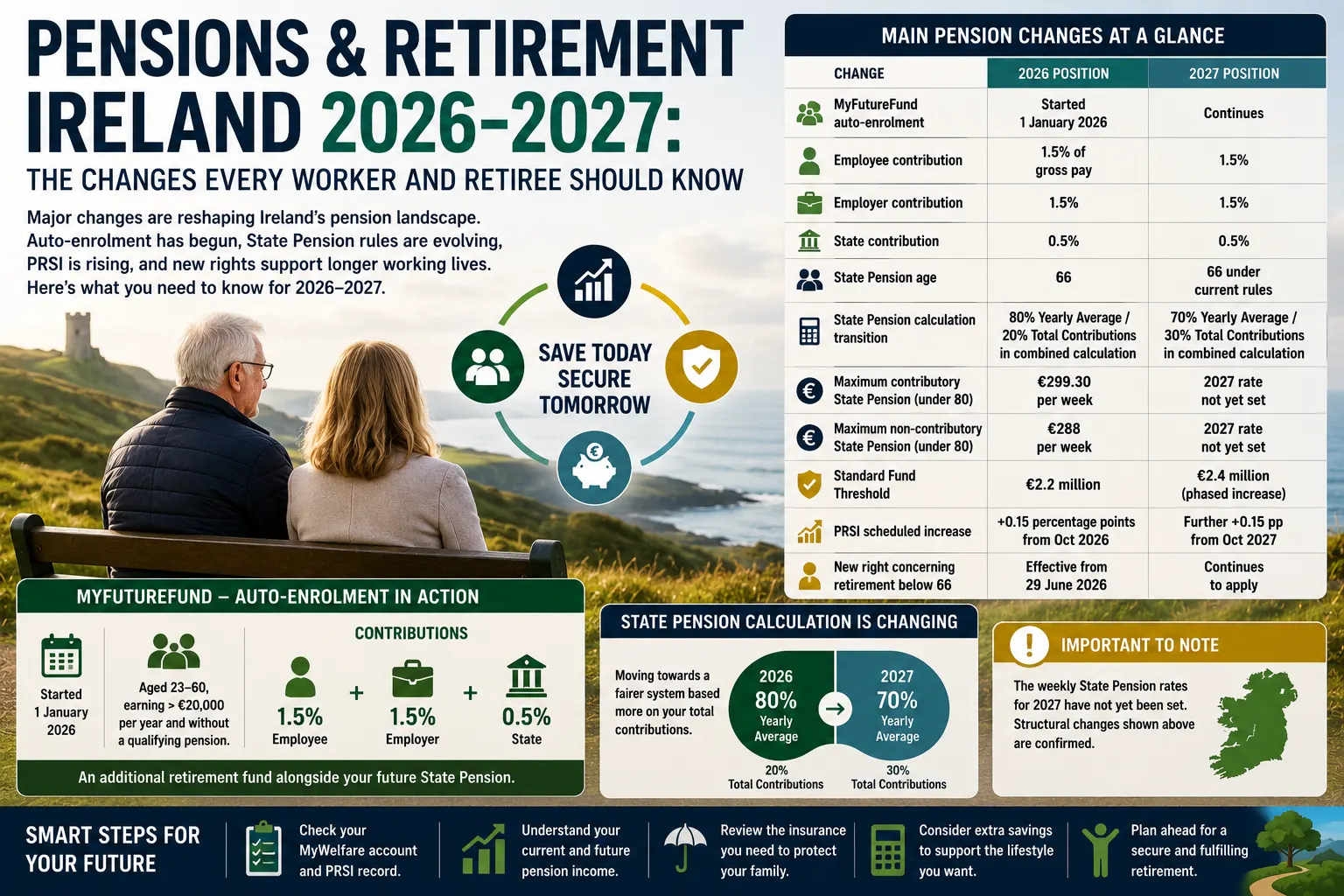
Pensions & Retirement Ireland 2026–2027: The Changes Every Worker and Retiree Should Know
Ireland’s pension system is entering one of its most significant periods of change in decades. Auto-enrolment began in 2026, State Pension calculations are moving progressively towards a lifetime-contributions model, PRSI rates are rising, workers have gained new rights to remain employed until State Pension age, and the tax ceiling applying to large pension funds is increasing. Some changes for 2027 are already built into the system, while others — including the actual weekly State Pension rate for 2027 — have yet to be decided.
For years, retirement planning in Ireland could broadly be divided into two groups: people who had an occupational or private pension and those who expected to rely largely on the State Pension. The introduction of MyFutureFund in January 2026 has begun to alter that structure by automatically bringing many workers without existing supplementary pension coverage into a retirement savings system for the first time.
At the same time, reforms to the State Pension are changing how contribution histories are assessed, while new employment legislation gives some older workers greater control over when they leave the workforce. Taken together, the measures introduced in 2026 and those already scheduled for 2027 represent more than a collection of annual adjustments. They mark a gradual redesign of how Ireland expects workers to prepare financially for retirement.
The Main Pension Changes at a Glance
| Change | 2026 Position | 2027 Position |
|---|---|---|
| MyFutureFund auto-enrolment | Started 1 January 2026 | Continues |
| Employee MyFutureFund contribution | 1.5% of gross pay | 1.5% |
| Employer MyFutureFund contribution | 1.5% | 1.5% |
| State MyFutureFund contribution | 0.5% | 0.5% |
| State Pension age | 66 | 66 under current rules |
| State Pension calculation transition | 80% Yearly Average / 20% Total Contributions in combined calculation | 70% Yearly Average / 30% Total Contributions |
| Maximum contributory State Pension under 80 | €299.30 per week | 2027 rate not yet set |
| Maximum non-contributory State Pension under 80 | €288 per week | 2027 rate not yet set |
| Standard Fund Threshold | €2.2 million | €2.4 million under the phased increase |
| PRSI scheduled increase | +0.15 percentage points from October 2026 | Further +0.15 percentage points from October 2027 |
| New right concerning retirement below 66 | Effective from 29 June 2026 | Continues to apply |
The distinction between confirmed and unconfirmed 2027 measures is important. Structural changes such as the pension-calculation transition, the Standard Fund Threshold increase and the scheduled PRSI increase are already part of the current framework. The weekly State Pension rate for 2027, however, has not yet been set and should not be treated as known before the relevant budget decisions are made.
MyFutureFund Is the Biggest Structural Change of 2026
The most important pension development of 2026 is the introduction of MyFutureFund, Ireland’s automatic-enrolment retirement savings system. Contributions began on 1 January 2026, bringing workers without an existing qualifying pension arrangement into retirement saving through payroll.
Employees are generally automatically enrolled where they are aged between 23 and 60, earn more than €20,000 per year across their employments and are not already making qualifying pension contributions through payroll. The system is administered centrally rather than requiring every employer to establish a separate pension scheme.
This matters because MyFutureFund is not designed to replace the State Pension. Instead, it creates an additional retirement fund alongside future State Pension entitlement. For many employees who previously had no occupational pension or PRSA, retirement provision can therefore begin to consist of two separate elements: the State Pension based on social-insurance contributions and an invested MyFutureFund savings pot accumulated during employment.
How Much Goes Into MyFutureFund in 2026 and 2027?
The initial contribution rate is deliberately modest. During the first phase of the scheme, the employee contributes 1.5% of gross pay, the employer contributes another 1.5% and the State adds 0.5%. Those rates are scheduled to remain unchanged throughout 2026 and 2027.
Consider an employee earning €40,000 a year. At the current contribution rates, the employee contributes €600 annually, the employer contributes another €600 and the State adds €200. A total of €1,400 therefore enters the retirement fund during the year before investment performance and charges are considered.
| Example: €40,000 Annual Gross Pay | Annual Amount |
|---|---|
| Employee contribution at 1.5% | €600 |
| Employer contribution at 1.5% | €600 |
| State contribution at 0.5% | €200 |
| Total annual retirement contribution | €1,400 |
The example illustrates one of the main attractions of automatic enrolment. The worker contributes €600, but €1,400 is directed towards retirement because the employer matches the employee contribution and the State adds a further top-up.
MyFutureFund Is Different From Traditional Pension Tax Relief
MyFutureFund does not operate in exactly the same way as traditional pension tax relief. Qualifying personal contributions to occupational pensions, PRSAs and similar pension arrangements can generally receive Income Tax relief at the saver’s marginal rate, subject to Revenue limits. MyFutureFund instead provides a direct State contribution alongside the employee and employer contributions.
This difference can matter, particularly for workers paying Income Tax at the higher rate. A conventional pension contribution may produce a different tax result from the MyFutureFund State top-up. That does not automatically mean one option is superior in every case because employer contributions, fees, investment structures, scheme benefits and personal circumstances all matter. It does mean workers should not assume that all pension arrangements are financially identical simply because they are designed for retirement.
Employees Can Opt Out — but the Decision Has Consequences
Automatic enrolment does not mean an employee must remain in MyFutureFund permanently. After the initial participation period, an employee can use the scheme’s opt-out arrangements during the applicable window.
The decision should not be treated simply as a way to increase take-home pay. Opting out means future employee contributions stop, but so do the corresponding future employer and State contributions while the worker remains outside the scheme. A worker therefore gives up more than their own payroll deduction.
For somebody considering opting out, the financially relevant question is not only how much extra money will appear in the monthly salary. It is also how much employer and State money will no longer be added to retirement savings.
Existing Workplace Pensions Still Matter
MyFutureFund was not designed to replace every occupational pension arrangement. Employees already making qualifying pension contributions through payroll may fall outside automatic enrolment for that employment.
This creates an important comparison for workers. An existing occupational pension may offer employer contributions above the minimum required under MyFutureFund, different investment choices, lower or higher charges, death-in-service benefits or other protections. The fact that somebody already has “a pension” is therefore only the beginning of the analysis.
Employees should establish what type of scheme they have, how much they and their employer contribute, what charges apply, how funds are invested and what benefits are available before assuming that auto-enrolment would necessarily be better or worse.
Contribution Rates Will Eventually Rise — but Not in 2027
The 1.5% employee and employer contribution rates are only the starting point. MyFutureFund is designed to increase contribution percentages gradually over time, eventually reaching 6% from the employee and 6% from the employer, with the State contribution rising correspondingly.
For workers planning their household budgets, the important point is that the first scheduled increase does not occur during 2027. The initial rates remain in place through the introductory phase, giving employees and employers time to adjust before later contribution increases become more substantial.
That means the immediate effect on take-home pay remains relatively limited in 2026 and 2027, while the long-term effect on retirement saving becomes progressively greater in later years.
State Pensions Increased in January 2026
Budget 2026 increased the maximum weekly rates of State pensions by €10 from January 2026. The maximum personal rate of the State Pension (Contributory) for a person under the age of 80 therefore became €299.30 per week, while the maximum rate for someone aged 80 or over became €309.30.
The maximum State Pension (Non-Contributory) rate for people aged between 66 and 79 became €288 per week, rising to €298 for those aged 80 and over. Unlike the contributory pension, the non-contributory pension is means tested.
Other supports can also form part of retirement income. Depending on individual circumstances, older people may qualify for measures such as the Living Alone Increase, Household Benefits Package or Fuel Allowance. The weekly State Pension rate should therefore not automatically be viewed as the total amount of State support potentially available to a pensioner.
The 2027 State Pension Rate Is Not Yet Known
It is important not to present a future pension increase as a confirmed entitlement before the relevant budget has been decided. As of August 2026, the weekly State Pension rates applying in 2027 have not yet been established.
The confirmed 2026 maximum contributory rate for a person under 80 is €299.30 per week. Whether that figure rises in 2027, and by how much, will depend on future government budget decisions.
Consumers should therefore be cautious when they encounter forecasts or pension calculators that present an exact 2027 State Pension payment before those decisions have been announced.
The State Pension Age Remains 66
Ireland’s State Pension age remains 66 under the current system. People who qualify for the State Pension (Contributory) can generally begin claiming from that age.
For eligible people born on or after 1 January 1958, however, there is now greater flexibility. They can choose to begin claiming the contributory State Pension between the ages of 66 and 70. Deferring the pension can result in a higher actuarially adjusted weekly payment, while someone who continues working may also continue building qualifying PRSI contributions where their record is not already complete.
This means retirement age and State Pension age no longer necessarily represent the same moment. A person may retire before 66 and finance the gap privately, claim the State Pension at 66, continue working while drawing the pension where the rules permit, or defer the contributory pension until a later age.
State Pension Calculations Are Changing in 2026 and 2027
One of the most important but less visible reforms concerns how the State Pension (Contributory) is calculated. Ireland is gradually moving away from the traditional Yearly Average approach towards the Total Contributions Approach, which places greater emphasis on the total social-insurance contribution record built over a person’s working life.
The transition is being phased in over several years rather than changing overnight. In 2026, the combined calculation uses an 80% weighting for the Yearly Average result and 20% for the Total Contributions result. In 2027, that balance changes to 70% Yearly Average and 30% Total Contributions.
The transition continues gradually until the Total Contributions Approach becomes the dominant calculation method. This is important because two people who worked for similar numbers of years can have very different PRSI contribution patterns and therefore different pension outcomes.
Workers approaching retirement should therefore obtain their official PRSI Contribution Statement and check their record rather than assuming that years spent working automatically translate into the maximum State Pension.
Caring Periods Can Protect a Pension Record
The move towards a lifetime-contributions model does not mean periods spent outside paid employment because of caring responsibilities are simply ignored. Eligible HomeCaring Periods can be recognised for people who spent time caring for children or certain incapacitated persons, subject to the applicable rules.
Up to 1,040 HomeCaring Periods, equivalent to 20 years, can potentially be taken into account. Separate Long-Term Carers Contributions can also recognise extensive periods spent providing full-time care.
These provisions are important because a contribution system based purely on paid employment could otherwise disadvantage people who spent substantial parts of their working lives carrying out unpaid caring work. Anyone approaching retirement who has a significant caring history should therefore check whether the relevant periods have been properly recognised.
A New Right to Continue Working Took Effect in June 2026
Pension reform in 2026 extends beyond pension products themselves. The Employment (Contractual Retirement Ages) Act 2025 came into operation on 29 June 2026 and created a new right for certain employees whose contractual retirement age is below the State Pension age of 66.
Eligible employees whose contractual retirement age is 65 or younger can notify their employer that they do not consent to retirement at that age and wish to continue working until State Pension age. The law does not force employees to keep working; it gives qualifying workers greater ability to choose.
The change is particularly important for people who previously faced a potential income gap between compulsory retirement at 65 and access to the State Pension at 66. For those affected, remaining in employment for another year can mean another year of salary, further pension contributions and one less year in which private savings have to fund normal living costs.
Employers Can Still Enforce Earlier Retirement in Some Cases
The new legislation does not abolish contractual retirement ages entirely. Where an employer seeks to enforce a retirement age below 66 after receiving the relevant notification from an employee, the employer must be able to objectively and reasonably justify that decision by reference to a legitimate aim and demonstrate that the approach is appropriate and necessary.
The legislation therefore shifts the balance towards greater choice for older employees without making continued employment automatic in every case.
It also does not affect all occupations in exactly the same way. Certain professions and public-service roles can be subject to specific statutory retirement arrangements that operate under separate rules.
PRSI Rises Again in October 2026 and 2027
Another change with long-term pension significance is the scheduled increase in PRSI contributions. All PRSI classes are due to rise by 0.15 percentage points from October 2026, followed by a further 0.15 percentage-point increase from October 2027.
The purpose is broader than pensions alone because the Social Insurance Fund supports a range of benefits. However, the State Pension (Contributory) is one of the largest demands on that system, and the ageing of Ireland’s population is expected to increase long-term financing pressure.
For individual workers, each annual change is relatively small when viewed in isolation. Over time, however, the cumulative increase in social-insurance contributions becomes more noticeable for employees, employers and self-employed contributors.
The Standard Fund Threshold Rises for Large Pension Pots
A separate reform affects people with particularly large private or occupational pension entitlements. Ireland’s Standard Fund Threshold limits the capital value of tax-relieved pension benefits that can be crystallised before chargeable excess tax potentially applies.
The threshold increased from €2 million to €2.2 million in 2026. Under the phased schedule, it is set to rise again to €2.4 million in 2027, followed by further increases in subsequent years.
This will not affect the majority of pension savers. It is most relevant to people with substantial defined-benefit entitlements, senior executives, some public-sector professionals, business owners and individuals who have accumulated very large pension funds over long careers.
For those approaching the threshold, pension planning can become highly technical because fund value, retirement date, benefit type and taxation can all affect the final outcome.
The €200,000 Tax-Free Retirement Lump-Sum Limit Remains Separate
The increase in the Standard Fund Threshold should not be confused with the rules governing pension retirement lump sums. The lifetime amount of relevant pension lump sums that can currently be received free of Income Tax remains €200,000 across applicable pension arrangements.
Amounts between €200,001 and €500,000 are generally taxed at 20%, while amounts above that level can attract higher taxation under the applicable rules.
A higher Standard Fund Threshold therefore does not mean an individual can automatically take a larger tax-free cash amount at retirement. The two limits serve different purposes and should be considered separately.
Traditional Pension Tax Relief Remains Important
The introduction of MyFutureFund has not removed existing tax relief for qualifying private pension contributions. Employees and self-employed people can continue to receive Income Tax relief on eligible personal contributions to occupational pension schemes, PRSAs, Retirement Annuity Contracts and other qualifying arrangements, subject to Revenue rules.
The percentage of relevant earnings that can qualify for relief increases with age. Current limits range from 15% for people under 30 to 40% for those aged 60 or over, subject to the applicable earnings ceiling.
For example, a person aged 45 earning €60,000 can potentially obtain Income Tax relief on qualifying personal pension contributions of up to 25% of relevant earnings, or €15,000, assuming the other conditions are met.
This age-related system gives workers greater tax-relieved contribution capacity as retirement approaches. It can be particularly useful for people who wish to increase pension saving during their forties, fifties or early sixties, although larger late-life contributions cannot fully replicate the investment growth that might have been achieved by starting much earlier.
Self-Employed People Are Not Automatically Enrolled
One of the most important limitations of MyFutureFund is that the system is centred on employees and payroll. Self-employed people are not automatically placed into retirement saving in the same way.
A sole trader, freelancer, farmer, consultant or business owner must therefore continue to make an active decision to establish private pension provision if they want retirement income beyond the State Pension.
That distinction could become increasingly important over time. An employee without a pension may now be automatically moved into supplementary saving, while a self-employed person can still spend decades working without accumulating a private pension unless they deliberately create one.
For the self-employed, PRSAs and other qualifying personal pension structures therefore remain particularly significant.
What MyFutureFund Means for Someone Earning €50,000
Consider an employee aged 35 earning €50,000 per year who previously had no pension. At the introductory MyFutureFund rates, the employee contributes €750 annually. The employer adds another €750 and the State contributes €250.
| €50,000 Salary Example | Annual Contribution |
|---|---|
| Employee | €750 |
| Employer | €750 |
| State | €250 |
| Total annual retirement contribution | €1,750 |
If the worker remains enrolled throughout 2027, the same contribution percentages continue under the current timetable. If salary rises, the euro amount contributed also increases.
The significance is not simply the €1,750 accumulated during one year. The larger effect comes from making retirement contributions repeatedly over decades while receiving additional money from both the employer and the State.
Someone Turning 66 in 2027 Faces a Different Pension Calculation
For workers approaching retirement, the change in State Pension methodology may be more significant than MyFutureFund. A person reaching State Pension age in 2027 enters the transitional calculation when the combined method has moved from the 2026 weighting of 80% Yearly Average and 20% Total Contributions to 70% and 30% respectively.
That does not automatically mean a person retiring in 2027 receives more or less than somebody retiring in 2026. The outcome depends on the individual’s contribution history.
Someone with a strong and consistent lifetime PRSI record may fare differently from somebody whose older Yearly Average calculation was particularly favourable. This is precisely why workers approaching retirement should check their actual contribution record rather than trying to estimate entitlement based only on years worked.
Working Beyond 65 Can Have Major Financial Value
The interaction between retirement law and pension rules can significantly affect household finances. Consider someone earning €50,000 who previously expected to retire at 65 but did not qualify for the State Pension until 66.
If that person can now remain employed for another year, the financial effect is much greater than simply receiving one more year’s salary. The worker can avoid using private savings for living costs, potentially make another year of pension contributions and keep existing retirement funds invested for longer.
For someone with relatively modest private pension savings, that additional year can materially improve retirement security.
The right choice will still depend on health, family circumstances, employment conditions and personal priorities. The financially optimal retirement age is not necessarily the age at which an individual wants to stop working.
Retirement Is Becoming More Flexible — and More Complicated
Ireland is gradually moving away from a single fixed idea of retirement. The State Pension remains available from age 66, but eligible people can defer the contributory pension until as late as 70. Some workers now have stronger rights to remain employed until State Pension age, while those with sufficient private resources can still retire earlier.
Greater flexibility provides choice, but it also makes retirement planning more complicated. Someone deciding whether to retire at 65, 66, 67 or later has to consider salary, occupational pension rules, private savings, mortgage debt, State Pension entitlement, tax, health and family circumstances.
There is therefore no single retirement age that is financially best for everyone.
What Workers in Their Twenties and Thirties Should Do
For younger employees, MyFutureFund is the most immediate development. Workers automatically enrolled should understand what is being deducted, how much their employer contributes and how much the State adds before considering whether to opt out.
Someone with access to a strong occupational pension should compare the two arrangements carefully. Employer contribution rates, investment charges and additional benefits can make an existing workplace pension significantly more valuable than the minimum automatic-enrolment structure.
The greatest financial advantage younger workers possess is time. Even relatively modest pension contributions can accumulate over 30 or 40 years, giving investment returns far longer to compound than contributions begun shortly before retirement.
What Workers in Their Forties and Fifties Should Do
Workers in their forties and fifties should use the changes of 2026 as an opportunity for a complete pension review. Many people have pension benefits left with previous employers, a current occupational scheme, a PRSA or other retirement assets that have never been brought together into one financial picture.
The first step should be to identify every pension rather than automatically transferring or consolidating them. Each arrangement may have different charges, guarantees, retirement ages, investment options or benefit rules.
This age group can also make use of progressively higher limits for tax-relieved personal pension contributions. For people who have underfunded retirement earlier in life, the final 10 or 20 working years can therefore become an important period for increasing contributions.
What People Within Five Years of Retirement Should Do
Anyone approaching retirement should place particular emphasis on the accuracy of their PRSI Contribution Statement. Missing or incorrect contributions can affect State Pension entitlement, and identifying discrepancies several years before retirement is preferable to discovering them only when the pension application is made.
People in this group should also examine whether claiming the State Pension at 66 or deferring it would better suit their circumstances. Those facing contractual retirement before 66 should establish whether the new employment legislation applies to them.
For households with large private pension assets, the rising Standard Fund Threshold and retirement lump-sum tax rules may also affect the timing and structure of benefit drawdown. At this stage, individual financial and tax advice can become particularly valuable because relatively small planning decisions may involve large sums of money.
What Existing Pensioners Should Watch in 2027
For existing pensioners, one of the most important unanswered questions is the weekly State Pension rate that will apply in 2027. The 2026 maximum contributory pension for people under 80 is €299.30 per week, but any increase for the following year depends on future budget decisions.
Pensioners should also continue checking eligibility for supplementary supports. Living arrangements, age, income and household circumstances can affect access to measures such as the Living Alone Increase, Fuel Allowance and Household Benefits Package.
Retirement income should therefore be reviewed as a collection of possible entitlements rather than simply one weekly pension payment.
Ireland Is Moving Towards a Three-Part Retirement System
The direction of reform is becoming increasingly clear. For many workers, future retirement income is likely to come from three broad sources: the State Pension, an occupational or auto-enrolment pension, and additional private savings or investments.
MyFutureFund addresses a longstanding weakness by automatically creating a second retirement pillar for many employees who previously had no supplementary pension. The move towards the Total Contributions Approach simultaneously makes State Pension entitlement more closely connected with the contribution history accumulated across a working life.
The new employment rules add another component by making it easier for some workers to avoid an involuntary gap between contractual retirement and State Pension age.
Together, these changes create a retirement system that is more layered than the one many previous generations experienced.
What Is Already Certain for 2027 — and What Is Not
Several important developments for 2027 can already be identified with reasonable certainty. MyFutureFund continues at the introductory 1.5% employee contribution, 1.5% employer contribution and 0.5% State contribution. The State Pension transitional calculation moves to a 70% Yearly Average and 30% Total Contributions weighting. The Standard Fund Threshold is scheduled to increase to €2.4 million, and another 0.15 percentage-point PRSI increase is scheduled from October 2027.
The new rights concerning contractual retirement ages introduced in 2026 will also continue to affect eligible workers.
What cannot yet be stated with certainty is the weekly State Pension payment that will apply after any Budget 2027 decisions, whether new once-off payments or supplementary pensioner supports will be announced, or whether additional tax measures will be introduced.
Separating these two categories — already established changes and future political decisions — is essential when planning retirement finances.
A Major Shift in How Ireland Prepares for Retirement
For some workers, the individual changes introduced in 2026 can appear relatively small. A 1.5% MyFutureFund deduction may barely alter a monthly payslip. A 0.15 percentage-point PRSI increase looks modest. A technical adjustment to the State Pension calculation may seem remote to someone who is still years away from retirement.
Taken together, however, the reforms are significant. Workers who previously had no supplementary pension are beginning to save automatically. The State Pension is moving towards a system based increasingly on lifetime contributions. Older employees have gained greater choice over continuing to work until State Pension age, while the financing of social insurance is being gradually strengthened.
For younger people, the central question is whether automatic enrolment will provide enough retirement income over a full career. For workers in their forties and fifties, the priority is understanding what they have already accumulated and whether additional saving is required. For those approaching 66, the accuracy of the PRSI record, the timing of State Pension claims and the decision over when to leave employment become increasingly important.
The reforms of 2026 and 2027 do not guarantee that every future pensioner will have a comfortable retirement. They do, however, move Ireland towards a system in which retirement saving begins automatically for many more workers and in which State Pension entitlement, private saving and employment decisions are increasingly connected.
For consumers, perhaps the most important change is therefore not a single pension rate, threshold or contribution percentage. It is the recognition that retirement planning is becoming a process that begins with today’s payslip rather than a decision left until the final years of working life.
Source & Transparency
This article is published by Ireland Newspaper for editorial and informational purposes.
Published: 13 August 2026 · Updated: 13 August 2026

Newsroom Ireland Newspaper
Ireland Newspaper editorial team prepares daily news coverage for readers in Ireland and abroad.