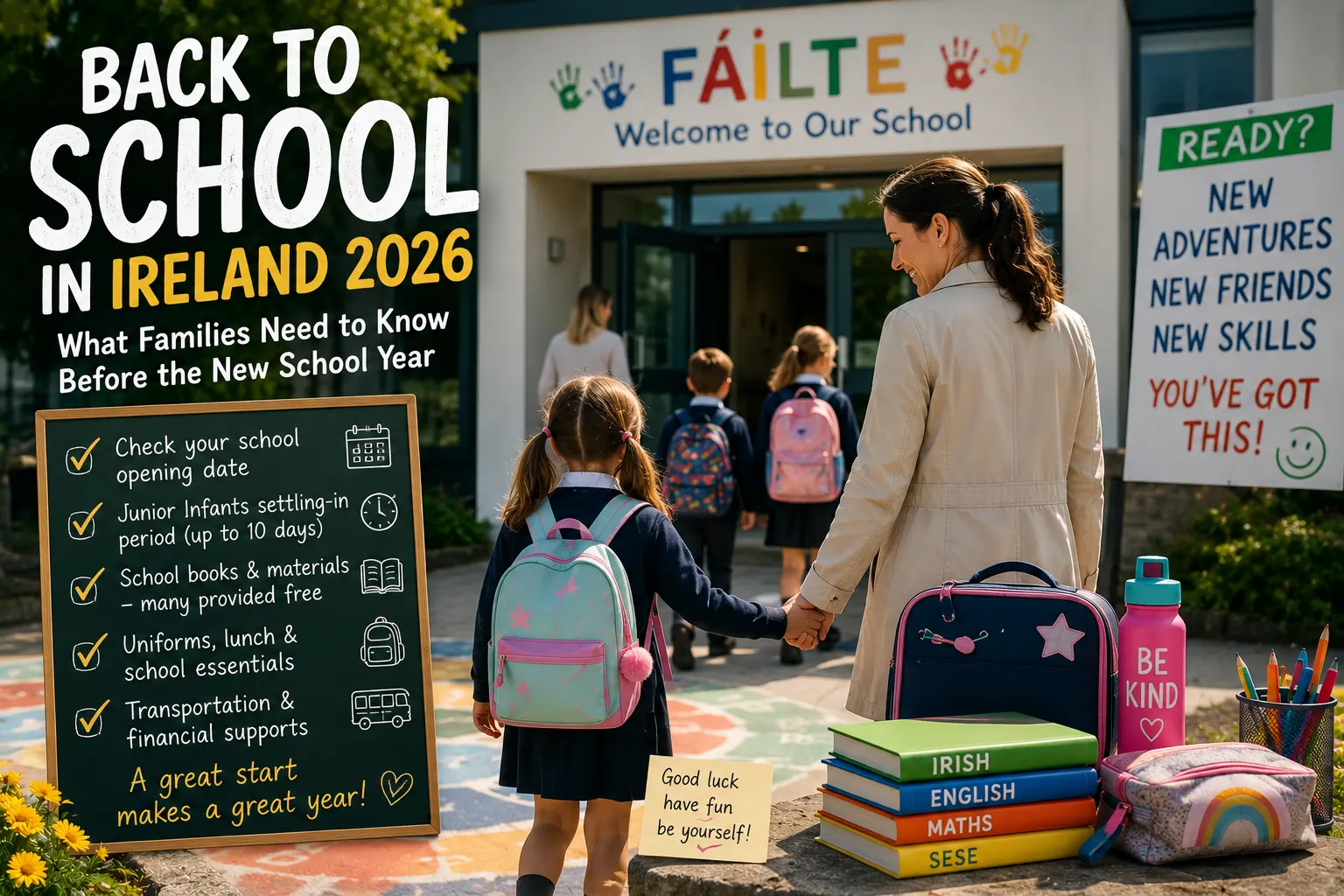
Across Ireland, school bags are being prepared, uniforms checked and new routines planned. For experienced parents, the return to school is familiar. For a child entering Junior Infants for the first time , however, late August or early September represents a major change: a new building, teacher, timetable, classmates and daily routine. There is also more practical information for parents to absorb than might initially appear. The 2026/27 school year does not have one nationally fixed first day
. Schools determine their precise reopening dates within the national framework and communicate them directly to families. Department of Education arrangements state that the school year would normally begin during the week in which 1 September falls, although schools retain some flexibility over the exact start and end of the year. That makes the school’s own calendar — rather than a general online school calendar — the document every parent should check first.
For Junior Infants, the first weeks can be different
Most children in Ireland begin primary school at the age of four or five , although compulsory education begins at six. Primary education then runs through Junior Infants, Senior Infants and First to Sixth Class. Children entering Junior Infants can have a slightly different start from older pupils. The national school-year arrangements permit schools to send Junior Infants home earlier during the initial settling-in period, but this practice is limited to no more than ten school days at the beginning of the year. Primary and special schools must otherwise provide at least 182 school days
during the academic year. This is particularly important for working parents. A child who will eventually attend a normal infant school day may therefore have a shorter timetable during the first days of September. Parents should ask their individual school exactly when Junior Infants finish during the settling-in period and when the normal timetable begins. It is a small detail that can create a surprisingly large childcare problem if discovered only on the first morning.
The first day does not need to be perfect
For a four- or five-year-old, school is an enormous change in scale. A child who has attended preschool may already be comfortable in a group environment, but primary school introduces different expectations: following the school timetable, managing belongings, listening to instructions in a larger class, navigating the playground and gradually taking greater responsibility for simple everyday tasks. Parents can prepare children without turning the beginning of school into an examination. Knowing how to open a lunchbox, recognise a coat or schoolbag, use the toilet independently as far as developmentally appropriate, put belongings away and tell an adult when something is wrong can be more useful during the first week than arriving with advanced academic knowledge. A Junior Infant is not expected to arrive already knowing how to read, write and do formal mathematics
. The purpose of school is to teach and develop those skills. The more useful preparation is often confidence in ordinary routines.
A simple routine can make the transition easier
The adjustment to school can begin before the classroom door opens. During the final weeks of the holidays, gradually returning to a consistent bedtime and morning routine can help reduce the shock of an early start. Parents can practise the journey to school, show children where they will enter and leave, and explain in simple terms what will happen. Long explanations are not necessarily better. For a young child, knowing that a parent or designated adult will return at a particular point in the day can be more reassuring than receiving a detailed description of the entire school system. It can also help to label clothing, coats, lunch containers and other personal items clearly. A classroom containing 20 or more similar jumpers, bottles and schoolbags makes unidentified property remarkably difficult to return to its owner.
Parents should check these things before the first morning
The details differ from school to school, but families preparing for Junior Infants should confirm:
- the exact first day and arrival time specified by the school;
- the Junior Infant collection time for the first ten school days and when normal hours begin;
- where children should be dropped off and collected;
- the school’s uniform requirements;
- what lunch and drink arrangements apply;
- whether the school participates in the Hot School Meals Programme;
- which books and classroom materials are being supplied by the school;
- whether any additional stationery must actually be purchased;
- transport arrangements and the location of the bus stop, where relevant;
- emergency contact details held by the school;
- details of allergies, medical conditions or medication that the school needs to know;
- after-school or childcare arrangements;
- and whether the school requires any remaining forms, consent documents or pupil information before term begins.
One short check with the school now can prevent a number of avoidable problems during the first week.
Families should not automatically buy schoolbooks
One of the biggest changes in the cost of education in recent years is Ireland’s Schoolbooks Scheme . At primary level, the scheme covers pupils in recognised primary and special schools and is intended to remove the cost to families of schoolbooks, workbooks and copybooks covered by the programme. Parents of a new Junior Infant should therefore wait for their school’s instructions before purchasing books or copybooks themselves . Schools decide how the scheme is implemented locally and communicate to parents what is being supplied. The principle now extends far beyond the first years of primary school. Since the 2025/26 academic year, students in post-primary schools participating in the Free Education Scheme have also been covered by the Post-primary Schoolbooks Scheme. It provides schoolbooks and core classroom resources including items such as journals, copybooks, dictionaries and calculators within the scheme. Parents are not expected to buy or rent the items covered. Some books remain the property of the school and may have to be returned. The practical message is simple: do not spend money on a general schoolbook list until the school has explained exactly what it provides.
Uniforms and clothing remain a significant cost — but support is still available
Books may now be covered, but preparing children for school can still create significant household costs. Uniforms, shoes, coats, sports clothing, bags and other items can add up quickly, particularly in families with several children. The Back to School Clothing and Footwear Allowance remains available in 2026 for households meeting its income and qualifying-payment conditions. For the 2026 scheme, the payment is €160 for each eligible child aged two to 11 and €285 for eligible children aged 12 and over within the scheme’s rules . More than 126,000 families were receiving payments when the Department of Social Protection issued the main 2026 payments in July. Families who did not automatically receive the payment may still be able to apply if they satisfy the conditions. The important date is 30 September 2026
, which is the closing date for applications for this year’s scheme. For a qualifying family with a child beginning Junior Infants, that €160 can therefore contribute towards clothing and footwear expenses even after the school year has started, provided the application is made by the deadline.
School transport: late applicants should act now
Transport deserves particular attention because the main on-time application deadline for 2026/27 has already passed . The Bus Éireann School Transport Family Portal is currently open for applications and payments, but the closing date for on-time applications was 8 May 2026 . Late applications can still be made, although a late application or payment can mean that a seat is not available. Under the general eligibility rules, primary pupils can qualify where they live at least 3.2 kilometres from their nearest appropriate national school , subject to the detailed rules of the scheme. For 2026/27, the annual mainstream School Transport charge is €100 for an eligible or concessionary primary pupil
, with a primary-school family maximum of €200 . At post-primary level, the corresponding individual charge is €100 and the family maximum is €220, with an overall maximum family contribution of €220 under the published fee structure. Anyone depending on school transport who has not completed the process should therefore not wait until the night before school begins. Parents should log into the Bus Éireann School Transport system and establish their child’s current application and ticket status now.
Free hot meals are increasingly part of the primary-school day
Another important change for families is the expansion of the Hot School Meals Programme . All primary schools have been given the opportunity to participate in the hot-meals programme following its phased national expansion, although the practical arrangements depend on whether the individual school has joined and completed the necessary arrangements. For parents of Junior Infants, that creates a very practical question: Does the child’s school provide a hot meal, and if so, when does the service begin? Families should not assume either way. Schools may have different ordering systems, menus and start dates. Children with food allergies, intolerances, cultural or other dietary requirements should have those issues communicated to the school according to its procedures. Even where a school provides a meal, a young child may still need a drink, snack or other items depending on the school’s daily arrangements.
Junior Infant vaccinations take place during the school year
Beginning primary school also coincides with an important stage in Ireland’s childhood vaccination programme. The HSE offers children in Junior Infants two vaccines : the 4-in-1 booster , protecting against diphtheria, tetanus, pertussis and polio, and a second MMR dose , protecting against measles, mumps and rubella. Primary-school vaccinations normally take place between September and December , with both vaccines usually given during the same visit. There is a regional exception. In Sligo, Leitrim and Donegal
, the Junior Infant vaccinations are not normally administered in the primary school; parents need to arrange them through their GP. Parents will receive information and consent arrangements through the school or health service. On vaccination day, the HSE asks children to bring their vaccination passport where available so the new vaccines can be recorded. Children entering the first year of secondary school enter another stage of the programme. The HSE offers first-year students HPV, Tdap and MenACWY vaccinations
, normally later in the school year.
Medical information should reach the school before it is urgently needed
A child with asthma, epilepsy, diabetes, severe allergies or another medical condition may need an individual arrangement with the school. The beginning of the year is the time to ensure that emergency contacts are correct, the school has the necessary medical information and any medication arrangements have been agreed. Parents should not assume that information provided to a preschool, GP or another service is automatically available to the primary school. For a severe food allergy in particular, parents should speak directly with the school about its procedures rather than relying exclusively on a note inside a schoolbag. The same principle applies to emotional, communication, mobility and other additional needs: early information gives the school more opportunity to plan appropriately.
More special classes are opening for 2026/27
The new school year also brings further expansion of special educational provision. In April, the Department of Education announced 40 new special classes and five new inclusive special classes for the 2026/27 school year , with additional staffing and funding arrangements attached to those classes. For parents of children with special educational needs, communication between the family, school and the National Council for Special Education remains particularly important. A child does not need to arrive on the first day with every aspect of school life already mastered. But where significant support is required, early discussion can help ensure that the appropriate people understand the child’s needs before difficulties emerge.
Children learning English can receive support through the school
Ireland’s classrooms continue to include children arriving from many different linguistic backgrounds. The Department of Education maintains arrangements allowing schools to seek English as an Additional Language support , including specific procedures for new entrants during the 2026/27 year. Parents whose child speaks little or no English at home should not see that fact as a reason to delay communication with the school. Schools regularly work with multilingual families. Parents should tell the school about the languages the child uses and ask how language support will be organised where it is required. For a young child, entering an English-speaking classroom can initially be tiring even when adaptation ultimately happens quickly.
Attendance begins to matter from the start
Irish law requires children to receive education from the age of six, but once a child is enrolled, regular attendance is important throughout primary school. Schools monitor pupil attendance, and Tusla’s Education Support Service is involved where significant attendance difficulties arise. Parents who experience persistent difficulties getting a child to school can seek advice rather than allowing the situation to continue without contact. For Junior Infants, occasional illness and the adjustment to a new environment are normal realities. Regular attendance does not mean sending an unwell child into school simply to preserve an attendance record. It means establishing school as the child’s normal daily routine and communicating with the school when absence is necessary.
What if a child still does not have a school place?
With the new term approaching, some families may still be dealing with admission difficulties. Schools must operate admissions policies under Ireland’s school-admission framework. Where admission has been refused because a school is oversubscribed, parents can request a review and may, subject to the statutory requirements, use the Section 29 appeal process . A Section 29 appeal concerning refusal of admission must generally be made within 63 calendar days of the decision to refuse admission . Families in that situation should therefore not assume they can simply wait until September and reconsider the issue later. Deadlines continue to run during the summer.
The 2026/27 school calendar
Although individual first and final days can vary, the principal breaks are nationally standardised. For October mid-term , schools will be closed from Monday 26 October to Friday 30 October 2026 , returning on Monday 2 November . The Christmas break begins after Tuesday 22 December 2026 , with schools reopening on Wednesday 6 January 2027 . At post-primary level, the February mid-term runs from Monday 15 to Friday 19 February 2027 . At primary level, the standard closure covers Thursday 18 and Friday 19 February
, although schools can use discretionary days to create a longer break where their calendar permits. Schools close for the Easter break after Friday 19 March 2027 and reopen on Monday 5 April 2027 under the standardised calendar. Parents should nevertheless keep their own school’s calendar because local discretionary closures, teacher training days and other permitted variations can produce differences outside the nationally standardised breaks.
Starting secondary school is another major transition
Junior Infants are not the only school beginners this autumn. Thousands of students are moving from Sixth Class into First Year of post-primary school , often from a relatively small primary-school environment into a much larger school with different teachers, classrooms, timetables and subjects. The national rules allow post-primary schools to stagger their return at the beginning of the school year, but only to a limited degree. All students and year groups must be back for tuition by the third day of the school’s year, and post-primary schools must provide at least 166 school days . For a First Year student, learning the timetable, locating classrooms, keeping track of equipment and adapting to several teachers can initially be more difficult than the academic work itself. As with Junior Infants, organisation is often more valuable than pressure.
The most important preparation is not something parents can buy
Back-to-school advertising naturally concentrates attention on shoes, uniforms, stationery, technology and bags. Those things have a practical role. But for a child entering school for the first time, the most valuable preparation is often simpler: knowing who will bring them to school, who will collect them, what their teacher’s name is if known, what happens at lunchtime and that there is an adult they can approach if they are worried. For parents, the equivalent is information. Know the school’s opening date. Know the collection time. Check the free-books arrangements before shopping. Confirm transport before depending on it. Apply for financial support before the deadline. Tell the school about health or additional needs. Read forms that come home in the schoolbag rather than leaving them until weeks later. The Irish school system has changed in ways that should reduce some of the cost pressures on families: free schoolbooks now extend across recognised primary education and participating post-primary schools in the Free Education Scheme, hot meals have expanded substantially across primary education, and targeted back-to-school financial support remains available. Yet no national programme can completely standardise a child’s first morning. Schools are different. Children are different. Some Junior Infants walk through the gate without looking back; others need considerably more time to feel secure. Both can become perfectly settled pupils. For families preparing for the 2026/27 school year
, the objective should therefore not be to create a flawless first day. It should be to remove the avoidable uncertainties so that the child can concentrate on the part that matters most: beginning school, meeting people and discovering that this new place will gradually become part of ordinary life.
Source & Transparency
This article is published by Ireland Newspaper for editorial and informational purposes.
Published: 12 August 2026 · Updated: 14 August 2026

Newsroom Ireland Newspaper
Ireland Newspaper editorial team prepares daily news coverage for readers in Ireland and abroad.