Ireland’s Energy Security in 2026: Far from the Wars, but Not from Their Consequences
Ireland does not depend heavily on Russian gas or Middle Eastern oil arriving directly at its ports, yet it remains one of Europe’s most import-dependent energy systems. The war in Ukraine reshaped Europe’s gas market; the conflict in the Middle East has disrupted the Strait of Hormuz and global oil and LNG flows. For Ireland, the immediate danger is less a sudden nationwide shortage than exposure to international prices, imported gas, oil-dependent transport and a small number of critical energy connections.
Ireland sits on Europe’s Atlantic edge, thousands of kilometres from the battlefields of Ukraine and the energy infrastructure of the Persian Gulf.
Geographically, it looks protected.
Energetically, the picture is very different.
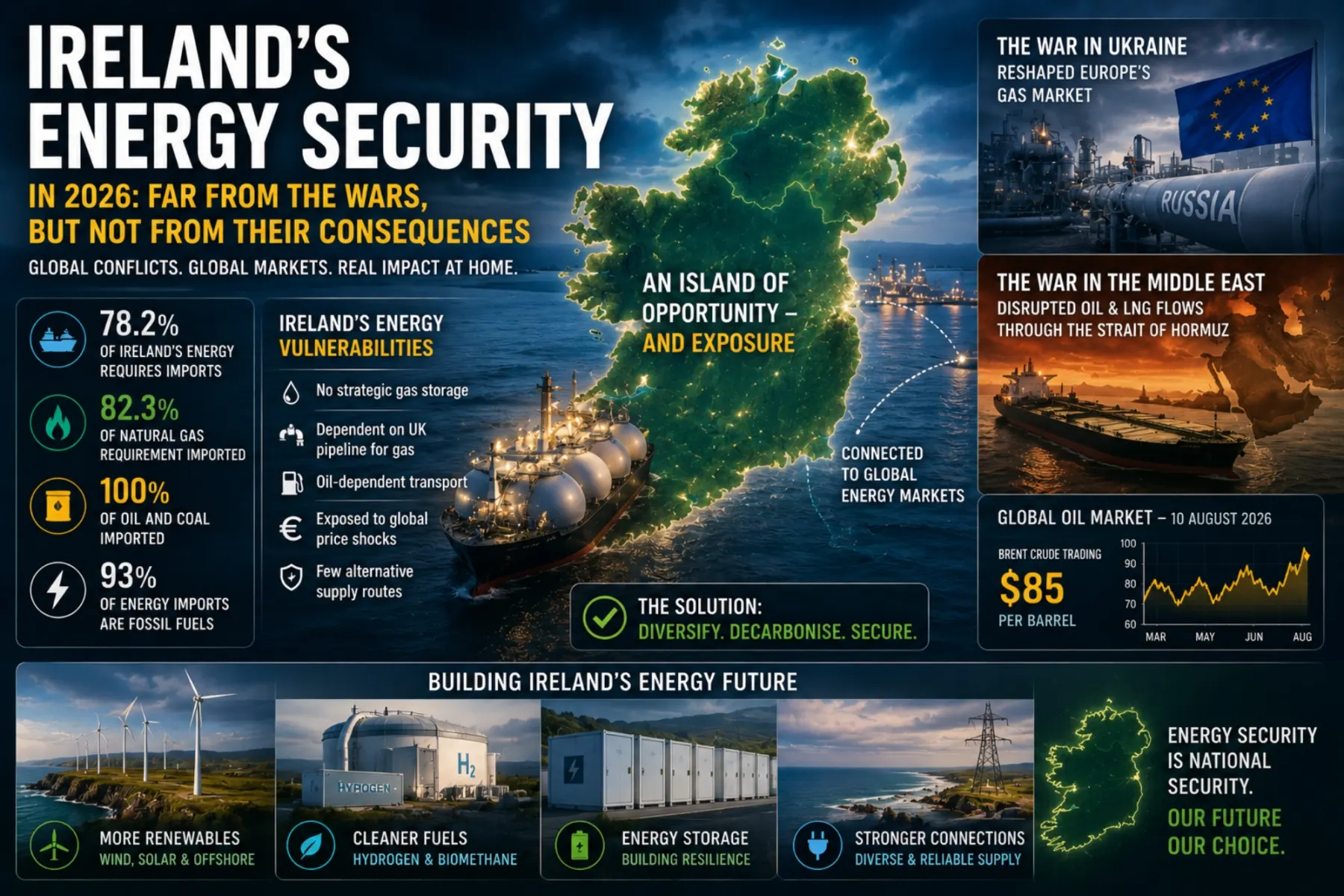
In 2025, 78.2% of Ireland’s total energy requirement depended on imports. The country imported all of its oil and coal and 82.3% of its natural-gas requirement. Almost 93% of its energy imports were fossil fuels. Ireland’s import dependence remained substantially above the latest comparable EU average of 57.3%.
That single set of figures explains why wars far outside Ireland can reach Irish households remarkably quickly.
Not necessarily by switching off the lights.
Through prices.
Through petrol and diesel.
Through aviation fuel.
Through natural gas.
Through electricity-generation costs.
Through fertiliser and transport.
Through industrial production.
And eventually through inflation.
The lesson of the past four years is becoming increasingly difficult to ignore: for an island that imports most of the energy it consumes, energy security is no longer simply about having enough fuel. It is about where that fuel comes from, how it reaches Ireland, what it costs when it arrives and how quickly the country can reduce its dependence on commodities whose prices are determined elsewhere.
Two Wars, Two Different Energy Shocks
Europe has now experienced two major geopolitical energy shocks within only a few years.
Russia’s full-scale invasion of Ukraine in 2022 exposed how dependent much of continental Europe had become on Russian pipeline gas.
The Middle East conflict that began on 28 February 2026 created a different problem.
This time the critical point was the Strait of Hormuz, one of the world’s most important energy shipping routes.
Before the conflict, nearly 20 million barrels per day of crude oil and petroleum products passed through the strait during 2025. The International Energy Agency said restrictions following the outbreak of war created the most severe disruption in the history of the global oil market.
By July, some flows had resumed, but global oil production remained significantly below its pre-war level. On 21 July, the IEA warned that Gulf exports had still not fully recovered and that delayed restoration of LNG traffic through Hormuz was tightening the global gas market.
As of 10 August 2026, uncertainty remains.
Oil prices moved higher again on Monday as negotiations over reopening the Strait of Hormuz remained unresolved. Brent crude was trading around the mid-$80s per barrel after falling sharply during the previous week on hopes of an agreement.
For Ireland, these two conflicts create different vulnerabilities.
Ukraine primarily changed the structure of European gas supply.
The Middle East crisis directly affects the global markets for oil, refined fuels and LNG.
Ireland is exposed to both.
Ireland’s Energy Problem Is Not Direct Dependence on Russia
Ireland’s position within Europe is unusual.
The State was never as directly dependent on Russian pipeline gas as countries such as Germany, Austria or several Central European economies.
Most imported natural gas enters Ireland through pipelines connecting the Irish system to Great Britain, while the Corrib gas field off County Mayo supplies part of domestic demand.
The Government currently describes Ireland as importing around four-fifths of its gas through pipelines from Britain.
That does not mean every molecule is necessarily produced in Britain.
Britain itself is connected to North Sea production, Norway, LNG terminals and European gas markets.
The important point is that Ireland is connected to international gas markets through Britain rather than directly to continental Europe or a domestic LNG terminal.
That protects Ireland from some forms of geopolitical exposure while creating another form of concentration risk.
If the British supply system functions normally, gas can continue flowing.
If something serious interrupts those pipeline connections, Ireland currently has no operational strategic gas-storage facility capable of replacing them for an extended period. The Government explicitly identifies this as a vulnerability.
Corrib Still Matters — but It Is Declining
The Corrib gas field transformed Irish energy security when production began.
For the first time in decades, a significant share of the natural gas consumed in Ireland could be produced domestically.
But natural-gas fields are finite.
Irish indigenous gas production fell another 15.3% in 2025, while import dependence increased to 82.3%.
That trend matters because gas remains deeply embedded in Ireland’s electricity system.
In 2025, 40% of Irish electricity supply came from gas, making it the largest individual source of electricity.
Wind supplied 32%.
Net electricity imports supplied 16.3%.
Renewables overall accounted for 40.9% of electricity supply.
This creates one of the central paradoxes of Irish energy policy.
Ireland has enormous renewable resources.
Yet when the wind is weak, electricity demand is high or imported electricity is unavailable, gas-fired generation remains essential to balancing the system.
Reducing dependence on gas is therefore not simply a matter of building more wind turbines.
The electricity system also needs grid reinforcement, interconnection, storage, flexible demand and reliable backup generation.
Ireland Does Not Currently Have a Strategic Gas Reserve
Oil and gas are treated very differently.
Ireland has strategic oil stocks.
It does not yet have an equivalent emergency gas reserve.
That gap has become increasingly important as Corrib declines and reliance on imported gas increases.
The Government has therefore decided to develop a State-led Strategic Gas Emergency Reserve.
The current proposal involves an LNG-based reserve using a Floating Storage and Regasification Unit, or FSRU.
Cahiracon Point on the Shannon Estuary in County Clare was selected in late 2025 as the preferred site. Under the proposed system, LNG would be imported and stored on a vessel moored at a newly constructed berth, allowing gas to be regasified and supplied to the Irish network in an emergency.
This is important.
But it is equally important not to describe the reserve as though it already exists.
It does not.
The project remains under development.
As recently as 20 July 2026, Shannon Foynes Port Company published a procurement process for a navigational risk assessment associated with the proposed reserve, with tenders due on 12 August.
Ireland therefore still enters the current geopolitical period without the strategic gas reserve that policymakers have concluded is necessary.
Why Gas Security Also Means Electricity Security
Natural gas is often discussed as a heating fuel.
In Ireland it has another crucial role.
It helps keep the electricity grid balanced.
Wind power can produce enormous quantities of electricity when weather conditions are favourable.
But electricity demand does not stop when the wind stops.
Solar power produces strongly during bright daytime conditions but not after sunset.
Batteries can move electricity from one hour to another, but present storage capacity cannot independently carry the entire Irish system through prolonged periods of low renewable generation.
Gas plants therefore continue to act as controllable generation.
They can produce electricity when needed rather than only when weather conditions permit.
That means a serious gas disruption could become an electricity-security problem too.
The Government’s long-term strategy is to reduce that vulnerability by moving towards an electricity-led energy system based increasingly on domestic renewables, interconnection and flexibility.
Until that transition is much further advanced, however, gas remains an important part of the system that enables more renewable electricity to operate safely.
Oil Is Ireland’s More Immediate Global Exposure
If gas is Ireland’s concentrated infrastructure vulnerability, oil is its broad economic vulnerability.
Ireland imported 100% of its oil supply in 2025.
That affects much more than private cars.
Diesel powers road freight.
Jet fuel powers aviation.
Heating kerosene remains important in many Irish homes, particularly outside the gas network.
Agriculture depends on diesel.
Construction equipment depends heavily on liquid fuels.
Fishing vessels need fuel.
Emergency services need fuel.
International shipping depends on petroleum products.
Ireland’s economy can therefore experience an oil shock even if not a single Irish cargo was due to pass directly through the Strait of Hormuz.
Oil is priced in a global market.
Remove millions of barrels from world supply and buyers compete for what remains.
Prices rise internationally.
Ireland Actually Buys Much of Its Crude from America
The source of Irish oil imports illustrates why direct trade statistics can be misleading when discussing geopolitical exposure.
In 2025, 67.7% of Ireland’s crude-oil imports came from the United States.
Ireland is therefore not primarily dependent on Iranian, Saudi, Qatari or Emirati crude arriving directly from the Gulf.
Yet Irish fuel prices remain exposed to the Gulf crisis.
Why?
Because American oil does not exist in a separate market.
If Asian buyers lose access to Gulf crude, they seek alternative supplies.
If Gulf production declines, global inventories fall.
If shipping becomes more expensive, freight costs rise.
If refineries lose access to particular crude grades, refined-product markets tighten.
The price of the oil Ireland buys can therefore rise even when its physical source remains unchanged.
Energy security is global before it becomes national.
Ireland Has Already Used Its Strategic Oil System During This Crisis
Unlike gas, oil is protected by a formal strategic-reserve system.
Ireland is required to maintain oil stocks equivalent to at least 90 days of supply, managed through the National Oil Reserves Agency.
That reserve became relevant almost immediately after the Middle East conflict escalated.
On 11 March, the International Energy Agency’s member countries agreed to make 400 million barrels of emergency oil stocks available, the largest coordinated release in the organisation’s history.
Ireland committed approximately 1.6 million barrels to that international action.
That quantity represented around 10.5 days of Irish supply.
This was an important demonstration of what strategic reserves are actually for.
They are not designed to permanently replace normal supply.
They provide time.
Time for markets to adjust.
Time for alternative producers to increase output.
Time for shipping routes to change.
Time for governments and consumers to respond.
Strategic Reserves Cannot Solve a Long War
The oil-stock release also reveals the limits of emergency reserves.
A 90-day stockholding sounds enormous.
It is not an alternative national energy system.
If a major supply disruption continues for many months, reserves eventually decline.
The IEA itself has emphasised that restoring normal traffic through Hormuz remains essential because emergency stock releases and additional production elsewhere cannot indefinitely replace lost Gulf supplies.
That is particularly important for Ireland.
An island economy cannot eliminate global oil-market risk simply by keeping more fuel in tanks.
Long-term security comes from reducing how much oil the economy needs in the first place.
Electric vehicles.
Public transport.
Rail.
Energy efficiency.
Alternative fuels.
Electrified heating.
And renewable electricity all become security policies as well as climate policies.
Europe Has Already Learned This Lesson from Ukraine
Before Russia’s full-scale invasion of Ukraine, Russian gas occupied an extraordinary position in Europe’s energy system.
The EU says Russian gas accounted for around 45% of its gas imports in 2021–22.
By 2025, that share had fallen to 12%.
Russian crude oil’s share fell to approximately 2% in 2025, while Russian coal had effectively been removed from the EU energy mix.
That transformation occurred through several mechanisms:
more LNG;
additional Norwegian supply;
lower gas demand;
renewable electricity;
storage;
new import terminals;
energy efficiency;
and major changes in industrial and consumer behaviour.
Between August 2022 and January 2026, EU gas demand was around 19% below the pre-crisis five-year reference level.
The EU has now gone further.
A regulation adopted in January and entering into force in February 2026 makes the phase-out of Russian gas legally binding.
Russian LNG imports are due to end by the end of 2026, while Russian pipeline gas is scheduled to be phased out by no later than November 2027.
Europe’s response to the Ukraine war therefore permanently changed the continent’s gas system.
But Europe Exchanged One Dependency for a More Diverse Set of Dependencies
Diversification has made Europe more resilient.
It has not made Europe energy independent.
More LNG now comes from the United States and other suppliers.
Norway has become Europe’s largest gas supplier.
North African and Azerbaijani supplies matter.
LNG terminals have multiplied.
The EU says LNG import capacity increased by 76 billion cubic metres between 2021 and 2025, reaching 242 bcm per year.
That is a substantial improvement.
But LNG is a global commodity.
A European buyer may compete with Japan, South Korea, China or another Asian economy for the same cargo.
The Middle East crisis demonstrated the consequence.
When Qatari LNG flows through Hormuz were disrupted, Europe did not necessarily face immediate physical shortages.
Instead, global LNG competition increased.
US and Canadian LNG helped replace much of the lost Gulf supply, but the IEA estimated in July that those additional flows had offset only around 70% of the lost gas passing through Hormuz.
Europe had reduced one geopolitical dependency.
It had not escaped geopolitics.
Europe Is Better Prepared Than It Was in 2022
That distinction matters because the present crisis is not simply a repeat of the first Ukraine energy shock.
Europe now has significantly more infrastructure.
Gas demand is lower.
Storage rules are established.
LNG import capacity is larger.
Supply sources are more diversified.
And governments have recent experience coordinating emergency responses.
The European Commission said in July that there was no immediate concern about EU gas supply for the 2026/27 winter, although storage remained below some historical averages and continued monitoring was necessary.
That is reassuring.
But physical availability and affordability are not the same thing.
Europe can have enough gas and still pay much more for it.
For Irish consumers, the second problem may be more likely than the first.
The Cost of the Middle East Conflict Is Already Enormous
The European Commission estimates that the EU imported around €340 billion of fossil fuels in 2025.
By the end of July 2026, it estimated that the energy crisis associated with the Middle East conflict had added approximately €62 billion to Europe’s fossil-fuel import bill since March.
That is one of the clearest ways of understanding energy dependence.
Europe sends additional money abroad because a geopolitical event raises the price of commodities it still needs.
The effect then spreads through the economy.
Transport costs rise.
Industrial margins tighten.
Household energy costs can increase.
Food production becomes more expensive.
Governments face pressure to intervene.
Inflation rises.
Central banks may keep interest rates higher.
Economic growth can weaken.
A war affecting oil infrastructure thousands of kilometres away can therefore influence an Irish mortgage borrower without either ever being directly connected.
Jet Fuel Is Particularly Important for Ireland
Ireland’s dependence on aviation gives refined petroleum products additional significance.
In 2025, 85.5% of Ireland’s available heating and jet kerosene supply was net imported.
This matters for an island that depends heavily on air connectivity for tourism, business, migration and multinational investment.
Irish airlines can hedge portions of their fuel purchases.
That reduces immediate exposure.
It does not permanently eliminate high fuel costs.
A prolonged global shortage of jet fuel eventually affects airlines, passengers and freight operators.
The same kerosene category also matters to households using oil-fired heating.
For many rural families, geopolitical energy risk therefore arrives not through the gas bill but through the heating-oil tank.
Ireland Does Have One Important Oil Advantage: Whitegate
Ireland is not completely without domestic oil infrastructure.
The Whitegate refinery in County Cork processes imported crude into petroleum products.
SEAI estimates that 73.5% of the available petrol supply in Ireland in 2025 came from indigenous refinery transformation.
The important word is transformation.
The crude itself is imported.
Ireland therefore has domestic refining capability but not domestic crude-oil independence.
That still provides strategic value.
A domestic refinery can convert crude into products required by the Irish market rather than relying entirely on imported finished petrol.
But the refinery remains exposed to international crude prices and shipping.
Electricity Is Where Ireland Has the Greatest Opportunity to Become More Independent
Ireland’s strongest defence against international fossil-fuel shocks is also obvious from its geography.
Wind.
The island has one of Europe’s strongest wind resources.
In 2025, renewables supplied 40.9% of Irish electricity, while wind alone produced 32%.
Installed wind capacity reached 5.1 GW.
Solar is expanding even faster from a smaller base.
Irish solar generation reached 1.65 TWh in 2025, 50% higher than in 2024 and two and a half times its 2023 level.
Every additional unit of electricity generated by an Irish wind turbine or solar farm reduces the amount that needs to be produced from imported fuel — provided the grid can accept and use it.
This is the point where climate policy and security policy converge.
Domestic renewable electricity cannot be blockaded in the Strait of Hormuz.
It cannot be turned off by a foreign gas supplier.
It does not arrive on a tanker.
Renewables Do Not Automatically Create Energy Security
That does not mean adding renewable capacity alone solves the problem.
A secure electricity system requires energy at the moment consumers need it.
Wind generation varies.
Solar disappears every night.
Large amounts of renewable generation may occur at times of relatively low demand.
Ireland therefore needs infrastructure capable of moving energy through time and across borders.
That includes:
battery storage;
stronger transmission lines;
flexible electricity demand;
more interconnectors;
grid-forming technologies;
renewable gas;
and sufficient dispatchable backup capacity.
Ireland’s energy transition is therefore increasingly becoming an infrastructure project rather than simply a generation project.
The turbines can exist.
The electricity still has to reach Cork, Dublin, Galway and every other demand centre safely.
Interconnection Has Already Become a Major Security Asset
One of Ireland’s most important changes is the expansion of electricity links to neighbouring systems.
The Greenlink Interconnector, connecting County Wexford with Pembrokeshire in Wales, entered commercial operation in 2025.
It provides 500 MW of capacity and allows electricity to flow between Ireland and Great Britain according to system needs and market conditions.
That is important for two reasons.
Ireland can import electricity when domestic supply is tight.
And it can export surplus electricity when renewable generation is strong.
Interconnectors therefore function almost like international energy insurance.
They do not create electricity.
They widen the pool from which it can be sourced.
The Celtic Interconnector Will Be Even More Strategically Important
The most important future electricity connection is the Celtic Interconnector between Ireland and France.
When operational, it will create Ireland’s first direct electricity link with continental Europe.
The cable will have 700 MW of capacity, sufficient in scale to represent electricity consumption equivalent to roughly 450,000 homes.
Its strategic importance extends beyond the number.
For the first time, Ireland will be electrically connected directly to another EU Member State rather than relying on Britain as its primary external bridge.
That diversification matters after Brexit and in an era of geopolitical instability.
But here again, timing matters.
The Celtic Interconnector is not available to help Ireland during the current 2026 energy crisis.
EirGrid’s latest project information now puts commissioning in Q4 2028, following delays in submarine cable manufacturing and installation.
That is later than earlier expectations.
The security benefit is substantial.
Ireland has to reach it first.
Electricity Imports Are Already Significant
In 2025, net imports supplied 16.3% of Ireland’s electricity.
That was an increase of 21% compared with 2024.
This demonstrates how rapidly interconnection is becoming part of the everyday Irish electricity mix.
But imported electricity should not simply be described as imported fossil fuel.
The electricity available on interconnected markets comes from mixtures of nuclear, renewable and fossil-fuel generation depending on the system and the hour.
Interconnection therefore diversifies risk even when it does not create complete independence.
France, with its large nuclear fleet, will add a particularly different generation profile once Celtic becomes operational.
Ireland, meanwhile, may eventually become an exporter during periods of very high offshore wind generation.
Offshore Wind Could Change the Strategic Equation
Ireland possesses vastly more offshore wind potential than its present electricity system uses.
If large-scale offshore projects are eventually built and connected successfully, Ireland’s energy-security position could change fundamentally.
Instead of importing most of the energy it consumes, the country could generate a much larger share domestically through electricity.
That electricity could power:
homes;
heat pumps;
electric vehicles;
industry;
data centres;
and eventually the production of hydrogen or other renewable fuels.
Surplus power could also be exported through interconnectors.
This is why offshore wind should not be understood solely through climate targets.
It represents a potential shift in the balance of national energy power.
Ireland cannot create oil fields by policy decision.
It can build wind farms.
But 80% Renewable Electricity by 2030 Remains a Major Challenge
Ireland’s national target is for up to 80% of electricity to come from renewable sources by 2030.
The 2025 figure was 40.9%.
That does not mean renewable generation must literally double in a simple linear fashion, because demand itself is changing and the mix of technologies will evolve.
It nevertheless shows the scale of the task.
Ireland needs more generation.
More grid.
More storage.
More system services.
More planning capacity.
More interconnection.
And faster project delivery.
Renewable targets become energy-security achievements only when the infrastructure is actually operational.
Data Centres Make the Challenge More Complex
Ireland’s electricity demand is also increasing.
Data centres are an especially important factor.
They are economically significant and closely connected to Ireland’s technology sector, but they add large and comparatively concentrated electricity requirements to a relatively small national power system.
SEAI reported that total electricity supply increased 3.6% in 2025 to meet rising demand.
When electricity demand grows faster than renewable deployment, additional gas generation or electricity imports may be needed.
This creates a difficult sequencing problem.
Electrifying transport and heating improves long-term energy security.
Economic growth increases electricity demand.
Data centres increase electricity demand.
Yet additional renewable supply and grid infrastructure take years to build.
Ireland therefore has to expand the clean electricity system at least as quickly as it expands demand.
The UK Relationship Is Still Central
Despite Ireland’s EU membership, Britain remains its most important external energy partner.
In 2025, the UK accounted for 55.5% of Ireland’s total energy imports. The United States accounted for 16.9% and other EU countries 16.2%.
This reflects geography.
Gas pipelines run from Britain.
Electricity interconnectors connect the two systems.
Energy products move across the Irish Sea.
The relationship is practical rather than ideological.
Ireland’s energy system cannot currently be understood without Britain.
This is another reason Celtic matters so much.
It will not replace Britain.
It will add another strategic route.
Energy resilience generally improves when a country has multiple routes rather than one.
The Biggest Near-Term Risk Is Probably Price, Not Physical Shortage
This is perhaps the most important conclusion for Irish households in August 2026.
There is currently no evidence that Ireland is about to run out of energy.
Europe’s gas-security authorities have not identified an immediate supply emergency for the coming winter.
Oil supplies have partially adjusted.
Alternative production has increased.
Strategic reserves have been released.
LNG from North America has replaced much of the lost Gulf gas supply.
But those adjustments have a cost.
Ireland remains exposed because international prices influence the cost of almost every imported fossil fuel entering the country.
A physical shortage is an extreme event.
A price shock requires only a tighter global market.
That Difference Matters for Families
Energy insecurity does not always look like a blackout.
It can look like a household deciding whether to fill the heating-oil tank.
A commuter spending more on diesel.
An airline raising fares.
A farmer facing higher fuel and fertiliser costs.
A haulage company increasing delivery charges.
A restaurant paying more for transported food.
A manufacturer facing higher electricity costs.
Eventually these costs can appear throughout the consumer-price index.
That is what makes imported energy dependence economically significant even when supply continues uninterrupted.
The energy reaches Ireland.
The problem is what Ireland has to pay for it.
Farmers Are Particularly Exposed
Irish agriculture illustrates how energy shocks move through sectors.
Diesel powers machinery.
Natural gas is an important feedstock for nitrogen fertiliser production internationally.
Transport moves livestock and food.
Electricity powers dairy equipment, refrigeration and processing.
A higher global gas price can therefore affect a farm that does not itself use natural gas.
The transmission happens through fertiliser.
A higher oil price affects fuel directly and then transport costs indirectly.
This is why geopolitical energy shocks can affect food prices months after the original event.
The relationship is not instantaneous.
It travels through supply chains.
Irish Industry Faces the Same Problem
The impact differs significantly between companies.
A technology service company may use comparatively little direct fossil fuel.
A food-processing plant needs heat, refrigeration and transport.
A pharmaceutical plant can have substantial energy requirements.
A logistics company depends heavily on diesel.
An airline is exposed to jet fuel.
Construction requires diesel-powered machinery and energy-intensive materials.
The same geopolitical event therefore produces different effects across the economy.
This is another reason governments cannot solve an energy shock through one universal measure without creating trade-offs.
Europe’s New Response Treats Renewables as Security Infrastructure
The European Commission’s response to the 2026 Middle East crisis is revealing.
Its AccelerateEU strategy explicitly treats faster deployment of domestic clean energy as a security measure designed to reduce dependence on volatile fossil-fuel imports.
The language has changed.
Renewable energy was once presented predominantly as environmental policy.
It is now increasingly discussed as:
industrial policy;
competitiveness policy;
national-security policy;
and protection against imported inflation.
That shift began after the Ukraine invasion.
The Middle East crisis has accelerated it.
Europe Still Imports More Than Half of the Fossil Energy It Uses
The scale of the structural problem remains enormous.
The European Commission estimates that 57% of energy consumed in the EU comes from imported fossil fuels.
The EU imports more than 80% of its gas and more than 95% of its oil.
Europe can change supplier.
It can purchase Norwegian gas instead of Russian gas.
US LNG instead of Russian pipeline gas.
American crude instead of Russian crude.
Those changes improve geopolitical diversification.
They do not eliminate import dependence.
The deeper transformation occurs only when imported fossil energy is replaced by energy generated inside Europe.
Ireland Has More to Gain From That Transition Than Many Countries
Ireland’s current 78.2% import dependence means the State is unusually exposed.
But the same geography that creates vulnerability also creates opportunity.
Ireland does not possess major current oil reserves.
It has declining gas production.
But it possesses abundant wind.
A long Atlantic coastline.
Large offshore areas.
Growing solar.
Potential biomethane.
Strong interconnection possibilities.
And a relatively sophisticated electricity market.
The energy transition can therefore change Ireland from a country importing most of its energy into one producing much more of it domestically.
That is not guaranteed.
The resource exists.
The infrastructure still has to be built.
Biomethane Can Reduce Some Gas Dependence — but Starts From a Small Base
Another part of the strategy involves renewable gases such as biomethane.
Produced from organic material, biomethane can be injected into the gas network and used in applications currently dependent on natural gas.
For Ireland, with a large agricultural sector, the potential is particularly interesting.
But the scale remains small relative to total gas demand.
Biomethane can therefore become one part of the security solution rather than an immediate replacement for imported natural gas.
The same principle applies to hydrogen.
Its long-term potential may be significant.
Its near-term contribution to keeping Irish homes and power stations supplied during the present crisis is limited.
Energy strategy needs to distinguish future potential from current capability.
The Strategic Gas Reserve Is the Most Important Near-Term Insurance Project
This is why the planned LNG emergency reserve has become so important.
Renewables reduce long-term import dependence.
The reserve addresses a more immediate contingency:
What happens if Ireland’s normal pipeline gas supply is seriously interrupted before the transition is complete?
A reserve based on an FSRU would provide an alternative physical route.
That does not mean Ireland is abandoning climate policy or planning permanent expansion of fossil-gas consumption.
The rationale is resilience during transition.
Ireland still needs gas today.
Corrib is declining.
Imports are concentrated through Britain.
No emergency gas storage currently exists.
Those four facts explain the project more clearly than political labels around LNG ever could.
The Challenge Is Avoiding a New Permanent Dependency
There is nevertheless an important policy balance.
Infrastructure built for emergency security can remain for decades.
Ireland therefore has to design transitional gas infrastructure without creating incentives that unnecessarily prolong fossil-gas dependence.
That is not a contradiction.
It is the central challenge of modern energy policy.
A country must keep the lights on today while constructing a system that needs less imported fuel tomorrow.
Too little backup creates security risk.
Too much long-lived fossil infrastructure can slow the transition.
The correct balance depends on technical requirements, demand forecasts, renewable deployment and the pace at which storage and interconnection become available.
The Celtic Delay Shows Why Energy Transitions Take Time
The Celtic Interconnector is a useful example.
The concept is straightforward.
Connect Ireland directly to France.
Improve security.
Increase renewable trading.
Strengthen European integration.
The engineering is not straightforward.
Hundreds of kilometres of high-voltage subsea cable must be manufactured, laid, buried, connected and tested.
Converter stations have to be completed.
Marine conditions matter.
Supply chains matter.
The project is now expected in Q4 2028 rather than on earlier timelines.
That illustrates why countries cannot wait for a crisis before building resilience.
Strategic infrastructure takes years.
What Happens If the Middle East Conflict Worsens?
Several scenarios are possible.
The first is gradual de-escalation.
If Hormuz traffic normalises, Gulf production recovers and LNG flows resume more fully, oil and gas prices could ease.
That would reduce pressure on Irish fuel costs and European inflation.
A second scenario is prolonged partial disruption.
In that case, Europe may continue obtaining sufficient physical energy but at elevated prices as buyers compete for alternative cargoes.
That would probably be the more economically painful scenario for Ireland: not rationing, but persistent cost pressure.
A third, more severe scenario would involve renewed disruption of shipping and energy infrastructure.
The European Commission’s Joint Research Centre has modelled prolonged crisis scenarios in which oil and gas prices rise dramatically above baseline levels. Those are stress scenarios rather than forecasts, but they demonstrate why policymakers are taking the risk seriously.
What Happens If the Ukraine War Continues?
The energy consequences are now different from 2022.
Europe has already substantially reduced Russian gas and oil dependence.
A continuation of the war therefore does not automatically recreate the same gas-supply vulnerability Europe faced four years ago.
But the conflict continues to shape:
sanctions;
energy trade;
infrastructure protection;
shipping;
global oil flows;
European defence spending;
and relations with alternative suppliers.
Europe is also continuing towards a full legal phase-out of Russian gas.
That process itself requires reliable replacement supplies and continued demand reduction.
The Ukraine war therefore remains part of the structural European energy transformation even if the immediate shock has shifted towards the Middle East.
Cybersecurity and Infrastructure Protection Are Becoming Part of Energy Security
War also changes the definition of energy infrastructure.
A pipeline does not need to run through a battlefield to become strategically important.
Subsea cables.
Gas pipelines.
Electricity interconnectors.
Ports.
LNG terminals.
Power stations.
Control systems.
And communications networks can all be vulnerable to physical or cyber disruption.
The EU now explicitly includes physical, cyber and climate threats in its work on a revised Energy Security Framework planned for 2026.
For an island increasingly dependent on subsea connections, this matters greatly.
Diversification must therefore mean not only multiple energy sources.
It must also mean resilient infrastructure.
Ireland’s Energy Security Is Better Than It Looks in Some Areas — and Worse in Others
The country possesses several important strengths.
It has strategic oil stocks.
It has domestic refining capacity.
It retains some indigenous gas production.
It has rapidly expanding renewable generation.
It has multiple electricity connections with Britain.
Greenlink added another 500 MW connection in 2025.
The Celtic Interconnector is under construction.
And a strategic gas reserve is being developed.
But the weaknesses are equally clear.
Overall import dependence remains very high.
All oil is imported.
More than four-fifths of gas is imported.
Corrib is declining.
There is no operational emergency gas reserve.
Gas remains central to electricity generation.
And Ireland’s direct electricity connection to continental Europe will not arrive until 2028 under the current timetable.
Energy security therefore cannot be described accurately as either safe or vulnerable.
It contains both characteristics simultaneously.
The Best Protection Is Not One Fuel or One Project
There is no single infrastructure project capable of making Ireland energy secure.
Not LNG.
Not offshore wind.
Not batteries.
Not Celtic.
Not Corrib.
Not strategic oil reserves.
Security comes from combinations.
More indigenous renewable electricity reduces fuel imports.
Storage helps manage renewable variability.
Gas provides dispatchable backup during transition.
A strategic reserve protects against pipeline emergencies.
Interconnectors provide access to neighbouring electricity systems.
Efficiency reduces the total amount of energy that must be supplied.
Electric transport reduces oil consumption.
Heat pumps reduce dependence on heating oil and gas.
Biomethane creates some domestic renewable gas.
Diversification makes failure of one source less dangerous.
This is the systemic lesson Ireland has learned from Europe’s energy crises.
The Wars Have Changed the Meaning of Renewable Energy
Before 2022, Ireland’s renewable-energy debate was dominated by climate targets.
That remains important.
But the economic meaning of a wind turbine has changed.
A megawatt-hour of Irish wind power is also a megawatt-hour that does not require imported gas.
A home heated by a heat pump powered increasingly by Irish renewable electricity requires less imported kerosene.
An electric car requires less imported petrol.
A battery allows more domestically generated renewable electricity to be used when it is needed.
An interconnector makes surplus energy tradable rather than wasted.
The climate and security objectives reinforce each other.
Energy Independence Does Not Mean Isolation
Ireland will never need to become a completely isolated energy island.
Nor would that necessarily be desirable.
Interdependence can increase security when connections are diversified.
Ireland can export wind power when it has excess supply.
Import electricity when another system has surplus.
Purchase oil from multiple countries.
Import gas during the transition.
Participate in European emergency arrangements.
Share strategic reserves through the IEA.
Energy independence therefore should not mean producing every unit of energy domestically.
A more realistic objective is strategic resilience:
no single foreign supplier;
no single pipeline;
no single fuel;
no single technology;
and no single geopolitical event capable of paralysing the entire system.
The Real Test Will Come During the Next Winter
Summer makes energy security easier.
Heating demand is lower.
Electricity demand patterns are different.
European gas storage can be rebuilt.
The more important test arrives when winter temperatures fall.
Europe is currently preparing storage for the 2026/27 heating season while Middle East gas markets remain constrained. The European Commission has said there is no immediate gas-security concern, but it continues to urge coordinated preparation.
For Ireland, the winter calculation will involve:
gas availability through Britain;
Corrib production;
electricity imports;
wind conditions;
domestic generation availability;
and peak electricity demand.
That is why energy security is planned years in advance but tested hour by hour.
Ireland Is Not on the Front Line — Its Energy System Is
The wars reshaping global energy markets are geographically distant from Ireland.
The consequences are not.
Russia’s invasion of Ukraine demonstrated that dependence on one major supplier can become a strategic vulnerability almost overnight.
The Middle East conflict has demonstrated that even a country buying most of its crude elsewhere can be affected when a global shipping chokepoint closes.
Ireland’s exposure is particularly clear because 78.2% of the energy it required in 2025 was imported.
Yet Ireland also has something many fossil-fuel importing economies do not possess to the same degree: a large domestic renewable resource capable of fundamentally changing that equation.
The transition will not be immediate.
Gas will remain important.
Oil will remain essential to transport for years.
Strategic reserves will still be required.
Interconnectors must still be completed.
The electricity grid must expand.
And the planned emergency gas reserve must move from proposal to operational infrastructure.
But the direction is becoming clearer.
For decades, Irish energy security meant ensuring enough imported fuel could reach an island at the edge of Europe.
The wars of the 2020s are forcing a broader definition.
The safest unit of energy may increasingly be the one Ireland does not need to import at all.
Source & Transparency
This article is published by Ireland Newspaper for editorial and informational purposes.
Published: 10 August 2026 · Updated: 10 August 2026

Newsroom Ireland Newspaper
Ireland Newspaper editorial team prepares daily news coverage for readers in Ireland and abroad.




Market data, financial news and economy content on Ireland Newspaper are provided for editorial and informational purposes only. They do not constitute financial advice, investment advice, trading advice or a recommendation to buy, sell or hold any financial product. Always verify live prices and consult a qualified professional before making financial decisions.