
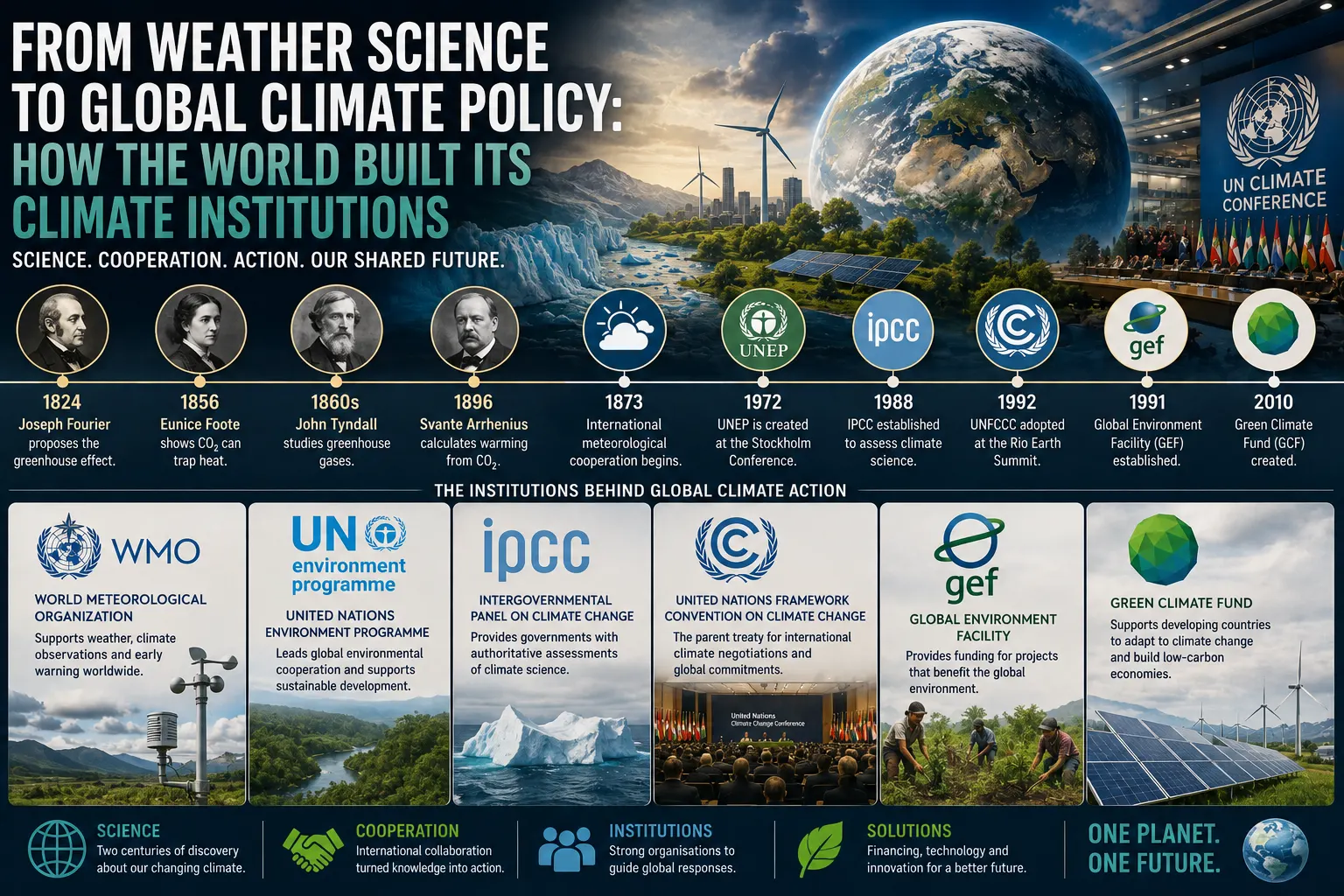
Long before climate change became associated with international summits, emissions targets or political debate, it began with a scientific question: what determines the temperature of the Earth, and can changes in the atmosphere alter it? The answer developed gradually through physics, chemistry, meteorology, oceanography and increasingly sophisticated observation. Only much later did governments create international organisations capable of coordinating the science, assessing what researchers had discovered and negotiating how countries should respond.
The history of climate research is therefore not the story of a single organisation or political initiative. It is a sequence extending across generations. Scientific theory came first, followed by experiments, direct atmospheric measurements, international weather networks, satellites, computers and global research programmes. As the evidence became broader and the questions more complex, new institutions were created to perform tasks that universities, national meteorological services or individual governments could not efficiently undertake alone.
The First Questions Were About the Physics of the Planet
The intellectual foundations of climate science reach back to the early nineteenth century. In 1824, French mathematician and physicist Joseph Fourier calculated that a planet the size of Earth, at Earth’s distance from the Sun, should be considerably colder than it actually is. He proposed that the atmosphere must influence the planet’s ability to retain heat. That insight did not amount to the modern theory of climate change, but it established one of the fundamental questions upon which later greenhouse science was built.
In 1856, American scientist Eunice Foote conducted experiments involving different gases and found that carbon dioxide had strong heat-retaining properties. During the 1860s, Irish-born physicist John Tyndall carried out more detailed work on the absorption of infrared radiation by atmospheric gases, including water vapour and carbon dioxide. These experiments helped establish the physical basis of what became known as the greenhouse effect.
The next major step was to ask whether changing the concentration of those gases could change the climate itself. In 1896, Swedish scientist Svante Arrhenius published calculations exploring how substantial changes in atmospheric carbon dioxide might alter surface temperatures. His calculations were far simpler than modern climate models, but the central scientific proposition was now clear: atmospheric composition and climate could be quantitatively connected. In 1938, British engineer Guy Callendar went further by linking increasing atmospheric carbon dioxide with observed warming.
Early Milestones in the Development of Climate Science
| Year | Development | Why It Mattered |
|---|---|---|
| 1824 | Joseph Fourier examines atmospheric warming | Raised the question of how the atmosphere regulates Earth’s temperature |
| 1856 | Eunice Foote studies the heating properties of gases | Provided early experimental evidence of the importance of carbon dioxide and water vapour |
| 1860s | John Tyndall measures infrared absorption | Helped establish the physical mechanism of the natural greenhouse effect |
| 1896 | Svante Arrhenius calculates the influence of changing CO₂ | Connected atmospheric carbon dioxide quantitatively with possible temperature change |
| 1938 | Guy Callendar links rising CO₂ and warming | Connected greenhouse theory with atmospheric and temperature observations |
| 1958 | Continuous CO₂ measurements begin at Mauna Loa | Created a long-term direct record of changing atmospheric carbon dioxide |
Sources: NASA Science and NOAA.
Direct Measurement Transformed the Scientific Question
A decisive development came in March 1958, when Charles David Keeling of the Scripps Institution of Oceanography began systematic measurements of atmospheric carbon dioxide at Mauna Loa in Hawaii. The resulting observational series became known as the Keeling Curve. NOAA describes the Mauna Loa series as the longest record of direct atmospheric carbon-dioxide measurements of its kind.
The measurements showed a recurring seasonal cycle, but beneath those annual fluctuations was a persistent long-term rise. Researchers now possessed a continuous observational record showing that atmospheric composition itself was changing. That development did not by itself answer every question about climate, but it strengthened the link between theoretical greenhouse physics and measurable changes in the real atmosphere.
Climate science was simultaneously becoming more technologically sophisticated. Satellites provided observations across oceans and remote regions, increasingly powerful computers allowed researchers to simulate atmospheric and ocean circulation, and oceanographic research demonstrated that the seas store and redistribute enormous quantities of heat. Climate was gradually being understood not merely as long-term weather but as an interconnected Earth system involving the atmosphere, oceans, land, ice and living organisms.
International Meteorology Came Before International Climate Policy
The international institutions associated with climate change did not begin with climate treaties. Meteorology had already demonstrated why countries needed to cooperate. Weather systems cross borders, and meaningful forecasting depends on observations from regions far beyond the territory of any single state. International meteorological cooperation therefore developed during the nineteenth century, ultimately leading to the creation of the World Meteorological Organization in 1950.
WMO became a specialised agency of the United Nations in 1951. Its original responsibilities were much wider than climate change: international cooperation in meteorology, observation networks, technical standards, data exchange and related fields. That infrastructure later became fundamental to climate science because reliable global climate analysis requires measurements collected using comparable methods across countries and over long periods.
The importance of this system is difficult to overstate. A global temperature record cannot be built from measurements in one country. Atmospheric circulation cannot be understood from one region. Ocean conditions, polar ice and rainfall patterns all interact across enormous distances. Climate research therefore became international because the physical system under investigation was international by nature.
UNEP Brought the Wider Environment Into the International System
A second institutional strand emerged from growing concern about environmental degradation during the post-war decades. The United Nations Conference on the Human Environment, held in Stockholm in 1972, became a defining moment in international environmental governance and led to the creation of the United Nations Environment Programme.
UNEP was not established solely to deal with climate change. Its mandate was much broader: monitoring the state of the environment, bringing scientific knowledge into policymaking and coordinating responses to environmental challenges. That wider remit later became highly relevant to climate change because changes in climate could affect ecosystems, agriculture, water, public health, development and economic activity as well as weather.
The eventual cooperation between UNEP and WMO was therefore significant. WMO brought established meteorological networks, atmospheric expertise and international observation systems. UNEP brought a broader environmental mandate and a stronger institutional connection between environmental science and international policy. Together, they would later establish the Intergovernmental Panel on Climate Change.
The 1979 World Climate Conference Changed the Scale of Cooperation
By the late 1970s, governments and researchers were dealing with two related questions. One concerned natural climate variability and society’s vulnerability to drought, unusual seasons and other climatic fluctuations. The other concerned the possibility that human activities could alter the climate over longer periods. Both required more systematic international cooperation.
The First World Climate Conference was held in Geneva from 12 to 23 February 1979. Organised under WMO leadership, it brought together expertise extending beyond meteorology into areas including agriculture, water resources, energy, ecology, economics and other climate-sensitive fields. The meeting helped establish climate as a permanent international research concern rather than a subject addressed through occasional scientific conferences.
One of the consequences was the development of the World Climate Programme. Its purpose extended beyond global warming: it sought to strengthen climate data, improve applications of climate information, advance research and examine the effects of climate on societies and economies. This broader origin is important because the international climate system was initially designed around understanding and using climate information as well as investigating human influence.
WCRP Became an International Engine for Climate Research
The World Climate Research Programme was established in 1980 under the joint sponsorship of WMO and the international scientific community represented at the time by the International Council for Science. The Intergovernmental Oceanographic Commission of UNESCO later joined as a sponsor. WCRP was created around two fundamental questions: to what extent can climate be predicted, and to what extent do human activities influence it?
Those questions required research that no individual discipline could adequately undertake alone. Atmospheric scientists needed oceanographers; researchers studying clouds needed observations of radiation and water cycles; polar researchers needed to understand connections with oceans and atmosphere; and all of them increasingly depended on computer modelling. International projects coordinated under WCRP could bring together observations, models and expertise on a scale difficult for a single country to reproduce independently.
The programme was therefore created to advance science rather than make political decisions. Its role was to improve understanding of the climate system and its predictability. That scientific separation would later become important when governments created a different institution specifically to assess the growing body of climate literature for policymakers.
The Major Institutions and Why They Were Created
| Institution | Established | Original Core Role |
|---|---|---|
| WMO | 1950 | Coordinate international meteorology, observation standards and data exchange |
| UNEP | 1972 | Connect environmental science, policy and coordinated international action |
| World Climate Programme | 1979 | Develop climate data, applications, research and impact studies |
| WCRP | 1980 | Advance international research on climate predictability and human influence |
| IPCC | 1988 | Assess scientific, technical and socio-economic knowledge about climate change |
| UNFCCC | 1992 | Provide the treaty framework for international governmental cooperation |
| GCOS | 1992 | Support sustained global climate observations and their availability |
Sources: WMO, UNEP, WCRP, IPCC, UN Climate Change and GCOS.
The 1980s Created a New Problem: How Should Governments Assess the Science?
By the middle of the 1980s, scientific research on greenhouse gases and climate had expanded considerably. The challenge was no longer simply a shortage of individual studies. Governments were confronted with a rapidly growing body of research produced by universities, meteorological agencies, oceanographic centres and scientific programmes around the world. They needed a mechanism capable of evaluating that evidence systematically.
Scientific meetings during this period, including international assessments involving WMO and UNEP, helped move the issue towards a more formal relationship between research and government. The central institutional question was becoming clear: scientific research should remain distributed across the wider research community, but governments needed a common process for understanding what that research collectively indicated.
The IPCC Was Designed to Assess Science Rather Than Replace It
WMO and UNEP established the Intergovernmental Panel on Climate Change in 1988. The purpose was not to create a single institution responsible for conducting all climate research. Instead, the IPCC was designed to assess existing scientific, technical and socio-economic knowledge relevant to climate change and make that assessment available to governments.
This distinction remains central to understanding the organisation. Universities, national agencies, laboratories and research programmes produce scientific studies; the IPCC assesses the published literature. It evaluates areas of strong evidence, identifies uncertainty and periodically produces broad assessments intended to inform decision-makers without itself determining national policy.
The IPCC completed its First Assessment Report in 1990. According to the organisation’s official history, the report underlined climate change as a challenge with global consequences requiring international cooperation and played an important role in the creation of the United Nations Framework Convention on Climate Change.
Scientific Assessment and Political Negotiation Were Kept Separate
The creation of the IPCC did not solve another fundamental institutional problem. Scientists could assess physical evidence and possible consequences, but they could not negotiate obligations between sovereign states. That required a separate diplomatic and legal framework.
The United Nations Framework Convention on Climate Change was adopted at United Nations Headquarters in New York on 9 May 1992. It subsequently opened for signature at the Rio Earth Summit and entered into force in 1994. The Convention created the enduring international framework within which governments could cooperate and negotiate over climate change.
The institutional separation was deliberate and remains significant. The IPCC evaluates scientific knowledge. The UNFCCC is the treaty framework through which governments negotiate political responses. Research programmes investigate the climate system, observing organisations collect data, scientific assessments synthesise published knowledge and governments decide what commitments they are prepared to undertake.
GCOS Addressed the Need to Observe Climate for Decades
Also established in 1992 was the Global Climate Observing System. Its purpose was to help ensure that the observations and information needed to address climate-related questions were obtained and made available to users. GCOS is co-sponsored by WMO, the Intergovernmental Oceanographic Commission of UNESCO, UNEP and the International Science Council.
The need for such a system follows directly from the nature of climate research. Weather can change within hours, but detecting climate trends requires measurements that remain comparable across decades. Researchers need reliable records of temperature, precipitation, ocean conditions, atmospheric composition, ice, soil and many other variables. If observation systems disappear, instruments change without proper calibration or large geographical areas remain poorly monitored, long-term analysis becomes more difficult.
GCOS therefore represents one of the less visible but fundamental layers of the international climate architecture. It does not negotiate emissions targets and does not produce the same type of assessment as the IPCC. Its purpose is to strengthen the observational foundation upon which climate science depends.
How the Global Climate System Is Divided
Observation: National meteorological services, satellites, ocean systems and international programmes collect long-term measurements of the atmosphere, oceans, land and ice.
Research: Universities, laboratories and programmes such as WCRP investigate how the climate system works, how predictable it is and how natural and human influences affect it.
Assessment: The IPCC evaluates published scientific, technical and socio-economic research and periodically presents governments with comprehensive assessments.
Negotiation: The UNFCCC provides the treaty framework through which governments negotiate international climate policy.
Implementation: Individual governments and institutions translate international agreements and national objectives into legislation, investment, technology, adaptation and other measures.
Kyoto and Paris Came Much Later Than the Scientific Foundations
The international agreements most familiar to the public came relatively late in this history. The Kyoto Protocol was adopted in 1997 and introduced binding emissions commitments for participating developed countries under its framework. Almost two decades later, the Paris Agreement created a broader system in which countries submit national climate commitments and are expected to strengthen them over time.
The Paris Agreement was adopted on 12 December 2015 and entered into force on 4 November 2016. It operates under the UNFCCC rather than replacing it. The development from the 1992 Convention through Kyoto and Paris demonstrates how climate diplomacy evolved after the scientific and institutional foundations had already been established.
This chronology matters. Climate science did not originate with the Kyoto Protocol, Paris Agreement or annual COP meetings. Those political processes were built on a much older scientific history that had already produced greenhouse theory, atmospheric measurements, global observation networks and international research organisations.
Why No Single Organisation Controls Climate Science
The modern climate landscape can appear complicated because numerous organisations are regularly mentioned together. In reality, their different functions are part of the design. WMO coordinates international meteorological and climate cooperation. UNEP addresses the wider environmental dimension. WCRP facilitates international climate research. GCOS supports sustained observations. The IPCC assesses the scientific literature. The UNFCCC provides the diplomatic framework for governments.
Much of the actual scientific work remains outside these organisations. Universities conduct experiments and develop models. National meteorological agencies operate observation systems. Space agencies launch satellites. Oceanographic institutions deploy instruments at sea. Research laboratories analyse atmospheric chemistry, ice, ecosystems and palaeoclimate records. The international bodies coordinate, assess or organise parts of that much larger scientific ecosystem rather than replacing it.
This distributed structure also helps explain why climate science cannot accurately be reduced to the position of a single institution. Scientific conclusions emerge from a wide body of research undertaken across countries, disciplines and organisations. Assessment bodies then evaluate that literature, while governments separately negotiate policy.
Why Climate Research Had to Become Worldwide
The global scale of climate research ultimately reflects the physical nature of the climate system. Atmospheric gases do not remain within political borders. Ocean currents redistribute heat across thousands of kilometres. Changes in tropical Pacific conditions can influence rainfall and temperature patterns in distant continents. Ice-sheet changes can affect global sea levels, while aerosols and greenhouse gases interact with planetary-scale atmospheric circulation.
No country can observe all of these processes from its own territory. Researchers require satellites, ocean buoys, research ships, weather stations, aircraft, polar observations and long-running monitoring programmes. Data must be comparable and increasingly shared internationally. Models must represent interactions extending across the entire planet.
The internationalisation of climate science was therefore not simply a political choice. It followed from the geography and physics of the problem. Once researchers attempted to understand climate as a complete system, international cooperation became one of the basic requirements of the science.
Climate Science Became an Earth-System Science
Modern climate research extends far beyond traditional meteorology. Atmospheric physicists investigate radiation, clouds and circulation. Oceanographers examine heat storage and currents. Glaciologists study sea ice, glaciers and ice sheets. Chemists investigate greenhouse gases and aerosols. Ecologists study relationships between climate and living systems, while palaeoclimate researchers reconstruct earlier climates using ice cores, sediments, corals and other natural archives.
Computing transformed these disciplines by allowing researchers to represent interactions across the Earth system numerically. Climate models became capable of exploring relationships between atmosphere, ocean, land and ice over periods ranging from seasons to centuries. Satellite systems simultaneously produced observations on a scale earlier researchers could scarcely have imagined.
That expansion also changed the institutional needs of the field. Large observing systems require long-term funding and coordination. Model comparisons involve many research centres. International assessments require specialists from numerous disciplines. Climate research therefore developed not only through scientific discoveries but also through increasingly sophisticated infrastructure for organising knowledge.
The Institutions Continue to Evolve
The roles established during the twentieth century remain visible today, but the questions facing climate research continue to change. Researchers increasingly investigate regional climate risks, extreme events, ocean and ice changes, carbon-cycle feedbacks, adaptation, attribution of observed changes and the interaction between physical climate processes and human systems. Improved observations, artificial intelligence, higher-resolution modelling and larger computing systems are also changing how climate information can be produced and interpreted.
Future scientific progress is likely to depend on maintaining long-term observations while improving regional detail. Global averages are essential for understanding planetary change, but governments, businesses, farmers, infrastructure planners and communities often need information at much smaller geographical scales. That creates a continuing challenge: translating global climate understanding into reliable information about particular places without overstating the precision of long-range projections.
The institutions themselves are therefore likely to remain specialised. Scientific research programmes will continue to investigate the physical system; observing networks will maintain the long-term records; assessment organisations will evaluate the expanding evidence base; and treaty institutions will remain responsible for political negotiation. Their functions overlap, but they are not interchangeable.
A Global System Built Over Nearly Two Centuries
The worldwide climate research system was not created by a single government, organisation or generation of scientists. Its origins lie in nineteenth-century attempts to understand planetary temperature, followed by experimental evidence about atmospheric gases, increasingly systematic observations, advances in oceanography, satellite technology and computing, and eventually the recognition that understanding climate required research on a global scale.
Institutions emerged as each stage created a new practical need. WMO provided international meteorological cooperation and observation standards. UNEP connected environmental science with global environmental policy. The World Climate Programme broadened the organised use and study of climate information. WCRP coordinated major international research. The IPCC created a mechanism for assessing a vast scientific literature. GCOS strengthened long-term observations, while the UNFCCC provided a separate framework through which governments could negotiate their response.
The history therefore runs from science towards institutions rather than the other way around. Political negotiations are the most visible part of the modern climate system, but beneath them lies a much older structure of measurement, experimentation, data exchange and international scientific cooperation. Climate change became a global institutional issue because the scientific problem itself proved to be global — and understanding a planetary system ultimately required institutions capable of working at a planetary scale.
Sources
NASA Science — Evidence for Climate Change.
NOAA — Five Significant Moments in Climate Science History.
NOAA Global Monitoring Laboratory — Trends in Atmospheric Carbon Dioxide.
World Meteorological Organization — A History of Climate Activities.
United Nations Environment Programme — UNEP: 50 Years of Environmental Milestones.
World Climate Research Programme — WCRP History.
Intergovernmental Panel on Climate Change — History of the IPCC.
United Nations Framework Convention on Climate Change — History and Convention.
Global Climate Observing System — GCOS History.
UN Climate Change — The Paris Agreement.
Source & Transparency
This article is published by Ireland Newspaper for editorial and informational purposes.
Published: 13 August 2026 · Updated: 13 August 2026

Newsroom Ireland Newspaper
Ireland Newspaper editorial team prepares daily news coverage for readers in Ireland and abroad.