Just
four months ago, farming contractor Christopher Duffy stood on O’Connell
Bridge in Dublin and proclaimed victory. The Government had just committed
€750 million in fuel and cost-of-living supports after a week of nationwide
protests that had brought much of the country to a standstill. “We have the
country by the balls,” Duffy told the cheering
crowd[reference:0][reference:1]. But the celebration was short-lived. By
August, fuel prices were creeping back towards €2 a litre, and the
political truce was unravelling[reference:2].
The protests that
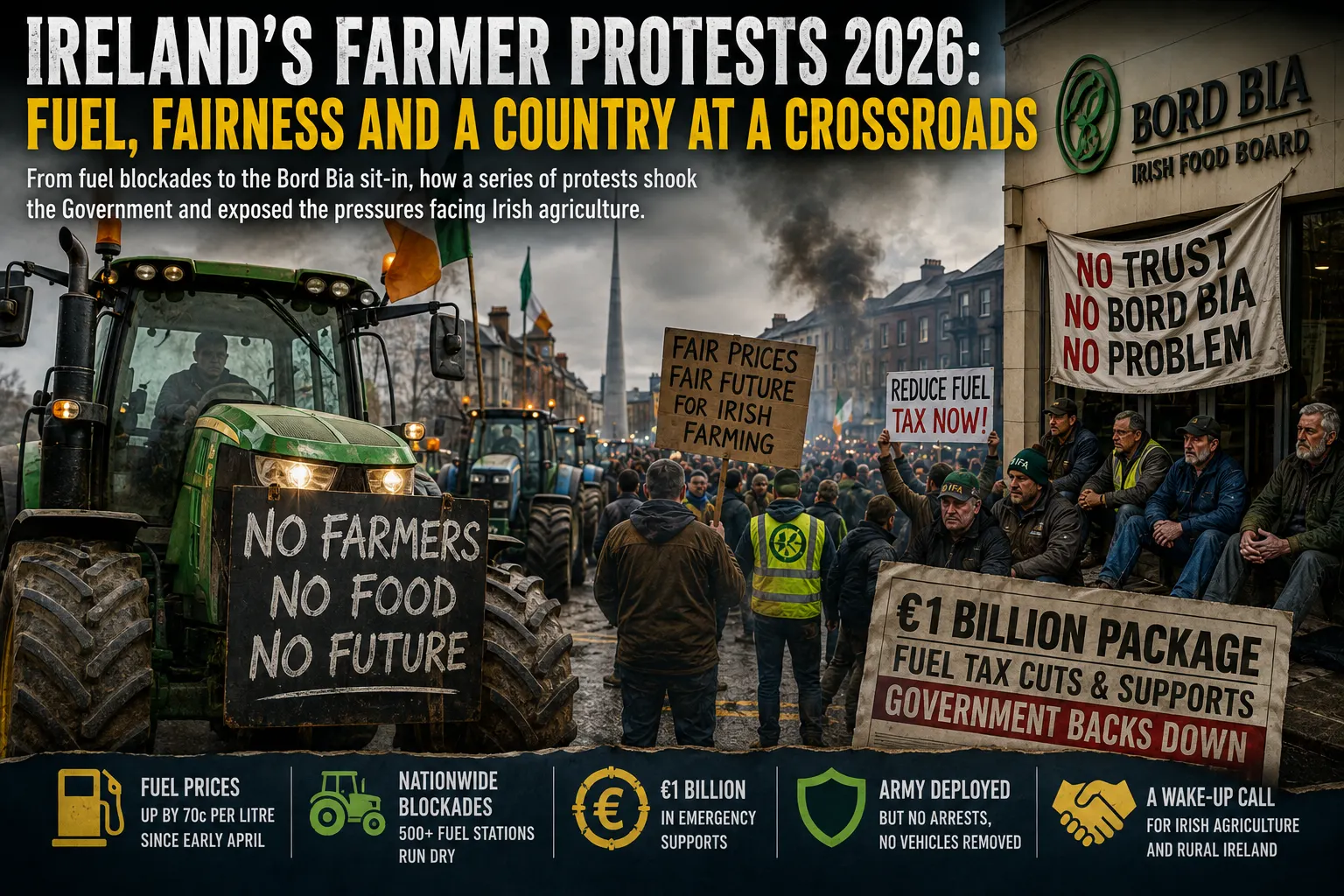
erupted in Ireland in 2026 were not a single event but a series of
overlapping movements, each with its own grievances and demands. What began
as localised demonstrations over surging fuel costs rapidly escalated into
a defining nationwide crisis, forcing the Government to deploy the Defence
Forces, commit over €1 billion in emergency spending, and survive a motion
of no confidence[reference:3][reference:4][reference:5]. The unrest laid
bare the deep structural pressures facing Irish agriculture — pressures
that had been building for years and were only accelerated by geopolitical
shocks beyond the country’s control.
The
Fuel Crisis That Brought the Country to a Standstill
The immediate
trigger for the largest wave of protests was the war in Iran. Following
US-Israeli attacks on Iranian infrastructure in early April, global fuel
prices spiked dramatically[reference:6][reference:7]. For Irish farmers,
hauliers and agricultural contractors — sectors almost entirely dependent
on diesel — the impact was immediate and severe. Green diesel prices had
risen by approximately 70 cents per litre since the start of the
conflict[reference:8].
On April 7, a protest by farmers and hauliers
over rising fuel prices quickly escalated into nationwide
blockades[reference:9]. Tractors and lorries blocked main roads in Cork,
Galway, Limerick, and Dublin, with O’Connell Street at a
standstill[reference:10]. Protesters blocked access to fuel depots and the
country’s only oil refinery in Whitegate, County Cork[reference:11]. By
April 10, three days into the protests, more than 500 petrol forecourts had
reportedly been emptied of fuel[reference:12].
The demands were
specific: a cap on diesel prices at €1.60 to €1.70 per litre plus VAT, a
price of 90 cents per litre on green diesel, and the abolition or
suspension of the carbon tax[reference:13]. The carbon tax, which accounted
for a significant portion of the retail price, was scheduled to increase in
May but was later deferred until October as a direct result of the
protests[reference:14]. Protesters also called for price caps on white
diesel, kerosene and petrol[reference:15].
The organisation behind
the protests was largely grassroots. The seeds of the disruption were sown
in meetings in late March, including a tense gathering at the Midlands Park
Hotel in Portlaoise on March 28[reference:16]. Momentum was built through
online forums and WhatsApp groups. One Facebook page — The People of
Ireland Against Fuel Prices — gained more than 60,000 followers in a matter
of weeks and began running ads encouraging people to join locally focused
protests[reference:17].
The Government’s initial response was one of
confrontation. Ministers ruled out negotiations with protest leaders, and
the Defence Forces were deployed alongside Garda public order units to
assist in clearing key sites[reference:18]. However, the Army never
appeared, and not a single protester was arrested nor a vehicle
removed[reference:19]. Faced with mounting pressure, the Government backed
down. An initial €250 million package for fuel tax cuts was bolstered with
another €505 million in sweeteners, bringing total approved spending to
approximately €1 billion[reference:20][reference:21].
On April 14,
the Coalition — a three-party alliance of Fianna Fáil, Fine Gael, and eight
independents — survived a motion of confidence by 92 votes to
78[reference:22]. But the political damage was done. The protests had
exposed a Government perceived by many as out of touch and sleepwalking
into a national disaster[reference:23].
The
Bord Bia Sit-In: A Dispute Over Trust and Brazilian Beef
While the
fuel protests dominated headlines in April, a separate but equally
significant protest had been unfolding since January. On January 26,
members of the Irish Farmers’ Association (IFA) began a rolling protest
outside the Dublin headquarters of Bord Bia, the State agency responsible
for promoting Irish food[reference:24]. Within days, five farmers had
staged an illegal sit-in inside the building’s reception area, occupying
the lobby for 28 days[reference:25][reference:26].
The dispute
centred on Larry Murrin, the chairman of Bord Bia and CEO of Dawn Farms, a
major Irish food processing company[reference:27]. It emerged that Dawn
Farms had been importing Brazilian beef as part of its supply chain — a
practice that farming groups said created a clear conflict of interest
given Bord Bia’s role in promoting Irish food[reference:28][reference:29].
The IFA and others, including Sinn Féin, called for Murrin to step
down[reference:30].
For the farmers occupying the building, the issue
was about standards and trust. “We pride ourselves on farm to fork and
traceability. That’s what we’re recognised for,” said Theresa Roche, a
dairy farmer and one of the occupiers[reference:31]. Tom Byrne, a
fourth-generation suckler farmer from Co Wicklow who spent 23 days inside
the building, told The Irish Times: “We have a great product and we want to
protect it”[reference:32]. The farmers were concerned that Brazilian beef —
which they said contained growth hormones and antibiotics — did not meet
the same standards required of Irish farmers[reference:33].
Bord Bia
described the protest as the “most significant breakdown in relations with
a key stakeholder” in its 30-year history[reference:34]. The protest cost
the taxpayer an estimated €220,000 in additional security and other
costs[reference:35]. Meetings with international customers were disrupted,
and 140 staff were forced to work remotely[reference:36].
The protest
ended on March 2, after directors of Bord Bia accepted proposals from
Minister for Agriculture Martin Heydon to break the impasse[reference:37].
Murrin remained in his role, but it was agreed that meetings would be
facilitated by another board member during a governance
review[reference:38]. However, the damage to trust between farmers and the
State agency was significant. “A lot of repair work needs to be done to fix
the trust,” Roche said[reference:39].
The
Anti-Mercosur Demonstration: A United Front Against Free Trade
As
the summer progressed, another protest was taking shape. On a Saturday in
August, up to 10,000 farmers were expected to take to the streets of
Athlone in what organisers said could be the largest farmer demonstration
in Ireland since the National Farmers’ Association’s 1966 Farmers’ Rights
campaign[reference:40]. The issue: the EU-Mercosur free trade deal.
The
protest, organised by Independent Ireland, was intended to send a “huge
message” highlighting farmer opposition to the deal, which would allow
increased imports of South American agricultural products, including beef,
into the European market[reference:41][reference:42]. Independent Ireland
MEP Ciarán Mullooly said that the “guts of 1,000 tractors and lorries” had
already pre-registered, with buses organised by marts and farming
organisations across the country[reference:43]. “A protest like this will
be dangerous to ignore,” Mullooly warned[reference:44].
The protest
was notable for its cross-party nature. Mullooly insisted that all farming
organisations and politicians would have the opportunity to speak, as the
issue of Mercosur was “too serious” to politicise[reference:45]. The
message to the Taoiseach and Tánaiste was clear: Ireland needed to actively
oppose Mercosur, rather than sit on the fence[reference:46].
A Crisis Years in the Making
While the
protests of 2026 were triggered by immediate events — the war in Iran, the
import of Brazilian beef, the Mercosur deal — they were also the expression
of a deeper crisis that had been building for years. The ICMSA, one of
Ireland’s main farm organisations, made this point explicitly. “The
problems in the pricing of Irish food and the ‘built in’ costs that were
making Irish farming unviable obviously preceded the war in the Gulf and
would still apply if and when the ceasefire held,” said ICMSA President
Denis Drennan[reference:47].
Drennan pointed to the fundamental maths
of Irish farming. Eight weeks before the protests, a farmer had to sell two
litres of milk to cover the cost of one litre of green diesel. By the time
of the protests, that same farmer had to sell five litres of milk to cover
the cost of one litre of green diesel[reference:48]. Even before the price
spike, it was costing farmers more to produce milk than they were receiving
in payment[reference:49]. “Any farmer in Ireland today is considerably
better off by not doing anything,” Drennan said[reference:50].
The
underlying problems, he argued, were structural: unfair margins along the
supply chain, inherent costs in Irish food production, and the resulting
volatility of farm incomes[reference:51][reference:52]. “This isn’t an
overnight problem; it didn’t start with the war in the Gulf — nor will it
end there,” he said[reference:53].
The protests also highlighted the
growing disconnect between farmers and the political establishment. Many
farmers felt they were not being listened to, and that their concerns were
being dismissed as “temporary blips” or beyond Government
control[reference:54]. The Government’s initial refusal to negotiate,
followed by its eventual climbdown, only reinforced the perception that the
political system was reactive rather than proactive.
What Lies Ahead
As of August 2026, the
situation remains volatile. The planned reversion to higher rates of excise
on petrol and diesel, due to begin on September 1, looms as the next
flashpoint[reference:55]. The first increment — 9 cents per litre on
petrol, 10 cents on diesel — is due to take effect at a time when forecourt
prices are already drifting back up, driven by ongoing volatility and
disruption in the Middle East[reference:56]. Diesel was on average €1.92
per litre in August, up 19 cents on July[reference:57].
If those
prices hold or climb, tapering the excise cuts will bring forecourt prices
close to or over the psychologically important €2 a litre mark — a
threshold that ministers privately believe could trigger a renewed public
backlash[reference:58]. Opposition parties have already called on the
Government to pause its plan to reverse the excise cuts, and both the IFA
and the Irish Road Haulage Association have said the reversal should be
stalled[reference:59]. Kevin McPartlan, chief executive of the fuel
industry lobbyist Fuels for Ireland, described reversing the excise cuts
with prices where they are as “political suicide”[reference:60].
There
are also concerns about the unspent funds from the support packages
announced in April. Tens of millions of the €220 million allocated for
farmers, hauliers and fishers remain unspent, with representative groups
complaining of members being bogged down in red tape[reference:61]. This is
likely to become a political pressure point in the weeks ahead.
The
Government faces a difficult choice. It can proceed with the planned taper,
change the pace of tapering, or postpone the increases
entirely[reference:62]. Each option carries political and fiscal risks. But
whatever the Government decides, the underlying pressures that drove
farmers to the streets in 2026 — the cost of production, the structure of
supply chains, the volatility of global markets — are not going away.
Source & Transparency
This article is published by Ireland Newspaper for editorial and informational purposes.
Published: 15 August 2026 · Updated: 15 August 2026

Newsroom Ireland Newspaper
Ireland Newspaper editorial team prepares daily news coverage for readers in Ireland and abroad.