A ruined 65-square-metre farmhouse offered for €150,000 can look like an opportunity when the State advertises refurbishment support of up to €70,000. On paper, the arithmetic appears compelling: buy an inexpensive rural home, obtain a large grant and renovate instead of paying hundreds of thousands of euros for a finished property. In practice, once structural repairs, services, VAT, professional fees, contingency, temporary accommodation and the cost of financing the works are included, the supposedly cheap house can cost as much as — or more than — a home that was habitable on the day of purchase.
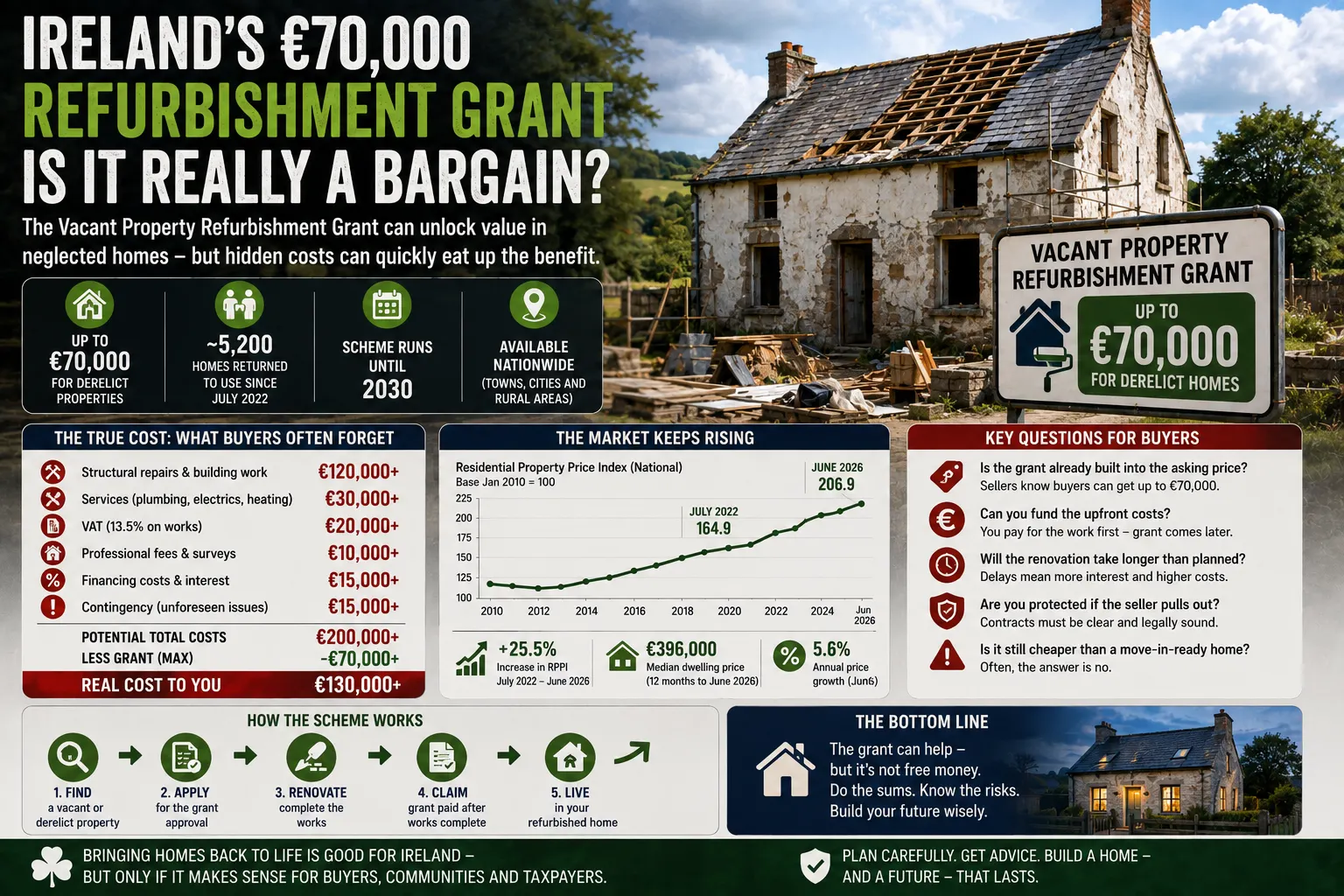
This is becoming one of the less discussed contradictions in Ireland’s attempt to reactivate vacant housing. The Vacant Property Refurbishment Grant has unquestionably helped bring properties back into use: the Department of Housing said in April 2026 that approximately 5,200 vacant and derelict homes had already been returned to residential use since the scheme began in July 2022. It would therefore be inaccurate to say that the programme has achieved nothing.
The more difficult question is whether the scheme always provides the economic advantage suggested by its headline value. In a housing market where supply is severely constrained, grants can influence not only what buyers can afford to spend on renovation but what sellers believe an eligible property is worth. Eligibility for up to €50,000 on a vacant property or €70,000 on a qualifying derelict one is now routinely advertised as a selling feature. If part of that public support is capitalised into the acquisition price before a renovation begins, the buyer receives considerably less real benefit than the nominal grant implies.
There is not currently sufficient transaction-level evidence to calculate how much of the Vacant Property Refurbishment Grant has been absorbed into the selling prices of eligible cottages and farmhouses nationally. No official Irish index separately tracks grant-eligible derelict homes before and after the scheme. It would therefore be wrong to state as fact that the grant itself caused a particular percentage increase in these prices. What can be demonstrated is that the wider property market has risen substantially, refurbishment economics were already weak in professional case studies, grant eligibility is now explicitly incorporated into property marketing and economic research shows why purchaser subsidies can partly flow into prices when the supply of the asset being purchased is constrained.
The Grant Arrived in a Market That Was Already Becoming Expensive
The Vacant Property Refurbishment Grant was introduced in July 2022 and initially targeted vacant homes in towns and villages. By November it had been extended to cities and remote rural areas. The original maximum was €30,000 for a vacant property and €50,000 where the dwelling qualified as derelict.
From May 2023 the standard maximum increased to €50,000, while qualifying derelict properties became eligible for another €20,000, taking the possible total to €70,000. The eligibility rules were also broadened to include properties built up to and including 2007 and homes intended for rental. The scheme has subsequently been continued to 2030.
Yet the property market was not inexpensive when the policy arrived. In July 2022, the month the scheme was launched, the CSO’s national Residential Property Price Index stood at 164.9 and was already 13 per cent higher than a year earlier. By June 2026 the index had reached 206.9. That represents an increase of approximately 25.5 per cent in the national price index between those two points.
This comparison must not be confused with evidence that the grant caused the increase. The RPPI covers the entire residential market, not vacant cottages, and Irish prices were being driven by population growth, income, credit availability and a persistent shortage of housing long before the refurbishment grant existed. Indeed, the fact that prices were rising by 13 per cent annually when the programme began demonstrates precisely why simple before-and-after comparisons cannot establish causation.
What matters for prospective renovators is the resulting environment. By June 2026, the median price paid for a dwelling during the preceding twelve months had reached €396,000. Residential prices were still increasing by 5.6 per cent annually, while properties outside Dublin were rising by 6.4 per cent. The Society of Chartered Surveyors Ireland reported in July that 92 per cent of surveyed estate agents regarded residential property as expensive or very expensive.
The Housing Market Since the Vacant-Home Grant Was Introduced
| Indicator | July 2022 | June 2026 |
|---|---|---|
| National RPPI | 164.9 | 206.9 |
| Annual RPPI change | +13.0% | +5.6% |
| Median dwelling price | €295,000 | €396,000 |
| Maximum derelict-property grant | €50,000 after rural expansion | €70,000 |
Sources: Central Statistics Office and Department of Housing. Median prices are shown for context and should not be used as a like-for-like price index because the mix of homes sold changes over time.
There Is No Reliable National Price Index for Derelict Cottages
The absence of specialised data is important. A 120-year-old cottage without a functioning roof is not economically comparable with an ordinary second-hand house, even if both appear in the same county’s residential listings. The cottage may contain a valuable site, planning potential, outbuildings or land, but the building itself can represent a substantial financial liability.
Official house-price statistics do not provide a separate time series for derelict farmhouses, vacant traditional cottages or properties qualifying for the refurbishment grant. Asking-price portals can show individual examples, but asking prices are not transaction prices and the condition, acreage and location of rural properties vary enormously.
Current advertisements nevertheless illustrate how grant eligibility has become part of the sales proposition. A 50-square-metre cottage near Avoca in County Wicklow was marketed in 2026 at €239,000 while requiring refurbishment, with its potential eligibility for the Vacant Property Refurbishment Grant highlighted. An 85-square-metre traditional farmhouse near Killarney, where the first floor had collapsed and complete internal refurbishment was required, was marketed at €130,000 on approximately 1.2 acres. A 114-square-metre farmhouse near Strokestown requiring complete refurbishment was offered at €125,000 with approximately 3.7 acres.
These examples do not prove overpricing. The sites, land, geography and development potential have independent economic value, and asking prices do not establish what buyers ultimately paid. They do demonstrate something more modest but still relevant: eligibility for public refurbishment funding is sufficiently valuable to have become a prominent marketing characteristic of distressed property.
The Economic Problem Is Called Capitalisation
Suppose a buyer has €150,000 available for acquisition and renovation. A State grant of €70,000 can theoretically increase that project’s resources to €220,000. If the price of the property remains unchanged, the buyer gains the full economic benefit of the support.
But sellers operate in the same market and know that grants exist. If several prospective purchasers can now spend more on the same small pool of eligible properties, sellers may be able to demand a higher price. Part of the subsidy is then capitalised into the asset value rather than being retained by the purchaser to pay builders.
The mechanism is familiar in housing economics. ESRI analysis has repeatedly warned that demand-side housing measures can place upward pressure on prices where demand is already strong and housing supply responds slowly. The Vacant Property Refurbishment Grant is different from a simple mortgage subsidy because it also encourages the creation of usable supply from existing buildings. But at the acquisition stage it can still increase the amount a purchaser is willing or able to offer for a scarce qualifying property.
Whether that effect is €5,000, €20,000 or considerably more in a particular transaction cannot be known without a credible counterfactual: what would the identical property have sold for if the grant did not exist? Ireland currently does not publish the data necessary to answer that question nationally.
A useful way of understanding the risk is through an illustrative example. Imagine a derelict cottage that would otherwise clear the market at €110,000. If grant eligibility and greater buyer competition allow it to sell for €150,000, €40,000 of the acquisition-price increase has effectively consumed part of the buyer’s additional financial capacity. A €70,000 headline grant would then provide only €30,000 of extra project capacity relative to that hypothetical counterfactual. This is an economic illustration, not evidence that any specific Irish property experienced precisely that increase.
The Grant Can Lower Renovation Costs and Raise Acquisition Prices at the Same Time
This dual effect is why debate about the scheme should avoid two extremes. It is not correct to dismiss every grant euro as a disguised payment to property owners. Thousands of completed projects demonstrate that public money has funded real renovation work. Equally, it is too simplistic to assume that a household receiving €70,000 has automatically become €70,000 better off.
The net benefit is the difference between the buyer’s financial position with the policy and the position that would have existed without it. That calculation must include any change in acquisition price, renovation costs, borrowing costs, professional expenses and the probability that the project would have proceeded anyway.
A grant paid for the renovation of a home is also not automatically the same thing as an additional home caused by the grant. Some recipients may have renovated without assistance, while others could not possibly have proceeded without it. Measuring additionality requires comparing actual outcomes with what would otherwise have happened, something simple application and payment totals cannot provide.
The Department’s figures nevertheless establish that the policy has real output. More than 3,000 grants were paid in 2025 alone, and by April 2026 the Government reported approximately 5,200 homes returned to use since launch. The stronger criticism is therefore not that the grant literally produces no homes; it is that the programme may deliver less additional housing and less buyer benefit per euro than the headline figures suggest if acquisition and construction costs absorb a substantial part of the support.
Professional Research Had Already Identified the Viability Problem
The strongest evidence that vacant-home economics can fail even before today’s prices is contained in a 2023 study by the Society of Chartered Surveyors Ireland. Chartered surveyors assessed 20 vacant and derelict properties around the country, combining market valuations with detailed refurbishment budgets.
For the 13 case studies considered appropriate for individual owner-occupiers, only four were financially viable where the property first had to be purchased and then renovated without grant support. When the same properties were assumed already to be owned, eight of the 13 became viable. Acquisition cost was therefore often the factor that changed the result.
The investor cases were even weaker. Only one of seven properties was financially viable when it had to be bought before renovation, compared with five of seven where the property was already owned.
The report used the grant levels in force at the time, which were lower than today’s maximum. Among the 13 owner-occupier cases, the €30,000 grant did not make an additional case financially viable. Nor did the then-enhanced €50,000 grant by itself. Combining €50,000 with the report’s assumed average SEAI support of €21,500 made one additional case viable. The report found that three more cases would have crossed its viability threshold under a hypothetical €100,000 Croí Cónaithe grant.
These figures cannot simply be transferred to 2026. The projects were costed using 2022 construction prices, today’s grant is higher and property values have changed. The structural conclusion remains relevant: the difference between owning a derelict building already and having to purchase it at market price before renovation can determine whether the entire project makes financial sense.
Renovating an Old House Is Not the Same as Building an Interior Inside Existing Walls
Buyers frequently underestimate old-building risk because the visible structure creates an impression that much of the expensive work has already been done. A roof and four walls can conceal defects whose cost is difficult to determine before opening the building.
Older rural homes may require structural stabilisation, new floors, damp remediation, a complete electrical installation, plumbing, heating, windows, roofing, insulation, ventilation and drainage. A private well may require treatment or replacement. An old septic system may need a new tank and percolation area. Access roads, boundaries and connections can add further costs.
Traditional construction introduces another issue. Stone, cob and other older buildings may need breathable materials and conservation techniques rather than solutions designed for modern cavity-wall construction. Inappropriate cement renders or impermeable insulation can create moisture problems instead of solving them. Protected structures and buildings in Architectural Conservation Areas can require further professional input, although not every old cottage is protected.
SCSI’s 20-case study exercise demonstrated the enormous cost range. Hard refurbishment costs for existing structures in its 2022 analysis varied from below €700 per square metre in one case to above €4,000 per square metre in another, before the cost of new extensions. The condition and configuration of the individual property mattered more than any simple national average.
The SCSI Has Already Studied a 65-Square-Metre Rural House
One case in the SCSI research is particularly instructive for buyers looking at small farmhouses. A rural one-off dwelling in Kells, County Meath was more than 100 years old, in poor condition and had only 65 square metres of internal floor area at purchase.
The actual completed project was not a simple restoration of those 65 square metres. It expanded the building to 117 square metres through a 52-square-metre extension. The work included a new floor slab, new septic tank and percolation area, new windows and doors, heating, rewiring, external works and a specification designed to achieve a B2 energy rating.
The SCSI recorded a total development budget of €255,920 excluding VAT at Q2 2022 prices, of which €130,000 related to the 52-square-metre extension. The case therefore cannot be used as a direct cost estimate for renovating today’s 65-square-metre farmhouse without an extension. It does, however, demonstrate how quickly the economics of a seemingly small old building can move into six figures once structural work and modern services are required.
A €150,000 Ruin Versus a Ready 65m² Apartment
To understand the problem more directly, consider a model farmhouse matching the example in question. It has 65 square metres of existing residential floor area, is in ruinous condition and costs €150,000. For comparison with an apartment, the model assumes the farmhouse comes with only a modest residential site and no substantial agricultural acreage with independent value. If several acres of productive land or valuable outbuildings were included, the comparison would cease to be like-for-like.
The renovation model assumes comprehensive rather than cosmetic work. It uses a core construction allowance of €2,400 per square metre before VAT, equivalent to €156,000 for 65 square metres. This figure is an illustrative assumption, not a contractor quotation. It sits within the very wide range found by SCSI’s case-study work, while recognising that the actual cost of a particular ruin can be substantially lower or higher.
The example adds VAT at an assumed 13.5 per cent to that modelled contractor amount, although the actual VAT treatment of individual materials and services can differ. It then adds professional and engineering costs, utilities and wastewater allowances and a 15 per cent contingency on the core building work. The contingency is important because unknown conditions are one of the defining risks of derelict buildings.
The apartment comparison uses an illustrative €300,000 purchase price for a ready-to-occupy 65-square-metre apartment in a middle-price Irish market rather than a premium Dublin location. There is no official CSO national price statistic for a 65-square-metre mid-market apartment, so €300,000 is deliberately a model assumption rather than a claimed market average.
Model: 65m² Ruinous Farmhouse
| Cost | Model Amount | Basis |
|---|---|---|
| Purchase price | €150,000 | Given scenario |
| Stamp Duty | €1,500 | 1% residential assumption |
| Legal, survey and structural due diligence | €4,000 | Model allowance |
| Core refurbishment works | €156,000 | €2,400/m² before VAT |
| Model VAT on works | €21,060 | 13.5% assumption |
| Professional and engineering fees | €15,000 | Model allowance |
| Septic, water, electricity and drainage | €15,000 | Model allowance |
| Contingency | €23,400 | 15% of core works |
| Total before grant | €385,960 | Model total |
| Maximum derelict grant | -€70,000 | If fully eligible and approved |
| Net project cost | €315,960 | Before finance and temporary housing |
Illustrative calculation only. Actual quotations, VAT treatment, grant eligibility, site conditions and professional costs can vary substantially.
Model: Ready-to-Occupy 65m² Apartment
| Cost | Model Amount | Basis |
|---|---|---|
| Purchase price | €300,000 | Illustrative mid-market price |
| Stamp Duty | €3,000 | 1% residential rate |
| Legal and survey costs | €4,000 | Model allowance |
| Major immediate renovation | €0 | Ready-to-occupy assumption |
| Total acquisition cost | €307,000 | Before financing |
Illustrative comparison. Apartment service charges, furnishing and financing costs are excluded. A detached rural property has different ongoing maintenance and services costs.
Even the Full €70,000 Grant Does Not Make the Ruin Cheaper in the Model
After deducting the maximum €70,000 derelict-property grant, the model farmhouse has already cost approximately €315,960. The ready-to-occupy apartment comes to approximately €307,000. The apparently cheap €150,000 farmhouse is therefore around €9,000 more expensive before accounting for the time required to renovate it, the cost of somewhere else to live or interest paid while the project is under construction.
The comparison becomes more pronounced when temporary accommodation is added. If renovation takes twelve months and the household spends €1,500 a month on temporary rent, another €18,000 is required. Effective expenditure on the farmhouse rises to approximately €333,960, around €27,000 above the apartment model.
If delays extend the process to eighteen months, the temporary accommodation assumption rises to €27,000 and the farmhouse total reaches approximately €342,960 — around €36,000 more than the ready property. Planning complications, contractor delays or unexpected structural defects could push the gap further.
This calculation deliberately excludes borrowing interest. That is significant because renovation finance can be more difficult and expensive than financing an ordinary habitable home. The effective difference for a buyer needing substantial borrowed capital could therefore be greater than shown.
What the Buyer Actually Spends in the Model
| Scenario | Total Cost | Difference vs Apartment |
|---|---|---|
| Ready 65m² apartment | €307,000 | Reference |
| Farmhouse after €70,000 grant | €315,960 | +€8,960 |
| Farmhouse plus 12 months temporary rent | €333,960 | +€26,960 |
| Farmhouse plus 18 months temporary rent | €342,960 | +€35,960 |
Ireland Newspaper model. Financing costs are excluded from both sides. The comparison assumes the farmhouse has no separately valuable agricultural acreage.
The €70,000 Headline Can Hide the Real Financial Decision
The most misleading way to evaluate the farmhouse would be to subtract €70,000 from its €150,000 purchase price and say the property effectively costs €80,000. That is not how the scheme works economically. The grant contributes towards approved refurbishment expenditure; it does not transform a structurally compromised building into a completed home for €80,000.
The relevant calculation is acquisition cost plus all expenditure required to produce a habitable property, less the support actually received. If the total finished cost exceeds the market value of a comparable completed home, the purchaser is effectively spending more to produce the same housing utility while also accepting construction risk.
There may still be rational reasons to proceed. A rural site may offer privacy, land, outbuildings or a location unavailable in an apartment. A traditional cottage may have architectural character that a buyer values independently of financial return. A household may also perform significant work itself at lower cost. These are genuine advantages, but they should not be confused with evidence that renovation is economically cheaper.
Conversely, the apartment carries costs not included in the simple acquisition model. Management-company service charges can be substantial and continue indefinitely. A rural house requires its own maintenance, insurance, heating system, roof, wastewater arrangements and site upkeep. Long-term ownership costs therefore require a second analysis beyond the initial purchase comparison.
The Grant Is Not €70,000 of Cash Available on Purchase Day
Another frequent misunderstanding concerns timing. The Vacant Property Refurbishment Grant is generally paid after approved works have been completed, documentation has been supplied and the local authority has inspected the property. The household must therefore be capable of getting the project through the construction phase before receiving the final payment.
For a buyer already struggling to obtain finance for an uninhabitable building, this creates an obvious cash-flow problem. A builder requires payment during construction, not after the State has completed its final inspection.
The Government has partly recognised this issue through the Local Authority Purchase and Renovation Loan. For eligible borrowers unable to obtain sufficient commercial finance, the scheme combines purchase and renovation lending with a two-year bridging element corresponding to the refurbishment grant. From 2026 the bridge facility carries a variable rate of 3.5 per cent and is repaid when the grant arrives or within two years, whichever occurs first.
This is a useful development because it addresses one reason apparently generous grants were difficult for some households to use. It does not change the underlying viability calculation. Borrowing allows the project to proceed; it does not reduce the project’s underlying construction cost.
Energy Grants Can Help, but the Same Work Cannot Be Paid for Twice
Owners of eligible vacant properties may also qualify for SEAI energy-upgrade support. This can materially improve the economics of projects requiring insulation, heating or other energy improvements.
But the schemes cannot simply be added together and deducted twice from one renovation budget. SEAI states that a home-energy upgrade funded through the Vacant Property Refurbishment Grant cannot also receive SEAI support for the same work, and vice versa.
A well-designed project can allocate different eligible measures to the most appropriate support programme, but the real benefit depends on the work required, grant conditions and the applicant’s circumstances. Advertising a property as potentially qualifying for €70,000 plus unspecified energy grants can therefore create an impression of public support considerably larger than the amount that can ultimately be applied to the actual invoices.
A €150,000 Farmhouse May Contain €100,000 of Land Value — or Almost None
Farmhouse comparisons require particular care because a rural sale can contain several assets inside one asking price. The dwelling, residential site, agricultural land, sheds, road frontage and development potential each have value. A ruin standing on ten productive acres cannot fairly be compared with a 65-square-metre apartment by looking at the buildings alone.
If an old house is worth little or even represents a negative renovation liability but sits on valuable land, a €150,000 asking price may be economically defensible. The purchaser is buying land as well as accommodation. The problem arises when the price of the house and modest site alone approaches that of completed residential alternatives despite the buyer still having to finance a near-total reconstruction.
This distinction should be reflected in valuations. Buyers considering a grant-eligible farm property need to know how much of the asking price represents the residential structure, how much belongs to the site and how much is attributable to agricultural land or other assets.
Tax treatment can also differ. A dwelling and qualifying residential curtilage can be taxed as residential property, while agricultural land beyond the residential element normally falls into the non-residential Stamp Duty regime, subject to any applicable reliefs. A mixed farmhouse transaction therefore requires professional apportionment rather than the simple 1 per cent residential assumption used in the 65-square-metre model.
Why the Flat €70,000 Maximum Has Very Different Effects Around Ireland
A national maximum grant inevitably behaves differently in markets with radically different property values. In an inexpensive rural area, €70,000 can represent a very large proportion of the pre-renovation value of a building. In Wicklow or within commuting distance of Dublin, the same sum may represent only a modest fraction of the acquisition price.
The refurbishment cost does not move in the same way as local property values. Roofing materials, electrical equipment, insulation and skilled labour remain expensive even where completed houses are relatively cheap. This is one reason rural renovation can be financially paradoxical: a contractor may charge broadly similar amounts for structural work in two counties while the resulting completed homes have very different market values.
That geographical mismatch was visible in the SCSI case studies. Some projects in stronger property markets could absorb large renovation bills because the completed building had a correspondingly high value. Others could not justify the same construction expenditure because the local finished value was too low.
A single national grant ceiling can therefore be too small to rescue a deeply unviable project in one location while potentially influencing acquisition prices strongly in another. The design is simple administratively but not economically neutral.
The Most Attractive Ruins Can Become the Least Attractive Deals
Grant programmes can change buyer behaviour before any building work takes place. Once households actively search for properties vacant for two years, built before 2008 and potentially capable of qualifying for €50,000 or €70,000, those eligibility characteristics themselves become valuable.
That creates a possibility familiar from other subsidised markets: the properties most obviously suited to the scheme attract more buyers, reducing the discount that originally made renovation attractive. An asset that previously required a deep price reduction because of its condition can begin trading partly on the value of the support attached to its refurbishment potential.
This effect can be self-reinforcing in a thin rural market. Unlike new cars or manufactured products, the supply of 100-year-old cottages in a particular village cannot increase because their price rises. If six buyers compete for two suitable vacant houses, the additional purchasing capacity created by a grant can be reflected in the bids.
At the same time, neglected properties that are complicated, badly located or subject to legal and planning problems may remain empty because a €70,000 contribution still does not make them viable. The scheme can therefore intensify competition for the easier projects without necessarily unlocking the hardest part of the vacant stock.
That Does Not Mean Sellers Are Doing Anything Wrong
Higher asking prices should not automatically be portrayed as profiteering. Property owners respond to the market available to them. If several buyers are prepared to pay €150,000 for a cottage, an owner has little economic reason to sell it for €100,000 merely because renovation will be expensive.
Estate agents similarly have a duty to obtain an appropriate market result for their clients. Mentioning potential grant eligibility gives prospective purchasers relevant information, provided eligibility is clearly conditional rather than guaranteed.
The policy issue lies in the design of the subsidy. If the State introduces additional purchasing capacity into a market with fixed or slowly responding supply, some of the benefit can flow to asset owners through prices. That is a system effect, not evidence of improper conduct by individual sellers.
The distinction matters because effective reform depends on correcting incentives rather than assigning motives. The objective should be to ensure public money changes the decision to renovate and creates additional usable housing, rather than merely changing who captures the value of an already intended transaction.
Ireland’s Official Vacancy Number Is Frequently Misunderstood
Census 2022 recorded 163,433 vacant houses and apartments. The figure is often presented as though Ireland possesses more than 160,000 immediately recoverable homes waiting for renovation. The CSO explicitly warns against that interpretation.
Census vacancy is a point-in-time measure. A dwelling can be classified as vacant because it is being sold, undergoing renovation or temporarily unoccupied. Holiday homes are recorded separately, while dwellings considered derelict and uninhabitable are not included in the Census vacant-dwelling count at all.
The 163,433 figure therefore cannot be treated as the addressable market for the €70,000 grant. The number of buildings that are genuinely long-term vacant, legally available, structurally recoverable, located where households want to live and financially viable to renovate is smaller and requires much more detailed local information.
This data problem also weakens policy evaluation. Ireland can count applications, approvals and payments accurately, but establishing how many economically usable properties remain and how their asking prices respond to intervention requires a more specialised property database.
The Policy Has Produced Homes — but Its Success Metric Should Be Harder
The Government reported 16,607 applications, 12,096 approvals and 4,514 completed grant payments by the end of 2025, with almost €247 million paid. By April 2026 the number of homes reported as returned to use had reached approximately 5,200.
Those numbers establish administrative throughput and physical completion. They do not answer whether every supported property represents genuinely additional housing, whether the completed property cost less than alternatives or how much of the subsidy was reflected in the initial acquisition price.
A more rigorous evaluation would ask how many recipients would have undertaken the work anyway. It would compare grant-assisted purchase prices with similar non-assisted properties and measure the market value of the completed dwelling against the buyer’s total project expenditure. It would also distinguish owner-occupiers from landlords and separate properties already owned from those purchased specifically for renovation.
The SCSI evidence suggests that this last distinction is crucial. Renovating a derelict property that a family already owns can make considerably more economic sense than paying today’s market price to acquire the same building first.
The crucial policy distinction is between a renovation subsidy and an acquisition subsidy. The State intends the money to make building work viable. If scarcity allows part of the support to be captured in the pre-renovation property price, less of the public intervention remains available to solve the physical problem for which it was created.
Why Simply Increasing the Grant Again Could Make the Problem Worse
Faced with construction costs above €70,000, the intuitive policy response is to raise the maximum grant. The SCSI’s earlier modelling showed that larger support could make more projects financially viable, so there is a rational argument for higher funding in genuinely difficult cases.
But increasing the headline amount across every property without changing the acquisition-side rules could strengthen capitalisation. If buyers know that a qualifying ruin comes with €100,000 rather than €70,000 of potential public support, the market value of eligibility itself may rise.
The result depends on supply. Where many suitable vacant homes are genuinely available and sellers compete for a limited number of buyers, much of the larger grant can remain with the buyer. Where eligible stock is scarce and purchasers compete aggressively, sellers have greater capacity to capture part of it.
Any future increase should therefore be accompanied by evidence on prices, project costs and additionality rather than judged solely by the number of applications received. A larger subsidy without better market information risks spending more public money while leaving affordability surprisingly unchanged.
An Independent Pre-Purchase Viability Test Could Protect Buyers and Public Money
One possible reform would be to assess the entire economics of a grant-assisted purchase before the buyer becomes committed. An independent professional could value the property in its current condition, estimate essential refurbishment costs and provide an indicative completed-market value.
If a ruin is being sold for €150,000, requires €220,000 of credible work and is expected to be worth only €300,000 when complete, the financial problem is visible before contracts are signed. Providing a €70,000 grant may narrowly change the equation, but the buyer should know how little margin remains for overruns.
This would not require the State to dictate private sale prices. It would simply make grant approval or associated public finance conditional on demonstrating that the project is economically coherent.
Such an assessment could also identify cases where the acquisition price is unusually high relative to the independent as-is valuation. That would provide policymakers with data on whether grant eligibility is becoming embedded in prices.
Grants Could Be Better Related to the Actual Building
The current maximum is easy to understand but relatively blunt. A 45-square-metre cottage requiring roof repairs and a 200-square-metre stone farmhouse requiring complete reconstruction can potentially enter the same broad grant framework even though the underlying projects are radically different.
A more targeted system could take account of floor area, structural condition, protected or vernacular status and independently verified essential works. It could retain an overall cap while varying support according to the type of intervention genuinely required.
That approach would carry additional administration costs and could make the scheme harder for households to understand. But it would better align public support with the physical problem rather than with the mere fact that a property has been vacant for the qualifying period.
Specialist conservation advice is already recognised separately for traditional buildings, including eligible farmhouses. Expanding technical assessment at the beginning of a project could prevent buyers from discovering only after purchase that apparently inexpensive restoration requires far more specialised work than expected.
Stage Payments Could Reduce the Financing Penalty
Another possible improvement concerns when money is paid. Requiring completion before final grant payment protects public funds by ensuring approved work has actually been carried out, but it pushes financing responsibility onto the household during the most expensive part of the project.
The Local Authority Purchase and Renovation Loan now provides an answer for some eligible borrowers, including bridge finance corresponding to the grant. That does not reach every renovator, however, and private borrowers may still face expensive or difficult financing.
Professionally certified staged payments could reduce the amount households need to finance at one time. For example, portions of support could follow verified structural completion, weatherproofing, services and final certification. SCSI previously recommended exploring more flexible mechanisms around funding and project delivery.
Such a system would need safeguards against unfinished projects, but it would align public cash flow more closely with the way construction expenditure actually occurs.
The State Needs a Price Series for the Properties It Is Subsidising
Ireland now publishes quarterly statistics on applications, approvals and payments but lacks equivalent information about the market into which the grant is injected. That limits the ability to determine whether public support is improving affordability or partly raising asset values.
A useful dataset could record the independently assessed pre-renovation value, purchase price where applicable, floor area, county, property type, grant amount, verified works cost and post-renovation valuation. Personal information would not need to be published.
Over several years, such data could answer questions that currently depend on anecdote. Are grant-assisted buyers paying more per square metre for derelict houses than comparable purchasers did before the programme? Does the relationship differ between Donegal, Wicklow and Cork? Are already-owned properties delivering substantially better public value than recently purchased ones?
Without those figures, government can measure activity but has much less ability to measure price capitalisation and additionality.
Vacant Homes Are Valuable Supply, but Not at Any Price
Reusing existing buildings has strong advantages. Infrastructure and roads may already exist, established communities can gain new residents and embodied carbon in an existing structure can be preserved instead of demolishing and rebuilding everything. Rural cottages and town-centre buildings can also provide types of housing that large new developments do not.
But vacancy should not create an economic assumption that every building must be saved regardless of cost. A structure requiring €250,000 of work is not automatically an affordable home merely because the walls already exist.
In some cases, refurbishment will be clearly superior. In others, the economics support demolition and replacement where planning and heritage rules allow it. In still others, the rational decision may be not to purchase at the seller’s current price.
The existence of a State grant should not remove that discipline. Indeed, public support makes rigorous project economics more important because taxpayers as well as purchasers are contributing capital.
The €150,000 Asking Price Is Often the Decisive Number
Return to the 65-square-metre farmhouse. If the same ruin cost €70,000 rather than €150,000, every other model assumption remaining unchanged, the project’s net expenditure after the maximum grant would fall by €80,000 to approximately €235,960 before temporary accommodation. The economic proposition would change completely.
This demonstrates why focusing only on whether €70,000 is sufficient to pay for renovation misses half of the equation. The acquisition price can determine viability as strongly as construction cost.
Traditionally, a seriously derelict building should trade at a substantial discount to a habitable property because the purchaser accepts the cost and risk of making it usable. When a housing shortage, site value and public subsidy compress that discount, the economic reason for choosing the project can disappear.
A grant cannot simultaneously compensate the buyer for renovation and support an inflated underlying asset price without becoming very large. The more expensive the ruin becomes, the more public money is required simply to recreate the original discount.
A Buyer Should Calculate the Completed Cost, Not the Grant
The most useful figure for a prospective purchaser is therefore not €70,000. It is the expected all-in cost per completed home.
That includes the purchase, Stamp Duty, legal and technical due diligence, building work, VAT, professional fees, connections, septic or water systems where needed, contingencies, temporary accommodation and finance. From that total, genuinely available grants can be deducted once, without double-counting the same work across programmes.
The resulting number should then be compared with two alternatives: the market value of the property when complete and the realistic cost of purchasing another suitable habitable home. If the renovation project exceeds both, it is difficult to justify financially unless the site, character, land or lifestyle has additional value to the purchaser.
This is particularly important for first-time buyers. A household should not take on substantial construction and cost-overrun risk merely because a ruin’s asking price falls beneath the headline price of conventional homes.
Future Policy Should Measure Net Additional Homes, Not Headline Support
The Vacant Property Refurbishment Grant is due to continue to 2030, giving Ireland enough time to move from emergency-style intervention towards a more evidence-driven programme. The first phase proved that there is substantial public demand: applications and completions have risen rapidly.
The next question should be whether the State is buying additional housing supply efficiently. Success is not simply a €70,000 approval, a high number of applications or even a completed renovation. The relevant measure is how many homes returned to productive use because of the intervention, at what total public cost and with what effect on the prices of the properties being targeted.
A programme that restores thousands of homes has clearly had an effect. But a programme in which sellers capture part of the subsidy, purchasers face uneconomic total costs and projects that would have happened anyway receive public funding can simultaneously be less effective than its headline numbers indicate.
That is why the strongest criticism of Ireland’s current approach is more nuanced than saying the grant has failed. The policy tackles a genuine problem and has produced measurable housing. Yet the combination of a fixed subsidy, scarce eligible properties, high construction costs and rapidly rising general housing values creates conditions in which part of the intended benefit can be neutralised before the first builder arrives.
A Ruin Is Only Affordable When the Finished Home Is Affordable
Ireland needs to bring viable vacant and derelict properties back into use. With housing supply still failing to keep pace with demand, leaving recoverable buildings empty makes little economic or social sense. The environmental case for reusing existing structures can also be compelling.
But a derelict cottage is not automatically an affordable home, and a €70,000 grant does not automatically create €70,000 of affordability. The value of the policy depends on what the property costs before renovation, how much the work actually costs and how much of the subsidy remains with the household rather than being reflected elsewhere in the transaction.
The 65-square-metre model demonstrates the point. A €150,000 ruin can become a €316,000 project even after the maximum derelict-property grant, before temporary accommodation and financing. Add only one year of temporary housing and the model reaches approximately €334,000, compared with €307,000 for the illustrative ready-to-occupy apartment.
That does not prove every farmhouse at €150,000 is overpriced. Land, location and development potential can justify substantial value, and some purchasers can renovate more cheaply than the model assumes. It does show why the asking price of the ruin cannot be considered independently of the cost required to turn it into a home.
The policy risk is that public support intended to compensate for dereliction gradually makes derelict property itself more valuable. Ireland does not yet have the data to establish how large that effect is, but the mechanism is economically plausible and sufficiently important to measure.
If future evaluation shows that grant eligibility is being systematically absorbed into purchase prices, simply increasing the subsidy would be the wrong response. Independent pre-purchase valuations, project-viability assessments, better price data, appropriately staged funding and support targeted to actual verified renovation costs would be more likely to ensure that public money pays for homes rather than higher prices for buildings that still need to become homes.
Sources
Central Statistics Office — Residential Property Price Index, June 2026
Central Statistics Office — Residential Property Price Index, July 2022
Central Statistics Office — Census 2022 and Vacant Dwellings
Department of Housing — Vacant Property Refurbishment Grant, current scheme rules
Department of Housing — Vacant Property Refurbishment Grant Statistics
Department of Housing — Grant Outcomes to December 2025
Department of Housing — Vacant-Homes Measures, April 2026
Department of Housing — Expansion of the Refurbishment Grant, November 2022
Society of Chartered Surveyors Ireland — Real Cost of Renovation
Society of Chartered Surveyors Ireland — Real Cost of Renovation Report
Society of Chartered Surveyors Ireland — Residential Property Mid-Year Market Monitor 2026
Economic and Social Research Institute — Housing Demand Supports and Price Pressure
Economic and Social Research Institute — Tax Breaks and the Residential Property Market
Economic and Social Research Institute — Supply, Demand and Irish House Prices
Government of Ireland — Local Authority Purchase and Renovation Loan
Government of Ireland — Local Authority Mortgage Changes 2026
Sustainable Energy Authority of Ireland — Energy Grants for Vacant and Derelict Homes
Revenue — Stamp Duty on Property
Wicklow People — 2026 Vacant Cottage Asking-Price Example
Source & Transparency
This article is published by Ireland Newspaper for editorial and informational purposes.
Published: 1 September 2026 · Updated: 1 September 2026

Newsroom Ireland Newspaper
Ireland Newspaper editorial team prepares daily news coverage for readers in Ireland and abroad.