
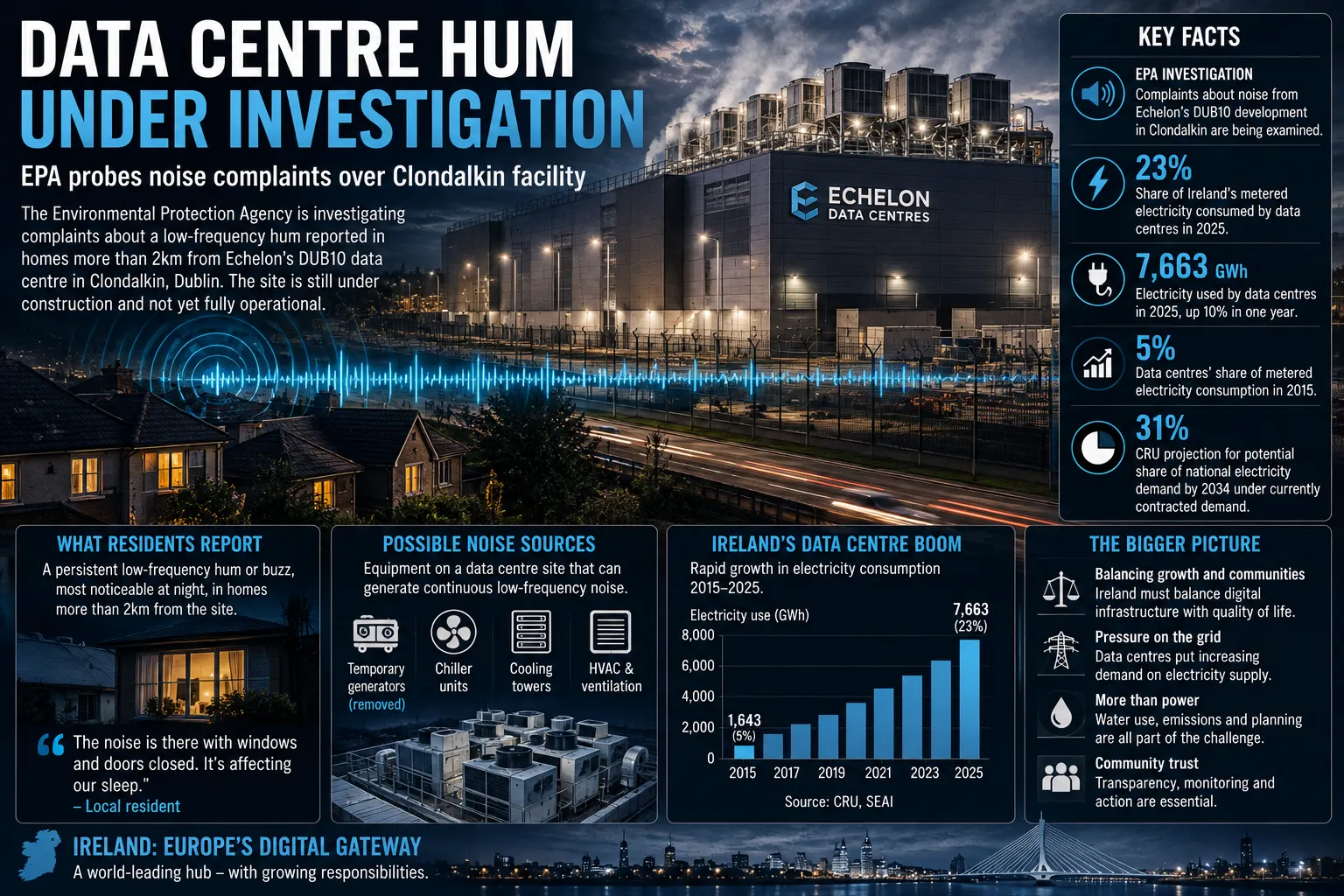
A low-frequency hum heard in homes more than two kilometres from a west Dublin data centre has become the latest test of Ireland’s ability to live alongside one of its fastest-growing industries. The Environmental Protection Agency is investigating complaints concerning Echelon Data Centres’ DUB10 development in Clondalkin after residents began reporting persistent noise in July, particularly during the night. The EPA has not concluded that the operator has breached its licence, and its investigation remains under way.
Echelon says it has commissioned acoustic specialists, removed a temporary generator used by a construction contractor and carried out mitigation work on roof-mounted chiller units. The company says the site remains under construction and is not yet fully operational, while further measurements are being analysed to identify the source of the reported sound. That distinction is important: complaints establish that residents are experiencing a problem, but determining precisely which equipment is responsible and whether licensed noise limits have been exceeded requires measurement and regulatory assessment.
The dispute is nevertheless much larger than one industrial estate. Data centres consumed 7,663 gigawatt hours of metered electricity in Ireland during 2025, representing 23% of the national total and almost six times their share a decade earlier. Government policy still regards digital infrastructure as strategically important to Ireland’s technology economy, but the State has simultaneously tightened the conditions under which new facilities can connect to the electricity system. Noise, electricity, water, emissions, grid capacity and proximity to communities are increasingly becoming parts of the same planning question.
EPA investigation: complaints about noise from Echelon’s DUB10 development in Clondalkin are currently being examined.
23%: share of Ireland’s metered electricity consumed by data centres in 2025.
7,663 GWh: electricity used by data centres in 2025, up 10% in one year.
5%: data centres’ share of metered electricity consumption in 2015.
31%: CRU projection for their potential share of national electricity demand by 2034 under currently contracted demand.
The Complaints Began With a Sound Residents Could Not Easily Identify
Residents in and around Clondalkin began reporting an unusual continuous noise during July. Accounts gathered by RTÉ describe a humming or buzzing character that could be heard mainly at night but sometimes during the day. One resident living more than two kilometres from the development said the sound remained noticeable even after windows and doors were closed and had interfered with sleep.
Low-frequency or tonal sound can be particularly difficult to investigate because the way it is perceived varies between people and buildings. Sound may travel differently depending on atmospheric conditions, background traffic, building construction and the operating cycle of industrial equipment. A noise that is conspicuous during a quiet night can also be masked during daytime by road traffic and other urban activity.
The local acoustic environment is already complicated. The DUB10 site lies within the Clondalkin Industrial Estate beside the M50, while the EPA’s licensing assessment described traffic on the M50 and nearby R134 as important components of existing background noise. At the same time, residential properties are close to the industrial area: the EPA inspector’s assessment identified an apartment complex approximately 80 metres south of the installation as the nearest residential noise-sensitive location.
That combination makes objective measurements crucial. The regulatory question is not simply whether the area was silent before the data centre arrived. It is whether emissions attributable to the licensed installation comply with the conditions imposed on it and whether tonal or other characteristics require additional assessment or mitigation.
Echelon Has Already Removed One Possible Source
Echelon initially identified a temporary generator used by a construction contractor as a possible, although unverified, contributor to the disturbance. The generator was subsequently removed and the contractor was instructed to restrict further activity to normal working hours. Complaints nevertheless continued.
The company then widened its investigation and commissioned external acoustic consultants. It has also carried out mitigation work on roof-mounted chiller units, according to its latest public response. Chillers and associated cooling equipment are potentially significant sources of continuous mechanical noise because removing heat is one of the fundamental operating requirements of a data centre.
Echelon says it is comparing external noise recordings with measurements gathered at the site and has described addressing the complaints as a high priority. The fact that mitigation measures have been introduced should not itself be read as an admission that a particular item of equipment breached an environmental condition. Determining compliance remains a matter for the EPA.
The regulator has confirmed that it received a number of complaints and is investigating them. It has engaged both with complainants and the licensee and has required the operator to examine the source of the noise and the mitigation measures required.
The EPA Licence Already Anticipated Noise as a Material Risk
The Clondalkin installation operates under an Industrial Emissions licence because its energy centre involves fuel combustion on a scale covered by environmental licensing legislation. The revised EPA licence is registered to Echelon Clondalkin DC Services Limited and covers an energy centre together with four information and communications technology buildings and associated infrastructure.
The energy centre design includes ten natural-gas turbines, while the data-centre buildings are supported by numerous back-up generators. Natural gas is intended as the principal fuel for the energy centre, with diesel or hydrotreated vegetable oil available as alternative fuels, while the back-up generators have diesel or HVO capability. It is this large combustion infrastructure, rather than the existence of computer servers by itself, that brings the installation within the relevant Industrial Emissions licensing category.
Noise was specifically considered when the revised licence was assessed. The EPA inspector identified gas turbines, back-up generators and associated plant as the main potential operational noise sources. Modelling submitted during the licensing process predicted normal operating noise at sensitive locations within limits of 55 decibels during daytime, 50 in the evening and 45 at night.
The assessment also identified possible night-time exceedances at several modelled locations during emergency operation. The licence consequently requires continuing noise management and monitoring. This is an important distinction in the current investigation: modelling undertaken before full operation predicted how the facility should perform, whereas complaints now allow regulators to compare those assumptions with conditions experienced in the real world.
Noise Conditions Built Into the EPA Assessment
| Period | Noise limit | Regulatory context |
|---|---|---|
| Daytime | 55 dB | Noise-sensitive locations |
| Evening | 50 dB | Noise-sensitive locations |
| Night-time | 45 dB | Noise-sensitive locations |
Source: EPA Inspector’s Report for Industrial Emissions Licence P1113-02. The figures are licence-assessment limits and do not establish whether the current complaints represent an exceedance.
A Noise Management Plan Is a Licence Requirement, Not an Optional Response
The licence requires the operator to conduct an annual survey of site noise and to prepare, maintain and implement a Noise Management Plan to the satisfaction of the EPA. The plan must be submitted within three months of the licence grant and implemented within six months. It must set out measures for reducing and abating noise, including dealing with equipment or operations responsible for any exceedance measured at noise-sensitive locations.
The EPA can therefore assess more than a single measurement taken on one night. Compliance can involve patterns of operation, equipment maintenance, tonal characteristics, the timing of noise and whether mitigation measures are adequate. Its NG4 guidance also contains procedures for examining tonal, impulsive and low-frequency noise, all of which can require more detailed analysis than a simple reading from a conventional sound meter.
This matters because decibels do not tell the whole story of perceived disturbance. A repetitive tone can be more noticeable than broadband background sound at the same nominal level. Intermittent start-ups can have a different effect from a constant steady source. At night, the reduction in competing road and neighbourhood noise can make an industrial source significantly more conspicuous.
European environmental-health research also identifies prolonged noise exposure as a legitimate public-health concern, particularly through annoyance and sleep disturbance. Most of the strongest population evidence relates to road, rail and aircraft noise rather than this specific type of industrial installation, so those Europe-wide findings cannot be used to diagnose health effects from the Clondalkin site. They do, however, explain why regulators treat persistent environmental noise as more than an aesthetic inconvenience.
DUB10 Is Part of a Much Larger Digital Cluster
Echelon describes its Clondalkin campus as capable of providing more than 90 megawatts of IT load, with an energy centre designed for substantial on-site generation. The location is not accidental. West and south-west Dublin have developed into one of Europe’s largest concentrations of data-centre infrastructure, with major campuses around Clondalkin, Grange Castle, Profile Park and surrounding industrial areas.
Ireland became attractive for several interconnected reasons. Large American technology companies already had European operations here. Dublin developed dense international fibre connectivity and a substantial ecosystem of cloud, telecommunications and engineering expertise. EU Single Market membership, an English-speaking workforce and decades of foreign-direct-investment policy reinforced those advantages.
Once a cluster exists, it can become self-reinforcing. Data-centre developers want fibre, power infrastructure, specialist contractors and customers nearby. Construction and engineering companies develop expertise around the sector. Cloud and technology groups can place computing capacity near existing European operations and major users.
The same clustering that creates economic efficiencies can also concentrate environmental and infrastructure pressures. Electricity demand, grid connections, substations, transmission infrastructure, generators, cooling equipment, land requirements and water use can accumulate within the same geographical area. Dublin has become the clearest expression of both sides of Ireland’s data-centre strategy.
The Electricity Numbers Explain Why National Policy Has Changed
In 2015, Irish data centres consumed 1,240 GWh of metered electricity and represented 5% of national consumption. By 2020 their use had increased to 3,030 GWh and their share to 11%. Three years later it had more than doubled again to 6,339 GWh.
The latest CSO data show consumption reaching 7,663 GWh in 2025, another 10% annual increase. Data centres consequently accounted for 23% of all metered electricity, compared with 18% for urban households and 9% for rural households. Total residential electricity consumption still exceeded data-centre consumption when urban and rural homes are combined, but a single industrial category has moved remarkably close to household electricity demand.
The change is even more striking across the full decade. Data-centre electricity use increased by more than sixfold between 2015 and 2025. Consumption by other metered customers did not remotely approach that growth rate.
A Decade of Rapid Data-Centre Electricity Growth
| Year | Electricity use | Share of metered total |
|---|---|---|
| 2015 | 1,240 GWh | 5% |
| 2020 | 3,030 GWh | 11% |
| 2022 | 5,273 GWh | 18% |
| 2024 | 6,973 GWh | 22% |
| 2025 | 7,663 GWh | 23% |
Source: Central Statistics Office, Data Centres Metered Electricity Consumption 2025.
Growth has not yet stopped. The Commission for Regulation of Utilities said in December that contracted demand could see data-centre electricity consumption rise from about 9.4 TWh in 2025 on EirGrid’s broader demand measure to 14.6 TWh in 2034. Under that forecast, the sector could represent around 31% of national electricity demand by 2034.
The CSO and EirGrid figures should not be treated as interchangeable because they arise from different datasets and forecasting methodologies. The important structural conclusion is the same: digital infrastructure is expected to remain one of the strongest sources of new Irish electricity demand.
Ireland Has Moved From Encouraging Growth to Managing Where It Happens
For much of the industry’s expansion, economic policy focused heavily on attracting investment while electricity capacity was assumed to be available when required. That became increasingly difficult as a large share of new demand concentrated around Dublin. Grid constraints and concerns over generation adequacy caused connection policy to tighten substantially from 2021 onwards.
The regulatory framework changed again at the end of 2025. The CRU introduced a new connection policy intended to create a route for future data centres while preventing uncontrolled growth in demand from undermining electricity security or national renewable-energy targets.
New data-centre connections must now be accompanied by generation or storage capacity located on-site or nearby sufficient to match the facility’s requested maximum import capacity. That capacity must participate in the wholesale electricity market rather than exist exclusively behind the data centre’s gate, allowing it to contribute to the wider system.
The renewable requirement is equally significant. New connections are expected to meet at least 80% of their annual electricity demand through additional renewable projects located in the Republic of Ireland. Existing renewable generation already supported under schemes such as RESS cannot simply be reassigned to fulfil the requirement. Developers are given a six-year glide path in recognition of the time needed to construct new renewable projects.
Location also matters more explicitly. EirGrid and ESB Networks must assess whether the requested connection sits in a constrained part of the electricity system. The policy therefore begins moving Ireland away from treating every potential data-centre location as equally suitable.
The Government Wants the Next Generation of Data Centres to Follow Energy
The Large Energy User Action Plan published in January takes that principle further. Instead of continually expanding electricity infrastructure to wherever very large users independently choose to locate, Government policy envisages more deliberate co-location of electricity-intensive industry with renewable generation.
The proposed model includes green energy parks where data centres, semiconductor manufacturing, pharmaceuticals and other large energy users could be located close to significant renewable resources and planned grid infrastructure. Some could be privately developed, while the State may identify a limited number of strategic locations itself.
This represents an important change in industrial policy. Dublin became a data-centre cluster because digital networks, customers and investment were already concentrated there. The next phase could increasingly favour regions where renewable electricity is abundant and where grid constraints are lower.
Such redistribution would not make environmental questions disappear. Rural and regional developments can create new planning disputes over land, landscapes, transmission infrastructure and water. But spreading future demand could reduce the extraordinary concentration currently placed on the Greater Dublin electricity network.
Climate Policy Makes Simply Building More Electricity Supply Insufficient
Ireland is not merely trying to generate enough electricity to satisfy additional demand. It is simultaneously required to decarbonise electricity production. The Climate Action Plan targets a 75% reduction in emissions from the electricity sector by 2030 compared with 2018 and aims for 80% of electricity demand to be supplied from renewable sources.
The transition is progressing. Coal generation at Moneypoint ended in 2025, renewable generation increased and electricity imports through interconnectors became more important. Preliminary EPA data show emissions from electricity generation falling by 8.9% in 2025.
But electricity demand is also rising. Every additional terawatt hour required by data centres, electric vehicles, heat pumps, industry and a growing population has to be supplied while the carbon intensity of the system falls. Building renewable generation must therefore outpace both the replacement of fossil electricity and the arrival of new consumption.
The EPA’s latest projections illustrate how difficult this remains. Electricity-sector emissions are projected to fall substantially by 2030 but, even under a scenario with additional measures, remain above the reduction required by the sectoral target. Data centres are not the only reason for that gap, but rapid demand growth increases the amount of renewable generation, storage, flexible generation and network infrastructure that must be delivered.
This is why the policy debate cannot sensibly be reduced to whether data centres are powered by renewable electricity on an annual accounting basis. The power system must also have electricity available on a still winter evening when wind and solar output are low. Security of supply depends on dispatchable generation, storage, interconnection and flexible demand as well as renewable capacity.
On-Site Generators Solve One Problem While Creating Others
Data centres require exceptionally reliable electricity. A momentary loss of power can disrupt servers and digital services, so facilities commonly contain multiple layers of backup generation. At a large campus, that can mean many diesel, gas or alternative-fuel generators.
From an electricity-security perspective, local generation can reduce dependence on the grid during an emergency and, under newer policy, potentially support the wider system. From an environmental perspective, combustion brings additional considerations: greenhouse gases, nitrogen oxides, particulate emissions, fuel storage and noise.
The revised Echelon licence illustrates this intersection clearly. The EPA assessed potential air emissions, noise, water discharges, accidental releases and climate effects from the energy centre and backup plant. Conditions were imposed to mitigate those risks through emission limits, monitoring, management plans and operating requirements.
This does not establish that the Clondalkin facility is currently exceeding any of those conditions. It demonstrates instead why very large digital facilities cannot be regulated as if they were simply warehouses containing computers. Their supporting energy and cooling systems can have industrial-scale environmental footprints.
Water Has Become Another Infrastructure Question
Water consumption varies enormously between data centres because cooling systems are designed differently. Some facilities rely extensively on air cooling, some use closed water loops and others use evaporative systems whose consumption rises in hot conditions. The amount of water used by one campus therefore cannot safely be extrapolated across the sector.
The issue nevertheless attracted renewed attention during Ireland’s unusually hot and dry summer. Figures supplied by Uisce Éireann and reported by The Journal showed that data centres connected to the public water network consumed approximately 514 million litres between May and July, compared with about 276 million litres between January and April.
Uisce Éireann said 57 known data centres were connected to the public water supply and stated that the fluctuation did not pose a risk to national public-water supplies. Data centres account for only a small fraction of Ireland’s total drinking-water production, while sectors such as pharmaceuticals can use considerably larger quantities.
Again, the national aggregate can conceal local constraints. Water infrastructure operates through regional networks, treatment plants and reservoirs. A relatively small national percentage can be important if consumption is concentrated in an area where spare capacity is already limited. The same principle applies to electricity: infrastructure constraints are geographical as well as national.
The Economic Case for Data Centres Is Real — but Easy to Overstate
Government continues to regard data centres as an important part of Ireland’s economic model. They underpin cloud computing, artificial intelligence, online banking, healthcare systems, communications and countless digital services used by businesses and households. Their presence also reinforces Ireland’s position as a European base for major multinational technology groups.
A Government-commissioned KPMG study published in June estimated that construction and operation of data centres contributed €2.2 billion in gross value added and supported approximately 19,500 jobs in 2024. It also identified a substantial high-tech construction and engineering industry that has developed expertise in Ireland and increasingly sells those skills abroad.
The report attributed much larger economic values to sectors considered dependent on data-centre infrastructure, including ICT, finance, healthcare and professional services. Those broader figures require more caution. Modern businesses certainly need digital infrastructure, but that does not mean every job in a digitally intensive sector exists solely because servers are physically located in Ireland. Cloud services can cross borders, and economic dependency is not the same thing as direct employment by a data centre.
The strongest economic argument is therefore narrower and more defensible. Data centres create construction and operational activity, support specialist Irish suppliers and form part of the infrastructure supporting Ireland’s technology ecosystem. They may also strengthen the case for some multinational investment. Those benefits are genuine without implying that every increment of data-centre capacity automatically creates an equivalent increase in wider national prosperity.
€2.2 billion in GVA and around 19,500 jobs were attributed to data-centre construction and operation in 2024 by a Government-commissioned KPMG study.
The Costs Are Also More Complicated Than a Single Electricity Percentage
The same caution applies on the other side of the argument. Saying that data centres use 23% of metered electricity does not prove that households are being denied 23% of electricity that would otherwise be available to them. Electricity generation, networks and demand respond over time to investment and policy.
Large customers can fund grid connections, sign contracts for renewable generation and create demand that supports new electricity investment. Under the new CRU framework, future projects must make a much more direct contribution to generation adequacy and renewable supply.
But additional demand still has an opportunity cost. Transmission capacity, substations, planning resources, construction labour and renewable projects cannot be delivered instantly. If grid development fails to keep pace, competition emerges between new data centres, housing, electrified transport, industrial investment and other demands on infrastructure.
This is why the central question is not whether data centres consume electricity. Their purpose necessarily requires electricity. The policy question is whether each additional project creates enough economic and strategic value to justify the infrastructure and environmental capacity it uses, and whether the developer bears an appropriate share of the costs created by that demand.
AI Makes the Question More Urgent
The rise of artificial intelligence is increasing the strategic value of computing infrastructure while making its resource requirements harder to ignore. AI training and inference can require specialised processors with very high power densities, increasing the electricity and cooling capacity required inside modern facilities.
That creates an opportunity for Ireland. Existing technology companies, fibre connectivity, engineering expertise and renewable-energy potential give the State a plausible basis for competing for the next generation of digital investment. Losing all new capacity could eventually weaken an ecosystem that depends on rapid access to computing services.
But AI also challenges the assumption that the demand trajectory of the previous decade can simply continue. Electricity used by Irish data centres tripled between 2019 and 2025. If power-intensive AI infrastructure accelerates demand again, renewable and grid development will have to move correspondingly faster.
For that reason, the Government’s new emphasis on additional renewable generation and strategic location is less a rejection of the data-centre industry than an acknowledgement that its previous growth model has reached physical constraints.
The Clondalkin Case Shows Why Planning Cannot Stop at the Site Boundary
Traditional planning often focuses on whether a development fits within its immediate site: building height, traffic, drainage, noise, visual impact and neighbouring land uses. Large digital infrastructure introduces a second set of impacts extending far beyond the property line.
An individual data centre may require new electricity generation elsewhere, strengthened transmission infrastructure, additional substations and potentially new renewable projects. Its cooling design can influence water demand. Backup generation can require environmental licensing. The social effect of noise, meanwhile, may be highly local and experienced only by particular communities living close enough to hear equipment operating at night.
That produces different geographical scales of benefit and cost. A data centre in Clondalkin can support digital services used throughout Europe while its persistent sound, if ultimately traced to the facility, is experienced by residents of a handful of nearby neighbourhoods. Renewable generation required to supply the project may be built in another county. Transmission infrastructure may pass through another community again.
A mature policy framework therefore has to evaluate the complete system rather than treating each decision independently. Planning permission, environmental licensing, grid connection, water capacity, renewable generation and local community impacts are different regulatory processes, but they increasingly describe one development.
Noise Is a Small Part of the National Debate but a Large Issue for the People Hearing It
Electricity consumption understandably dominates national discussion because the numbers are exceptional. For a household repeatedly hearing an unfamiliar industrial hum during the night, however, the national percentage of electricity consumed by data centres is largely irrelevant. The immediate issue is whether people can sleep in their homes without unreasonable disturbance.
That distinction is important in both directions. A legitimate local noise complaint does not prove that Ireland’s entire data-centre strategy is economically or environmentally unsustainable. Equally, the economic importance of digital infrastructure does not reduce the obligation of an individual facility to comply with environmental conditions.
Effective regulation is supposed to reconcile precisely those interests. The purpose of an Industrial Emissions licence is not to guarantee an operator freedom from complaints, nor to guarantee that every complaint establishes a violation. It sets measurable obligations and gives the regulator powers to investigate actual operations against them.
The EPA’s findings will therefore matter beyond Clondalkin. If measurements demonstrate compliance and the reported noise is traced elsewhere, that will be important evidence. If data-centre equipment is identified and mitigation resolves the problem, that will provide lessons for plant design elsewhere. If a licence exceedance is established, the regulator has enforcement mechanisms available.
Ireland Is No Longer Deciding Whether to Have Data Centres
That argument was effectively settled years ago. Ireland already hosts a globally significant digital-infrastructure sector, hundreds of millions of online transactions and a multinational technology economy that depends on reliable computing. Removing that infrastructure is neither the Government’s policy nor a realistic short-term proposition.
The question has become more sophisticated: how much additional capacity should be built, where should it be located and under what conditions? The answer will differ between a project beside constrained Dublin infrastructure and one capable of locating close to new renewable generation in another region.
Economic value will increasingly have to be demonstrated rather than assumed. Government’s 2022 data-centre policy already expressed a preference for developments associated with strong economic and employment activity, efficient use of renewable resources and appropriate grid infrastructure. The CRU connection rules and 2026 Large Energy User Action Plan turn more of that principle into practical conditions.
Environmental performance will also become more transparent. EU energy-efficiency rules require large data centres to report indicators including energy use, renewable energy, waste-heat reuse and water inputs into a European database. The direction of regulation is towards measuring digital infrastructure not simply by computing capacity but also by the resources required to provide it.
The Next Phase Will Be About Quality of Development Rather Than Unlimited Growth
A credible long-term strategy does not require choosing between becoming a technology economy and protecting the electricity system. It requires making new digital investment compatible with infrastructure that can actually support it. That means locating major loads intelligently, building additional renewable generation, making greater use of storage and flexibility, and ensuring operators manage local impacts such as noise and water.
It may also mean rejecting or delaying projects where those conditions cannot be met. The CRU’s policy explicitly allows grid constraints and security of supply to influence connection decisions. Government policy increasingly favours strategic planning rather than allowing very large energy users to determine their location entirely through commercial preference.
For developers, this changes the investment calculation. A site is no longer attractive simply because fibre, land and customers are nearby. Access to renewable generation, grid capacity and community acceptance become part of commercial viability. Facilities capable of flexible operation, efficient cooling, waste-heat recovery and low-noise design may gain an advantage over projects that externalise more of their infrastructure requirements.
For communities, stronger policy should mean that concerns are addressed before construction rather than only once a facility begins testing equipment. The Clondalkin investigation demonstrates how difficult mitigation becomes once a recurring noise has already entered people’s homes.
The EPA Investigation Is Local; the Test for Ireland Is National
The immediate question in Clondalkin is comparatively narrow. Investigators must establish what is producing the reported sound, whether it originates from Echelon’s licensed installation, whether applicable environmental conditions are being met and what further mitigation may be necessary. No finding of non-compliance should be assumed before that process is complete.
The wider questions are already supported by national data. Data-centre electricity consumption has risen from 5% to 23% of metered demand in a decade. Contracted connections could take the sector still higher. Ireland must at the same time electrify transport and heating, build housing and industry, maintain security of supply and cut electricity-sector emissions dramatically before 2030.
Those pressures do not eliminate the economic case for digital infrastructure. They change the standard by which new development must be judged. A data centre that brings investment while funding new renewable supply, supporting the grid, using resources efficiently and operating without unreasonable disruption to neighbouring communities is fundamentally different from one whose infrastructure costs are shifted elsewhere.
That is why a humming noise in Clondalkin has relevance far beyond the streets where it is being heard. Ireland’s first phase as a major European data-centre location was built primarily around attracting investment. The next will depend on whether the State can decide where that investment belongs, what infrastructure must accompany it and what environmental standards communities are entitled to expect when the servers switch on.
Sources
RTÉ News — EPA Investigating Noise Complaints at Dublin Data Centre
Environmental Protection Agency — Industrial Emissions Licence P1113-02
Environmental Protection Agency — Inspector’s Report for Echelon Clondalkin DC Services Limited
Environmental Protection Agency — Guidance Note for Noise, NG4
Central Statistics Office — Data Centres Metered Electricity Consumption 2025
Commission for Regulation of Utilities — New Electricity Connection Policy for Data Centres
Government of Ireland — Large Energy User Action Plan
Department of Enterprise, Tourism and Employment — Economic Value of Data Centres to Ireland
Government of Ireland — Climate Action Plan 2025
Environmental Protection Agency — Electricity Sector Emissions and Projections
The Journal — Data Centre Water Use During Ireland’s 2026 Summer
European Environment Agency — Environmental Noise in Europe 2025
Source & Transparency
This article is published by Ireland Newspaper for editorial and informational purposes.
Published: 3 September 2026 · Updated: 3 September 2026

Newsroom Ireland Newspaper
Ireland Newspaper editorial team prepares daily news coverage for readers in Ireland and abroad.




Market data, financial news and economy content on Ireland Newspaper are provided for editorial and informational purposes only. They do not constitute financial advice, investment advice, trading advice or a recommendation to buy, sell or hold any financial product. Always verify live prices and consult a qualified professional before making financial decisions.