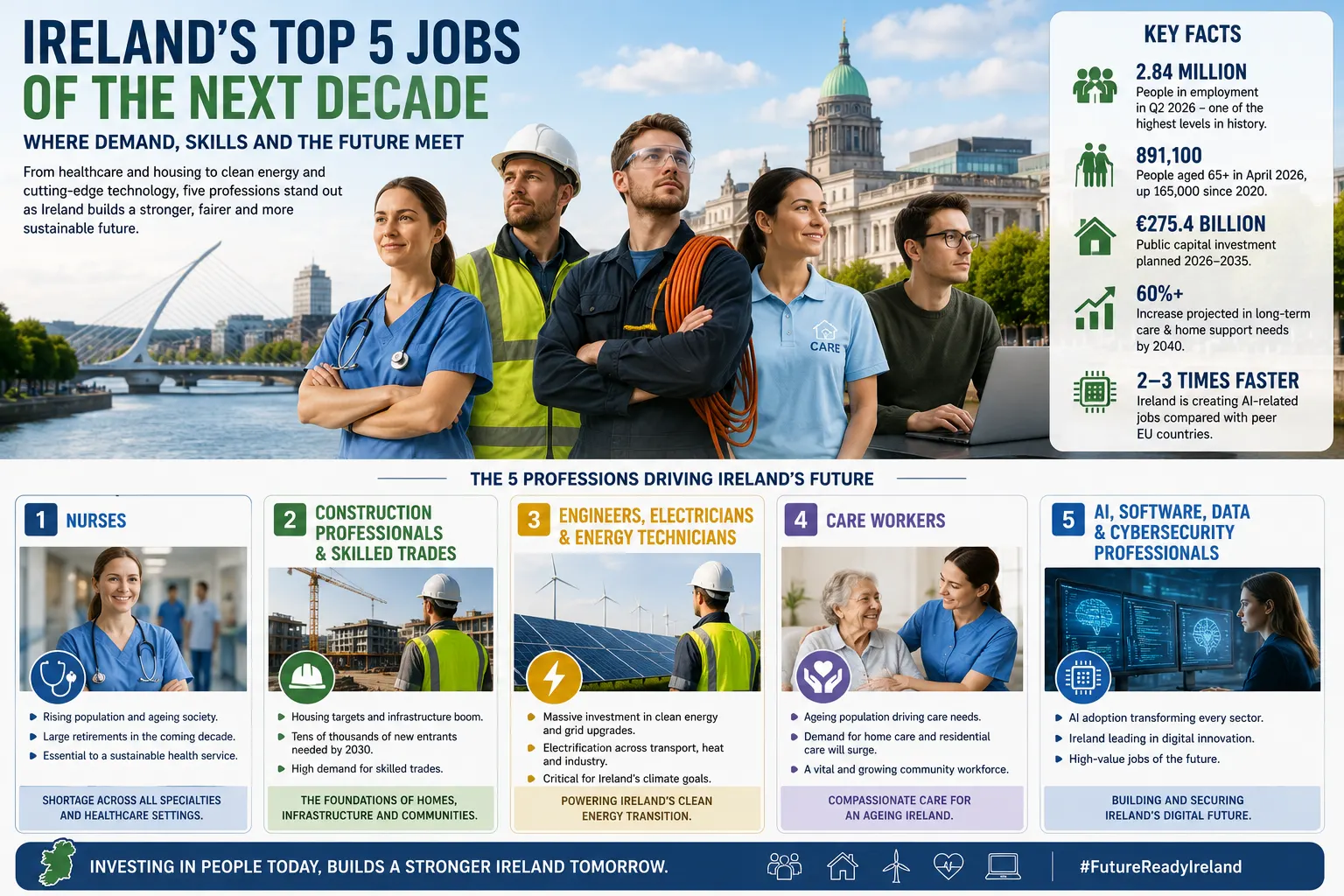
Ireland entered 2026 with more than 2.8 million people in employment, one of the largest workforces in the State’s history. Yet the central labour-market question for the next decade is no longer simply how many jobs the economy can create. It is whether enough people with the right qualifications will be available to staff hospitals, care for an ageing population, build hundreds of thousands of homes, reconstruct the electricity system and operate an economy increasingly organised around artificial intelligence, data and cybersecurity.
The answer is complicated because Ireland is being reshaped by several structural forces at once. The population is continuing to grow but is ageing rapidly. Housing and infrastructure investment must expand after years in which supply failed to keep pace with population and economic growth. Electrification is shifting investment towards grids, renewable generation, heating and transport. At the same time, AI is changing the tasks performed inside professional occupations rather than simply creating an entirely separate technology sector.
The five professions identified here are therefore not a Government ranking and should not be interpreted as a prediction that they will produce the five largest increases in employment. They are an evidence-based editorial assessment using five criteria: existing evidence of labour or skills shortages; expected structural demand rather than short-lived cyclical demand; importance to essential national systems; difficulty of replacing the work through automation; and the scale of Government or private investment already committed to the underlying sector.
On that basis, five occupational families stand out: nurses; construction professionals and skilled trades; electrical and automation engineers, electricians and energy technicians; care workers; and advanced digital professionals working in AI, software, data and cybersecurity. Their importance comes from very different causes, but together they reveal what Ireland’s economy is likely to need most as it moves into the 2030s.
2.84 million: people were in employment in Ireland in the second quarter of 2026.
891,100: people aged 65 and over were living in Ireland by April 2026, 165,000 more than in 2020.
69,000: approximate number of new construction-sector entrants required to 2030 under a scenario with substantial use of modern construction methods.
At least 60%: projected increase in long-term residential care and home-support requirements by 2040 under ESRI modelling.
2–3 times: the rate at which Ireland was generating AI-related jobs compared with peer EU countries in a 2026 Expert Group on Future Skills Needs assessment.
The Forces Behind the Ranking Are Already Visible
The first force is demographic. CSO estimates show that Ireland had 891,100 residents aged 65 or over in April 2026, representing 16.1% of the population. That age group had increased by 165,000 people since 2020. At the opposite end of the demographic structure, the population aged under 15 fell below one million for the first time since 2014.
The longer-term movement is considerably larger. The Expert Group on Future Skills Needs estimates that Ireland’s population could increase by roughly one million people over the next three decades under a medium projection, while the old-age dependency ratio rises sharply. Its analysis suggests that Ireland currently has close to four people of working age for every person aged 65 or over, but that the ratio could fall towards two to one by the middle of the century.
This does two things simultaneously. More people generate demand for homes, infrastructure and public services, while ageing creates greater demand for healthcare and long-term care. But the proportion of the population available to supply labour does not expand at the same rate. Ireland can therefore experience population growth and labour scarcity at the same time.
The second structural force is capital investment. The updated National Development Plan provides for €275.4 billion of public capital investment between 2026 and 2035. Housing, water, electricity networks, transport and public facilities must all compete for workers drawn from many of the same engineering and construction occupations.
The third force is technological change. Ireland already has an unusually large technology sector and is adopting AI rapidly across multinational companies, domestic firms and the public service. AI will automate some tasks, but it simultaneously raises the value of people capable of building, integrating, securing and governing complex digital systems.
Five Occupational Groups With the Strongest Structural Case
| Occupation | Main demand driver | Evidence today |
|---|---|---|
| Nurses | Population ageing and health expansion | Documented skills shortage |
| Construction professionals and trades | Housing and infrastructure | Large recruitment requirement |
| Electrical and energy specialists | Grid, renewables and electrification | Engineering shortages |
| Care workers | Ageing and home support | Documented labour shortage |
| AI, software, data and cyber specialists | Digitalisation and AI adoption | Persistent high-skill shortages |
Assessment based on SOLAS, CSO, ESRI and Irish Government workforce and investment studies. The ordering is analytical rather than an official forecast ranking.
1. Nurses — The Profession Demography Makes Almost Impossible to Avoid
If one occupation has the strongest combination of current shortage and predictable long-term demand, it is nursing. SOLAS classifies nurses as a skills-shortage occupation and expects shortages to persist. Unlike many economic forecasts, where demand depends heavily on investment cycles or technological developments, the core driver behind nursing demand is comparatively simple: Ireland will have considerably more older people.
The Department of Health recorded 76,558 practising nurses in Ireland in 2024, an increase of 5.5% in one year. SOLAS, using a broader occupational labour-market measure covering nurses and midwives, counted more than 80,000 workers. The precise totals differ because the datasets measure different concepts, but both demonstrate that nursing is already one of the largest professional occupations in the country.
The striking figure is where Ireland obtains its nurses. According to the Department of Health, 54% of practising nurses in 2024 had received their first nursing qualification outside Ireland. India, the United Kingdom and the Philippines were the largest countries of training among the internationally educated workforce.
International recruitment has made an enormous contribution to Irish healthcare and will continue to be important. But relying indefinitely on other countries to educate more than half of the nursing workforce creates strategic vulnerability, particularly because ageing populations are simultaneously increasing demand for nurses throughout Europe and much of the developed world. Countries from which Ireland recruits are also attempting to retain their own healthcare professionals.
The Demand Increase Is Not Simply a Prediction About Hospital Beds
The ageing effect reaches almost every part of healthcare. ESRI modelling projects GP consultations increasing by at least 23% by 2040. Separate modelling projects substantial increases in acute hospital activity, while primary and community-care workforce requirements are also expected to rise.
Ageing matters because healthcare use is not evenly distributed across the population. Older people generally require more hospital care, medication, rehabilitation, chronic-disease management and community support. Improvements in healthy ageing can reduce demand at particular ages, but the sheer increase in the number of older people still produces substantial aggregate growth.
The health system is also deliberately trying to shift more treatment away from hospitals. Sláintecare, community care, virtual wards and digital-health programmes aim to provide more treatment closer to patients’ homes. That can reduce pressure on expensive hospital capacity, but it does not eliminate the need for clinical staff. In many cases it relocates nurses from one setting to another.
Technology will change nursing considerably. Electronic health records, remote monitoring, AI-supported diagnostics and automated administration could reduce paperwork and allow professionals to spend more time with patients. They are far less capable of replacing physical assessment, medication administration, clinical judgement, emergency response and human care.
This distinction is fundamental when discussing the future of work. Automation risk is highest where a job consists predominantly of information processing that can be codified. Nursing combines knowledge with physical presence, responsibility, interpersonal communication and rapidly changing real-world conditions. That makes it comparatively resistant to full automation.
Ireland Is Expanding the Training Pipeline — but Training Takes Years
The State has already begun increasing healthcare education capacity. In February 2026, the Government announced €28.5 million intended to support more than 1,100 additional third-level healthcare places each year over the following three years. The expansion covers nursing and midwifery alongside medicine, therapies, social care, pharmacy and other disciplines.
The increase amounts to approximately 27% additional annual capacity across the targeted healthcare courses. New nursing provision, including Maynooth University’s School of Nursing, is intended to expand the domestic pipeline rather than depending entirely on international recruitment.
But healthcare workforce policy contains unusually long delays. A decision to create a new nursing place does not create a qualified nurse tomorrow. University education, clinical placements and professional registration all take time. Increasing student numbers also requires lecturers, supervisors and clinical placements, so training capacity itself can become a bottleneck.
This is why the current shortage matters for the future. Ireland cannot wait until the ageing population reaches its 2040 size before deciding how many nurses to educate. Workforce planning has to anticipate demand many years before it materialises.
2. Construction Professionals and Skilled Trades — Because Almost Every Other National Plan Needs Them
The second occupational group is not a single trade but the network of skills required to convert planning permission and investment into physical infrastructure. Civil engineers, construction project managers, quantity surveyors, carpenters, plumbers and other skilled trades form a production system. A shortage at one stage can slow the entire chain.
Housing provides the most visible source of demand. Government policy is built around delivering approximately 300,000 additional homes by 2030. But the construction workforce must simultaneously retrofit existing housing, maintain the current building stock and deliver roads, railways, hospitals, electricity infrastructure, water systems and commercial projects.
The scale of the workforce challenge has been modelled explicitly. An updated Government-commissioned analysis estimated that almost 79,000 new construction entrants would be required between 2024 and 2030 if traditional methods remained dominant. Under a scenario with much greater use of Modern Methods of Construction, the requirement falls to approximately 69,000.
These figures are not forecasts that precisely 69,000 or 79,000 people will actually be hired. They are estimates of the labour required to deliver specified housing and retrofit output, including replacement of workers leaving the industry. If construction output is lower, labour demand will also be lower — but housing and infrastructure targets would then not be achieved.
Modern Methods of Construction could reduce the estimated recruitment requirement by about 10,000 workers while delivering the same modelled housing and retrofit output to 2030.
Why Productivity Matters as Much as Recruitment
The construction problem cannot realistically be solved simply by finding ever larger numbers of workers. Ireland is trying to increase productivity through factory production, modular systems, standardised designs, digital building information modelling and other Modern Methods of Construction.
This changes the labour market rather than making skills unnecessary. Some work traditionally carried out on individual building sites moves into controlled manufacturing environments. Digital design, production engineering, logistics and quality assurance become more important, while certain repetitive site activities require fewer labour hours.
The effect is visible in the Government workforce modelling: greater productivity lowers the number of additional entrants required by roughly 10,000. Yet even the more technologically advanced scenario still requires approximately 69,000 new entrants. Automation reduces the scale of the shortage; it does not remove it.
SOLAS already identifies shortages among civil engineers and construction project managers, quantity surveyors and carpenters, with plumbers regarded as a potential future shortage. Employers have specifically reported difficulty obtaining site managers, project managers and engineers with capabilities in areas such as BIM, design and specialised sectors.
This illustrates another feature of future labour demand: the highest-value construction worker may increasingly combine traditional sector knowledge with digital capability. Knowing how buildings are physically assembled remains important, but so does understanding digital design, energy standards, prefabrication and complex project management.
Housing Makes Construction a Labour-Market Issue Beyond the Building Site
Construction has a circular relationship with the wider workforce. Ireland needs builders to produce more housing, but inadequate housing itself makes it harder to recruit workers. Nurses, engineers, teachers, technicians and technology professionals all need somewhere affordable to live near their workplace.
High housing costs can therefore become a labour-supply constraint across sectors. An employer may have a funded vacancy and an appropriately qualified candidate, yet still struggle to recruit if accommodation is unavailable or absorbs an excessive proportion of the salary.
This is particularly important for international recruitment. Ireland has used migration extensively to supplement domestic labour supply. If workers arriving from abroad cannot secure accommodation, the effectiveness of migration as a solution to labour shortages diminishes.
Construction capacity therefore has economic effects beyond the number of houses completed. It influences the ability of almost every other expanding sector to attract and retain workers.
3. Electrical and Energy Specialists — The Workforce Behind Electrification
Electricity is moving from being one infrastructure system among many to becoming the central energy platform for a much larger part of the economy. Cars are becoming electric. Heating is moving towards heat pumps and electrical systems. Data centres and advanced manufacturing require large quantities of reliable power. Renewable generation must be connected to the national grid, while electricity networks themselves require unprecedented expansion.
This makes electrical and automation engineers, electricians, grid specialists and renewable-energy technicians strategically important. SOLAS already identifies shortages of mechanical, electrical and automation engineers. Ireland’s offshore-wind workforce analysis has separately identified significant recruitment challenges across 33 important roles spanning engineering, marine operations, construction, grid connection and project management.
Climate policy adds a legislated long-term driver. Ireland is working towards a 75% reduction in electricity-sector greenhouse-gas emissions by 2030 relative to 2018 and an ambition for 80% of electricity demand to be supplied from renewable sources. Current policy also aims to have 5GW of offshore wind projects in construction by 2030 and energised as soon as feasible thereafter.
Those targets cannot be delivered merely by purchasing turbines. Offshore wind farms need foundations, cables, substations, control systems, ports, grid connections, maintenance vessels, electrical protection systems and skilled workers capable of operating them safely for decades.
The Grid May Be the Most Important Construction Project People Rarely See
Renewable electricity alters where and when power enters the system. Historically, Ireland’s electricity network was designed around a relatively small number of large generating stations. Future generation is more geographically distributed, with wind and solar resources located where weather conditions are favourable rather than necessarily close to major centres of demand.
The network must therefore change. The National Development Plan includes €3.5 billion of State equity for EirGrid and ESB Networks intended to support a much larger programme of electricity-network investment. New transmission infrastructure, substations and distribution capacity are also required to connect new housing and commercial development.
Engineers working on these systems need skills that increasingly overlap. Traditional electrical engineering is being combined with power electronics, digital control, telecommunications, cybersecurity, energy storage and data analysis. A future grid is not merely a larger version of the twentieth-century grid; it is a more complex digital system managing electricity moving in multiple directions.
The same technological convergence is occurring in factories. SOLAS identifies electrical and automation engineering among occupations facing shortages because pharmaceutical plants, medical-device facilities and other advanced manufacturing increasingly rely on sophisticated control systems and automated production.
This makes the occupation unusually diversified. A qualified electrical or automation specialist can be needed by renewable-energy developers, utilities, construction companies, data centres, pharmaceutical plants and manufacturing businesses at the same time. Competition between sectors can intensify scarcity even when the total number being trained rises.
Why Electrical Skills Are Becoming More Strategic
| System | Change under way | Skills required |
|---|---|---|
| Electricity grid | Major reinforcement and expansion | Power and grid engineering |
| Offshore wind | Multi-gigawatt development | Electrical, marine and maintenance skills |
| Buildings | Heat pumps and electrification | Electrical installation and controls |
| Transport | Growing EV fleet | Charging and distribution systems |
| Industry | Automation and digital production | Controls and automation engineering |
Based on Climate Action Plan, National Development Plan and Government offshore-wind workforce analysis.
4. Care Workers — The Future Job Whose Importance Is Easy to Underestimate
Care work rarely receives the same attention as AI engineering or offshore wind, yet demography makes it one of the strongest candidates for sustained labour demand. SOLAS classifies care workers as experiencing a labour shortage, while the Expert Group on Future Skills Needs expects healthcare and long-term care to absorb a larger share of the workforce as Ireland ages.
The distinction between a labour shortage and a skills shortage matters. A skills shortage means employers cannot find enough people with the required qualifications or specialist capabilities. A labour shortage may instead arise because insufficient people are willing or able to work in the occupation under prevailing wages, hours, employment conditions and geographic constraints.
That makes care policy especially complex. Ireland could expand training programmes but still struggle to recruit if pay, travel requirements, unpredictable schedules or the physical demands of the work make other occupations more attractive. Workforce supply is therefore inseparable from employment conditions.
The underlying demand, however, is difficult to avoid. ESRI projections show the requirement for home-support hours for older people rising from 28.7 million annually in 2022 to between 44.9 million and 54.9 million by 2040. That represents an increase of between 57% and 91%, depending on population, healthy-ageing and policy assumptions.
Long-stay residential-care requirements are projected to rise by between 61% and 80% over the same period. The number of people aged 85 and over — the age group making particularly intensive use of long-term care — is expected to more than double by 2040.
Home Care Could Become One of the Largest Workforce Challenges
Government policy increasingly favours allowing older people to remain in their own homes for as long as possible. There are strong personal and social reasons for this approach, and home support can prevent or delay entry into residential care for some people.
But care delivered at home is labour-intensive. A residential facility concentrates workers and patients in one location. Home support requires workers to travel between individual houses, often for relatively short appointments. Rural areas can therefore require more travel time for every hour of direct care provided.
The geographical problem becomes more significant as the older population grows outside major cities. A national headline figure for care demand can conceal substantial differences between Dublin, regional towns and rural counties where staff must cover greater distances.
Technology can improve productivity. Digital scheduling, remote health monitoring, medication systems and communication tools can reduce unnecessary journeys or administrative work. But bathing, dressing, mobility assistance, preparing meals and providing human companionship cannot simply be converted into software.
This is one of the reasons care work may prove surprisingly resistant to AI substitution. Its economic value comes partly from exactly those characteristics that machines find most difficult: physical adaptation to unpredictable environments, trust, empathy and continuous human judgement.
The Economic Problem Is That Essential Does Not Automatically Mean Attractive
A profession can be socially indispensable without labour markets automatically supplying enough workers. If demand rises faster than the workforce, either pay and conditions must improve, productivity must increase, migration must supply additional labour, families must provide more unpaid care or some demand will remain unmet.
These are not equivalent outcomes. Increased reliance on unpaid family care can reduce labour-market participation among relatives who leave employment or reduce their hours to care for parents or partners. Care shortages can therefore reduce labour supply elsewhere in the economy.
This creates another feedback loop. Ireland will need more people participating in the workforce as the ratio between workers and retirees falls. Yet inadequate childcare, disability services or elder care can prevent working-age adults from participating fully. Spending on care services can therefore support labour supply as well as meet social needs.
The importance of care work is consequently larger than the employment statistics for the occupation itself. A functioning care system enables other people to remain in their own jobs.
5. AI, Data, Software and Cybersecurity Specialists — But Not Simply More Programmers
The fifth occupational group is the most technologically dynamic and the most difficult to forecast. Ireland has one of Europe’s most technology-intensive economies and the Government’s updated Digital and AI Strategy aims to make the country a leading centre for applied AI while digitalising key public services.
The latest evidence suggests exceptionally rapid adoption. In August 2026, the Expert Group on Future Skills Needs reported that Ireland was generating AI-related jobs at two to three times the pace of peer EU countries. Ireland ranked second in the EU for AI-related skills and second for the spread of AI use through the economy in the measures examined.
SOLAS already identifies software developers and engineers as a skills-shortage occupation, alongside IT analysts and engineers. The supply pipeline is substantial, but demand is international. In 2024, 37% of people working in ICT occupations in Ireland were non-Irish citizens, far above the national average, demonstrating how dependent the sector is on internationally mobile talent.
Yet it would be a mistake to extrapolate the software labour market of the 2010s directly into the 2030s. Generative AI can already write, test, document and modify computer code. Routine programming and some entry-level software tasks are therefore among the forms of professional work most exposed to automation.
SOLAS explicitly acknowledges this uncertainty. Its National Skills Bulletin notes that future demand for some entry-level software roles could ease as AI and automation spread. At the same time, it expects shortages in more advanced roles to persist because organisations still need people capable of implementing, integrating and governing rapidly changing technology.
The Valuable Digital Worker Is Moving Up the Complexity Chain
The future shortage is therefore less likely to be simply “people who can code”. Coding is becoming one component of a broader technical profession. The more valuable skill set increasingly combines software architecture, machine learning, data engineering, cloud infrastructure, cybersecurity, business understanding and regulatory knowledge.
A company implementing AI does not merely purchase an algorithm. It needs reliable data, computing infrastructure, integration with existing software, security controls, evaluation systems and people capable of determining whether outputs are accurate and appropriate.
Cybersecurity becomes more important as digital dependence increases. Ireland is home to major technology companies, financial services, data infrastructure and multinational businesses while its public services are undergoing further digital transformation. The updated national digital strategy therefore calls for additional cybersecurity capacity, a new Cyber Security Research Centre of Excellence and expanded capabilities at the National Cyber Security Centre.
EU regulation is also increasing the need for specialist expertise. The NIS2 framework and Cyber Resilience Act place additional security obligations on organisations and technology providers. AI regulation creates parallel demand for professionals capable of understanding both technology and legal compliance.
The fastest-growing technology profession may consequently be a hybrid rather than a traditional job title: an engineer or analyst who understands AI but also understands cybersecurity, data governance, a regulated industry or a specific business process.
AI Is Both a Source of Jobs and a Tool for Reducing Other Labour Shortages
The strategic importance of AI skills extends beyond the technology sector because Ireland faces a constrained labour supply. If the working-age population grows more slowly than demand for services, productivity becomes increasingly important.
AI can potentially allow the same number of workers to process more information, automate administration and make better use of specialist expertise. A nurse may spend less time documenting routine information. An engineer may analyse infrastructure data faster. A construction company may optimise scheduling and design. A civil servant may automate repetitive case processing.
Those productivity gains cannot be assumed. Poorly implemented technology can add bureaucracy, create security risks or produce unreliable decisions. The economic value of AI depends substantially on whether organisations possess people capable of using it effectively.
This creates a paradox. AI may reduce employment in some digital tasks while making advanced digital specialists more important to the economy as a whole. The relevant career question is therefore not whether AI will eliminate technology jobs, but which level and combination of technology skills will remain scarce after basic automation becomes commonplace.
Why Teachers Are Not in the Five — Despite Genuine Shortages
Several other occupations could reasonably appear on a list of strategically important Irish professions. Teachers are an obvious example. SOLAS identifies shortages of subject-specific secondary teachers, while individual schools and special-education services continue to experience recruitment difficulties.
But national demographics complicate the long-term picture. Primary enrolment is projected to decline until around 2036, while post-primary numbers were expected to peak around 2025 and then fall into the following decade. Demand for special-education teachers and shortages in particular subjects can therefore coexist with falling aggregate pupil numbers.
This is why the present analysis does not place teaching among the five strongest national structural growth cases. It does not mean teachers will cease to be needed or that specialist shortages will disappear. It means the demographic driver is less uniformly expansionary than it is for health and elder care.
Transport is another important case. Ireland’s transport workforce has a relatively old age profile, creating substantial replacement demand as drivers and other employees retire. Agriculture faces an even more pronounced ageing challenge. But replacement demand is different from the simultaneous combination of replacement and large structural expansion visible in health, housing, electricity and certain digital occupations.
The Five Careers Do Not All Require University
One of the most important conclusions is that Ireland’s future skills problem cannot be solved exclusively through universities. Nursing, engineering and advanced digital professions generally require higher education, but construction, electrical work and care include apprenticeship, further-education and work-based pathways.
Ireland recorded more than 9,000 apprenticeship registrations in 2024, with more than half in construction programmes and hundreds more in construction-related occupations. Government policy targets 12,500 annual apprenticeship registrations by 2030.
This matters economically because an education system concentrated too heavily on one pathway can create shortages elsewhere. A country can produce large numbers of graduates while simultaneously lacking carpenters, technicians or skilled electrical workers necessary to build the laboratories, homes and energy systems in which those graduates work.
The distinction between academic and vocational education also becomes less clear as technologies evolve. Modern electricians work with digital controls and renewable-energy systems. Construction workers increasingly use BIM and factory-production techniques. Care staff interact with remote-monitoring technology. Technicians in automated factories may operate equipment more technologically sophisticated than machinery once associated primarily with graduate engineers.
The future labour market is therefore likely to reward technical depth rather than educational status alone.
Migration Will Remain Necessary Even With More Domestic Training
Ireland cannot realistically meet all of these workforce requirements solely from its existing population. The Expert Group on Future Skills Needs notes that inward migration has become a central source of labour-force growth and expects it to remain important as the population ages.
The evidence is already visible in individual occupations. More than half of practising nurses were trained abroad in 2024. More than a third of workers in ICT occupations were non-Irish citizens. Construction has also become increasingly dependent on workers born outside Ireland.
Migration is therefore not simply a demographic phenomenon occurring alongside labour-market policy. It is one mechanism through which labour shortages are currently being filled.
But recruitment abroad is not an unlimited resource. Healthcare professionals, engineers and technology specialists are sought internationally. Other ageing European countries are competing for many of the same people. Ireland’s ability to attract them will depend on wages and career prospects but also housing, transport, childcare, public services and the ability of spouses or partners to build their own lives in the country.
A labour-shortage policy that considers only work permits while ignoring living conditions will therefore become increasingly ineffective.
Retention May Matter as Much as Recruitment
The number of people entering an occupation does not determine workforce supply by itself. Workers also leave occupations, move abroad, reduce hours, retire or change careers. In several shortage professions, retention is therefore as important as education capacity.
SOLAS noted this particularly clearly for nursing. Despite large recruitment flows and substantial numbers of employment permits, employment had declined between 2023 and 2024 in its occupational data. That pattern suggested that many new recruits were replacing people who had left rather than expanding the workforce.
A similar problem can exist in care work where turnover is high. Increasing training output without improving retention can create a revolving door in which large numbers enter but net workforce growth remains small.
Employers and policymakers consequently need to distinguish between a training shortage and a retention shortage. The policy solutions are different. More university places help the first. Pay, workload, working conditions, housing and career progression can be more relevant to the second.
The Labour Market Is Becoming a Competition Between National Priorities
Another difficulty is that these five occupational groups do not exist in isolation. The same engineer may be recruitable by a pharmaceutical company, data centre, utility, renewable-energy developer or construction contractor. The same qualified digital specialist may choose between a multinational technology company, bank, hospital system or Government agency.
Public investment can therefore increase labour demand faster than labour supply. The €275.4 billion National Development Plan is designed to increase economic capacity over the long term, but during construction it requires workers who are also wanted by private industry.
That can push wages higher, which helps attract workers but also raises project costs. Higher construction costs can then reduce the number of projects financially viable within fixed budgets. Labour scarcity thus becomes part of the inflation and delivery problem.
Sequencing investment matters for this reason. Attempting simultaneously to build unprecedented numbers of houses, expand electricity networks, construct transport projects, retrofit buildings and expand healthcare facilities can create bottlenecks even when every individual project is economically justified.
This is not an argument for reducing investment. It is an argument for aligning investment plans with realistic workforce and supply-chain capacity.
How the Five Occupations Differ
| Occupation | Automation exposure | Primary bottleneck |
|---|---|---|
| Nursing | Low to moderate | Training and retention |
| Construction | Moderate | Skills volume and productivity |
| Electrical and energy | Low to moderate | Specialist technical supply |
| Care work | Low | Recruitment and retention |
| AI and digital | High within routine tasks | Advanced and hybrid skills |
Analytical assessment based on the characteristics of each occupation and evidence from national workforce studies.
The Geography of Future Jobs Will Also Change
The five professions will not be distributed evenly across Ireland. Dublin will remain the country’s largest concentration of digital employment, Government activity and specialist healthcare. But some of the strongest future labour needs will be regional.
Offshore wind development can create engineering, construction, marine and maintenance demand around ports and coastal regions. Housing construction is required in every growing city and county. Care demand follows the older population and therefore reaches rural areas where providing services can be more labour-intensive.
Healthcare workforce projections already show regional differences because populations grow and age at different rates. The ESRI has begun modelling future workforce requirements across the six HSE health regions rather than treating Ireland as one uniform healthcare market.
This matters for training policy. Producing enough qualified workers nationally does not guarantee that they will live where vacancies exist. A nurse trained in Galway cannot automatically solve a shortage in a remote part of another region if housing, transport or family circumstances make relocation unattractive.
The same problem exists with trades and engineers. Skills policy therefore increasingly needs a geographical dimension alongside national totals.
What Could Change the Ranking
No scientific analysis can identify the five most important occupations of 2035 with certainty. Population projections depend particularly on migration. Housing output can rise or fall. New technologies can change labour productivity far faster than expected. Government investment programmes can be delayed or redesigned.
The ranking would change if Ireland experienced substantially lower population growth. Construction demand could fall below current assumptions, although an existing housing deficit and infrastructure requirements would continue to support significant activity. Healthcare demand would be less affected because ageing is already embedded in the population structure.
A major technological breakthrough in robotics could eventually reduce labour intensity in construction or care, but widespread replacement of human workers in unstructured physical environments remains considerably harder than automation of office-based information processing.
AI presents the greatest uncertainty. Routine coding, administrative analysis and some professional tasks may require fewer workers. Conversely, successful AI adoption could expand companies and create entirely new categories of employment. The most defensible conclusion is therefore not that every existing software role will grow, but that advanced digital capability will remain strategically necessary.
Energy policy also matters. Delays to offshore wind could postpone some specialised employment, but grid reinforcement, electrification, industrial automation and renewable generation create overlapping demand for electrical skills even if individual technologies progress more slowly than planned.
The Most Secure Careers Share a Common Feature
What links these five occupational groups is not simply shortage. It is that their work sits close to a physical or institutional constraint that Ireland cannot easily outsource.
A software service can sometimes be purchased from another country, but a nurse treating a patient generally needs to be present within the health system. A house must be built where people need to live. An electricity network must be physically installed and maintained in Ireland. Home support has to reach the person receiving care. Critical digital systems still require people accountable for their security and integration even when individual coding tasks can be automated.
Local necessity therefore increases employment resilience. Occupations tied to essential physical systems or direct human care are less exposed to international outsourcing than many purely informational jobs.
The strongest career prospects may consequently emerge where three characteristics overlap: a difficult skill, a growing structural need and work that cannot easily be moved or automated.
Ireland’s Real Future-Skills Problem Is Time
There is ultimately nothing mysterious about why Ireland will need these workers. The evidence is visible years in advance. The difficulty is that workforce supply reacts slowly.
A nursing school takes time to establish. Students need several years to qualify. An electrician completes an apprenticeship over multiple years. Engineers require extensive education and professional experience. Senior cybersecurity and AI specialists are not created by a short training course. Experienced construction managers usually develop their capability across successive projects.
Infrastructure has similar lead times. Universities need buildings and lecturers before they can take more students. Apprentices need employers willing to train them. Healthcare students require clinical placements. Renewable-energy specialists require projects on which to gain experience.
The decisions determining the workforce available in 2032 are therefore being made now. Waiting for shortages to become severe before expanding education guarantees that supply arrives late.
The Future Is Likely to Reward Combinations of Skills
The other major change is that traditional occupational boundaries are becoming less rigid. The future civil engineer will increasingly work with digital modelling, environmental data and modern manufacturing methods. The electrical engineer will encounter software and cybersecurity. The nurse will use digital records, remote monitoring and AI-supported tools.
The technology professional, meanwhile, will increasingly need knowledge outside technology. Building AI for healthcare requires understanding clinical risk. Developing energy software requires understanding electricity systems. Automating a factory requires knowledge of manufacturing processes. Cybersecurity increasingly intersects with law and regulation.
These combinations are difficult to automate because they require contextual judgement across domains. They are also difficult to recruit because education systems traditionally organise qualifications into separate disciplines.
For students and workers choosing careers, this suggests a different strategy from attempting to predict a single fashionable job title. A strong foundational profession combined with digital, analytical and communication skills may prove more durable than narrow expertise in one current technology.
Ireland Cannot Train Its Way Out of Every Labour Shortage
More education is necessary, but it is not sufficient. Ireland’s long-term workforce analysis shows that labour-force participation, migration, productivity and retention must all contribute as the population ages.
Greater participation among older workers could expand labour supply. Better childcare and care services could enable more parents and family carers to work. Flexible retirement could keep experienced professionals economically active for longer. Migration will continue to fill gaps that cannot be supplied domestically.
Technology must also increase productivity. The construction workforce forecast demonstrates the principle particularly clearly: modern construction methods reduce the estimated recruitment requirement by roughly 10,000 people. Similar productivity improvements will be necessary elsewhere if Ireland is to provide more services with a working-age population growing more slowly than total demand.
But productivity should not be confused with simply requiring existing workers to do more. Sustainable productivity comes from better processes, technology, infrastructure, training and organisation. Continually increasing workload without those improvements eventually damages retention and can worsen shortages.
The Five Professions Reveal the Ireland of the 2030s
Nurses and care workers appear on this list because Ireland is ageing. Construction workers appear because the country has not built enough housing and infrastructure for the population and economy it now supports. Electrical and energy specialists appear because decarbonisation requires rebuilding much of the energy system. AI, data and cybersecurity professionals appear because economic activity is becoming increasingly digital.
These are not independent transformations. More homes require electricity connections. A larger health system requires buildings and digital infrastructure. AI requires electricity and data networks. Renewable energy requires engineers and construction workers. Healthcare and construction employers require housing for their own workers. Care services help other adults remain in the labour force.
This interconnectedness is why labour shortages can become a national constraint rather than an isolated employer problem. A shortage of one profession can delay an investment that another sector depends upon.
The favourable side of the same equation is opportunity. Ireland is not facing a future in which technological change simply removes employment. It is facing a reallocation of work towards areas where human expertise remains scarce and economically valuable.
The five professions most likely to matter are therefore not necessarily those producing the most dramatic headlines today. They are the people who will keep essential systems functioning while Ireland becomes older, more populated, more electrified and more digital. The country’s ability to educate, attract and retain them will help determine whether the ambitious plans already written for housing, healthcare, climate and technology become physical reality or remain targets on paper.
Sources
Central Statistics Office — Labour Force Survey, Quarter 2 2026
Central Statistics Office — Population and Migration Estimates, April 2026
Expert Group on Future Skills Needs — Skills Needs for Ireland in the Long-term
SOLAS — National Skills Bulletin 2025
Department of Health — Ireland’s Future Health and Social Care Workforce
Department of Health — National Healthcare Statistics 2025
Government of Ireland — National Development Plan
Department of Further and Higher Education — Offshore Wind Skills Action Plan
Department of Enterprise, Tourism and Employment — The Irish Labour Market and AI in 2026
Government of Ireland — Cyber Security and the National Digital and AI Strategy
Source & Transparency
This article is published by Ireland Newspaper for editorial and informational purposes.
Published: 3 September 2026 · Updated: 3 September 2026

Newsroom Ireland Newspaper
Ireland Newspaper editorial team prepares daily news coverage for readers in Ireland and abroad.




Market data, financial news and economy content on Ireland Newspaper are provided for editorial and informational purposes only. They do not constitute financial advice, investment advice, trading advice or a recommendation to buy, sell or hold any financial product. Always verify live prices and consult a qualified professional before making financial decisions.