
Ireland is creating jobs, employment stands at almost 2.84 million and average earnings are rising. Yet in the 12 months to April 2026, an estimated 35,400 Irish citizens packed their lives into suitcases, cars and shipping boxes and moved abroad. During the same period, 30,200 Irish citizens came home. The difference — a net outward movement of 5,200 Irish citizens — captures one of the more complicated realities of modern Ireland: a successful national economy does not necessarily persuade every individual that Ireland is the best place to build the next stage of a life.
The figures are striking, but they require perspective. Ireland as a whole is not experiencing population loss. There were 110,600 immigrants and 62,500 emigrants of all citizenships in the year to April 2026, producing positive net migration of 48,100 and helping lift the usually resident population to 5.526 million. What is happening among Irish citizens is different: departures have exceeded returns in each year since 2022, and the gap widened again in 2026.
Nor does the current movement resemble the mass economic emigration that followed the financial crisis. In the year to April 2013, 50,900 Irish nationals emigrated while only 15,700 returned, creating net outward migration of 35,200 Irish nationals. Today’s net loss is far smaller, the labour market is dramatically stronger and many departures are voluntary choices involving work, study, travel and lifestyle rather than unemployment or economic necessity.
But describing all modern emigration as adventure would be equally misleading. Housing has become extraordinarily expensive, rents for people starting new tenancies continue to rise faster than average earnings, home ownership is difficult for many younger adults and surveys repeatedly show dissatisfaction with the cost of establishing an independent life. Modern Irish emigration therefore sits somewhere between two old narratives: it is neither simply exile through economic failure nor merely a carefree rite of passage.
Irish migration in the year to April 2026
- 35,400 Irish citizens emigrated.
- 30,200 Irish citizens returned to Ireland.
- Net migration among Irish citizens was therefore -5,200.
- Total immigration of all citizenships was 110,600 and total emigration was 62,500.
- Ireland’s overall net migration remained strongly positive at 48,100.
- Across all citizenships, 85% of emigrants were aged between 15 and 44.
Emigration Never Disappeared — Its Meaning Changed
Few countries have a relationship with emigration as deeply embedded as Ireland’s. Economic weakness, unemployment and limited opportunity drove generations abroad during the nineteenth and twentieth centuries. The late 1980s brought another severe period: total net migration was negative by 41,900 in 1988 and 43,900 in 1989. For families across the country, departure was often less a lifestyle choice than a response to a labour market unable to provide enough work.
The Celtic Tiger changed that pattern dramatically. Ireland became a country of substantial net immigration as employment expanded and workers arrived from Europe and elsewhere. By 2007, immigration reached an estimated 151,100 and total net migration was positive by 104,800. Emigration continued — people always leave prosperous countries as well as struggling ones — but it no longer defined the national economy in the same way.
The financial crash reversed that transformation. Total emigration rose to 89,000 in the year to April 2013. Irish nationals accounted for 50,900 of those departures, while just 15,700 Irish nationals returned. Net outward migration among Irish nationals reached 35,200. Jobs had disappeared, public finances were under severe pressure and emigration once again became closely associated with economic distress.
Today’s figures look very different. An Irish citizen leaving in 2026 is entering a world in which Ireland itself has labour shortages in several sectors and one of Europe’s more internationally connected economies. The question is therefore no longer simply whether Ireland can provide employment. Increasingly, it is whether the combination of employment, pay, housing, career progression, public services and personal lifestyle is competitive with what the same person believes is available somewhere else.
Irish Citizens Leaving and Returning
| Year to April | Returned | Emigrated | Net |
|---|---|---|---|
| 2013 | 15,700 | 50,900 | -35,200 |
| 2020 | 33,600 | 25,000 | +8,600 |
| 2021 | 36,400 | 21,400 | +15,000 |
| 2022 | 23,500 | 25,600 | -2,100 |
| 2023 | 29,600 | 30,500 | -900 |
| 2024 | 30,000 | 34,700 | -4,700 |
| 2025 | 31,500 | 35,000 | -3,500 |
| 2026 | 30,200 | 35,400 | -5,200 |
Source: Central Statistics Office Population and Migration Estimates. Figures for recent years are preliminary and subject to revision.
The table shows both continuity and change. Gross emigration among Irish citizens has risen from its pandemic-era lows, but current departures remain well below the post-crash peak. More importantly, roughly 30,000 Irish citizens are also returning each year. Ireland’s migration story is consequently a two-way flow rather than a one-way evacuation.
The People Leaving Are Disproportionately Young
Age is central to the story. Of all 62,500 emigrants leaving Ireland in the year to April 2026, irrespective of citizenship, 19,900 were aged between 15 and 24 and another 32,900 were between 25 and 44. Together, those groups represented 85% of total emigration. The CSO does not provide the same age breakdown specifically for Irish citizens in its headline release, so those figures should not be used as though all of the younger emigrants were Irish.
More detailed evidence about young Irish adults comes from the Growing Up in Ireland study. When members of its Cohort ’98 were contacted at age 25, 12.7% of those eligible to participate were living abroad. Among the 500 emigrants who completed the study’s short emigration questionnaire, 43.3% identified employment opportunities as their main reason for leaving, 21.1% education or training and 17.3% holiday or travel opportunities.
The destination pattern was equally revealing. Among those surveyed emigrants, Britain was the most common location, accounting for 35.6%, while Australia and New Zealand together accounted for 24.6%. Nearly half — 48.6% — said they intended eventually to return to Ireland, while 30.2% were undecided and 21.2% did not intend to return. The sample is not a national census of every 25-year-old emigrant and the figures are unweighted, but it provides unusually direct evidence of why one cohort actually left rather than merely asking people whether they might consider leaving.
This matters because employment emerges as a reason for departure even though unemployment in Ireland is relatively low. The apparent contradiction disappears when employment is distinguished from career opportunity. Having a job is not the same as having the job, salary, promotion path, specialist experience or professional environment a person wants. London, Sydney, Melbourne, New York, Toronto, Dubai and other international centres can offer occupational experiences that are difficult to reproduce in a country of Ireland’s size.
Ireland’s Labour Market Is Not Behaving Like an Economy People Have to Escape
The contrast with the financial-crisis era could hardly be clearer. In the second quarter of 2026, 2,839,300 people were employed in Ireland, 21,200 more than a year earlier. The unemployment rate was 5.1%. Youth unemployment was higher at 13.2%, but the overall picture remains one of high employment rather than widespread lack of work.
Average weekly earnings reached €1,046.88 in the second quarter, 3.9% higher than a year earlier. Consumer prices increased by 3.6% over the same comparison period. On that broad measure, nominal pay was slightly ahead of inflation, although averages conceal large differences between industries, occupations, working hours and households.
The latest national accounts, released on 4 September, reinforce the unusual character of the economy. GDP rose by 10.2% between the first and second quarters of 2026, driven largely by multinational-dominated activity. Domestic sectors grew by a much smaller 0.7%, while Modified Domestic Demand — a more useful measure of underlying domestic spending and investment — fell 0.8% in the quarter but was 3.1% higher across the first six months of the year than in the corresponding period.
This illustrates why national economic success and personal dissatisfaction can coexist. Irish GDP can rise sharply because of multinational activity without every household experiencing a comparable improvement in disposable income or access to housing. A graduate does not decide whether to emigrate by studying GDP. The calculation is more personal: what will I earn, where will I live, how much of my salary will housing consume and what kind of life will remain after those costs are paid?
Housing Has Become the Most Powerful Part of That Calculation
The housing figures explain why a country with strong employment can still feel financially restrictive to younger adults. The national standardised average rent for a new tenancy reached €1,839 a month in the first quarter of 2026, according to the latest RTB and ESRI Rent Index. That was 9.1% higher than a year earlier. Existing tenancies averaged €1,513, up 4.2%.
The distinction between new and existing rents is important for migration. A person who already has a long-established tenancy may experience a very different housing market from somebody graduating, separating from a partner, moving for a new job or returning from several years overseas. Emigrants and returning emigrants frequently enter the market as new renters and are therefore exposed to the prices associated with new tenancies rather than the lower averages paid by many established tenants.
Buying presents another barrier. The median price of a dwelling purchased in the 12 months to June 2026 was €396,000. In Dublin the median was €500,000, rising to €682,334 in Dún Laoghaire-Rathdown. At the other end of the national market, Longford’s median was €198,000. Those differences show why speaking about a single Irish housing market can obscure the choices facing individual households.
Prices also continue to move faster than many pay packets. Residential property prices rose by 5.6% nationally in the 12 months to June 2026, compared with the 3.9% annual increase in average weekly earnings recorded in the second quarter. New-tenancy rents rose still faster. These measures are not perfectly comparable, but their direction explains why an employee can receive a pay increase and still feel further from home ownership or more exposed when changing accommodation.
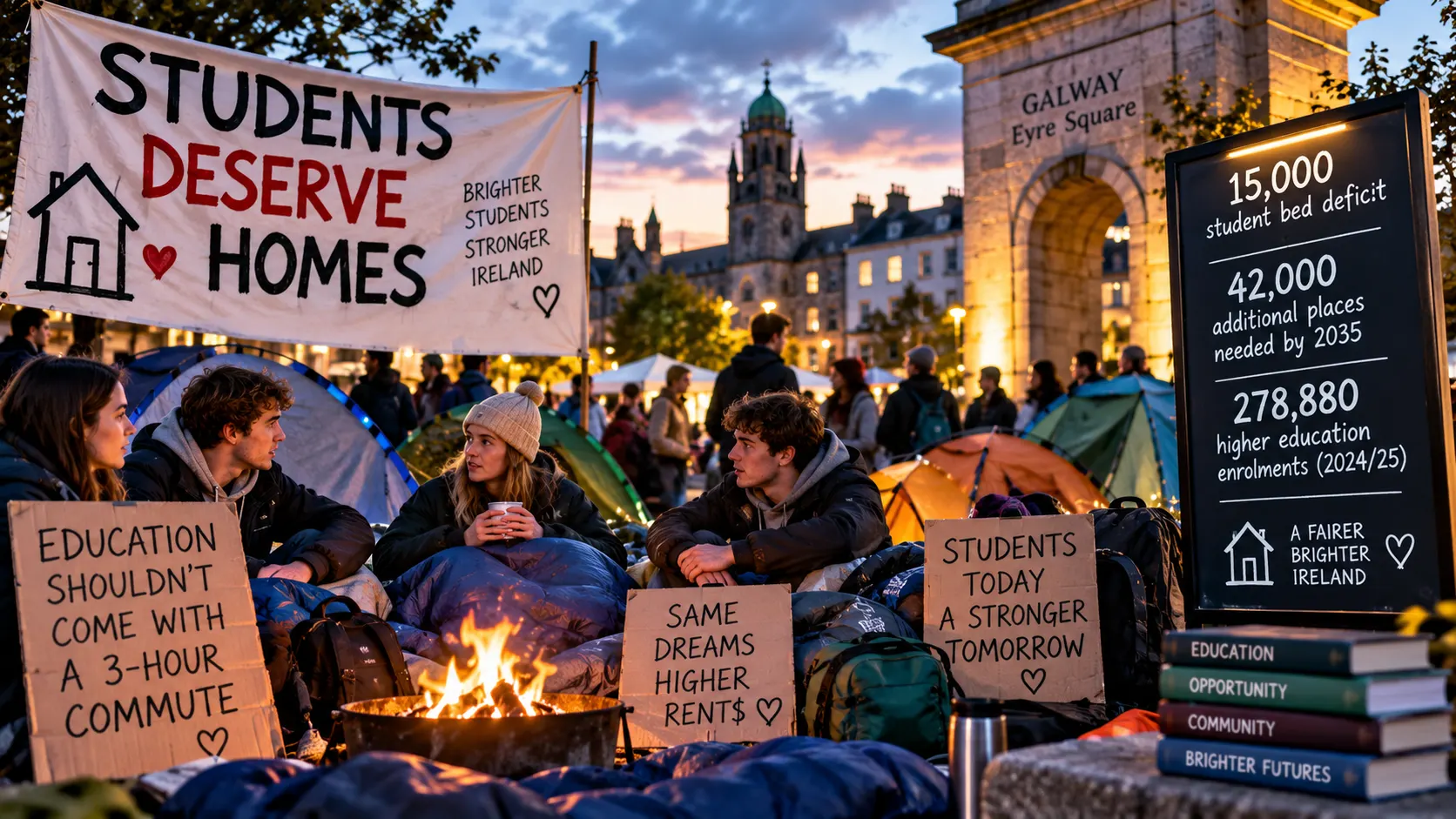
The pressure is also visible in household surveys. In 2025, 26.6% of households described housing costs as a heavy financial burden. Among rented or rent-free households the proportion was 35.8%. The experience is therefore not confined to people considering emigration, but young adults are particularly exposed because they are more likely to be entering the rental market, saving for a first home or still dependent on their parents.
At 25, Financial Independence Is Often Delayed
The Growing Up in Ireland study provides a vivid picture of this stage of life. Among 25-year-olds who were still living in their parental home, 62.4% said they were doing so mostly for financial reasons. Only 3.8% of the group examined in the study owned their own home. The study therefore connects migration with a broader problem affecting those who stay: delayed residential independence.
A 25-year-old living with parents while working full time is not necessarily experiencing poverty. In some families, living at home is convenient, culturally normal or deliberately used to save a deposit. But when the reason is predominantly financial, the implications extend beyond housing. Relationships, decisions about having children, geographical mobility for work and the ordinary experience of establishing an independent household can all be affected.
Against that background, moving abroad can offer something beyond a higher salary. For some people it represents the possibility of starting an adult life in a different housing market or experiencing independence that feels difficult to achieve at home. Whether that expectation is fulfilled depends heavily on the destination: London, Sydney, Vancouver and other popular cities have serious affordability problems of their own.
It is therefore dangerous to imagine an uncomplicated world in which Ireland is expensive and everywhere abroad is cheap. The decision is comparative. A higher rent abroad may still be acceptable if wages, career progression, transport or lifestyle are perceived to compensate for it. Conversely, someone may return to Ireland despite higher housing costs because proximity to family and friends has become more valuable than the financial advantages of remaining overseas.
The Cost-of-Living Debate Is Closely Linked to Thoughts of Leaving
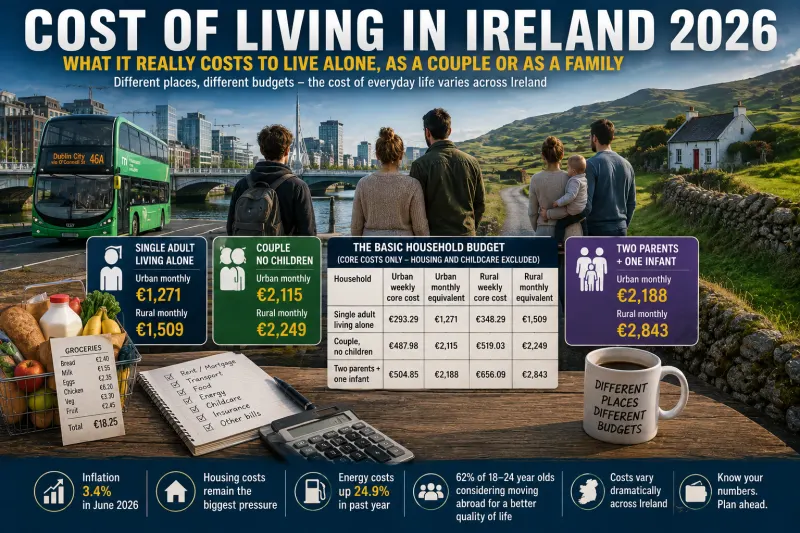
A 2025 RED C survey commissioned by the National Youth Council of Ireland found that three in five people under 25 were considering moving abroad for a better quality of life, with 31% strongly considering doing so. Among 18- to 24-year-olds, 84% agreed that the housing crisis affected younger people disproportionately, while rent and accommodation emerged as the largest financial challenge.
The figures are important, but they measure intentions and perceptions rather than actual migration. Most people who tell a pollster that they are considering emigration will not necessarily leave. Decisions can change rapidly after finding a job, meeting a partner, securing housing or reassessing opportunities overseas.
Still, the survey reveals something that migration statistics alone cannot: the possibility of leaving is present in the thinking of a substantial proportion of younger adults. Ireland’s long tradition of emigration may reinforce that option. Moving abroad is socially familiar, English-speaking destinations have established Irish communities, and Irish citizens have unusually straightforward labour mobility across the European Union as well as access to Britain under the Common Travel Area.
The result is a relatively low psychological barrier to departure. For a young person in another country, moving to another continent may feel like a radical rupture. For many Irish families, there is already a sibling, cousin, school friend or former colleague in London, Australia, Canada or elsewhere who can explain how the move works and provide an initial social network.
Australia Remains a Powerful Magnet — but the Flow Has Eased
Australia illustrates the continuing pull of international mobility. In the year to April 2026, 11,800 people of all citizenships left Ireland for Australia. That was down by 1,700 from the previous year, but still a substantial flow. The number moving in the opposite direction from Australia to Ireland fell to 8,300.
The figures are not restricted to Irish citizens, so they cannot be treated as an Irish-emigration total. But Australia has long held particular attractions for young Irish adults: an English-speaking labour market, existing Irish networks, opportunities in sectors such as construction and healthcare and a cultural expectation that a period abroad can be combined with travel.
Britain operates differently. Geography means leaving Ireland does not necessarily mean moving far from family. Flights are frequent, professional labour markets are deeply interconnected and Irish citizens retain extensive rights under the Common Travel Area. For certain careers, particularly highly specialised professions and industries concentrated in London or other British cities, the decision can resemble regional labour mobility more than permanent emigration.
Calling It a Brain Drain Is Tempting — but Too Simple
Concern about young and skilled people leaving is understandable. Ireland has invested heavily in education, while many sectors report shortages of workers. The Department of Enterprise expanded employment-permit eligibility again in 2026 in response to shortages in construction, healthcare, transport and agri-food. Losing trained Irish workers while recruiting workers internationally can appear contradictory.
But the available evidence does not justify describing every current emigrant as a highly qualified professional permanently lost to the economy. The annual 2026 migration release does not classify Irish emigrants by qualification. Some people leave to study, some to travel, some are already highly skilled, some are at the beginning of their careers and some ultimately return.
What can be said with confidence is that Ireland’s younger adult population is highly educated. In 2024, 65% of people aged 25 to 34 held a third-level qualification. Earlier CSO migration data also showed that third-level graduates made up a substantial share of emigrants, although the CSO cautioned that detailed migration estimates by education were based on relatively small samples and should be treated as indicative.
Return migration changes the economic calculation further. A person who leaves after university, gains specialist experience abroad and comes back five years later has not necessarily represented a permanent loss of human capital. The returning worker may bring skills, professional networks, capital and experience that would have been difficult to acquire domestically. Ireland’s 2026–2030 Diaspora Strategy explicitly recognises returning emigrants as a source of new skills and perspectives.
Why 30,200 Irish Citizens Came Home
The return figure deserves as much attention as the departure figure. More than 30,000 Irish citizens moved back in the year to April 2026. That is not a marginal counterflow; it is almost as large as the number leaving. Modern Irish migration is therefore highly circular.
There is no single reason to return, just as there is no single reason to leave. Career opportunities in Ireland can become more attractive after experience abroad. Parents may want children to grow up closer to grandparents and extended family. People may return to care for relatives, start businesses, buy homes outside the most expensive areas, reconnect socially or simply decide that the life they wanted abroad has run its course.
Ireland’s third Diaspora Strategy, published in 2026 after extensive consultation overseas, provides unusually current evidence of the desire to come home. The Global Irish Survey attracted 10,186 responses from individuals and organisations; after data cleaning, 6,503 individual responses were included in the main quantitative analysis. Among respondents, 34.7% said they wanted to return to Ireland, 40.7% were unsure and only 24.7% said they did not want to return.
That does not mean 34.7% of the entire Irish diaspora will come back. The survey was an open consultation, not a representative probability sample of every Irish person abroad. What it demonstrates is a substantial reservoir of return interest among the people who engaged with the consultation.
Wanting to Return and Being Able to Return Are Different Things
The same Diaspora Strategy identifies a revealing set of obstacles. Qualitative responses repeatedly raised the cost of housing and living in Ireland, administrative difficulties, returning with a non-EEA spouse and problems surrounding recognition of skills and qualifications. Access to school places for children was also raised during the wider consultation.
These barriers can make returning surprisingly complicated. An Irish citizen has an automatic right to live and work in Ireland, but a household assembled abroad may have to navigate immigration arrangements for a spouse, housing before arrival, school enrolment, taxation, banking, driving licences, health services and social-protection rules. A family earning a good income overseas can find that the decisive difficulty is not securing employment in Ireland but finding suitable accommodation close enough to that employment.
The Government has responded partly through information and administrative measures. The Returning to Ireland information portal has been expanded, EURES provides recruitment and relocation information, and the 2026–2030 Diaspora Strategy contains commitments to make return procedures easier. The strategy also commits to promoting vacancies in key sectors to Irish people overseas and continuing the Back for Business programme for returning entrepreneurs.
Those policies can reduce administrative friction, but they cannot substitute for housing supply. Information explaining how to rent a property does not create an additional property. If housing is the binding constraint, the effectiveness of return policy ultimately depends on domestic housing policy.
Housing Supply Is Increasing — but Not Yet Fast Enough to Remove the Constraint
Ireland is building more homes than during the years immediately after the financial crash, and government policy now explicitly targets a much larger expansion. The current housing plan aims to deliver more than 300,000 homes by the end of 2030, alongside social and affordable housing supports and investment in the infrastructure needed to unlock development.
Yet the latest construction data demonstrate the scale of the challenge. There were 8,823 new dwelling completions in the second quarter of 2026, 3.6% fewer than during the corresponding quarter of 2025. Apartment completions fell by 12.2%, while scheme-house completions increased by 2%.
The ESRI’s summer 2026 forecast expects approximately 38,500 housing completions during 2026 and just under 40,500 in 2027. Those would be significant totals by recent historical standards, but the institute still expects housing supply to remain below demand and the accumulated deficit to increase over its forecast horizon.
This is the connection between migration and housing that is easiest to misunderstand. Emigration does not solve the housing shortage, and immigration cannot fairly be described as its sole cause. Ireland entered the period of rapid population growth with a long-standing shortage of housing supply. At the same time, a growing population increases the number of households competing for accommodation. Both processes can be true simultaneously.
The Consequences Reach Beyond the Person Who Boards the Plane
For families, migration reorganises everyday life. Parents and grandparents can gain the opportunity to visit another country but lose routine proximity to children and grandchildren. Adult children abroad may be unable to provide regular care as parents age. Weddings, funerals, Christmas visits and family emergencies acquire an international travel dimension that is familiar across generations of Irish households.
The cost can be particularly visible in rural communities and smaller towns. Losing a few dozen young adults from a small area has a different effect from losing the same number from a large city. Sports clubs, voluntary organisations, schools, local businesses and community groups all depend on a continuing population of working-age adults. If departures are concentrated among people in their twenties and thirties, the social impact can remain long after the headline national population has continued to grow.
For employers, the consequences are mixed. Emigration reduces the pool of domestic workers available in particular occupations, while immigration expands it. Ireland’s current economy depends heavily on inward migration and international recruitment, meaning the workforce is becoming more internationally mobile in both directions. A company may lose an Irish engineer to Australia while recruiting an engineer from another country.
This is not inherently economically inefficient. International mobility can match workers with opportunities and distribute skills more effectively. The concern arises when people who would prefer to remain in Ireland conclude that housing or other structural barriers make that choice unrealistic. At that point, emigration is no longer simply evidence of an open economy; it can also represent a failure to convert employment and national income into a viable personal future.
For Ireland, the Critical Question Is Not How to Stop People Leaving
Trying to prevent emigration would be both unrealistic and undesirable. The freedom to study, work and live abroad is valuable, and overseas experience has contributed enormously to Irish business, culture and public life. The success of the Irish diaspora is itself part of Ireland’s international reach.
A healthier objective is choice. Someone who wants to spend three years working in Sydney should be able to leave without being portrayed as evidence of national failure. Someone who wants to remain in Cork, Galway, Dublin, Waterford or a rural county should not feel that independent housing is unattainable despite stable employment. And somebody who has spent ten years overseas should be able to consider returning without discovering that accommodation or administrative barriers make the move impractical.
That requires policy in several areas rather than an anti-emigration programme. Housing supply is the most obvious. Faster delivery of homes in places with employment demand, more viable rental supply and affordable purchase options would affect the financial calculation directly. Planning, water, energy and transport infrastructure matter because homes cannot be delivered at the required scale without them.
Career structures matter as well. Ireland cannot reproduce every specialised labour market available in much larger countries, but employers can compete through training, progression, flexible working and opportunities to gain responsibility. Public services matter because families considering whether to live in one country or another compare childcare, education, transport and healthcare alongside gross salary.
Finally, return migration should be treated as part of workforce strategy. Ireland has thousands of citizens overseas with experience in construction, medicine, nursing, engineering, technology, research, finance, education and entrepreneurship. When shortages exist in those same sectors at home, making return easier is a form of talent policy rather than merely diaspora engagement.
The Future Will Probably Remain a Story of People Moving Both Ways
There is little reason to expect Irish emigration to disappear even if housing conditions improve. A wealthy, highly educated, English-speaking population integrated into the European labour market will remain internationally mobile. Younger adults will continue to seek travel, education and professional experience, while global companies make careers increasingly multinational.
The more meaningful indicator will be the balance between choice and constraint. If departures remain high while survey evidence continues to show that housing and living costs make young people doubt whether they can establish themselves in Ireland, the economic success story will remain incomplete. If more emigrants are able to return when they want to, and more young adults who want to remain can secure independent housing and viable careers, gross emigration itself becomes less troubling.
The current figures contain both sides of that story. Thirty-five thousand four hundred Irish citizens left, but 30,200 came home. Ireland gained population overall, employment remained high and wages increased, yet Irish citizens still recorded a fifth consecutive year of net outward migration. There is no single crisis hidden inside those numbers, but neither should the numbers be dismissed as ordinary wanderlust.
The personal reality lies between the statistics: the graduate who wants experience unavailable at home, the renter who sees little path towards buying, the nurse or engineer offered better conditions overseas, the traveller who always planned to return, the parent who comes home because grandparents are growing older, or the emigrant who wants to return but cannot make the housing mathematics work. These are different decisions, and official migration totals cannot tell us which one applies to each person.
Tell Us Your Story
Ireland Newspaper would like to hear from readers who have lived this experience. Have you left Ireland in recent years, are you currently considering moving abroad, or have you returned after living overseas? What actually influenced your decision — housing, rent, work, salary, career progression, family, childcare, healthcare, lifestyle, relationships or something entirely different?
We also want to hear from parents and relatives whose family members have emigrated, employers who have struggled to retain or recruit staff, and people who deliberately chose to remain in Ireland when friends or colleagues left. Personal experiences can reveal aspects of migration that national statistics cannot measure.
Reader letters and first-hand accounts are welcome through our Reader Stories page. If your experience involves sensitive personal information, please make that clear when contacting us. We take privacy and personal rights seriously and can discuss how a story should be handled before any information is published.
Sources
Central Statistics Office — Population and Migration Estimates, April 2026
Central Statistics Office — Population and Migration Estimates, April 2013
Central Statistics Office — Labour Force Survey, Quarter 2 2026
Central Statistics Office — Earnings and Labour Costs, Quarter 2 2026
Central Statistics Office — Quarterly National Accounts, Quarter 2 2026
Central Statistics Office — Residential Property Price Index, June 2026
Central Statistics Office — New Dwelling Completions, Quarter 2 2026
Central Statistics Office — Growing Up in Ireland: Cohort ’98 at Age 25
National Youth Council of Ireland and RED C — Cost of Living Impact Study 2025
Department of Foreign Affairs and Trade — Ireland’s Diaspora Strategy 2026–2030
Source & Transparency
This article is published by Ireland Newspaper for editorial and informational purposes.
Published: 4 September 2026 · Updated: 4 September 2026

Newsroom Ireland Newspaper
Ireland Newspaper editorial team prepares daily news coverage for readers in Ireland and abroad.