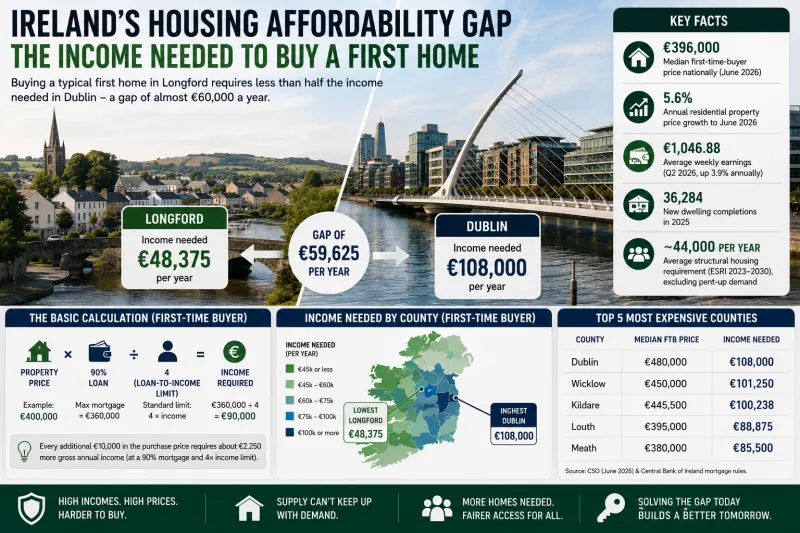
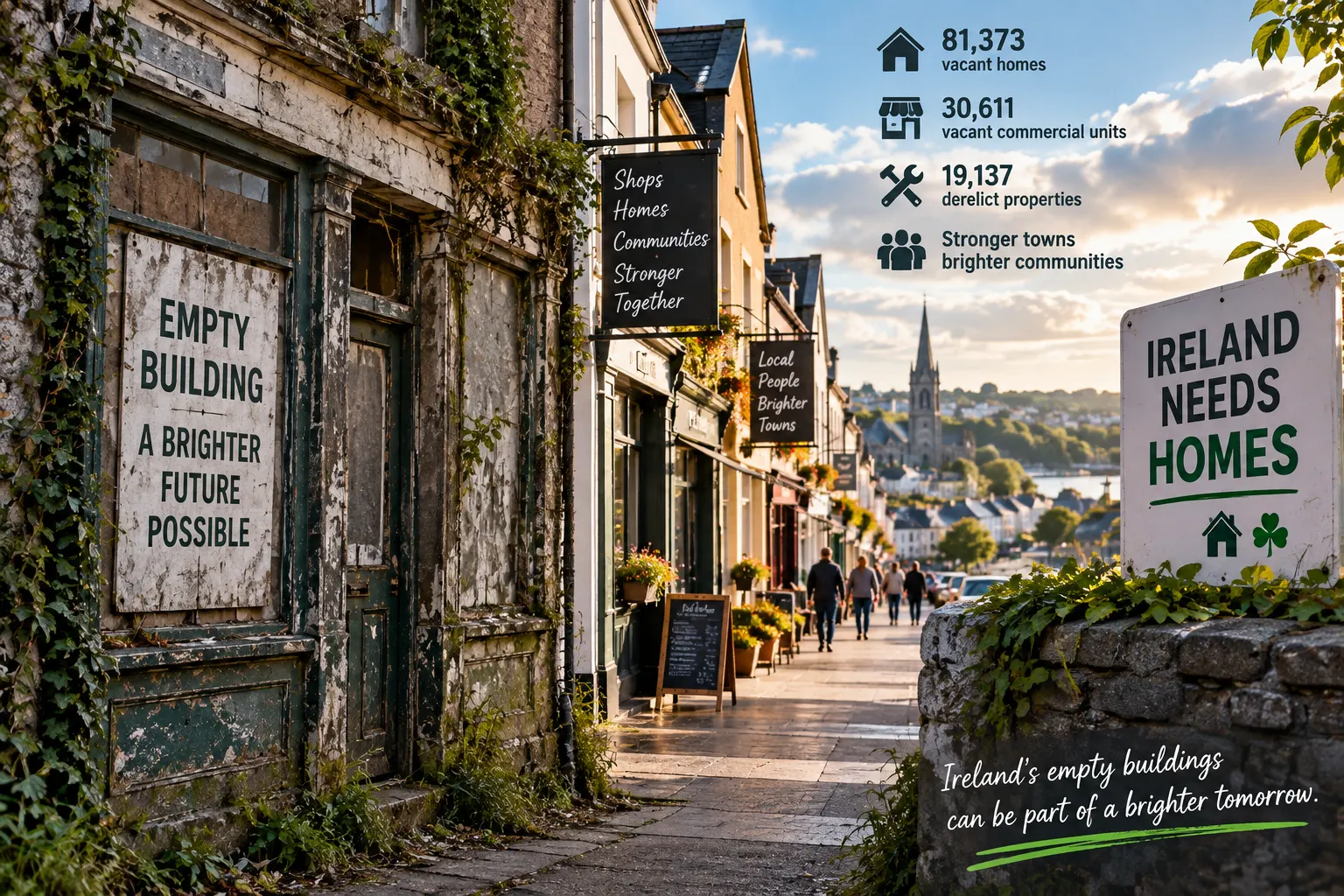
Walk down the main street of almost any Irish town and one of the country’s most uncomfortable economic contradictions can appear within a few hundred metres: a housing market in which the median dwelling price has reached €396,000, beside an old shop, house, pub or upper floor that has stood unused for years. In some western and north-western counties the contrast is particularly visible. Ireland urgently needs more homes, yet thousands of existing buildings remain empty, underused or derelict.
The Government is spending increasingly large sums trying to break that pattern. The Town and Village Renewal Scheme, introduced in 2016, has approved more than €210 million for over 1,900 projects. Its 2026 programme again includes a specific mechanism for acquiring vacant and derelict buildings and land, with up to €13 million available under the Building and Land Acquisition Measure. The wider Town Centre First strategy, the Rural Regeneration and Development Fund, refurbishment grants, tax measures, planning exemptions and compulsory-purchase powers all now form part of an anti-vacancy system that barely existed in this form a decade ago.
Yet the empty buildings have not disappeared. GeoDirectory classified 81,373 residential units as vacant in June 2026 and another 19,137 properties as derelict. On the commercial side, 30,611 units were vacant, equivalent to 14.5% of the national commercial building stock measured by GeoDirectory. The commercial figure had finally fallen slightly year on year — the first annual decline since its reporting began in 2013 — but vacancy remained deeply uneven, exceeding 20% in both Donegal and Sligo.
The persistence of vacancy despite strong housing demand is sometimes presented as proof that somebody is simply refusing to use perfectly good buildings. That happens in individual cases, but it is an inadequate explanation of the national problem. Ireland’s vacant stock includes properties trapped in probate, buildings whose owners cannot be established easily, structures requiring reconstruction rather than decoration, former shops unsuited to modern homes, properties in places with weak commercial demand, homes undergoing renovation, houses whose elderly owners have moved into care and buildings where the cost of restoration can approach or exceed their finished market value.
The problem is therefore not one vacancy problem. It is several different problems occupying the same streets.
Vacancy and dereliction in 2026
- 81,373 residential units were classified as vacant by GeoDirectory in Q2 2026.
- The GeoDirectory national residential vacancy rate was 3.7%.
- 19,137 properties were classified as derelict, 3.5% fewer than a year earlier.
- 30,611 commercial units were vacant in Q2 2026.
- The national commercial vacancy rate was 14.5%.
- Donegal had a 20.7% commercial vacancy rate and Sligo 20.2%.
- The Town and Village Renewal Scheme has approved more than €210 million for over 1,900 projects since 2016.
- Up to €13 million was made available in April 2026 for local authorities to acquire vacant or derelict buildings and land.
First, Ireland Has to Define What an Empty Home Actually Is
The vacancy debate is complicated by the fact that different official and commercial data sets measure different things. Census 2022 identified 163,433 vacant dwellings excluding holiday homes in its detailed final results. GeoDirectory’s June 2026 count was only about half that level. Neither figure is necessarily wrong.
The census provides a point-in-time assessment around Census Night. A property can therefore be counted as vacant even when the vacancy is temporary. A house may be between tenants, recently sold, advertised for sale, undergoing renovation or temporarily empty because its normal resident is in hospital. GeoDirectory uses a different methodology designed around address and building data and consequently produces a narrower measure.
The Central Statistics Office has repeatedly warned against treating every census vacancy as a house immediately available for somebody to occupy. In Census 2022, more than 23,000 vacant properties were recorded as undergoing renovation. More than 27,000 were associated with a former resident who had died. Nearly 11,000 were empty because a resident was in a nursing home or hospital, while more than 5,000 were associated with somebody staying with relatives.
At the same time, Ireland clearly does have long-term vacancy. Almost 48,000 dwellings identified as vacant in 2022 had also been vacant in 2016. More than 23,000 had been vacant in all three censuses of 2011, 2016 and 2022. Those repeated vacancies are far harder to explain as normal movement through the housing market.
Why a Vacant Dwelling May Not Be Immediately Available
| Reason | Census 2022 evidence |
|---|---|
| Renovation | More than 23,000 properties |
| Former resident deceased | More than 27,000 |
| Resident in hospital or nursing home | Nearly 11,000 |
| Resident staying with relatives | More than 5,000 |
| Rental transition | Large temporary-vacancy category |
| For sale | Includes homes moving through market |
Source: Central Statistics Office, Census of Population 2022.
The Housing Shortage and the Vacancy Problem Are in Different Places
The apparent contradiction between empty homes and a national housing shortage becomes easier to understand when geography is added. Ireland’s estimated population reached 5.526 million in April 2026 after increasing by another 66,900 people in a year. Much of the strongest housing demand is concentrated in Dublin, the other cities, commuter counties and employment centres.
Residential vacancy is concentrated differently. GeoDirectory recorded the highest June 2026 vacancy rates in Leitrim at 11.5%, Mayo at 10.3%, Roscommon at 9.9%, Donegal at 8.9% and Sligo at 8.3%. Dublin’s rate was only 1.4%, while Kildare’s was 1.6%.
That does not make western vacancy economically irrelevant. Many of those counties also need additional housing, particularly in towns where employers struggle to recruit staff. But a vacant farmhouse in remote Leitrim cannot meet the demand of a worker who needs to live near a Dublin hospital. Housing is location-specific.
The same divide appears in economic performance. The OECD’s 2026 review of rural Ireland found that rural regions close to urban centres have generally performed strongly, while remote regions face weaker infrastructure and more limited service access. Rural Ireland as a whole is not experiencing demographic collapse: approximately 42.5% of the population lives in regions classified as rural under the OECD methodology, and Irish rural population growth has been unusually strong by international standards. But growth is distributed unevenly.
This is one of the reasons that national vacancy figures can mislead. Ireland can simultaneously need many tens of thousands of additional homes in high-demand locations and possess unused buildings in lower-demand places.
The Main Street Lost Its Monopoly on Everyday Life
For generations, the Irish town centre concentrated functions that now occur in different places. People lived above shops. The main street contained grocers, banks, pubs, professional offices, post offices and local services. Employment, shopping and social life generated footfall through the same relatively compact space.
That arrangement gradually changed. New housing expanded towards the edges of settlements and into surrounding countryside. Larger retail formats required bigger floorplates and parking areas that were easier to provide outside historic centres. Employment increasingly clustered in business parks, industrial estates and larger urban areas. Better roads widened the area across which people could commute, shop and obtain services.
The OECD now describes part of the challenge facing Irish towns as a combination of commercial restructuring and a drift towards car-dependent, edge-of-town development. This did not occur because of one planning decision or one generation of policymakers. It developed over decades through changing consumer preferences, road investment, suburban housing, land availability, retail economics and the growing geographic separation between where people live, work and shop.
Online shopping added another layer. A main-street retailer no longer competes only with another shop in the neighbouring town. It competes with national chains, retail parks and online businesses capable of delivering almost anywhere. GeoDirectory’s latest commercial data illustrates that continuing structural change: the number of occupied retail and wholesale units with assigned economic classifications fell by 434 in the year to Q2 2026.
The result can become self-reinforcing. When one shop closes, the immediate effect is one vacancy. When several close, the street attracts fewer journeys. Lower footfall makes the remaining businesses less attractive. Reduced activity discourages investment in surrounding buildings. What began as individual business closures can become a wider town-centre problem.
Commercial Vacancy Is Far Higher Than Residential Vacancy
That difference is one of the most important numbers in the debate. GeoDirectory’s residential vacancy rate stood at 3.7% in June 2026. Its commercial vacancy rate was 14.5%. Ireland therefore has a much larger problem finding economically viable uses for parts of its commercial building stock than it does with ordinary residential vacancy under the same data system.
Regional variation is extreme. Donegal’s commercial vacancy rate reached 20.7%, Sligo’s 20.2%, Galway’s 18.6%, and both Leitrim and Limerick stood at 18.1%. Meath, by contrast, was below 10%.
At town level, the gap becomes more dramatic. GeoDirectory measured a 34.9% commercial vacancy rate in Shannon, 34.5% in Ballybofey and 30.1% in Boyle. Carrigaline in County Cork stood at only 5.1%.
Those figures should not be interpreted as a league table of successful and failed communities. Shannon has an unusual commercial geography and employment structure, while towns differ substantially in size, building stock and boundaries. But the divergence demonstrates that a national vacancy policy cannot assume the same cause in every location.
Commercial Vacancy Across Ireland, Q2 2026
| Area | Vacancy rate |
|---|---|
| Donegal | 20.7% |
| Sligo | 20.2% |
| Galway | 18.6% |
| Leitrim | 18.1% |
| Limerick | 18.1% |
| Ireland | 14.5% |
| Dublin | 13.3% |
| Meath | 9.9% |
Source: GeoDirectory Commercial Vacancy Rates Report, Q2 2026.
Why Not Simply Turn Every Empty Shop Into a Home?
The proposal sounds obvious. If Ireland has vacant commercial buildings and insufficient housing, convert one into the other. Government policy increasingly encourages precisely that, but the physical reality of historic buildings makes the process more complicated than the arithmetic.
Many traditional town-centre properties are narrow buildings on deep plots developed incrementally over generations. Ground floors may have been altered repeatedly for commercial use while upper floors were abandoned. Independent street access to the upper storey may have disappeared when neighbouring rooms were combined into one shop. Rear extensions can leave little daylight or usable outdoor space. Roofs, floors, wiring, plumbing and drainage may require replacement rather than repair.
A building that appears complete from the street may therefore need major structural work before it becomes a safe modern dwelling. Fire separation, escape arrangements, ventilation, insulation, heating, electrical systems and accessibility all have to be addressed where applicable. Historic fabric can make the work more technically demanding, particularly where a protected structure or architecturally significant frontage is involved.
Planning is only one part of that process. Since 2018, Ireland has provided exemptions allowing certain vacant commercial premises to change to residential use without a conventional planning application. The exemption was expanded to include former pubs and, in December 2025, extended through the end of 2028. By May 2025 local authorities had received 1,457 notifications covering 3,429 potential homes.
Removing the planning application does not rebuild the roof, create an independent staircase or finance the project. Nor does it remove applicable building, fire, structural or environmental requirements. Planning reform can eliminate one barrier while leaving the underlying economics unchanged.
The Empty Rooms Above Shops Became a Policy Problem of Their Own
Upper floors demonstrate how gradual decline can persist unnoticed. A ground-floor shop may remain viable while residential rooms above it remain empty for decades. When a building has only one entrance through the commercial premises, restoring independent access can require significant alteration. A small property owner may have little incentive to undertake the work while the shop continues generating enough income.
The Government created a dedicated Vacant Above the Shop Grant in April 2026 in response. A qualifying owner can receive up to €95,000 for the first residential unit, up to €115,000 where two units are created and up to €135,000 for three or more. A separate Expert Advice Grant can provide up to €5,000 towards professional advice, taking the possible combined support for some projects to €140,000.
The scale of that assistance is revealing. If converting an empty upper floor were normally a straightforward and inexpensive project, the State would not need to offer support approaching six figures. The grant implicitly recognises the high cost and complexity of adapting older mixed-use buildings.
There is also an economic limit. A project costing €180,000 to restore a dwelling in a location where its completed market value is €170,000 will not become commercially attractive merely because Ireland has a national housing shortage. The valuation at the end of the project matters to the lender, owner and purchaser.
A Cheap Derelict Building Can Be an Expensive House
This explains one of rural Ireland’s most misleading property prices. A derelict house advertised for a comparatively small purchase price can appear to be an extraordinary bargain beside a €396,000 national median home price. But the acquisition price may be the least difficult part of the project.
A buyer may need to finance structural repairs, roof work, drainage, damp treatment, insulation, windows, heating, electrical rewiring, plumbing, professional services and unforeseen defects. Older buildings can reveal problems only after work begins. Mortgage finance is also more complicated when a property is not immediately habitable.
The Government’s Vacant Property Refurbishment Grant addresses part of that gap. Up to €50,000 is available for a qualifying vacant property and a derelict top-up can increase the support to €70,000. Since April 2026, additional support can also apply where a former commercial or public building is converted into multiple residential units.
The programme has begun producing homes at meaningful scale. By the end of 2025, 16,607 applications had been received, 12,096 approved and 4,514 grants paid after completion of works, involving almost €247 million. Government subsequently reported that approximately 5,200 vacant and derelict homes had been brought back into use by the time the expanded measures were announced in April 2026.
That progress is significant, but the difference between approvals and completed payments illustrates the time involved. A grant approval is not a finished home. Owners still have to finance, organise and complete the works before the grant is ultimately paid.
Ownership Can Be Harder to Repair Than the Building
The physical condition of a property is sometimes not the largest obstacle. Ireland’s 2018–2020 Town Centre Living pilot, involving Ballinrobe, Banagher, Boyle, Callan, Cappoquin and Castleblayney, found that the reasons for vacancy were numerous and complex. The subsequent policy response explicitly identified the need for stronger mechanisms around ownership and support for property owners.
A building can have several beneficiaries after an inheritance. The registered owner may have died years earlier. Family members may live abroad. An estate may not yet have been administered. Ownership can be disputed, or a property may belong to a company that no longer trades. Older title records can require substantial legal work before a sale or development proceeds.
This matters because almost every voluntary solution begins with somebody having legal authority to make a decision. A grant cannot refurbish a building if nobody can establish who is entitled to apply. A developer cannot buy it if a clean title cannot be transferred. A local authority cannot simply take possession because the building looks abandoned.
Evidence given to an Oireachtas housing committee in 2025 captured the distinction clearly. Local-authority representatives described cases with an identifiable owner as difficult but potentially manageable through engagement, incentives or sale. Cases involving no clear owner, disputed ownership or dissolved companies were described as substantially more complicated, even though compulsory-purchase powers ultimately exist.
Death and Ageing Are Part of the Vacancy Story
Ownership problems are also connected with demography rather than deliberate land hoarding. Census 2022 recorded more than 27,000 vacant properties where the former resident was deceased. In Roscommon and Mayo, around one-quarter of recorded vacant dwellings were in that category. Galway County showed a similar pattern.
A further group of properties was vacant because owners had moved into hospitals, nursing homes or relatives’ houses. These homes can remain legally and emotionally connected with an older person who may never return permanently but whose family is understandably unwilling or unable to sell immediately.
This distinction matters when designing taxation. A vacant dwelling held speculatively for future appreciation presents a different policy problem from the former home of somebody who has just entered long-term care. Treating the two identically may produce a simple system but not necessarily a fair one.
The Vacant Homes Tax therefore contains exemptions for circumstances including death, certain periods of probate, illness, structural works and properties genuinely marketed for sale or rent. Those exemptions reduce unintended hardship, but inevitably mean that the tax does not apply to every dwelling that appears empty.
Ireland Has Increased the Cost of Leaving Homes Empty
The Vacant Homes Tax began with the chargeable period starting in November 2022. It generally applies to a residential property that is suitable for Local Property Tax purposes and is used as a dwelling for fewer than 30 days during the relevant 12-month period, subject to exclusions and exemptions.
The tax was initially set at three times the property’s basic Local Property Tax liability. It increased to five times the basic LPT rate for the following period and is now seven times the basic rate for the periods covering November 2024 to October 2025 and November 2025 to October 2026.
The escalation shows a deliberate policy shift away from treating persistent residential vacancy as largely costless. But the tax has boundaries. A structurally ruined building may not qualify as a residential property for LPT in the same way as a habitable empty house. Commercial buildings sit outside the ordinary residential mechanism. Exemptions also apply in legitimate circumstances.
Vacant Homes Tax is therefore a pressure on one section of the problem, not a tax on every shuttered doorway visible on an Irish main street.
Derelict Buildings Fall Under a Different System
Dereliction is legally distinct from vacancy. A building does not become a derelict site merely because nobody is using it. Under the Derelict Sites Act 1990, local authorities can act where land or buildings meet statutory conditions associated with dangerous, ruinous, neglected or unsightly conditions or the presence of waste and debris.
Local authorities maintain Derelict Sites Registers and can serve notices, require action, carry out works, acquire sites by agreement or use compulsory-purchase powers. Sites entered on the register can be subject to an annual levy equal to 7% of their market value.
The existence of a powerful levy does not mean enforcement is automatic. Valuation, ownership, service of notices, objections, collection and potential acquisition all require administrative work. Historical local-authority returns have also shown significant amounts of derelict-site levy remaining outstanding in some areas.
This exposes a broader lesson in vacancy policy. Legislation can grant a local authority strong powers, but powers do not exercise themselves. Effective enforcement requires staff, legal capacity, property data, valuations, budgets and a willingness to pursue complicated cases over long periods.
By the end of 2023, 1,913 sites were recorded on local-authority Derelict Sites Registers. GeoDirectory’s 2026 estimate of 19,137 derelict properties is far larger, but again the definitions are different: appearing derelict in a property database and having formally completed the statutory process for entry on a Derelict Sites Register are not the same thing.
Residential Zoned Land Tax Attacks Another Form of Underuse
Residential Zoned Land Tax is aimed principally at serviced land rather than empty buildings. The tax became payable from 2025 at 3% of market value on qualifying land that is zoned for residential or mixed use, serviced or capable of being serviced and not otherwise excluded.
Its purpose is to discourage owners from holding developable residential land indefinitely while housing demand remains high. Annual maps prepared through local authorities identify potentially relevant land.
RZLT matters to towns because unused and underdeveloped sites can interrupt otherwise compact settlements. But, like the Vacant Homes Tax and Derelict Sites Levy, it addresses only one category of inactivity. An occupied building, an exempt dwelling, a ruined building and an idle serviced plot can all be governed by different tax and legal systems even if they stand beside one another.
Ireland’s anti-vacancy policy has consequently become a network of overlapping tools rather than a single vacancy tax.
Ireland’s Main Anti-Vacancy Instruments
| Instrument | Main target | Current support or charge |
|---|---|---|
| Vacant Homes Tax | Habitable residential vacancy | 7 × basic LPT rate for current period |
| Derelict Sites Levy | Registered derelict sites | 7% of market value annually |
| Residential Zoned Land Tax | Qualifying serviced zoned land | 3% of market value annually |
| Vacant Property Refurbishment Grant | Vacant homes/buildings | Up to €50,000 |
| Derelict top-up | Qualifying derelict property | Up to additional €20,000 |
| Above the Shop Grant | Vacant upper floors | Up to €135,000 |
| Town and Village Renewal | Town-centre regeneration | Project-based public funding |
Sources: Revenue Commissioners and Government of Ireland schemes, 2026.
The State Is Now Beginning to Buy Buildings It Cannot Persuade the Market to Reuse
The 2026 Town and Village Renewal Scheme illustrates how policy has shifted from improving streetscapes towards intervening directly in property. The Building and Land Acquisition Measure, opened in April, makes up to €13 million available to enable local authorities to buy vacant or derelict buildings and sites.
Each eligible local authority can seek up to €500,000 to acquire as many as three properties or sites for future town-regeneration purposes. The previous 2025 acquisition programme supported the purchase of 24 properties, including former station houses, schools and other town-centre assets.
The significance lies in ownership. Earlier regeneration schemes often improved public areas surrounding privately owned vacancy. The acquisition programme allows a council to bring a strategic property into public ownership and then create a community, cultural or economic use that the private market may not have delivered.
It is not intended to nationalise every empty shop. Public acquisition has to be selective because the purchase is only the beginning. Renovation, operating costs and the eventual use of the property all require further resources.
The broader Town and Village Renewal Scheme has approved more than €210 million for over 1,900 projects since 2016. Budget 2026 allocated €21 million to the scheme for the year, while the 2026 main scheme and project-development measure are expected to follow the acquisition round.
Town Centre First Changed the Question From Building to Place
Government policy increasingly recognises that restoring one building in isolation may not solve the reason it became vacant. Town Centre First, introduced in 2022, therefore treats regeneration as a place-based problem involving housing, business, transport, public space, heritage and community services together.
The approach developed partly from the earlier Town Centre Living Initiative. That pilot concluded that tackling individual properties piecemeal would have limited impact if the wider town remained unattractive as a place to live. It recommended town visions, dedicated officers, stronger support for owners and clearer ownership mechanisms.
Under Town Centre First, local Town Teams and regeneration officers are intended to identify clusters of problems rather than waiting for isolated grant applications. A former courthouse might become a library, an empty bank a community facility, an unused shop an apartment, a derelict plot a public space and an adjoining street an improved pedestrian route.
The underlying economic logic is that these interventions can reinforce one another. More residents create demand for shops. Better public space attracts visitors. Active ground floors improve perceived safety. Remote-working facilities generate daytime footfall. Housing above commercial properties increases town-centre activity after shops close.
Footfall Is the Currency of a Main Street
A small retailer does not need a national population of 5.5 million. It needs enough customers to pass its door. This makes town-centre residential population particularly important.
When residents move towards the edge of a town, their spending does not necessarily disappear from the local economy. But the journey changes. A household travelling by car can shop at a supermarket or retail park with parking and leave without entering the traditional centre. Workers commuting to another town may purchase food, coffee and services near their workplace.
The OECD’s rural review notes that daily working, shopping and service patterns often extend across several settlements and even county boundaries. For many smaller towns, the economic catchment therefore no longer matches the municipal boundary or the historic assumption that residents conduct most of their daily life locally.
This helps explain why beautifying a street cannot by itself revive its retail economy. Public realm matters, but businesses need customers. Successful regeneration ultimately requires some combination of residents, workers, services, tourists and visitors generating repeat activity.
Remote Work Created an Opportunity, but Not a Universal Rescue
The pandemic temporarily changed the economics of location. If a professional could keep a Dublin-based job while living in a smaller town, rural housing and town-centre buildings acquired a new potential use. Government invested in Connected Hubs and incorporated remote work into rural-development policy partly for this reason.
The opportunity remains important. Broadband allows some knowledge-based employment to take place in towns that would never attract a large corporate office. Remote-working hubs can also convert former banks, offices or institutional buildings into productive space while bringing daytime users into local businesses.
But remote work cannot replace every lost economic function. Manufacturing, healthcare, hospitality, construction, farming and many services require people to be physically present. Employers have also adjusted hybrid-working requirements since the pandemic. A regeneration strategy built entirely on the assumption that urban workers will relocate permanently would therefore be fragile.
The more durable opportunity is diversification: making smaller towns places where remote work, local enterprise, tourism, services, housing and community activity can coexist.
Public Services Can Either Anchor a Town or Remove Footfall From It
Banks, post offices, schools, Garda stations, courthouses and public offices historically generated journeys into Irish town centres. When such facilities close or consolidate, their buildings can become some of the most prominent symbols of vacancy.
Government regeneration programmes now repeatedly fund the reuse of precisely those structures. Former Garda stations, schools, banks, post offices, parish buildings and railway properties have all appeared in Town and Village Renewal or Rural Regeneration projects.
This is more than architectural recycling. A centrally located library, community hub or public service can become an anchor that brings people into the town throughout the week. The opposite is also true: relocating an active service to an edge-of-town building may be individually efficient for the organisation while reducing activity in the centre.
Town Centre First is partly an attempt to make public-sector location decisions consider this cumulative effect.
Heritage Is Both an Asset and a Cost
The historic character of Irish towns is one reason people value them. Terraces, shopfronts, former hotels, market houses, mills and civic buildings give individual places an identity that modern development cannot easily reproduce.
Those same characteristics can make redevelopment more difficult. Traditional buildings may require specialist materials and trades. Inappropriate work can destroy historic fabric or create moisture problems. Protected structures can require additional conservation expertise. A conventional developer comparing two projects may therefore prefer a straightforward new building on an accessible site.
The policy response has increasingly recognised this problem. Conservation advice grants can cover 67% of the cost of specialist advice for qualifying traditional vacant houses, up to €5,000. The separate Expert Advice Grant introduced in 2026 similarly supports professional assessment of above-shop and former commercial conversions.
These relatively small grants can have disproportionate importance because one of the first barriers is uncertainty. An owner may not know whether a building can physically be converted, what permissions are required or how much the work is likely to cost. Paying for professional investigation before deciding whether to proceed can itself discourage action.
Vacancy Can Become Dereliction — and Dereliction Raises the Cost of Recovery
A building does not remain economically static while it sits empty. Roof defects allow water penetration. Gutters block. Heating is turned off. Minor leaks go unnoticed. Timber deteriorates and vegetation spreads. Vandalism can accelerate damage.
This creates a powerful time effect. A building that might have been returned to use after two years with modest renovation can require major reconstruction after fifteen. The cost rises precisely while the owner’s ability or willingness to intervene may be declining.
Dereliction can therefore be understood partly as the accumulated consequence of unresolved vacancy. Preventing buildings from reaching that stage is generally cheaper than rescuing them afterwards.
This is one argument for active local vacancy registers and early engagement with owners. Waiting until a structure satisfies the statutory definition of a derelict site can mean that much of its economic value has already been lost.
One Empty Building Can Damage Several Occupied Ones
Vacancy produces external effects that an individual owner does not necessarily bear. An empty property contributes no customers to neighbouring businesses. A visibly neglected facade can lower the perceived attractiveness of an entire street. Dereliction can create safety problems and additional maintenance demands for adjoining owners.
Several vacancies together can change investor expectations. A prospective shopkeeper considering a street with strong footfall and almost full occupancy sees evidence of demand. The same investor confronting a row of shuttered premises sees risk, even if rents are cheaper.
This feedback loop helps explain why commercial vacancy often becomes geographically concentrated. The latest GeoDirectory data shows a continuing divide between stronger areas benefiting from population growth and investment and parts of the west and north-west where vacancy remains much higher.
The relationship with property prices is complex. Lower-demand locations often have both cheaper property and more vacancy, but this does not prove that vacancy alone caused lower prices. Employment, population growth, income, accessibility and local services influence both. In June 2026, for example, the national median dwelling transaction was €396,000, while Longford’s median was €198,000 and the Castlerea Eircode area in Roscommon had a median of €157,000. Those lower prices may improve the economics of purchase while simultaneously reflecting a smaller pool of buyers.
Cheap Property Does Not Automatically Produce Development
A developer decides whether to renovate by comparing the entire project cost with the expected value or rent after completion. A lower acquisition price helps, but only one side of that calculation.
Building labour, insulation, windows, heating systems and professional fees do not become proportionately cheaper merely because a property is in a lower-value county. Some specialist work can be more difficult to source in remote areas. A renovation costing €150,000 may therefore be viable where the finished property is worth €300,000 and marginal where it is worth €180,000.
This produces a structural reason why grants can matter more outside the most expensive markets. State assistance can bridge a viability gap that ordinary market values would otherwise leave unresolved.
It also explains why compulsory purchase alone is not a complete solution. Transferring ownership from an inactive owner to a public authority or new purchaser does not remove the refurbishment cost.
The Housing Crisis Does Not Make Every Rural Renovation Economically Rational
Housing demand in Ireland is extraordinarily high in aggregate. Residential property prices were 5.6% higher in June 2026 than a year earlier, while the population is continuing to grow. But aggregate demand does not guarantee sufficient demand for every building type in every settlement.
A family may reject a main-street apartment because it needs a garden, parking or additional bedrooms. An older person may like the central location but require accessible accommodation without stairs. A worker may find an attractive rural home but be unable to commute to employment. A property can therefore be technically convertible without matching the household demand that exists locally.
Successful town-centre housing has to offer forms of accommodation people actually want. That can include smaller units for older residents, apartments for workers, starter homes, rental accommodation and family housing rather than simply maximising the number of units within old buildings.
The OECD has specifically argued that vacancy and regeneration policy should be connected more closely with local labour-market needs. A town struggling to recruit teachers, nurses or other workers may have a stronger case for targeted refurbishment than one where additional housing would remain detached from employment demand.
Ireland Is Building Homes — but Mostly Not by Reusing the Oldest Buildings
There were 8,823 new dwelling completions nationally in the second quarter of 2026. Almost 95% of scheme-house completions occurred in cities, satellite urban towns or independent urban towns. Single-house construction, by contrast, remained heavily associated with rural areas.
New construction is usually easier to standardise. Developers work with contemporary layouts and can design energy, accessibility and fire requirements into a project from the beginning. Refurbishment starts with whatever conditions previous generations left behind.
Yet abandoning existing buildings carries its own costs. New development requires additional land and infrastructure, while an old building may already sit beside streets, shops, schools and utilities. Reuse also preserves embodied materials and historic streetscapes.
The economic case for refurbishment is therefore strongest where the building, location and local demand align. Government policy increasingly tries to create that alignment rather than assuming every vacant building should be restored regardless of cost or usefulness.
The Residential Vacancy Rate Is Falling — Which Makes the Remaining Stock Harder
The long-term trend is often overlooked. Census vacancy fell substantially from the aftermath of the property boom. The detailed 2022 census recorded 163,433 vacant homes compared with 183,312 in 2016 and 230,056 in 2011. GeoDirectory’s narrower measure now puts residential vacancy at a record-low 3.7% in its series.
This is encouraging, but it changes the nature of the challenge. The easiest properties are generally the first to return to use. A habitable dwelling between tenancies requires no public intervention. A structurally damaged building with disputed ownership and no functioning utilities can remain vacant even when nearby property prices rise substantially.
As vacancy falls, the remaining stock may increasingly contain these difficult cases. Reducing the rate from 8% to 4% is not necessarily comparable with reducing it from 4% to 2%.
This is why the existence of thousands of vacant properties should not be converted mechanically into a claim that Ireland could solve its housing shortage simply by occupying them. Reuse can make an important contribution, particularly in towns, but it is complementary to new construction rather than a substitute for it.
Commercial Vacancy May Be the More Difficult Long-Term Problem
The latest data provides a small reason for optimism: the commercial vacancy rate fell from 14.6% to 14.5% in the year to Q2 2026, its first year-on-year reduction in the GeoDirectory series. Yet 13 counties still experienced an increase.
The deeper issue is that some commercial space may never return to its previous function. Ireland may not need the same number of traditional bank branches, travel agencies, small offices or certain categories of retail premises that it once did. Attempting indefinitely to refill every former shop with another shop can therefore preserve vacancy rather than solve it.
Adaptive reuse becomes essential. Some premises can become homes. Others may become cafés, childcare facilities, health services, creative spaces, remote-working hubs, workshops or community facilities. Ground floors can remain commercial while upper floors return to residential use.
A resilient town centre is consequently unlikely to resemble a perfectly restored version of the 1980s high street. Its future depends on finding twenty-first-century uses for a building stock created for a different economy.
Regeneration Can Raise Property Values — but That Is Not an Unqualified Success
Bringing residents and businesses back into a declining centre can improve demand for property, support renovation and raise surrounding values. For existing owners, that can make further investment commercially viable. For local authorities, stronger occupancy can increase the economic usefulness of existing infrastructure.
Higher values, however, also create distributional consequences. If a town becomes substantially more desirable, rents and purchase prices can rise. A regeneration strategy that succeeds economically can therefore create affordability pressures for residents or small businesses that were present before the improvement.
This is a familiar problem in urban regeneration internationally, although the scale varies greatly by location. Many rural Irish towns remain far from a situation in which gentrification is the immediate concern. The principle nevertheless matters: the objective should be functioning communities, not merely appreciating property assets.
A Town Needs People Living in It, Not Just People Visiting It
Tourism can provide essential demand for restaurants, pubs, accommodation and shops, particularly along the west coast. GeoDirectory’s commercial data shows the importance of accommodation and food services in counties such as Kerry, Clare and Donegal.
But tourism is seasonal and cannot replace a permanent residential base in every town. Year-round inhabitants shop in winter, use schools and pharmacies, volunteer in organisations and create demand for ordinary services that visitors do not.
This is one reason Town Centre First places such importance on living in town centres. Restoring upper floors and empty houses increases the number of people with a direct economic interest in the main street functioning after 6pm and outside the tourist season.
A successful town centre is therefore not simply an attractive shopping district. It is a neighbourhood.
The Future Depends on Moving From Grants to a Property Pipeline
Ireland now has more anti-vacancy programmes than at any previous point. That represents progress, but it also creates a coordination challenge. A property owner may encounter separate systems for planning, conservation, housing grants, energy upgrades, tax, local-authority enforcement and finance.
The stronger model is a pipeline in which local authorities identify strategic buildings early, establish ownership, assess condition, determine the most appropriate use and then connect the property with the correct intervention. Some will need only owner engagement. Some need a grant. Some need planning assistance. Some need compulsory purchase. Others are so uneconomic that public or community use may be more realistic than private redevelopment.
Town Regeneration Officers and Vacant Homes Officers are intended to provide part of that coordination. Their success will depend not only on national funding but on the technical and legal capacity available locally.
The OECD’s 2026 rural review identifies this as a continuing challenge. It recommends stronger links between housing, infrastructure and labour demand and points to the potential value of pooled technical expertise rather than expecting every local authority to solve complex refurbishment cases independently.
Water, Electricity and Infrastructure Can Decide Whether an Empty Building Has a Future
A town-centre location may look fully serviced because roads and neighbouring buildings already exist, but infrastructure capacity cannot be assumed. Converting one shop into one dwelling is very different from converting a large former institution into twenty apartments.
Water and wastewater capacity can restrict development even where the structure itself is suitable. Electricity demand is growing as heating and transport electrify. Access, drainage and public-realm conditions can all influence project viability.
The OECD specifically identifies water and electricity constraints among the barriers to activating vacant and derelict rural housing. This means regeneration policy cannot operate independently from national infrastructure investment.
A grant that makes refurbishment affordable does not help if the required capacity cannot be connected. Conversely, infrastructure investment becomes more productive when existing buildings around it return to use.
More Aggressive Compulsory Purchase Could Help — but It Is Not Free
Calls for stronger compulsory purchase are understandable when prominent buildings remain derelict for years. The Derelict Sites Act already provides local authorities with significant acquisition powers, and government has encouraged greater use of compulsory purchase as part of its Vacant Homes Action Plan.
CPO can be particularly effective where ownership has become an obstacle and the public interest in redevelopment is strong. It can break a stalemate that voluntary negotiation has failed to resolve.
But compulsory acquisition requires due process and compensation under the applicable legal framework. The authority then becomes responsible for what happens next. Acquiring a dangerous building without a funded redevelopment plan can transfer a problem from a private balance sheet onto a public one.
The strongest use of CPO is therefore strategic: acquire properties where ownership is blocking an otherwise credible reuse project, not simply increase the number of buildings held by councils.
The New Policy Direction Is Carrot, Stick and Public Intervention
Ireland’s vacancy regime has gradually evolved into three categories of intervention. Grants provide the carrot, reducing the cost of doing something. Taxes and levies provide the stick, increasing the cost of doing nothing. Public acquisition is the final intervention where neither produces the desired result.
The Vacant Property Refurbishment Grant and new above-shop supports represent the incentive side. Vacant Homes Tax, the Derelict Sites Levy and Residential Zoned Land Tax increase carrying costs for selected forms of underuse. Town and Village Renewal and compulsory purchase give local authorities the capacity to intervene directly.
No single element can work everywhere. Taxing an owner who lacks clear title does not produce clean title. Giving a grant to an economically unviable shop does not create customers. Buying a building does not finance its refurbishment. Improving the street does not automatically create housing.
The success of the current approach will therefore depend on whether these instruments operate as one regeneration system rather than as separate funding announcements.
Ireland Should Not Aim for Zero Vacancy
A functioning property market requires some vacancy. Rental homes are empty between tenants. Properties are vacant during sale. Buildings are refurbished. Residents enter hospital or care. Businesses open and close. A zero vacancy rate would indicate a market with no capacity for movement.
The meaningful target is persistent and harmful vacancy: buildings remaining unused without a transitional reason, structures deteriorating because ownership problems are unresolved and commercial properties that have no realistic route to a new function.
This is why long-term vacancy data matters more than dramatic point-in-time totals. The 23,000-plus homes found vacant in three successive censuses deserve a different policy response from a rental property that happened to be empty for two weeks around Census Night.
The West and North-West Need a Different Answer From Dublin
Regional differences are too large for a uniform national strategy. Dublin has intense housing demand and very low residential vacancy by the GeoDirectory measure. Where a viable empty home exists there, market values can often support significant renovation without requiring the same subsidy as a lower-value location.
Leitrim, Mayo, Roscommon, Donegal and Sligo have much higher residential vacancy. Several also have high commercial vacancy. Here the challenge can include weaker demand, older housing, dispersed settlement patterns and smaller local labour markets.
The solution in these areas cannot simply be to import Dublin’s development model. Rural regeneration has to connect housing with employment, transport, broadband, health, education and local services. A restored house becomes more attractive when somebody can realistically build a life around it.
The opposite also applies. Rural areas close to stronger cities and commuter corridors can experience substantial growth. Their vacancy problems may resemble those of expanding urban areas more than those of remote counties.
The First Annual Fall in Commercial Vacancy Is Encouraging — but Too Small to Declare Victory
The fall from 14.6% to 14.5% in national commercial vacancy is modest, yet symbolically significant because GeoDirectory had not previously recorded an annual decline since launching its series in 2013. It may indicate that conversion, economic growth and regeneration are finally beginning to absorb some surplus space.
At the same time, 30,611 commercial units remain vacant and half of Ireland’s counties experienced rising vacancy over the year. The improvement is therefore neither large enough nor geographically broad enough to conclude that the problem has turned decisively.
The coming years will show whether public investment can change the structural pattern rather than merely individual buildings. A former school converted into a successful community facility is valuable. The larger test is whether the surrounding street attracts residents, businesses and further private investment without requiring perpetual public rescue.
By 2030, the Most Important Measure May Be How Many Buildings Never Became Derelict
Government has extended the main Vacant Property Refurbishment Grant to 2030, giving the current strategy several years to mature. Thousands of approved projects are still moving through renovation, while the new above-shop scheme has only begun. Planning exemptions for relevant commercial-to-residential conversions now run through 2028.
This creates a realistic possibility that vacancy will continue falling, particularly where refurbishment economics have been transformed by grants. It is also plausible that the easiest properties will be completed first and the remaining stock will become progressively harder to activate.
Long-term success should therefore be measured in more than grant payments. Authorities need to know how many persistent vacant buildings return to use, how long properties stay empty, whether commercial vacancy declines in the most affected towns, how many new residents move into centres and whether private investment follows public intervention.
Prevention deserves equal attention. A building kept weatherproof and actively marketed after a business closes is far cheaper to reuse than the same building after a decade of water damage. Early engagement can therefore be as important as a large grant later.
The Empty Building Is Usually a Symptom of Something Larger
The great temptation in the vacancy debate is to concentrate on the visible structure. It is easy to photograph a boarded window and ask why nobody has fixed it. The harder question is what economic and legal history produced the boarded window.
Sometimes the answer is an owner who simply chose not to act. Sometimes it is an inheritance involving several relatives. Sometimes the local shop lost its customers to a retail park or the internet. Sometimes the bank closed. Sometimes the resident died. Sometimes the roof deteriorated until restoration no longer made commercial sense. Sometimes the town has homes but not enough jobs; elsewhere it has jobs but insufficient usable homes.
This is why vacancy has survived successive periods of economic growth and escalating property prices. It is not governed by one national housing market. It sits at the intersection of property rights, demographics, construction economics, planning, infrastructure and the changing geography of Irish life.
The Real Opportunity Is Not Simply Housing — It Is Rebuilding the Centre of the Town
Every vacant building will not become a home, and it should not. Towns need businesses, services, cultural facilities, workplaces and community spaces as well as residents. The objective is productive use.
That distinction is visible in the 2026 Town and Village Renewal acquisition programme. Buildings purchased by local authorities are intended to become multi-purpose community assets or other regeneration infrastructure rather than automatically being converted into housing. In some locations that may create more value for the town than another residential unit.
Housing nevertheless plays a central role because people provide permanent footfall. A family living above a shop, an older resident moving into a central apartment and a worker renting a restored building all contribute to local demand every day. Their presence also makes public transport, shops and services more viable.
If Ireland succeeds, the result will not be a country with no vacant buildings. It will be a country where buildings do not remain empty simply because the ownership cannot be resolved, the planning process is unnecessarily difficult or a potentially viable refurbishment falls just outside financial reach.
The €210 million already approved through the Town and Village Renewal Scheme demonstrates how seriously the State now takes rural regeneration. But money alone cannot reverse patterns created over several decades. A town centre needs owners willing or able to act, councils capable of intervening, infrastructure that can support development, businesses with customers and homes that people genuinely want to live in.
The boarded shop on the main street is therefore more than an unused property. It is a test of whether Ireland can use the buildings and infrastructure it already has while continuing to build for a rapidly growing population. Solving that problem will require less attention to the national number of empty buildings and more attention to why each cluster of buildings became empty in the first place.
Sources
Department of Rural and Community Development and the Gaeltacht — Town and Village Renewal Scheme
Government of Ireland — Town Centre First Policy
Department of Rural and Community Development — Town Centre Living Initiative Review
GeoDirectory and EY — Residential Buildings Report, Q2 2026
GeoDirectory and EY — Commercial Vacancy Rates Report, Q2 2026
Central Statistics Office — Census 2022: Vacant Dwellings
Central Statistics Office — Residential Property Price Index, June 2026
Central Statistics Office — Population and Migration Estimates, April 2026
Department of Housing, Local Government and Heritage — Vacant Property Refurbishment Grant
Department of Housing, Local Government and Heritage — Vacant Above the Shop Grant
Revenue Commissioners — Vacant Homes Tax
Government of Ireland — Residential Zoned Land Tax
Department of Housing, Local Government and Heritage — Policy on Addressing Vacancy and Dereliction
Source & Transparency
This article is published by Ireland Newspaper for editorial and informational purposes.
Published: 4 September 2026 · Updated: 4 September 2026

Newsroom Ireland Newspaper
Ireland Newspaper editorial team prepares daily news coverage for readers in Ireland and abroad.