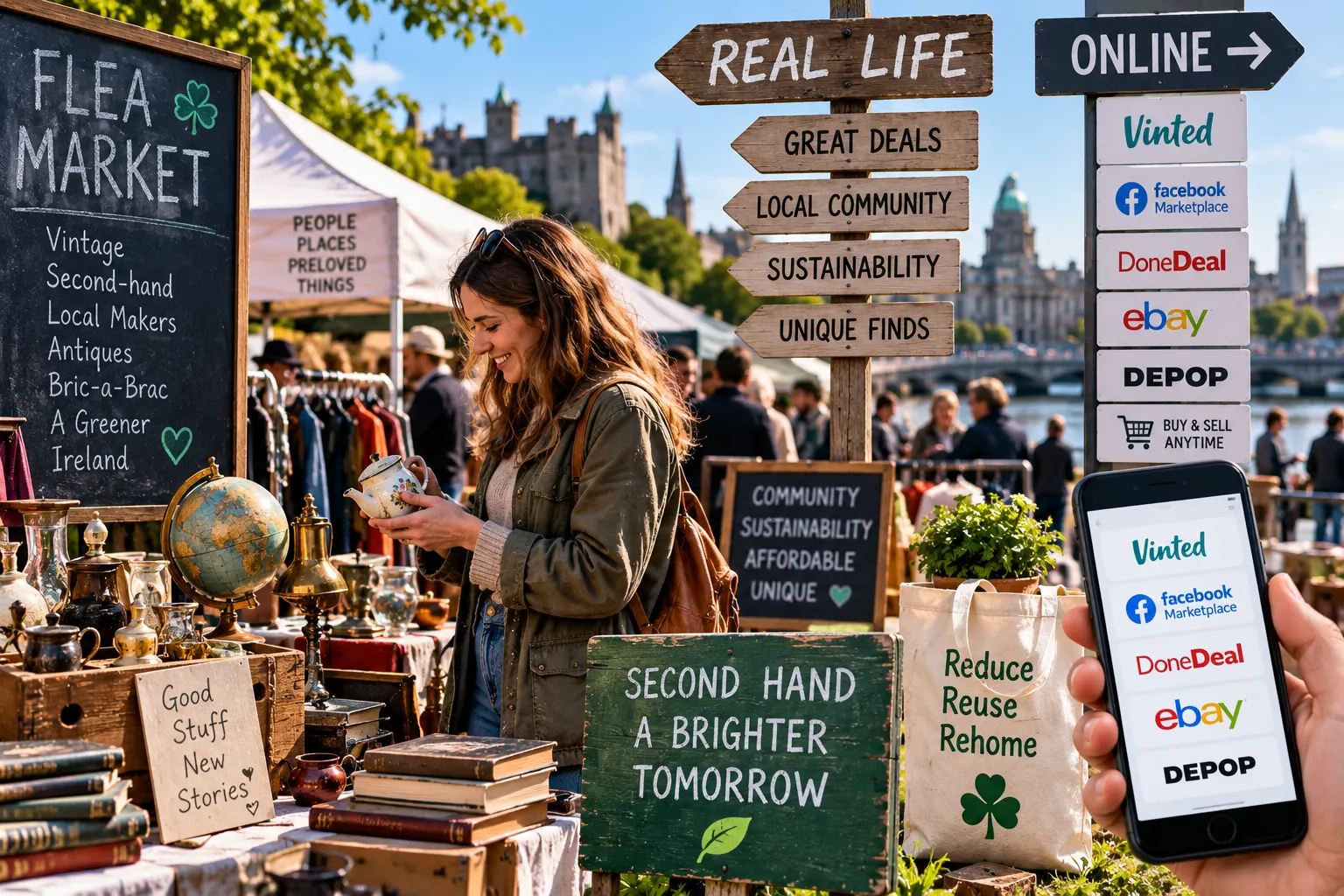
Ireland has never had more efficient ways to sell an unwanted jacket, bicycle, record collection or piece of furniture. A photograph taken on a phone can put an object in front of thousands of potential buyers on Vinted, Facebook Marketplace, DoneDeal, Depop or eBay within minutes. In 2025, 25% of Irish internet users told the Central Statistics Office that they had bought physical goods from another private person through a website or app. Yet on weekends across the country, sellers still unload boxes from car boots, hang second-hand clothes on temporary rails and spend hours negotiating face to face with people who could theoretically have bought almost everything from home.
That persistence is not evidence that Ireland has resisted digital commerce. Quite the opposite: 85% of internet users bought goods or services online in 2025. Physical second-hand markets survive in one of Europe’s highly connected consumer economies because they do several things that digital platforms do poorly. Buyers can touch an object, inspect its condition and take it home immediately. Sellers can dispose of dozens of unrelated items without photographing, listing, packaging and posting each one. And both sides participate in a social event in which the search itself can be part of the value.
There is also a financial reason for renewed interest. Irish consumer prices were 3.4% higher in July 2026 than a year earlier, clothing and footwear prices were up 8.5%, and the latest August harmonised estimate showed energy prices 11.8% above their level a year before. In the CSO’s 2025 household survey, 44.8% of households reported at least some difficulty making ends meet and more than one-third had no money to set aside at the end of a typical month. That does not prove that the cost-of-living squeeze caused every flea-market visit, but it makes the economic appeal of paying substantially less for an object that still works easy to understand.
At the same time, something more structural is happening. Buying used is being absorbed into Ireland’s emerging circular economy. The Environmental Protection Agency estimates that Irish households reused 83,400 tonnes of second-hand products in 2024. Government policy now explicitly aims to increase reuse and repair, with new right-to-repair rules, a planned repair-voucher scheme and a national target to raise reuse from 15.5 kilograms per person in 2024 to 20 kilograms by 2030.
Ireland’s second-hand economy
- 85% of Irish internet users bought goods or services online in 2025.
- 25% bought physical goods from private individuals through online platforms.
- 22% of households reported buying between 11 and 50 second-hand clothing items from a second-hand shop or marketplace in 2024.
- 83,400 tonnes of second-hand products were reused by Irish households in 2024.
- Furniture accounted for 38,300 tonnes of that measured reuse.
- Textiles accounted for 4,660 tonnes.
- Ireland’s measured reuse rate was 15.5kg per person in 2024.
- The national reuse target is 20kg per person annually by 2030.
Dublin’s Flea Market Story Needs One Important Correction
Current listings can create some confusion about Dublin’s best-known flea-market name. The original Dublin Flea Market began in 2008 and became closely associated with Newmarket in Dublin 8 before moving to The Digital Hub in 2019. Its own website states that it held its final market in September 2019 and is no longer trading under the original operation.
What exists today at The Digital Hub is a newer flea-market culture. We Love Markets has operated recurring markets on the campus since 2022, combining vintage clothing, second-hand goods, furniture, bric-a-brac, crafts, local design and food. The Digital Hub is hosting another We Love Markets event for Culture Night on 18 September 2026, with vintage clothing, mid-century furniture, arts, crafts and local design among the advertised categories.
The distinction is more than a piece of event trivia. It illustrates how second-hand markets survive. Individual organisers, venues and market names can disappear, move or change, while the underlying format re-emerges because the economic and social demand for it remains. Ireland’s current market landscape ranges from curated urban vintage events to traditional car boots, antiques fairs, charity retail, indoor markets and community fundraisers.
Unlike an online platform, these markets can also be seasonal and vulnerable to weather, venue availability and volunteer capacity. Their survival is therefore not based on logistical superiority. It is based on offering something sufficiently different from the digital alternative.
The Internet Did Not Destroy Second-Hand Trading — It Made It Bigger
Before online marketplaces, second-hand trade was constrained by geography. A seller could advertise in a newspaper, take an object to an auction, offer it to a dealer, place it in a charity shop or bring it to a market. The potential buyer pool was limited by who happened to see the advertisement or visit the location.
Digital platforms transformed that matching process. A particular jacket in Cork can find somebody looking for exactly that size and brand in another county or another country. Search functions replace hours of browsing. Price comparisons are immediate. Seller ratings, messaging, digital payments and integrated postage reduce some of the uncertainty of dealing with strangers.
The scale of that behavioural change is visible in the CSO data. One quarter of internet users purchased physical goods from private people through services such as Facebook Marketplace, Vinted, Depop, DoneDeal and similar platforms in 2025. Among men aged 30 to 44, the proportion reached 36%.
This means physical markets are no longer surviving because people lack a digital alternative. They exist alongside a highly developed one. In fact, online resale may have helped normalise second-hand consumption by making the idea of buying from another person an ordinary part of retail behaviour rather than a niche activity associated only with charity shops or bargain hunters.
The Physical Market Solves Problems the Algorithm Cannot
A digital marketplace is exceptionally efficient when the buyer already knows what they want. Search for a particular brand, size, model, record or piece of furniture and software can reduce thousands of listings to a manageable list. Flea markets operate almost in reverse.
The visitor often arrives without knowing what they will buy. The attraction is discovery: an old lamp, a box of photographs, a vinyl record, a jacket, a tool or a piece of furniture that would never have been entered into a search box because the buyer did not know it existed. Economically, this is an inefficient search process. Psychologically, that inefficiency is part of the entertainment.
Inspection is another advantage. A photograph cannot reproduce the feel of fabric, the weight of a tool, the smell of an old book, the stability of a chair or the exact scratches on a record sleeve. Condition descriptions help online, but second-hand objects are heterogeneous. Two items produced by the same manufacturer can have experienced twenty years of completely different use.
A physical transaction removes another inconvenience: fulfilment. There is no packaging, courier collection, postage delay or uncertainty about whether the object will look the same when it arrives. For bulky low-value furniture in particular, transport can cost enough to undermine the entire economic advantage of buying used.
For Sellers, a Car Boot Is a Different Technology
The seller faces a mirror image of the same calculation. Online platforms give access to more buyers but demand time. Each object may need to be cleaned, photographed, described, priced, uploaded, answered about, packaged and posted. A €5 item can require almost as much administrative effort as a €50 one.
A car-boot sale bundles that labour. A household can load fifty unrelated objects into a vehicle, display them for several hours and negotiate directly with anybody interested. Some goods will sell below the price that might theoretically have been achieved online, but the seller is exchanging price optimisation for speed and convenience.
This is particularly effective for household clear-outs. Children’s toys, books, kitchenware, tools, clothing, decorative objects and inexpensive furniture are exactly the type of mixed inventory that is cumbersome to manage listing by listing.
The disadvantages are equally real. The seller needs transport, a stall or pitch, several hours of time and enough customers to make the exercise worthwhile. Outdoor markets are vulnerable to rain. A digital listing can remain visible for weeks; the physical market may provide only one morning to find a buyer.
Vintage Is No Longer Simply Another Word for Cheap
The second-hand economy has also fragmented into distinct markets. A traditional car boot is often dominated by households disposing of surplus possessions. A curated vintage market can contain professional resellers who source, clean, repair, style and select their stock. The same second-hand jacket can therefore occupy very different economic categories depending on how it reaches the customer.
This helps explain why a consumer can find a €3 garment in a charity shop and a considerably more expensive vintage piece in a specialist shop or curated market. The buyer is paying partly for the underlying object and partly for selection, knowledge, presentation and the time saved searching through less desirable stock.
Scarcity can push vintage prices higher still. Particular clothing labels, furniture designers, records, ceramics, toys and objects associated with specific decades can become collectable. At that point the market is no longer functioning mainly as a cheap alternative to buying new. It overlaps with fashion, nostalgia and collecting.
This distinction complicates the idea that the entire second-hand economy is driven by financial hardship. Affordability is important, but one shopper can be searching for a €5 winter coat while another is deliberately paying a premium for a rare 1990s garment. They occupy the same market without having the same motivation.
The Cost-of-Living Crisis Has Changed the Meaning of a Bargain
The financial context nevertheless matters. Ireland’s inflation rate is far below the peaks experienced during the energy crisis, but a lower inflation rate does not reverse the price increases accumulated in previous years. Households continue buying at a permanently higher overall price level.
In July 2026, clothing and footwear prices were 8.5% higher than a year earlier. The volume of sales through specialist clothing, footwear and textile retailers was meanwhile 2% lower year on year in the CSO’s July Retail Sales Index. The two figures do not prove that consumers are replacing new purchases with second-hand goods, but they show the environment in which resale is competing for household spending.
Financial pressure is not equally distributed. In 2025, 15.1% of people experienced enforced deprivation. Among rented or rent-free households, the figure was 31.9%. More broadly, 44.8% of households reported some difficulty making ends meet, while 5.2% needed to draw on savings at the end of a typical month and 2.7% needed to borrow.
Against that background, second-hand purchasing can operate as a form of household cost management without requiring a formal support programme. Furniture, children’s clothing, bicycles, tools and household equipment retain considerable practical utility after their first owner has stopped needing them.
The saving is not automatic. A used product that fails immediately can be more expensive than a durable new one. Transport, repairs and replacement parts matter. Good second-hand value therefore depends on remaining useful life, not simply on a low sticker price.
Why Physical and Digital Second-Hand Markets Coexist
| Feature | Physical market | Online platform |
|---|---|---|
| Buyer search | Browsing and discovery | Precise search and filtering |
| Inspection | Immediate physical examination | Photos and descriptions |
| Geographic reach | Mostly local | National or international |
| Delivery | Immediate collection | Often requires shipping |
| Seller effort | Many items displayed at once | Individual listings usually required |
| Price discovery | Face-to-face negotiation | Searchable comparable listings |
| Social element | Central to the experience | Usually secondary |
Ireland Newspaper analysis of physical and platform-based resale models.
Ireland Is Already Reusing Far More Than Clothing
Fashion dominates public discussion of resale because it is visually prominent and particularly well suited to apps. By physical weight, however, Ireland’s reuse economy looks very different.
The EPA’s latest figures estimate that 83,400 tonnes of second-hand products were reused by Irish households in 2024. Furniture accounted for approximately 38,300 tonnes, making it the largest measured category. Textiles accounted for 4,660 tonnes.
The difference partly reflects weight rather than transaction numbers: one wardrobe can weigh more than dozens of shirts. But it illustrates an important environmental point. Reuse is relevant to everything from sofas and tables to electrical equipment, construction materials and ordinary household objects.
The EPA defines reuse narrowly. The item must remain a product and be used again for the purpose for which it was conceived rather than first entering the waste stream for treatment. In other words, a table sold from one household directly to another represents something environmentally different from a table discarded as waste, processed and turned into another material.
Reuse Comes Before Recycling for a Reason
Modern environmental policy sometimes treats recycling as the obvious desirable end point for unwanted possessions. The official waste hierarchy places prevention and reuse above recycling because retaining an existing product can preserve more of the energy, materials and labour already embodied in it.
Recycling a usable metal bicycle requires collection, processing and eventually manufacturing another product. Selling the same bicycle to another rider preserves the bicycle itself. Repairing it can extend that useful life further.
Ireland’s government reuse guidance gives a clothing example: extending the life of garments by nine months through reuse, repair, sharing or swapping can reduce their carbon, water and waste footprints by an estimated 20% to 30%. The exact environmental effect of an individual purchase will differ according to the product and what the consumer would otherwise have done.
That final condition matters. A person who buys a second-hand jacket instead of a new jacket has probably reduced demand for new production. Someone who buys ten cheap second-hand jackets because resale makes overconsumption inexpensive has not necessarily created the same environmental benefit.
Second-Hand Is Sustainable Only When It Extends Useful Life
The circular-economy argument is strongest when an existing product replaces the need to manufacture another one. This is why environmental analysis has to consider displacement rather than simply counting transactions.
Digital resale platforms make used goods more accessible, which can increase reuse. But the European Environment Agency also warns that digital technologies can increase consumption by making products easier and cheaper to buy. The same technology can therefore support circularity and encourage higher purchasing volumes at the same time.
The environmental value of a flea market is similarly not created merely because an object is old. A broken electrical item purchased and thrown away the following week has barely extended its useful life. A solid table that serves another household for fifteen years has.
This distinction becomes increasingly important as sustainability becomes a marketing term. “Vintage”, “pre-loved” and “circular” describe different commercial narratives, but environmental performance ultimately depends on resource use and product life.
Clothing Shows Why the Circular Economy Has Become Urgent
Europe’s relationship with clothing has changed dramatically through inexpensive mass production and fast-moving fashion cycles. The European Environment Agency estimates that EU citizens consumed an average of 19 kilograms of clothing, footwear and household textiles per person in 2022, up from 17 kilograms in 2019.
Textiles rank among the household consumption categories creating the greatest environmental pressures from raw materials, greenhouse gases, land and water use. EU textile waste reached about 16 kilograms per person in 2022. A substantial proportion still entered mixed waste rather than separate collection systems capable of supporting reuse or recycling.
Ireland’s 2026 National Policy Statement and Roadmap on Circular Textiles explicitly prioritises reuse and repair alongside better collection and material management. Nationwide enhanced separate collection is among the longer-term objectives towards 2030.
Physical markets occupy a small but useful place inside that system because they keep clothing in circulation before it becomes waste at all. Charity shops, swaps, vintage stores and digital resale perform the same function through different business models.
Irish Households Are Already Participating — but Reuse Is Not Yet Dominant
The CSO’s Household Environmental Behaviours survey gives unusually detailed evidence about how reuse occurs. In 2024, clothing was the most common reused category. One quarter of households reported receiving clothing through private gifts, donations or swaps.
Second-hand shops and marketplaces were also significant. Twenty-two per cent of households reported buying between 11 and 50 second-hand clothing items through a second-hand shop or marketplace during the year. Another group bought smaller quantities, while most households reported no purchases in that particular category.
The survey separately measures online platforms, showing that digital resale and physical second-hand retail are not interchangeable statistical categories. A household can use all three channels: family swaps, local markets and apps.
EPA data places the overall household reuse rate at 15.5 kilograms per person in 2024. That was broadly similar to 15.9 kilograms measured in 2021 and remains below the national 20-kilogram target for 2030. Ireland therefore has an established reuse economy, but not yet one expanding quickly enough to assume that circular consumption has become the norm.
A Flea Market Can Be a Tiny Business Incubator
Physical markets are not composed exclusively of households clearing attics. Many contain craftspeople, vintage dealers, food businesses, designers, record sellers, artists, upcyclers and small traders operating at different stages between hobby and established enterprise.
The barrier to testing demand can be far lower than opening a permanent shop. A seller can bring a limited quantity of stock to a market, see what people pick up, hear comments directly and discover which price points generate resistance. The feedback arrives within hours rather than through web analytics.
This is one reason contemporary markets often mix second-hand goods with new craft and local design. The combination may offend a purist definition of a flea market, but economically it broadens the event. A person arriving for vintage clothes may buy food, a handmade object or a record from another stall.
We Love Markets describes support for local enterprise as part of its purpose, and The Digital Hub has similarly framed the events as a way of supporting small businesses and creative activity. For the surrounding area, a popular market can also create footfall for cafés, pubs and other shops even when those businesses are not trading inside the market itself.
The Market Stall and the Instagram Account Are Becoming the Same Business
The idea that physical markets are competing against the internet also becomes less convincing when sellers use both. A vintage trader can acquire customers at a weekend market, show new stock through social media during the week and complete later transactions online. A buyer who hesitates at the stall may follow the business and purchase a month later.
Digital technology can therefore strengthen the physical market rather than replace it. Organisers advertise dates online, sellers promote their stalls before arrival, visitors share purchases and traders continue relationships after the event.
The reverse also happens. An online seller can use a physical market to move stock that has attracted little digital attention or to avoid the administrative cost of listing lower-value items individually.
The modern second-hand economy is consequently better understood as hybrid. The division is no longer between old-fashioned physical sellers and modern internet sellers. The same person can operate in both worlds.
Physical Markets Sell Trust Differently
Online platforms attempt to manufacture trust through ratings, payment systems, buyer protection, identity checks and dispute procedures. Physical markets use another mechanism: proximity.
The buyer sees the seller, handles the object and can ask questions immediately. In many transactions the money and product change hands simultaneously, eliminating the fear that payment will be sent but nothing will arrive.
That does not mean physical transactions are safer in every respect. A buyer may have no record of the seller after the market ends. An item’s defect may become apparent only later. Counterfeit or misdescribed goods can exist in any sales channel.
The legal protection depends principally on who is selling, not whether the transaction occurs on a phone or beside an open car boot.
Buying From a Private Seller Is Not the Same as Buying From a Business
The Competition and Consumer Protection Commission makes this distinction clear. When a consumer buys a second-hand item from a business, ordinary consumer protections generally continue to apply. The product must match its description, be fit for its normal purpose and meet the standards that can reasonably be expected given its used condition and price.
A private-to-private transaction is different. Consumer law protections that apply when buying from a business generally do not apply when one private individual buys from another. The principle is effectively buyer beware.
This matters at physical markets because two adjacent stalls can have different legal status. One may belong to a professional vintage dealer trading commercially every week; the other may belong to a family selling unwanted possessions for one morning.
The same distinction applies online. Marketplaces are required to tell users whether the seller identifies as a business or a consumer. A business cannot simply present itself as a private seller to escape its legal obligations.
Inspection Matters Most Where the Buyer Has the Fewest Rights
Private sales therefore reward careful examination. Clothing can be checked for stains, damage and missing fasteners. Furniture can be tested for stability and signs of deterioration. Electrical goods require greater caution because defects may not be visible during a brief inspection.
For expensive second-hand jewellery, antiques and similar items, the CCPC recommends considering independent expert advice. The same underlying logic applies to any purchase where authenticity or condition accounts for a large part of the value.
The advantage of a flea market is that inspection occurs before payment. Its disadvantage is that the inspection environment can be imperfect: poor lighting, a crowded stall or lack of electricity may limit what can actually be tested.
A bargain therefore requires a second question after price: what risk is the buyer assuming in exchange for the saving?
Markets Also Have a Social Function That E-Commerce Cannot Fully Reproduce
Retail is normally measured in transactions, but a flea market produces activity even when no purchase takes place. People walk around, meet acquaintances, speak to traders, listen to music, eat, browse and occupy public or semi-public space together.
This helps explain why contemporary flea markets increasingly incorporate food, craft, music and community programming. They are competing not only with online retailers but with other uses of leisure time.
The physical market can also bring together groups whose retail behaviour otherwise differs sharply. Dedicated collectors arrive early looking for particular objects. Families browse casually. Young people search for vintage clothing. Older householders sell possessions accumulated over decades. Professional dealers search for stock beside people buying their first second-hand item.
No single statistical measure captures the value of those interactions. But the repeated reappearance of markets after individual venues close suggests that the demand is not exclusively for inexpensive goods.
Haggling Is an Information System
Negotiation is another feature largely reduced by fixed-price retail. At a flea market, the displayed price can be the beginning of a conversation rather than the end of one.
Economically, haggling performs price discovery where the object has no obvious standard value. A seller who thought an old chair was worth €40 may accept €25 because the market is nearly over and taking it home carries a cost. A buyer prepared to pay €35 may obtain it for €30 because both sides reveal information through negotiation.
Digital platforms also allow offers, but the physical interaction can make the seller’s circumstances visible. How much stock remains? Is the seller packing up? Are several buyers looking at the same item? These signals influence the final transaction.
The process can disadvantage people uncomfortable negotiating, and an apparently low price is not necessarily fair value. Yet it remains one reason car boots feel economically different from conventional retail.
The Search for a Bargain Can Create Its Own Form of Overconsumption
The second-hand economy is sometimes presented as automatically opposed to excessive consumption. That is too simple. Cheap goods can encourage people to buy more of them.
A consumer who would never spend €100 on five new shirts might willingly spend the same amount on fifteen used ones because each individual purchase appears inexpensive. The environmental result depends on how long those clothes remain in use and whether new purchases were actually avoided.
This is one of the tensions emerging in online resale as well. The easier platforms make it to resell possessions, the more consumers can begin considering resale value when buying new. That can encourage better care of products, but it can also turn ownership into a rapid cycle of buying and reselling.
A genuinely circular economy is therefore not simply a larger second-hand retail sector. It is an economy in which products stay useful for longer and total material demand falls relative to the services those products provide.
Furniture May Be the Quiet Giant of Reuse
Furniture’s 38,300 tonnes in the EPA’s 2024 reuse estimate deserves particular attention. Unlike fashion, furniture resale has not acquired the same app-driven public image, yet extending the life of tables, chairs, wardrobes, shelving and other large objects can retain substantial material value.
Physical markets have an advantage with smaller furniture because buyers can inspect construction and avoid shipping. Larger items more often move through charity warehouses, second-hand shops, local online listings and direct collection from homes.
Here digital and local systems work particularly well together. The internet finds the nearby buyer; the physical handover completes the transaction. A national delivery network is unnecessary when two households within several kilometres can arrange collection.
This illustrates why the circular economy need not be technologically complicated. Sometimes its most efficient infrastructure is simply information that connects one person who no longer needs an object with another who does.
Repair Determines Whether Used Electronics Become Assets or Waste
Electronics create a different challenge. A used laptop, phone, appliance or audio system can offer substantial savings and avoid premature replacement, but technological complexity makes condition harder for an ordinary buyer to judge.
Battery degradation, unavailable software support, hidden damage and expensive replacement components can shorten remaining life. Repairability therefore becomes central to whether second-hand electronics form a meaningful circular market.
Ireland took an important regulatory step in August 2026 by implementing the EU Right to Repair Directive through new domestic regulations. The rules are designed to make repair more accessible for products covered by EU repairability requirements and include a standardised European repair information framework and plans for a national repair platform.
The Government’s Circular Economy Strategy also provides for a pilot national repair-voucher scheme, intended for rollout by 2027, to reduce the cost gap between repairing and replacing certain consumer products. If those measures succeed, they could increase the economic value of used goods because a repairable second-hand product is more useful than one effectively designed to become waste after its first major fault.
Government Policy Is Beginning to Resemble What Flea Markets Have Done for Generations
The central principle of Ireland’s Circular Economy Strategy 2026–2028 is that products and materials should remain in use for longer rather than move rapidly through a take-make-waste system. In this sense, the humble car boot performs a function that modern environmental policy now describes in much more technical language.
The policy framework is considerably broader than weekend trading. Ireland’s latest strategy aims to raise the circular material use rate towards 12% by 2030, expand repair and reuse infrastructure, develop digital product information and reduce reliance on virgin raw materials.
In April 2026, the Government announced more than €29 million from the Circular Economy Fund for initiatives including repair hubs, reuse centres and projects intended to keep materials in productive use.
These programmes are needed because markets alone cannot solve the problem. Some goods require professional testing or refurbishment. Reuse organisations need storage and logistics. Textiles have to be sorted. Electrical products require safe repair. Construction materials operate at a scale far beyond what can fit into a weekend stall.
Flea markets are therefore one visible part of a much larger circular infrastructure rather than the infrastructure itself.
Ireland’s Reuse Challenge
| Measure | Latest position |
|---|---|
| Household second-hand reuse | 83,400 tonnes in 2024 |
| Reuse per person | 15.5kg in 2024 |
| 2030 reuse target | 20kg per person |
| Furniture reused | 38,300 tonnes |
| Textiles reused | 4,660 tonnes |
| Current circular material use metric | 2.7% baseline cited by Government |
| 2030 circular material use goal | 12% |
Sources: Environmental Protection Agency and Whole of Government Circular Economy Strategy 2026–2028.
The 2.7% Circularity Figure Shows How Far Ireland Still Has to Travel
The Government’s latest strategy cites a Circularity Gap assessment putting Ireland’s circularity metric at 2.7%. In simplified terms, that means the overwhelming majority of material flowing through the economy continues to come from virgin rather than recirculated sources.
The measure covers far more than household shopping, so it would be wrong to judge flea markets against it directly. Construction, industry, food systems, packaging and infrastructure dominate enormous material flows that an individual consumer cannot alter through second-hand purchases alone.
But the figure provides perspective. Buying a used chair rather than a new one is environmentally rational, yet Ireland will not reach a genuinely circular economy solely by asking households to shop differently. Product design, industrial reuse, construction materials, repair systems, public procurement and waste infrastructure matter on a much larger scale.
The consumer role is nevertheless important because durable second-hand markets improve the economics of making durable goods. A product with meaningful resale value is less disposable than one whose economic value falls to zero as soon as its first owner stops using it.
Resale Value Can Change How People Think About Ownership
This may become one of the most significant long-term effects of the second-hand boom. When consumers expect an item to have another owner later, purchase decisions can begin to include future resale value.
That creates an incentive to keep objects in better condition and, potentially, to choose brands or products known for durability. A well-made coat that can be sold after five years has a different lifetime cost from a cheap garment with almost no resale market.
The effect is already familiar in cars, where depreciation and resale value have influenced buying decisions for generations. Digital platforms are extending that logic towards clothing, electronics, furniture and collectibles.
Physical markets reinforce the same principle in a less formal way. Objects displayed on a table make visible that ownership does not have to be permanent and that yesterday’s clutter can still have economic value to somebody else.
Digital Product Passports Could Make the Used Market More Trustworthy
One of the more technical elements of Europe’s circular-economy policy may eventually have important consequences for second-hand trade. Digital Product Passports are intended to store information about products including sustainability, circularity and regulatory characteristics.
Ireland’s 2026 strategy identifies textiles, furniture, tyres and other categories among areas expected to be affected as the European framework develops. In principle, better product information could help future second-hand buyers understand materials, repairability, origin or other characteristics long after the original receipt has disappeared.
That could reduce a basic information problem in used markets. The first purchaser receives packaging, instructions and specifications. A third owner ten years later may receive only the object.
The extent to which product passports ultimately transform everyday resale remains uncertain. But the policy direction is clear: Europe increasingly wants useful information to travel with products across multiple ownership cycles rather than disappear after the first sale.
Second-Hand Markets Can Keep Spending Local
When two people in the same community trade an existing object, much of the transaction can remain within the local economy. A professional vintage seller may spend proceeds in nearby businesses, employ staff or pay for storage, transport and market pitches locally. Markets can also bring visitors into a neighbourhood who then purchase food or visit surrounding businesses.
This does not mean local resale is always economically superior to conventional retail. New retailers employ people, pay taxes and support complex supply chains too. Nor does every euro spent on a second-hand object represent new economic activity; some of it substitutes for money that would otherwise have been spent elsewhere.
The distinctive feature is accessibility. A household can participate on the supply side without becoming a conventional retailer. A hobbyist or new business can test demand without leasing a shop. That lowers barriers between consumer and seller.
For rural and community markets, that feature can be particularly important because a permanent specialist second-hand shop may not have enough customers to operate all week, while a monthly market can aggregate demand into one day.
Markets Can Strengthen Town Centres — but Only if People Come
Temporary markets are increasingly used as tools for activating town centres, public squares and underused spaces. Their appeal to local authorities and community organisations is straightforward: they can generate activity without requiring every stallholder to maintain a permanent premises.
A successful event brings people into an area at a specific time, creating concentrated footfall. The effect can help cafés, pubs and shops surrounding the market and make public space feel active.
The economics can also fail. If the location is inaccessible, the weather poor, marketing weak or stall mix unattractive, traders can spend a day selling very little. Repeatedly disappointing markets lose sellers first and visitors soon afterwards.
This is why successful physical markets depend on curation and organisation as much as nostalgia. The internet has raised the standard of the alternative. A shopper will not travel across a county simply because some tables have been placed in a car park.
What Markets Offer Is Increasingly an Experience, Not Merely Inventory
This helps explain the evolution from the most utilitarian car boot towards markets combining vintage goods, crafts, food and music. Online retail is almost unbeatable at inventory. A physical event therefore competes on atmosphere.
The Digital Hub’s current We Love Markets programme demonstrates the model. Its Culture Night market this September combines local design, mid-century furniture, vintage clothing, arts and crafts in an event running into the evening rather than functioning solely as an early-morning clearance sale.
That type of market has a different customer proposition from searching Vinted for a particular coat. One solves a purchasing problem. The other provides somewhere to spend part of a day.
The distinction mirrors developments elsewhere in physical retail. Bookshops host events, shopping centres add restaurants and independent stores build communities around products. When the internet makes the transaction easy, physical retail has to make the visit worthwhile.
Traditional Car Boots Still Have an Advantage Curated Markets Cannot Replicate
Curated vintage markets create consistency, but they can lose the unpredictability that made the traditional flea attractive. Professional sellers know approximate market values. Their stock is selected. The obvious bargain becomes harder to find.
A household car boot is different because the seller may value speed more than maximising price and may have little commercial interest in researching every object. That creates genuine price dispersion and the possibility of discovery.
For collectors, this is part of the attraction. Records, books, tools, toys, ceramics and other objects can emerge from homes after decades without having passed through a professional dealer.
The same uncertainty that creates opportunity creates risk. A buyer can discover something undervalued, but can just as easily pay too much for something ordinary. Knowledge remains valuable even in a market famous for bargains.
Second-Hand Prices Are Becoming More Transparent
Smartphones have quietly changed the balance of information at physical markets. A buyer standing in front of a €50 object can search for comparable items before agreeing to the price. Sellers can do the same before opening their stall.
This reduces some of the extreme information advantages once enjoyed by specialist dealers. A recognisable product with a model number can be researched instantly. Completed auction or marketplace results can reveal a rough range of value.
Yet unique condition still matters. An online listing priced at €100 does not prove that the item actually sold for €100, and two apparently identical products may differ materially in wear, completeness or authenticity.
The physical market therefore now combines old-fashioned negotiation with digital price discovery. The internet is present even when the transaction itself is cash across a folding table.
The Resale Boom Creates Opportunities for Fraud Too
As more money moves into second-hand markets, incentives for misdescription and counterfeiting grow. High-value trainers, designer clothing, watches, collectibles, electronics and branded accessories can all require authentication knowledge beyond what the average buyer possesses.
Platforms can provide structured reporting systems and, in some categories, authentication services. Physical buyers have the advantage of inspection but may have less recourse after an anonymous private seller has left.
The correct response is not to treat all second-hand transactions as dangerous. It is to match the amount of due diligence to the value and risk of the product. A €3 paperback does not require the same scrutiny as a €2,000 watch.
The same proportionality applies to condition. Savings on inexpensive used goods can easily justify modest wear. A high-value purchase requires a much clearer understanding of what is being bought.
Children’s Goods Expose the Limits of the Cheapest-Price Principle
Families are among the obvious potential beneficiaries of reuse because children can outgrow clothing, furniture, toys and equipment long before those products are physically worn out. Passing items between siblings, relatives or other households can preserve considerable value.
But not every product should be judged solely by whether it looks usable. Items whose safety depends on age, hidden structural integrity, recalls or compliance standards require greater caution. The fact that an object can be resold does not prove that it should be.
This illustrates a wider principle for the circular economy. Reuse must remain compatible with product safety. Extending useful life is beneficial only while the product remains fit for purpose.
Professional refurbishment, better product histories and future digital information systems may make that assessment easier. Informal markets will continue to depend heavily on buyer judgement.
The Social Meaning of Second-Hand Has Changed
There was a time when buying used could carry a stigma for consumers who would have preferred to buy new. That association has weakened substantially as vintage fashion, resale apps, sustainability and collecting have entered mainstream consumer culture.
The distinction between necessity and preference has consequently blurred. A person may buy a second-hand coat because it is affordable, because the design is no longer available new, because they dislike fast fashion or because they enjoy finding something unusual. Several motives can operate simultaneously.
This matters economically because a market based only on financial distress tends to shrink as incomes rise. A market built on value, style, sustainability and entertainment can persist even among consumers who could afford to buy new.
The survival of physical flea and vintage markets during a period of widespread online shopping suggests that second-hand consumption has acquired exactly that broader appeal.
The Digital Platforms Have Actually Removed Some of the Stigma
Resale apps present used goods through the same interface conventions as mainstream e-commerce: clean photographs, search filters, wish lists, notifications and integrated payments. The shopper no longer needs to enter a shop explicitly labelled second-hand.
This has made resale particularly easy to incorporate into ordinary consumer behaviour. Someone can compare a new garment on one app with used versions of the same brand on another within seconds.
The consequence for physical markets can be positive. People who become comfortable buying used online may become more willing to browse vintage shops and flea markets offline. The digital sector can therefore enlarge the culture from which traditional markets draw visitors.
Competition remains real, particularly for specialist vintage retailers whose customers can now search enormous cross-border inventories. But normalisation can expand the overall demand pool at the same time.
A Smaller Environmental Footprint Is Not Guaranteed by a Longer Delivery Route
Cross-border digital resale introduces another trade-off. Matching a buyer in Ireland with a seller in France may keep an object in use, but the transaction requires packaging, transport and logistics that a local market exchange avoids.
For many products, manufacturing the replacement item is environmentally significant enough that reuse can still have a strong advantage. But the exact outcome depends on product type, distance, transport system and whether the second-hand purchase actually substitutes for something new.
This gives local physical resale a simple environmental strength: the transaction can involve almost no additional packaging and relatively little dedicated delivery infrastructure. A buyer carries the object away.
Its weakness is travel. If hundreds of people each drive significant distances solely to visit a market, the transport footprint rises. Environmental claims therefore need the same nuance as economic ones.
Ireland’s New Right to Repair Could Make Flea-Market Goods More Valuable
The right-to-repair changes introduced in 2026 are important because the second-hand value of many modern products is determined not by appearance but by repair access. A five-year-old appliance with an inexpensive replaceable component can remain useful. The same appliance becomes effectively disposable if parts and information are inaccessible.
The new rules implement European requirements intended to make repair more attractive and practical for specified categories of goods. Ireland also plans a national repair platform that should make it easier for consumers to locate repair services.
If repair becomes easier, the economic life of products can lengthen and the used market can become deeper. Buyers will be more willing to purchase second-hand goods where they know maintenance remains possible.
This relationship works in reverse too. A strong resale market gives manufacturers and consumers more reason to care about durability because the product’s useful economic life can extend beyond the first owner.
The Planned Repair Voucher Tests Whether Price Is the Real Barrier
The Circular Economy Strategy acknowledges one of the biggest problems facing repair: replacement can sometimes be cheaper or appear better value. The Government plans a pilot repair-voucher scheme for rollout by 2027, supported through the Circular Economy Fund.
The objective is to narrow the price difference between repairing an existing product and replacing it. If successful, the scheme could preserve both products already owned and second-hand goods that require modest work before resale.
Its eventual effect will depend on design, eligible products, available repair capacity and consumer take-up. Those details determine whether a voucher generates additional repairs or simply subsidises repairs that would have happened anyway.
The programme nevertheless signals a wider policy change. Repair and reuse are moving from informal frugality towards explicit economic policy.
Flea Markets Are Not Going to Defeat Amazon — Nor Do They Need To
The future of physical markets does not depend on replacing digital retail. Their comparative advantage is much narrower and more durable.
An online platform is better for finding a particular product quickly across a vast inventory. A flea market is better at transforming a pile of miscellaneous local goods into immediate, inspectable opportunities while creating a social event around the transaction.
A conventional retailer provides consistency, guarantees, new stock and predictable availability. A flea market offers variation, negotiation and discovery. A charity shop adds a social-purpose model. A vintage shop offers curation. A resale app offers scale.
These channels overlap, but none completely reproduces the others. That is why technological substitution has been incomplete.
The More Digital Shopping Becomes, the More Face-to-Face Retail Can Become an Event
This may be the most counter-intuitive explanation for the survival of flea markets. Digital efficiency can increase the value of inefficient physical experiences.
If everyday necessities can be ordered quickly from a phone, there is less reason to spend Saturday afternoon walking through shops simply to complete routine transactions. But there can be more reason to visit a market precisely because the outcome is uncertain.
The shopper is buying time and experience as well as objects. Food, music, conversation, local culture and the possibility of finding something unexpected become part of the product.
This helps explain why urban flea events increasingly resemble small festivals and why community car boots can function as social gatherings even where individual transaction values remain tiny.
Rural Markets Have a Different Future From Urban Vintage Fairs
In cities, density allows curated markets to attract specialised sellers and large visitor numbers. Vintage clothing, records, design and collectibles can support businesses serving customers with specific tastes.
In smaller towns and rural communities, a market may need to combine more functions: car boot, crafts, household goods, produce and community fundraising. The commercial catchment is smaller, but the social role can be greater because fewer alternative gathering places exist.
Digital platforms have particular advantages in lower-density areas because they connect local sellers with distant demand. At the same time, shipping costs and transport can make very cheap or bulky goods difficult to sell nationally.
The likely future is therefore not one national market model but continued variation according to population, tourism, transport and local organisation.
The Next Stage of Second-Hand Retail Will Be About Information
The first digital revolution in resale was about matching buyers and sellers. The next may be about making used products easier to understand.
Product passports, better repair information, traceability, platform transaction histories and professional refurbishment can reduce uncertainty about what an object is, how old it is and whether it can be repaired. That could make used goods acceptable to consumers currently reluctant to buy them.
At the same time, physical inspection will retain value because no database can fully describe years of wear. The most effective future second-hand systems may combine digital histories with local inspection and exchange.
That would represent less a victory of online over offline than a merging of the two.
Ireland’s Circular Economy Needs Markets, but It Needs People to Buy Less Too
There is a final paradox. A thriving second-hand sector is good at extending product life, but an economy cannot become circular simply by increasing the total number of transactions.
If people continue buying ever larger quantities of new goods and use resale only to clear space for the next purchase, material consumption can remain high. The circular economy requires durable design, repair, reuse and better recycling, but also a slower flow of unnecessary products through households.
Ireland’s current circularity baseline shows the scale of that challenge. More than 80,000 tonnes of measured household reuse is significant, but the country’s material economy remains overwhelmingly dependent on virgin resources.
Flea markets cannot fix that structural problem. What they can do is make one principle visible: an object does not cease to have value simply because its first owner is finished with it.
By 2030, Second-Hand Could Look Less Like an Alternative Market
Several already-decided policy changes point in the same direction. Ireland has a formal 20-kilogram-per-person reuse target for 2030. The 2026–2028 Circular Economy Strategy is supporting repair and reuse infrastructure. Right-to-repair rules are now in force. Textile policy is moving towards better separate collection, while European product-passport requirements will gradually improve product information.
One plausible scenario is that the distinction between new and second-hand retail becomes less culturally important. Conventional retailers may incorporate refurbished goods, manufacturers may design around resale and repair, and consumers may routinely check a used market before buying new.
Another possibility is less encouraging: resale grows rapidly but mainly enables faster consumption, with cheap products circulating briefly before becoming waste. The existence of a secondary market does not automatically determine which path emerges.
Public policy can influence the outcome through durability standards, repairability, waste collection and better product information. Consumer behaviour will determine whether longer product life becomes normal.
The Market Has Survived Because It Is No Longer Just a Place to Buy Cheap Things
The internet won the contest for convenience years ago. No physical flea market can display millions of searchable objects, remain open twenty-four hours a day and bring a distant seller into contact with a buyer almost instantly.
Yet that was never the whole value of a market. A flea or car-boot sale can turn household surplus into cash with minimal infrastructure. It allows buyers to inspect unique goods before paying. It supports small traders, generates local footfall and provides an entry point into second-hand consumption for people who may never think of themselves as environmentalists.
Its social inefficiency is also part of its resilience. People stop, talk, negotiate and look at things they had no intention of buying. Digital commerce is designed to remove much of that friction. The market makes the friction enjoyable.
The contemporary second-hand economy therefore has room for both models. The phone is better at finding exactly what someone is searching for. The flea market is better at showing them what they never thought to search for.
In an Expensive Economy, an Old Idea Has Acquired a New Purpose
For households under pressure, reuse provides access to useful goods at lower prices and a way of recovering some value from possessions no longer needed. For sellers, it can create supplementary income or a low-cost route into trading. For communities, markets can activate spaces and concentrate local economic activity. For environmental policy, every product that remains useful for longer delays the point at which new materials have to replace it.
None of those benefits should be exaggerated. Second-hand goods can fail. Private buyers have fewer legal protections. Vintage can become expensive. Resale can encourage additional consumption, and the environmental benefit varies according to what is bought, how far it travels and whether it genuinely replaces a new purchase.
But the broader direction is increasingly clear. Ireland’s government is now attempting through circular-economy policy to encourage behaviours that flea markets, charity shops, swaps and hand-me-downs practised long before the terminology existed.
The digital revolution has not killed that old economy. It has connected it to a much larger one. The result is a second-hand market that can be a car boot on a Sunday morning, a vintage rail in Dublin, a charity furniture warehouse or a transaction between two strangers on an app.
For the flea market, survival no longer depends on being the only place where used goods can be found. Its relevance comes from being the one place where reuse still happens in public.
Sources
Central Statistics Office — Household Digital Consumer Behaviour 2025: Sharing Economy
Central Statistics Office — Household Environmental Behaviours 2024: Reuse
Environmental Protection Agency — Reuse Statistics for Ireland 2024
Central Statistics Office — Consumer Price Index, July 2026
Central Statistics Office — Flash Estimate for the Harmonised Index of Consumer Prices, August 2026
Central Statistics Office — Survey on Income and Living Conditions: Enforced Deprivation 2025
Department of Climate, Energy and the Environment — Reuse Your Stuff
Department of Climate, Energy and the Environment — Circular Economy Fund 2026
Department of Enterprise, Tourism and Employment — Right to Repair Regulations 2026
Competition and Consumer Protection Commission — Buying Second-Hand Goods
European Environment Agency — Circularity of the EU Textiles Value Chain
Source & Transparency
This article is published by Ireland Newspaper for editorial and informational purposes.
Published: 4 September 2026 · Updated: 4 September 2026

Newsroom Ireland Newspaper
Ireland Newspaper editorial team prepares daily news coverage for readers in Ireland and abroad.