
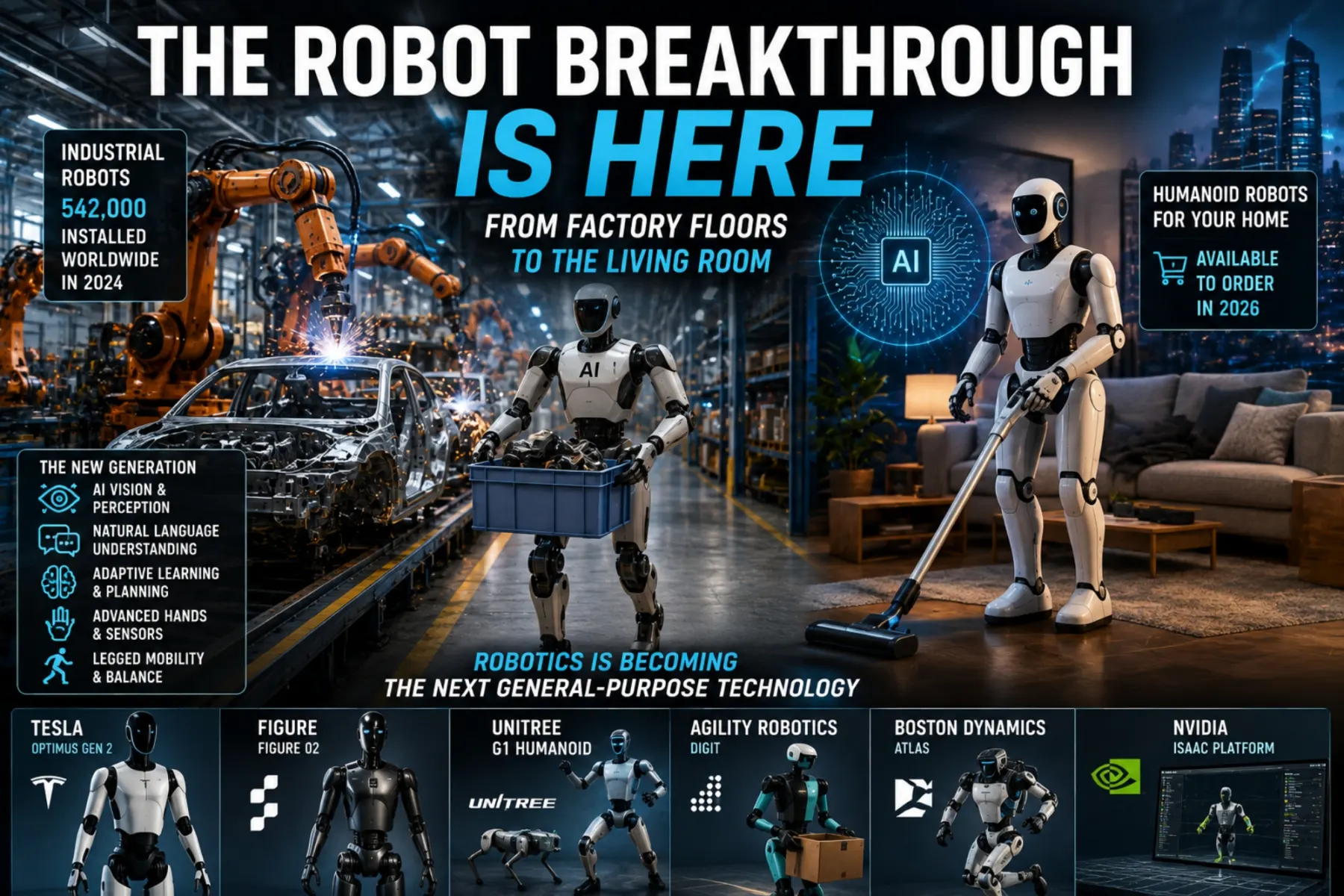
The Robot Breakthrough Is Here: From Factory Floors to the Living Room
Industrial robots have spent decades welding, lifting and assembling products behind safety fences. The new generation is different: humanoid machines can walk through workplaces built for people, AI models are learning to control entire bodies from natural-language instructions, and the first household humanoids can now be ordered by consumers. Companies from the United States, China, Europe and beyond are racing to turn robotics from specialised automation into a general-purpose technology.
For most of the industrial age, a robot was easy to recognise.
It was usually bolted to the floor.
It performed one task extremely well.
It welded the same seam.
Moved the same component.
Stacked the same boxes.
Repeated the same movement thousands of times without getting tired.
The modern industrial robot is one of manufacturing’s great success stories. According to the International Federation of Robotics, 542,000 industrial robots were installed worldwide in 2024, more than twice as many as a decade earlier. Around 4.66 million industrial robots were already operating in factories worldwide, with annual installations exceeding half a million for the fourth consecutive year.
But something more fundamental is now happening.
Robots are beginning to move away from the model of a machine programmed for one carefully defined task and towards machines capable of seeing their surroundings, understanding spoken instructions, planning a sequence of actions and physically adapting when the environment changes.
The breakthrough is not one invention.
It is the convergence of several technologies that matured at roughly the same time:
powerful artificial intelligence;
computer vision;
better batteries;
smaller and stronger electric motors;
force and tactile sensors;
cheaper computing;
simulation;
reinforcement learning;
vision-language-action models;
and increasingly sophisticated robotic hands.
The result is what the technology industry increasingly calls physical AI or embodied intelligence.
Instead of artificial intelligence existing only inside a computer, it gains a body.
And 2026 is beginning to look like the year in which that concept moves decisively from laboratory demonstrations towards factories — and, for the first time, towards ordinary homes.
The Robot Revolution Has Already Happened — Just Not in Human Form
It is tempting to imagine that robots are only now arriving.
In reality, factories are already full of them.
Asia accounted for 74% of new industrial robot installations in 2024, compared with 16% in Europe and 9% in the Americas. China alone installed approximately 295,000 industrial robots, representing 54% of global deployments that year. Its operational stock exceeded two million machines.
Traditional manufacturers such as ABB continue to develop robotic arms, collaborative robots and autonomous mobile platforms used across automotive manufacturing, electronics, logistics and consumer-goods production. ABB is now explicitly shifting its strategy towards what it calls Autonomous Versatile Robotics — machines capable of switching between tasks with less conventional programming.
In March 2026, ABB announced a collaboration with NVIDIA that integrates Omniverse technology into RobotStudio, aiming to make it easier to train and validate AI-powered robotic systems in simulation before transferring them into real factories.
That transition is important.
The traditional industrial robot is extraordinarily good when the world around it remains predictable.
The emerging robot is being designed for a world that does not.
Why Build a Robot Shaped Like a Human?
A humanoid robot initially appears unnecessarily complicated.
Wheels are easier than legs.
A fixed robotic arm is easier than shoulders, elbows and hands.
A specialised machine designed to move one particular component can usually perform that task more efficiently than a general-purpose humanoid.
So why are billions being invested in robots with two arms and two legs?
The answer is not that the human body is mechanically perfect.
It is that the world has already been designed around it.
Factory stairs are designed for human legs.
Doors are positioned for human hands.
Shelves are built at human height.
Warehouses contain aisles wide enough for people.
Tools have handles designed for fingers.
Factories have ladders, trolleys, switches, workstations and storage areas constructed around human proportions.
A specialised robotic system often requires the workplace to be redesigned around the robot.
A sufficiently capable humanoid could theoretically enter infrastructure that already exists.
That is the economic promise.
Instead of rebuilding a warehouse for automation, bring automation into the warehouse.
The Real Breakthrough Is the Brain, Not the Legs
Robots capable of walking have existed for years.
Boston Dynamics famously demonstrated extraordinary robotic mobility long before the current AI boom.
The harder problem is making the machine useful without manually programming every movement.
Consider a simple human instruction:
“Take that blue container from the table, walk over to the shelf, move the box that is blocking the bottom level, and put the container behind it.”
A conventional industrial robot does not naturally understand that sentence.
A human does.
The new generation of robotics companies is trying to close that gap.
This is where vision-language-action models become important.
The robot needs to connect three worlds:
language — what the person wants;
vision — what is physically around it;
and action — how its motors should move to complete the task.
That is why companies best known for artificial intelligence are suddenly central to robotics.
Google DeepMind Has Made One of 2026’s Most Important Robotics Advances
On 30 July 2026, Google DeepMind introduced Gemini Robotics 2, one of the most significant recent developments in embodied AI.
Earlier generations could control parts of a robot during manipulation tasks. Gemini Robotics 2 extends AI control to the complete humanoid body.
Google demonstrated the model controlling Apptronik’s Apollo 2 robot through tasks requiring walking, grasping, balancing and object placement from natural-language instructions.
In one demonstration, the robot was instructed to place a watering can inside a green bin on a lower shelf.
The system had to understand the instruction, identify the relevant objects, walk towards them, pick up the watering can, move across the room and place it in the correct location.
That sounds trivial because humans perform such sequences almost unconsciously.
For robotics, combining all of those operations inside one AI-controlled sequence is far more difficult.
Gemini Robotics 2 can also control different robotic embodiments rather than being designed exclusively around one machine. Google says its on-device model can be adapted to new dual-arm robot platforms with fewer than 200 examples in some cases.
That may prove enormously important.
The future robotics industry may not require every robot manufacturer to create its intelligence entirely from scratch.
The same way smartphone companies can build different devices around common software ecosystems, robotics may eventually develop common AI foundations that operate across many machines.
Google Is Also Teaching Robots to Work Together
Another significant development in Gemini Robotics 2 is multi-robot collaboration.
The system allows different robots to coordinate parts of a larger task rather than operating as completely isolated machines.
Google describes its embodied-reasoning model as the higher-level brain: it interprets what the human wants, observes the environment, creates a sequence of steps, supervises progress and can adjust if something goes wrong.
This could eventually change the economics of warehouses and factories.
Instead of purchasing a collection of independently programmed machines, a company might operate an intelligent robotic workforce in which several machines receive tasks from a common planning system.
One robot transports material.
Another unloads it.
A third performs inspection.
A fourth packages the finished component.
The important innovation is not simply having four robots.
It is making them behave like a coordinated system.
NVIDIA Wants to Supply the Operating Infrastructure of the Robot Age
If Google DeepMind is attempting to build some of the intelligence, NVIDIA is positioning itself as one of the major infrastructure providers.
Its Isaac GR00T initiative develops foundation models, simulation systems and training tools for general-purpose robotics.
GR00T models combine information from human demonstrations, real robot trajectories, simulated robot movements and synthetic data.
That solves one of robotics’ biggest problems: training data.
A language model can learn from enormous quantities of text available online.
A robot needs examples of physical interaction.
How should the fingers rotate this cup?
How hard can the hand grip it?
How should the body balance while reaching?
What happens when an object slips?
Collecting millions of hours of real robotic experience is expensive and slow.
Simulation and synthetic data can help generate much larger training datasets without physically operating millions of robots.
In May 2026, NVIDIA announced a GR00T reference humanoid design scheduled to become available through Unitree later in the year.
This is another sign that the industry is becoming an ecosystem.
Some companies build bodies.
Others build motors.
Others develop hands.
Others create AI.
Others provide simulation.
The eventual winner may not be a single robot company at all.
Figure AI: One of the Clearest Examples of AI Entering the Factory
California-based Figure has become one of the most closely watched humanoid robotics companies.
Its current machine, Figure 03, is designed as a general-purpose humanoid controlled by Figure’s Helix AI platform.
Figure’s earlier Figure 02 platform accumulated more than 1,250 hours of runtime at BMW and contributed to the production process associated with more than 30,000 BMW X3 vehicles, according to the company.
The important point is not that humanoids are already building complete cars.
They are not.
The breakthrough is that robots originally associated mainly with spectacular laboratory demonstrations are now accumulating meaningful operating hours inside real industrial environments.
In June 2026, Figure showed Figure 03 performing a logistics workflow at BMW’s Spartanburg plant.
Its Helix 02 AI coordinated the hands, arms, torso and legs while the robot manipulated parts and repositioned its whole body to move a heavy wheeled cart.
That is precisely the type of workflow humanoids are intended to unlock.
Not one fixed movement.
A chain of physical actions.
Figure’s Helix 02 Shows Where Robot Intelligence Is Going
Figure introduced Helix 02 in January 2026 as a single AI system capable of controlling the full humanoid body directly from visual input.
Rather than separating walking completely from manipulation, the model coordinates movement continuously.
This is important because humans do not treat the body as disconnected machines.
When reaching for a heavy object, we move our feet.
Shift our hips.
Adjust our balance.
Change the position of the shoulders.
Apply force with the hands.
A truly useful humanoid must do the same.
Figure describes its approach as pixels-to-action: cameras observe the world, AI interprets it and the system turns that perception into physical movement.
This direction increasingly resembles the development of autonomous vehicles.
First teach the machine to perceive.
Then teach it to understand.
Then teach it to act.
And Figure Is Already Looking Beyond the Factory
Perhaps more important for private consumers is what Figure says comes next.
The company now explicitly describes Figure 03 as a robot intended to move from workplace applications into the home.
Its current product information shows the robot performing tasks including laundry, cleaning and dish handling, while Figure says its AI is being developed to adapt to stairs, narrow spaces and changing home layouts.
That does not mean consumers can walk into a store today and buy a fully autonomous Figure robot.
The distinction matters.
Figure is demonstrating and developing household capabilities rather than operating a mass-market consumer robot business.
But the strategic direction is clear.
The factory is being used as the proving ground.
The home is the much bigger long-term challenge.
Agility Robotics: Perhaps the Strongest Evidence That Humanoids Can Actually Work
While several companies are competing to produce impressive AI demonstrations, Agility Robotics has focused heavily on commercial deployment.
Its humanoid is called Digit.
In June 2024, Digit entered commercial operations at a GXO logistics facility near Atlanta in what Agility described as the first humanoid robot deployed into a long-term commercial workplace operation.
By November 2025, Digit robots had moved more than 100,000 totes at the facility.
That number matters.
A robot performing a spectacular demonstration once is interesting.
A robot repeating useful work tens of thousands of times is commercially much more significant.
Then, in February 2026, Toyota Motor Manufacturing Canada signed a commercial agreement to deploy Digit after completing a pilot programme.
Agility is therefore one of the strongest examples of the humanoid industry moving from experimental pilots towards actual operational contracts.
Digit v5 Is Trying to Solve the Safety Problem
One of the greatest obstacles to widespread humanoid adoption is not intelligence.
It is safety.
Traditional industrial robots are often separated from workers by fences, cages or defined safety zones.
That works extremely well when a robot remains in one place.
It defeats part of the purpose of a humanoid designed to move through a human workplace.
Agility’s next-generation Digit v5 is being designed specifically around what the company calls cooperative safety — enabling robots and people eventually to work within shared environments rather than remaining permanently separated.
As of June 2026, Agility said it had secured more than $300 million in multi-year contracted orders for Digit v5, subject to contractual milestones, and had a pipeline exceeding 30 customers.
Its RoboFab manufacturing facility in Oregon has been designed for potential production of up to 10,000 Digit robots annually.
This is another crucial transition.
The question is no longer only:
“Can we build a humanoid?”
It is becoming:
“Can we manufacture thousands reliably, maintain them and make the economics work?”
Boston Dynamics: Atlas Finally Becomes a Product
For decades, Boston Dynamics represented the spectacular side of robotics.
Its machines could run.
Jump.
Climb stairs.
Recover their balance.
Videos of Atlas performing acrobatics became some of the most famous demonstrations in modern robotics.
But a research robot and an industrial product are fundamentally different.
In January 2026, Boston Dynamics unveiled the production version of Atlas and announced that manufacturing would begin, with deployments scheduled at Hyundai and Google DeepMind.
The new electric Atlas is designed primarily for industrial work, including material handling and manufacturing applications.
In May, Boston Dynamics demonstrated Atlas manipulating and moving heavy objects using coordinated whole-body movement.
The important breakthrough is therefore no longer Atlas’ ability to do something visually astonishing.
It is Boston Dynamics attempting to transform decades of advanced mobility research into a maintainable industrial machine.
Hyundai Could Give Atlas Something Robotics Start-Ups Often Lack: Scale
Boston Dynamics is controlled by Hyundai Motor Group.
That relationship could be strategically significant because an automotive manufacturer does not merely provide capital.
It provides factories.
Supply chains.
Real industrial tasks.
Engineering expertise.
And potentially an enormous internal customer.
Hyundai Motor Group has announced plans to purchase tens of thousands of robots as it expands the use of robotics across its operations.
Hyundai Mobis is also collaborating on Atlas components, including actuators intended to support future production.
If humanoids become economically viable in automotive manufacturing, the sector could provide an ideal early market.
Car factories already use enormous amounts of automation.
They contain repetitive physical tasks.
Their production volumes justify expensive investment.
And manufacturers can measure very precisely whether a robot saves money.
Apptronik: Apollo Becomes the Body for Google’s New Robotics AI
Another US company moving rapidly is Apptronik, based in Austin.
Its humanoid robot Apollo has partnerships or collaborations involving Mercedes-Benz, GXO Logistics and manufacturing company Jabil. Apptronik is also working strategically with Google DeepMind on the development of AI-powered humanoid robotics.
Jabil’s relationship is particularly interesting because the company is both helping to manufacture Apollo robots and investigating the use of Apollo inside manufacturing operations.
That produces an almost science-fiction loop:
robots helping manufacture products;
some of those products eventually being more robots.
Apptronik has raised more than $935 million in Series A funding, illustrating the enormous amounts of capital now flowing into the sector.
But Apollo’s most interesting development in July 2026 came through Google DeepMind.
Gemini Robotics 2 was demonstrated controlling an Apollo 2 robot’s entire body from natural-language commands.
This could be more important than any single robot design.
It demonstrates what happens when a specialised robotics company and a frontier AI laboratory work on the same machine.
China Has Become the Other Centre of the Humanoid Race
The American robotics boom is only one side of the global story.
China already dominates conventional industrial robot installations and has developed an increasingly powerful domestic robotics manufacturing base.
Two companies are particularly important when looking at the emerging humanoid market:
UBTECH and Unitree.
They illustrate two different Chinese advantages.
UBTECH is focusing heavily on industrial deployment.
Unitree has become notable for aggressive pricing, manufacturing volume and making advanced humanoid hardware accessible to researchers, developers and increasingly private purchasers.
UBTECH’s Walker S2 Can Change Its Own Battery
UBTECH’s industrial humanoid programme has progressed through Walker S, Walker S1 and the current Walker S2.
The company says its Walker robots have been tested in automotive manufacturing environments including production operations associated with companies such as NIO and Geely.
Walker S2 introduced a particularly practical innovation: an autonomous hot-swappable battery system.
Instead of stopping for a long charging period, the robot can change its own battery and continue operating.
For industrial automation, that matters far more than it might initially seem.
Humans can finish a shift and another worker can replace them.
A robot that spends hours charging cannot produce continuously.
Battery management therefore directly affects the economic value of the machine.
UBTECH says it has moved into mass production and delivery of Walker S2.
The company is also experimenting with groups of humanoids performing different tasks inside the same industrial environment.
That puts it in the same broader race towards fleet intelligence being pursued by American AI and robotics companies.
Unitree May Be the Company That Forces Humanoid Prices Down
Hangzhou-based Unitree has taken a different approach.
The company first became well known for four-legged robots but has expanded aggressively into humanoids.
Its G1 humanoid starts at approximately $13,500, according to Unitree’s official product information.
That price is remarkable.
It is still far too expensive for most households to buy casually.
But humanoid robots historically belonged to research programmes costing vastly more.
Unitree is pushing them towards the price of a car.
The company said it delivered more than 5,500 humanoid robots during 2025 and manufactured more than 6,500 that year.
That is one of the strongest signals that humanoid manufacturing is beginning to scale beyond dozens of laboratory prototypes.
Unitree is also moving onto public capital markets. Reuters reported on 10 August 2026 that the company was progressing through a Shanghai listing as it raises capital for further expansion.
But the Unitree G1 Is Not Yet Rosie from The Jetsons
The low price can create the wrong impression.
Unitree itself warns buyers that the humanoid industry remains in an early stage and advises individual users to understand the limitations before purchasing. Some demonstrated capabilities remain under development.
The G1 is therefore much closer to an advanced robotics platform than to a completely autonomous housekeeper.
A private buyer can own sophisticated humanoid hardware.
That does not mean it will independently clean the kitchen, sort a week of laundry and cook dinner.
This distinction is going to become increasingly important as consumer interest grows.
Walking is not enough.
Dancing is not enough.
A useful home robot must reliably manipulate thousands of unfamiliar objects without breaking them — or the house.
Tesla’s Optimus Has the Largest Manufacturing Ambition
No discussion of humanoid robotics is complete without Tesla.
The company is developing Optimus, a general-purpose humanoid intended eventually for repetitive, dangerous and everyday physical tasks. Tesla’s AI division describes the programme as requiring advances across perception, navigation, balance and physical interaction.
Tesla now lists its Fremont Factory as a production hub for both vehicles and Optimus.
The company’s long-term ambition is enormous.
But this is also an area where it is important to distinguish announced manufacturing plans from proven deployment.
Tesla has not yet demonstrated the type of sustained external commercial operation already recorded by Agility’s Digit at GXO.
Reuters reported earlier this year that Optimus production was expected to begin with a very slow ramp before expanding later.
That makes Tesla fascinating for a different reason.
The breakthrough has not yet been commercial deployment.
It is the attempt to apply Tesla’s experience in batteries, electric motors, AI computing and high-volume manufacturing to humanoid robotics.
If it succeeds, those manufacturing capabilities could become as important as the robot’s intelligence.
The Biggest Robotics Problem May Eventually Be Manufacturing, Not AI
A brilliant prototype can be assembled slowly by highly trained engineers.
A consumer product cannot.
A household robot must eventually be manufactured repeatedly with:
consistent motors;
consistent sensors;
reliable hands;
durable joints;
replaceable components;
safe batteries;
simple servicing;
and software that works across thousands or millions of units.
Cars demonstrate how difficult this is.
A robot has many of the same mechanical systems plus dramatically more articulated joints and sophisticated manipulation hardware.
This is why companies with strong manufacturing supply chains — Tesla, Hyundai, Chinese robotics manufacturers and major electronics producers — could have an important structural advantage.
The humanoid industry is becoming a race between intelligence and manufacturability.
Winning only one side may not be enough.
Then Comes the Bigger Prize: The Home
The industrial market is large.
The potential consumer market could be much larger.
There are billions of households.
Most contain physical work that humans would rather not perform.
Laundry.
Cleaning.
Dishwashing.
Tidying.
Carrying groceries.
Taking bins out.
Fetching objects.
Making beds.
Basic food preparation.
Looking after gardens.
Helping elderly residents.
Eventually, perhaps, assisting people with reduced mobility.
The economic dream is obvious.
A general-purpose household robot could become one of the most valuable consumer products ever created.
But the home is far harder than the factory.
A Factory Is Predictable. Your Kitchen Is Not.
Factories are engineered environments.
Objects have known dimensions.
Products arrive at predictable locations.
Floors are kept clear.
Lighting can be controlled.
Workflows repeat.
Homes are chaotic.
A shoe appears where it was not yesterday.
A child leaves a toy on the floor.
A chair moves.
The dog walks through the room.
Someone puts a glass close to the edge of the table.
Laundry contains hundreds of different materials and shapes.
Cupboard doors vary.
Objects are fragile.
People move unpredictably.
The robot must understand all of it.
This is why success in the home may ultimately be a greater technical achievement than success on a production line.
1X Has Crossed an Important Consumer Threshold
The company currently making perhaps the most direct attempt to put a humanoid inside ordinary homes is 1X.
Its robot is called NEO.
1X markets NEO as a consumer-ready humanoid designed specifically for household use rather than as an industrial machine later adapted to the home.
The robot is designed to perform chores, navigate a home, communicate through natural language and learn additional tasks.
1X shows NEO carrying out activities such as tidying, folding laundry, organising shelves, fetching objects and opening doors.
More importantly, consumers can actually place an order.
As of August 2026, 1X lists two purchasing options:
$499 per month through a subscription
or
$20,000 for Early Access ownership, with a $200 refundable deposit.
US deliveries are scheduled to begin during 2026.
That may represent one of the most important psychological milestones in consumer robotics.
The humanoid home robot is no longer merely a research concept.
It has a price.
But NEO Reveals How Early the Consumer Market Still Is
NEO also demonstrates the limitations of the current generation.
1X says early owners receive basic autonomous functionality and that capabilities will improve over time.
For complicated tasks the robot has not yet learned, an owner can schedule a 1X expert to remotely supervise or guide the robot through the task.
That is clever because it solves an immediate practical problem.
It also reveals how far the industry still has to go before full household autonomy.
A truly mature home robot would not need a remote human to help it understand unfamiliar chores.
But the current approach could create exactly the training data required to make later generations more autonomous.
Every unfamiliar household becomes a learning environment.
Privacy Could Become One of the Great Consumer-Robot Questions
A household humanoid requires cameras.
Microphones.
Spatial awareness.
Memory.
Potentially cloud connectivity.
Those capabilities make the robot useful.
They also place the machine inside some of the most private environments humans have.
Bedrooms.
Kitchens.
Living rooms.
Family conversations.
Children.
Personal possessions.
If a system allows remote assistance, the privacy architecture becomes even more important.
Consumer adoption may therefore depend not only on what a robot can do.
It will depend on whether people trust who can see, hear or store what the robot experiences.
The smartphone placed powerful sensors in everyone’s pocket.
The humanoid robot could place mobile sensors throughout the entire house.
That will require a much higher level of consumer trust.
Home Robots Are Already a Mass Market — Just Not Humanoid Ones
The idea of buying a household robot is actually no longer unusual.
According to the International Federation of Robotics, close to 20 million consumer service robots were sold in 2024 within its supplier sample, an increase of 11%.
Domestic cleaning and lawn-care robots formed by far the largest group.
Robot vacuum cleaners therefore represent the first successful generation of consumer robotics.
They teach an important lesson.
Consumers do not necessarily care whether a machine looks like a robot from science fiction.
They care whether it performs a useful job reliably at an acceptable price.
That will also determine the future of humanoids.
A beautiful robot that requires constant supervision may remain a curiosity.
A less spectacular robot that reliably saves two hours of housework every day could become a mass-market product.
Why Humanoids Could Eventually Replace Several Household Machines
Today, consumers purchase specialised devices.
A robotic vacuum cleans floors.
A robotic lawnmower cuts grass.
A dishwasher cleans dishes.
A washing machine handles clothes.
A smart speaker answers questions.
A security camera watches the house.
A future general-purpose robot could combine some functions across these categories.
It might unload the dishwasher rather than replace it.
Carry laundry into the washing machine.
Put groceries away.
Vacuum using ordinary cleaning equipment.
Water plants.
Check whether doors are locked.
Fetch items for an elderly person.
The key advantage is not necessarily performing one job better than a specialised robot.
It is performing many different jobs with one body.
That is why general-purpose robotics could become economically transformative if the technology reaches sufficient reliability.
The Hands May Matter More Than the Walking
Humanoid robotics videos focus heavily on walking, running and dancing because those movements are visually impressive.
For practical work, hands may matter more.
A domestic robot must manipulate:
cups;
plates;
clothing;
door handles;
keys;
food packets;
tools;
phones;
toys;
cables;
cutlery;
and thousands of objects with completely different properties.
Some require force.
Others break under force.
Some slide.
Some bend.
Some deform.
Some are wet.
Some are hot.
A human hand solves these problems automatically through an extraordinary combination of sensing, muscle control and learned experience.
Robotic hands remain one of the hardest engineering problems in the entire field.
Google DeepMind’s latest Gemini Robotics 2 experiments show both the progress and the remaining challenge. The system can perform sophisticated manipulation tasks with multi-finger robotic hands, but Google’s own results show wide variation between individual tasks.
This is an important reality check.
The robot revolution is progressing rapidly.
Human-level dexterity has not been solved.
Battery Life Is Another Hidden Limitation
Humans operate for hours using food eaten long before the work begins.
Robots need electricity.
A humanoid carries motors in its legs, hips, arms, hands and torso while running computers and sensors continuously.
That consumes significant energy.
Figure lists a runtime of approximately five hours for Figure 03.
For some factory applications, that may be manageable through battery swaps or scheduled charging.
For a household robot expected to remain available throughout the day, energy management becomes more complicated.
1X addresses this by designing NEO to manage charging itself.
UBTECH’s Walker S2 takes another approach with autonomous battery swapping.
These sound like secondary features.
They are fundamental.
A robot that knows how to fold laundry but spends half the day plugged into a wall is considerably less useful.
Reliability Will Separate the Winners from the Viral Videos
Robotics may be one of the few technology sectors where spectacular online videos can make technological maturity appear greater than it is.
A robot completing a complicated task once demonstrates possibility.
An industrial customer needs something different.
It needs the machine to perform the task on Monday.
Again on Tuesday.
And Wednesday.
Thousands of times.
For months.
With predictable maintenance.
This is why Agility’s 100,000-tote milestone is arguably more commercially meaningful than many much more dramatic robotics demonstrations.
The next phase of the industry will increasingly be measured in boring statistics:
uptime;
mean time between failures;
cost per operating hour;
maintenance intervals;
task-success rates;
battery replacement;
and return on investment.
That is when robotics becomes a real industry.
The Companies Currently Closest to Different Types of Breakthrough
There is no single leader because companies are solving different parts of the problem.
Agility Robotics — commercial industrial proof
Digit has one of the clearest records of sustained commercial humanoid work, including more than 100,000 tote movements at GXO and a subsequent agreement with Toyota Motor Manufacturing Canada.
Boston Dynamics — industrial mobility and engineering
Atlas combines decades of research in dynamic movement with a new production-oriented industrial design and is entering customer environments with Hyundai.
Figure — AI-driven humanoid autonomy
Figure is integrating whole-body AI with industrial deployment experience from BMW while openly targeting eventual household applications.
Apptronik — the bridge between robotics and frontier AI
Apollo is being developed alongside major industrial partners and has become one of the key bodies used to demonstrate Google DeepMind’s latest whole-body robotics intelligence.
UBTECH — Chinese industrial humanoid scaling
Walker S2 combines industrial deployment with autonomous battery changing and is moving into production and delivery.
Unitree — price and manufacturing scale
The G1 begins around $13,500, while Unitree says it delivered more than 5,500 humanoids in 2025, making the company an important example of rapidly falling hardware costs.
1X — the clearest direct move into the consumer home
NEO can already be ordered for delivery in the United States, putting an actual commercial price on the idea of a household humanoid.
Tesla — manufacturing ambition
Optimus remains less commercially proven than some competitors, but Tesla’s combination of AI, electric actuators, battery technology and manufacturing scale makes the project strategically important.
Google DeepMind and NVIDIA — the robot brains and training infrastructure
These companies may not need to manufacture the winning robot body if their AI and software become foundational technology used across many manufacturers.
The United States and China Are Developing Different Strengths
A broad pattern is beginning to emerge.
American companies have particularly strong positions in frontier artificial intelligence, software and advanced humanoid research.
China has immense advantages in manufacturing supply chains, electric motors, batteries, electronics and cost-efficient mass production.
China already accounts for more than half of annual global industrial robot installations.
Unitree’s ability to offer a humanoid starting around $13,500 demonstrates what happens when robotics intersects with a deep domestic hardware supply chain.
American companies such as Google DeepMind, NVIDIA, Figure, Apptronik, Agility, Boston Dynamics and Tesla are meanwhile pushing strongly on embodied intelligence and advanced control.
The global humanoid race may therefore become similar to other strategic technology competitions.
Software capability on one side.
Manufacturing scale on the other.
And an increasingly intense effort by everyone to master both.
Europe Should Not Be Counted Out
Europe may currently attract less attention in humanoid headlines, but it remains deeply important to industrial robotics.
ABB is one of the world’s leading industrial automation companies and is pushing towards increasingly autonomous AI-enabled machines.
Europe also possesses major automotive companies, precision-engineering suppliers, research institutes and industrial customers capable of adopting robotics at scale.
Google DeepMind is supporting European robotics start-ups through its robotics accelerator, including companies developing humanoids, waste-sorting robots and autonomous marine systems.
The robot revolution will not therefore be defined only by humanoids.
Agricultural robots.
Warehouse systems.
Autonomous mobile machines.
Medical robotics.
Inspection robots.
Underwater systems.
And specialised collaborative robots may all create enormous markets without ever looking remotely human.
Jobs Will Change Before They Simply Disappear
The economic debate around robotics frequently jumps immediately to one question:
Will robots take human jobs?
Some roles will almost certainly become increasingly automated if machines become cheaper and more capable.
That has already happened repeatedly throughout industrial history.
But the actual process is usually more complicated than one robot replacing one worker.
Automation changes workflows.
One repetitive movement disappears.
A new maintenance job appears.
A machine operator becomes a fleet supervisor.
Production becomes cheaper.
A factory expands.
New products become possible.
Some occupations decline.
Others grow.
The most immediate humanoid applications are deliberately targeting work that is repetitive, physically demanding, difficult to staff or potentially hazardous.
Agility and Apptronik both explicitly position their systems partly around these categories of work.
The larger labour-market impact will depend on how quickly robots improve relative to wages and how widely companies can deploy them economically.
That remains uncertain.
The Economics Will Eventually Matter More Than the Technology
Imagine a humanoid costing €100,000.
If it performs only one low-value task for two hours per day, the economics may be poor.
Now imagine a robot costing €20,000 that works safely for 16 hours per day across several jobs.
The calculation changes completely.
This is why falling hardware cost is so important.
Unitree is already pushing humanoid prices towards conventional vehicle territory.
1X offers NEO at $499 per month.
Manufacturers are designing larger production facilities.
Robot AI is becoming increasingly transferable between different bodies.
If these trends continue simultaneously, the economics can change rapidly.
The robot does not need to become human.
It only needs to become financially useful.
The Private Robot May Arrive Gradually Rather Than Suddenly
Science fiction often imagines a single moment when the humanoid robot arrives.
Reality will probably be less dramatic.
First comes the vacuum robot.
Then the lawnmower.
Then security and telepresence robots.
Then increasingly capable mobile assistants.
Then early humanoids costing as much as a small car.
Then subscription models.
Then perhaps one generation crosses the threshold where a household can calculate that the time saved is worth the monthly payment.
The smartphone followed a similar pattern.
Early versions were expensive compromises.
A few years later, they were indispensable.
Whether humanoids follow the same curve remains unknown.
But for the first time, the possibility no longer feels remote.
2026 Is Not the Year Every Family Gets a Robot
It is important not to exaggerate the present state of the technology.
A general-purpose robot capable of entering any ordinary home and autonomously performing every household task with human reliability does not yet exist as a mainstream mass-market product.
Robotic hands remain challenging.
Battery life remains limited.
Safety has to improve further.
AI still fails.
Consumer humanoids remain expensive.
Privacy questions are substantial.
Industrial deployments are still tiny compared with the millions of conventional industrial robots already operating.
The humanoid revolution is beginning from a very small base.
But something important has nevertheless changed.
The debate has moved from:
“Can such a robot be built?”
to:
“Can it work reliably?”
Then to:
“Can it be manufactured economically?”
And finally:
“When will ordinary people want one?”
Those are the questions of an emerging industry, not a science-fiction project.
The Factory Will Probably Reach the Future First
Factories remain the logical testing ground.
Businesses can identify exact tasks.
Measure costs.
Control environments.
Provide trained support.
And calculate whether the robot produces a return.
That allows humanoids to improve before entering uncontrolled household environments.
Agility’s Digit is moving materials.
Figure has accumulated manufacturing experience with BMW.
Boston Dynamics is moving Atlas towards industrial deployments.
Apptronik is working with major manufacturing and logistics groups.
UBTECH is deploying Walker robots around automotive manufacturing.
Tesla intends to use Optimus around industrial work before attempting much broader applications.
The path from factory floor to family home therefore makes sense.
Industry pays for the training.
Consumers eventually receive the mature technology.
Then the Robot Could Become Something Much Bigger Than a Household Appliance
If general-purpose robots eventually become genuinely reliable, their effect could extend far beyond cleaning.
An ageing population could create enormous demand for physical assistance.
A robot might carry heavy objects for somebody with limited strength.
Retrieve medication.
Bring food from the kitchen.
Open doors.
Help maintain a home.
Call for assistance.
Perform routine physical tasks that allow an older person to live independently for longer.
Robots could also transform small businesses.
A restaurant might use one for cleaning and stock movement after closing.
A farmer might use several machines for repetitive yard work.
A hotel could deploy robots for laundry and logistics.
A shop could use one for shelf replenishment before opening.
The truly transformative characteristic is therefore not humanoid appearance.
It is generality.
One machine.
Many tasks.
The Smartphone Gave AI Eyes and Ears. Robotics Gives It Arms and Legs.
The first modern AI revolution largely happened on screens.
Artificial intelligence writes.
Translates.
Analyses.
Searches.
Programs.
Creates images.
Interacts through text and voice.
Robotics is the next logical step.
It takes the intelligence behind the screen and gives it access to the physical world.
Google DeepMind’s Gemini Robotics 2 can interpret instructions and coordinate a humanoid’s entire body.
NVIDIA is building foundation models and simulation systems intended to train many kinds of robots.
Figure is combining AI with manufacturing experience.
Agility has robots performing repetitive commercial work.
Boston Dynamics has turned Atlas from a research icon towards an industrial product.
Unitree is pushing down hardware cost.
UBTECH is scaling industrial humanoids.
1X is accepting orders for a machine intended specifically for the home.
These developments are happening simultaneously.
That is why the current moment feels different from previous waves of robotics excitement.
The Real Robot Race Has Only Just Begun
The biggest winner may not be the company producing the robot that runs fastest.
Or dances best.
Or looks most human.
The successful machine will have to do something considerably less glamorous.
It must arrive at work every morning.
Understand what it has been asked to do.
Perform the task correctly.
Avoid hurting anyone.
Know when it has made a mistake.
Recover from unexpected situations.
Operate for hours.
Recharge itself.
Require manageable maintenance.
And cost less than the economic value of the work it performs.
The household version faces an even higher standard.
It must do all of that while living around children, animals, furniture, fragile objects and people who have absolutely no interest in learning robot programming.
That remains an extraordinary engineering challenge.
But in 2026, the outlines of the solution are becoming visible.
Industrial robotics has already reached millions of machines.
Consumer service robots already sell in the millions.
Humanoid robots are beginning real commercial work.
Artificial intelligence can increasingly control the complete robotic body.
And the first consumer humanoids now have published prices and delivery plans.
For decades, robots changed the world from behind factory fences.
The next generation is learning to walk through the door.
The decisive breakthrough will come when nobody finds that remarkable anymore.
Source & Transparency
This article is published by Ireland Newspaper for editorial and informational purposes.
Published: 10 August 2026 · Updated: 10 August 2026

Newsroom Ireland Newspaper
Ireland Newspaper editorial team prepares daily news coverage for readers in Ireland and abroad.