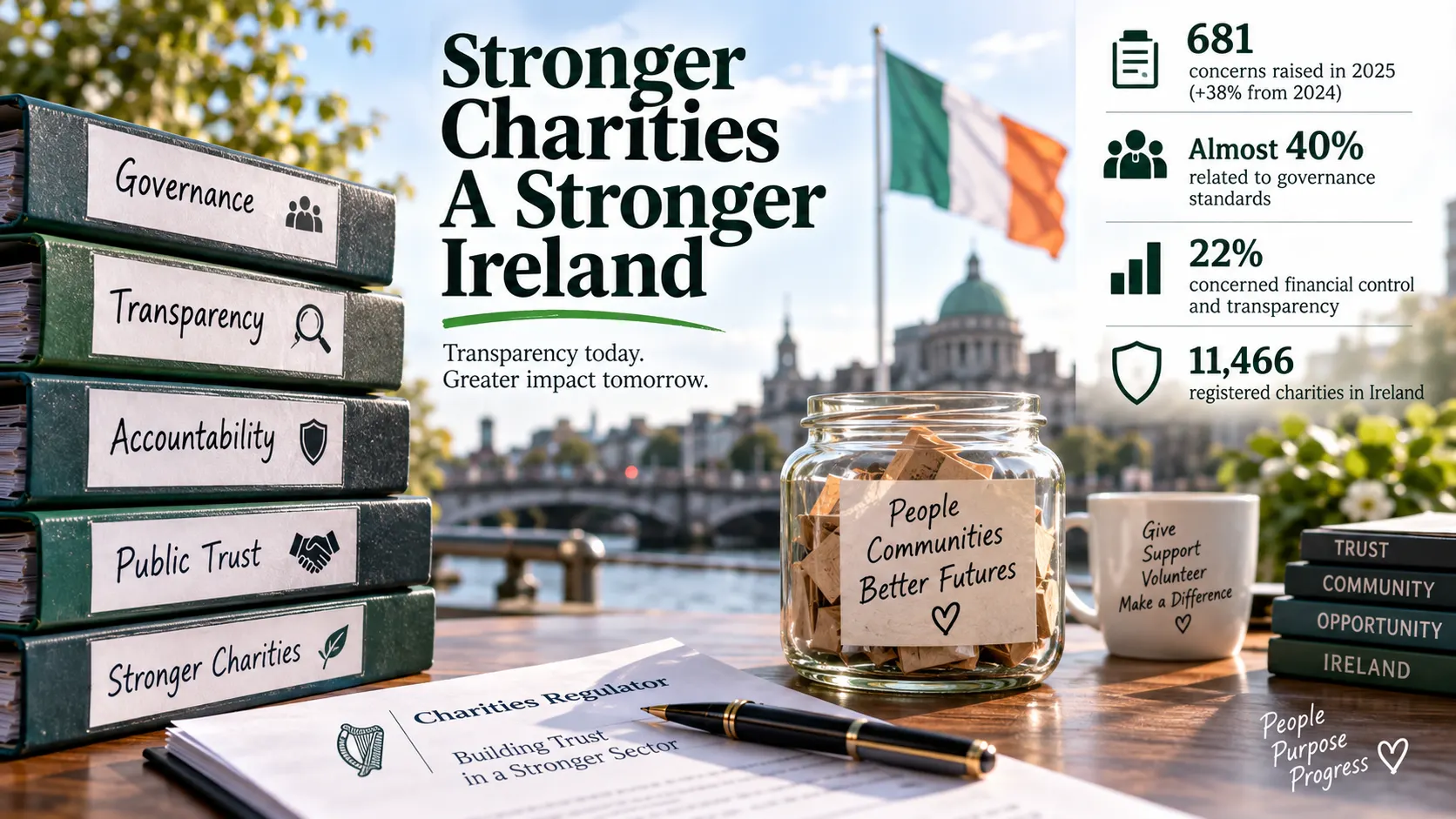
A 38% increase in concerns about Irish charities sounds, at first sight, like evidence of a rapidly worsening problem. The Charities Regulator received 681 concerns during 2025, compared with 493 a year earlier. But 681 concerns are not 681 proven breaches of charity law, nor do they necessarily relate to 681 different registered charities. More than 80 of the matters received were outside the Regulator’s remit, while the total was only moderately above the five-year average of 603 concerns.
The more important finding is what people are reporting. Almost 40% of the concerns received in 2025 related to governance standards, continuing a pattern that regulators have identified for years. A further 24% concerned organisations presenting themselves as charities despite not being registered, while 22% related to financial control and transparency. The figures therefore describe several different problems at once: governance failures inside some charities, questions about the legitimacy of organisations seeking public support, financial transparency concerns and reports that may ultimately fall outside charity law altogether.
For Ireland’s approximately 11,500 registered charities, that distinction matters. The sector includes schools, local voluntary organisations, religious bodies, community groups and major organisations employing large numbers of staff. A rise in reports can uncover genuine problems, but it can also reflect greater public awareness of the regulator, easier access to information and stronger expectations about how charities should be governed.
Charity regulation in 2025
- 681 concerns were raised with the Charities Regulator, 38% more than in 2024.
- The five-year average for 2021–2025 was 603 concerns.
- More than 80 of the 2025 concerns related to matters outside the Regulator’s remit.
- Almost 40% concerned governance standards.
- 24% concerned unregistered organisations holding themselves out as charities.
- 22% related to financial control and transparency.
- Ireland had 11,466 registered charities at the end of 2025.
- Four statutory investigations were opened during the year and sanctions were imposed on another charity.
The 38% Increase Looks Different When Viewed Over Time
The comparison with 2024 is mathematically correct but incomplete. The 493 concerns recorded that year represented a significant fall from earlier levels. Moving from that unusually low base to 681 produces a dramatic percentage increase even though the 2025 total is not unprecedented.
In 2018, the Regulator recorded 686 concerns, five more than in 2025. There were 649 in 2019 and 642 in 2022. The pandemic disrupted the pattern, with the number falling to 466 in 2020 before rising again as charities and public activity resumed.
The official five-year average reinforces this point. The 681 concerns recorded in 2025 were around 13% above the average of 603 for 2021 to 2025. That is still an increase worth examining, but it is substantially less dramatic than the headline comparison with 2024 suggests.
Concerns Raised With the Charities Regulator
| Year | Concerns | Context |
|---|---|---|
| 2018 | 686 | Higher than 2025 |
| 2019 | 649 | Pre-pandemic |
| 2020 | 466 | Activity restricted during pandemic |
| 2021 | 568 | Activity recovering |
| 2022 | 642 | Further reopening |
| 2023 | 632 | Broadly similar to 2022 |
| 2024 | 493 | Marked decline |
| 2025 | 681 | 38% increase from 2024 |
Source: Charities Regulator annual and compliance reports. Changes in reporting categories and regulatory activity should be considered when comparing individual years.
The sequence also shows why a single year’s percentage movement should not be interpreted as a direct measure of misconduct. The number of concerns can respond to activity in the charity sector, public awareness, media attention, regulatory campaigns and the behaviour of organisations that are not registered charities at all.
The Regulator has not published evidence establishing that the additional 188 concerns between 2024 and 2025 were caused by a general increase in wrongdoing. Its own assessment has been more restrained: year-to-year fluctuations are expected in a sector of this scale, while the persistent pattern of governance-related reports is regarded as more significant than the headline total itself.
A Concern Is the Beginning of a Regulatory Process, Not Its Verdict
The term used by the Charities Regulator is important. A concern can be raised by members of the public, trustees, employees, volunteers, beneficiaries, donors, funding organisations or other authorities. Information can also come to the Regulator through media reports and its own monitoring work.
That information is then assessed to determine whether an issue involving charity law may exist. Depending on the circumstances, the Regulator can seek information or assurances from an organisation, engage with trustees to correct a problem or use formal statutory powers where a more serious response is considered necessary.
Some complaints belong elsewhere. Employment disputes, ordinary disagreements between trustees, dissatisfaction with a service, personal grievances and matters primarily falling within another regulator’s jurisdiction are not normally issues for the Charities Regulator. Suspected criminal activity may also need to be reported to An Garda Síochána.
This explains why more than 80 of the 681 matters received in 2025 were described as outside the Regulator’s remit. A rise in the number of people contacting the regulator can therefore occur without an equivalent rise in actual breaches of the Charities Acts.
Governance, Rather Than Missing Money, Is the Dominant Concern
The largest category in 2025 was governance. Reports included allegations that a chief executive, chair or founder had acquired excessive influence over how an organisation was managed, that trustees were unable to obtain financial information from executives and that trustees were failing to exercise sufficient oversight.
These examples describe concerns reported to the Regulator, not findings of wrongdoing in every case. Even so, their recurrence points towards a structural challenge in the charity sector: legal responsibility rests with trustees even when day-to-day management has been delegated to employees.
In a large organisation, this can produce a familiar corporate-governance problem. Senior executives may possess far more information about finances, operations and staffing than unpaid board members who meet periodically. Unless trustees ask difficult questions, receive sufficiently detailed financial information and retain real authority over major decisions, formal responsibility and practical control can begin to separate.
Small charities face a different version of the same problem. Many rely heavily on volunteers, long-serving founders or a small number of highly committed individuals. The organisation may work effectively for years because those people know every detail, but concentrated knowledge and authority can become a weakness when responsibilities are not documented, boards do not renew themselves or other trustees become reluctant to challenge established personalities.
Ireland’s Regulatory System Is Still Relatively Young
The present framework developed from the Charities Act 2009, but the Charities Regulator itself was established only on 16 October 2014. Its creation produced Ireland’s first comprehensive statutory register of charities and transferred regulation towards a more structured system of registration, annual reporting, governance standards and enforcement.
Thousands of organisations already existed when the new regime began. Some 8,452 organisations that already held valid charitable tax exemptions from Revenue were automatically treated as registered charities when the Regulator was established. They did not pass through the same formal registration process subsequently required of new applicants.
The Regulator has said that governance difficulties are encountered particularly among some older charities that entered the system through those transitional arrangements. That does not mean older charities are generally poorly run. It suggests that formal registration itself can be an important educational process because newer applicants are required to confront questions about charitable purpose, trustee responsibilities and organisational structure before registration is granted.
This historical legacy helps explain why governance remains a recurring concern more than a decade after the regulator was created. Regulatory systems can be established quickly; changing organisational culture across thousands of long-established bodies takes considerably longer.
The Governance Code Turned Good Practice Into a Visible Standard
The Charities Governance Code attempts to translate trustee responsibility into practical standards. It is built around six principles: advancing the charity’s purpose, behaving with integrity, leading people, exercising control, working effectively and being accountable and transparent.
The Code was deliberately designed for a sector containing both sophisticated national organisations and small volunteer-run charities. Core standards apply broadly, while additional standards are intended for more complex organisations. Charities report on their implementation of the Code through the regulatory system.
This has an important side effect. As governance standards become more explicit, behaviour that might once have been regarded as an internal organisational disagreement can increasingly be recognised as a governance problem. Stronger standards can therefore generate more reporting without necessarily indicating that behaviour has suddenly deteriorated.
The same applies to greater public information. The more donors, employees and trustees understand what a board should be doing, the easier it becomes to identify when oversight appears inadequate.
Unregistered Fundraising Remains a Different Type of Risk
Almost one quarter of the concerns raised in 2025 involved unregistered organisations holding themselves out as charities. This category differs fundamentally from governance concerns within a legitimate registered organisation.
Ireland has dealt with this problem for years. Earlier regulatory reports frequently identified questions about organisations soliciting clothing, cash or other donations without appearing on the Register of Charities. Some charitable causes are genuine community initiatives but do not meet the statutory definition of a charity; other organisations may improperly imply that they are regulated charities.
The practical rule for donors is straightforward. An organisation operating as a charity in Ireland should be identifiable on the public Register of Charities. Registration does not guarantee that every decision the organisation makes is good, but it confirms that the organisation exists within the statutory charity-regulation framework.
A Registered Charity Number should also not be confused with a Revenue CHY number. Revenue separately deals with charitable tax exemption and schemes that allow qualifying charities to benefit from tax relief on donations. The two systems interact but perform different functions.
How Irish Donations Are Actually Supervised
It is easy to imagine charity regulation as a system in which every euro donated is monitored by the State from receipt to expenditure. Ireland does not operate that way. Trustees remain responsible for the charity’s money, records, controls and use of assets, while regulation relies on reporting requirements, governance obligations, financial statements, complaints, risk assessment and targeted enforcement.
Registered charities must submit an annual report within the statutory reporting period after the end of their financial year. Information includes their activities and financial position, and relevant financial statements form part of the reporting system. Information drawn from those reports is then made available through the public Register.
The Regulator has also made clear in its published data analyses that financial information submitted through annual reports is provided by charities themselves and is not routinely verified transaction by transaction. Information and financial statements can, however, be scrutinised where issues arise through regulatory inquiries or the concerns process.
This is an important distinction for donors. Regulation provides accountability mechanisms, but it does not transform a charity registration into a government guarantee that every expenditure is appropriate.
What Charity Regulation Does — and Does Not — Mean
| Protection | What it provides | What it does not guarantee |
|---|---|---|
| Charity registration | Organisation is within statutory charity framework | Approval of every management decision |
| Annual reporting | Public information on activities and finances | Continuous auditing by the Regulator |
| Governance Code | Standards for trustee oversight | That governance failures cannot occur |
| Concerns process | Route for possible breaches to be assessed | That every concern is substantiated |
| Revenue approval | Separate tax-exemption and donation-relief framework | Substitute for charity governance oversight |
Source: Charities Regulator, Charities Acts and Revenue guidance.
Fundraising Carries Its Own Expectations
The Regulator’s fundraising guidelines require charities to approach the public in an open, transparent, honest, respectful and accountable way. Fundraisers should be able to explain what money is being raised for, avoid misleading potential donors and make clear whether money is intended for a particular restricted purpose or for the charity’s general work.
Where charities employ third-party fundraising companies, trustees are expected to maintain oversight. Guidance calls for written agreements and clarity about costs, including the proportion of donations going towards charitable purposes where relevant.
Complaints about fundraising should generally be raised with the charity first. If the response is inadequate or the issue indicates a possible breach of charity law, the concern may then be brought to the Regulator.
This again illustrates the layered nature of oversight. Regulation places responsibility on trustees to establish adequate systems rather than attempting to supervise each fundraising interaction centrally.
Financial Transparency Is Becoming Easier for the Public to See
One of the most significant recent changes has occurred not in criminal enforcement but on the public register. Since April 2025, a traffic-light system has made it easier to see whether charities are meeting their annual-reporting deadlines. Green indicates an on-time report, amber indicates a late submission and red indicates that the required report remains outstanding.
This seemingly simple change matters because a legal reporting obligation that previously required more effort to interpret can now be understood at a glance. During 2025, individual charity records on the Register received more than 363,000 public views. The Regulator also reviewed more than 4,000 charity records and corrected more than 5,000 errors.
Greater visibility can increase confidence in compliant organisations, but it can also expose weaknesses that previously attracted little attention. That is another reason rising regulatory activity should not automatically be read as evidence of worsening behaviour. Better transparency can reveal existing problems more clearly.
Enforcement nevertheless remains real. Twenty charities were removed from the Register in 2025 for failing to file annual reports, while two were prosecuted for failure to submit reports. These actions concern specific statutory obligations and should not be conflated with the 681 concerns received during the year.
The Regulator Can Escalate Serious Cases
When ordinary engagement is insufficient, the Charities Act provides stronger powers. The Regulator can seek information, issue directions, use statutory sanctions and appoint inspectors to investigate the affairs of a charity.
During 2025, four statutory investigations were opened and sanctions were imposed on another charity. Those figures should not be treated as a simple outcome table for the 681 concerns because regulatory cases can begin from different sources and continue across several years.
The contrast nevertheless illustrates the filtering process. A concern is information requiring assessment. A statutory investigation represents a substantially more serious regulatory step. Reporting the first number as though every case had already reached the second stage would exaggerate the evidence.
The system also includes obligations to notify authorities where suspected criminal conduct arises. Charity regulation and criminal enforcement can therefore operate in parallel rather than one replacing the other.
Public Trust Matters Because Charities Depend on More Than Law
Regulation can compel organisations to file reports and comply with statutory duties. It cannot compel people to donate. That makes trust an economic asset for the charity sector as well as a moral one.
The latest detailed public-attitudes research commissioned by the Charities Regulator, based on a survey conducted in December 2024, found that about eight in ten respondents regarded charities and their work as important. Seventy-one per cent said trust and confidence in a charity was very important when deciding whether to donate.
That proportion had fallen from 80% in the comparable 2022 survey, but trust remained one of the strongest influences on giving. Around a quarter of respondents said their confidence in charities had decreased, while almost two-thirds said it was unchanged. The research also showed persistent public interest in how donations are used, administrative expenditure and evidence of what charities actually achieve.
The timing is important. That survey was completed before the 2025 concerns total was published and therefore cannot show how the latest figures affected donors. There is currently no basis for concluding that the 38% increase in concerns caused a national fall in charitable donations.
Transparency Can Protect Good Charities From the Failures of Others
A well-run charity has much to lose when public discussion treats the sector as a single organisation. A highly publicised governance failure in one charity can make potential donors question unrelated organisations with completely different trustees, finances and operating models.
Greater transparency can reduce that spillover effect by allowing donors to distinguish between charities. Registration status, trustee information, annual reports, financial data and reporting compliance give the public evidence on which to judge an organisation individually rather than relying solely on the reputation of the sector as a whole.
This is particularly important for small local charities. They may have fewer resources for communications, compliance and professional fundraising than major national organisations, yet public-attitudes research indicates that smaller and local charities often enjoy strong levels of trust.
Additional compliance requirements can therefore have two opposite effects. They impose administrative work on organisations that may already depend heavily on volunteers, but they also give legitimate charities tools to demonstrate that they are being managed responsibly.
Governance Failures Can Be Expensive Even Without Fraud
Public discussion of charity regulation often focuses on stolen money. Yet many governance problems are less dramatic and can still be financially damaging. Weak budgeting, inadequate board scrutiny, poorly managed conflicts of interest, excessive dependence on one individual and failure to receive timely financial information can all undermine an organisation without involving deliberate dishonesty.
This explains why governance and financial control are treated as distinct but closely connected categories. A board that does not receive reliable information cannot exercise meaningful financial oversight. An executive team operating without sufficient challenge can make decisions that expose the charity to risks even when nobody intends to benefit personally.
Good governance is therefore preventive. Its purpose is not merely to detect misconduct after it occurs but to create structures that make serious mistakes, unmanaged conflicts and misuse of resources less likely.
That preventative role is particularly important because many charities handle public grants as well as private donations. Poor governance can consequently affect taxpayers, donors, employees and beneficiaries at the same time.
Why More Reports Can Be a Sign of Stronger Oversight
The number of concerns is influenced by willingness to report. If employees, trustees and donors do not know that a regulator exists, serious problems may remain invisible. A system in which nobody raises concerns is not necessarily a system in which nothing is wrong.
Awareness of the Register has grown, compliance information is easier to see and the Regulator has increased its outreach to trustees and the public. During 2025 it participated in more than 30 stakeholder events and meetings, including nine webinars dealing with practical issues for charities and trustees.
The Government has interpreted increased public engagement with the regulator as potentially positive evidence that people know where to raise concerns. That interpretation is plausible, but it should not be treated as a proven explanation for the 2025 increase.
The available evidence supports a more cautious conclusion: stronger visibility and awareness may contribute to reporting levels, while recurring governance issues show that some of the underlying problems are real. The data cannot reliably separate those effects.
The Numbers Also Show Why 2024 Was an Unusual Benchmark
The strongest argument against interpreting the 38% increase as a sudden deterioration comes from the Regulator’s own historical data. The 681 concerns recorded in 2025 were almost identical to the 686 reported seven years earlier.
If 2025 were compared with 2023 rather than 2024, the increase would be much smaller. Compared with 2019, the difference would also be modest. The dramatic percentage arises partly because the number fell to 493 in 2024.
That does not make the increase meaningless. A return to one of the higher levels of the past decade warrants scrutiny. It simply means the most defensible question is why concerns returned to the upper end of their recent range, rather than why misconduct supposedly exploded by 38%.
The regulator has so far not provided a statistical decomposition capable of answering that question conclusively.
Ireland Is Still Updating Charity Law
The regulatory framework itself continues to evolve. The Charities (Amendment) Act 2024 introduced a wide range of reforms concerning registration, trustee duties, financial reporting, enforcement and protection of charitable organisations.
Only part of the Act came into operation on 27 January 2025. According to the Irish Statute Book’s consolidated commencement information updated in June 2026, numerous sections still required future commencement orders, including significant provisions affecting accounting, reporting and enforcement.
This phased approach reflects the practical complexity of changing rules for thousands of organisations ranging from small volunteer groups to major service providers. New regulations, guidance and administrative systems have to be developed before some provisions can operate effectively.
The direction of policy is nevertheless clear: charity governance is moving towards stronger statutory definition, more visible reporting and a broader set of enforcement tools.
Revenue Has a Separate Role in Charitable Giving
Another common source of confusion is the relationship between the Charities Regulator and Revenue. An organisation must first be a registered charity before it can apply for charitable tax exemption, but tax administration remains a separate function.
Under the Charitable Donation Scheme, an approved body can claim tax relief on qualifying donations from individuals where the donor authorises it. A qualifying donation must generally total at least €250 in a year, and the specified relief rate is currently 31%.
For a €250 qualifying donation, Revenue’s calculation means an approved body may potentially claim an additional €112.32, subject to the donor having paid sufficient tax and the relevant conditions being satisfied. Companies operate under a different mechanism, claiming their own tax deduction.
Tax approval should not be interpreted as an additional guarantee about everyday governance. Revenue administers tax status and donation relief; the Charities Regulator supervises compliance with charity law. Donors benefit from understanding both distinctions.
What Donors Can Check Before Giving
For individual donors, the most effective protection is not to attempt to audit a charity personally but to use the information already available. The first step is confirming that the organisation appears on the Register of Charities and that its identity matches the organisation requesting money.
The register can then provide information about trustees, charitable purposes, annual reports, finances and reporting status. A current green reporting indicator is evidence that an organisation met the relevant annual-report deadline; it is not a quality rating of every aspect of the charity.
Donors can also look at a charity’s own annual report and website to understand what it says it achieved, how its income is generated and where money is spent. Larger organisations may publish detailed audited accounts, impact reports and governance information in addition to what appears on the statutory register.
Pressure to donate immediately, unclear explanations of the organisation’s identity or purpose, reluctance to provide a Registered Charity Number and inconsistencies between fundraising claims and official information are reasonable reasons to carry out additional checks before transferring money.
Administration Costs Are Not Automatically Evidence of Waste
Public concern about administrative expenditure creates another governance challenge. Donors understandably want as much of their contribution as possible to reach the intended charitable purpose. But interpreting every administrative cost as money diverted from beneficiaries can be misleading.
Charities require accounting, safeguarding, insurance, cybersecurity, fundraising systems, premises, qualified staff, governance support and regulatory compliance. Organisations delivering complex health, housing or international programmes may require substantial professional infrastructure precisely because the consequences of poor control are serious.
The more useful question is whether costs are proportionate, transparent and connected to effective delivery. A charity spending very little on financial control may not necessarily be better managed than one investing in professional accounting and audit systems.
This is why transparency matters more than a simplistic overhead percentage. Donors need enough information to understand both what an organisation achieves and what it costs to achieve it.
Serious Cases Can Damage More Than One Organisation
When confidence falls, the financial consequences are unlikely to stop at the charity directly involved. Donors cannot investigate every organisation in detail, so perceptions about one high-profile case can influence attitudes towards others.
For charities that depend heavily on public fundraising, reduced confidence can mean more expenditure on communications and donor acquisition, difficulty securing recurring donations and greater pressure to demonstrate impact. Smaller organisations may find those costs particularly difficult to absorb.
Institutional funders also tend to respond to governance risk with increased due diligence. More reporting can protect public money, but it can add administrative costs for charities that receive grants from several different bodies with different compliance systems.
The opposite effect is also possible. Visible enforcement against organisations that fail to meet basic obligations can strengthen confidence by showing donors that registration has consequences. Effective regulation therefore has to expose problems without creating the impression that the existence of regulatory action proves the entire sector is untrustworthy.
Trust Is Not the Same as Blind Confidence
A mature charity sector should not depend on the public assuming every organisation is beyond criticism. Sustainable trust is more likely to come from the ability to verify information, challenge governance and see that problems are addressed.
In that sense, an increase in concerns is ambiguous. It can be negative because it may reveal weaknesses. It can also be positive because trustees, employees, donors and beneficiaries are prepared to use the regulatory system rather than remaining silent.
The crucial measures are what happens after the concern is raised, whether genuine problems are corrected, whether serious breaches lead to appropriate enforcement and whether compliant charities can demonstrate the difference between themselves and poorly governed organisations.
The 2025 figures therefore say more about the importance of regulation than they do about the morality of the charity sector as a whole.
The Next Phase Will Be More Visible and More Data-Driven
The Regulator continued developing a new digital platform during 2025 intended to improve communication, document management, reporting and access to regulatory information. Combined with the traffic-light reporting system, that points towards a future in which compliance becomes easier for donors and funders to inspect.
Such transparency could increase the number of issues identified in the short term. Better information often makes failures more visible before it makes them less common. Over the longer term, visible reporting can also create stronger incentives for trustees to meet deadlines and maintain accurate records.
Further commencement of the 2024 legislative reforms could strengthen that framework, although the exact effect will depend on regulations, implementation and the resources available both to the Regulator and to charities themselves.
The risk for policymakers is creating a system so administratively demanding that small, volunteer-led charities struggle to comply. The opposite risk is allowing weak oversight to damage confidence in organisations that depend on public goodwill. Effective regulation has to balance both.
681 Concerns Should Prompt Questions — Not a Verdict on 11,466 Charities
Ireland’s charity sector ended 2025 with 11,466 registered organisations. Against that scale, 681 concerns are significant enough to warrant attention but far too broad a measure to support the conclusion that misconduct is widespread.
The strongest signal inside the data is the continued recurrence of governance problems. Trustees who lack information, boards dominated by powerful individuals and inadequate oversight create risks even where there is no allegation of fraud. The second major issue, unregistered organisations presenting themselves as charities, shows why donors should distinguish genuine regulated charities from organisations merely using charitable language.
The headline 38% increase is real, but the longer series prevents an alarmist interpretation. The 2025 total was close to levels recorded before the pandemic and only moderately above the recent five-year average. More than 80 reports were outside the Regulator’s remit, and a concern remains an allegation or piece of information until it has been assessed.
For serious charities, stronger scrutiny is ultimately preferable to a system in which poor governance remains hidden. Their greatest protection is not a lack of complaints but credible evidence that they are registered, transparent, properly governed and willing to show donors how money is used.
Sources
Charities Regulator — Annual Report 2025
Charities Regulator — 38% Rise in Concerns Raised About Charities in 2025
Charities Regulator — Annual Report 2023
Charities Regulator — Compliance Report 2022
Charities Regulator — Annual Report 2019
Charities Regulator — Concerns Policy
Charities Regulator — Charities Governance Code
Charities Regulator — Guidelines for Charitable Organisations on Fundraising from the Public
Charities Regulator and data.gov.ie — Public Attitudes Towards Ireland’s Charity Sector
Department of Rural and Community Development and the Gaeltacht — Charities (Amendment) Act 2024
Irish Statute Book — Charities (Amendment) Act 2024 Commencement Status
Source & Transparency
This article is published by Ireland Newspaper for editorial and informational purposes.
Published: 5 September 2026 · Updated: 5 September 2026

Newsroom Ireland Newspaper
Ireland Newspaper editorial team prepares daily news coverage for readers in Ireland and abroad.