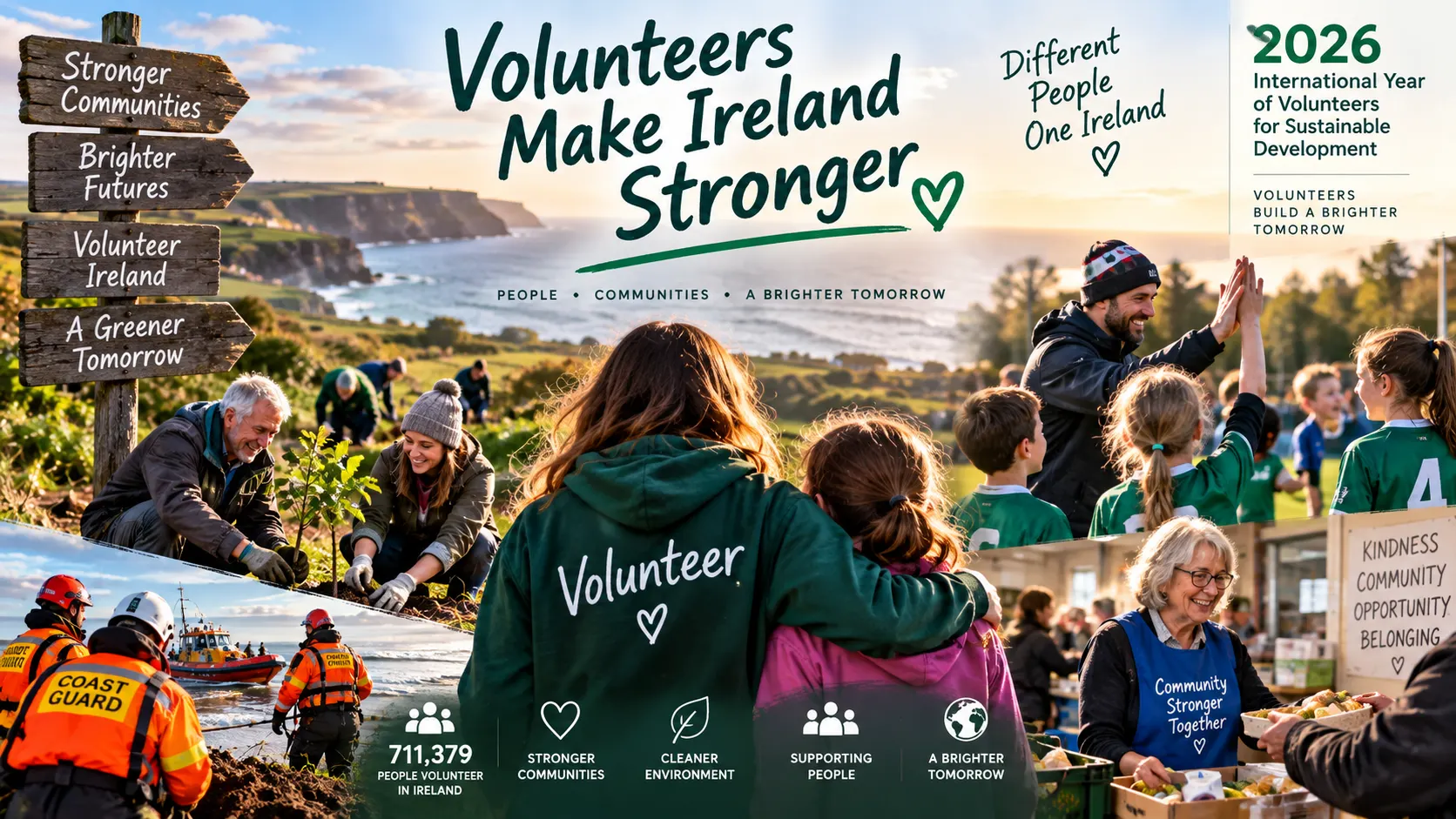
Ireland’s voluntary workforce is large enough to fill several cities. In the 2022 Census, 711,379 people said they regularly engaged in unpaid helping or voluntary work, equivalent to 14% of the population. They coached children, organised clubs, supported charities, worked in their communities and staffed organisations whose activities range from local events to emergency response. Yet the United Nations’ decision to designate 2026 as the International Year of Volunteers for Sustainable Development comes at a moment when the model itself is changing: volunteers are getting older, working lives are busy, Ireland is becoming more diverse and organisations increasingly need participation that fits around people’s time rather than demanding the traditional open-ended commitment.
The international designation was not a response to one sudden shortage of volunteers in Ireland or elsewhere. The UN General Assembly adopted Resolution 78/127 in December 2023, deliberately choosing 2026 because it marks 25 years since the original International Year of Volunteers in 2001 and 55 years since the establishment of the United Nations Volunteers programme. The resolution also places volunteering within the final years of the global effort to achieve the Sustainable Development Goals by 2030.
That gives the year a more serious purpose than simply thanking people who work without pay. The UN is asking governments and organisations to recognise and measure formal and informal volunteering, remove barriers and inequalities, integrate voluntary action into development policy and adapt to new forms of participation. Volunteer Ireland, the national volunteer development organisation, has been named national lead for the International Volunteer Year in Ireland and is coordinating activities with government, civil society, academia and the private sector.
Volunteering in Ireland
- 711,379 people reported regular voluntary activity in Census 2022, representing 14% of the population.
- 286,887 people volunteered with sporting organisations, the largest category measured.
- 226,822 volunteered in community work and 198,274 in social or charitable organisations.
- Volunteers had an average age of 47 in 2022.
- Leitrim recorded the highest county volunteering rate at 18%; Dublin City and South Dublin recorded 11%.
- Sport Ireland found 12% of adults volunteering in sport in 2024.
- More than 900 volunteers operate through 44 Irish Coast Guard units, while Civil Defence has about 2,000 volunteer members nationally.
Why the UN Chose 2026
The first International Year of Volunteers in 2001 helped place volunteering more firmly on the international development agenda. Twenty-five years later, the UN has returned to the subject with a broader argument: voluntary action is not confined to charities or organised fundraising but forms part of how societies respond to emergencies, support vulnerable people, strengthen communities and pursue environmental and social objectives.
The timing is also connected to the 2030 Agenda. With only four years remaining after 2026 to meet the Sustainable Development Goals, the UN resolution describes volunteering as a cross-cutting means of implementation rather than an activity at the margins of public policy. It specifically calls for better measurement because much voluntary activity happens informally between neighbours, families and communities and therefore never appears in an organisation’s annual report.
The scale revealed by newer international measurement is striking. The United Nations Volunteers programme’s 2026 State of the World’s Volunteerism Report estimates that about 2.1 billion working-age people engage in volunteer work during a typical month worldwide, or 34.5% of the global working-age population. Informal volunteering is substantially more common than formal organisation-based volunteering.
Those global figures should not be compared directly with Ireland’s Census rate because the definitions, reference periods and methodologies are different. Their importance is conceptual: volunteering is far larger than the portion visible through registered charities, volunteer databases or club membership lists.
Ireland Already Depends on a Large Volunteer Base
The Census provides the clearest nationwide picture of regular organised and community volunteering in Ireland. Sport was the largest measured category in 2022, involving almost 287,000 people, followed by community work and social or charitable activity. Some people volunteered in several categories, so these numbers cannot simply be added together.
Sixteen per cent of all volunteers identified by the Census were involved in more than one type of activity. This matters because the same highly engaged individuals can sit on a committee, coach a team and help another community organisation at the same time. A community may therefore appear to contain several healthy volunteer groups while depending heavily on a smaller core of people carrying multiple responsibilities.
The geographical pattern reinforces the importance of volunteering outside the major urban centres. Leitrim recorded an overall volunteering rate of 18%, while Mayo and Sligo each recorded 17%. Dublin City and South Dublin were at 11%. These differences do not prove that rural communities are inherently more civic-minded; age profiles, settlement patterns, sporting structures, commuting, employment and the availability of organisations all influence participation.
They do, however, show why a shortage can be particularly disruptive in smaller communities. Where a club, festival, hall, social service or local committee depends on a limited number of people, the departure of only a few experienced organisers can remove a significant share of its capacity.
Where Ireland’s Volunteers Were Active in Census 2022
| Activity | People volunteering | Share of all volunteers |
|---|---|---|
| Sporting organisations | 286,887 | 40% |
| Community work | 226,822 | About 32% |
| Social or charitable organisations | 198,274 | About 28% |
| Political organisations | 17,295 | About 2% |
Source: Central Statistics Office, Census of Population 2022. Categories overlap because some people volunteered in more than one activity.
The Long-Term Story Is More Change Than Collapse
Ireland does not have evidence of a straightforward long-term disappearance of volunteering. When the Census figures for people aged 15 and over are adjusted to make the broadest possible comparison, 553,255 people reported volunteering in 2006 and 681,246 did so in 2022. The number increased by approximately 23%, but so did the population aged 15 and over.
The comparison must be treated cautiously because the Census question changed substantially between the two years. The 2006 question used a four-week reference period and different categories, while the 2022 Census asked about regular voluntary activity. The CSO therefore explicitly warns that the two datasets have limited comparability.
Even with that qualification, the composition appears to have shifted. Among people aged 15 and over, the number volunteering with sporting organisations was 50% higher in 2022 than in 2006, while volunteering in religious organisations or church groups fell by 13%. Social and charitable volunteering was broadly stable in absolute numbers but represented a slightly smaller share of the enlarged population.
This reflects wider changes in Irish society. Religious institutions have a different place in community life than they did several decades ago, while organised sport has expanded and become a major infrastructure for childhood and family activity. New community organisations, integration groups, environmental initiatives and social enterprises have also created different routes into voluntary participation.
Sport Shows What Happens When Unpaid Time Becomes Infrastructure
No part of the Irish volunteering system demonstrates its economic importance more clearly than sport. Sport Ireland’s 2024 monitoring found that 12% of adults were volunteering in sport, back at the pre-pandemic rate recorded in 2019. Coaching, transport, administration, fundraising, equipment, officiating and event organisation all form part of the volunteer system behind clubs.
The burden becomes clearer when coaching is examined separately. Sport Ireland estimated around 268,000 current coaches in 2024, with 84% saying they received no payment for their coaching time. Coaches spent an average of 5.5 hours a week on the role, including preparation and competitions, adding up to almost one million hours of coaching activity during a typical week, overwhelmingly on a voluntary basis.
This is not simply free labour that could effortlessly be replaced by salaried employees. Clubs are built around relationships between parents, former players, local residents and sporting communities, and those relationships themselves contribute to participation. But the numbers illustrate how dramatically the economics of community sport would change if a large proportion of those hours had to be purchased commercially.
The risk is already visible in the reasons people stop. Among former coaches surveyed by Sport Ireland, 33% said their principal reason for leaving was that they no longer had enough time because of work or study, while another 6% cited lack of time for family reasons. Time pressure was substantially more important than dissatisfaction with coaching.
High Employment Is Good News — but It Changes the Volunteer Equation
Ireland entered the second half of 2026 with 2.84 million people in employment and an employment rate of 74.3% among those aged 15 to 64. That represents a strong labour market, but it also means large numbers of potential volunteers have jobs competing for their time alongside commuting, childcare, caring responsibilities and household administration.
Employment does not prevent volunteering. Census 2022 actually found that 18% of people who were at work engaged in at least one voluntary activity, slightly above the 17% rate among retired people. The relationship is therefore more complicated than assuming people with jobs do not volunteer.
Working arrangements may nevertheless influence what is practical. Twenty-four per cent of people who worked from home at least one day a week volunteered, compared with 17% of people who never worked from home. This is a correlation rather than proof that home working causes volunteering, but it is consistent with a wider point: reducing travel and increasing control over time can make community involvement easier.
For organisations, that changes recruitment strategy. A role demanding attendance every Tuesday evening for three years may appeal to a smaller pool than one divided among several people, organised around shorter shifts or completed partly online. The future of volunteering may depend as much on redesigning roles as on persuading more people to volunteer.
From Committee Membership to Two Hours When You Can
The traditional model of Irish volunteering often involved sustained attachment to one organisation. People joined committees, coached the same age group for years, ran annual festivals or became long-standing members of local associations. That model remains important because many tasks require continuity, trust and experience.
But Volunteer Ireland increasingly promotes flexible, episodic and microvolunteering alongside conventional roles. Microvolunteering divides useful work into small tasks that may take minutes rather than committing someone to a permanent schedule. Virtual volunteering allows some roles to be performed partly or entirely through the internet.
These models expanded in visibility during the pandemic, when organisations had to redesign activities around remote participation. Their longer-term relevance is different: they give people with disabilities, caring responsibilities, irregular working patterns or limited transport more ways to contribute.
Digital volunteering is not suitable for everything. A youth team still needs adults physically present, a Coast Guard rescue cannot be conducted from a laptop and a community event requires people on the ground. But administration, mentoring, communications, translation, research, fundraising, website work and professional advice can often be provided remotely.
The distinction between digital and physical volunteering is also becoming less rigid. A volunteer might manage registrations online during the week and help at an event on Saturday. Hybrid participation can reduce the time spent travelling while preserving the personal contact that makes volunteering socially valuable.
The Ageing of Ireland Creates Both an Opportunity and a Risk
Volunteers are older than the population as a whole. Census 2022 found an average volunteer age of 47, compared with 37.5 among people who did not volunteer. Thirty-eight per cent of volunteers were aged between 45 and 64, while another substantial group was aged 25 to 44.
The demographic context is changing quickly. Ireland had an estimated 891,100 people aged 65 and over in April 2026, representing 16.1% of the population. That was 165,000 more people than in 2020. At the same time, the number of children aged under 15 fell below one million for the first time since 2014.
An older population can expand the potential volunteer pool because some people have more discretionary time after retirement. Census data show that volunteers aged 65 and over were particularly active in community, social and charitable organisations. Older volunteers can also bring professional knowledge, local networks and decades of organisational memory.
The challenge is succession. Some organisations depend heavily on people who have carried responsibilities for many years. If younger members do not enter those roles, retirement from volunteering can happen faster than replacement.
Ageing also increases demand on some of the same organisations. Community transport, social inclusion, befriending and support for older people may require more voluntary capacity at precisely the time when established volunteer groups themselves are ageing. The demographic effect therefore operates in both directions.
Migration Is Changing Who Ireland’s Volunteers Are
Ireland is also becoming much more internationally diverse. The estimated population reached 5.526 million in April 2026, with 931,000 non-Irish citizens, equivalent to 16.8% of the total. Net migration remained positive at 48,100 during the year to April.
This makes the integration of new residents into clubs and community organisations increasingly important. Volunteering can create social networks for people who have recently arrived, provide opportunities to use professional skills and connect newcomers with residents who have lived in an area for generations.
The Census shows that participation is not uniform. In 2022, 15% of Irish citizens volunteered compared with 11% of non-Irish citizens. Yet that average conceals striking differences: 21% of citizens of African countries volunteered, while participation among UK citizens was the same as among Irish citizens at 15%.
Measured by ethnic group or background rather than citizenship, people identifying as Black or Black Irish-African recorded a volunteering rate of 27%, the highest rate among the groups captured by the Census. Almost two-thirds of those volunteers were involved with religious organisations.
The evidence therefore does not support a simplistic conclusion that immigration reduces community participation. It suggests instead that different groups enter volunteering through different institutions. A new resident may not immediately become involved in the local sports club or residents’ association but may already be highly active through a church, cultural group, migrant organisation or informal community network.
Sport Still Has a Diversity Problem of Its Own
The picture is less balanced inside sport. Sport Ireland’s current work on volunteer diversity has found White Irish adults substantially more likely to volunteer in sport than people from several other backgrounds. In 2026 it launched a sector-wide survey intended to understand the experiences of volunteers and non-volunteers and help create a more representative volunteering base.
This distinction is important. A community can have high volunteering among migrant groups while established sporting organisations fail to capture that participation. Language, unfamiliarity with club structures, social networks, whether someone is directly asked to help and assumptions about the skills required can all influence recruitment.
There is also a practical demographic reason to improve inclusion. Ireland’s population growth is increasingly shaped by migration. An organisation recruiting mainly from the same established social group will be choosing from a progressively narrower share of the community it serves.
Diversity should therefore not be treated only as a social objective. For many organisations it is also a recruitment strategy. The wider the pool of people who see themselves as potential volunteers, the more resilient the organisation becomes.
Emergency Services Reveal the Consequences Most Clearly
Some voluntary roles have consequences extending far beyond club membership or community events. Ireland’s emergency-response system incorporates trained volunteers alongside professional services, particularly in coastal rescue and Civil Defence.
The Irish Coast Guard has 44 volunteer units around the coast involving more than 900 volunteers from local communities. These units provide coastal search capability, while different units are trained in areas including cliff rescue, boat rescue and drone-supported search. They can be called upon around the clock throughout the year.
Civil Defence has approximately 2,000 volunteer members across Ireland. They are trained in functions including medical response, search and rescue, emergency response, communications and community assistance. The organisation supports the principal emergency services and carries out more than 3,000 emergency and community duties annually.
These volunteers are not casual substitutes for professional emergency staff. Their roles require training, equipment, management and formal operational structures. The value of the system lies partly in having people distributed throughout local communities who can provide additional capacity during searches, severe weather, flooding, major incidents and public events.
If recruitment weakened significantly over a prolonged period, the immediate result would not necessarily be the complete disappearance of those services. More likely consequences would include thinner local coverage, greater reliance on neighbouring units, increased pressure on remaining volunteers and a stronger case for additional paid capacity.
The Pandemic Demonstrated Both the Strength and Fragility of Volunteering
COVID-19 was one of the major turning points in recent Irish volunteering history. Community organisations, charities and local volunteer networks mobilised around vulnerable households, food distribution, medicines and practical support. At the same time, the restrictions stopped many traditional club, sporting and face-to-face activities.
The National Volunteering Strategy 2021–2025 was launched in December 2020 against that background. It was Ireland’s first national volunteering strategy and contained 56 actions covering participation, diversity, volunteer infrastructure, recognition, international volunteering and policy coordination.
The post-pandemic recovery demonstrated that interrupted participation does not automatically return. Sport volunteering fell sharply during the restrictions and then recovered gradually. By 2024, the measured rate had returned to its 2019 level, but the experience reinforced the need for organisations to maintain contact with volunteers rather than assume they will always come back.
It also accelerated recognition that volunteer management is a professional organisational function even when the people being managed are unpaid. Recruitment, induction, training, safeguarding, communication, recognition and retention all require time and resources.
Ireland Built a National Infrastructure Around Volunteering
One of the less visible changes of the past decade has been the development of a nationwide support structure. Ireland now has 29 Volunteer Centres, providing local information and helping organisations recruit and manage volunteers. Volunteer Ireland operates as the national development organisation and support body for that network.
Government funding for volunteering supports increased from €6.6 million in 2024 to €7.3 million in Budget 2025. That investment is small beside major health, education or social-protection budgets, but it reflects an important policy principle: voluntary effort itself may be unpaid, yet maintaining an effective volunteering system costs money.
Organisations need staff who can advertise roles, screen applications, provide training, carry out administrative work and support volunteers when difficulties arise. Emergency volunteers require vehicles and specialist equipment. Sports coaches need education and safeguarding structures. Community organisations need insurance, premises and governance.
Public investment can therefore increase voluntary capacity without paying volunteers a wage. The distinction is between funding the infrastructure around volunteering and converting the volunteer role itself into employment.
Youth Organisations Are Already Being Funded to Recruit More Volunteers
The pressures are sufficiently tangible that government is now financing recruitment and retention directly in some sectors. In June 2026, the Department of Education and Youth announced more than €1.2 million for 12 national youth organisations under the Volunteer Activation Fund.
The projects include establishing new volunteer-led Scout groups, expanding environmental clubs, supporting Irish-language youth work, creating youth film hubs and increasing services for young people with additional needs. The fund is explicitly intended to increase the number of volunteers and volunteer-led clubs while strengthening recruitment, training and retention.
This is an instructive example of why volunteer shortages cannot always be solved by appealing for people to be more generous. A youth organisation may need paid staff whose job is to recruit, train and support unpaid local volunteers. Without that organisational layer, willing people may never find a suitable role or may leave after an unsatisfactory experience.
The fund also shows what is at stake when volunteer capacity weakens. In some communities, fewer volunteers do not merely mean existing adults doing more work. They can mean that a youth club never opens in the first place.
Why People Stop Is as Important as Why They Start
Recruitment campaigns tend to focus on motivation: helping others, meeting people, sharing skills or supporting a cause. Retention depends on a different set of questions. Is the time commitment realistic? Are responsibilities clearly defined? Does the volunteer receive sufficient training? Are expenses manageable? Does the organisation respect the fact that the person has a life outside the role?
The Sport Ireland coaching research is particularly valuable because it measures reasons for leaving rather than relying on assumptions. Work and study were the leading reason former coaches gave for stopping. Moving away from the area was another significant factor, ahead of several issues connected with age, health or children’s participation.
This suggests that volunteer organisations are competing primarily for time, not simply goodwill. Ireland can have strong public support for volunteering while still experiencing recruitment shortages because willingness does not automatically translate into four free hours every week.
Successful organisations are therefore increasingly likely to divide responsibilities, offer defined terms, create substitute systems and allow people to contribute at different intensities during different phases of their lives.
The 26 for ’26 Idea Reflects the New Model
Volunteer Ireland’s national campaign for the International Volunteer Year asks people to consider giving 26 hours during 2026. Spread over the year, that is little more than two hours a month. The campaign deliberately presents volunteering as something that can include recurring activity, helping from home or participating in occasional events.
The arithmetic is simple but the underlying shift is important. Volunteering no longer has to begin with the expectation that someone joins a committee indefinitely. A small initial commitment can expose people to an organisation and later develop into deeper involvement.
This is particularly relevant to younger adults and people in demanding stages of working and family life. An organisation insisting on the traditional model may conclude that people no longer want to volunteer; another offering smaller and more flexible roles may discover that the willingness still exists but is expressed differently.
There are limits to flexibility. Some organisations need continuity, especially where volunteers build relationships with vulnerable people or acquire specialist technical skills. The challenge is to distinguish tasks that genuinely require long-term commitment from those that have simply always been organised that way.
Digital Volunteering Expands the Pool — but Cannot Replace Community Presence
Online volunteering is one of the new models explicitly relevant to the UN’s 2026 agenda. It allows tasks to be completed partly or entirely through digital channels and can reduce barriers connected with geography, mobility and commuting.
For a rural organisation, a volunteer with accounting, communications, design or IT skills no longer necessarily needs to live nearby. A charity can obtain specialist assistance from someone elsewhere in Ireland. People who cannot easily attend evening meetings may still contribute from home.
Microvolunteering takes the flexibility further by breaking activities into small, self-contained tasks. These may be useful for campaigns, research, digital promotion or one-off community projects where a traditional weekly role would be unnecessary.
But the movement towards digital participation should not obscure the physical nature of much Irish volunteering. Sport, rescue work, befriending, food distribution, festivals and youth activities still depend on people turning up. Online systems can widen recruitment and reduce administration; they cannot remove the need for local human presence.
Volunteering Can Help Integration — if Organisations Open the Door
Migration gives volunteering another function beyond delivering services. Someone arriving in a new country may possess professional experience and skills but lack local relationships. A volunteer role can provide contacts, language practice, knowledge of institutions and a sense of belonging.
The benefit also flows in the other direction. Clubs and community organisations that recruit people from different backgrounds gain access to new skills, languages and networks while becoming more representative of the population around them.
Yet integration through volunteering does not happen automatically. Recruitment based on knowing the right person, informal family networks or long-established club relationships can unintentionally exclude newcomers. Even a public appeal may reach only the communities already connected with the organisation.
More deliberate recruitment, clearer role descriptions and asking people directly can therefore matter. In a country where almost one in six residents is now a non-Irish citizen, relying only on inherited volunteer networks will become increasingly unsustainable.
Rural Ireland Has More to Lose From Volunteer Fatigue
The higher volunteering rates recorded across much of western Ireland reflect communities in which local organisations often perform functions that are particularly visible. Sports clubs, community centres, festivals, tidy towns groups and social organisations can form part of the practical infrastructure of places with relatively small populations.
That creates resilience but also concentration risk. The same person may hold several roles because there are simply fewer people available. Census 2022 found multiple volunteering to be particularly common in several western and north-western counties, including Leitrim, Mayo, Sligo and Roscommon.
When those individuals step back, the effect can spread across several organisations simultaneously. A shortage is therefore not always visible as a dramatic fall in national volunteering rates. It may appear locally as one fewer team, a cancelled event, reduced opening hours or the failure to replace a committee treasurer.
Regional policy has to recognise this distinction. A 14% national volunteering rate tells little about the vulnerability of a small community where a handful of people maintain several essential local activities.
Volunteers Are Not a Substitute for the State
The scale of unpaid activity creates a difficult policy question. If volunteers deliver socially valuable services at little direct labour cost, governments and organisations can become accustomed to that capacity. But there is an important boundary between supporting voluntary action and designing essential public services around the assumption that unpaid labour will always be available.
Emergency-service volunteering works because it sits within formal structures, training and professional coordination. Community organisations work best when volunteers complement rather than silently replace skilled staff where paid professional work is required. Youth organisations may depend on volunteers while still needing salaried employees to manage programmes and safeguarding.
An excessive dependence on goodwill creates fragility. If the workload becomes too great, volunteers can burn out. If organisations cannot recruit replacements, services can contract even though public demand has not fallen.
The strongest model is therefore not one in which volunteers make services artificially cheap. It is one in which public funding, professional staff and voluntary participation are combined according to the type of work being performed.
What Would Happen if Volunteer Numbers Fell Persistently?
The consequences would vary by sector and would emerge gradually. Sports clubs might initially ask existing coaches to take additional teams. If that became unsustainable, group sizes could increase, waiting lists could lengthen, teams could disappear or clubs could consider higher fees to pay for functions previously undertaken voluntarily.
Community organisations could reduce opening hours or the number of activities they offer. Festivals and cultural events might become smaller, less frequent or more expensive. Charities could divert money from frontline programmes to staffing functions previously performed by volunteers.
In emergency services, declining recruitment could place greater demands on neighbouring volunteer units or professional agencies. The effect would be particularly important in areas where local knowledge and geographic proximity are central to rapid response.
Not every unpaid role would be replaced with a salaried worker. Some activity would simply stop. That is why calculating the financial value of volunteering solely by multiplying hours by an hourly wage can be misleading: it assumes that society would purchase every activity commercially if volunteers withdrew.
Some services probably would require paid replacement; others would contract; families would provide more informal help; communities would reorganise; and some activities would disappear entirely. The total consequence would therefore be economic, social and institutional rather than a single replacement-cost figure.
If Volunteer Capacity Falls, Where Does the Pressure Go?
| Sector | Volunteer role | Possible consequence of sustained shortages |
|---|---|---|
| Sport | Coaching, transport, administration | Fewer teams, waiting lists, higher costs |
| Youth services | Clubs, mentoring, activities | Reduced local provision |
| Emergency response | Search, rescue, Civil Defence | More pressure on remaining and professional services |
| Community organisations | Events, centres, committees | Fewer activities and shorter opening |
| Charities | Support, fundraising, governance | Higher staffing pressure or reduced reach |
| Culture | Festivals and local programmes | Smaller or fewer community events |
Source: Ireland Newspaper analysis of the functions documented by CSO, Sport Ireland, Civil Defence, the Irish Coast Guard and government volunteering policy. Outcomes are plausible scenarios, not forecasts.
A Volunteer Shortage Can Become a Cost-of-Living Issue Too
The connection between volunteering and household finances is easy to miss. Many community activities remain affordable precisely because a large part of the labour behind them is donated. A children’s club with volunteer coaches can charge differently from an organisation that must purchase every hour of instruction commercially.
This does not imply that paid work is undesirable or that professional staff should be replaced. It means that voluntary labour can make additional services possible beyond what fees and public funding alone could support.
If clubs respond to shortages by employing more staff, that may improve professionalism but also requires additional revenue. Depending on the organisation, the cost can be met through public grants, sponsorship, fundraising or higher charges to users.
For families already watching the cost of children’s activities, that transmission matters. Volunteer recruitment can therefore affect not only whether a service exists but how affordable it remains.
Volunteer Management Is Becoming More Professional
The paradox of modern volunteering is that unpaid participation increasingly requires professional management. Organisations face expectations around governance, safety, inclusion, data protection, training and clear responsibilities. Volunteers themselves reasonably expect a well-run environment rather than being asked to solve every operational problem because they are helping for free.
This can increase administrative pressure on small organisations. A local group may be excellent at delivering its core activity while struggling with recruitment systems, communications or volunteer retention. National organisations and Volunteer Centres increasingly provide training and support precisely because goodwill does not automatically produce good management.
Better organisation can also reduce burnout. Clearly defined responsibilities make it easier to share work and allow someone to leave without the entire system depending on personal knowledge held by one long-serving volunteer.
The future is therefore likely to require more investment around volunteers rather than less. The labour may remain unpaid, but the systems that make volunteering safe, sustainable and effective need resources.
Measurement Has Become Part of the Policy Problem
One reason 2026 matters internationally is that even governments do not fully know how much volunteering occurs. Ireland’s Census gives an unusually detailed snapshot, but it measures particular categories and a particular definition of regular voluntary work. It cannot capture every act of informal helping.
Volunteer Ireland separately refers to more than one million people giving their time each year, while its own volunteer-matching infrastructure records only the people and organisations interacting with that system. These figures can all be valid while describing different populations and reference periods.
The same problem exists globally. The UN’s latest work argues that measuring only membership of formal organisations misses enormous amounts of informal volunteering. It also argues that counting hours alone fails to capture effects on trust, social cohesion, skills and community resilience.
Volunteer Ireland is now promoting an Irish Volunteering Index intended to build a nationally representative picture of who volunteers, why people participate and what stops them. Better recurring data would allow Ireland to distinguish a genuine decline in volunteering from a shift between formal clubs, short-term projects, digital roles and informal helping.
The Next Challenge Is Not Simply to Find More People
Recruitment campaigns often assume that a shortage can be solved by increasing the number of volunteers. That may be only part of the answer. An organisation that needs ten people for ten hours each may be better served by redesigning the work for 30 people with smaller commitments than by searching indefinitely for ten traditional volunteers.
Technology can simplify rotas, communications and training. Expenses can be reimbursed where organisations have the resources to do so. Roles can be separated into operational, administrative and occasional tasks. Experienced volunteers can mentor newcomers rather than holding every responsibility themselves.
Recruitment can also extend beyond the population groups historically associated with an organisation. Ireland’s demographic change makes that increasingly important. Young adults, migrants, retired professionals and people unable to attend traditional evening meetings may all become more accessible if the role is redesigned around them.
None of these changes removes the need for commitment. Some organisations require people prepared to train for months and remain available for years. The objective is not to make every voluntary role effortless but to stop unnecessary rigidity excluding people who could contribute.
2026 Is Also a Test of Whether Ireland Values Volunteer Time Properly
Public recognition is one part of that test. Volunteer awards, campaigns and International Volunteer Year events can make invisible work more visible. But recognition loses meaning if organisations simultaneously assume that volunteers can absorb unlimited workloads.
Valuing a volunteer may mean providing proper training, responding to concerns, covering reasonable expenses where possible, offering flexibility and being clear about where responsibility begins and ends. It can also mean accepting when someone needs to reduce a commitment rather than treating departure as disloyalty.
For government, valuing volunteering means recognising that the surrounding infrastructure requires funding. Ireland’s network of Volunteer Centres, sports organisations, emergency-response systems and youth programmes all demonstrate that successful volunteering is organised rather than spontaneous.
The International Volunteer Year creates an opportunity to examine those systems rather than simply celebrate the people within them.
Ireland’s Ageing and Growing Population Will Raise the Stakes
Demography makes the issue more important beyond 2026. Ireland’s population exceeded 5.5 million in April, and migration continues to reshape the composition of towns and cities. The population aged 65 and over is growing much faster than the total population.
This creates new needs for community connection, social support and local services while simultaneously opening opportunities for older people who want to remain active after retirement. A successful volunteering system could connect these two trends without assuming that every older person either needs support or has unlimited free time.
Younger generations will also determine whether established organisations can renew themselves. Sport Ireland’s coaching data offer some encouragement: young adults show substantial involvement in coaching, and many people who previously coached say they would consider returning. The problem is therefore not a complete absence of potential recruits.
The challenge is converting potential participation into roles compatible with modern working and family life.
The Future Will Probably Contain More Types of Volunteer
The most plausible future is not the disappearance of traditional volunteering but a more fragmented mixture of models. Some people will continue to coach teams or serve on committees for years. Others will help at one festival, contribute professional expertise online, participate during an emergency or complete a few hours each month.
Organisations that can combine these different levels of commitment may become more resilient. A small group of experienced volunteers can provide continuity while a larger pool handles occasional work. Digital systems can connect the two.
The risk is that organisations interpret flexibility as unreliability. Short-term volunteers cannot carry every responsibility, and high-turnover systems require more coordination. The benefit is access to a much wider population that might otherwise contribute nothing.
This is precisely the type of transition identified by the UN resolution: new forms of volunteering create opportunities but also new challenges that policy and measurement need to understand.
What 2026 Should Tell Ireland
International years can disappear quickly once the banners and campaigns end. The more useful outcome would be a clearer understanding of which parts of Irish life are dependent on voluntary labour, where recruitment is becoming difficult and which barriers can realistically be removed.
The evidence already rejects two easy narratives. Ireland is not experiencing a simple collapse in community participation: more than 700,000 people were regularly volunteering when the Census measured it, and sports volunteering has recovered from its pandemic decline. But neither is the system guaranteed to reproduce itself automatically.
The volunteer base is ageing. Work and study are measurable reasons people leave coaching. Ireland’s population is becoming more diverse, while some established organisations have yet to reflect that diversity. Traditional long-term commitments increasingly coexist with episodic, digital and flexible forms of participation.
Those changes mean the question facing Ireland is no longer simply how to persuade people to volunteer. It is how to build organisations around the amount of time people can realistically give.
The Work Is Unpaid, but Its Absence Would Not Be Free
Every weekend, children play matches because adults coach and organise them. Community groups run events because residents take responsibility for them. Coastal searches can mobilise locally based volunteers, while Civil Defence personnel support emergency services and public events. Charities, youth organisations and community centres extend their reach because people contribute time that does not appear on a payroll.
Much of this work is so familiar that it becomes visible only when nobody is available to do it. A cancelled team, an unfilled committee position or a struggling local service can look like an isolated organisational problem. Across thousands of organisations, the same pattern would become a national capacity problem.
That is ultimately why 2026 has significance beyond the ceremonial title of an international year. The UN is asking countries to recognise volunteering as part of their social infrastructure while adapting it to a world of changing demographics, work patterns and technology.
Ireland enters that discussion with unusually deep traditions of community participation and an extensive network of clubs, volunteer centres and voluntary organisations. Its challenge is not to preserve every old form unchanged. It is to ensure that the willingness to help survives even when the ways people have time to help are changing.
Sources
United Nations Volunteers — State of the World’s Volunteerism Report 2026
Volunteer Ireland — International Volunteer Year 2026
Central Statistics Office — Census of Population 2022: Volunteering in Ireland
Central Statistics Office — Volunteering in Ireland: Diversity
Central Statistics Office — Population and Migration Estimates, April 2026
Central Statistics Office — Labour Force Survey Quarter 2 2026
Sport Ireland — Irish Sports Monitor 2024: Spotlight on Coaching
Sport Ireland — National Review of Volunteer Diversity in Sport
Department of Education and Youth — Volunteer Activation Fund 2026
Department of Transport — Irish Coast Guard Building Strategy
Civil Defence — About Civil Defence and Its Volunteer Network
Volunteer Ireland — Volunteering From Home, Microvolunteering and Virtual Volunteering
Source & Transparency
This article is published by Ireland Newspaper for editorial and informational purposes.
Published: 5 September 2026 · Updated: 5 September 2026

Newsroom Ireland Newspaper
Ireland Newspaper editorial team prepares daily news coverage for readers in Ireland and abroad.