Ireland’s Empty Rural Houses: Why Thousands of Homes Still Stand Unused During a Housing Shortage
Vacancy is falling nationally, yet parts of western and north-western Ireland still contain striking numbers of empty and derelict homes. The reasons lie in demographic change, ageing housing stock, inheritance, renovation costs and a fundamental mismatch between where houses already exist and where demand is strongest.
Along quiet roads in rural Ireland, they are difficult to miss.
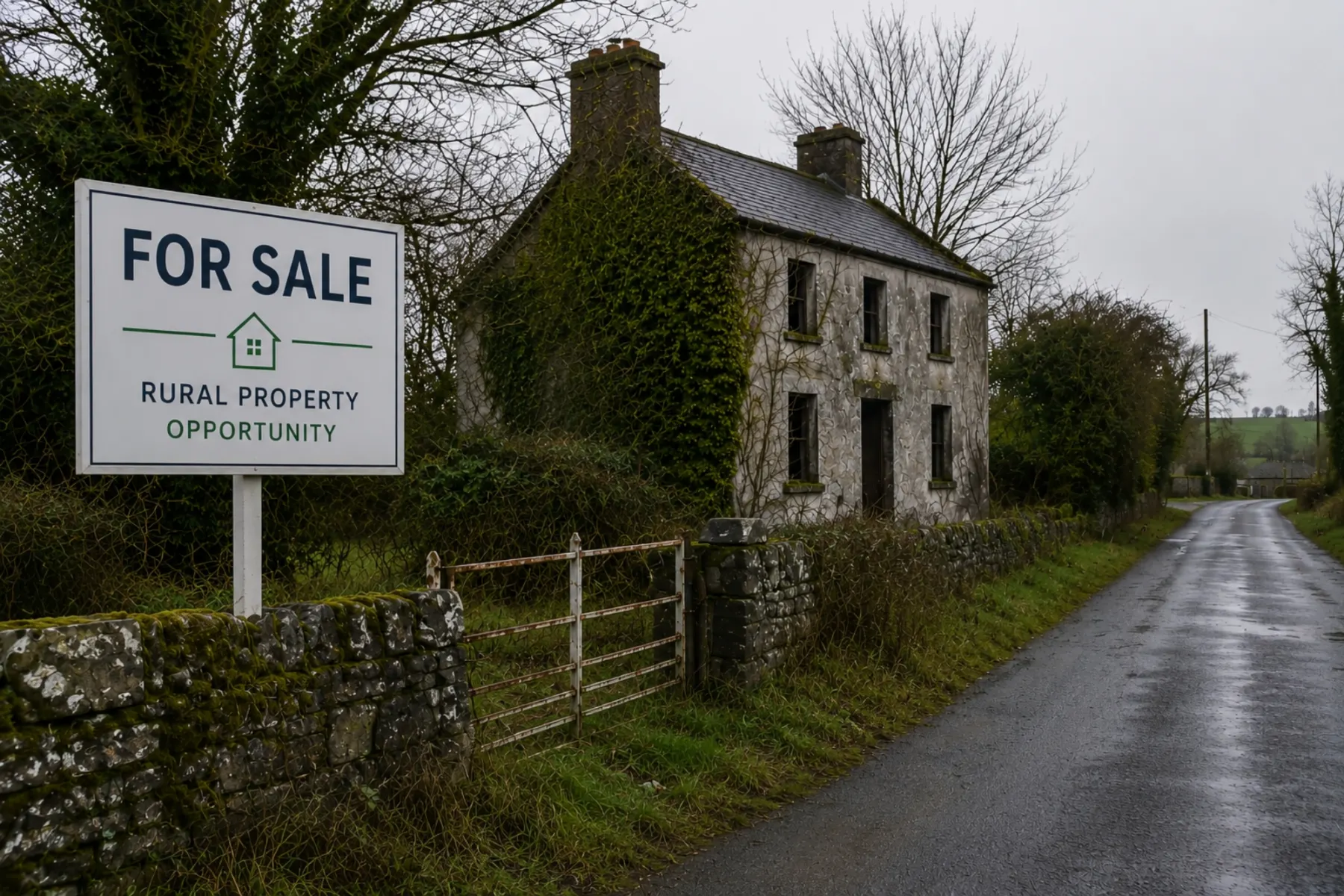
A small cottage disappearing behind an overgrown hedge. An old farmhouse with dark windows and a roof beginning to fail. A stone house standing beside fields that remain productive while the building itself has not been lived in for years.
At a time when Ireland is struggling to provide enough homes for a growing population, these properties present an obvious question: how can a country facing intense housing pressure still have tens of thousands of residential buildings standing empty?
The answer is more complicated than the numbers initially suggest.
GeoDirectory recorded 81,373 vacant residential units across Ireland in June 2026, alongside 19,137 properties classified as derelict. The national residential vacancy rate stood at 3.7%.
But vacancy is distributed very unevenly.
Leitrim recorded a vacancy rate of 11.5%, followed by Mayo at 10.3%, Roscommon at 9.9%, Donegal at 8.9% and Sligo at 8.3%. Dublin, by comparison, stood at just 1.4%.
That geographical divide is central to understanding Ireland’s empty-house problem.
The country does not simply have a national stockpile of unused homes waiting to solve a national housing shortage. Instead, several different housing problems are occurring at the same time: severe demand in cities and commuter regions, persistent vacancy in some rural areas, buildings that are technically houses but no longer practically habitable, and properties caught between inheritance, renovation and eventual sale.
Ireland’s empty rural homes are therefore not so much a contradiction as a reflection of how dramatically the country has changed.
A Housing Landscape Built for a Different Ireland
Much of Ireland’s rural housing pattern was established when the country’s population, economy and working lives were organised very differently.
Generations of families lived close to agricultural land, villages and small local economies. Homes were distributed across townlands and rural communities where farming and locally based employment supported a much more dispersed population.
Over time, that geography changed.
Employment increasingly concentrated around larger towns and cities. Young people left some rural communities for education, work or emigration. Household sizes changed. Ireland’s population aged. Transport patterns shifted, and economic opportunity became more closely associated with urban centres and major regional towns.
The result was not the decline of rural Ireland as a whole. Many rural communities remain economically strong and attractive places to live.
But some parts of the country were left with significantly more housing relative to local demand than others.
Census 2022 demonstrated that pattern clearly. Vacancy was generally lower in eastern Ireland, the south-east and suburban areas around major cities, while higher rates were concentrated in the west and north-west.
Long-term vacancy showed an even sharper divide.
Leitrim, Mayo and Roscommon had the highest proportions of homes recorded as vacant in both the 2016 and 2022 censuses, at around 6% of housing stock in each county.
The latest figures show that the geographical pattern remains visible today.
At the same time, most new housing is being created elsewhere.
Of the more than 37,000 residential address points added across Ireland in the year to June 2026, Dublin accounted for more than 12,500. Cork added over 4,100, Kildare more than 2,700, Galway over 2,200 and Meath almost 2,000.
Leitrim added fewer than 100.
Ireland is therefore dealing with a fundamental mismatch: some of the counties containing the greatest proportion of unused housing are not the counties experiencing the strongest growth in housing demand.
Not Every Vacant House Has Been Abandoned
There is another important distinction.
A property classified as vacant is not necessarily a house that has been deserted for years.
Census 2022 identified 163,433 vacant dwellings across Ireland, excluding holiday homes. That represented a decline from 183,312 in 2016 and 230,056 in 2011.
Those Census figures should not be directly compared with GeoDirectory’s more recent vacancy total because the two systems use different methodologies.
More importantly, Census data showed that homes can be vacant for many reasons.
More than 33,000 vacant properties in 2022 were rental homes, some of which would have been between tenants. More than 17,000 were for sale and over 23,000 were undergoing renovation.
In more than 27,000 cases, the previous resident had died.
Almost 11,000 homes were vacant because their residents were in a nursing home or hospital, while thousands of others were associated with people temporarily staying with relatives.
The pattern was particularly significant in rural counties.
In Roscommon and Mayo, the death of the previous resident accounted for around a quarter of recorded vacancy. Galway County showed a similar pattern.
That helps explain why rural vacancy cannot simply be characterised as owners deliberately choosing to leave perfectly usable homes empty.
Often, vacancy begins with an ordinary change in life.
An elderly resident dies or moves into care. Children have established homes elsewhere. A property passes to several family members. Decisions about ownership, sale or refurbishment take time.
The problem is what happens next.
Once a house is no longer occupied and regularly maintained, temporary vacancy can gradually become long-term deterioration.
The Houses That Stay Empty for Years
The most revealing figures are not necessarily those showing how many homes are vacant on a particular day.
More significant are the properties that remain empty year after year.
The Central Statistics Office identified almost 48,000 homes that were vacant in both the 2016 and 2022 censuses.
More strikingly, 23,072 dwellings were recorded as vacant in 2011, 2016 and 2022.
These properties are much harder to explain as homes simply caught between two occupants.
Yet even this long-term vacant stock cannot automatically be treated as immediately available housing.
A house left unoccupied for a decade can deteriorate significantly.
Water ingress, damaged roofs, defective gutters, moisture and poor ventilation can affect walls, floors and structural timber. Electrical systems may require complete replacement. Heating systems may be obsolete or absent. Windows, chimneys, insulation and plumbing can all require major work.
Many older rural homes also depend on private wells and individual wastewater systems rather than public utilities.
At that point, the question is no longer why somebody does not simply move into the building.
The real question becomes whether restoring it makes financial and practical sense.
The Difficult Economics of Bringing Old Homes Back to Life
This is one of the central problems in Ireland’s rural property market.
An old cottage can appear inexpensive when judged only by its asking price, particularly compared with homes in Dublin or rapidly growing commuter counties.
But purchase price and total cost are very different things.
A badly deteriorated rural property may require structural repairs, a new roof, heating, plumbing, rewiring, insulation, windows, ventilation, damp treatment, drainage work and substantial energy improvements before it becomes a comfortable modern home.
Traditional buildings can add another layer of complexity because older stone houses and cottages often require materials and construction techniques different from those used in modern developments.
And renovation costs do not necessarily fall in line with local property values.
A heating system, roof, electrician or building material can cost broadly similar amounts whether a house is in Dublin, Mayo or Leitrim.
The finished property, however, may have a dramatically different market value depending on its location.
That creates a difficult equation.
Residential property prices remain deeply regional. While the national median transaction price reached €395,000 in the 12 months to May 2026, values in some parts of rural Ireland were less than half the level recorded in the country’s most expensive areas.
For somebody considering a severely neglected property in a lower-value location, refurbishment costs can therefore represent a very large proportion of the value of the finished home.
In some cases, restoring a building may make complete sense for an owner who intends to live there for many years.
As a purely commercial project, however, the economics can be considerably more difficult.
That helps explain why market forces alone have not returned every vacant rural property to use.
Ireland’s Housing Shortage Makes the Contrast More Visible
The issue has become harder to ignore because Ireland as a whole continues to grow.
The population reached an estimated 5.46 million in April 2025 after increasing by more than 78,000 people in a single year. Net migration accounted for a substantial share of that increase.
Housing demand remains strong.
Residential property prices were 6.2% higher nationally in May 2026 than a year earlier. Outside Dublin, prices increased by 7.3%, compared with 4.7% in the capital.
Ireland is also building more housing than it did during the years following the financial crisis, although delivery fluctuates from quarter to quarter.
There were 8,823 new dwelling completions during the second quarter of 2026.
Where those homes are being built is particularly revealing.
Almost 95% of new scheme houses completed during the quarter were located in cities, satellite towns or independent urban towns. Only a relatively small number were built in the country’s most remote rural areas.
There is a clear economic logic behind that concentration.
New housing tends to follow population growth, employment, schools, transport connections, utilities and demand.
But it also explains the apparently strange sight of new housing estates being built while an old cottage 100 kilometres away remains empty.
Both buildings may technically be houses.
Economically and practically, they are not always substitutes for one another.
A Home Is More Than a Building
Location may ultimately be the greatest limitation on how far rural vacancy can help solve Ireland’s wider housing problem.
People do not simply require walls, bedrooms and a roof.
They also need reasonable access to employment, education, healthcare, childcare, shops, communications and transport.
A household in which both adults work in Dublin cannot necessarily solve its housing problem by buying an inexpensive vacant property in rural Roscommon.
A family dependent on public transport cannot treat an isolated house several kilometres from the nearest town in the same way as a home close to schools, employment and regular transport connections.
Remote and hybrid working have widened the range of locations available to some households.
Improved broadband has also made rural living practical for people who might previously have needed to remain close to major employment centres.
But geography has not disappeared.
This is how housing scarcity and relatively high vacancy can coexist within the same country.
Demand is concentrated in particular places.
Much of the vacancy exists somewhere else.
The housing challenge is therefore not simply about the number of buildings Ireland possesses.
It is about the relationship between homes, people, employment and infrastructure.
Government Grants Have Changed the Calculation
Public policy has increasingly recognised that existing buildings have to form part of Ireland’s housing response.
One of the most important measures has been the Vacant Property Refurbishment Grant.
Introduced in 2022 and subsequently extended nationwide, the scheme provides financial assistance towards bringing qualifying vacant and derelict properties back into residential use.
The grant can provide up to €50,000 towards the refurbishment of an eligible vacant property, with an additional dereliction top-up of up to €20,000.
That means qualifying projects can receive support of as much as €70,000.
The scheme has also been extended to 2030.
By July 2026, more than 14,000 applications had been approved and 6,312 grants had been paid following completed works. More than €348 million had been issued through the programme.
During the second quarter of 2026 alone, more than 900 properties were returned to use through completed grant-supported projects.
The regional distribution is significant.
Donegal, one of the counties with a high residential vacancy rate, has also recorded particularly strong use of the refurbishment scheme.
The figures do not mean that every grant represents a house that would otherwise have remained empty permanently.
Nor does approval guarantee that every proposed renovation will ultimately be completed.
But they show that thousands of properties previously outside active housing use are being physically restored and occupied again.
The National Vacancy Rate Has Already Fallen
It is easy to assume that Ireland’s empty-house problem is getting progressively worse because derelict buildings are highly visible.
The longer-term statistics tell a more complicated story.
Census vacancy declined from more than 230,000 dwellings in 2011 to around 183,000 in 2016 and approximately 163,000 in 2022.
GeoDirectory’s more recent figures show a national residential vacancy rate of 3.7% in June 2026, while the number of properties classified as derelict fell year on year.
A majority of counties also recorded lower vacancy rates than a year earlier.
Ireland is therefore not experiencing a simple increase in residential abandonment.
Over the longer term, vacancy has been declining.
The challenge increasingly lies with the properties that remain.
A habitable house in a strong market is relatively likely to be sold, rented or occupied again.
A structurally deteriorated cottage in a remote location with a low potential resale value is a very different proposition.
As easier properties return to use, a greater proportion of what remains may consist of the difficult cases.
Reducing a high vacancy rate is one challenge.
Dealing with the final persistent layer can be considerably harder.
Why Counting Every Empty House Gives the Wrong Picture
One of the most common mistakes in discussions about vacancy is to treat every empty dwelling as an immediately available home.
That is not how the housing market works.
Some vacant houses are between tenants.
Some are being sold.
Some are undergoing renovations.
Some have owners temporarily living elsewhere.
Some belong to people who have moved into care.
Some form part of deceased estates.
Others are genuinely abandoned or seriously derelict.
Ireland also has a substantial number of holiday homes, which the Census records separately from ordinary vacant dwellings.
The most useful question for housing policy is therefore not simply:
How many empty houses does Ireland have?
The more important question is:
How many vacant homes can realistically be returned to permanent residential use, in places where people can and want to live, at a cost that makes economic sense?
That figure is much harder to establish.
The Opportunity Is Still Significant
None of these complications mean Ireland should accept persistent rural vacancy as inevitable.
Existing homes represent an important resource.
A property already occupies developed land. A road usually reaches it. Electricity infrastructure may already be nearby. In towns and villages, vacant homes can sit close to shops, schools and public services.
Restoring sound buildings can also preserve Ireland’s traditional architecture while avoiding the need for every additional household to be accommodated through completely new construction.
For rural communities, the benefits can extend beyond national housing numbers.
A restored house can bring a family back into a village.
That family may support a local school, shop, sports club or other services.
Several restored properties in a small settlement can visibly change the character of its centre.
Refurbishing older cottages and farmhouses can also preserve part of Ireland’s built heritage that cannot simply be recreated through modern housing developments.
This is why current housing policy increasingly combines new construction with measures aimed at vacancy, dereliction and town-centre regeneration.
But refurbishment cannot replace new building.
Ireland still requires significant quantities of new housing in the locations where population and employment are expanding.
More than 30,000 residential buildings were under construction nationally in June 2026.
The country therefore has to pursue two objectives at the same time: build where new homes are required and recover existing housing wherever doing so is practical.
What Happens Next
The coming years will show whether Ireland can turn the current emphasis on refurbishment into a sustained reduction in long-term rural vacancy.
There are reasons for cautious optimism.
The refurbishment grant will continue to 2030. Thousands of properties have already been returned to use, and the number classified as derelict has begun to decline.
At the same time, the remaining challenge may become progressively more difficult.
A vacant but habitable house in a desirable location may require little public intervention before returning to the market.
A remote property with structural damage, uncertain ownership and limited resale value can require far more effort.
Financial incentives can reduce the cost gap.
Better broadband and more flexible employment can make a wider range of locations practical.
Investment in villages and regional towns can improve their attractiveness as places to live.
Local authorities can identify long-term vacancy and help bring properties back into use.
But none of those measures can remove the importance of location altogether.
One Housing Crisis, Several Different Problems
Ireland’s empty rural houses tell a wider story about the country.
They reflect demographic change, ageing, inheritance, migration, shifting employment patterns and profound differences between regional property markets.
They also reveal something fundamental about the national housing debate.
A country can simultaneously have too few homes where people urgently need them and too many unused homes somewhere else.
The challenge is to close that gap wherever it is practical to do so.
Some old houses will never become homes again. Their condition, location or economics may ultimately make restoration unrealistic.
Others represent genuine housing capacity hidden beneath years of neglect — buildings that can be returned to productive use at a time when every additional viable home matters.
Ireland has already begun bringing thousands of them back.
The longer-term challenge is not only to restore the houses that can still be saved, but to prevent temporary vacancy from becoming permanent dereliction and to find a sustainable role for an ageing rural housing stock inherited from a very different Ireland.
Source & Transparency
This article is published by Ireland Newspaper for editorial and informational purposes.
Published: 9 August 2026 · Updated: 9 August 2026

Newsroom Ireland Newspaper
Ireland Newspaper editorial team prepares daily news coverage for readers in Ireland and abroad.