Irish Farming in 2026: Record Exports, Falling Incomes and a Sector Being Remade
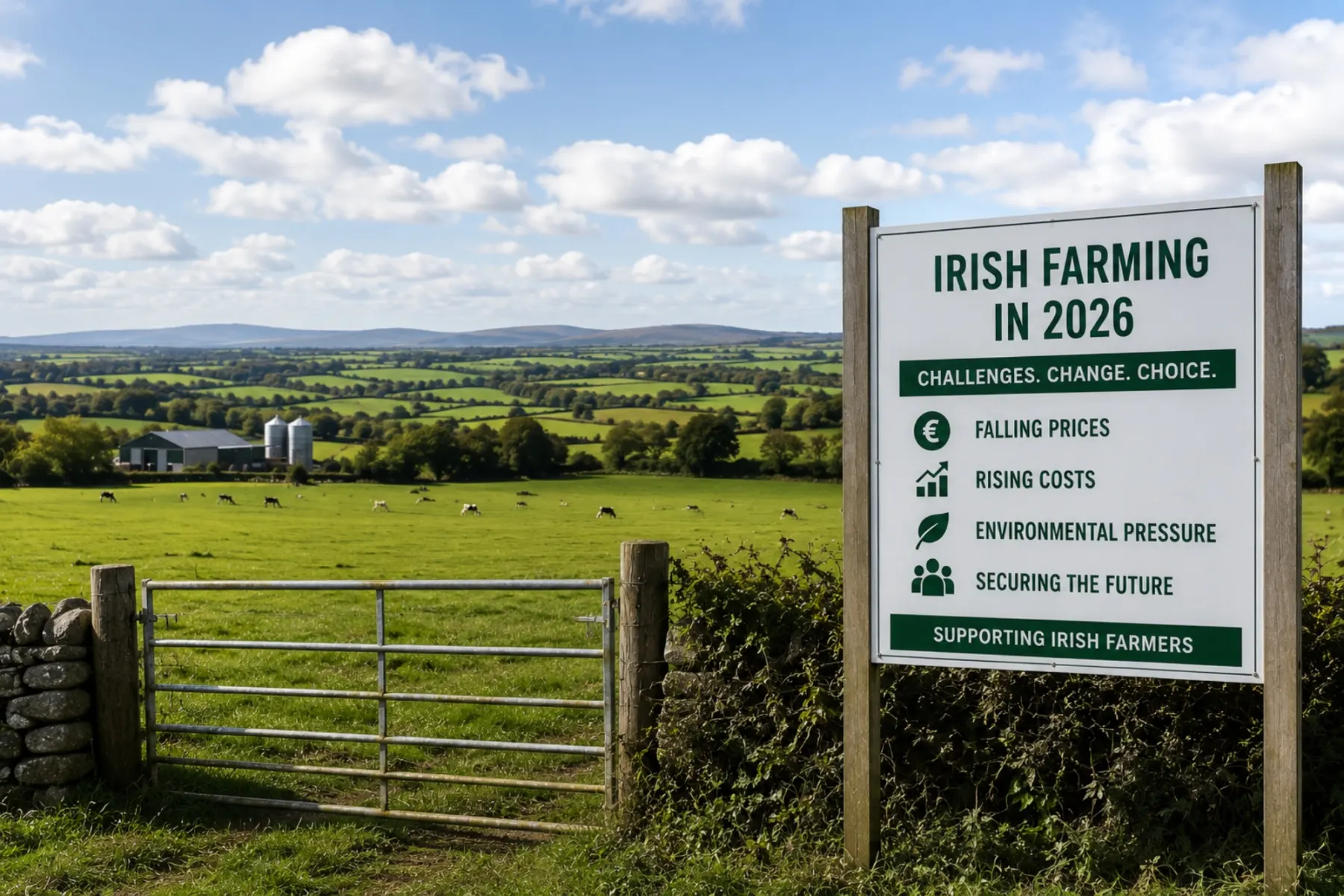
Ireland’s farms emerged from 2025 with stronger incomes and record export values. Months later, lower commodity prices, rising fuel and fertiliser costs, environmental obligations and an ageing farming population are exposing how quickly prosperity can change in one of the country’s most important rural industries.
Irish agriculture entered 2026 from what appeared, on paper, to be a position of remarkable strength.
Family farm income had risen sharply during 2025. Beef prices were exceptionally strong. Dairy farms enjoyed another highly profitable year. Food, drink and horticulture exports reached a record €19 billion, while the broader value of Irish agri-food exports was estimated at €21.2 billion.
Yet only months later, the picture looks considerably less comfortable.
Teagasc now forecasts average family farm income across Ireland’s principal farming systems at approximately €33,600 for 2026, down 38% from €53,800 in 2025. Dairy income is expected to fall particularly sharply, while cattle, tillage and pig enterprises are also facing weaker margins.
The speed of that reversal reveals something fundamental about Irish farming.
The industry can generate enormous economic value, sustain rural communities and supply international markets, yet individual farms remain unusually exposed to forces they cannot control: global commodity prices, weather, energy markets, fertiliser costs, international trade, environmental regulations and movements in consumer demand.
Farming in Ireland in 2026 is therefore not simply a story of good times turning bad.
It is a story about an industry becoming more productive and internationally valuable while simultaneously confronting some of the most difficult questions about income stability, environmental performance, succession and long-term viability that it has faced in decades.
The Extraordinary Rise of 2025
Understanding the current situation requires first understanding how strong the previous year was.
Average family farm income rose by 49% in 2025 to just over €53,800. Every major farming system tracked by the Teagasc National Farm Survey recorded an improvement.
That national average, however, concealed enormous differences.
Dairy farms recorded average family farm income of approximately €153,300. Cattle-rearing farms averaged about €24,100, other cattle enterprises approximately €32,800, sheep farms €29,300 and tillage farms almost €54,900.
The difference illustrates one of the defining characteristics of Irish agriculture: there is no single farming economy.
A 100-cow dairy enterprise in Cork, a suckler farm in Roscommon, a sheep holding in Mayo and a cereal business in Wexford may all be described as Irish farms, but their economics are profoundly different.
The strong performance of 2025 was particularly influenced by high cattle values and favourable dairy returns. Irish food, drink and horticulture exports increased by 12% to €19 billion, with dairy exports reaching €7.3 billion and meat and livestock exports exceeding €5 billion. Beef exports alone were worth more than €3.4 billion.
Those figures confirmed Ireland’s position as a major food exporter far beyond what might be expected from a country of its population size.
But they also contained an early warning.
Export values can increase because Ireland produces more. They can also increase because the same or even smaller quantities command higher prices.
In beef, strong export values during 2025 were supported by sharply higher prices even as volumes remained constrained. That matters because price-led prosperity can disappear much faster than production capacity can be adjusted.
By the closing months of 2025, that change had already begun.
What Changed in 2026
The clearest description of the pressure now facing farmers can be found in the relationship between what they receive for their products and what they pay to produce them.
In May 2026, Ireland’s Agricultural Output Price Index was 14.9% lower than a year earlier.
Over precisely the same period, the Agricultural Input Price Index rose by 8%.
Milk prices were down 23.7% year on year. Cattle prices were 11.5% lower and pig prices were down 17.7%. At the same time, motor fuel costs had risen by 33.3%, fertiliser prices by 22.7% and veterinary expenses by 7.1%.
The resulting change in agriculture’s terms of trade — the relationship between output and input prices — was severe. By May it was 21.2% weaker than a year earlier.
For a conventional business, higher costs can sometimes be passed directly to customers.
Farming rarely works that way.
An individual farmer cannot simply decide what a supermarket, processor or international commodity market will pay for milk, cattle or grain. Yet the same farmer must still buy diesel, fertiliser, machinery parts, veterinary services, electricity and feed at prevailing prices.
That imbalance is what makes agricultural margins capable of changing so quickly.
A farm can remain physically productive while becoming significantly less profitable.
Dairy: From Exceptional Returns to a Sharp Correction
No sector demonstrates that volatility more clearly than dairy.
Irish dairy farming has become one of the most economically significant parts of the agricultural sector, supported by grass-based production and a sophisticated processing and export industry.
In 2025, dairy exports rose by 14% to a record €7.3 billion. Farm-level earnings were also exceptionally strong, with average dairy family farm income reaching approximately €153,300.
The outlook for 2026 is dramatically different.
Teagasc expects the average milk price received during the year to be about 20% below its 2025 level. With production costs also increasing, average dairy family farm income is forecast to fall to approximately €78,000 — a decline of 49% in a single year.
That does not mean the average dairy farm has suddenly become unviable.
But it demonstrates the extraordinary sensitivity of farm income to commodity pricing.
The physical farm may be almost identical. The cows are still being milked. Grass still has to be managed. Machinery, buildings and land remain in place.
What changes is the margin earned on every litre.
This is one reason agricultural prosperity can look very different depending on which year is chosen as the reference point. Average dairy income in 2022 exceeded €157,000, fell to little more than €51,000 in 2023, recovered above €108,000 in 2024 and reached €153,000 in 2025. The current forecast is €78,000 for 2026.
Few industries experience swings of that magnitude while continuing essentially the same core production process.
Cattle Farming Tells a Different Story
Ireland’s beef and cattle sectors face a different economic structure.
Cattle prices in 2026 remain historically high, but they are below the exceptional levels recorded last year. Teagasc expects finished cattle prices to average roughly 8% below 2025 levels and weanling prices around 10% lower.
Average income on cattle-rearing farms is consequently forecast to fall from approximately €24,100 to €19,000, while other cattle farms — principally finishing enterprises — are expected to see average income decline from approximately €32,800 to €21,000.
Those figures need context.
Even after the forecast decline, cattle-rearing income in 2026 would remain substantially above its average for the five years from 2021 to 2025. Sheep farm income is also expected to remain above its recent five-year average despite a projected fall this year.
The current situation is therefore more nuanced than a simple agricultural downturn.
Some sectors are falling from unusually strong levels rather than returning to historically unprecedented lows.
But cattle farming also exposes a deeper structural issue: relatively modest farm earnings can coexist with valuable land, substantial physical assets and considerable amounts of labour.
A farm may possess land and livestock worth significant sums while generating a comparatively limited annual cash income.
That distinction between asset wealth and operating income is central to understanding the economics of Irish farming.
Sheep and Tillage Face Their Own Pressures
Sheep farming has so far shown greater resilience in output prices.
Teagasc expects sheep prices to average around 3% higher in 2026 than in 2025. Yet rising production costs and weaker returns from cattle enterprises operated alongside sheep on many holdings are expected to reduce average sheep farm income by about 10%, from approximately €29,300 to €26,500.
The tillage sector faces a different combination of forces.
Grain prices at the 2026 harvest are expected to remain broadly similar to last year, but the national tillage area has declined and early indications point towards lower crop yields than in 2025. Higher production expenses add further pressure.
Teagasc currently forecasts average tillage farm income of roughly €44,000, compared with almost €55,000 last year.
For cereal growers, the international nature of grain markets creates another vulnerability.
A successful Irish harvest does not guarantee strong prices if global grain supply is abundant. Conversely, poor harvests in major producing regions elsewhere can transform international markets.
An Irish farmer may therefore make decisions months before knowing the eventual value of the crop being planted.
That uncertainty is not an abnormal feature of farming.
It is built into the business.
Ireland’s Export Strength Can Hide Farm-Level Fragility
One of the most striking features of Irish agriculture is the contrast between the success of the national food industry and the financial position of individual farms.
Ireland exported €19 billion worth of food, drink and horticulture products in 2025. When non-edible agri-food products are included, total agri-food exports were estimated at €21.2 billion. The European Union alone accounted for €7.1 billion of food, drink and horticulture exports.
These are exceptionally valuable industries.
But export value should not be confused with farm income.
Between the farm gate and the final consumer sits an extensive economic system involving processors, manufacturers, transport companies, distributors, retailers and international customers.
A record year for exports can therefore coincide with sharply different financial outcomes among primary producers.
The contrast is important because public discussion about agriculture often moves between two apparently conflicting descriptions.
One portrays Irish farming as a globally successful export industry.
The other portrays many farm households as financially vulnerable.
Both can be true at the same time.
The Second Income Behind Many Irish Farms
Perhaps no statistic illustrates the reality of farm household economics better than the prevalence of work outside agriculture.
In 2025, either the farmer or their spouse was employed off-farm in 59% of farm households represented by Teagasc’s National Farm Survey. Some 43% of farm holders themselves had an off-farm job.
The proportion varies considerably by enterprise.
Around 74% of tillage farm households had employment income outside the farm, compared with 62% of cattle-rearing households and 57% of cattle and sheep households. Even among dairy households — where relatively few farmers themselves work elsewhere because of the labour intensity of dairying — 58% had off-farm employment income, principally through spouses.
Pensions are also becoming increasingly important.
Some 39% of farm households represented in the survey received pension income through either the farmer or spouse during 2025.
These numbers change the way farm viability has to be understood.
For a large part of rural Ireland, the economic unit is not simply the farm.
It is the household.
Income from employment elsewhere can support mortgage payments, household spending and family finances while farm revenue fluctuates. A pension can similarly provide stability to an older farm household whose agricultural income alone would be considerably less predictable.
This does not diminish the economic importance of farming.
It demonstrates how the modern rural economy actually works.
The Succession Problem Is Becoming Harder to Ignore
Behind questions about prices and profitability lies another challenge that develops much more slowly but may ultimately prove just as important.
Irish farmers are getting older.
The latest comprehensive CSO Farm Structure Survey found that the average farm holder was 59.4 years old in 2023.
More than 37% of farm holders were aged 65 or above. Only 4.3% were under 35. Between 2013 and 2023, the number of farm holders aged 65 and over increased by more than a third, while the number under 35 fell by almost 30%.
The issue is not simply whether young people are interested in farming.
Farm succession involves land, housing, tax, family relationships, capital requirements and the prospective income available from the business.
A young farmer taking over land may inherit an important asset, but modern agriculture can demand substantial further investment in machinery, buildings, livestock, environmental compliance and technology.
At the same time, the existing generation may still depend financially on the farm.
Succession is therefore rarely just a matter of transferring a set of keys from one generation to another.
It is an economic restructuring of a family business.
The ageing profile is particularly significant in cattle farming. Teagasc reported an average age of around 60 for cattle farmers in 2025, compared with 55 for dairy farmers and 56 for tillage farmers.
Unless younger generations can see a viable economic future, demographics may gradually reshape agricultural production regardless of any formal government target.
Land Is Becoming More Expensive Even as Income Becomes More Volatile
Another apparent contradiction can be found in the farmland market.
The national average price for good-quality agricultural land reached €14,126 per acre in 2025, an increase of 7% in a year. Poorer-quality land averaged €6,963 per acre, up 5%.
Land prices and rents are forecast to increase by a further 4% nationally during 2026.
Regional differences are substantial.
Good-quality land averaged more than €19,000 per acre in Wexford, while poorer land in Leitrim averaged below €4,000 per acre. Connacht and Ulster remained cheaper than Leinster and Munster overall, but experienced particularly strong percentage increases during 2025.
Rising land values can strengthen the balance sheet of established owners.
For farmers seeking to expand, however, expensive land and higher rents increase the cost of increasing production.
For new entrants, the barrier can be considerably greater.
This is another reason why farm wealth and farm income cannot be treated as the same thing.
Ireland possesses valuable agricultural land.
That does not guarantee that the agricultural activity conducted on every acre generates a proportionately high annual return.
Environmental Regulation Is Now Part of the Business Model
The economics of farming are no longer determined only by production and markets.
Environmental performance has become part of the operating environment itself.
Ireland’s agricultural system is particularly exposed because livestock plays such a large role in national farming and because agriculture represents a substantial share of the country’s greenhouse gas emissions.
Provisional Environmental Protection Agency data shows agricultural emissions fell only slightly in 2025, by 0.2%. A 3.3% reduction in cattle numbers helped lower emissions, but this was partly offset by a 12.7% increase in nitrogen fertiliser use and a 4.8% increase in milk production.
Ireland’s established climate framework requires a 25% reduction in agricultural greenhouse gas emissions by 2030 compared with the sectoral baseline, meaning further changes will be required during the remainder of the decade.
Water quality adds another layer.
Ireland secured a further three-year extension of its EU Nitrates Derogation from the beginning of 2026 to the end of 2028. The system allows qualifying grassland farms to operate above the standard limit of 170 kilograms of livestock manure nitrogen per hectare, subject to additional environmental requirements and limits of up to 220 or 250 kilograms depending on the applicable conditions and location.
For more intensive dairy and livestock farms, these rules are not abstract environmental policy.
They can influence how many animals can be carried on a given land base, how manure is managed, whether additional land needs to be rented and what investments are required to remain compliant.
The challenge for policymakers is equally complex.
Agriculture must reduce environmental pressures while remaining economically viable, maintaining food production and supporting rural communities.
Those objectives do not always conflict.
But neither do they automatically align.
The Environmental Transition Is Also a Technology Story
The changes taking place across Irish farms are not solely about restrictions.
They are also creating a different model of agricultural management.
Precision fertiliser application, improved nutrient planning, better grassland measurement, low-emission slurry spreading, protected fertiliser products, improved breeding, digital herd management and more detailed measurement of farm performance increasingly connect environmental efficiency with economic efficiency.
The logic is straightforward.
Fertiliser that is lost rather than used by a crop represents both an environmental problem and wasted money. Poor animal health reduces productivity as well as farm profitability. Energy inefficiency increases emissions and operating costs.
This creates areas where environmental and economic interests can reinforce one another.
But investment has a cost.
The farms best positioned to adopt new technologies rapidly are not necessarily those experiencing the greatest financial pressure.
That makes the pace of transition important. Regulation may define where agriculture has to go, but investment capacity can determine how quickly individual farms are able to get there.
Farming Is Becoming More Exposed to Events Far Beyond Ireland
The traditional image of agriculture is intensely local: land, weather, animals and the farming family.
Economically, modern farming is anything but isolated.
International energy markets influence diesel and fertiliser prices. Global dairy production affects Irish milk values. European cattle supply changes beef prices. Disease outbreaks abroad can alter international meat trade. Currency movements affect export competitiveness.
The 2026 cost increase demonstrates that exposure particularly clearly.
Irish agricultural input prices have risen while important output prices have fallen, producing a margin squeeze that originated partly in international commodity and energy markets rather than on Irish farms themselves.
Ireland’s export success makes this global connection economically valuable.
It also creates vulnerability.
A country that exports much of what its agricultural sector produces cannot insulate farmers completely from conditions in the markets buying those products.
Diversification across destinations can reduce dependence on any single market.
It cannot eliminate global volatility.
There Is No Single Irish Farming Experience
National averages are useful, but they can also obscure more than they reveal.
Dairy farming is concentrated heavily in the south and east.
Beef and sheep production play a greater role across many western, border and midland counties.
Tillage is concentrated in areas with soils and conditions suited to cereal production.
Land values differ sharply from county to county. Farm sizes vary. Dependence on off-farm employment differs. Age profiles vary by enterprise. Access to processors, contractors and infrastructure is not uniform.
The economic importance of agriculture also becomes greater once the analysis moves away from Ireland’s largest cities.
Teagasc notes that agriculture and food production account for a significantly greater share of employment and economic activity in rural regions than their national share would suggest.
A change in cattle prices can therefore have effects extending well beyond the person selling an animal.
It influences marts, hauliers, contractors, machinery businesses, veterinary practices, feed merchants, processors and household spending in rural towns.
Agricultural policy is consequently also regional economic policy.
Why a Quick Fix Does Not Exist
Many of the pressures facing farming appear individually solvable.
Reduce input costs.
Increase farmgate prices.
Help young farmers.
Improve water quality.
Cut emissions.
Increase productivity.
Diversify exports.
Encourage succession.
The difficulty is that these objectives interact.
Higher production can improve the economics of a farm but potentially increase environmental pressure if efficiency does not improve at the same time.
Lower stocking rates can reduce some environmental pressures but may weaken income unless value per animal or alternative income increases.
Expanding land area can allow a farm to operate less intensively, but rising purchase and rental prices make expansion expensive.
New environmental technology can reduce emissions or nutrient losses, but the investment required may be hardest for low-income farms to afford.
Encouraging younger farmers to enter agriculture is difficult if expected returns remain uncertain.
There is therefore no single policy capable of resolving all of Irish farming’s challenges.
The future will depend on how successfully multiple changes occur together.
What Comes Next
The immediate outlook for 2026 is weaker than the extraordinary performance of 2025.
That much is clear.
But it would be misleading to interpret the projected income decline as evidence of uniform decline across Irish agriculture.
Cattle and sheep incomes are still forecast to remain above their recent five-year averages. Food exports are operating from record values. Agricultural land remains highly sought after. Ireland retains an extensive farming and food-processing infrastructure and access to valuable European and international markets.
The deeper question is what kind of farming system emerges over the remainder of the decade.
It is likely to be more measured, more technologically managed and more environmentally constrained than the system of the past.
Farm businesses will increasingly have to judge success not simply by output, but by margin, nutrient efficiency, environmental performance, labour requirements and resilience to market shocks.
Some farmers may expand.
Others may become more extensive.
Some will diversify into forestry, renewable energy, tourism, contracting or other enterprises. Others will continue to combine farming with employment outside agriculture.
Succession will gradually move more land into different hands, although the pace remains uncertain.
And international markets will continue to determine much of the value ultimately returned to Irish producers.
An Industry Stronger and More Fragile Than It Appears
Irish farming in 2026 contains two apparently opposing realities.
At national level, the industry is formidable.
Ireland sells billions of euro worth of food into international markets. Dairy, beef and other agricultural products remain central to rural economic life, and the wider agri-food sector has demonstrated an ability to compete far beyond the domestic market.
At farm level, however, the picture can be remarkably fragile.
One movement in milk prices, one surge in fertiliser or energy costs, a difficult harvest or a change in an international market can transform the economics of a year.
That tension explains why record exports and concern about farm incomes can exist simultaneously.
It also explains why the central challenge facing Irish agriculture is no longer simply how much food it can produce.
The harder question is how to create a farming system capable of generating reliable family incomes, attracting another generation, protecting land and water, reducing emissions and remaining competitive in markets that can change faster than a farmer can change the farm.
Ireland’s agricultural sector has adapted repeatedly before.
The next transformation is already under way.
Whether it succeeds will be measured not by a single year of record prices or record exports, but by whether Irish farms remain economically viable and environmentally sustainable after the exceptional years have passed.
Source & Transparency
This article is published by Ireland Newspaper for editorial and informational purposes.
Published: 9 August 2026 · Updated: 9 August 2026

Newsroom Ireland Newspaper
Ireland Newspaper editorial team prepares daily news coverage for readers in Ireland and abroad.