From Farm Gate to Supermarket: Why Ireland’s Food Prices Are Moving in Different Directions
Irish farmers are receiving sharply less for milk, cattle and pigs than a year ago while fuel, fertiliser and veterinary costs remain higher. Yet the decline at the farm gate is reaching supermarket shelves unevenly — revealing how complicated the journey from agricultural prices to the household food bill has become.
A year can transform the economics of a farm.
In 2025, Irish agricultural output prices rose strongly, helped above all by an extraordinary increase in cattle values. By the middle of 2026, that picture had reversed. Prices received by farmers were falling while many of the costs required to produce food were still rising.
The latest official Agricultural Price Indices available from the Central Statistics Office, covering May 2026, show the scale of the shift. Agricultural output prices were 14.9% lower than a year earlier, while agricultural input prices were 8% higher. The resulting agricultural terms of trade — broadly the relationship between what farmers receive and what they pay for inputs — deteriorated by 21.2% in twelve months.
For farmers, that is a direct squeeze on margins.
For consumers, however, the story is much less straightforward.
Irish food and non-alcoholic beverage prices were only 0.6% higher in June 2026 than a year earlier, according to the CSO. Some dairy products had become cheaper, yet fresh beef remained more expensive. Egg prices were substantially higher. Other foods moved in different directions again.
This apparent contradiction lies at the heart of Ireland’s food economy in 2026.
A fall in the price received by a farmer does not automatically produce an equivalent fall at the supermarket checkout.
Between the farm and the consumer sit processors, factories, packaging suppliers, transport companies, wholesalers, retailers, energy costs, wages, contracts and international markets.
The price of food begins on the farm.
It does not end there.
A Remarkable Reversal from 2025
The current weakness in farm prices looks particularly severe because it follows an unusually strong year.
Across 2025 as a whole, the CSO’s Agricultural Output Price Index was 14.2% higher than in 2024. Cattle prices rose by an extraordinary 40.6%, while sheep prices increased by 5.1%, milk by 3.3% and poultry by 3.1%.
Those higher prices helped push agricultural incomes upwards and contributed to record export values for Irish food.
Bord Bia estimated that Irish food, drink and horticulture exports reached €19 billion in 2025. Meat and livestock exports exceeded €5 billion, while dairy exports reached €7.3 billion. Beef exports alone were valued at more than €3.4 billion, despite export volumes remaining below their longer-term average.
The beef figures were particularly revealing.
Ireland exported less beef by volume than it had during many previous years, yet earned substantially more from it because prices were so strong.
That distinction matters.
High export value does not necessarily mean greater physical production. Sometimes it reflects scarcity and unusually high prices.
The conditions that produced those prices began changing before 2025 had even ended.
By December, monthly milk prices had fallen sharply and cattle prices were also weakening. The annual farm-price statistics therefore concealed a considerable change between the beginning and end of the year.
That change became much more visible during the first half of 2026.
Milk Has Experienced the Sharpest Fall
Dairy farmers are facing the most dramatic adjustment.
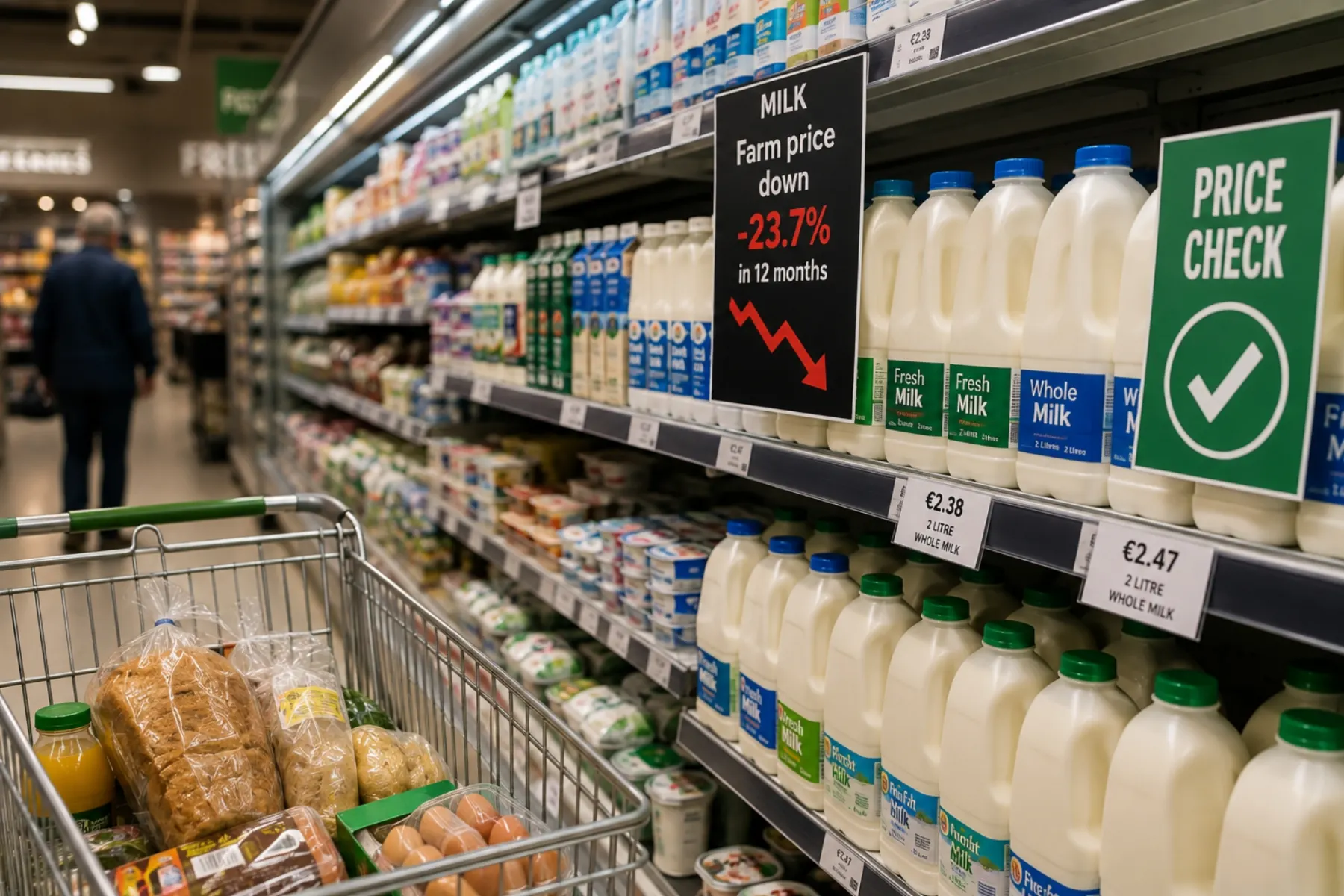
The CSO recorded farm-level milk prices in May at 23.7% below their level a year earlier.
Teagasc expects the average milk price received by Irish farmers across 2026 to be approximately 20% below the 2025 average.
Because production costs are rising at the same time, the effect on profitability is expected to be much larger than the fall in milk price alone.
Average dairy family farm income is forecast to decline from approximately €153,300 in 2025 to €78,000 in 2026 — a fall of 49%.
The physical farm can look almost unchanged during such a reversal.
The same cows still require milking.
The same land has to be managed.
The parlour still consumes electricity.
Grassland still requires nutrients.
Machinery, insurance, veterinary work and labour remain necessary.
What changes is the amount of money received for each litre of milk leaving the farm.
A relatively small movement in the selling price of a high-volume commodity can therefore produce a much larger change in the final income of the business.
Yet Consumers Are Paying Only Slightly Less for Milk
The supermarket picture is different.
In June 2026, the consumer price index for raw and whole milk was 3.4% lower than a year earlier, while skimmed milk was down 4.1%. Cheese prices were 1% lower, yoghurt 1.4% lower and butter and other milk-derived fats 7.2% lower.
The CSO’s national average price data provides an even more tangible comparison.
A two-litre container of full-fat milk averaged €2.38 in June, nine cents less than a year earlier. A pound of butter averaged €4.29, down 54 cents, while Irish cheddar was 30 cents per kilogram cheaper.
Consumers are therefore seeing some benefit from weaker dairy markets.
But the reduction is nowhere near the 23.7% fall recorded in the farm-level milk price.
That difference does not, by itself, demonstrate that any participant in the supply chain is earning an excessive margin.
Farm and retail prices measure different products and different stages of production.
Raw milk collected from a farm has to be transported and processed. Depending on the final product, it may be pasteurised, separated, homogenised, fermented, dried, churned, matured or packaged.
A block of cheese contains milk, but its retail price also contains the cost of manufacturing, refrigeration, packaging, transport, labour, energy, storage and retailing.
Those costs do not automatically fall simply because the raw material becomes cheaper.
Beef Shows the Opposite Pattern
The contrast is even more striking in beef.
The CSO’s latest agricultural index showed cattle prices received by farmers 11.5% lower in May 2026 than a year earlier.
Yet the consumer price index for fresh, chilled and frozen beef was 4.3% higher in June than a year earlier. Lamb and sheep meat was 6.5% higher, pork 4.9% higher and poultry 3.2% higher.
At first glance, the figures appear contradictory.
Farm cattle prices are falling while retail beef prices remain higher.
But the two measures are not directly equivalent.
The farm-price index measures cattle prices. The consumer index measures particular meat products after slaughtering, processing, distribution and retailing.
There is also a timing difference. The latest available official agricultural price index covers May, while the latest complete consumer price data covers June.
Inventory and contracts can create further delays.
A supermarket does not necessarily sell this week a product purchased from a farmer this week.
Animals move through processors, meat can be aged, distribution arrangements can be contracted in advance, and retailers may change shelf prices at different speeds.
For consumers, falling livestock prices therefore do not guarantee an immediate reduction in the price of a Sunday roast.
Even Beef Prices Tell Different Stories Depending on the Product
The CSO’s detailed data also demonstrates why broad averages require care.
While the overall consumer index for fresh beef was higher year on year in June, the national average price of one particular product — sirloin steak — actually fell by 35 cents per kilogram to €21.77.
Both statistics can be correct.
Different cuts move differently.
Promotional activity changes.
Retailers source different products.
Premium and cheaper cuts carry different margins and consumer demand.
The same principle applies across the entire food system.
There is rarely a single “beef price”, “milk price” or “grain price”.
There are farm prices, processor prices, wholesale prices, retail prices, contract prices and international market prices — each representing a different point in the supply chain.
Cattle Farmers Are Still Receiving Historically Strong Prices
The current cattle situation also requires a longer perspective.
Prices have fallen from the exceptional levels reached in 2025, but Teagasc still describes cattle prices in 2026 as historically high.
Finished cattle prices are forecast to average approximately 8% below 2025 levels, while weanling prices are expected to be around 10% lower.
Recent market weakness has been linked partly to softer beef prices in important European export destinations and changing competitive conditions in the British market. Ireland exports a large proportion of its beef, so prices available abroad have a direct influence on what processors can pay domestically.
The income consequences are nevertheless significant.
Average income on cattle-rearing farms is forecast at about €19,000 in 2026, down from €24,100 last year.
Other cattle farms, including many finishing enterprises, are forecast to average around €21,000, compared with €32,800 in 2025.
These figures include agricultural support payments.
That is important because market income alone can be considerably lower on many farms.
Pigs Have Faced Another Sharp Price Decline
Pig farmers are also experiencing substantial pressure.
Farm-level pig prices were 17.7% lower in May than a year earlier, according to the CSO.
This follows a difficult international trading environment.
Bord Bia reported that Irish pigmeat export values declined by 3% during 2025 despite a 3% increase in export volumes, reflecting lower prices, intense international competition and weaker demand in important markets.
Yet pork purchased by Irish consumers was 4.9% more expensive in June 2026 than a year earlier.
Once again, this demonstrates the distinction between the price of the agricultural commodity and the final retail product.
A pig farmer can receive less while a shopper pays more.
The difference is not necessarily retained by one participant. It can be absorbed across processing, energy, labour, packaging, distribution and retail.
Sheep Farmers Are One of the Exceptions
Not every agricultural sector is experiencing falling output prices.
Sheep prices were 11.4% higher in May 2026 than a year earlier, according to the CSO. Eggs were up 12.6% and poultry prices were 5.5% higher.
Teagasc expects sheep prices across 2026 to average around 3% above their 2025 level.
However, higher production costs and weaker income from cattle enterprises operated alongside sheep on many farms are still expected to reduce average sheep farm income from approximately €29,300 to €26,500.
This is another important distinction.
A farmer can receive a higher selling price and still earn less money.
Price is only one side of the equation.
Cost determines the other.
Eggs Show How Closely Farm and Consumer Prices Can Sometimes Move
Eggs currently provide a contrasting example.
Farm-level egg prices were 12.6% higher in May than a year earlier.
Consumer egg prices were 10% higher in June.
The movements are not directly comparable because the indices cover different stages of the market and slightly different periods.
But unlike dairy and beef, the direction at farm and retail level is broadly similar.
That highlights why there is no universal rule governing agricultural price transmission.
Some products move through relatively short supply chains.
Others require substantial processing.
Some are sold under longer contracts.
Some face strong international competition.
Some have limited substitutes.
Consumer behaviour differs by product as well.
Price movements therefore reach the supermarket with different delays and different intensity.
The Biggest Problem for Farmers Is What They Have to Buy
Falling farm prices would be challenging even in a stable cost environment.
In 2026, costs are not stable.
Agricultural input prices were 8% higher in May than a year earlier.
Motor fuel costs were up 33.3%.
Fertiliser prices were 22.7% higher.
Veterinary expenses increased by 7.1%.
These inputs matter across virtually every farming system.
Diesel powers tractors and machinery and contributes to contractor and haulage costs.
Fertiliser affects grass and crop production.
Veterinary expenditure is unavoidable in livestock farming.
Electricity is particularly important for dairy enterprises, where milking, cooling and water systems consume substantial amounts of energy.
The difficulty is that farmers have limited ability to pass these costs directly to customers.
A dairy farmer cannot decide tomorrow that milk will be sold for five cents more per litre.
A cattle farmer cannot add a fuel surcharge to an animal presented for sale.
Agriculture generally operates as a price-taking industry: individual producers respond to market prices rather than determining them.
That makes the gap between output and input prices especially important.
The 21% Collapse in the Terms of Trade Explains the Pressure
The CSO combines agricultural output and input prices into a terms-of-trade measure.
In May 2025, that index stood at 132.9.
By May 2026 it had fallen to 104.8.
That represents a 21.2% deterioration in twelve months.
This does not mean every farm’s profit fell by precisely 21.2%.
Farm structures differ too much for that.
A dairy farm has a different cost base from a sheep farm.
A tillage farmer buys different inputs from a suckler farmer.
Some farmers own machinery while others rely heavily on contractors.
Some use substantial fertiliser; others operate more extensively.
But nationally, the index captures the central problem of 2026:
what farmers sell has become less valuable relative to what they must purchase to produce it.
That is why farm income is expected to fall much faster than consumer food prices.
Average Farm Income Is Forecast to Fall by 38%
Teagasc’s latest mid-year assessment forecasts average family farm income across Ireland’s principal farming systems at approximately €33,600 in 2026.
That compares with €53,800 in 2025 — a fall of 38%.
Dairy accounts for much of the national decline because dairy farms had unusually high average incomes last year and are now experiencing the steepest correction.
But income is expected to decline across most other major systems as well.
Cattle-rearing income is forecast down 21%.
Other cattle farms are forecast down 36%.
Sheep income is expected to fall around 10%.
Average tillage income is forecast at approximately €44,000, compared with €54,900 in 2025.
These are averages, not guarantees.
Individual farm results can vary enormously according to size, efficiency, debt, land ownership, production system, weather and market timing.
But the direction is clear.
The financial environment has become substantially more difficult.
Tillage Farmers Face the Margin Problem in a Different Form
For cereal growers, the pressure is not being driven by a dramatic collapse in grain prices.
Teagasc expects harvest grain prices in 2026 to be broadly similar to 2025.
The problem is that production costs are rising and early indications have pointed towards lower yields, while Ireland’s total tillage area has also declined.
A farmer can therefore sell grain for approximately the same price yet make less money because fewer tonnes are harvested or because producing each tonne costs more.
That distinction is important for consumers.
A stable grain price does not automatically mean a stable loaf of bread.
Bread contains flour, but its retail price also includes milling, energy, labour, packaging, transport and retail costs.
Indeed, the CSO recorded bread and bakery-product prices as broadly unchanged year on year in June, while cereal prices within the consumer index were slightly lower.
The relationship between field and shelf is therefore again more complex than a direct line.
Food Manufacturers Are Facing Their Own Inflation
The supply chain between farmer and shopper is also experiencing cost pressure.
Irish producer prices for manufactured food products were 2.9% higher in June 2026 than a year earlier.
Across food products, beverages and tobacco, producer prices were 2.4% higher.
Energy remains particularly significant.
Wholesale electricity prices were 42.2% higher in June than a year earlier, even though they remained far below their 2022 peak.
Energy fuels were 24.5% higher year on year.
These figures help explain why falling farmgate prices may not immediately create sharply lower food prices.
A processor buying cheaper raw milk can simultaneously face higher electricity expenditure.
A meat factory paying less for cattle can face higher transport, energy, refrigeration or labour costs.
A bakery can buy cheaper grain but spend more on energy and wages.
Price movements therefore meet one another inside the supply chain.
The consumer sees only the final result.
The Household Food Bill Is Remarkably Stable Overall
Despite all this movement underneath the surface, Ireland’s overall food inflation rate is currently relatively modest.
Food and non-alcoholic beverages were 0.6% more expensive in June 2026 than in June 2025. Food alone was up 0.5%.
That is far below Ireland’s overall CPI inflation rate of 3.4% in June.
But an average of 0.6% does not mean every household is paying almost exactly the same amount for groceries.
The basket contains products moving in opposite directions.
Fresh beef was 4.3% more expensive.
Lamb and sheep meat increased 6.5%.
Eggs rose 10%.
Coffee increased 5.1%.
At the same time, milk, butter, cheese, potatoes and several fruit and vegetable categories were cheaper.
Two households with different diets can therefore experience food inflation very differently.
A family buying substantial quantities of meat and eggs may feel more pressure than one whose basket contains more products whose prices have fallen.
National inflation is an average.
Household inflation is personal.
Why Supermarket Prices Usually Move More Slowly
There are several structural reasons why changes at the farm gate can take time to appear in shops.
The first is contracts.
Processors and retailers may agree prices over periods longer than a day or week.
The second is inventory.
Food purchased today may have been processed from agricultural commodities acquired weeks or months earlier.
The third is value added.
The raw agricultural product often represents only one part of the eventual retail cost.
The fourth is competition.
Retailers may choose to absorb a cost increase temporarily on one high-profile product while raising another price elsewhere.
They may also use promotions to compete for customers.
Finally, international markets matter.
Ireland is simultaneously a major food exporter and a food importer. Supermarket prices therefore reflect both domestic agricultural conditions and prices in international supply chains.
The transmission from farm prices to consumers is consequently neither immediate nor uniform.
Lower Farm Prices Can Eventually Help Consumers
None of this means farmgate prices are irrelevant to household food costs.
They matter enormously.
If raw-material prices remain lower for a sustained period, processors eventually purchase more of their inputs at those lower prices.
That can reduce manufacturing costs and create scope for wholesale and retail prices to fall or rise more slowly.
The dairy sector appears to be providing some evidence of that process in 2026.
Farm milk prices fell sharply before retail milk, butter and cheese prices moved lower.
The consumer decline has been smaller, but the direction is visible.
What cannot be assumed is that a 20% fall at farm level will eventually become a 20% fall at retail level.
It almost certainly will not, because the raw commodity is only part of the final cost.
Rising Farm Prices Can Also Reach Consumers with a Delay
The same mechanism works in reverse.
When farm prices rise sharply, supermarket prices may take time to respond.
Existing contracts can temporarily protect processors and retailers.
Stocks purchased earlier can delay the impact.
Businesses can initially absorb higher costs in their margins.
But if high agricultural prices persist, the pressure eventually moves along the chain.
This is one reason the exceptional cattle-price increases of 2025 can still influence beef prices paid by consumers in 2026 even after cattle values have begun falling again.
The farm market can turn before the retail market catches up.
Consumers and farmers can therefore appear to be experiencing opposite price trends at the same time.
They may simply be standing at different points in the same price cycle.
Government Support Can Cushion Costs but Cannot Control Markets
Public policy can reduce some of the volatility but cannot determine international agricultural prices.
Ireland’s farming sector already operates within the EU Common Agricultural Policy, under which direct payments and environmental schemes provide income support independent of the immediate market price of agricultural commodities.
Teagasc’s farm-income calculations include these support payments.
In 2026, the Government also introduced fuel-related income support in response to higher energy costs. A €100 million allocation was announced for fuel supports covering farmers, fishers and agricultural contractors, with payments focused on the high-use period from March through July.
Such measures can help businesses absorb temporary shocks.
They cannot decide the world price of butter.
They cannot determine cattle prices in Britain or continental Europe.
They cannot remove global fertiliser-price volatility.
And they cannot guarantee that consumer prices will move in parallel with farm prices.
Ireland’s food economy is too integrated into European and international markets for that.
Ireland’s Export Success Is Also Its Exposure
This international dependence is sometimes overlooked because Ireland produces far more dairy and beef than its domestic population can consume.
The country’s agricultural model is fundamentally export-oriented.
Strong international demand therefore supports farmgate prices.
Weak demand abroad can reduce them.
Bord Bia’s 2025 figures demonstrate how powerful that connection can be. Tight cattle supply across Ireland and important export markets pushed beef prices sharply higher even while Irish export volumes remained comparatively constrained.
The opposite dynamic can occur when international supply expands or demand weakens.
Irish consumers therefore do not determine the value of Irish cattle or milk by themselves.
A farmer in Cork can be affected by dairy production elsewhere in Europe.
A cattle finisher in Meath can be affected by beef-market conditions in Britain, France or Germany.
An Irish pig producer competes within a highly international market.
The price of food grown in Ireland is partly determined far beyond Ireland.
Farmers and Consumers Share One Important Interest
Discussion of food prices can sometimes create the impression that farmers and consumers are inevitably on opposite sides.
Farmers want high prices.
Consumers want low prices.
Reality is more complicated.
Farmers need prices capable of supporting sustainable production.
Consumers need food that remains affordable.
Both benefit from a food system that is efficient, competitive and resilient.
If agricultural prices remain too low for too long, producers can reduce investment or production.
Some may leave the sector.
Over time, reduced supply can itself contribute to higher prices.
If consumer prices become too high, households reduce purchases or move towards cheaper alternatives.
That can weaken demand throughout the supply chain.
A functioning food economy therefore needs enough value to sustain production without allowing basic food to become unnecessarily expensive.
That balance changes constantly.
2026 Is Demonstrating How Quickly the Balance Can Move
The most important lesson from the latest figures is the speed of change.
During 2025, farm output prices averaged 14.2% above the previous year, led by a 40.6% surge in cattle prices.
By May 2026, overall farm output prices were 14.9% below their level a year earlier.
That is an extraordinary reversal within a relatively short period.
Yet supermarket food inflation has not followed the same path.
The overall food basket remains broadly stable, with modest annual inflation and substantial variation between individual products.
The difference reveals how agricultural markets really work.
Farm prices are often highly volatile.
Retail food prices are usually slower and more stable because many other costs sit between the commodity and the consumer.
That stability can protect households when agricultural prices surge.
It can also frustrate consumers when farm prices fall and supermarket prices do not immediately follow.
What Happens Next
The remainder of 2026 is likely to remain challenging for Irish farmers.
Teagasc expects dairy prices to remain significantly below their 2025 average and cattle prices to remain below last year’s exceptional levels, while production costs continue to weigh on profitability.
There are, however, reasons not to interpret the current correction as a uniform agricultural collapse.
Cattle prices remain high by longer-term standards.
Sheep prices are stronger.
Consumer food inflation is currently modest.
Ireland’s food-export industry remains large and internationally competitive.
And the same volatility that can push agricultural prices down can eventually move in the opposite direction.
The largest uncertainty lies in costs.
Fuel, fertiliser and energy markets remain exposed to international developments.
If those costs ease while farmgate prices stabilise, margins could improve.
If output prices continue weakening while inputs remain expensive, farm incomes could come under further pressure.
For consumers, the key question will be how much of the current farmgate weakness eventually moves through processors and retailers.
Dairy prices suggest some transmission is already happening.
Other categories may take longer.
The Price of Food Is Really a Chain of Prices
There is no single Irish food price.
There is the price paid to the farmer.
The cost of producing the raw material.
The price paid by the processor.
The cost of manufacturing.
The wholesale price.
The cost of transport and refrigeration.
The retailer’s price.
And finally, the amount paid by the household.
In 2026, those prices are moving in different directions.
Farmers are seeing the value of important outputs fall while many production costs remain elevated.
Consumers are receiving some relief on products such as milk, butter, cheese and potatoes, while paying more for others including beef, lamb and eggs.
The apparent contradiction is not evidence that one set of statistics must be wrong.
It is evidence of how complex the modern food economy has become.
The challenge for Ireland is therefore broader than producing cheaper food or achieving higher farm prices.
It is maintaining a system in which farms can remain economically viable, processors can invest, retailers can compete and households can afford the food they need.
Those objectives do not always move together.
But over the long term, none can succeed without the others.
The journey from an Irish field to an Irish supermarket shelf may sometimes be only a few kilometres.
Economically, it is considerably longer.
Source & Transparency
This article is published by Ireland Newspaper for editorial and informational purposes.
Published: 10 August 2026 · Updated: 10 August 2026

Newsroom Ireland Newspaper
Ireland Newspaper editorial team prepares daily news coverage for readers in Ireland and abroad.