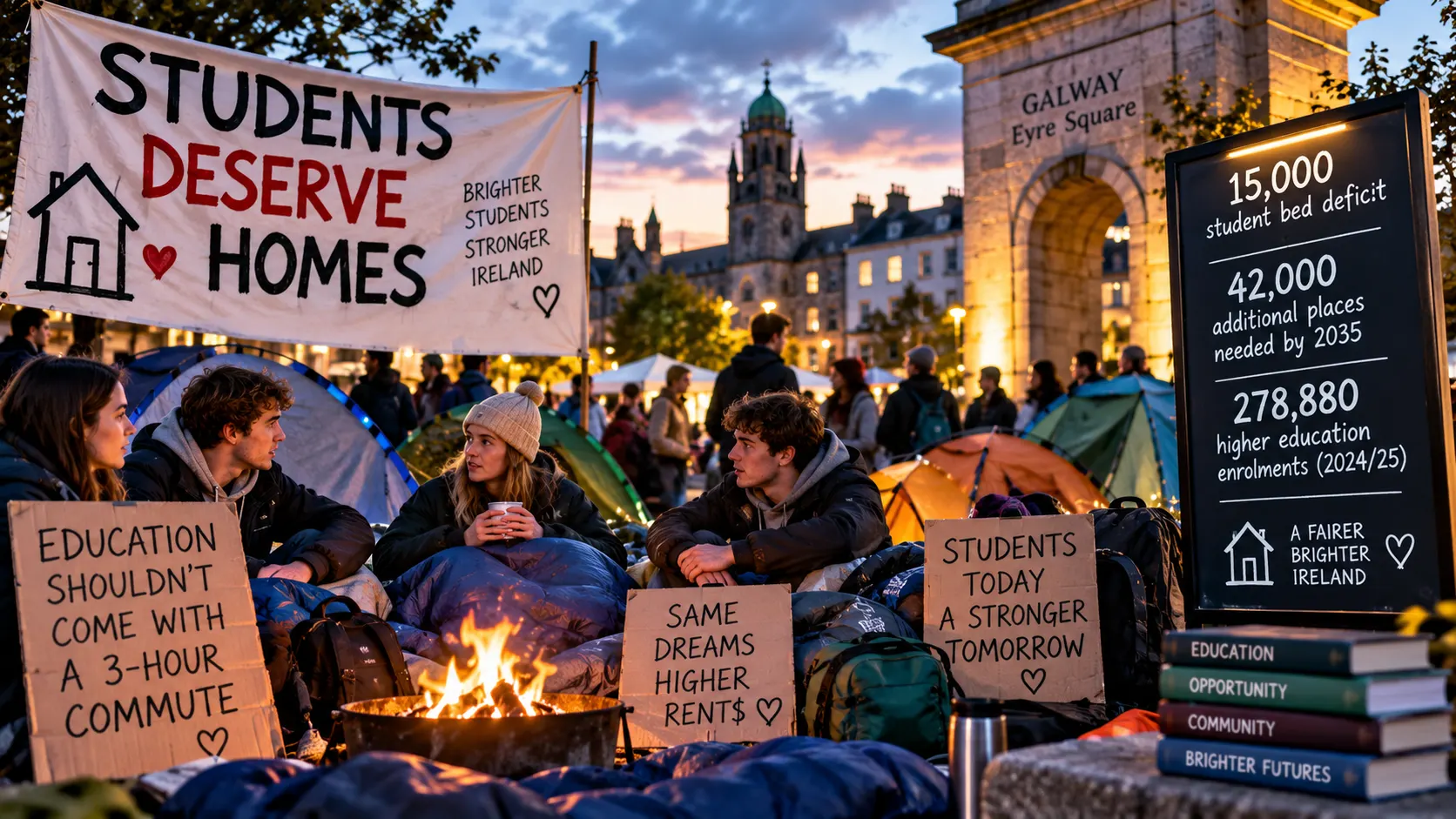
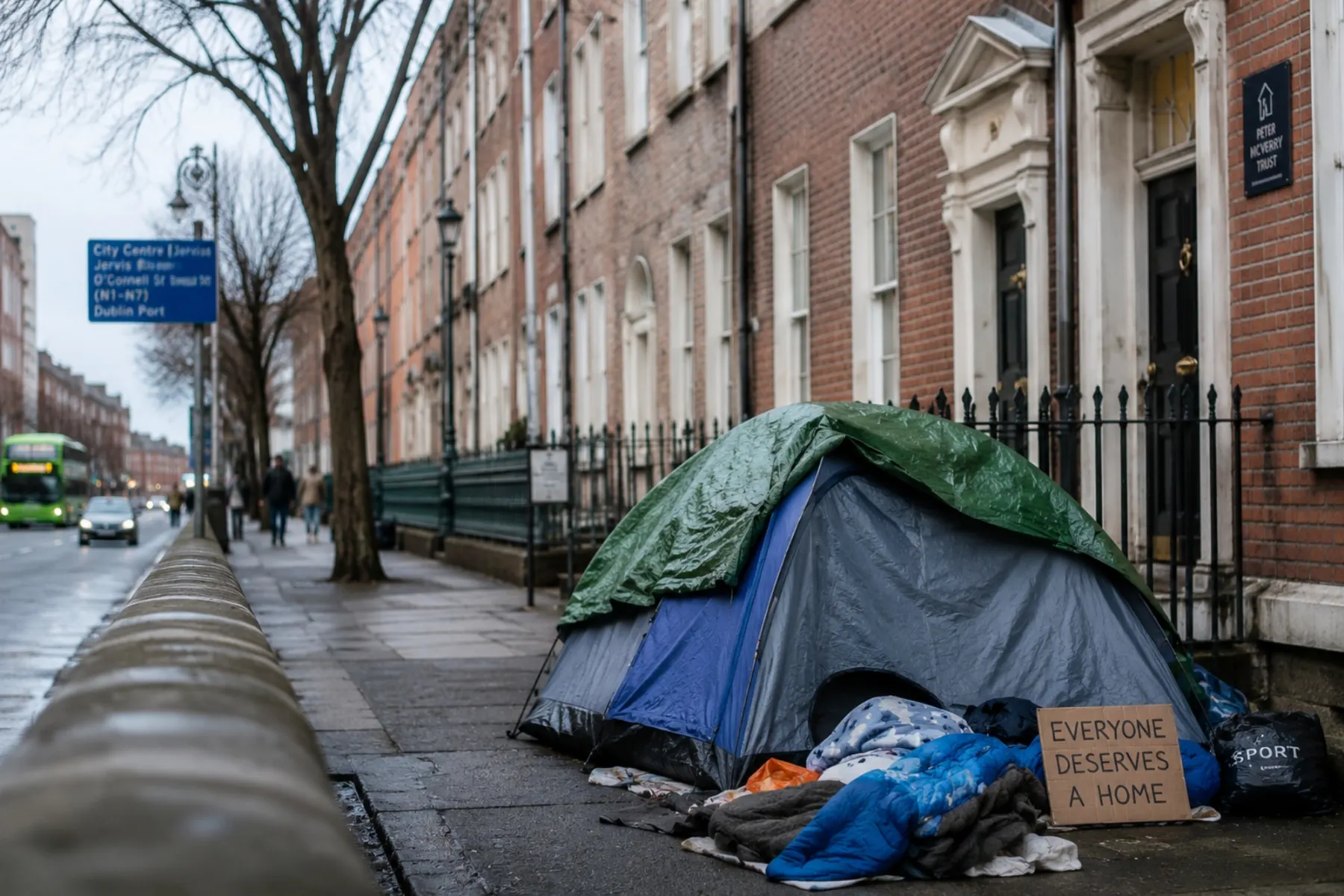
Ireland’s Homelessness Emergency: Why Rising Housing Supply Has Not Stopped the Numbers Climbing
More than 17,000 people are now living in State-funded emergency accommodation, including 5,620 children. Ireland is building more homes and delivering record numbers of new social houses, yet high rents, insecure tenancies, shortages of suitable affordable homes and the time required to move households out of emergency accommodation continue to push homelessness in the wrong direction.
Ireland entered the summer of 2026 with one of the most troubling contradictions in its housing system.
More homes are being built. Social housing construction has increased. The State is spending billions of euro on housing. Rental registrations have risen rather than collapsed.
Yet the number of people living in emergency homeless accommodation remains close to the highest level recorded.
The latest Department of Housing figures show 17,482 adults and children in State-funded emergency accommodation in June 2026. That included 11,862 adults and 5,620 children, with 2,706 families affected. The total was 1,567 people, or 9.8%, higher than in June 2025. The number of children increased by 662 in twelve months, while family homelessness rose by about 17%.
Five years earlier, in June 2021, the equivalent total was 8,014. On that comparison, the number of people in emergency accommodation has more than doubled.
The figures do not describe every person without a secure home in Ireland. The Department’s monthly series principally counts people accommodated in emergency facilities funded and overseen by local authorities. Other forms of homelessness and housing exclusion — including some people sleeping rough, staying temporarily with friends or relatives, living in domestic-violence refuges or accommodated within separate international-protection systems — are not captured in the same monthly measure.
That distinction matters.
But it does not diminish what the official numbers show.
Ireland has moved from a period in which approximately 8,000 people were using emergency accommodation in 2021 to one in which the total regularly approaches 17,500.
Understanding how that happened requires looking beyond any single government decision, landlord, tenant group or economic event.
Homelessness sits at the end of a housing system. When affordable homes are scarce, rents are high, households lose tenancies, family circumstances change and exits from emergency accommodation cannot keep pace with new arrivals, pressure accumulates.
Ireland is now seeing the consequences of that accumulation.
The Pandemic Briefly Changed the Direction
The present trend did not move upwards continuously.
During the Covid period, emergency measures affecting evictions, housing supports and the private rental market coincided with a substantial reduction in homelessness, particularly among families.
By June 2021, 8,014 people were recorded in emergency accommodation. In September of that year, the Government reported that the total remained almost one-fifth below an earlier level of 10,514.
The decline demonstrated something important.
Homelessness numbers can move down.
But the conditions supporting that improvement did not persist.
As the economy reopened, population growth resumed strongly, rents continued increasing and pressure on the wider housing market intensified. Emergency pandemic-era interventions were gradually removed, while the underlying shortage of affordable housing remained.
The subsequent rise has been rapid.
By June 2023, 12,600 people were in emergency accommodation. By June 2024, the Department recorded 9,899 adults alongside 4,404 children. June 2025 reached 15,915. Twelve months later, the figure stood at 17,482.
The scale of the increase suggests that Ireland is no longer dealing simply with a short-lived consequence of the pandemic or one unusual period in the rental market.
The problem has become structural.
Homelessness Is Ultimately About Flows
The easiest way to understand the current situation is to think of emergency accommodation as a system with two doors.
Through one door come people who have lost housing or cannot secure somewhere suitable to live.
Through the other leave households who obtain social housing, private rental accommodation, Housing Assistance Payment-supported tenancies, cost-rental homes or other long-term solutions.
Homelessness rises when arrivals through the first door consistently exceed exits through the second.
Adding emergency beds can prevent people from sleeping without shelter.
It does not by itself reduce homelessness.
To reduce the total, Ireland must either prevent more households from becoming homeless, move more households into permanent housing, or do both.
This distinction is crucial because public discussion often concentrates on the visible emergency response — hotels, family hubs, hostels and other temporary accommodation.
Those services are necessary once a household becomes homeless.
But they are not the same thing as a housing solution.
The Private Rental Market Sits Close to the Centre of the Problem
For many households at risk of homelessness, the private rental sector is critically important.
Ireland had 241,251 registered private tenancies at the end of the first quarter of 2026, alongside 5,226 cost-rental tenancies. The number of registered private tenancies was 1.4% higher than a year earlier, while the number of private landlords rose by 1.3%.
Those figures complicate the frequent claim that Ireland’s entire private rental sector is simply disappearing.
It is not.
But availability and affordability are different questions from the total number of registered tenancies.
The latest RTB/ESRI Rent Index available in 2026 put the standardised average rent for a new tenancy at €1,755 per month in the fourth quarter of 2025, 5% higher than a year earlier. Existing tenancies averaged €1,503, up 4.4%. A household entering the market therefore faced an average rent €252 higher than an existing tenant.
That gap matters enormously.
A household may be capable of maintaining an older tenancy at a regulated or historically lower rent while being unable to replace that tenancy at current market prices.
Losing a home therefore does not necessarily mean simply finding an equivalent property somewhere else.
The replacement can be substantially more expensive.
A Notice of Termination Does Not Equal Homelessness — but the Numbers Matter
The Residential Tenancies Board received 7,062 Notices of Termination during the first quarter of 2026, 50.5% more than in the same quarter of 2025 and the highest quarterly total in the series.
Around 60% were issued because the landlord intended to sell the property.
Those figures require careful interpretation.
A termination notice does not mean a tenant will become homeless.
Many households obtain another rental property, purchase a home, move in with family or find another solution.
Nor does the fact that a landlord intends to sell establish anything improper; sale of property is an ordinary feature of a housing market.
But in a market where replacement accommodation is expensive and scarce, a termination notice can become significantly more consequential for low-income households.
The issue is therefore not simply the number of tenancies ending.
It is whether households leaving those tenancies have somewhere affordable to go.
Housing Assistance Can Work Only Where Housing Is Available
The Housing Assistance Payment, or HAP, has become one of the State’s most important mechanisms for helping lower-income households rent from private landlords.
Budget 2026 provided more than €570 million for HAP and the Rental Accommodation Scheme, with the Government expecting support for more than 61,000 existing tenancies and access for thousands of additional households.
But a rent subsidy cannot create a property that is not available.
A recent Simon Communities snapshot illustrates the problem. In a June 2026 survey covering 16 rental areas, the organisation identified 1,303 properties advertised for rent but found only 20 available within applicable HAP limits — 17 in Dublin and three in Kildare. The survey is a targeted affordability snapshot rather than a complete census of Ireland’s rental market, but it highlights the difficulty lower-income households can face in converting eligibility for support into an actual tenancy.
This distinction is central to homelessness prevention.
Financial support is valuable when a suitable property exists.
When almost every available property costs more than the support mechanism can realistically accommodate, the effectiveness of that support weakens.
Ireland Is Building More Homes
The rise in homelessness is particularly striking because housing construction has improved substantially.
Ireland completed 36,284 new dwellings in 2025, the highest annual total since the current CSO series began in 2011 and 20.4% more than in 2024.
Apartment completions increased particularly strongly, rising by almost 39% to more than 12,000.
The first quarter of 2026 continued that progress.
There were 7,856 completions, up almost 33% from the corresponding period of 2025 and the strongest first quarter in the series.
The second quarter was less positive.
Ireland completed 8,823 homes between April and June, 3.6% fewer than a year earlier. Apartment completions declined by 12.2%, although scheme-house completions increased slightly.
Across the first half of 2026, that means 16,679 new dwellings were completed.
So why has homelessness not fallen?
Because total construction and housing accessible to a household leaving emergency accommodation are not the same thing.
A New Home Is Not Automatically an Affordable Home
Housing supply ultimately affects the entire market, but different types of housing solve different problems at different speeds.
A newly built home costing several hundred thousand euro may increase national supply without being accessible to a family currently living in a hotel on a low income.
A new apartment rented at market rates can help overall availability while remaining beyond the means of households dependent on HAP.
A one-bedroom apartment does little for a family needing three bedrooms.
A house built in one county cannot directly satisfy a household that must remain close to employment, schools or medical services elsewhere.
The housing shortage is therefore not only numerical.
It is also about tenure, price, size and location.
Ireland needs more homes overall, but homelessness is particularly sensitive to the supply of homes affordable to households at the lower end of the income distribution.
That is why social housing, cost rental and homelessness-prevention measures matter alongside private construction.
Social Housing Delivery Has Increased Sharply
There has also been genuine progress in public and supported housing.
Ireland delivered 9,089 new-build social homes in 2025, 16% more than in 2024 and the highest level reported under the current programme.
The construction pipeline is significant as well.
By the end of 2025, almost 23,000 new social homes were in the delivery pipeline, including 9,703 under construction and a further 13,246 at earlier stages.
These homes can directly help reduce housing need.
But construction operates with delays.
Land has to be acquired.
Projects require design and approval.
Infrastructure must be available.
Planning has to be secured.
Contractors must build the homes.
Then households must be allocated appropriate properties.
A social-housing project conceived today may affect homelessness years rather than months later.
That time lag is one of the hardest features of the present crisis.
The demand exists now.
Much of the housing response arrives later.
Ireland’s Population Has Been Growing Faster Too
Housing demand has also been shaped by the rapid expansion of Ireland’s population.
A growing country requires more housing not simply because there are more people, but because new households form continuously.
Young adults leave family homes.
Couples separate.
Families grow.
People move for employment.
Older people may require different accommodation.
New residents arrive from abroad.
The population increase therefore affects every part of the housing system — ownership, renting, social housing and emergency accommodation.
Migration is part of that story, but it is not the only one, and treating population growth as a complete explanation for homelessness would oversimplify the problem.
Ireland already had a serious housing shortage before the latest population increases.
New demand has intensified pressure on a system in which supply was already constrained.
Homelessness Is No Longer Primarily the Stereotype Many People Imagine
One of the most important changes in Irish homelessness is social rather than statistical.
The traditional public image of homelessness often centres on a single person sleeping rough.
That remains a serious and highly visible form of homelessness.
But Ireland’s emergency accommodation figures describe a much broader population.
In June 2026 there were 5,620 children living in emergency accommodation and 2,706 families.
There were also 2,073 young adults aged 18 to 24 and 285 adults aged 65 or older.
The Census provides an even wider picture.
On Census Night in April 2022, 10,321 people were identified as homeless under the Census methodology. Their average age was only 29.5 years, compared with 38.8 years across the State population.
More than 3,000 were aged under 18, and almost 1,400 family units were included in the count.
Homelessness in modern Ireland therefore includes children attending school, working adults, single-parent families, couples with children, older people and young adults beginning their independent lives.
It is increasingly a housing-system problem rather than an issue that can be explained primarily through individual behaviour.
Personal Circumstances Still Matter
That does not mean every case has the same cause.
Homelessness can follow relationship breakdown, domestic circumstances, loss of employment, illness, rent arrears, leaving institutional care, addiction, mental-health difficulties or the end of a tenancy.
Earlier Department quarterly data has repeatedly shown both tenancy terminations and family or relationship circumstances among common reasons for households presenting to homeless services.
For some individuals, housing alone is not enough.
A person who has spent years sleeping rough and who also has significant physical health, mental health or addiction needs may require intensive ongoing support after receiving a tenancy.
That is the principle behind Housing First.
Instead of expecting somebody to resolve every other difficulty before receiving permanent housing, Housing First seeks to provide a secure home accompanied by wraparound health and social support.
Ireland’s current housing strategy plans to expand the programme by more than 50%, providing more than 2,000 additional supported tenancies for people with histories of rough sleeping or long-term emergency accommodation.
For chronic homelessness, this approach addresses a different problem from the one facing a family that has recently lost a private tenancy.
Both are homeless.
Their pathways out may be very different.
Children Change the Meaning of Emergency Accommodation
The presence of 5,620 children makes the current situation particularly consequential.
Emergency accommodation can keep a family physically sheltered, but a hotel room or family hub cannot automatically reproduce the stability of a permanent home.
Children may have limited private space.
Families can have restricted cooking or storage facilities.
School journeys can become more complicated when emergency accommodation is far from a child’s existing school.
Parents may find routines difficult to maintain.
Moving between temporary locations can deepen disruption.
These effects become more important as stays lengthen.
The central policy question is therefore not only how many children enter emergency accommodation but how quickly families can leave it for permanent homes.
That is why the Government has been developing a dedicated Child and Family Homelessness Action Plan within its wider housing strategy.
The objective is not simply to make emergency accommodation better.
It is to reduce how long children need it.
The Geography of Homelessness Is Changing Too
Dublin remains the centre of Ireland’s homelessness problem.
The 2022 Census found that more than two-thirds of people counted as homeless were in the Dublin region.
But homelessness is not confined to the capital.
Recent figures point to growing pressure elsewhere.
For example, NOVAS reported that the share of homeless adults located in the Midwest increased from 5% of the national total in June 2025 to 6.3% in June 2026. Families in emergency accommodation in that region rose from 151 to 215 over the same period.
This matters because smaller regional housing markets can have less capacity to absorb sudden increases in demand.
A family searching in Dublin faces exceptionally high rents but a large market.
A household in a smaller town may encounter lower nominal rents but very few suitable properties becoming available at all.
Affordability and availability therefore interact differently across the country.
More Emergency Accommodation Is Necessary — but It Can Become Part of the Problem
When homelessness rises, government and local authorities have little choice but to secure additional emergency accommodation.
People need somewhere safe to sleep.
The difficulty comes when a system designed as temporary accommodation becomes a long-term substitute for housing.
Emergency provision is expensive.
It can involve hotels, private emergency accommodation, family hubs, hostels and other specialist facilities.
The longer households remain in the system, the more emergency capacity is required simply to accommodate people who have not yet been able to leave.
This can create a feedback loop.
More people enter.
Exits remain insufficient.
Beds stay occupied longer.
Additional emergency capacity is purchased.
The system becomes larger without necessarily becoming better at reducing homelessness.
Public expenditure consequently rises even though the underlying housing problem persists.
Government auditors have previously highlighted substantial increases in expenditure linked to rising homeless presentations and the expanding cost of emergency services.
The most effective homeless service is ultimately the one a household no longer needs because secure housing has been found.
Prevention Can Be Cheaper Than Emergency Accommodation
This is why homelessness prevention has become increasingly important.
The policy logic is straightforward.
If a household can be kept in an existing tenancy, transferred to another secure home or supported before a crisis becomes an emergency, the State avoids both the human disruption and much of the cost associated with emergency accommodation.
Threshold reported that it prevented 899 households from entering homelessness during the first quarter of 2026, involving more than 2,000 adults and children.
Not every threatened tenancy can be preserved.
A landlord may legitimately need to sell.
A property may no longer be suitable.
A household’s circumstances can change.
But prevention measures can buy time, resolve rent problems, help households understand their legal rights or assist them in obtaining another home before emergency accommodation becomes necessary.
In a system operating near capacity, every successful prevention matters twice.
One household avoids homelessness, and one emergency place remains available for somebody who cannot.
The Political Debate Has Shifted Towards Emergency Measures
The persistence of high homelessness has intensified political debate.
In June, the Oireachtas Joint Committee on Housing, Local Government and Heritage published a report calling for a stronger emergency response and recommending that the Government keep options under review including a temporary ban on certain no-fault evictions.
The committee also placed greater emphasis on homelessness prevention, social housing supply and protections for families and children.
Such proposals are contested.
Supporters of stronger tenant protections argue that preventing avoidable tenancy loss is essential while emergency accommodation remains under severe pressure.
Critics of broad restrictions warn that measures affecting landlords’ ability to recover or sell properties can discourage participation in the rental sector and potentially reduce future supply.
Both concerns relate to real parts of the housing system.
A policy can protect existing tenants while creating longer-term supply effects.
Equally, increasing rental supply in the future does little for a family losing a home this month.
That tension explains why housing policy rarely produces simple solutions.
The Government’s New Plan Is Much Larger Than the Homelessness System
Ireland’s current national strategy, Delivering Homes, Building Communities 2025–2030, aims to facilitate 300,000 homes by 2030.
That includes 72,000 social homes and 90,000 affordable housing supports. The strategy also expands Housing First, strengthens homelessness prevention and includes measures intended to move households out of emergency accommodation more quickly.
The scale reflects an important change in thinking.
Homelessness cannot be separated from housing supply.
If Ireland attempts to manage homelessness only through shelters and emergency accommodation, the system treats the consequence without changing the market producing many of the pressures.
Conversely, simply maximising overall construction does not guarantee rapid reductions in homelessness unless enough of the additional supply reaches households who cannot compete successfully for market-rate housing.
The two strategies have to operate together.
Build more.
And make sure some of what is built is accessible to the people most vulnerable to homelessness.
Why the Numbers Can Rise Even During a Building Boom
The apparent contradiction between increasing construction and increasing homelessness becomes easier to understand once timing is considered.
Suppose Ireland builds tens of thousands of additional homes.
That is positive.
But if population and household formation are also increasing rapidly, much of the new supply is absorbed immediately.
If rents remain high, low-income households may still be unable to compete.
If social housing takes several years to construct, families currently in emergency accommodation cannot wait for every project in the pipeline.
If many new homes are the wrong size or location for households needing them, the numerical increase does not translate directly into exits.
And if new households continue becoming homeless faster than existing households leave emergency accommodation, the total rises even while the country is building at its fastest pace in years.
That is broadly the problem Ireland faces in 2026.
Housing supply is improving.
But the backlog is large, demand continues growing and the affordable end of the market remains exceptionally tight.
The Figures Also Reveal a Deeper Question About Poverty
Ireland’s housing crisis does not affect every household equally.
People with high incomes can respond to scarcity by paying more.
Middle-income households may compromise on location, size or commuting distance.
Lower-income households have fewer options.
CSO wellbeing data published in June showed that when rent and mortgage interest were taken into account, the at-risk-of-poverty rate among rented households was 45.2% in 2025, compared with 6.3% among owner-occupiers who still had mortgages.
That does not mean 45% of renters are homeless or about to become homeless.
It does demonstrate how strongly housing costs can alter household financial security.
For a low-income household, the difference between a tenancy being affordable and unaffordable may be relatively small in euro terms but enormous in practical consequences.
Homelessness therefore sits at the intersection of housing supply and income.
A home can exist physically while remaining economically inaccessible.
Ireland Cannot Build Its Way Out Overnight
The most difficult reality is that there is no immediate mechanism capable of creating tens of thousands of appropriately located affordable homes within months.
Construction takes time.
Infrastructure takes time.
Land activation takes time.
Planning takes time.
Social housing procurement takes time.
Training additional construction workers takes time.
Even where funding is available, the physical economy imposes limits on how quickly housing can appear.
Ireland entered 2026 with nearly 23,000 social homes in the development pipeline, while overall residential construction was running at levels substantially above those seen earlier in the decade.
That gives the country more housing capacity in the future.
It does not automatically resolve this summer’s homelessness figures.
The gap between policy decision and finished front door is one of the defining difficulties of housing policy.
But Rising Homelessness Is Not Inevitable
The scale of the problem should not be confused with permanence.
Ireland’s own recent history shows homelessness can fall.
During the pandemic period, the number of households in emergency accommodation declined significantly under an unusual combination of policy interventions and market conditions.
The lesson is not that every emergency pandemic measure should simply be recreated indefinitely.
The lesson is that homelessness responds to changes elsewhere in the housing system.
When fewer households lose homes and more can move into secure accommodation, the figures fall.
That makes the current direction changeable.
But reversing it requires more than one intervention.
Rental-market stability matters.
HAP effectiveness matters.
Social housing matters.
Cost rental matters.
Housing First matters.
Prevention services matter.
Private construction matters.
Infrastructure matters.
And the speed with which households can move from emergency accommodation into permanent homes matters.
The Next Two Years Will Be More Important Than Any Single Monthly Figure
Monthly homelessness statistics attract attention because they provide a clear number.
One month rises.
Another falls.
May 2026, for example, recorded a decrease of 101 people from April before the total rose again slightly in June.
But movements of a few dozen people should not be mistaken for a structural turning point.
The relevant trend is longer.
June 2026 was almost 10% higher than June 2025 and more than twice the level recorded five years earlier.
A real improvement would therefore require sustained declines over many months, accompanied by evidence that households are leaving emergency accommodation for secure housing faster than new households are entering.
That is a much higher standard than one encouraging monthly report.
Ireland’s Homelessness Problem Is Really a Housing-System Test
The 17,482 people counted in emergency accommodation in June are often described collectively as Ireland’s homeless population.
But behind that number are very different circumstances.
A family whose landlord is selling.
A single adult unable to find a one-bedroom property within their means.
A young person leaving care.
An older person with complex support needs.
Someone who has slept rough for years.
A parent working while living with children in temporary accommodation.
They do not all need the same intervention.
What connects them is the absence of a secure home they can realistically access.
That is why homelessness cannot be solved by assigning one cause or one group to blame.
Ireland’s current position emerged from the interaction of insufficient housing supply, rapid demand growth, high rents, affordability constraints, tenancy instability, shortages of appropriate social housing and the inevitable delay between launching housing programmes and completing homes.
The country is now investing more, building more and expanding social housing.
Those developments matter.
But the test is no longer whether activity is increasing.
It is whether permanent housing begins to appear faster than homelessness does.
Until that happens consistently, emergency accommodation will continue absorbing the gap between the homes Ireland has and the homes its people can actually afford to live in.
The central challenge is therefore not simply to manage 17,482 people more effectively.
It is to make that number smaller — month after month, year after year — by ensuring that an emergency bed once again becomes what it was intended to be: a temporary bridge to a permanent home.
Source & Transparency
This article is published by Ireland Newspaper for editorial and informational purposes.
Published: 10 August 2026 · Updated: 10 August 2026

Newsroom Ireland Newspaper
Ireland Newspaper editorial team prepares daily news coverage for readers in Ireland and abroad.