Digital Assets Are Becoming Financial Infrastructure — And These Companies Are Leading the Transformation
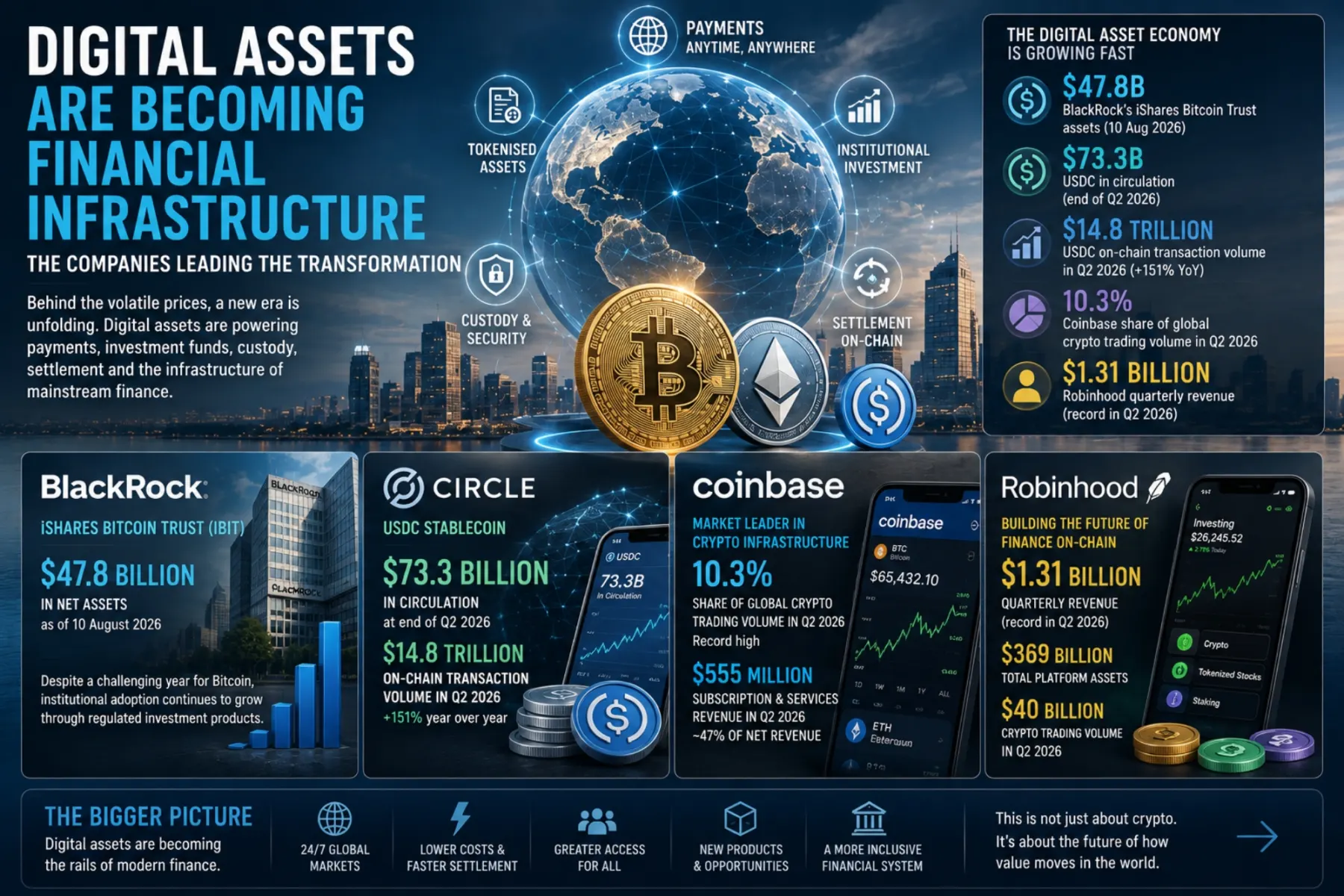
BlackRock now manages almost $48 billion through its flagship Bitcoin product, Circle’s USDC reached $73.3 billion in circulation at the end of the second quarter, Coinbase has continued gaining trading market share and Robinhood is building tokenised securities and blockchain services alongside its traditional brokerage business. Behind the volatile cryptocurrency prices, a quieter transformation is taking place: digital assets are moving from a specialist market into payments, investment funds, custody, settlement and the infrastructure of mainstream finance.
For much of their history, digital assets could be summarised by one question:
What is Bitcoin worth today?
That question still attracts attention. But in 2026, it increasingly misses the larger development taking place underneath the market.
Some of the world’s largest asset managers are offering regulated cryptocurrency investment products. Banks are developing digital-asset custody systems. Stablecoins are moving trillions of dollars across blockchain networks. Traditional securities are being tokenised. Payment companies are experimenting with blockchain settlement. Financial institutions are constructing infrastructure capable of moving conventional assets around the clock.
And a group of companies has begun turning those developments into substantial businesses.
The most important change is therefore not simply that cryptocurrency survived another market cycle.
It is that digital assets are starting to become infrastructure.
BlackRock provides perhaps the clearest evidence. Its iShares Bitcoin Trust ETF had approximately $47.8 billion in net assets on 10 August 2026, despite Bitcoin having experienced another difficult and volatile year. BlackRock’s Ethereum products add billions more in digital-asset exposure.
Circle, meanwhile, reported $73.3 billion of USDC in circulation at the end of the second quarter, while quarterly USDC on-chain transaction volume reached $14.8 trillion, 151% more than a year earlier.
Coinbase reported that its share of crypto trading volume reached a company record 10.3% during Q2 2026, while subscription and services revenue reached $555 million and represented almost half of net revenue.
Robinhood generated a record $1.31 billion of quarterly revenue, held $369 billion in total platform assets and processed $40 billion of crypto trading volume across its app and Bitstamp operation during the quarter.
These businesses are not identical.
That is precisely why they matter.
Together they reveal the different layers of the emerging digital-asset economy.
Digital Assets Are Becoming Much Bigger Than Cryptocurrency
The term “digital assets” once functioned almost as another name for cryptocurrencies.
That definition is becoming outdated.
Today the category increasingly includes:
Bitcoin and other cryptocurrencies;
stablecoins;
tokenised government bonds;
tokenised money-market funds;
digital securities;
blockchain-based payment instruments;
institutional digital custody;
programmable financial assets;
and potentially conventional shares, funds and other securities represented on distributed ledgers.
That distinction matters.
A Bitcoin investment product and a tokenised US Treasury fund both use digital-asset infrastructure, but their economic purposes are completely different.
One gives investors exposure to a volatile decentralised cryptocurrency.
The other may represent ownership of conventional financial assets using blockchain technology.
The future of digital assets therefore does not depend on every cryptocurrency increasing in value.
Blockchain-based finance can expand even during periods when cryptocurrency prices are falling.
That may be one of the most important signs that the sector is maturing.
BlackRock: The Company That Brought Digital Assets Into Mainstream Asset Management
Few developments changed the institutional perception of Bitcoin more dramatically than the arrival of BlackRock.
The company is not a cryptocurrency start-up.
It is one of the world’s dominant asset managers.
That distinction gave its entry into digital assets unusual significance.
The iShares Bitcoin Trust ETF, known by its ticker IBIT, provides Bitcoin exposure through a conventional exchange-traded structure rather than requiring investors to purchase Bitcoin directly and manage private keys themselves.
By 10 August 2026, IBIT had approximately $47.8 billion in net assets.
The number is striking for another reason.
IBIT’s year-to-date return remained deeply negative because Bitcoin had fallen substantially during 2026.
Yet tens of billions of dollars remained inside the product.
That illustrates the difference between price performance and structural adoption.
Bitcoin can fall while the infrastructure connecting Bitcoin to traditional financial markets continues expanding.
BlackRock has also moved beyond Bitcoin.
Its iShares Ethereum Trust held approximately $5.65 billion in net assets on 7 August, while a newer staked Ethereum product had grown to roughly $576 million.
For traditional investors, the significance is considerable.
Digital-asset exposure no longer necessarily requires a specialist crypto exchange.
It can increasingly sit beside shares, bonds and ETFs inside conventional brokerage infrastructure.
BlackRock’s More Important Experiment May Eventually Be Tokenisation
Cryptocurrency investment products attract headlines.
Tokenisation could ultimately have greater implications for financial markets.
BlackRock launched the USD Institutional Digital Liquidity Fund — BUIDL — with digital-securities platform Securitize.
Instead of creating a new speculative cryptocurrency, the project represents conventional financial assets through blockchain infrastructure.
Securitize acts as the digital platform through which the fund is made available.
That changes the nature of the blockchain proposition.
The question is no longer:
Can blockchain create a new currency?
It becomes:
Can blockchain improve the way existing financial assets are issued, owned, transferred and settled?
That is a much larger potential market.
Shares.
Bonds.
Money-market funds.
Private credit.
Funds.
Collateral.
And eventually other financial claims could potentially be represented digitally.
The financial asset remains conventional.
The infrastructure underneath it changes.
Securitize: Building the Bridge Between Securities and Blockchains
That places Securitize in an unusually interesting position.
The company is less familiar to the general public than Coinbase or BlackRock because its primary role is not consumer crypto trading.
It operates in the infrastructure required to bring regulated financial assets onto blockchain networks.
Its collaboration with BlackRock on BUIDL demonstrates the importance of that role.
Tokenising a security is not simply a matter of creating a digital token.
Regulated financial assets involve ownership records.
Investor eligibility.
Transfer restrictions.
Identity.
Compliance.
Dividend or interest distributions.
Custody.
Reporting.
Redemption.
And legal rights.
The technology has to interact with all of them.
That creates a business opportunity for companies capable of combining blockchain technology with financial regulation.
The winner in tokenisation may therefore not necessarily be the company creating the most exciting blockchain.
It may be the company that makes blockchain finance sufficiently reliable and ordinary for institutions to use.
Circle: Turning the Dollar Into a Digital Asset
If BlackRock represents the institutional investment side of digital assets, Circle represents digital money.
Its principal product, USDC, is designed to maintain a value of one US dollar while moving over blockchain networks.
The difference between USDC and Bitcoin is fundamental.
Bitcoin is designed as an independent scarce digital asset.
USDC is designed to represent stable dollar-denominated value.
That makes its potential uses very different.
Payments.
Trading.
Settlement.
Corporate treasury.
Cross-border transfers.
Digital commerce.
Collateral.
And increasingly tokenised capital markets.
At the end of Q2 2026, Circle reported $73.3 billion of USDC in circulation, 19% more than a year earlier.
The more remarkable number may be transaction activity.
USDC generated $14.8 trillion of on-chain transaction volume during the second quarter alone, according to Circle, an increase of 151% year on year.
Not all of that represents people buying coffee or companies paying invoices.
Trading, institutional transfers, treasury movements and automated blockchain transactions contribute significantly.
But the scale demonstrates that stablecoins are already functioning as substantial financial infrastructure.
Circle Has Become a Real Operating Business, Not Merely a Token Issuer
Circle’s financial results also illustrate how commercial the stablecoin market has become.
The company generated $701 million of revenue and reserve income in Q2 2026, 7% more than a year earlier.
Net income from continuing operations was $48 million, while adjusted EBITDA reached $143 million.
Circle earns significant revenue from the reserve assets backing USDC.
That makes stablecoin economics fundamentally different from many traditional crypto businesses.
A crypto exchange often earns more when people trade frequently.
A stablecoin issuer can benefit from the amount of currency circulating and the returns generated on reserve assets, subject to regulation and distribution arrangements.
As of 10 August, BlackRock’s Circle Reserve Fund itself contained approximately $61.2 billion, invested in highly liquid government instruments supporting part of Circle’s reserve infrastructure.
That is an extraordinary meeting point between old and new finance.
A stablecoin moves across public blockchain networks.
Much of the financial backing behind it remains based on some of the most traditional assets in global finance: cash and short-term US government securities.
Circle’s Next Bet Is an Entire Blockchain for Finance
Circle is now attempting to move further up the financial infrastructure stack.
Its Arc blockchain is scheduled for public mainnet launch on 16 September 2026.
The planned network is focused on programmable finance, stablecoins, tokenised real-world assets and institutional financial activity.
What makes the project particularly interesting is the group of institutions already associated with its development.
Circle has announced a founding validator cohort including BlackRock, DTCC, Mastercard, Visa, Standard Chartered, ICE, Galaxy, Global Payments, MoneyGram, SBI Group and Sumitomo Corporation.
BlackRock is expected to deploy BUIDL on Arc.
DTCC is exploring tokenisation of assets held through its Depository Trust Company infrastructure.
Other institutions are examining digital custody, stablecoin access, foreign-exchange and repo applications.
Those are planned integrations rather than proof that the network will succeed.
But they demonstrate how far the conversation has moved.
A few years ago, blockchain advocates were asking whether traditional finance would use public digital-asset infrastructure.
Today, traditional financial institutions are helping build it.
Coinbase: From Crypto Exchange to Financial Infrastructure Company
Coinbase is another company whose evolution illustrates the maturation of the sector.
Its original business was relatively straightforward.
People bought and sold cryptocurrency.
Coinbase collected transaction fees.
That model made the company extremely sensitive to crypto-market cycles.
When Bitcoin enthusiasm surged, trading revenue surged.
When the market collapsed, revenue could fall sharply.
Coinbase has spent several years attempting to change that relationship.
The Q2 2026 numbers suggest substantial progress.
Its share of crypto trading volume reached a record 10.3%, up from 9.1% during the first quarter and representing the company’s third consecutive quarterly market-share increase.
But the more important figure may be the composition of revenue.
Coinbase said 88% of Q2 net revenue came from activities other than Bitcoin spot trading.
Subscription and services revenue reached $555 million, compared with only $6 million in the second quarter of 2020.
That division represented 48% of net revenue during the latest quarter.
This is a fundamentally different business from the Coinbase of crypto’s earlier era.
Coinbase Is Trying to Become an “Everything Exchange”
The company now operates across multiple areas.
Spot cryptocurrency trading.
Derivatives.
Stablecoins.
Institutional custody.
Payments.
Blockchain infrastructure.
Staking.
International markets.
And emerging financial products.
Coinbase also reported its 14th consecutive quarter of positive adjusted EBITDA despite a comparatively difficult crypto market during 2026.
Another important measure is USDC.
Average USDC held within Coinbase products reached an all-time high of $20 billion during Q2.
The relationship between Coinbase and Circle illustrates another characteristic of the emerging industry.
The strongest companies are increasingly interconnected.
Circle issues USDC.
Coinbase distributes and uses it.
Blockchains move it.
Institutional custodians safeguard digital assets.
Traditional financial companies connect them to existing markets.
An ecosystem is forming rather than one company controlling the entire chain.
Base Could Be One of Coinbase’s Most Important Long-Term Assets
Coinbase is also building technology beneath its own exchange.
Its Base blockchain has become a platform for digital applications, stablecoin transactions and on-chain financial activity.
Coinbase reported that stablecoin transaction volume on Base increased sevenfold year on year during Q2 2026.
The strategic logic is significant.
An exchange earns when customers use the exchange.
A blockchain ecosystem can participate in a much broader range of financial activity.
Payments.
Applications.
Trading.
Digital identity.
Tokenisation.
Automated financial transactions.
The long-term Coinbase proposition is therefore increasingly less about predicting the price of Bitcoin and more about whether financial activity itself moves onto crypto infrastructure.
Robinhood: Bringing Digital Assets Into the Consumer Investment Account
Robinhood approaches digital assets from another direction.
It began primarily as a consumer brokerage rather than a crypto-native company.
That provides an important advantage.
Millions of customers already use its platform for traditional financial products.
Digital assets can be added alongside them.
Robinhood reported 28.4 million funded customers at the end of Q2 2026 and total platform assets of $369 billion, 32% higher than a year earlier.
Quarterly revenue reached a record $1.31 billion, while net income increased 48% year on year to $573 million.
Crypto trading itself had a weaker quarter.
Robinhood’s cryptocurrency revenue fell 38% year on year to $100 million.
That is worth acknowledging because success in digital assets does not mean every metric moves upwards continuously.
Yet its broader digital-asset footprint continued expanding.
Total crypto notional trading volume was $40 billion, including $22 billion through Bitstamp.
Robinhood Is Betting on Tokenised Shares
The more forward-looking part of Robinhood’s strategy concerns tokenisation.
The company has launched the public mainnet of Robinhood Chain, an Ethereum Layer 2 network designed for financial services and real-world assets.
It has also announced stock tokens available to eligible users through Robinhood Wallet in more than 120 countries.
This development could become significant if tokenised securities grow.
Traditional stock markets operate according to defined trading hours, settlement arrangements and geographic structures.
Blockchain-based representation creates the possibility of financial assets moving differently.
Potentially longer trading hours.
More automated settlement.
Greater programmability.
Cross-border distribution.
And easier integration with other digital financial products.
Regulation remains critical, and tokenised securities still represent securities rather than escaping existing legal obligations.
But Robinhood’s strategy demonstrates how quickly brokerage and blockchain technology are beginning to converge.
Fireblocks: The Company Building the Plumbing
Some of the most important companies in a technological revolution are almost invisible to the final customer.
Fireblocks is an example.
It provides digital-asset infrastructure used by financial institutions, payment companies, exchanges and other businesses to manage wallets, custody, transfers, stablecoins and tokenisation.
The company says it works with more than 95 banks and that thousands of organisations use its infrastructure across more than 150 blockchains.
That places Fireblocks in a different part of the value chain from Coinbase.
A bank does not necessarily want to build an entire digital-asset security and wallet architecture internally.
It may instead use specialist infrastructure.
The analogy is similar to cloud computing.
Most companies do not build their own global data-centre networks.
They purchase infrastructure from companies specialising in it.
Digital finance could develop in much the same way.
Banks Are Preparing for Digital Assets Even Before Most Have Fully Deployed Them
Fireblocks’ 2026 survey of more than 600 senior decision-makers across banks, custodians, financial-market infrastructure providers and corporate clients provides an interesting indication of institutional direction.
According to the company’s research, 88% of surveyed financial institutions had committed or expected to commit budget to digital-asset infrastructure during 2026, while only 16% said they had reached production.
Only 15% considered their custody and wallet-governance infrastructure fully production-ready.
The study is company-sponsored research and should therefore be interpreted as an industry survey rather than an official measurement of the entire global banking system.
Nevertheless, the gap is revealing.
Money is being allocated before infrastructure is fully operational.
That resembles the early phases of other major technology transitions.
Financial institutions increasingly appear to be asking not whether digital assets will matter, but which systems they need before they can use them safely.
That is precisely the market companies such as Fireblocks are attempting to serve.
Visa Demonstrates That Blockchain Is Entering Payments Without Replacing Cards
Traditional payment companies provide another important piece of evidence.
Visa has been developing stablecoin settlement capabilities that allow selected issuers to settle through supported stablecoins such as USDC, including seven-day-a-week settlement arrangements.
The significance is subtle.
Visa is not abandoning its payment network and replacing everything with cryptocurrency.
It is connecting blockchain-based money to the existing network.
That may ultimately be the more realistic adoption model.
New infrastructure does not always destroy old infrastructure.
Sometimes the two merge.
A consumer may eventually use a stablecoin-linked payment product without knowing or caring whether part of the settlement process used a blockchain.
That is often what mature technology looks like.
The technology disappears behind the service.
Stablecoins Could Become the First Digital Asset Used by Billions Without Most People Thinking About Crypto
Bitcoin attracts more attention because its price moves dramatically.
Stablecoins may have the more straightforward path to everyday use.
Their proposition is easily understood:
move familiar currency using modern digital infrastructure.
For international businesses, that could potentially mean faster settlement.
For financial institutions, it can mean moving dollar-denominated value outside normal banking hours.
For digital markets, stablecoins can provide the cash side of a transaction.
For emerging-market users, dollar-denominated digital assets can provide another method of accessing widely used international currency.
Visa describes stablecoins as increasingly relevant to cross-border trade, wholesale settlement and consumer banking, not merely cryptocurrency trading.
That is a fundamental change.
Crypto infrastructure is beginning to serve people who may have no interest in speculating on crypto prices.
Regulation Is Becoming an Enabler Rather Than Only a Constraint
Another reason companies are investing more heavily is that the legal environment has become clearer in several major markets.
The European Union’s MiCA framework has established a common regime for crypto-asset service providers, with ESMA maintaining a central register of authorised businesses. The final transitional period for unauthorised providers ended during 2026.
The United States established a federal framework for payment stablecoins through the GENIUS Act in July 2025, including requirements around reserve backing and regulatory supervision.
In March 2026, the US Securities and Exchange Commission also issued an interpretation clarifying how federal securities laws apply to different categories of crypto assets and transactions, alongside greater coordination with the Commodity Futures Trading Commission.
Regulation creates costs.
But uncertainty also creates costs.
A major bank may hesitate to invest hundreds of millions in infrastructure if nobody can explain which rules will apply.
Clearer regulation gives companies specifications against which they can build.
That is one reason institutional participation is accelerating.
The Most Successful Companies Are Moving Away From the Old Crypto Business Model
A pattern emerges when the leading companies are considered together.
BlackRock is not building its digital-asset strategy around transaction speculation.
Circle is developing stable digital money and settlement infrastructure.
Coinbase is diversifying away from dependence on Bitcoin trading fees.
Securitize is tokenising regulated financial products.
Fireblocks is selling digital infrastructure to institutions.
Robinhood is combining conventional brokerage with tokenised assets and blockchain technology.
Visa is connecting stablecoins to established payments infrastructure.
The centre of gravity is shifting.
The first crypto businesses largely earned money when people traded cryptocurrencies.
The next generation is increasingly trying to earn money because financial activity itself uses digital-asset infrastructure.
That is a much larger ambition.
Tokenisation Could Become the Industry’s Next Major Growth Market
Imagine a conventional investment fund represented digitally.
Ownership can potentially be updated rapidly.
Transfers can be programmable.
Settlement can interact with digital cash.
Collateral can potentially move around the clock.
Administrative processes can be automated.
That does not mean every asset should be tokenised.
Nor does it mean blockchain automatically makes financial markets more efficient.
Legal ownership still matters.
Regulators still matter.
Identity still matters.
Liquidity still matters.
Cybersecurity still matters.
But the potential economic opportunity is substantial enough that BlackRock, DTCC, banks, exchanges and specialist technology companies are actively investing in it.
The biggest digital-asset market of the future may therefore not be a new cryptocurrency.
It could be existing assets represented in a new technological format.
Artificial Intelligence Could Make Digital Assets Even More Important
Another emerging development is the intersection between blockchain and artificial intelligence.
AI systems increasingly act autonomously.
They can search.
Purchase services.
Use computing resources.
Interact with software.
Eventually, autonomous software may also need mechanisms for making very small machine-to-machine payments.
Traditional banking systems were designed for people and companies.
They were not designed primarily for millions of software agents making transactions continuously.
Coinbase says more than 99% of the on-chain agentic commerce measured through its ecosystem during Q2 used USDC, while more than 90% of agentic stablecoin transaction volume ran through Base. These figures reflect Coinbase’s own network and definitions rather than the entirety of global AI commerce, but they show an emerging use case worth watching.
Circle’s forthcoming Arc platform is likewise being designed with programmable and agent-based finance in mind.
The next digital consumer may not always be human.
The Industry Is Developing During a Difficult Crypto Market — And That Matters
Perhaps the most encouraging aspect of the 2026 development is the timing.
Bitcoin and Ethereum have both experienced substantial price declines this year.
BlackRock’s IBIT showed a year-to-date decline of around 26% by early August, while its Ethereum product had fallen even more.
Robinhood’s crypto trading revenue has declined.
Coinbase has operated through weaker overall crypto-market activity.
Yet infrastructure development has continued.
USDC circulation has increased.
Tokenisation projects have expanded.
Banks continue allocating budgets.
New institutional products are being launched.
That is important because genuine industries have to function during bad markets as well as good ones.
A sector that exists only while asset prices are rising is speculation.
A sector that continues building when prices fall begins to look more like an industry.
Success Should Not Be Confused With Investment Certainty
The positive development of digital assets does not mean every company or token associated with the sector will succeed.
Digital assets remain a competitive and rapidly changing industry.
Regulation can alter business models.
Technology can become obsolete.
Cybersecurity failures can be expensive.
Crypto prices remain volatile.
Tokenisation projects may fail to attract sufficient liquidity.
Stablecoin issuers face regulatory and interest-rate risks.
Trading platforms remain exposed to market cycles.
Even successful companies can have falling share prices or disappointing quarters.
The distinction is essential.
The argument for the development of digital assets is much stronger than the argument that every digital-asset investment will rise.
Technological adoption and investment returns are related.
They are not the same thing.
The Winners May Be the Companies That Make Crypto Boring
This is perhaps the most interesting possibility.
The great success of digital assets may arrive when people stop talking constantly about digital assets.
When sending a stablecoin feels no more unusual than sending an email.
When an investor buys a tokenised fund without needing to understand the blockchain underneath it.
When a bank settles assets overnight automatically.
When an international payment moves on Sunday because the underlying infrastructure operates continuously.
When a financial institution uses digital custody without advertising itself as a “crypto company”.
When blockchain becomes plumbing.
The internet achieved mass adoption partly because users eventually stopped needing to understand TCP/IP.
Digital assets could follow a similar trajectory.
BlackRock, Circle and Coinbase Represent Three Different Futures
The current leaders illustrate three broad directions.
BlackRock represents institutional investment and tokenisation.
It shows how conventional asset management can absorb digital assets without abandoning traditional financial structures. Its almost $48 billion Bitcoin product demonstrates the scale that regulated access can achieve.
Circle represents programmable money.
Its $73.3 billion USDC circulation and trillions of dollars in quarterly blockchain activity demonstrate that stable digital currency has become a major financial category.
Coinbase represents the digital financial marketplace.
Its business is expanding from cryptocurrency trading towards stablecoins, payments, derivatives, infrastructure and blockchain-based services.
Around them sit companies such as Securitize and Fireblocks building the infrastructure, and companies such as Robinhood and Visa connecting that infrastructure to millions of existing financial customers.
No single business owns the future.
The ecosystem is becoming large enough for several different kinds of winner.
The Next Phase Is About Integration
The first phase of digital assets was about invention.
Could digital money exist without a central issuer?
Bitcoin answered that question.
The second phase was about speculation.
Thousands of cryptocurrencies emerged and digital assets became an international investment market.
The third phase now appears to be about integration.
Crypto exchanges connecting to banks.
Stablecoins connecting to payment systems.
Blockchains connecting to asset managers.
Tokenised funds connecting to traditional securities.
Digital custody connecting to institutional portfolios.
And artificial intelligence potentially connecting to programmable money.
That is a fundamentally different stage of development.
The Most Important Digital-Asset Companies May Eventually Stop Looking Like Crypto Companies
The boundaries are already becoming difficult to identify.
Is BlackRock a digital-asset company because it manages one of the world’s largest Bitcoin products and develops tokenised funds?
Is Visa a digital-asset company because it supports stablecoin settlement?
Is Robinhood a crypto company because it operates a blockchain and distributes tokenised assets?
Is Circle a payments company, stablecoin company or blockchain infrastructure company?
The categories are beginning to merge.
That may be the strongest evidence of all that digital assets are moving towards the mainstream.
Successful technology eventually stops existing as an isolated industry.
It becomes part of every other industry.
From Speculation to Infrastructure
Digital assets still carry risks, and cryptocurrency prices remain volatile enough to remind investors that technological progress does not remove financial uncertainty.
But beneath those prices, something significant is developing.
Almost $48 billion sits in BlackRock’s flagship Bitcoin product.
Circle has more than $70 billion of USDC circulating through the digital economy.
Coinbase is reporting record trading market share while almost half of its net revenue now comes from subscription and services activities.
Robinhood is combining hundreds of billions of dollars of conventional customer assets with blockchain-based products.
Securitize is helping one of the world’s largest asset managers place regulated funds on-chain.
Fireblocks is supplying digital infrastructure to banks.
Visa is connecting stablecoin settlement with one of the world’s largest payment networks.
These developments do not prove that blockchain will replace the financial system.
The more plausible outcome may be more interesting.
Blockchain could become part of the financial system.
The companies currently leading digital assets are increasingly those that understand this distinction.
They are no longer trying merely to persuade the world to buy crypto.
They are building systems through which money, investments and financial assets can move differently.
That is why 2026 may eventually be remembered as an important period for digital assets even if cryptocurrency prices themselves remain volatile.
The biggest breakthrough is no longer simply that digital assets have survived.
It is that some of the world’s most important financial companies have begun building businesses on top of them.
Source & Transparency
This article is published by Ireland Newspaper for editorial and informational purposes.
Published: 11 August 2026 · Updated: 11 August 2026

Newsroom Ireland Newspaper
Ireland Newspaper editorial team prepares daily news coverage for readers in Ireland and abroad.




Market data, financial news and economy content on Ireland Newspaper are provided for editorial and informational purposes only. They do not constitute financial advice, investment advice, trading advice or a recommendation to buy, sell or hold any financial product. Always verify live prices and consult a qualified professional before making financial decisions.