From Tenant Fields to Global Markets: How 200 Years Remade Irish Farming
Famine, land reform, emigration, mechanisation, European integration and global trade transformed Irish agriculture beyond recognition. Today’s farmer operates in a productive, export-driven and technologically advanced sector — but one still shaped by family ownership, volatile incomes, an ageing population and a new environmental challenge.
Two hundred years ago, the central economic question for a large part of rural Ireland was whether access to a few acres of land could sustain a family. Today, an Irish farmer may be making decisions about milk solids, cattle prices, fertiliser costs, interest rates, environmental schemes, carbon emissions, succession planning, renewable energy and demand in international markets.
The fields may still look familiar. The economic system behind them does not.
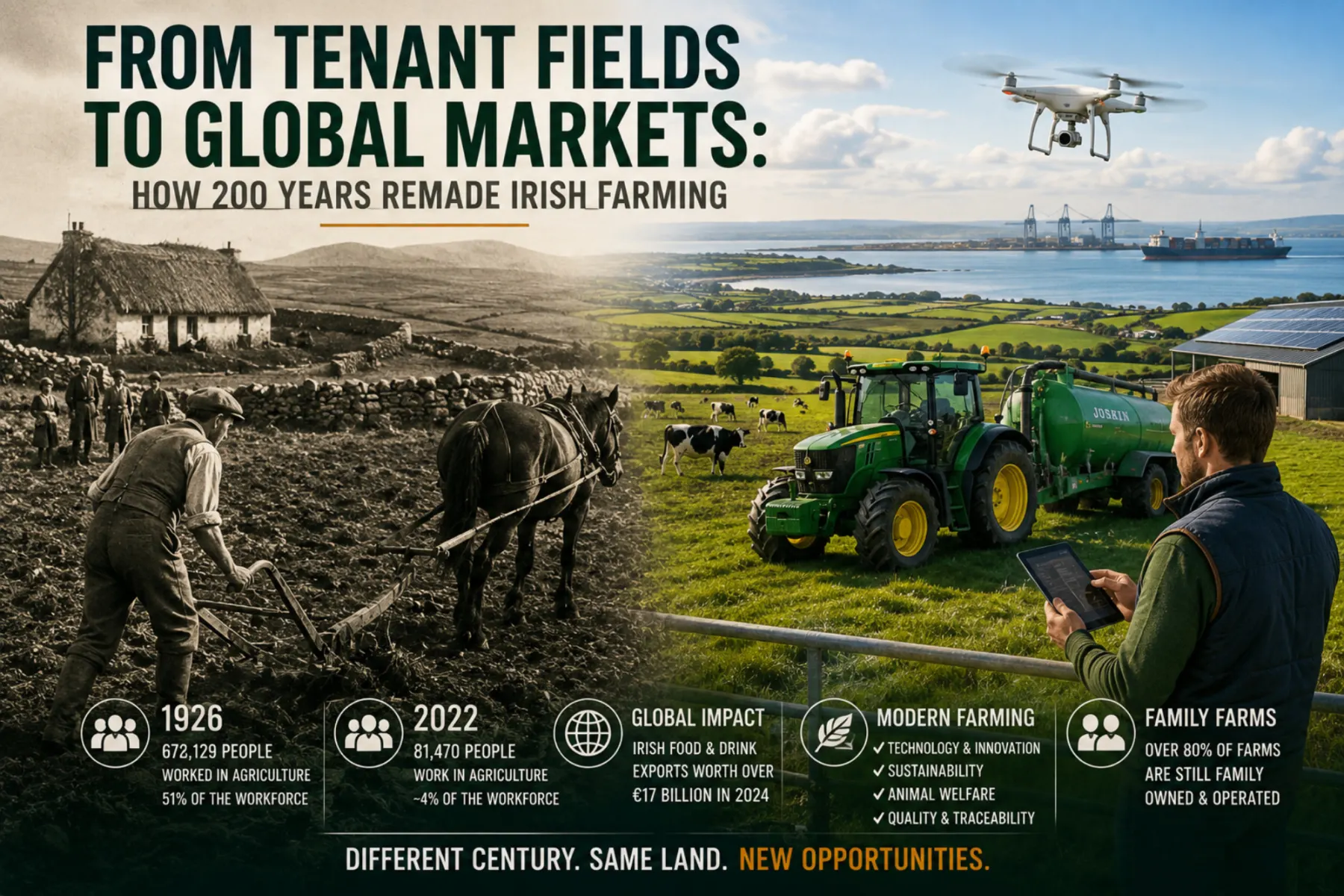
Few sectors illustrate Ireland’s transformation as clearly as farming. In 1926, agriculture employed 672,129 people — 51 per cent of the entire Irish workforce. By the 2022 Census, the comparable number had fallen to 81,470, or almost 4 per cent of those at work. Yet agriculture still occupies most of Ireland’s productive landscape, feeds a major export industry and remains economically and socially important to large parts of rural Ireland.
The story of how that happened is not simply one of farms becoming larger or tractors replacing horses. It is a story of changing ownership, population collapse and recovery, technological progress, European integration, international markets and an extraordinary shift in what it actually means to be an Irish farmer.
When Land Was About Survival
To understand Irish farming today, it is necessary to begin in the early nineteenth century, when Ireland was overwhelmingly rural and access to agricultural land shaped the lives of much of the population.
Agriculture operated within a complicated hierarchy of landlords, tenants, sub-tenants, smallholders and agricultural labourers. Conditions varied greatly by region and farm size, and it would be misleading to describe every Irish farmer of the period in the same way. But for many poorer rural households, a small plot of land was not primarily a commercial business asset. It was the basis of subsistence.
This created an agricultural economy capable of supporting a large rural population but also one in which many families had little protection against a catastrophic harvest failure.
That vulnerability became devastatingly apparent during the Great Famine.
Between 1845 and 1852, more than one million people died and more than one million left Ireland. The population of the territory that now forms the Republic had exceeded 6.5 million in the 1841 Census. Famine mortality followed by decades of heavy emigration contributed to the population being roughly halved by 1901.
The potato blight was the immediate agricultural shock, but the scale of the disaster cannot be understood through crop disease alone. Poverty, limited economic alternatives, dependence among poorer households on a narrow food base, the structure of landholding and the capacity of families to withstand harvest failure all influenced the consequences.
The Famine therefore became much more than an agricultural crisis. It altered Irish demography, rural communities, land use and the structure of farming itself.
The Long Retreat from Subsistence Farming
The decades after the Famine produced a very different countryside.
Continued emigration reduced the rural population. Holdings changed hands or were consolidated. Livestock and grass-based farming became increasingly important, while the intensive cultivation of crops associated with the earlier subsistence economy declined dramatically.
The scale of that change can still be seen in agricultural statistics.
In 1916, around 172,000 hectares were devoted to potatoes and approximately 294,000 hectares to oats. By 2010, those areas had fallen to roughly 12,000 and 20,000 hectares respectively. At the same time, grass remained the overwhelmingly dominant use of Irish farmland.
This was not simply farmers abandoning one crop for another. Irish agriculture was gradually moving from a system in which much production supported rural households directly towards one increasingly centred on livestock, commercial sales and external markets.
Another fundamental transformation was occurring at the same time: the relationship between the farmer and the land itself was changing.
From Tenant to Owner
The nineteenth-century struggle over land was simultaneously economic, political and social.
Successive land reforms altered rents, tenant rights and eventually ownership. The process was gradual rather than the result of a single law. But by the beginning of the twentieth century, state-supported land purchase had become a powerful mechanism for transferring farms from landlords to their occupiers.
The 1903 Irish Land legislation was particularly significant. Parliamentary debate at the time described a system under which public finance would facilitate transactions: owners would sell land through the state and occupiers would acquire it under long-term purchase arrangements.
The change did not happen overnight, nor did it remove every inequality in Irish agriculture. But over time it helped establish one of the defining characteristics of modern Irish farming: the owner-operated family farm.
Statistics from 1916 already show a countryside in transition. There were 443,695 recorded holdings when very small plots of less than an acre were included, of which 157,470 — 35.5 per cent — were classified as tenanted. Historical and modern definitions are not directly comparable, but by 2010 only 3.4 per cent of farms rented all of their land, although almost 30 per cent rented at least some additional acreage.
The significance of ownership extended far beyond property law. A farmer who expected land to remain within the family had a different incentive to improve buildings, drainage, livestock and soil than somebody farming under insecure tenure.
It also strengthened something that remains visible today: the expectation that the farm will pass from one generation of a family to another.
Independence Inherited an Agricultural Country
When the Irish Free State emerged in the 1920s, it inherited an economy in which farming was not merely one industry among many. It was the economic foundation of much of the country.
The first census of the new state makes that clear. In 1926, more than half of all working people were employed on the land. In several western counties, dependence on agricultural employment was considerably greater.
For rural Ireland, the farm was also often more than the workplace. It was the family home, an inheritance, a source of food, a form of economic security and a central part of local social structures.
But agricultural dependence had another side. Ireland’s limited industrial base meant that opportunities outside farming remained restricted in many regions. Small farms could sustain families, but not necessarily provide incomes comparable with those available in more industrialised economies.
For much of the twentieth century, emigration therefore remained part of the economic reality of rural Ireland.
The population of what is now the Republic eventually reached a low point of about 2.8 million in 1961, after more than a century in which Famine mortality and subsequent outward migration had dramatically altered the country’s demographic structure.
By then, however, another revolution was under way.
Machines Changed the Farm — and the Rural Workforce
Mechanisation gradually changed the economics of agricultural labour.
Tractors, improved machinery, artificial fertilisers, better animal breeding, veterinary medicine, improved grassland management and new production techniques allowed substantially more output to be produced with fewer workers.
The effect over generations was enormous.
Official historical comparisons show, for example, that yields per hectare for major crops increased dramatically during the twentieth century. At the same time, livestock farming became more productive and increasingly specialised.
Mechanisation also changed rural society.
Tasks that once required several family members or hired labour could increasingly be performed by one person with machinery. Young people had greater opportunities to work elsewhere. Education expanded. Roads, communications and transport improved. Farm households became progressively integrated into the wider cash economy.
Agriculture did not disappear. It became less labour-intensive.
This distinction is crucial. Falling agricultural employment did not necessarily mean that farming was producing less. In many cases, exactly the opposite was happening: fewer people were producing considerably more.
The transformation accelerated after one of the most important dates in modern Irish agricultural history.
1973: The European Turning Point
Ireland’s accession to the European Economic Community in 1973 fundamentally changed the environment in which Irish farmers operated.
The Common Agricultural Policy provided agricultural supports, greater market certainty and access to a much larger European marketplace. Investment in farms accelerated, production systems became more commercial and many farms expanded.
Teagasc describes the fifty years following membership as a period in which Irish agriculture became increasingly modernised, mechanised and specialised, accompanied by substantial productivity and efficiency improvements.
Early CAP support was often connected to production. That created incentives for farms capable of expansion to produce more. At the same time, financial support made investment in buildings, machinery, livestock and farm improvement easier. Economies of scale favoured larger operations in some sectors. The result was a continuing decline in farm numbers alongside increasing average scale and specialisation.
Mixed farming became less common.
A holding that might once have kept dairy cows, beef cattle, pigs, poultry and several crops increasingly concentrated on one principal enterprise. Dairy farmers became dairy specialists. Beef production developed distinct suckler and finishing systems. Pig and poultry production became far more concentrated.
The pig sector provides an unusually vivid illustration. Teagasc records that in 1960 Ireland had around 111,000 pig farmers with an average of only eight pigs. By 2023, it estimated only about 280 commercial pig farms remained, operating on an entirely different scale and producing millions of pigs annually.
The same structural principle, though not always to the same degree, appeared throughout agriculture: fewer producers, greater specialisation and higher output per worker.
From the British Market to the World
European membership also changed where Irish food could be sold.
Britain remained an important destination, but Irish producers became part of the European single market and increasingly connected to markets much further afield. Teagasc credits EU membership with greatly expanding the market orientation of Irish agri-food exports beyond Britain’s traditional dominance.
This encouraged a profound change in the farmer’s economic position.
A nineteenth-century farmer might have been overwhelmingly concerned with local conditions and the ability of the farm to feed a household. A modern dairy, beef or tillage farmer can be affected by international commodity prices, exchange rates, energy costs, fertiliser markets, consumer demand overseas and geopolitical disruption thousands of kilometres from Ireland.
That connection creates opportunity, but also vulnerability.
Ireland’s food, drink and horticulture exports reached a record €19 billion in 2025, according to Bord Bia, up 12 per cent during a year it described as being shaped by geopolitical uncertainty, extreme weather, inflation and changing consumer behaviour.
The modern Irish farmer is therefore part of a global supply chain in a way that earlier generations could scarcely have imagined.
The Irish Farm of Today
The latest comprehensive CSO Farm Structure Survey counted 133,174 farms in 2023, with an average size of 34.7 hectares. Ireland had more than 4.6 million hectares of utilised agricultural land excluding commonage, and grassland accounted for 92 per cent of agricultural land.
Those figures reveal something important: despite two centuries of technological and economic transformation, Ireland remains fundamentally a grass-based agricultural country.
That geography helps explain why cattle and dairy production became so dominant.
In 2025, the value of Irish agricultural output reached approximately €14 billion, according to final CSO estimates. Cattle generated about €4.2 billion and milk almost €4.5 billion. Together, those two categories accounted for the majority of agricultural output value.
But the 2025 figures also demonstrate one of farming’s oldest economic problems: a farmer can produce well and still have limited control over the price eventually received.
Cattle production volume fell by 5 per cent in 2025, yet cattle prices rose by 43 per cent, increasing the value of cattle output by €1.1 billion. Milk volumes rose by 4 per cent and prices by 3 per cent. Meanwhile, the sector spent just over €8 billion on intermediate inputs, including feed, fertiliser, energy, maintenance and other production costs.
A modern farm may therefore possess machinery and productive capacity unimaginable 100 years ago while still being exposed to a familiar agricultural reality: weather, output prices and input costs can rapidly transform a good year into a difficult one.
There Is No Single “Irish Farmer”
National averages can disguise enormous differences.
Teagasc’s 2025 National Farm Survey estimated average family farm income across the major systems at approximately €53,842, up 49 per cent from 2024. But dairy farms averaged about €153,319, compared with around €24,061 for cattle-rearing farms, €32,798 for other cattle farms, €29,344 for sheep farms and €54,916 for tillage farms.
Those figures should not be interpreted as permanent income levels. Teagasc specifically notes substantial volatility: the five-year averages for 2021–2025 were considerably below the unusually strong levels recorded in 2025.
This helps explain why discussions about “farmer income” can be misleading.
A large dairy operation in Cork, a suckler farm in Leitrim, a sheep farm in Mayo and a tillage enterprise in Wexford may all be described as Irish farms, yet their capital requirements, labour demands, market exposure, land productivity and earning potential can be radically different.
Regional differences reinforce the divide. The CSO recorded median standard agricultural output of more than €34,000 in the South-East in 2023, compared with around €11,000 in the Border region.
Geography remains an economic force.
The Part-Time Farmer Is Not an Exception
Another major change has taken place quietly within the farm household.
Farming increasingly coexists with employment elsewhere.
In 2024, 43.4 per cent of Irish farm holders had an off-farm income, according to Teagasc. Among dairy farmers the proportion was only 10.6 per cent, but it exceeded half among some cattle and tillage categories.
This is not simply evidence that farming has become less important. In many cases, outside employment may be one of the mechanisms that allows a family farm to continue.
Income earned away from the holding can stabilise household finances when commodity prices fall, reduce dependence on a single agricultural enterprise and sometimes provide capital for investment back into the farm.
Modern rural Ireland has therefore developed a hybrid economic model that would have been far less common in earlier generations: a household can remain deeply connected to farming while simultaneously participating in construction, public services, manufacturing, professional employment or other sectors.
Support Payments Remain Part of the Economic Architecture
European agricultural policy has changed significantly since the early years of the CAP. Support has progressively become less closely linked to simply maximising production, while environmental requirements, rural development and payments for land management have gained importance.
Yet public support remains economically significant.
CSO figures show net agricultural subsidies of about €2.05 billion in 2025. That was equivalent to roughly 39 per cent of agricultural operating surplus and 45 per cent of entrepreneurial income.
The significance varies considerably between sectors and individual farms. But the figures show why agricultural policy is not a peripheral issue for rural Ireland.
It is part of the financial structure within which farming operates.
Over the past half-century, the purpose of that policy has also broadened. Farmers are increasingly being asked not only to produce food, but to manage water, soil, habitats, nutrients, carbon and biodiversity.
That may prove to be the next great transformation.
The New Constraint Is Environmental
For most of agricultural history, improving production meant overcoming physical scarcity: increasing yields, improving livestock, draining land, mechanising work and producing more with less labour.
The challenge of the twenty-first century is more complicated.
Farmers are still expected to remain economically viable and supply food, but agriculture must also operate within tightening climate, water-quality and environmental limits.
The Environmental Protection Agency estimates that Irish agricultural greenhouse-gas emissions declined by just 0.2 per cent in 2025. Cattle numbers fell by 3.3 per cent, but increased nitrogen fertiliser use and higher milk production offset much of the resulting emissions reduction. Agriculture emitted approximately 20.4 million tonnes of CO2 equivalent during the year.
This does not reduce the issue to a simple conflict between farming and environmental policy.
The challenge is structural. Ireland developed a highly successful grass-based livestock economy because its climate and land are particularly suited to grass production. The same concentration of ruminant agriculture means methane and agricultural emissions occupy an unusually important place in Ireland’s climate debate.
Future adjustment may therefore involve several changes occurring simultaneously: better breeding, improved nutrient efficiency, new technologies, lower-emission fertilisers, changes in animal numbers or production intensity, renewable energy, diversification, forestry, organic production and greater payment for environmental services.
Some of these changes are already visible. The CSO counted 4,168 organic farms in 2023, compared with 1,686 in 2020, while 5 per cent of farms reported having a renewable-energy source.
The eventual balance between food production, farm income and environmental performance remains unresolved.
The Next Problem Is Who Will Farm the Land
Perhaps the most important long-term challenge is not a commodity price or regulation.
It is age.
The average Irish farm holder was 59.4 years old in 2023. Less than half of holders — 47 per cent — reported having a succession plan. Where a successor had been identified, 98 per cent expected the farm to remain within the family.
That statistic connects modern Ireland directly to the land reforms of more than a century ago.
The family farm became one of the central institutions of Irish rural life because ownership passed into the hands of occupiers. That model proved remarkably durable. But it can also make structural change slow.
Land carries emotional, family and inheritance value as well as economic value. A farm may remain within a family even when its agricultural return alone would not justify its market value. Young people considering farming must weigh that inheritance against other careers, high capital requirements, long working hours, uncertain commodity prices and increasing regulatory complexity.
The question is therefore no longer simply whether a family has a farm to pass on.
It is whether the next generation wants — and can afford — to make farming its future.
Why There Will Be No Single Answer
The history of Irish agriculture offers a warning against searching for one explanation for complex change.
The Famine did not alone create modern Irish agriculture. Neither did the Land Acts, independence, mechanisation, the Common Agricultural Policy, globalisation or environmental regulation.
Each altered the system inherited from the period before it.
Population decline reduced pressure on the land. Land reform changed ownership. Mechanisation reduced the demand for labour. Economic development created jobs outside farming. European membership opened markets and supplied investment and income support. Specialisation increased productivity. International trade brought both opportunity and volatility. Environmental pressures are now changing the conditions under which future production can expand.
The effects have also been uneven.
Some farms have grown into highly productive businesses requiring substantial capital and advanced management. Others continue on relatively small holdings where agricultural income is supplemented by employment elsewhere. Some sectors have prospered during strong market conditions while others remain heavily dependent on support payments.
There is therefore no meaningful single description of the economic condition of “the Irish farmer”.
There are many Irish farming economies operating side by side.
What the Next Generation May Inherit
Over the next twenty years, the Irish farm is unlikely simply to become a larger version of today’s farm.
Technology will almost certainly become more important. Precision agriculture, genetics, automated milking, data-based grassland management, nutrient measurement, renewable energy and emissions-reduction technologies could change both productivity and labour requirements.
Environmental payments may also become a more important part of farm economics, particularly where the market value of food alone cannot deliver an adequate return from more marginal land.
Consolidation is likely to continue in some commercial sectors, although the cultural attachment to family ownership means Ireland may not follow the path of agricultural systems dominated by very large corporate farms.
Part-time farming is also likely to remain important. Rather than representing the disappearance of the family farm, it may increasingly be one of the ways in which smaller family farms survive.
Much will depend on forces farmers cannot fully control: international food prices, trade agreements, climate policy, interest rates, energy and fertiliser costs, extreme weather, technological progress and consumer demand.
That uncertainty is itself part of the continuity of farming.
Two Hundred Years, One Remarkable Transformation
The distance travelled by Irish agriculture over two centuries is extraordinary.
The farmer of the 1820s lived in a society in which land could determine whether a family survived. The farmer of the early twentieth century was increasingly becoming an owner rather than a tenant. The farmer of the 1950s was entering the age of machinery. The farmer of the 1970s was entering Europe. The farmer of the early twenty-first century became part of an increasingly sophisticated global food economy.
Today’s farmer faces another transition.
The challenge is no longer simply to produce more. It is to remain profitable while using land, nutrients, livestock, technology and natural resources in ways that can withstand economic volatility and increasingly demanding environmental constraints — and to create a farming system attractive enough for another generation to want to inherit it.
Ireland’s agricultural landscape did not arrive at its present form through one government, one policy or one economic event. It is the result of two centuries of demographic upheaval, political reform, technological progress, market integration and individual decisions made on hundreds of thousands of family farms.
The remarkable continuity is that the family farm survived all of them.
The question for the decades ahead is not whether Irish farming will change again.
After 200 years of history, that much is almost certain.
The real question is what kind of Irish farmer will be standing in those fields when the next transformation is complete.
Source & Transparency
This article is published by Ireland Newspaper for editorial and informational purposes.
Published: 11 August 2026 · Updated: 11 August 2026

Newsroom Ireland Newspaper
Ireland Newspaper editorial team prepares daily news coverage for readers in Ireland and abroad.