From Cheap Money to a New Interest-Rate Era: What Comes Next for Ireland?
Ireland entered the 2020s after years of exceptionally low borrowing costs, only to experience the fastest monetary tightening in the euro era. Rates then fell sharply through 2024 and 2025 before the ECB unexpectedly reversed course in June 2026 as a new energy shock lifted inflation risks. For Irish mortgage holders, savers and businesses, the next phase is unlikely to be a simple return to the ultra-low rates of the past.
For more than a decade, an entire generation of Irish borrowers became accustomed to something historically unusual: money was extraordinarily cheap.
European Central Bank interest rates fell close to zero and eventually below zero. Governments could borrow cheaply, banks had abundant liquidity and households became used to the idea that exceptionally low rates might be a permanent feature of the financial system.
They were not.
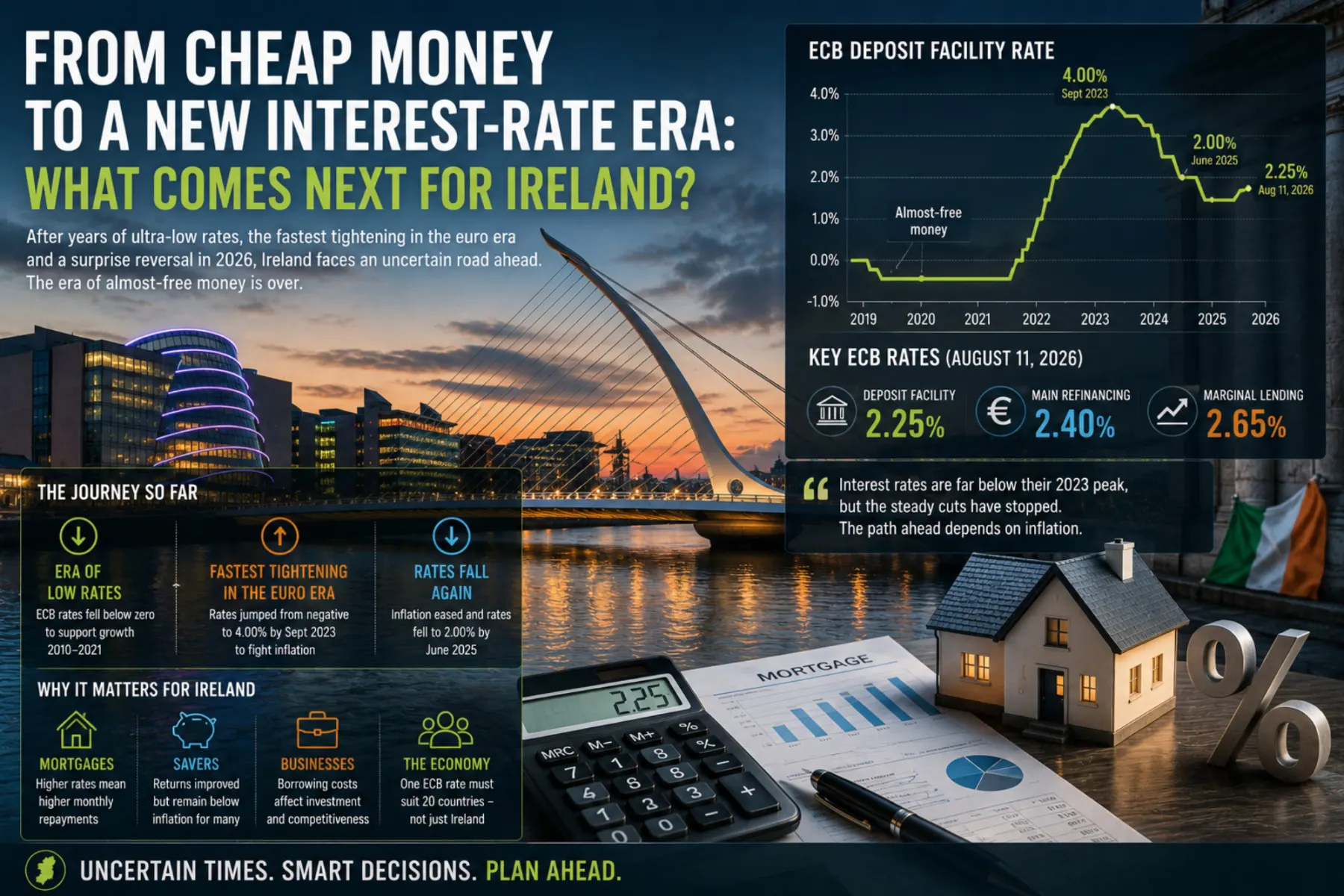
Beginning in 2022, inflation transformed the interest-rate environment. The ECB’s deposit facility rate moved from negative territory to 4.00 per cent by September 2023, one of the fastest tightening cycles since the creation of the euro.
Then the direction changed again.
As inflation subsided, the ECB began cutting rates in June 2024. By June 2025, its deposit facility rate had fallen to 2.00 per cent.
For a while, the direction appeared clear: inflation was moving back toward target and monetary policy was gradually normalising.
Then 2026 disrupted that path.
A renewed energy-price shock linked to conflict in the Middle East pushed inflation expectations higher. On 11 June 2026, the ECB raised all three of its key interest rates by 0.25 percentage points.
As of 11 August 2026, the ECB deposit facility rate stands at 2.25 per cent, the main refinancing rate at 2.40 per cent, and the marginal lending facility at 2.65 per cent. At its latest meeting on 23 July, the Governing Council left all three unchanged.
Ireland has therefore entered an unusually uncertain phase.
Interest rates are far below their 2023 peak, but the steady sequence of reductions has stopped.
Whether borrowing costs fall again, remain around current levels or rise further will depend primarily on what happens to inflation.
And for Ireland, there is an additional complication: Irish interest rates are not set according to the Irish economy alone.
Ireland Does Not Have an Irish Central-Bank Interest Rate
Before the euro, Ireland could operate its own monetary policy.
That is no longer the case.
As a member of the euro area, Ireland shares a common monetary policy with countries ranging from Germany and France to Spain, Italy, Portugal, Greece and the Baltic states.
The European Central Bank sets interest rates according to conditions across the entire euro area, with the objective of maintaining inflation at around 2 per cent over the medium term.
That distinction is fundamental when considering the outlook for Ireland.
Irish inflation could be above 3 per cent while another euro-area economy experiences much weaker price growth.
Ireland’s economy could be expanding strongly while another member state struggles with stagnant demand.
Housing costs in Dublin could be rising rapidly while economic conditions elsewhere are considerably softer.
The ECB nevertheless sets one monetary policy for all of them.
Ireland therefore receives the interest rate considered appropriate for the euro area as a whole — not necessarily the rate that would have been chosen if monetary policy were determined solely by conditions in Ireland.
The Era of Almost-Free Money
The origins of today’s position go back much further than the recent inflation shock.
Following the global financial crisis and later the euro-area sovereign debt crisis, economic growth was weak and inflation repeatedly remained below the ECB’s objective.
Interest rates fell dramatically.
Eventually the ECB moved its deposit facility rate below zero.
For borrowers, investors and governments, the consequences were profound.
Low interest rates reduced the cost of servicing debt.
They increased the attractiveness of borrowing.
They lowered returns available on traditional bank deposits.
They also increased the relative attractiveness of assets such as property, shares and bonds.
In Ireland, the environment coincided with a recovering economy, strong population growth and an increasingly severe shortage of housing.
Interest rates were not the sole cause of higher Irish property prices — constrained housing supply, rising incomes, employment growth and population increases were all important — but inexpensive finance became part of the broader economic environment.
For many borrowers, low rates began to feel normal.
That assumption was challenged dramatically after 2021.
Inflation Changed Everything
The post-pandemic reopening of the global economy produced supply-chain disruption, shortages and rapid demand changes.
Energy and commodity prices subsequently surged following Russia’s invasion of Ukraine.
Inflation across Europe accelerated far beyond the ECB’s 2 per cent target.
Central banks faced a difficult problem.
Interest-rate increases cannot produce additional gas, oil, wheat or computer chips.
But persistent inflation can spread from the original source.
Workers may seek larger wage increases.
Businesses facing higher costs may increase prices.
Consumers may begin expecting inflation to remain high.
Those secondary effects can turn an external price shock into broader inflation.
The ECB therefore began raising interest rates in July 2022.
The shift was extraordinarily rapid.
The deposit facility rate, which had been -0.50 per cent, reached zero in July 2022 and ultimately 4.00 per cent in September 2023.
For financial markets, banks, businesses and households, it was an abrupt transition from one monetary era to another.
Ireland Did Not Feel Every Rate Increase Immediately
The effect on Irish households was more complicated than the movement in the ECB rate might suggest.
Interest-rate changes do not pass directly and instantly from Frankfurt to every Irish mortgage.
Banks fund themselves in different ways.
Mortgage competition matters.
Existing loans have different contractual arrangements.
Some borrowers have tracker mortgages directly linked to ECB rates.
Others have variable rates determined by lenders.
Many more recent borrowers have fixed-rate mortgages and therefore experience no immediate change until their fixed period expires.
Central Bank of Ireland research has previously found that the pass-through of ECB interest-rate changes to Irish household deposits and new mortgages can differ both in speed and scale from that seen elsewhere in the euro area.
That helps explain why two Irish households with similar mortgage balances can experience completely different consequences from the same ECB decision.
Mortgage Rates Have Come Down — But Not to the Old World
The latest confirmed Central Bank of Ireland retail-interest-rate data available on 11 August cover May 2026. The June statistics are scheduled for publication on 12 August.
In May, the weighted average interest rate on new Irish mortgage agreements fell to 3.48 per cent.
That was two basis points below April and 13 basis points lower than a year earlier.
More significantly, Ireland’s average new mortgage rate matched the euro-area average for the first time since March 2023.
That marks a notable change.
Irish mortgage borrowers spent a prolonged period paying higher average rates on new loans than many counterparts elsewhere in the euro area.
The gap has now largely disappeared at the aggregate level.
But the structure of new lending is equally revealing.
In May 2026, 93 per cent of new Irish mortgage lending was fixed-rate lending, the highest share since February 2023.
The average rate on new fixed mortgages was 3.44 per cent.
The corresponding rate on new variable-rate mortgages was considerably higher at 4.03 per cent.
Irish households are therefore showing a strong preference for certainty.
That preference is understandable after experiencing several years in which interest-rate expectations changed repeatedly.
Fixed Rates Create a Delay
The dominance of fixed-rate borrowing has an important consequence for the economy.
Monetary policy works with a delay.
Imagine the ECB raises rates today.
A household with a mortgage fixed for another three years may notice almost nothing.
Another borrower whose fixed period expires next month may immediately face a materially different refinancing rate.
A tracker borrower can experience the effect much sooner.
This means changes in ECB policy arrive in Irish household budgets at different times.
The same is true when rates decline.
Borrowers who fixed at comparatively high rates during the tightening cycle do not automatically benefit the moment the ECB cuts its policy rate.
They generally have to refinance, switch mortgage provider or wait for their existing fixed term to expire.
For that reason, the average mortgage burden across Ireland can continue changing long after the ECB has stopped moving rates.
The 2024–25 Rate-Cutting Cycle
By 2024, euro-area inflation had fallen sufficiently for monetary easing to begin.
The ECB reduced its deposit facility rate from 4.00 per cent to 3.75 per cent in June 2024.
Further reductions followed.
By December 2024 it stood at 3.00 per cent.
Cuts continued through early 2025:
2.75 per cent in February,
2.50 per cent in March,
2.25 per cent in April,
and finally 2.00 per cent from 11 June 2025.
The ECB had lowered its key rates by 100 basis points in the first half of 2025 alone.
For borrowers, the direction appeared encouraging.
For savers, it meant the opposite.
The return available on many deposit products began declining again.
Then geopolitical events changed the outlook.
The 2026 Energy Shock Interrupted the Decline
The ECB entered 2026 with rates unchanged at the levels reached in June 2025.
Then higher energy prices associated with conflict in the Middle East pushed inflation forecasts upward.
The ECB initially waited.
In March it projected euro-area inflation of 2.6 per cent for 2026.
By June, the baseline forecast had risen to 3.0 per cent, with 2027 inflation projected at 2.3 per cent and 2028 at 2.0 per cent.
The Governing Council responded on 11 June by raising rates 25 basis points.
That took the deposit facility rate back to 2.25 per cent.
The July meeting then produced no further increase.
The ECB said energy prices remained highly volatile and uncertainty was high, while the full inflationary consequences of the shock had yet to emerge.
This is the crucial point for the interest-rate outlook.
The ECB has not returned to a sustained rate-hiking cycle.
But neither has it resumed the rate-cutting path.
It is waiting for evidence.
Irish Inflation Is Still Too High for Comfort
Ireland has its own inflation problem within the wider euro-area picture.
The CSO’s flash estimate for July 2026 put Irish Harmonised Index of Consumer Prices inflation at 3.1 per cent year-on-year.
The final Irish CPI reading for June had shown annual inflation of 3.4 per cent, with inflation excluding energy and unprocessed food at 2.9 per cent.
The composition is important.
Ireland’s Central Bank substantially revised its inflation outlook upward in June and now expects inflation to average 3.5 per cent during 2026 and 2.9 per cent in 2027 under its central scenario, largely because of higher energy prices.
This does not mean the ECB will automatically raise interest rates because Irish inflation is above 3 per cent.
The ECB targets euro-area inflation.
But persistent Irish price growth matters greatly for Irish households because high inflation and high borrowing costs can operate simultaneously.
A family may therefore face expensive energy, insurance or services at the same time as a mortgage refinancing becomes more costly.
That combination is considerably more uncomfortable than either problem in isolation.
Savers Have a Different Problem
Higher interest rates should theoretically benefit savers.
In practice, the benefits depend heavily on where savings are held.
In May 2026, the average interest rate on Irish household overnight deposits was only 0.14 per cent.
New household deposits with an agreed maturity paid an average of 1.81 per cent.
The equivalent euro-area average for term deposits was 15 basis points higher.
The distinction between overnight money and term deposits is therefore enormous.
Irish households holding substantial balances in ordinary current or instant-access accounts can receive very little interest even while ECB rates are above 2 per cent.
This creates an important financial lesson from the current rate cycle:
The ECB rate is not the rate automatically paid to the saver.
Deposit competition, product structure and customer behaviour all influence what banks actually offer.
Higher central-bank rates create the possibility of higher savings returns.
They do not guarantee them.
Irish Businesses Are Paying Much More Than Households See in Mortgage Headlines
The interest-rate discussion is often dominated by mortgages.
For Irish businesses, the picture can be more difficult.
The Central Bank recorded an average interest rate of 4.97 per cent on new lending to non-financial corporations in May 2026.
For smaller new business loans below €250,000, the average reached 5.7 per cent.
Separate SME data showed the weighted average rate on new SME lending at 4.98 per cent during the first quarter of 2026, while the average rate on outstanding SME loans was 4.99 per cent.
That matters for investment.
A new machine, vehicle, hotel development, agricultural building or production facility has to generate a greater return when financing costs are close to 5 or 6 per cent than when money costs 2 or 3 per cent.
Higher financing costs can therefore delay projects even when the underlying business remains viable.
This is one of the channels through which monetary policy eventually slows inflation: some investment and spending that made financial sense under cheap money becomes less attractive.
Consumer Credit Remains Particularly Expensive
Irish households considering unsecured borrowing face still higher rates.
The weighted average rate on new consumer loans was 7.25 per cent in May 2026.
Floating-rate consumer loans averaged 7.97 per cent, compared with 5.33 per cent for new fixed-rate agreements.
This illustrates why discussions about “interest rates” should never focus on one number.
At the same time in Ireland, a saver might receive 0.14 per cent on an overnight deposit, a new mortgage borrower might pay around 3.5 per cent, a business around 5 per cent and a consumer borrower more than 7 per cent.
All are influenced by ECB monetary policy.
None is identical to the ECB rate.
Interest Rates Also Matter for the Housing Market
Lower interest rates generally increase the amount households can afford to borrow for a given monthly payment.
Higher rates do the opposite.
But Irish housing is complicated by severe supply constraints.
If mortgage rates fall while the number of homes available for purchase remains insufficient, cheaper finance can support demand without necessarily improving affordability.
Part of the benefit may ultimately appear in higher property prices.
Conversely, high rates can reduce borrowing capacity but do not automatically create additional homes.
This is why interest-rate reductions alone cannot solve Ireland’s housing problem.
Planning, construction capacity, infrastructure, land availability, development finance, population growth and housing supply remain critical.
Monetary policy changes the cost of financing housing.
It does not create housing supply by itself.
Why Ireland Is Better Positioned Than During the Financial Crisis
Higher rates naturally revive memories of Ireland’s financial crisis.
The economic structure today is different in several important respects.
The Central Bank’s 2026 Financial Stability Review describes Irish household indebtedness as relatively modest while noting that credit growth has been increasing, particularly through mortgages.
Ireland also operates macroprudential mortgage measures intended to limit excessive leverage among new borrowers.
These safeguards cannot prevent individual households from experiencing financial pressure.
Nor can they eliminate the consequences of recession, unemployment or unexpectedly high interest rates.
But they reduce some of the system-wide vulnerabilities associated with an economy in which borrowers accumulate extreme levels of debt relative to income.
That distinction is important when comparing today’s environment with the years before 2008.
What Happens Next Depends Heavily on Energy
The greatest uncertainty in the current outlook is not primarily Irish.
It is geopolitical.
The June Eurosystem projections were revised upward because of the energy shock. The ECB expects euro-area inflation under its central scenario to average 3.0 per cent in 2026, 2.3 per cent in 2027 and return to 2.0 per cent in 2028.
But those numbers are projections, not promises.
The ECB examined alternative energy scenarios in which inflation outcomes differ materially depending on how the shock develops.
Central Bank of Ireland Governor Gabriel Makhlouf noted in June that the Eurosystem’s scenarios produced euro-area inflation outcomes ranging from 2.9 to 4.0 per cent in 2026 and from 1.8 to 5.0 per cent in 2027, demonstrating the extraordinary uncertainty created by energy markets.
That range explains why confident predictions that rates “will definitely fall” or “must rise sharply” are currently difficult to justify.
The central bank itself does not know which path will ultimately be required.
Scenario One: Inflation Falls and Rate Cuts Return
The most favourable scenario for Irish borrowers would involve energy prices stabilising or declining, supply disruption easing and the inflation shock failing to become embedded in wages and broader service prices.
Under those circumstances, euro-area inflation could continue moving toward 2 per cent.
That would create room for the ECB eventually to reduce policy rates again.
The ECB’s latest Survey of Professional Forecasters provides some support for the view that the current inflation surge need not become permanent. Respondents expect euro-area inflation to average 2.7 per cent in 2026, 2.2 per cent in 2027 and 2.0 per cent in 2028 and over the longer term.
If that path materialised, Irish mortgage rates could gradually decline.
But the transmission would not necessarily be immediate or complete.
Banks set retail rates using funding costs, competition, credit risk and commercial considerations as well as ECB policy.
A 0.25 percentage-point ECB cut does not guarantee every Irish mortgage rate will fall by precisely 0.25 percentage points.
Scenario Two: Rates Remain Around Current Levels
A second possibility may be less dramatic but economically important.
Inflation could fall, but only slowly.
The ECB might then judge that neither substantial further tightening nor rapid easing is appropriate.
Rates could remain near their current level for an extended period.
For Ireland, such an outcome would create an environment very different from the 2010s.
Borrowing would not be exceptionally expensive by long-term historical standards.
But money would no longer be almost free.
Households would have to evaluate mortgages assuming meaningful interest costs.
Businesses would need stronger investment returns.
Savers would have greater reason to compare deposit products.
And asset valuations would have to coexist with financing costs that remain structurally above zero.
This may ultimately prove to be the most important legacy of the inflation shock: not permanently high rates, but the disappearance of the assumption that near-zero rates are normal.
Scenario Three: Inflation Forces Another Increase
The third possibility is the least comfortable for borrowers.
If energy costs remain elevated, supply chains suffer prolonged disruption, wage growth accelerates or businesses pass higher costs broadly through the economy, inflation could remain above target for longer.
The ECB has made clear that it is monitoring indirect and second-round effects from the energy shock.
If evidence emerged that elevated inflation was becoming persistent, further interest-rate increases could not be ruled out.
That does not mean another increase is currently predetermined.
The ECB explicitly says it is taking a data-dependent, meeting-by-meeting approach rather than committing to a fixed interest-rate path.
For households and businesses, that makes flexibility particularly valuable.
The Next Important Date Is 10 September
The next ECB monetary-policy decision is scheduled for 10 September 2026, following the two-day Governing Council meeting in Berlin. Further decisions are scheduled for 29 October and 17 December.
By September, policymakers will have more information on energy markets, euro-area inflation, wage developments, credit conditions and economic activity.
That does not make a particular decision predictable today.
But it means the coming weeks will be important.
If inflation indicators soften and energy prices stabilise, arguments for maintaining or eventually reducing rates would strengthen.
If inflation broadens or the energy shock intensifies, the ECB could remain cautious or consider further tightening.
What Irish Mortgage Holders Should Watch
For an individual household, trying to predict every ECB meeting may be less useful than watching several practical indicators.
The most important are:
the date a fixed mortgage rate expires;
the difference between existing and refinancing rates;
alternative offers available from competing lenders;
the loan-to-value ratio following changes in the property’s value;
the remaining mortgage term;
and whether early repayment or switching costs apply.
A household coming off a fixed rate faces a different decision from a tracker-mortgage borrower.
Some borrowers may benefit from switching.
Others may value payment certainty enough to accept a slightly higher fixed rate.
The appropriate choice depends on household finances rather than on a single forecast about the ECB.
What Savers Should Watch
Savers face almost the opposite decision.
Falling rates can reduce future deposit returns.
If a household knows it will not require part of its savings for a defined period, term-deposit rates can be considerably higher than ordinary overnight-account rates.
But locking money away also reduces flexibility.
The key comparison should therefore not simply be the advertised interest rate.
Liquidity, deposit term, access conditions, tax treatment and the financial strength and deposit-protection arrangements of the institution also matter.
The striking gap between Ireland’s 0.14 per cent average overnight-deposit rate and 1.81 per cent new term-deposit rate in May demonstrates how much product choice can matter even without any change in ECB policy.
The Return of Interest as an Economic Price
The most important change since 2022 may be conceptual.
For many years, interest almost disappeared as a meaningful economic cost.
That distorted expectations.
Households could assume cheap mortgages would persist.
Companies could finance projects at unusually low rates.
Investors could justify higher asset valuations because safe returns were minimal.
Governments became accustomed to extraordinarily inexpensive financing.
The inflation shock restored interest to its traditional economic role: the price of borrowing money over time.
That price affects almost everything else.
Property.
Investment.
Savings.
Business expansion.
Construction.
Government finance.
Consumer spending.
And ultimately economic growth.
Ireland’s Outlook: Lower Than the Peak Does Not Mean Low Forever
Ireland has already travelled a considerable distance from the peak of the interest-rate cycle.
The ECB deposit facility rate is now 2.25 per cent, compared with 4.00 per cent in September 2023.
New Irish mortgage rates have fallen to around 3.5 per cent and are no longer unusually high relative to the euro-area average.
That is meaningful relief.
But the events of 2026 demonstrate why assuming a straight line back toward zero would be dangerous.
Interest rates were falling because inflation was moving toward target.
Then an external energy shock altered the calculation.
The same could happen again in either direction.
A resolution of geopolitical tensions and declining energy prices could accelerate disinflation and reopen the possibility of lower rates.
Persistent energy disruption or broader inflation could keep rates higher for longer.
A significant economic slowdown could eventually create pressure for monetary easing.
Strong demand and persistent wage and service-price inflation could do the opposite.
The future is therefore likely to be defined less by a predetermined sequence of rate changes and more by continual adjustment to new information.
The End of the One-Way Interest-Rate Bet
For Irish households and businesses, perhaps the most useful lesson from the past five years is that interest rates can move rapidly in both directions.
The period from 2022 to 2023 demonstrated how quickly they can rise.
The period from 2024 to 2025 demonstrated how quickly they can fall.
And 2026 has demonstrated that a declining cycle can reverse when the inflation environment changes.
Ireland cannot control that cycle independently because its monetary policy is shared with the wider euro area.
What Irish borrowers, savers and businesses can control is how exposed they are to it.
For mortgage borrowers, that means understanding fixed and variable-rate risk.
For businesses, it means testing whether investments remain viable under higher financing costs.
For savers, it means recognising that leaving money in a near-zero-interest account carries its own opportunity cost.
The years of negative and near-zero European interest rates created an impression that cheap money might be permanent.
The events since 2022 have provided a different lesson.
Interest rates still move with inflation, risk and economic conditions — and those conditions can change far faster than borrowers expect.
For Ireland, the most realistic outlook is therefore not a confident prediction that rates will rise or fall.
It is a return to a world in which the cost of money matters again — and where households, companies and investors will need to plan for the possibility that 2 to 4 per cent central-bank rates, rather than zero, may periodically form part of the normal economic landscape.
Source & Transparency
This article is published by Ireland Newspaper for editorial and informational purposes.
Published: 11 August 2026 · Updated: 11 August 2026

Newsroom Ireland Newspaper
Ireland Newspaper editorial team prepares daily news coverage for readers in Ireland and abroad.




Market data, financial news and economy content on Ireland Newspaper are provided for editorial and informational purposes only. They do not constitute financial advice, investment advice, trading advice or a recommendation to buy, sell or hold any financial product. Always verify live prices and consult a qualified professional before making financial decisions.