From Pandemic Collapse to Higher-Value Growth: How Irish Tourism Is Entering a New Era
Five years after travel restrictions brought international tourism close to a standstill, Ireland has rebuilt a multibillion-euro visitor economy. The recovery has not followed a straight line: 2024 delivered record revenues, 2025 exposed cost and capacity pressures, and the first half of 2026 has brought renewed growth. Between now and 2029, the country’s strategy is shifting from simply attracting more tourists towards longer stays, higher spending, stronger regional tourism and a less seasonal industry.
Five years ago, the central question facing Irish tourism was whether international travel could recover at all.
Today, the question is very different.
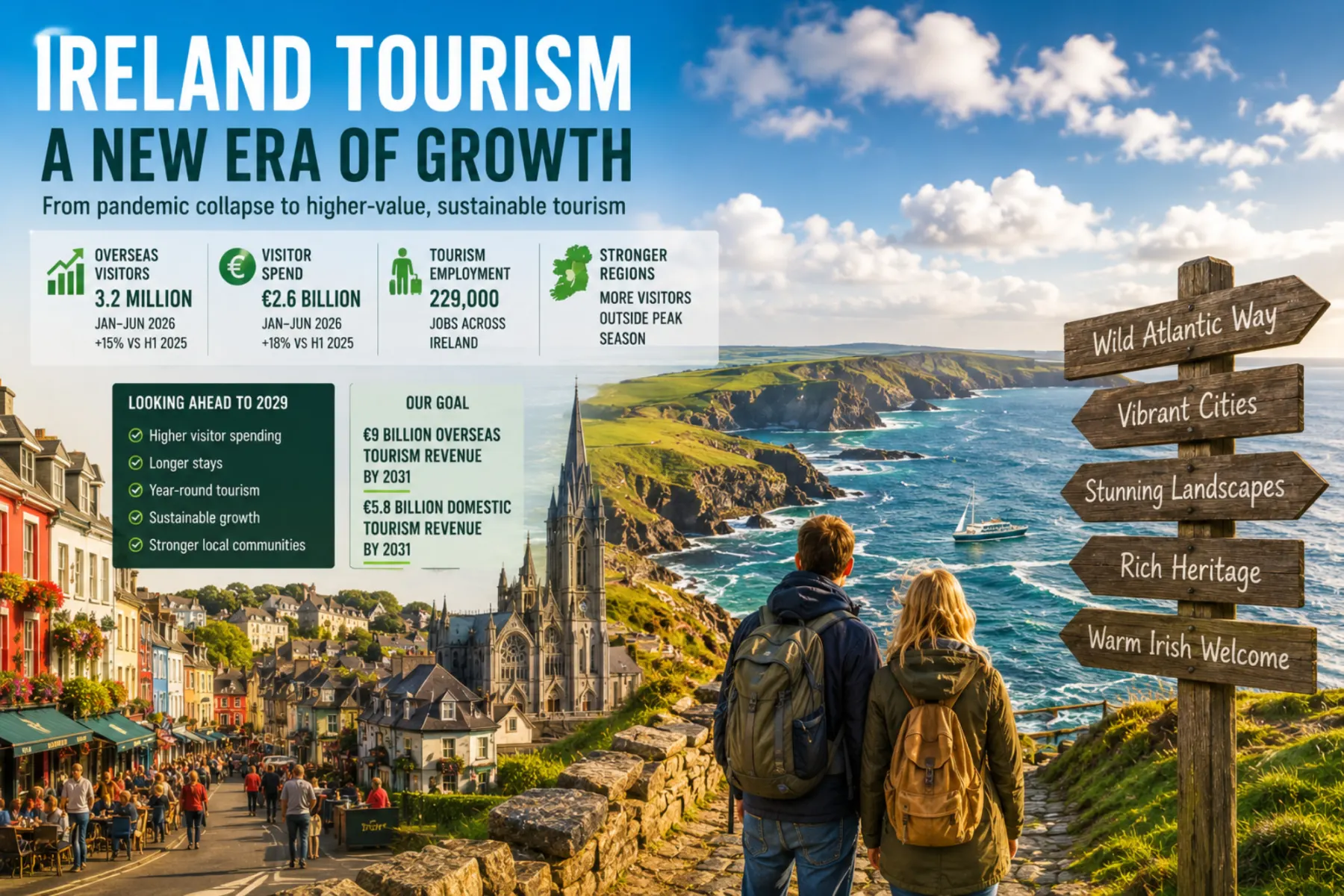
Ireland is again receiving millions of overseas visitors, tourism businesses employ almost 230,000 people, international air connections have recovered strongly and visitor spending has returned to levels that would have seemed remote during the pandemic.
In the first six months of 2026 alone, more than 3.2 million overseas visitors travelled to Ireland and spent approximately €2.6 billion, increases of 15 per cent and 18 per cent respectively compared with the first half of 2025.
But the recovery has revealed something more important than a rebound in visitor numbers.
Irish tourism is changing.
The country’s new policy direction increasingly measures success through revenue, length of stay, regional distribution, seasonality, productivity and sustainability, rather than treating the maximum possible number of arrivals as the sole objective.
Government policy aims to raise overseas tourism revenue to €9 billion by 2031 and domestic tourism revenue to €5.8 billion, while increasing employment and directing more tourism towards less mature destinations.
The next three years will therefore be about more than recovery.
They will determine what kind of tourism economy Ireland wants after recovery has been achieved.
2021: A Tourism Industry Still Under Restrictions
The five-year story begins in an exceptional place.
During the first half of 2021, essential travel restrictions remained in force as Ireland and its major tourism markets continued dealing with Covid-19.
The year remained dominated by successive waves of the pandemic, changing restrictions and uncertainty surrounding international travel.
The statistical picture from this period requires particular caution.
The Central Statistics Office suspended its collection of detailed tourism information at Irish airports and seaports in March 2020 to protect survey staff and travellers.
Full inbound tourism surveying did not return immediately, meaning figures from the pandemic years cannot simply be placed beside today’s inbound-tourism statistics as though they were one uninterrupted series.
Transport statistics nevertheless show the extraordinary scale of the disruption.
Only around 5 million passengers arrived in Ireland on overseas routes during all of 2021, a figure that included returning Irish residents as well as visitors.
That compares with more than 20 million overseas passenger arrivals in 2019.
For tourism businesses, 2021 therefore remained more an exercise in survival than expansion.
Hotels, restaurants, attractions, tour operators, activity providers and transport businesses were operating in an environment where international demand could be interrupted by health restrictions with little warning.
At the same time, the crisis had an unexpected consequence.
Domestic tourism became strategically more important.
Irish residents who could not travel internationally to the same extent rediscovered destinations within Ireland, strengthening interest in rural holidays, self-catering accommodation, outdoor recreation and shorter domestic breaks.
Some of those behavioural changes would survive the pandemic.
2022: The Release of Pent-Up Demand
If 2021 represented restriction, 2022 represented release.
Ireland removed most remaining domestic Covid restrictions in January, and international travel rebounded rapidly as households acted on holiday plans postponed during the pandemic.
The transport data shows how dramatic the change was.
Ireland recorded approximately 17.26 million overseas passenger arrivals in 2022, compared with just under 5 million in 2021.
The figure was still below the 2019 level, but the scale of the recovery within a single year was remarkable.
May alone illustrates the change.
About 1.59 million passengers arrived from overseas routes in May 2022, compared with only around 85,000 in May 2021.
This was the period of so-called pent-up demand.
Households in Europe and North America had accumulated savings during restrictions.
Travel had been postponed rather than permanently abandoned.
Once borders reopened and confidence returned, many consumers prioritised holidays.
Ireland benefited from that demand.
But the recovery brought its own problems.
Businesses that had spent two years dealing with insufficient customers suddenly had to deal with labour shortages, rising energy costs, inflation, disrupted supply chains and rapidly rebuilding demand.
The tourism crisis did not simply end.
Its nature changed.
2023: The First Full Year of Normal Tourism
By 2023, Irish tourism had entered a much more recognisable operating environment.
It became the first full year of broadly normal tourism trading after the pandemic.
The new inbound-tourism statistics recorded almost 6.3 million overseas tourists in 2023, generating approximately €5.4 billion in spending excluding fares and more than 51 million visitor nights.
The average overseas tourist stayed approximately 8.2 nights.
Those figures represented a substantial recovery, but they also revealed that Ireland’s tourism industry was not simply returning to its old structure.
North America was becoming particularly important.
American visitors typically stay longer and spend more per trip than visitors from many shorter-haul markets.
This means a relatively modest increase in high-spending North American tourism can have a disproportionately large effect on tourism revenue.
That distinction would become increasingly important over the following years.
Ireland began moving from the logic of visitor volume towards the economics of visitor value.
2024: Revenue Moves Ahead of Volume
The change became much clearer in 2024.
Fáilte Ireland’s latest harmonised figures put overseas tourist trips at approximately 6.89 million, with overseas expenditure excluding fares reaching €6.17 billion.
That represented a major increase in economic value compared with 2023.
It did not necessarily mean visitors were simply staying longer.
The significance was that Ireland was extracting more economic value from the tourism it attracted.
North America became particularly important.
In 2024, visitors from North America generated approximately €2.22 billion in expenditure, compared with roughly €2.09 billion from mainland Europe and €1.33 billion from Great Britain.
This matters strategically because not all visitors contribute equally to the tourism economy.
A traveller taking a two-night break on a limited budget produces a different economic effect from someone staying eight nights, booking hotels, restaurants, attractions, car rental and premium experiences.
That does not make one visitor more welcome than another.
But from an economic-development perspective, it explains why tourism agencies increasingly focus on spending, length of stay and regional distribution, not only arrival numbers.
2024 also became an important benchmark because it established a high revenue base against which subsequent years would be measured.
2025: A Reminder That Growth Is Not Guaranteed
After the strength of 2024, 2025 demonstrated how exposed tourism remains to external conditions.
Fáilte Ireland estimates that Ireland received approximately 6.7 million overseas tourists in 2025, around 3 per cent fewer than in 2024.
Overseas visitors spent approximately €5.7 billion, excluding fares, a decline of roughly 8 per cent.
The weakness was concentrated particularly in the first half of the year.
Several factors influenced tourism demand and business conditions, including global economic uncertainty, disruption associated with severe weather and constraints affecting aviation capacity.
Performance improved during the second half and visitor growth returned across the main markets.
The composition of tourism was again important.
North American visitor numbers increased during 2025, while mainland European trips weakened and Great Britain remained broadly stable.
North America consequently accounted for roughly 35 per cent of overseas visitor expenditure, despite representing a much smaller proportion of total visitors than Britain and continental Europe combined.
Ireland’s dependence on high-value North American tourism therefore became simultaneously a strength and a risk.
A wealthy, long-haul market can generate substantial revenue.
But an industry reliant on that market is also exposed to changes in the US economy, exchange rates, aviation costs and consumer confidence.
Domestic Tourism Has Become a Much Bigger Economic Force
The post-pandemic tourism story is not solely international.
Domestic tourism has undergone its own transformation.
Irish residents spent approximately €3.6 billion on domestic overnight tourism in 2025, unchanged from the record level reached in 2024.
While the number of domestic overnight trips declined during 2025, spending remained strong.
Compared with 2019, domestic tourism spending was substantially higher, while both trip numbers and overnight stays remained above pre-pandemic levels.
This suggests a structural change.
Irish residents are taking more economically valuable domestic trips than before the pandemic.
That creates an important stabiliser for tourism businesses.
International tourism remains vital, but domestic visitors can support accommodation, restaurants and attractions when overseas markets weaken.
They are also less concentrated in the summer season.
A substantial proportion of shorter domestic trips take place outside the main summer months.
For regional tourism, that may be one of the most valuable characteristics of the domestic market.
Tourism Is Now an €11 Billion-Plus Industry
The broader scale of the industry is considerable.
When overseas tourism, domestic tourism and additional tourism-related earnings are combined, Fáilte Ireland estimates that Irish tourism generated approximately €11.2 billion in total earnings during 2025.
The sector generated an estimated €3.3 billion in Exchequer revenue and supported approximately 229,400 employees.
Around 70 per cent of tourism employment is located outside Dublin.
That last figure explains why tourism has a significance beyond its national contribution to economic output or tax revenue.
A technology company may generate enormous output from a relatively concentrated urban workforce.
Tourism operates differently.
Hotels, restaurants, attractions, activity operators, pubs, tour companies and visitor services distribute employment through towns, coastal communities, islands and rural regions where alternative sources of large-scale economic activity may be limited.
Tourism is therefore not simply an export industry.
It is also a regional-development industry.
2026: The Recovery Regains Momentum
The latest figures provide a more encouraging picture.
Between January and June 2026, Ireland welcomed just over 3.2 million overseas visitors, around 15 per cent more than during the first half of 2025.
Spending rose even faster, increasing approximately 18 per cent to €2.6 billion.
The comparison with 2024 is particularly instructive.
Visitor numbers during the first half of 2026 were close to the corresponding period in 2024 — a year that produced exceptionally strong visitor spending.
In June alone, approximately 670,000 foreign visitors completed overnight trips to Ireland and spent almost €700 million.
Average spending per visitor exceeded €1,000 for the month.
Great Britain remained the largest source of visitors, followed by continental Europe and North America.
North American visitors nevertheless generated a disproportionately large share of total spending.
Once again, the same pattern emerges:
Visitor numbers tell only part of the story.
Ireland’s Tourism Economy Is Becoming More Valuable per Visitor
The fundamental change over the past five years can therefore be described relatively simply.
The recovery began as a race to restore lost visitors.
It is evolving into a strategy designed to generate greater value from each visitor.
That value can come from several places:
longer stays,
better-paid accommodation,
restaurants and food experiences,
paid attractions,
outdoor activities,
car hire and transport,
festivals,
golf,
business events,
premium tours,
and spending in smaller communities outside the principal tourism centres.
Food and drink represent one of the largest components of visitor spending, alongside accommodation.
That makes the economic opportunity broader than hotels alone.
Tourism revenue reaches farms supplying food, local producers, taxis, shops, pubs, guides, cultural institutions and entertainment businesses.
The more a visitor moves through the local economy, the greater the economic footprint of the trip.
Ireland Still Has a Seasonality Problem
One characteristic has proved remarkably resistant to change.
International tourism remains heavily concentrated in summer.
A large proportion of overseas arrivals and visitor nights still occur between June and September.
January and February remain considerably quieter.
That creates an inefficient tourism economy.
A hotel may struggle to accommodate demand in August and struggle to fill rooms in January.
A restaurant may need additional staff in July but insufficient customers to retain them through winter.
Roads and attractions can become crowded for several months while possessing spare capacity for much of the rest of the year.
Solving seasonality does not require making January as busy as August.
A much more realistic objective is to strengthen spring, autumn and selected winter periods.
That can be achieved through products less dependent on good weather:
food,
festivals,
culture,
business events,
wellness,
sporting events,
heritage,
and short city breaks.
This is now an explicit part of Ireland’s tourism strategy for the period to 2029.
Dublin and the South-West Still Capture Most of the Value
Tourism is also uneven geographically.
Dublin and the South-West together account for a very large proportion of overseas tourism revenue.
There are logical reasons.
Dublin is Ireland’s principal international gateway, largest city and strongest concentration of hotel, cultural and business-event infrastructure.
The South-West combines Cork and Kerry with internationally recognised destinations, coastal scenery and the tourism infrastructure developed around them.
The challenge is not to weaken successful destinations.
It is to create additional destinations capable of persuading international visitors to spend another night elsewhere.
Ireland’s Hidden Heartlands, less-developed parts of Ireland’s Ancient East and locations away from the most heavily visited sections of the Wild Atlantic Way therefore form an important part of the next stage of tourism policy.
Government policy aims for particularly strong visitor growth in less mature tourism destinations.
If successful, that would distribute tourism income more widely rather than simply concentrating additional visitors in Dublin, Galway, Killarney and a limited number of famous attractions.
Air Access Remains Ireland’s Strategic Lifeline
Ireland’s geography creates one unavoidable economic reality.
International tourism depends heavily on aviation.
The overwhelming majority of overseas tourists travel to and from Ireland by air.
This makes airline connectivity part of tourism infrastructure in the same way that roads and railways are infrastructure for domestic travel.
A new route from a major European or North American city does more than transport passengers.
It effectively puts Ireland closer to millions of potential customers.
Cork, Shannon, Ireland West and Kerry airports also have strategic significance because direct international services can allow visitors to begin a holiday outside Dublin.
That can support regional tourism much more effectively than attracting visitors to the capital and hoping they subsequently travel across the country.
Accommodation Capacity Could Become a Growth Constraint
Attracting additional visitors only works if Ireland has somewhere for them to stay.
Accommodation demand has remained strong while the pace of new supply is limited in several areas.
Dublin experiences particularly sustained pressure, while several regional destinations face seasonal capacity constraints.
This is an important distinction between tourism marketing and tourism economics.
Advertising can create demand relatively quickly.
Building hotels, guesthouses and other accommodation takes years.
It requires land, planning permission, finance, construction capacity, staff and confidence that future occupancy will justify the investment.
The next three years will therefore require supply and demand to develop together.
Successfully attracting considerably more high-value visitors without increasing accommodation capacity could simply increase room prices rather than increasing the number of people able to stay.
Price Competitiveness Is Becoming More Important
Ireland is not competing only with itself.
A traveller considering an Irish holiday may simultaneously be considering Scotland, France, Portugal, Spain, Iceland, Italy or Scandinavia.
Airfares matter.
Hotel prices matter.
Restaurant prices matter.
Car hire matters.
And the total cost of the trip matters.
Tourism businesses themselves face rising wages, energy, food, insurance, finance and maintenance costs.
Visitors simultaneously expect competitive prices.
Reducing quality to lower prices would damage Ireland’s tourism proposition.
Allowing prices to rise without improving perceived value could weaken competitiveness.
The sustainable solution is therefore productivity: better technology, stronger occupancy outside peak periods, higher direct-booking conversion and experiences visitors consider worth paying for.
Digital Tourism Is Moving Beyond Online Booking
Technology will be another major change between now and 2029.
Tourism has already moved from brochures to websites and from traditional travel agents towards online booking platforms.
The next phase involves artificial intelligence.
Travellers increasingly ask AI systems where to stay, what to do, which route to drive and which destination suits their interests.
A tourism business that cannot be understood by these systems may become less visible even if it operates an excellent website.
Ireland’s tourism strategy for 2026–2029 therefore places increasing emphasis on digital and AI adoption, including tools designed to improve online presence, AI discoverability, booking conversion and productivity.
This could become one of the most underestimated developments in Irish tourism.
The competition for tourists increasingly begins before the visitor has chosen a country.
Food Is Being Treated as a Tourism Product
Ireland’s next three-year strategy also gives food and drink a more prominent position.
A stronger culinary-tourism strategy is intended to link food producers, places and visitor experiences while increasing spending and supporting off-season demand.
The logic is strong.
A landscape can be seen once.
A visitor eats several times every day.
Food tourism can operate year-round, supports local agricultural and food businesses and gives individual regions something distinctive to market.
West Cork seafood, Galway oysters, artisan producers, whiskey distilleries, breweries, food markets and farm-based experiences can therefore become part of Ireland’s tourism infrastructure rather than simply hospitality services accompanying the trip.
This represents a movement from feeding tourists towards using Irish food as a reason to travel.
Outdoor Ireland Could Be Another Major Growth Area
The same strategy gives greater emphasis to walking, cycling and water-based experiences.
This fits Ireland’s underlying strengths.
The country does not need to manufacture mountains, coastline, lakes or rural landscapes.
They already exist.
The commercial challenge is turning those natural assets into experiences visitors can easily discover, book and combine with accommodation and food.
Greenways provide a useful example.
A cycling route by itself produces limited tourism revenue.
A cycling route connected with bicycle rental, cafés, accommodation, luggage transfer, restaurants and nearby attractions becomes a tourism economy.
This is likely to be an important model for rural destinations between now and 2029.
Climate Change Creates Both Risk and Opportunity
Tourism is unusually dependent on the physical environment.
Coastal erosion, flooding, extreme rainfall and changing weather patterns can damage precisely the landscapes and infrastructure on which the sector depends.
National tourism policy therefore increasingly incorporates climate adaptation and more resilient tourism infrastructure.
It also encourages greater use of public transport, active travel and lower-carbon mobility.
At the same time, Ireland’s relatively moderate climate could become an advantage during periods when southern European destinations experience extreme summer heat.
That does not guarantee a tourism windfall.
Irish weather remains unpredictable.
But climate change could gradually alter European seasonal travel patterns and increase demand for cooler outdoor destinations.
The tourism industry will have to adapt to both sides of that equation.
The 2027 Outlook: Consolidating the Recovery
The first full year beyond the current 2026 rebound is likely to be about consolidation rather than another post-pandemic surge.
If the current momentum continues, Ireland enters 2027 with stronger international demand, restored aviation capacity and a tourism-development strategy focused more directly on economic value.
Government and tourism policy does not promise a specific number of visitors for 2027.
The longer-term ambition is instead to generate strong annual growth in overseas tourism revenue and move towards €9 billion in annual overseas tourism revenue by 2031.
Several factors could support growth:
continued demand from North America,
improved mainland European performance,
strong international air connectivity,
domestic tourism,
and expansion of off-season experiences.
The principal risks will remain international economic weakness, geopolitical disruption, aviation and energy costs, accommodation capacity and Ireland’s overall price competitiveness.
A good 2027 would therefore not necessarily mean record visitor growth.
It could instead mean moderate visitor growth combined with stronger spending and longer stays.
2028: Regional Growth Should Become More Visible
By 2028, investment decisions being taken today should begin having a more visible effect.
Ireland is shifting towards more targeted tourism investment based on economic impact, destination competitiveness, regional growth and return on investment.
That could mean a stronger emphasis on improving existing attractions rather than relying solely on constructing entirely new flagship projects.
The economic rationale is important.
Ireland already possesses internationally recognised tourism brands.
The Wild Atlantic Way, Dublin, Ireland’s Ancient East and increasingly Ireland’s Hidden Heartlands provide geographical frameworks visitors can understand.
The next phase is likely to be about adding depth within those brands.
That means giving visitors more reasons to stop.
More reasons to stay overnight.
More things to do after 5pm.
More bookable experiences.
And more reasons to travel between October and May.
If those objectives are achieved, 2028 could mark the point at which tourism growth begins spreading more noticeably beyond Ireland’s established hotspots.
2029: The Test of the New Tourism Model
By 2029, Ireland should be able to judge whether its new strategy has worked.
The targets extend beyond visitor numbers.
Domestic revenue is intended to continue growing.
Less-developed tourism destinations are supposed to receive stronger growth.
Shoulder-season demand is expected to become more important.
Digital adoption should become close to universal among tourism businesses.
Food and outdoor experiences should form stronger components of the national offering.
Employment is intended to move towards 250,000 jobs.
And tourism businesses are expected to make significant progress in reducing carbon emissions.
The success of 2029 should therefore not be judged simply by asking:
How many tourists came to Ireland?
Better questions will be:
How much did they spend?
How long did they stay?
Where did they travel?
Did they visit outside summer?
Did smaller destinations benefit?
Were tourism businesses profitable?
Did local communities continue to support tourism?
And did growth occur without damaging the landscapes and culture visitors came to experience?
What Could Derail the Outlook?
Tourism forecasting is particularly uncertain because demand can change quickly.
The past five years demonstrate that clearly.
A pandemic can close borders.
A war can alter energy prices and aviation routes.
An economic downturn can reduce discretionary spending.
Exchange-rate movements can make Ireland considerably cheaper or more expensive for American or British visitors.
Aviation capacity can restrict growth.
Accommodation shortages can limit the number of people who can stay.
Weather can alter a season.
And high operating costs can damage businesses even when visitor spending remains strong.
The three-year outlook must therefore be treated as a range of possibilities, not as a guaranteed upward line.
The Strongest Scenario
In a favourable scenario, the international economy remains reasonably resilient, aviation capacity grows, North American demand stays strong and mainland European visitor numbers recover.
Ireland successfully expands shoulder-season travel.
More visitors combine major attractions with regional destinations.
Food, outdoor activities and festivals provide additional reasons to travel outside July and August.
Accommodation investment gradually increases capacity.
Digital tools allow small tourism businesses to market and sell more effectively overseas.
Under those conditions, the Government’s target of strong annual growth in overseas tourism revenue would look achievable.
Growth would increasingly come from value rather than simply volume.
That would be the strongest outcome for both tourism businesses and local communities.
The More Difficult Scenario
A weaker scenario is also plausible.
Persistent high travel costs could make Ireland less competitive.
Accommodation shortages could restrict supply.
A slowdown in the United States could disproportionately affect Ireland because of the importance of high-spending American visitors.
Geopolitical instability could increase fuel and aviation costs.
Domestic consumers could increasingly choose overseas holidays instead of breaks within Ireland.
And regional destinations might struggle to convert national tourism growth into overnight stays.
Ireland would still have a major tourism industry.
But growth could become slower, more concentrated and more dependent on price increases rather than increasing real visitor activity.
That distinction matters.
Rising tourism revenue caused mainly by inflation is not equivalent to a genuinely stronger tourism economy.
What Five Years Have Changed
The period from 2021 to 2026 has transformed Irish tourism more profoundly than the headline recovery numbers suggest.
In 2021, the immediate task was keeping tourism businesses alive.
In 2022, the challenge became accommodating the extraordinary return of travel.
In 2023, international tourism entered its first full normal year after the pandemic.
In 2024, visitor spending moved to record levels.
In 2025, Ireland discovered that recovery did not eliminate vulnerability to costs, capacity and international uncertainty.
And in 2026, the industry has returned to growth while beginning a new strategic phase.
The sector that emerged from the pandemic is therefore not exactly the one that entered it.
Domestic tourism is economically stronger.
North America is increasingly valuable.
Visitor spending matters more.
Technology is changing how holidays are discovered and purchased.
Environmental considerations are becoming part of tourism development.
And public policy is paying greater attention to where and when visitors travel.
Ireland Does Not Need Unlimited Tourism to Build a Bigger Tourism Economy
That may be the most important conclusion for the next three years.
Ireland does not necessarily need to double the number of tourists in order to build a substantially more valuable tourism economy.
A visitor who stays seven nights rather than five produces additional demand.
A visitor who travels from Dublin to Mayo, Donegal or the Midlands distributes spending.
A visitor arriving in October rather than August helps extend employment.
A visitor who books a guided walk, local restaurant, cultural attraction and small hotel produces more local economic value than one simply passing through.
This is the logic behind Ireland’s emerging tourism model.
The Government wants overseas tourism revenue to rise from around €6 billion in 2024 to €9 billion by 2031, domestic revenue from €3.6 billion to €5.8 billion, and tourism employment towards at least 250,000 people.
Those targets are ambitious.
Their achievement is not guaranteed.
But Ireland begins the period with something it did not have five years ago: a tourism industry that has already demonstrated it can survive an unprecedented collapse, rebuild international demand and generate substantial economic value after one of the most disruptive periods in the history of modern travel.
The challenge between now and 2029 is therefore no longer simply to bring tourism back.
Tourism is back.
The harder task is to make it more productive, more regional, less seasonal and sufficiently competitive that visitors continue to regard Ireland as worth the journey — while ensuring that the communities and landscapes on which the industry depends benefit from its success.
Source & Transparency
This article is published by Ireland Newspaper for editorial and informational purposes.
Published: 11 August 2026 · Updated: 11 August 2026

Newsroom Ireland Newspaper
Ireland Newspaper editorial team prepares daily news coverage for readers in Ireland and abroad.


Market data, financial news and economy content on Ireland Newspaper are provided for editorial and informational purposes only. They do not constitute financial advice, investment advice, trading advice or a recommendation to buy, sell or hold any financial product. Always verify live prices and consult a qualified professional before making financial decisions.