From Skibbereen to the Olympic Podium: How Ireland Became a Rowing Power
Once a relatively small sport operating largely through local clubs and volunteers, Irish rowing has developed into one of the country’s most successful international sporting programmes. Olympic champions Paul O’Donovan and Fintan McCarthy transformed expectations, but the deeper story now extends from Fiona Murtagh’s world title and Ireland’s first heavyweight Olympic medal to a growing club network, stronger youth pathways and a new challenge ahead of Los Angeles 2028.
There are easier countries in which to become a rowing power.
Ireland does not possess the population of Britain, Germany or the United States. It does not have an enormous professional league generating commercial income. Much of the sport still begins in relatively small clubs where coaches, parents and volunteers spend winter mornings beside rivers, lakes and stretches of coastline long before an athlete comes close to wearing an Irish vest.
And yet, over the past decade, Ireland has repeatedly defeated some of the largest and best-funded rowing nations in the world.
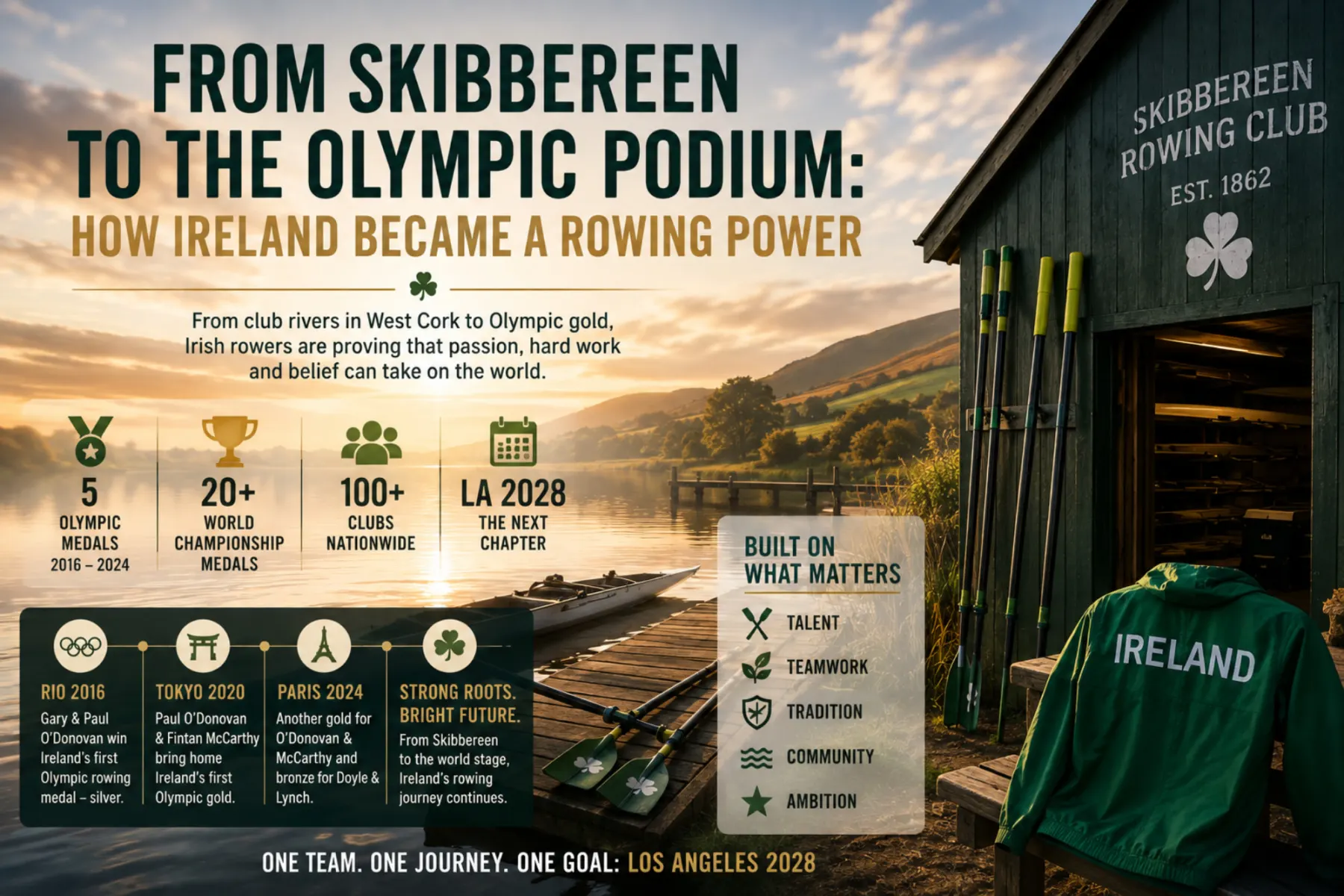
Since the breakthrough Olympic silver medal won by brothers Gary and Paul O’Donovan at Rio 2016, Irish rowers have accumulated five Olympic medals: that silver in Rio; gold for Paul O’Donovan and Fintan McCarthy and bronze for the women’s four at the Tokyo Games; followed by another O’Donovan-McCarthy gold and bronze for Philip Doyle and Daire Lynch at Paris 2024.
The performances have changed the status of rowing within Irish sport.
But Ireland’s success did not begin in Rio, and it is no longer dependent on one boat.
The next stage may be the most interesting yet.
Irish Rowing Had Champions Long Before the Olympics Delivered Medals
Ireland’s modern rowing story reaches back considerably further than the O’Donovan brothers.
Rowing Ireland traces the country’s first World Championship medal to Sean Drea, who took silver in the men’s single sculls in 1975.
The first Irish World Championship gold followed in 1991, when Niall O’Toole won the lightweight men’s single sculls.
The 1990s brought further international medals through athletes including Neville Maxwell, Tony O’Connor, Gearoid Towey and others.
Then came another significant period at the beginning of the new century.
At the 2001 World Rowing Championships in Lucerne, Ireland won gold through Sam Lynch in the lightweight men’s single, Sinead Jennings in the lightweight women’s single, and Tony O’Connor and Gearoid Towey in the lightweight men’s pair. Lynch successfully defended his world title the following year.
These achievements established that Irish rowers could compete at world level.
What had not yet happened was the Olympic breakthrough.
That changed in spectacular fashion in Brazil.
Rio 2016 Changed Irish Rowing’s Public Identity
When Gary and Paul O’Donovan won silver in the lightweight men’s double sculls at Rio 2016, they became Ireland’s first Olympic rowing medallists.
The result was important enough on its own.
What followed made the moment larger.
Their relaxed personalities, distinctive interviews and obvious enjoyment of competition introduced rowing to a much wider Irish audience.
For many people who had rarely watched a 2,000-metre rowing race, the sport suddenly had recognisable athletes and a compelling story.
But behind the public enthusiasm was something more substantial.
The medal demonstrated that athletes emerging from an Irish club system could defeat almost everyone in an Olympic final.
Paul O’Donovan reinforced the point almost immediately, winning the lightweight single sculls world title later in 2016 and successfully defending it in 2017.
From that point onwards, the standard changed.
International medals were no longer treated simply as exceptional surprises.
Ireland began expecting to compete for them.
Skibbereen Became One of the Great Stories of Irish Sport
Few places are more closely associated with Ireland’s rowing rise than Skibbereen in West Cork.
Skibbereen Rowing Club produced Gary and Paul O’Donovan and later Fintan McCarthy, among a wider group of successful rowers.
Its influence demonstrates one of the most interesting characteristics of Irish rowing.
Elite sport does not always have to begin in a major city or vast national academy.
A strong local club can become an extraordinarily productive sporting environment when talented athletes, knowledgeable coaching, competition and community support reinforce one another over many years.
Paul O’Donovan’s career subsequently developed into something unprecedented in Irish rowing.
After Olympic silver with Gary in Rio, he won world titles in the lightweight single and then partnered Fintan McCarthy to win the lightweight double world championship in 2019.
That new partnership would soon produce Irish sporting history.
Tokyo Delivered Ireland’s First Olympic Rowing Gold
The Tokyo Olympics, postponed from 2020 until 2021 because of the pandemic, marked the next transformation.
Paul O’Donovan and Fintan McCarthy won the lightweight men’s double sculls, becoming Ireland’s first Olympic rowing champions.
It was not Ireland’s only rowing medal.
The women’s four of Aifric Keogh, Eimear Lambe, Fiona Murtagh and Emily Hegarty won bronze, becoming the first Irish women to win an Olympic rowing medal.
Those two medals were significant for different reasons.
The lightweight double confirmed that the success beginning in Rio could be converted into Olympic gold.
The women’s four demonstrated something broader: Ireland was becoming competitive across multiple parts of the programme.
That distinction matters enormously in high-performance sport.
One extraordinary athlete can create a golden period.
A functioning national system produces competitive crews repeatedly.
Paris 2024 Confirmed That the Success Was Sustainable
By Paris 2024, Ireland was no longer arriving at an Olympic rowing regatta as an emerging outsider.
It sent its largest Olympic rowing team ever: 16 athletes across seven boats.
Four Irish crews reached Olympic A finals, and every Irish boat finished inside the top ten.
The greatest attention naturally centred on O’Donovan and McCarthy.
They successfully defended their Olympic title in the lightweight double.
For Paul O’Donovan, it was a third successive Olympic medal following silver in Rio and gold in Tokyo.
For McCarthy, it was a second successive Olympic gold.
But another result may have been equally important for the future of Irish rowing.
Philip Doyle and Daire Lynch won bronze in the men’s double sculls.
It was Ireland’s first Olympic medal in men’s openweight rowing.
That removed one of the remaining questions surrounding Ireland’s rise.
The country had become exceptionally successful in lightweight rowing.
Could it reproduce that success against the larger openweight athletes who form the central Olympic rowing programme?
Doyle and Lynch answered yes.
Philip Doyle and Daire Lynch Opened Another Door
The Doyle-Lynch partnership had developed rapidly.
They began racing together internationally in 2023, won World Championship bronze that year and qualified the boat for Paris.
During 2024 they added another World Cup bronze before winning a World Cup gold in the run-up to the Olympics.
Then came Olympic bronze in Paris.
Their performance was strategically important because the future Olympic programme is changing.
Paris 2024 was the final Olympic Games to include lightweight rowing.
Ireland could therefore no longer assume that the event in which it had won silver in Rio and gold in Tokyo and Paris would remain available.
Success in openweight rowing is becoming essential.
Doyle and Lynch demonstrated that Ireland already possesses that capacity.
2025 Produced Another Major Breakthrough
The year after an Olympic Games can be difficult for high-performance programmes.
Successful crews change.
Athletes take breaks.
New combinations are tested.
Some retire.
Others move into different events.
Ireland used 2025 to demonstrate that its competitive depth extended beyond the Paris crews.
The clearest example came from Fiona Murtagh.
Murtagh had already won Olympic bronze as part of the women’s four in Tokyo and competed in the pair at Paris.
In 2025 she moved into the single scull — one of rowing’s most demanding individual events.
The transition proved remarkably successful.
She won European silver and another silver at the World Cup in Lucerne before reaching the World Championship final in Shanghai.
There, Murtagh became world champion in the women’s single sculls, defeating Great Britain’s Lauren Henry by just 0.03 seconds.
For Ireland, the significance went beyond another gold medal.
A rower who had built much of her international career in sweep boats had successfully reinvented herself as a world-class single sculler.
That is evidence of adaptability as well as talent.
Fintan McCarthy Proved He Could Succeed Beyond Lightweight Rowing
Fintan McCarthy faced a different transition.
For years his sporting identity had been tied to the lightweight double.
With lightweight rowing leaving the Olympic programme, the question was how one of the world’s most successful lightweight rowers would perform against openweight competition.
The answer came quickly.
McCarthy partnered Konan Pazzaia in the men’s double during 2025, winning bronze at the European Championships and another bronze at the Lucerne World Cup. Later in the season, McCarthy partnered Olympic bronze medallist Philip Doyle at the World Championships in Shanghai.
They won World Championship bronze in the openweight men’s double.
It was an important result.
McCarthy was no longer simply one half of the world’s dominant lightweight double.
He had demonstrated that he could reach a global podium in an openweight Olympic boat class.
Then, before the Shanghai championships ended, he won another world title.
Ireland Won the First Mixed Double World Championship
The 2025 World Championships introduced mixed double sculls.
Ireland paired Fintan McCarthy with Margaret Cremen.
They won.
McCarthy and Cremen became the first world champions in the history of the mixed double sculls event, winning the final in 6:24.22 after taking control around halfway.
Ireland left Shanghai with four senior medals:
Gold — Fiona Murtagh, women’s single sculls
Gold — Margaret Cremen and Fintan McCarthy, mixed double sculls
Bronze — Fintan McCarthy and Philip Doyle, men’s double sculls
Bronze — Jake McCarthy, lightweight men’s single sculls.
That medal distribution is perhaps more revealing than any individual victory.
Different athletes.
Different boats.
Men and women.
Lightweight and openweight.
Individual and team events.
The centre of gravity of Irish rowing had broadened.
The Success Is No Longer Only About Senior Athletes
A national sporting programme cannot remain successful indefinitely by relying on the same generation.
There has to be another one behind it.
Rowing Ireland currently represents 122 clubs and more than 7,700 registered members, while its Get Going Get Rowing programme says it reaches around 42,000 students each year.
The domestic competition structure is also substantial.
The 2026 Irish Rowing Championships at the National Rowing Centre in Cork attracted 1,350 athletes, 1,017 crews and 60 clubs, competing across 138 races.
Those numbers matter because Olympic champions do not appear at Olympic Games by accident.
They normally enter the sport years earlier.
They learn technique in a local club.
They race domestically.
They develop through junior competition.
Some move through schools and universities.
A small proportion eventually enter a national high-performance pathway.
The medal seen on television is therefore the final stage of a much larger sporting structure.
Ireland’s Clubs Remain the Foundation
Rowing Ireland was established as the Irish Amateur Rowing Union in 1899 and today governs rowing across the island.
Despite increasing professionalisation at elite level, the organisation itself emphasises the central role played by clubs and volunteers.
Its National Rowing Centre at Farran Wood in County Cork now acts as the headquarters of Irish high-performance rowing and the principal training base for national athletes.
But national facilities cannot replace the club network.
Skibbereen, UCC, University of Galway, Belfast, UCD, Tralee, Lee Valley, Shandon, Commercial, Neptune and numerous other clubs have all contributed athletes to the national programme over different generations.
That local diversity is one of Irish rowing’s strengths.
It creates several pathways into the same national system rather than requiring every potential champion to come from one geographical area or one institution.
Universities Have Become Part of the Pathway
University rowing also plays an important role.
Athletes can continue developing while completing degrees, and some Irish rowers have trained in powerful university systems overseas as well as at home.
Daire Lynch, for example, studied and rowed at Yale before returning to compete within the Irish high-performance system.
The relationship between education and rowing is particularly interesting because the sport often demands many years of development before an athlete reaches peak international performance.
Unlike sports in which teenagers can become global stars, elite rowers frequently improve well into their twenties and sometimes beyond.
A pathway capable of combining education, employment and high-level training can therefore help retain athletes who might otherwise leave the sport before reaching their best years.
High-Performance Investment Has Increased
Success has also been supported by greater public investment in high-performance sport.
Sport Ireland has allocated €1.155 million in High Performance Programme Funding to Rowing Ireland for 2026, up from €1.1 million in 2025.
Its current 2025–2028 allocation for Rowing Ireland under that programme totals €4.565 million.
Separate Sport Ireland core funding for Rowing Ireland has risen from €210,000 in 2018 to €440,000 in 2026.
Funding alone does not produce medals.
Countries can spend heavily without creating champions.
But elite rowing requires boats, equipment, international travel, physiotherapy, sports science, coaching, nutrition, medical support and enough training time for athletes to compete against full-time international opposition.
Stable investment makes long-term planning possible.
The important test is whether those resources continue generating a broad and sustainable athlete pathway rather than isolated results.
The National Rowing Centre Gives the Programme a Home
The development of the National Rowing Centre in Farran Wood, County Cork, has provided Irish rowing with an important physical centre.
Elite athletes can train there, national championships are held there and Rowing Ireland’s headquarters are based there.
This creates something previous generations of Irish rowers had in more limited form: a consistent national training environment.
Athletes from different clubs can remain club members while also training together within a national system.
Coaches can compare potential combinations.
Sports scientists can monitor athletes.
Crews can be changed as performance develops.
The difference is subtle but important.
Irish rowing has retained a strong club identity while building a more centralised high-performance layer above it.
Women’s Rowing Has Become Central to Ireland’s Success
The development of women’s rowing is another essential part of the story.
Sinead Jennings became Ireland’s first female world rowing champion in 2001.
Sanita Puspure later established herself among the world’s leading single scullers, winning consecutive World Championship titles in 2018 and 2019.
Then the Tokyo women’s four produced Ireland’s first female Olympic rowing medal.
Fiona Murtagh has now added a world single-sculls title.
The progression matters because it increases the number of credible pathways visible to young female athletes.
Rowing Ireland is also receiving €75,000 through Sport Ireland’s 2026 Women in Sport programme, part of a national €4 million investment supporting female participation, coaching and leadership across sport.
The next challenge is maintaining depth across multiple women’s boat classes rather than relying on a small group of elite athletes.
Para Rowing Is Developing Too
Ireland’s rowing progress is not limited to Olympic competition.
At Paris 2024, Katie O’Brien and Tiarnán O’Donnell returned Ireland to Paralympic rowing for the first time since London 2012.
That represented an important step in broadening the high-performance programme.
Para rowing operates with different classifications and challenges, but the underlying requirements remain familiar: coaching, athlete identification, equipment, access to water and sustained competition against international opposition.
A genuinely strong rowing nation should ultimately be able to develop Olympic, Paralympic, flatwater, coastal and recreational rowing simultaneously.
Ireland is moving closer to that model.
2026 Is a Transition Year — Not an End Point
The current season is particularly interesting because Ireland is now between Olympic eras.
The 2026 international calendar continues with the World Rowing Championships in Amsterdam from 24 to 30 August, followed by U23 European competition and later coastal and beach sprint championships.
Not every regatta will produce medals.
Nor should that be expected.
The period between Paris 2024 and Los Angeles 2028 is partly about testing new athletes, moving established rowers into different events and identifying combinations capable of succeeding when Olympic qualification begins.
Ireland’s 2025 World Championship results suggest that process has already produced important answers.
Fiona Murtagh can win globally in the single.
Fintan McCarthy can medal in openweight rowing.
Philip Doyle remains a world-level double sculler.
Margaret Cremen can win a senior world title.
And younger athletes continue entering the international pathway.
That is a stronger position than simply hoping the Paris crews remain unchanged for another four years.
Los Angeles 2028 Changes the Sport Itself
Ireland’s greatest Olympic rowing success has come in the lightweight men’s double.
That event no longer exists on the Olympic programme.
World Rowing confirmed that Paris 2024 was the final Games to include lightweight rowing. At Los Angeles 2028, coastal beach sprint rowing will make its Olympic debut, with men’s solo, women’s solo and mixed double events replacing the men’s and women’s lightweight double sculls.
There is another major change.
Classic rowing at Los Angeles will be contested over 1,500 metres rather than the traditional 2,000 metres because of the dimensions of the Long Beach venue. World Rowing says international qualification regattas will remain over 2,000 metres; the shorter distance is specific to the 2028 Olympic and Paralympic regattas.
For coaches and athletes, that creates a fascinating performance problem.
A 1,500-metre Olympic race will place slightly different demands on pacing, power and tactical decisions.
The underlying sport remains rowing.
But the race itself will change.
Beach Sprints Could Suit Ireland
The arrival of beach sprint rowing also creates an intriguing opportunity.
Ireland has an extensive coastline and a longstanding tradition of coastal rowing.
Beach sprint racing combines running on sand, entering a coastal boat, racing through an open-water slalom-style course and returning to the beach.
It is considerably different from traditional Olympic rowing on a straight flat-water course.
But it opens another route to Olympic participation.
World Rowing describes coastal rowing as one of the fastest-growing disciplines in the sport, while Rowing Ireland’s own calendar now includes substantial coastal and beach sprint activity. Rowing Ireland lists 14 domestic coastal and beach sprint events alongside its flatwater programme.
Ireland therefore enters the new Olympic discipline with an existing coastal culture rather than starting entirely from zero.
Whether that ultimately produces Olympic medals is impossible to predict.
But it represents a genuine development opportunity.
The Real Achievement Is Broader Than the Medal Table
Olympic medals are the most visible measure of sporting success.
They are not the only one.
Rowing Ireland today reports more than 7,700 members, 122 clubs, around 270 coaches and tens of thousands of students reached through school programmes.
The 2026 national championships brought more than a thousand crews to Cork.
The international team includes athletes from clubs across the island.
World and Olympic medallists now exist across men’s, women’s, lightweight and openweight rowing.
That combination suggests that Ireland’s rowing success has moved beyond an exceptional generation.
It has begun creating infrastructure around that generation.
This distinction will determine what happens next.
Paul O’Donovan and Fintan McCarthy Changed What Irish Rowers Believe Is Possible
Every successful sporting period contains athletes who change expectations.
For modern Irish rowing, Paul O’Donovan and Fintan McCarthy have played that role.
Their results speak for themselves.
Two successive Olympic titles together.
Multiple world titles.
European success.
And in O’Donovan’s case, Olympic medals at three successive Games beginning with his silver alongside Gary in Rio.
But their wider influence may be harder to measure.
A junior rower joining a club today enters a different sporting culture from one joining before Rio 2016.
The evidence now exists.
An Irish rower can become an Olympic champion.
An Irish women’s crew can win an Olympic medal.
An Irish openweight men’s crew can stand on an Olympic podium.
An Irish woman can become world champion in the single scull.
And those achievements can emerge from clubs in Cork, Galway, Belfast, Dublin and elsewhere rather than from one single route.
That changes ambition.
The Next Great Irish Rower May Already Be in a Club Boat
This may ultimately be the most encouraging part of Ireland’s rowing story.
High-performance sport inevitably concentrates attention on famous names.
But underneath those names is a much larger system.
A junior learning to row today has Olympic champions to watch.
A club coach can point to athletes who began in environments similar to their own.
School programmes introduce tens of thousands of young people to the basic movement of rowing.
Domestic championships expose athletes to serious competition.
Universities provide another development stage.
The National Rowing Centre offers a pathway towards international performance.
Sport Ireland provides increasingly substantial high-performance support.
None of these guarantees another Paul O’Donovan, Fintan McCarthy or Fiona Murtagh.
Sport does not work that way.
But it increases the probability that exceptional talent will be discovered, developed and retained.
From Surprise Medals to Sustained Ambition
Irish rowing has travelled an extraordinary distance.
Sean Drea’s world silver in 1975 demonstrated what an Irish single sculler could achieve.
Niall O’Toole’s 1991 victory delivered the country’s first World Championship gold.
Sam Lynch and Sinead Jennings helped establish another successful generation.
Sanita Puspure became a double world champion.
Gary and Paul O’Donovan finally broke the Olympic barrier in Rio.
Paul O’Donovan and Fintan McCarthy converted that breakthrough into consecutive Olympic titles.
Aifric Keogh, Eimear Lambe, Fiona Murtagh and Emily Hegarty delivered Ireland’s first women’s Olympic rowing medal.
Philip Doyle and Daire Lynch opened the Olympic podium to Irish men’s openweight rowing.
And in 2025 Fiona Murtagh became world champion in the single while McCarthy, Margaret Cremen, Philip Doyle and Jake McCarthy added further world medals.
The story is therefore no longer about whether Ireland can succeed at rowing.
That question has been answered.
The more interesting question is whether Ireland can turn an extraordinary decade into a lasting sporting tradition.
Los Angeles 2028 will present a different test: no Olympic lightweight double, a shorter classic rowing course and the arrival of beach sprints.
Some familiar champions may move into new events. New combinations will emerge. Younger athletes will challenge established names.
There will inevitably be races Ireland does not win.
That is the nature of a global sport decided by seconds — and sometimes hundredths of a second.
But Ireland approaches the next Olympic cycle from a position that would have been difficult to imagine before Rio 2016.
It now has champions to follow, world-class experience to draw upon, a national training centre, public investment, a substantial club system and a generation of younger athletes who have grown up watching Irish crews win on the largest stage.
The medals have been remarkable.
The greater achievement may be that Irish rowing no longer needs to surprise the world in order to belong among its best.
Source & Transparency
This article is published by Ireland Newspaper for editorial and informational purposes.
Published: 11 August 2026 · Updated: 11 August 2026

Newsroom Ireland Newspaper
Ireland Newspaper editorial team prepares daily news coverage for readers in Ireland and abroad.