
Ireland’s Construction Industry in 2026: Builders Scale Up as Housing Demand Meets the Infrastructure Test
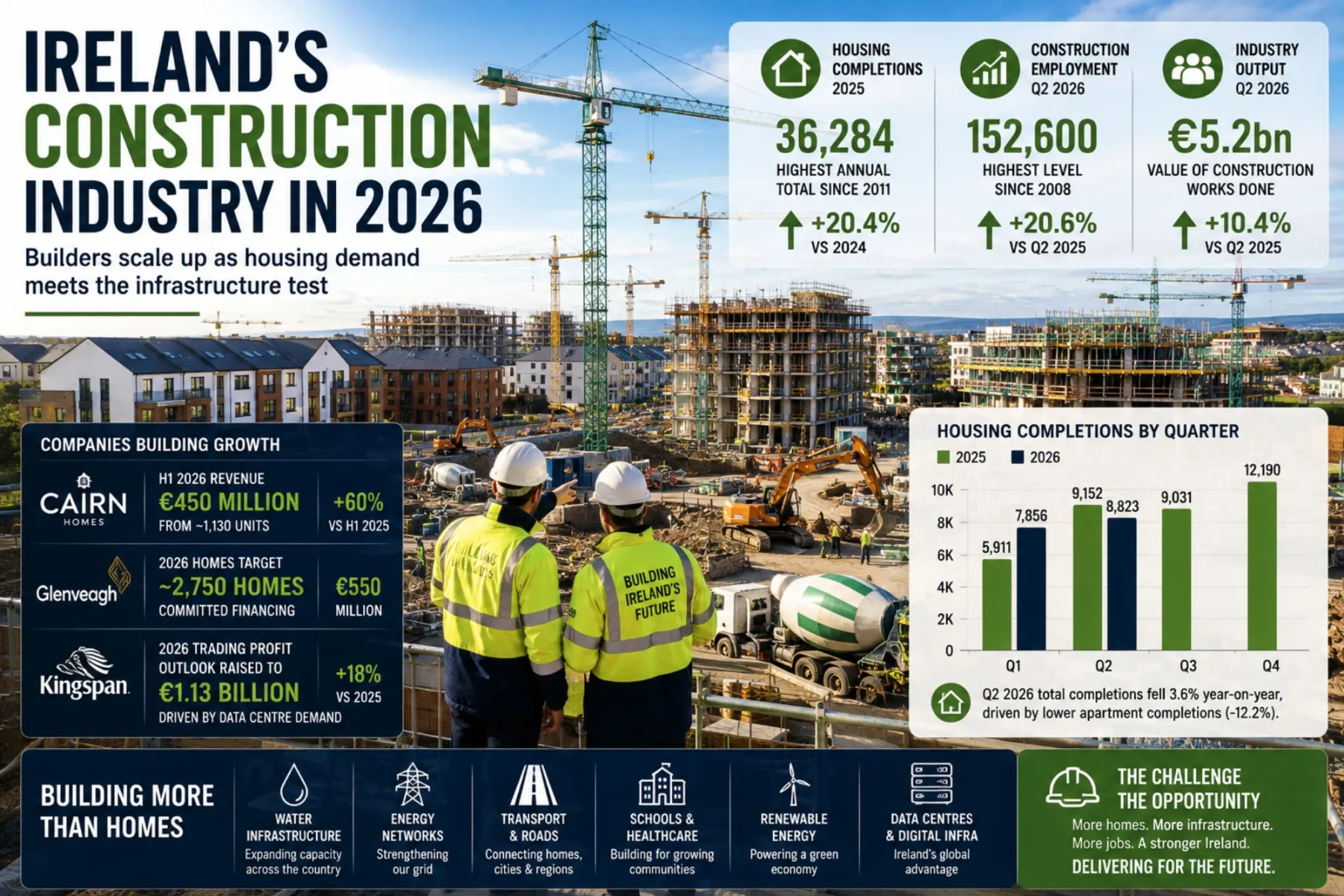
Cairn Homes has reported a roughly 60% rise in first-half revenue, Glenveagh expects to deliver around 2,750 homes this year and Kingspan has just raised its profit forecast on booming data-centre demand. Yet Ireland’s national housing figures tell a more complicated story: construction employment is rising rapidly and order books are strong, but second-quarter housing completions fell and planning, water, energy and labour capacity remain critical constraints on how quickly the industry can expand.
Ireland’s construction industry is entering one of the most consequential periods in its modern history.
The reason is not simply housing.
The country simultaneously needs homes, water infrastructure, electricity networks, roads, public transport, schools, healthcare facilities, renewable-energy projects, industrial plants and the data-centre infrastructure required by a rapidly expanding digital economy.
The demand for construction is therefore coming from almost every direction at once.
And some of Ireland’s largest construction-related companies are responding with striking growth.
Cairn Homes reported approximately €450 million of revenue from around 1,130 units in the first half of 2026, roughly 60% more revenue than during the same period last year.
Glenveagh Properties expects to deliver the equivalent of about 2,750 homes during 2026 and has increased its committed financing to €550 million.
Kingspan, one of Ireland’s largest internationally operating building-products groups, has just raised its full-year trading-profit forecast to approximately €1.13 billion, helped particularly by extraordinary demand for infrastructure serving data centres.
At company level, therefore, large parts of the sector look increasingly confident.
At national level, however, the picture is less straightforward.
Ireland completed 8,823 new homes during the second quarter of 2026, 3.6% fewer than in the same quarter of 2025. Apartment completions fell by 12.2%.
The construction industry is expanding.
The question is whether it can expand fast enough.
Ireland Is Building More Homes Than It Was — But the Path Is Uneven
The long-term direction is unmistakable.
Ireland completed 36,284 new dwellings during 2025, 20.4% more than in 2024 and the highest annual total recorded since the current CSO series began in 2011. Apartment completions increased particularly strongly, rising 38.7% to 12,047.
The beginning of 2026 initially suggested that momentum might accelerate further.
The first quarter produced 7,856 completions, 32.9% more than the 5,911 recorded in Q1 2025 and the strongest first quarter in the series.
Then came the second quarter.
Completions fell from 9,152 in Q2 2025 to 8,823 in Q2 2026.
Scheme houses still increased 2%, but apartment completions fell from 3,027 to 2,658 and one-off houses declined slightly.
Taken together, the first six months still produced approximately 16,679 completed homes, around 10.7% more than the corresponding first half of 2025.
That is meaningful growth.
But it also demonstrates why quarterly housing statistics should not be interpreted as a simple straight line.
Construction is lumpy.
Large apartment developments can move hundreds of completions from one quarter into another.
Planning decisions arrive irregularly.
Infrastructure delays can hold back entire sites.
Weather, financing and utility connections affect timing.
A weak quarter does not automatically represent a downturn.
Equally, one exceptionally strong quarter does not prove that Ireland has permanently solved its housing-delivery problem.
The Government Is Asking the Industry to Move Into a Much Higher Gear
Ireland’s current housing plan targets the delivery of 300,000 homes between 2025 and 2030, including 72,000 social homes and 90,000 affordable housing supports.
That scale changes the economics of the entire construction industry.
Delivering 300,000 homes over six years requires something approaching an average of 50,000 annually, although actual annual targets and delivery will naturally vary across the period.
By comparison, the record 2025 total was 36,284.
The gap illustrates the industrial challenge.
Ireland does not simply need existing builders to work slightly harder.
The country needs more:
sites;
planning capacity;
workers;
finance;
water infrastructure;
electricity connections;
materials;
modern construction methods;
and companies capable of building at greater scale.
The housing target is therefore also a corporate-growth target for the construction sector.
Cairn Homes Is Already Scaling Rapidly
Among the most important company developments in 2026 is the acceleration at Cairn Homes.
The listed Irish housebuilder reported approximately €450 million of first-half revenue from around 1,130 units, compared with €284.5 million from 708 units during H1 2025.
That represents roughly a 60% increase in revenue year on year.
Perhaps even more important is what has happened to the forward pipeline.
Cairn reported average sales of around 100 units per week since its previous trading update at the end of April.
Its closed and forward order book had grown to approximately 4,800 new homes with a net sales value of €1.8 billion.
For a construction company, forward sales matter because they provide visibility.
A builder that knows large numbers of units already have buyers, public-sector partners or institutional customers can plan labour, materials and capital with greater confidence.
The challenge then shifts from demand to delivery.
Cairn’s 26 Active Sites Show the Scale of Modern Homebuilding
Cairn reported five additional site commencements during the first half and was active across 26 developments in the Greater Dublin Area, Cork and Galway.
The company also said year-to-date build-cost inflation was running at approximately 2.5%.
That figure is worth noticing.
Construction-cost inflation remains positive.
But it is dramatically different from the cost shock that confronted builders during the energy and materials disruption earlier in the decade.
Greater predictability makes large projects easier to finance and price.
It also allows developers to commit to new sites with more confidence.
Cairn’s next detailed test comes on 2 September 2026, when the company is scheduled to publish its interim results.
Those figures will provide a much clearer picture of margins, cash generation and the company’s full-year trajectory.
The Apartment Market Is Becoming Particularly Important
One of Cairn’s most interesting current developments concerns apartments.
The company reported more than 150 apartments sold following the launch of Exchange Square at Seven Mills.
Published prices for the one- and two-bedroom apartments ranged from approximately €235,000 to €400,000 including VAT.
The significance goes beyond one development.
Ireland’s ability to increase housing supply in its largest urban areas increasingly depends on apartment construction.
Dublin cannot realistically meet housing demand through low-density suburban development alone.
Yet apartments are more complicated and frequently more expensive to deliver than standard houses because they require common areas, lifts, fire systems, underground or structured parking in some schemes and more sophisticated construction.
The national numbers show how important this category has become.
Almost 76% of apartments completed in Q2 2026 were in Dublin.
When Dublin apartment construction slows, the national housing figures can therefore move quickly.
Glenveagh Is Building a Different Kind of Scale
Glenveagh Properties is following its own expansion strategy.
Its May trading update showed a €1.5 billion closed and forward order book across its Homebuilding and Partnerships divisions, up from €1.3 billion in March.
More than 1,828 Homebuilding units were sold, signed or reserved, compared with 1,252 only two months earlier.
The company expects to deliver the equivalent of around 2,750 homes in 2026, including approximately 1,600 through its Homebuilding business.
That places Glenveagh among the companies increasingly important to whether Ireland can move from annual national housing delivery in the 30,000s towards materially higher levels.
But Glenveagh’s strategy illustrates another structural change in construction.
The business is becoming less dependent on the traditional model of simply buying land, constructing houses and selling each home individually.
Its Partnerships division increasingly works with the State and other institutional partners on larger developments.
The State Has Become a Much Bigger Customer for Private Builders
Glenveagh’s Partnerships order book stood at approximately €800 million in May.
The company expects that activity to support an average annual gross-profit contribution of at least €60 million.
This reflects a broader transformation in Irish housing.
The line between private-sector construction and State-supported housing delivery has become less distinct.
Private builders construct homes.
Local authorities, approved housing bodies, the Land Development Agency and other public or public-backed entities can purchase, finance or support parts of developments.
Affordable, social, cost-rental and private housing may exist within the same broad construction pipeline.
For builders, this can diversify demand.
Instead of relying completely on individual mortgage buyers, companies can have several categories of customer.
For the State, partnerships can provide access to private-sector development capacity.
The relationship nevertheless requires careful structuring because public money, commercial returns and affordability objectives do not always point automatically in the same direction.
Glenveagh Has Secured €550 Million of Funding for Expansion
Perhaps the most revealing part of Glenveagh’s 2026 update concerned financing.
The company increased committed funding from €450 million to €550 million.
The package includes a five-year €450 million revolving credit facility involving AIB, Bank of Ireland, Barclays, Home Building Finance Ireland and new participant ING.
Glenveagh also issued €100 million of seven-year private-placement notes to MetLife Investment Management.
For the wider construction market, the importance is not simply that one company obtained more debt.
It demonstrates that large-scale Irish housing is attracting both domestic and international capital.
Construction requires enormous upfront expenditure.
Land is purchased before homes are sold.
Infrastructure must be installed.
Workers and subcontractors need paying throughout the build.
Materials are purchased months before revenue may be recognised.
The ability to finance working capital therefore determines how rapidly a builder can expand.
Housing targets ultimately need balance sheets behind them.
Glenveagh’s 19,000-Unit Landbank Provides Long-Term Visibility
The company says its existing landbank contains around 19,000 units and supports annual delivery of approximately 2,750 to 3,600 homes through 2030 without requiring material additional land investment.
That illustrates one of the less visible advantages enjoyed by larger developers.
A builder with a multi-year land pipeline can standardise designs, establish supplier relationships, invest in manufacturing capacity and plan staffing over several years.
A smaller builder working from one project to another cannot necessarily achieve the same economies of scale.
This does not mean Ireland’s future housing market will be supplied only by large listed companies.
Smaller and medium-sized builders remain essential, particularly outside major urban areas.
But the national targets create an obvious advantage for organisations capable of operating across numerous sites simultaneously.
Construction Is Becoming More Industrialised
Glenveagh’s emphasis on its manufacturing operations is another sign of where the industry is moving.
The company has invested in standardisation, vertical integration and off-site manufacturing through its NUA facilities in Carlow.
Its current programme includes development of external wall façade systems, integrated solar photovoltaics and battery-storage solutions.
The principle is straightforward.
Traditional construction performs large amounts of work outdoors on individual sites.
Industrialised construction attempts to shift more production into controlled manufacturing environments.
Components can be produced repeatedly.
Quality can be standardised.
Waste may be reduced.
Weather disruption can be lowered.
Site installation can become faster.
Ireland increasingly refers to these approaches as modern methods of construction, or MMC.
They will probably become increasingly important if the industry is expected to raise output without increasing its workforce at exactly the same rate.
Artificial Intelligence Is Arriving on the Building Site Too
AI is normally discussed in relation to software, finance or technology companies.
Construction companies are beginning to use it differently.
Glenveagh says it is applying AI and data to design, procurement and site-delivery processes alongside its existing standardisation and manufacturing systems.
The immediate purpose is not replacing builders with humanoid robots.
It is improving planning.
Predicting material requirements.
Optimising designs.
Reducing errors.
Managing schedules.
Monitoring cost.
And coordinating complicated projects containing hundreds of subcontractors and thousands of components.
Construction has historically suffered from relatively weak productivity growth compared with highly automated manufacturing sectors.
Technology therefore has an unusually large opportunity if it can reduce delays and rework.
Construction Productivity Has Become a National Economic Question
Ireland’s own competitiveness strategy now identifies construction-sector productivity as a key challenge, arguing that comparatively low productivity contributes to slower delivery of national infrastructure and housing targets.
That matters because labour alone cannot solve the problem.
Ireland can train more apprentices.
Recruit workers internationally.
Increase participation.
But if every additional house requires roughly the same labour intensity as before, enormous increases in national output require enormous increases in employment.
Productivity changes that calculation.
Build standard components faster.
Reduce redesign.
Use digital planning.
Manufacture more components off-site.
Coordinate sites better.
Shorten planning and utility delays.
Each improvement allows the same workforce to deliver more.
The construction companies capable of achieving this could become increasingly important over the remainder of the decade.
The Construction Workforce Is Already Growing Very Quickly
Employment figures demonstrate that expansion is underway.
Construction employment increased by 20,500 people in the year to Q1 2026, an increase of 11.7%.
Specialised construction activities accounted for an additional 12,700 workers, while civil engineering added approximately 5,400.
That was one of the strongest employment increases of any major Irish economic sector.
The increase makes sense.
Housing is rising.
Infrastructure investment is expanding.
Renewable-energy construction requires skilled workers.
Data centres require enormous construction teams.
Transport projects compete for engineers and contractors.
The problem is that many projects need the same people.
Labour Could Become the Industry’s Biggest Capacity Constraint
Ireland can allocate billions of euro to infrastructure.
That does not automatically create electricians.
Engineers.
Quantity surveyors.
Site managers.
Carpenters.
Plumbers.
Heavy-equipment operators.
Planning specialists.
The Government changed the employment-permit system again in May specifically to address shortages affecting construction and other strategic sectors.
Construction project managers are among occupations recognised on the current Critical Skills list.
International recruitment can help.
Training and apprenticeships matter more over the long term.
The harder reality is that Ireland is trying to build far more infrastructure while simultaneously experiencing housing shortages that can make it expensive for construction workers themselves to live near the places where they are needed.
The industry is therefore affected by the very housing shortage it is being asked to solve.
Costs Have Stabilised — But They Have Not Stopped Rising
Construction firms also continue to face cost pressure.
The CSO’s latest wholesale-price data show that construction-product prices were 3.1% higher in June 2026 than a year earlier.
When materials and wages are combined, the broader Building & Construction input-cost index was up 3.2%.
Those aggregate numbers conceal large differences between products.
Bituminous macadam, asphalt and related products were 14.9% more expensive than a year earlier.
Ready-mixed mortar and concrete increased 8.7%.
Copper pipes and fittings increased 8.7%.
Paints, oils and varnishes increased 8.4%.
Cement, by contrast, was 5.3% cheaper.
This is important for company margins.
A builder does not purchase a generic basket called “construction costs”.
It purchases specific materials.
A civil-engineering contractor exposed heavily to asphalt experiences inflation differently from a residential developer purchasing timber, concrete and electrical fittings.
Energy Remains a Risk for Construction Costs
The international energy situation adds another layer.
Wholesale electricity prices in Ireland were 42.2% higher in June 2026 than a year earlier, although they remained far below their 2022 peak.
Energy fuels were up 24.5% year on year.
Construction is energy intensive even when builders do not purchase electricity directly in huge quantities.
Cement needs energy.
Steel needs energy.
Glass needs energy.
Asphalt is linked to petroleum.
Materials must be transported.
Heavy machinery uses fuel.
A prolonged global energy shock can therefore gradually reappear in construction costs through several different supply chains.
The 2026 industry is better prepared for volatility than it was in 2022.
It is not insulated from it.
Kingspan Shows That Construction Is Now Connected to the AI Boom
The most striking recent corporate result from Ireland’s broader construction ecosystem came not from a homebuilder but from Kingspan.
The County Cavan-headquartered building-products group raised its full-year trading-profit guidance on 7 August to approximately €1.13 billion, around 18% higher than 2025 and above its previous €1.05 billion forecast.
First-half trading profit increased 10% to €487 million.
The major reason tells an entirely different construction story.
Data centres.
Kingspan’s ADVNSYS business, which supplies infrastructure including cooling and air-handling systems for data centres, increased first-half sales by 34%, while order intake and backlog more than doubled.
This demonstrates why the term “construction industry” increasingly covers much more than houses.
The artificial-intelligence boom ultimately needs buildings.
Every AI Model Needs a Physical Construction Project Somewhere
The digital economy can appear almost weightless.
Cloud computing.
AI.
Data.
Software.
But behind the screen sits an intensely physical economy.
Data centres require:
land;
concrete;
steel;
electrical substations;
cabling;
cooling systems;
backup power;
water infrastructure in some configurations;
specialist flooring;
insulation;
ventilation;
and grid capacity.
This creates an entirely new class of construction demand.
Kingspan now says it can reasonably expect annual revenue to pass €10 billion for the first time, while management has indicated that trading profit of around €1.3 billion could be achievable in 2027 if current momentum develops as expected.
Those are company expectations rather than guaranteed results.
But they illustrate the scale of capital flowing towards digital infrastructure.
Ireland’s Construction Companies Are Increasingly International Businesses
Kingspan also demonstrates another important distinction.
An Irish construction-related company does not necessarily depend primarily on Irish construction.
Kingspan operates internationally.
Its growth can be driven by American data centres, European building regulation, global insulation demand and acquisitions.
That provides diversification.
A slowdown in Irish housing does not automatically produce a comparable decline in Kingspan’s revenue.
The opposite is also true.
Strong global demand can create competition for materials, capital and skilled employees even when Ireland’s domestic building market has different needs.
Ireland’s construction sector therefore exists within an increasingly global industrial ecosystem.
The National Housing Statistics Are Not Keeping Pace With Corporate Confidence Every Quarter
The contrast between company announcements and national completions deserves attention.
Cairn reports rapidly increasing sales and a €1.8 billion forward book.
Glenveagh reports strong reservations and a €1.5 billion order book.
Yet national Q2 completions fell 3.6%.
There is no contradiction.
A sale today may correspond to a home completed months later.
An order book records future activity.
A construction company can be investing strongly while the national completion figure temporarily falls because large developments have not yet reached completion.
This timing difference is essential when interpreting housing data.
Corporate order books can provide clues about future supply.
Completions tell us what has already reached the finish line.
Planning Permissions Are the More Cautious Signal
One area deserves closer attention.
Ireland granted planning permission for 8,092 dwelling units during Q1 2026, 1% fewer than during Q1 2025.
House permissions were broadly unchanged while apartment permissions fell 2.7%.
One quarter is not enough to establish a long-term deterioration.
But Ireland ultimately cannot complete houses that never enter the development pipeline.
For the Government’s 300,000-home plan to succeed, planning permissions need to be available at sufficient scale well before the homes are expected to be delivered.
This is one reason planning reform remains central to construction policy.
Ireland Changed Its Planning Rules Again This Summer
The Planning and Development Amendment legislation was enacted in July 2026 as part of continuing attempts to streamline and clarify the planning system.
Planning reform is often described as though changing legislation immediately produces houses.
It does not.
A law can alter procedures.
Planning authorities then have to implement those procedures.
Applications must be submitted.
Decisions must be made.
Infrastructure must be secured.
Finance has to close.
Construction then begins.
The effect of planning changes can therefore take years to appear in national completion statistics.
That delay is one of the central difficulties of housing policy.
Political decisions happen quickly.
Construction does not.
Water May Be as Important as Planning
Ireland’s housing debate often focuses on land and planning permission.
But a site with planning permission still requires water and wastewater capacity.
This is becoming increasingly important around fast-growing towns and urban areas.
On 29 July, the Government approved a mechanism to provide an additional €2 billion investment in Uisce Éireann, intended to support infrastructure required for the national objective of 300,000 homes by 2030.
That investment illustrates the real nature of Ireland’s housing challenge.
A builder can own the land.
A customer can want the house.
A bank can be willing to finance it.
The planning permission can exist.
But development may still wait if water capacity is unavailable.
Housing construction therefore depends on infrastructure outside the control of the builder.
A €1 Billion Housing Infrastructure Fund Is Trying to Unlock Sites
The Government has also launched a €1 billion Housing Infrastructure Investment Fund over five years.
Its first call focuses on infrastructure projects sufficiently advanced to move towards tender and construction and capable of unlocking housing supply.
This approach reflects an important policy shift.
Instead of treating every housing project as an isolated construction site, the State is increasingly trying to identify the roads, water connections and other infrastructure capable of unlocking entire development areas.
That can produce larger effects.
One infrastructure project may enable thousands of homes rather than one estate.
For construction companies, that creates another pipeline of civil-engineering work alongside housing itself.
Ireland Is Preparing an Enormous Public Construction Programme
The National Development Plan has allocated €275.4 billion of public capital investment through 2035, with €102.4 billion allocated across the first five years and additional funding mechanisms for major water, energy and transport projects.
Not all of that money goes to construction companies.
But a very substantial proportion ultimately produces demand for:
design;
engineering;
project management;
civil construction;
materials;
utilities;
and specialist contracting.
This creates opportunity.
It also creates competition.
The workers constructing housing may also be needed for roads.
The engineer designing water infrastructure may also be required on an energy project.
The civil contractor building a transport scheme may compete with housing infrastructure for machinery and subcontractors.
Ireland’s problem is therefore not a lack of things to build.
It is capacity.
The Construction Boom Can Create Its Own Inflation
This is a classic economic constraint.
Increase national construction demand sharply and firms expand.
They hire workers.
Order materials.
Purchase equipment.
Bid for subcontractors.
If industry capacity expands equally quickly, output increases strongly.
If demand grows faster than capacity, prices rise.
That is why the Government’s spending plans cannot be assessed only by their euro value.
Delivery capacity matters just as much.
A €1 billion project does not create more physical infrastructure if shortages simply increase its cost from €800 million to €1 billion.
Controlling construction inflation therefore becomes part of public-investment strategy.
Financing Conditions Are Better Than During the Rate Shock — but Money Is Not Cheap
Interest rates remain another important issue.
Developers typically finance land and construction before homes are sold.
Commercial property projects can require even larger upfront borrowing.
Higher rates raise the carrying cost of that capital.
The effect is strongest on projects with long planning periods or uncertain sales timelines.
Large groups such as Glenveagh have been able to secure substantial committed financing.
Smaller builders may face more restrictive conditions.
This is one reason policy discussions increasingly focus on how to bring additional private and institutional capital into housing without making final homes unaffordable.
Finance can solve a construction problem.
It cannot solve an affordability problem if the cost of that finance ultimately has to be recovered through higher selling prices.
The Business Model of Housebuilding Is Changing
The sector that emerges by 2030 may look structurally different from the one Ireland knew before the financial crisis.
Larger landbanks.
More standard designs.
Greater manufacturing integration.
More State partnerships.
More apartments.
More digital project management.
More off-site production.
Greater use of AI.
More institutional funding.
And a larger role for infrastructure-led development.
The small speculative builder purchasing a site, securing permission and constructing one estate will remain part of the industry.
But national housing delivery increasingly depends on companies capable of coordinating thousands of units across multiple sites.
Scale is becoming a competitive advantage.
Smaller Builders Still Matter Enormously
That should not be confused with saying that large listed companies can meet Ireland’s housing needs alone.
They cannot.
Regional towns.
Rural housing.
Smaller apartment schemes.
Renovation.
Extensions.
Retrofits.
Commercial premises.
Local infrastructure.
All rely heavily on smaller contractors and specialist firms.
Ireland’s construction ecosystem consists of thousands of businesses.
The largest listed developers are simply the most visible indicators of broader conditions.
A healthy industry needs both.
Large companies provide scale.
Smaller companies provide local capacity, specialist expertise and competition.
Retrofit Is Another Construction Industry Hiding in Plain Sight
Ireland’s construction challenge is not limited to new buildings.
Existing homes and commercial buildings also need energy upgrades if climate and energy targets are to be achieved.
That creates demand for insulation, heat pumps, windows, ventilation systems, solar equipment and skilled installation.
The same workers may sometimes be needed by new-build construction.
This adds another layer to the labour problem.
A carpenter working on retrofit is not simultaneously building a new house.
An electrician installing solar panels is not wiring an apartment development.
National construction policy therefore has to balance new supply with upgrading the buildings Ireland already has.
Both are necessary.
Both use capacity.
Safety and Quality Become More Important as Speed Increases
Pressure to build faster creates an obvious risk.
Speed cannot come at the expense of safety or building quality.
A defective house is not a successful unit of supply merely because it appears in a completion statistic.
Modern methods of construction may improve consistency precisely because controlled manufacturing allows repeated quality checks.
Digital monitoring can improve traceability.
Standardisation can reduce design errors.
But these advantages depend on proper standards, certification and oversight.
Ireland’s ambition should therefore not simply be to build more.
It must be to build more reliably.
Housing lasts for generations.
Construction mistakes can last almost as long.
2026 Is Turning Into a Strong Year for the Sector — but Not an Easy One
The corporate evidence currently points towards considerable momentum.
Cairn’s first-half revenue increased approximately 60%.
Its forward sales pipeline reached €1.8 billion.
Glenveagh has a €1.5 billion order book and expects approximately 2,750 equivalent home deliveries this year.
Its financing capacity has increased to €550 million.
Kingspan has raised full-year profit guidance to around €1.13 billion.
Construction employment is up almost 12% year on year.
Those are not the characteristics of an industry without demand.
The challenge lies elsewhere.
Can demand be converted into physical output quickly enough?
The Second Half of 2026 Will Provide Important Answers
Several developments deserve close attention.
Cairn publishes interim results on 2 September.
Glenveagh follows with interim results on 10 September.
Those reports will provide updated information on:
sales;
margins;
build costs;
site openings;
cash generation;
future deliveries;
and the effect of the international economic environment.
Nationally, subsequent housing-completion and planning figures will show whether the Q2 decline was largely timing-related or the beginning of a weaker pattern.
Construction-cost data will reveal whether energy-market disruption feeds more aggressively into materials.
And the implementation of planning and infrastructure reforms will determine whether more sites can move from paper into construction.
The Bull Case for Irish Construction
A constructive scenario is easy to identify.
Housing demand remains strong.
Planning becomes more predictable.
Infrastructure investment unlocks more sites.
Construction-cost inflation remains manageable.
International capital continues funding large builders.
Interest rates stabilise.
Apprenticeships and international recruitment expand labour supply.
Modern methods of construction improve productivity.
Under those conditions, Ireland could plausibly move towards materially higher annual housing output while simultaneously delivering a large infrastructure programme.
The companies already investing in scale could benefit substantially.
The Constraint Scenario Is Equally Plausible
There is another possibility.
Demand remains strong but supply cannot respond quickly enough.
Water projects take longer than expected.
Planning permissions fail to accelerate.
Skilled labour remains scarce.
Energy pushes materials costs upward again.
Major public infrastructure projects compete with residential construction for workers.
Financing remains expensive.
In that scenario, Ireland could spend more money without achieving proportionately more construction.
Margins would come under pressure.
Housing affordability would remain difficult.
And national delivery targets could slip even while company order books remained strong.
This is why demand alone does not determine construction output.
Capacity does.
The Biggest Business Opportunity in Ireland May Simply Be Building Ireland
Many industries search for markets.
Irish construction does not currently have that problem.
The market is visible everywhere.
Homes.
Apartments.
Water.
Electricity.
Transport.
Data centres.
Renewable energy.
Schools.
Hospitals.
Factories.
Retrofitting.
The opportunity is enormous because years of economic and population growth have pushed existing infrastructure closer to its limits.
But the construction companies likely to benefit most will not necessarily be those capable of charging the highest prices.
They will be those capable of delivering more efficiently.
Managing complicated supply chains.
Securing land.
Obtaining finance.
Using technology.
Retaining workers.
And moving projects through planning and infrastructure constraints without losing control of cost.
Ireland’s Construction Industry Has Moved Beyond Recovery
A decade ago, much of the conversation about Irish construction concerned rebuilding an industry damaged by the financial crisis.
That phase is over.
The issue in 2026 is no longer whether construction activity can recover.
It is whether the industry can scale.
The evidence is increasingly visible.
Employment is rising.
Major homebuilders are expanding.
International lenders are providing capital.
Building-product groups are reporting record-level business.
The State has committed enormous sums to infrastructure.
And housing demand remains structurally high.
Yet the latest national figures provide the necessary caution.
Ireland produced a record 36,284 homes last year.
The first quarter of 2026 was the strongest Q1 on record.
Then second-quarter completions fell 3.6%.
That is the construction challenge in one sequence.
Progress is real.
So are the constraints.
Ireland’s biggest building companies increasingly have the land, customers, capital and ambition to increase output.
The next question is whether planning systems, infrastructure, labour supply and construction productivity can expand alongside them.
For investors, companies and policymakers, that may be the defining issue for the rest of the decade.
Ireland does not lack things that need to be built.
Its challenge is building them all at the same time.
Source & Transparency
This article is published by Ireland Newspaper for editorial and informational purposes.
Published: 10 August 2026 · Updated: 10 August 2026

Newsroom Ireland Newspaper
Ireland Newspaper editorial team prepares daily news coverage for readers in Ireland and abroad.




Market data, financial news and economy content on Ireland Newspaper are provided for editorial and informational purposes only. They do not constitute financial advice, investment advice, trading advice or a recommendation to buy, sell or hold any financial product. Always verify live prices and consult a qualified professional before making financial decisions.