Ireland’s Farm Weather in 2026: From Saturated Ground to Record Drought in a Single Growing Season
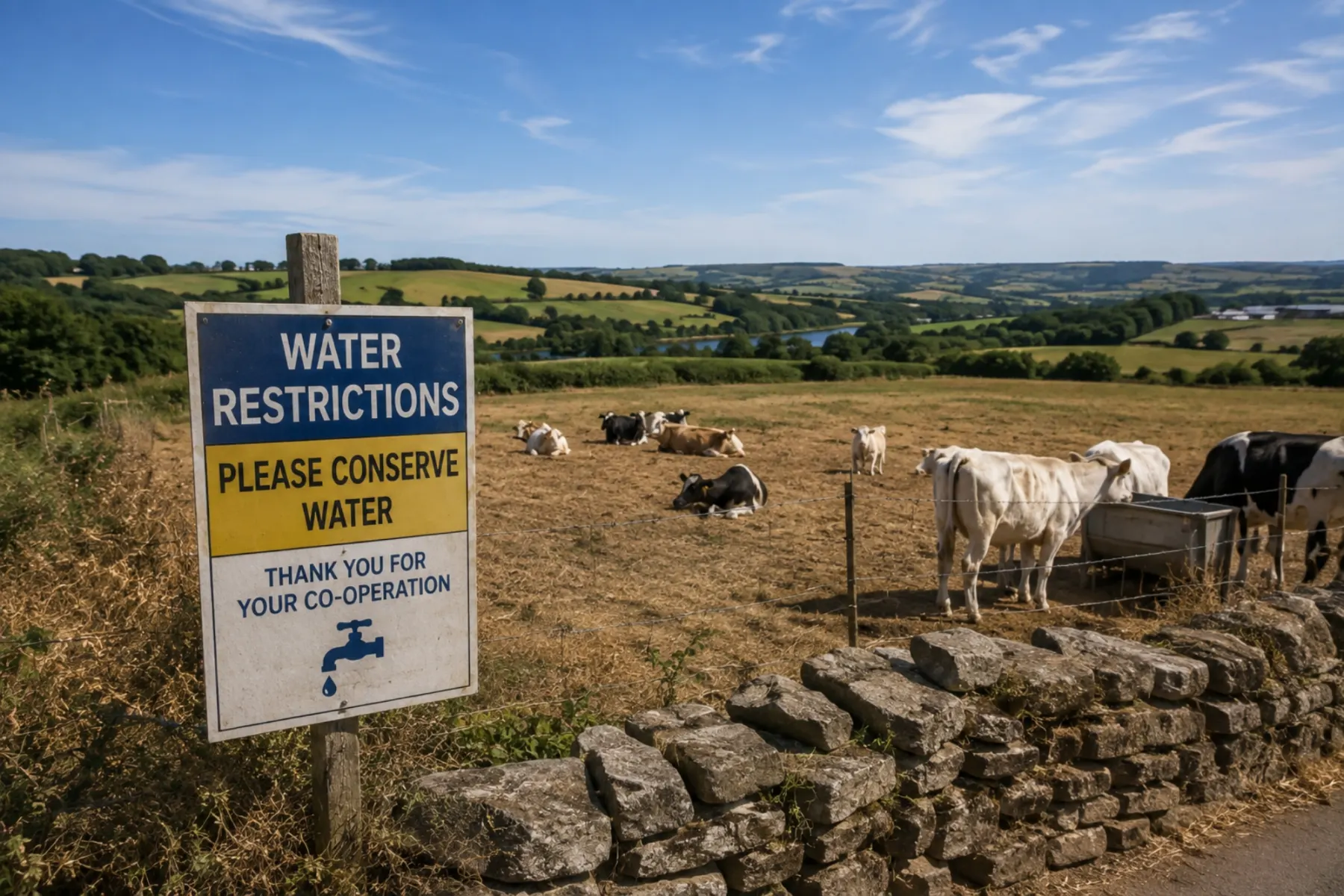
Irish farmers began the year dealing with waterlogged land and difficult grazing conditions. By July, Ireland was experiencing its driest July on record and one of its hottest. The consequences are now visible in grass growth, milk production, livestock feeding and crop yields — while climate projections suggest that greater weather variability may increasingly become part of farming rather than an occasional disruption.
For generations, Irish agriculture has been built around one of the country’s greatest natural advantages: a temperate maritime climate capable of growing grass for much of the year without the extreme heat or prolonged drought experienced across large areas of continental Europe.
In 2026, that advantage has not disappeared.
But it has been tested.
The year began with periods of excessive rainfall and difficult ground conditions. Spring then became exceptionally warm, while the country divided meteorologically between a wetter west and a much drier east. By midsummer, the pattern had changed dramatically again.
July 2026 became the driest July recorded in Ireland and the second hottest since national records began in 1900. Met Éireann’s provisional gridded data put national rainfall at only 16 millimetres — 17% of the 1991–2020 average — while the national mean temperature reached 17.25°C. Heatwaves were recorded at seven weather stations, lasting between five and 13 days.
For agriculture, those figures are not meteorological curiosities.
Rainfall determines grass growth.
Temperature affects animals, crops, evaporation and soil moisture.
Sunshine influences photosynthesis and crop development.
Ground conditions determine whether machinery can travel.
And the timing of all four can matter as much as the annual total.
The result is a farming year in which different parts of Ireland have experienced very different problems — sometimes only weeks apart.
Wet land constrained grazing early in the year.
Later, grass stopped growing on drought-affected farms.
Some cereal crops have produced excellent yields.
Others are expected to fall below the exceptionally strong 2025 harvest.
Milk deliveries have weakened compared with last year.
And farmers in drought-affected areas are already making decisions about supplementary feeding and autumn fodder that would normally belong much later in the season.
The most important question is therefore no longer whether Irish weather is good or bad for farming.
It is whether farms can remain productive when the weather becomes less predictable.
Ireland Entered 2026 With Wet Ground
The first weather difficulty of 2026 was not drought.
It was water.
Winter 2025–26 brought above-average rainfall to many parts of the country. At Johnstown Castle in County Wexford, winter rainfall reached 174% of the station’s long-term average, while several eastern and southern areas experienced particularly wet conditions.
February continued the pattern.
National rainfall reached 119% of the 1991–2020 average. Dublin Airport recorded its wettest February on record, receiving 133.7 millimetres — more than two and a half times its normal February rainfall.
March was also wetter than average nationally, receiving around 108% of normal rainfall.
For farmers, persistent winter and early-spring rain creates several interconnected problems.
Cattle cannot be turned onto saturated ground without damaging soil and grass swards.
Tractors carrying slurry or fertiliser may be unable to travel without causing compaction.
Spring cereal drilling can be delayed.
Livestock remain housed for longer.
Silage reserves are consumed.
Slurry storage continues filling.
And every additional week indoors increases feed, labour and bedding costs.
A wet spring therefore does not simply create inconvenience.
It can alter the economics of the whole season before grass growth has properly begun.
Then Spring Became Exceptionally Warm
The remarkable feature of 2026 is how quickly the pattern changed.
Spring became the third warmest recorded in Ireland since 1900.
The national mean spring temperature reached 10.14°C, 1.02°C above the modern 1991–2020 average and 1.77°C above the older 1961–1990 reference period. Seven of Ireland’s ten warmest springs have occurred since 2001.
But the rainfall distribution was deeply uneven.
Nationally, spring rainfall was close to average at 103%.
That national figure concealed an extraordinary geographical contrast.
Athenry in County Galway received 127% of its normal spring rainfall.
Casement Aerodrome in Dublin received only 60%.
Parts of the east experienced drought conditions during April and May, while western areas remained much wetter.
This is one reason national weather statistics can be misleading for agriculture.
A national average farm does not exist.
A dairy farmer on heavy soil in the west can be struggling with excessive moisture while a tillage grower in the east is beginning to worry about drought.
Both can occur during the same month.
May Gave an Early Warning of What Was Coming
Late May produced another extraordinary event.
A powerful area of high pressure brought exceptionally warm conditions, with Shannon Airport reaching 30.6°C on 26 May — provisionally the highest spring temperature ever recorded at an Irish synoptic weather station.
Warm weather can initially be highly favourable to farming.
Grass grows rapidly when moisture is available.
Cereal crops develop quickly.
Livestock can remain outdoors.
Machinery can travel.
Silage can be harvested under excellent conditions.
But temperature is only beneficial while sufficient soil moisture remains.
Once soils begin drying, warmer conditions accelerate water loss.
Plants continue transpiring.
Evaporation increases.
And the very sunshine that initially drives growth eventually contributes to the moisture deficit that restricts it.
This transition from productive warmth to damaging drought became increasingly visible as summer progressed.
June Was Warm but Brought Rain Back to Many Areas
June provided some temporary relief.
Met Éireann recorded a national mean temperature of 15.33°C, 1.65°C above the 1991–2020 average, making it the fourth warmest June in the 127-year national series.
The month was also wetter than May in many parts of the country, although rainfall distribution remained uneven.
For grassland farms, rainfall at that stage of the season was crucial.
June is normally one of the most productive periods of the Irish grazing year.
Teagasc describes typical summer grass growth rates of around 55 to 65 kilograms of dry matter per hectare per day on productive dairy farms, with strong beef farms capable of similar growth during favourable June conditions.
Where soil moisture was adequate, higher temperatures could support strong production.
Where the spring moisture deficit had already become established, the situation was more fragile.
On one Future Beef demonstration farm monitored by Teagasc in late June, grass growth had fallen to just 13kg of dry matter per hectare per day, against livestock demand of 26kg.
Average farm cover had declined to 315kg DM/ha — around half the 600–700kg target normally expected for that type of beef system at that time of year.
That farm is not representative of every Irish farm.
It demonstrates what happens economically when rainfall stops matching livestock demand.
The animals continue eating.
The grass does not continue growing.
The difference has to come from somewhere else.
July Changed the Farming Season
Then came July.
Met Éireann’s latest climate statement describes the month as one of the most exceptional in the modern Irish record.
The national mean temperature of 17.25°C made July 2026 the second hottest July since 1900.
Rainfall averaged only 16 millimetres nationally.
That was just 17% of normal and made it the driest July in the national record.
The southern and eastern counties experienced the most extreme conditions.
Cork Airport and Moore Park received only 1.1 millimetres of rain during the entire month.
Oak Park in Carlow and Johnstown Castle in Wexford received only 1.5 millimetres.
All four locations recorded their driest month on record.
Seventeen Met Éireann stations recorded their driest July.
Twenty stations experienced absolute drought conditions.
Fifteen stations, particularly across the Midlands, South and East, experienced partial droughts extending into periods of up to 45 days.
At the same time, sunshine became extraordinary.
Johnstown Castle recorded 332.4 hours of sunshine during July, provisionally the highest monthly sunshine total recorded anywhere in Ireland.
Cork Airport recorded 315.1 hours.
For tourists, it was exceptional summer weather.
For farmers, it increasingly became a production problem.
Grass Is Ireland’s Cheapest Feed — Until It Stops Growing
The economics of Irish dairy and livestock farming are built around grass.
Grazed grass is normally much cheaper than purchased concentrate or conserved silage.
That is one of the reasons Ireland can operate internationally competitive milk and beef systems despite relatively high labour, land and machinery costs.
The advantage depends on growing enough grass.
By July, Teagasc was reporting declining grass growth across much of the country, with soil moisture availability particularly restricted in the South and South-East. Farmers were advised to lengthen grazing rotations, reduce grazing demand and supplement cows where necessary.
In parts of the South and East, soil moisture deficits exceeded 50 millimetres during July.
At that level, Teagasc advised farmers to reduce nitrogen applications when grass growth fell below 50kg DM/ha/day.
Where moisture deficits exceeded 75 millimetres and severe drought had restricted growth, further nitrogen application was advised against until meaningful rain returned.
By early August, the advice had become still more cautious.
Teagasc recommended that chemical nitrogen should not be spread on drought-affected paddocks growing less than 35kg DM/ha/day because moisture, rather than nitrogen, had become the limiting factor.
This is important both economically and environmentally.
Fertiliser cannot make grass grow if the plant lacks water.
Applying more under those conditions wastes money.
When rain eventually returns, unused nitrogen can also become more vulnerable to loss.
Weather therefore changes not only the amount of grass grown but the economically sensible way of managing fertiliser.
The Drought Forces Farmers to Buy Back the Feed Nature Normally Provides
When grass growth falls below animal demand, farmers have several options.
They can slow the grazing rotation.
They can bring additional land into grazing.
They can feed silage.
They can purchase concentrates.
They can sell surplus or lower-priority animals.
Or they can combine several of these measures.
Every option has a cost.
Silage fed during July cannot be fed during winter.
Purchased concentrate increases cash expenditure.
Removing cattle early may mean selling them before reaching the weight or condition originally planned.
Bringing second-cut silage ground into grazing protects animals in the short term but reduces the amount of winter fodder harvested.
This is why drought can continue affecting a farm months after rain returns.
The visible problem in July is brown grass.
The financial problem may appear in December when winter silage stocks are lower than expected.
Water Becomes a Livestock Issue Too
Grass is not the only concern during unusually hot weather.
Animals require more water.
Teagasc advised dairy farmers during July that cows can consume more than 100 litres of water per cow per day in hot conditions.
Lactating suckler cows can require 40 to 70 litres daily during dry summer weather.
On a large herd, that becomes a substantial infrastructure requirement.
A 100-cow dairy herd consuming 100 litres per animal requires 10,000 litres in one day.
The farm therefore needs sufficient water supply, pipe capacity, trough storage and flow rate to deliver water where cattle are grazing.
A farm can theoretically have enough water available at source while still experiencing shortages at the trough because the pipe network cannot replenish it fast enough.
This is a reminder that climate resilience is partly an infrastructure problem.
The next drought may not require only more feed.
It may require larger water systems.
Milk Production Has Already Weakened
Ireland’s latest milk statistics provide another indication that 2026 is producing differently from the unusually strong year that preceded it.
Domestic milk intake by processors and co-operatives reached 1.05 billion litres in June 2026, 3.2% lower than in June 2025.
Across the second quarter, milk intake was 3.25 billion litres, down 2.8% year on year. For the first six months of 2026, intake was 1.3% below the corresponding period of 2025.
Those figures should not be attributed solely to weather.
Milk prices, cow numbers, calving patterns, farm management and previous production decisions also influence national supply.
But they show that output was already running below the exceptional 2025 level before the full effect of July’s record drought could appear in official monthly milk data.
Weather works through dairy production in several ways.
Less grass can reduce the amount of high-quality forage available.
Farmers may compensate with concentrates or silage, but that increases cost.
Heat can also reduce animal comfort and feed intake.
Water demand rises.
Grass quality and availability can deteriorate.
The economic result may therefore appear as lower milk output, higher feed expenditure or both.
A Drought Does Not Affect Every Dairy Farm Equally
The effect depends heavily on soil.
A heavier soil capable of retaining moisture can continue producing grass longer during a dry spell.
A shallow or free-draining soil can enter moisture stress much sooner.
Recently reseeded ryegrass may respond differently from older swards.
Fields with good soil fertility and structure may maintain stronger rooting and water access.
Stocking rate matters too.
A lightly stocked farm can tolerate a temporary reduction in grass growth more easily than a highly stocked grazing platform where demand is close to normal peak growth.
This is why Teagasc repeatedly advises farmers to assess individual paddocks rather than relying entirely on national averages.
Climate resilience ultimately operates at field level.
Beef Farmers Face Slower Weight Gain
The same grass shortage affects beef production differently.
A beef animal does not produce a daily tank of milk whose decline is immediately visible.
The effect is often slower liveweight gain.
If cattle are expected to gain weight from high-quality grazed grass but pasture availability declines, growth can slow unless supplementary feed is introduced.
That delay has consequences.
Animals may take longer to reach slaughter weight.
They may require more winter feed.
Finishing dates can move.
The cost per kilogram of gain rises.
Teagasc has warned that young cattle failing to achieve expected daily weight gains during the current dry spell may have to remain on farms longer or be sold at lower weights, reducing revenue.
A drought can therefore increase beef-production cost without visibly reducing the number of animals on the farm.
The animal is still there.
It is simply reaching its target more slowly.
Silage May Become the Hidden Story of 2026
Ireland’s livestock sector does not live on summer grass alone.
Winter depends on conserved forage.
Silage production is therefore the bridge between the growing season and the housed period.
Weather can affect it in several ways.
Wet weather can delay cutting and reduce quality as grass becomes older.
Dry weather can make harvesting easier but reduce regrowth and later cuts.
Prolonged drought can force farmers to graze land originally intended for silage.
Farmers who began summer with apparently secure winter reserves may therefore discover that supplementary summer feeding has reduced the margin of safety.
This is why the effect of the 2026 drought cannot be judged fully in August.
Its legacy will become clearer when livestock are housed and farmers calculate how much conserved forage remains.
Tillage Farmers Have Experienced a Different Side of the Same Weather
For crop growers, dry summer weather can initially be welcome.
Combines work efficiently.
Grain can be harvested at lower moisture.
Drying costs fall.
Straw can be baled quickly.
Machinery damage to soil is reduced.
The 2026 harvest began unusually early in some places because of the hot, dry conditions.
Yet prolonged heat and moisture stress can also cause crops to mature prematurely before they have fully filled their grain.
Teagasc’s July farm-income assessment expects national cereal yields in 2026 to be below the very strong levels achieved in 2025, with total cereal production consequently expected to decline.
The national result is not uniformly poor.
One Teagasc Signpost tillage farm in Cork began harvesting winter barley on 3 July and reported yields around 10 tonnes per hectare, while winter oats harvested a week later produced around 9 tonnes per hectare.
The farmer reported that strong rotations and high soil fertility appeared to help maintain performance despite concern that the dry heat would force premature ripening.
That individual example is useful precisely because it should not be generalised.
It demonstrates that extreme weather does not produce the same yield outcome on every farm.
Soil quality, crop rotation, variety, sowing date and local rainfall all influence the result.
Sunshine Can Help a Crop Before It Hurts It
The effect of hot, sunny weather on cereals is particularly complex.
Sunlight drives photosynthesis.
If roots have enough moisture, high sunshine levels can help plants manufacture the carbohydrates later stored in the grain.
Dry conditions also reduce some fungal disease pressure.
But once soil moisture becomes limiting, the relationship changes.
Plants reduce transpiration.
Photosynthetic activity declines.
Leaves can senesce earlier.
Grain-filling periods shorten.
The crop reaches harvest sooner but may produce lighter grain or fewer tonnes.
That is why the exceptional July sunshine cannot simply be classified as either favourable or unfavourable for tillage.
The timing matters.
A winter barley crop approaching natural maturity may benefit from dry harvesting weather.
A later spring crop still trying to fill grain can be damaged by the same conditions.
Soil Quality Is Becoming a Form of Weather Insurance
The 2026 season has also highlighted something less visible than rainfall totals.
Soil management affects how strongly weather shocks translate into yield shocks.
Healthy soils with good structure can allow roots to explore more deeply.
Organic matter can contribute to water retention.
Good drainage helps during wet periods.
Reduced compaction improves infiltration when rain arrives.
Correct soil pH improves nutrient availability.
Crop rotation can improve soil structure and reduce disease pressure.
The benefits become particularly valuable when weather moves rapidly between extremes.
A compacted soil can remain waterlogged during wet conditions and then dry hard during drought.
A structurally resilient soil is better able to handle both.
This is why climate adaptation on farms will not always look like expensive new technology.
Sometimes it is a better soil profile.
Ireland’s Weather Has Always Been Variable — but the Background Climate Is Changing
Irish farmers are accustomed to weather variability.
A wet summer is not new.
Neither is drought.
Heatwaves occurred long before modern climate change became a policy issue.
It would therefore be scientifically unjustified to claim that every unusual season is individually “caused” by climate change.
The Environmental Protection Agency explicitly notes that science cannot categorically attribute every individual extreme weather event to recent human-driven climate change.
But that does not mean climate change is irrelevant to the current farming discussion.
Climate is the statistical background against which individual weather events occur.
And that background is changing.
Ireland’s four years from 2022 through 2025 were the four warmest in the national record.
Seven of the country’s ten warmest years have occurred since 2005.
The 2025 annual mean temperature was 11.14°C, making it the second warmest year recorded since 1900.
Spring 2026 then became the third warmest on record.
July became the second hottest July.
These are individual observations, but together they sit within a clear longer-term warming trend.
Climate Change Does Not Mean Ireland Simply Becomes Drier
One of the most important misunderstandings is the assumption that a warmer Ireland automatically means a uniformly drier Ireland.
Current scientific projections are more complicated.
The latest high-resolution EPA-supported climate modelling projects warmer conditions, more heatwaves, fewer frost and ice days, longer growing seasons and a more variable rainfall regime.
Under higher-emissions scenarios, autumn and winter become wetter on average, while summers become drier.
At the same time, both dry periods and heavy rainfall events are projected to increase.
This means Ireland may increasingly have to manage two apparently opposite problems.
Too much water.
And too little water.
Possibly within the same farming year.
The weather pattern of 2026 provides an unusually clear illustration of what that agricultural challenge looks like, although one year by itself cannot establish a climate trend.
Longer Growing Seasons Could Be an Opportunity
Climate change is not projected to produce only negative agricultural effects.
Higher average temperatures and fewer frost days can lengthen Ireland’s growing and grazing seasons.
The latest EPA climate projections indicate increases in growing-season length, soil temperatures, growing degree days and crop heat units under future warming scenarios.
In principle, that could create opportunities.
Grass may begin growing earlier.
Grazing seasons could lengthen.
Some crops may mature more reliably.
New crop varieties or species may become commercially viable.
Livestock could spend fewer days housed in some years.
Heating and winter-management costs could decline.
But a theoretical longer growing season is useful only if water and ground conditions allow farmers to use it.
Warm February temperatures do not help grazing if soil is saturated.
A hot July does not increase grass production if rainfall disappears.
The relevant future agricultural climate is therefore not simply warmer.
It is warmer and more variable.
The West and East May Face Increasingly Different Farming Risks
Ireland’s geography complicates adaptation.
The Atlantic west is generally wetter.
The east and south-east contain much of the country’s tillage land and have historically been comparatively dry.
During spring 2026, this division was unusually pronounced.
Athenry recorded 127% of average spring rainfall while Casement recorded only 60%.
July then brought drought to the whole country but was particularly extreme across southern and eastern stations.
Future climate modelling also indicates the largest temperature increases are likely to occur in the east.
Ireland may therefore require increasingly regional agricultural adaptation.
Western farms may prioritise drainage, soil trafficability and winter water management.
Southern and eastern farms may need stronger drought planning, water-storage capacity and soil-moisture conservation.
National agricultural policy will increasingly have to recognise that the weather risk facing a farm in Kerry is not identical to that facing one in Wexford.
The Greatest Risk May Be Variability Rather Than Average Change
A farmer can adapt to a stable climate surprisingly well.
If summers are consistently dry, irrigation can be considered.
If winters are consistently wet, drainage can be designed accordingly.
If temperatures rise gradually, varieties and stocking systems can change.
The more difficult challenge is volatility.
A farm built for drought can be damaged by flooding.
A farm prepared for wet weather may be overstocked when drought arrives.
A cereal variety chosen for one expected disease environment can encounter another.
A grazing system optimised around average grass growth can run short when growth suddenly falls by half.
This is why averages alone are becoming less useful.
The economically important number may increasingly be the size of the deviation from normal.
Weather Forecasting Is Becoming a Farm Management Tool
The practical response is not simply to predict climate decades in advance.
Farmers increasingly need better short-term information.
Met Éireann forecasts.
Soil moisture deficits.
PastureBase grass measurements.
Crop-disease models.
Satellite imagery.
Grass-growth forecasts.
Rainfall radar.
Farm-specific weather stations.
These tools allow farmers to change decisions before a weather event becomes a financial loss.
A fertiliser application can be delayed.
Silage can be cut ahead of rain.
Animals can be supplemented before grass cover collapses.
A fungicide decision can respond to disease risk.
Harvest machinery can be organised around a short dry window.
The value of agricultural data therefore increases as weather variability increases.
Forecasting cannot create rain.
It can reduce the number of expensive decisions made without knowing whether rain is coming.
Water Storage Could Become More Important
Ireland does not traditionally think of itself as a country that needs to conserve agricultural water.
That assumption may require reconsideration.
Longer dry periods increase the value of secure water supplies for livestock.
Vegetable and horticultural operations already understand irrigation risk.
Even grass-based farms can face pressure when wells, springs or local supplies decline during prolonged dry spells.
Future investment may therefore include larger storage tanks, higher-capacity boreholes, rainwater capture and better distribution systems.
The economics will vary by farm.
Not every livestock operation needs an irrigation system.
But every livestock farm requires reliable drinking water.
The July 2026 drought has demonstrated how quickly that requirement can become critical.
Farm Infrastructure Must Work in Both Extremes
The challenge is that investment cannot focus only on drought.
Wet years remain part of Ireland’s future.
Climate projections indicate wetter autumns and winters under many scenarios, alongside heavier rainfall events.
That means farms may require:
better drainage for wet periods;
greater slurry storage when land cannot be travelled;
stronger roadways to extend grazing opportunities;
larger water systems for drought;
more flexible silage reserves;
and buildings capable of protecting animals during both heat and prolonged wet weather.
This is not simply climate policy.
It is capital investment.
And that means climate adaptation eventually becomes part of farm economics.
More Fodder Reserves May Become Rational, Even If They Look Inefficient
Agriculture traditionally seeks efficiency.
Unused silage left at the end of winter can appear inefficient.
Spare water capacity can appear unnecessary.
Extra land in the grazing platform can reduce measured stocking-rate efficiency.
But resilience has a value that becomes visible only in difficult years.
A farm carrying additional fodder can survive a drought without purchasing expensive emergency feed.
A lower stocking rate may allow a grass system to absorb poor growth.
Additional slurry storage provides flexibility when weather prevents spreading.
The most efficient farm under average conditions is not automatically the most profitable farm across a decade of variable weather.
Climate adaptation may therefore force agriculture to reconsider the economic value of spare capacity.
Weather Risk Also Becomes Financial Risk
Every weather event ultimately enters the farm accounts.
Drought increases feed purchases.
Flooding damages crops.
Delayed planting reduces yield.
Heat can reduce animal performance.
Excessive rain increases machinery costs and soil damage.
Poor harvest weather increases grain drying.
Fodder shortages raise winter costs.
Infrastructure repair requires capital.
A changing climate therefore does not only alter biological production.
It changes financial volatility.
Farm businesses may increasingly need stronger cash reserves, insurance products, flexible borrowing facilities and risk planning.
The weather forecast becomes part of the balance sheet.
Climate Mitigation and Adaptation Are Different Problems
There are also two distinct climate questions for agriculture that are sometimes confused.
Mitigation concerns reducing greenhouse gas emissions.
Adaptation concerns operating successfully under the climate changes that occur.
A farmer improving nitrogen-use efficiency may contribute to mitigation.
A farmer installing greater water storage is adapting.
Better soil fertility can contribute to both.
Improved grass utilisation can lower emissions intensity while also reducing dependence on purchased feed.
Maintaining healthy soils can increase productivity while improving resilience to both drought and heavy rainfall.
The most effective agricultural investments may increasingly be those that serve both objectives.
What the 2026 Harvest Can Teach Ireland
The current tillage harvest offers an early demonstration of this principle.
Some crops have performed surprisingly well despite prolonged heat.
Others are expected nationally to yield below last year’s exceptional levels.
The differences appear to reflect more than rainfall alone.
Soil fertility.
Rotation.
Crop choice.
Planting date.
Variety.
Disease management.
Local rainfall.
And soil water-holding capacity all matter.
On the Teagasc Signpost farm reporting around 10 tonnes per hectare from winter barley and 9 tonnes from winter oats, strong rotation and years of organic manure use were identified as important elements behind resilience.
No single farm proves a national agronomic rule.
But the wider lesson is credible.
Weather sets the conditions.
Management helps determine how much of the potential damage becomes actual loss.
The Full Cost of 2026 Will Not Be Known Until Winter
As of August, it is too early to calculate the final agricultural impact of the year.
The cereal harvest is still progressing.
Later crops remain to be cut.
Autumn grass growth has not yet been determined.
Official July milk figures are not yet available.
Winter fodder requirements are unknown.
Rain could return and produce a rapid recovery in grass growth.
Or prolonged dryness could extend the pressure.
This uncertainty needs to remain explicit.
Current evidence shows significant drought impacts on grass availability and management, but it does not justify declaring a final national crop or livestock loss before the season is complete.
The most meaningful assessment of 2026 will come later.
How many tonnes of grain were harvested?
How much grass was grown?
How much extra concentrate was purchased?
How much silage remains?
How did milk output develop?
How much additional cost did farmers absorb?
Those figures will determine whether 2026 was mainly an agronomic challenge or a major financial one.
What Happens Next
For the immediate weeks ahead, rainfall matters enormously.
Grass plants have not disappeared.
Where swards remain viable, meaningful rainfall combined with warm soils could trigger rapid recovery.
But recovery itself requires careful management.
Teagasc has advised farmers not to rush fertiliser onto drought-stressed ground immediately after the first rain. Soil biological activity can release nutrients rapidly when moisture returns, and premature fertiliser application can increase the risk of nutrient loss.
Farmers must also begin building grass cover for autumn at precisely the moment when many farms are operating with reduced summer reserves.
That makes August particularly important.
A strong recovery could restore much of the grazing platform before autumn.
A weak recovery would increase dependence on conserved feed.
Ireland Is Not Losing Its Agricultural Climate Advantage
It would be wrong to conclude from one record-dry month that Ireland’s grass-based agricultural model no longer works.
The country remains climatically well suited to grass production.
Rainfall remains abundant on an annual basis.
Temperatures are moderate compared with many major agricultural regions.
Severe continental heat remains relatively uncommon.
Ireland also possesses extensive experience in managing pasture under variable weather.
The climate advantage remains real.
What is changing is its reliability.
The traditional assumption that summer moisture will normally be sufficient across most Irish grassland can no longer be treated as equally secure in every region and every year.
Likewise, the assumption that mild winters automatically improve grazing ignores the possibility of heavier rainfall and poor soil trafficability.
Climate change does not remove Ireland’s farming advantages.
It alters the risks attached to them.
Farming’s Next Efficiency Measure May Be Resilience
For decades, Irish agricultural progress has been measured through yield.
More litres of milk.
More kilograms of beef.
More tonnes of grain.
More grass per hectare.
Those measures will remain important.
But another measure is becoming increasingly relevant:
How much production can a farm maintain when conditions move outside the normal range?
The answer depends on grass reserves, soil quality, water infrastructure, crop rotations, fodder stocks, stocking rate, drainage, financial resilience and the speed at which management responds.
The highest-yielding farm in a perfect year may not always be the strongest business across ten unpredictable years.
That is an important change in how agricultural efficiency may have to be understood.
2026 Is a Warning, Not a Forecast
The weather experienced in Ireland during 2026 should not be presented as a precise picture of every future farming season.
Climate does not work that way.
Ireland will still experience cool summers.
Wet summers will return.
Some winters will be relatively dry.
Individual years will continue deviating sharply from the long-term trend.
But the broader scientific projections are increasingly clear.
Ireland is expected to become warmer.
Heatwaves are expected to become more frequent.
Growing seasons are expected to lengthen.
Summer rainfall is projected to decline under many future scenarios.
Autumn and winter rainfall is projected to increase.
And both dry periods and intense rainfall events are expected to become more common.
For agriculture, that combination matters more than the simple increase in average temperature.
It means the same farm may have to cope with saturated ground in February and drought in July.
That is almost exactly what 2026 has already demonstrated.
The New Farming Question Is Not What Weather Ireland Has — but How Quickly It Can Change
Irish agriculture has always depended on the weather.
What is changing is the amount of economic risk contained within that dependence.
A few dry weeks can turn a surplus of grass into a feed deficit.
A wet spring can delay fieldwork before an exceptionally hot summer accelerates crop maturity.
One region can experience waterlogged land while another is already developing a soil-moisture deficit.
For the farmer, those are not abstract climate statistics.
They determine when cattle can graze.
Whether silage can be saved.
How much milk a cow produces.
How quickly an animal gains weight.
Whether a cereal crop reaches its yield potential.
How much fertiliser delivers a return.
And ultimately how much money remains after the weather has finished influencing the season.
Ireland’s agricultural climate remains one of its great economic assets.
But 2026 has shown that the future value of that asset may depend increasingly on flexibility.
The challenge is no longer simply to grow as much as possible when conditions are good.
It is to build farming systems capable of continuing to produce when the year moves rapidly from too wet to too dry — and when what once looked like exceptional weather begins occurring often enough that farmers have to plan for it.
Source & Transparency
This article is published by Ireland Newspaper for editorial and informational purposes.
Published: 10 August 2026 · Updated: 10 August 2026

Newsroom Ireland Newspaper
Ireland Newspaper editorial team prepares daily news coverage for readers in Ireland and abroad.