Ireland’s Farm Calendar: The Agricultural Events to Watch Over the Next 14 Days
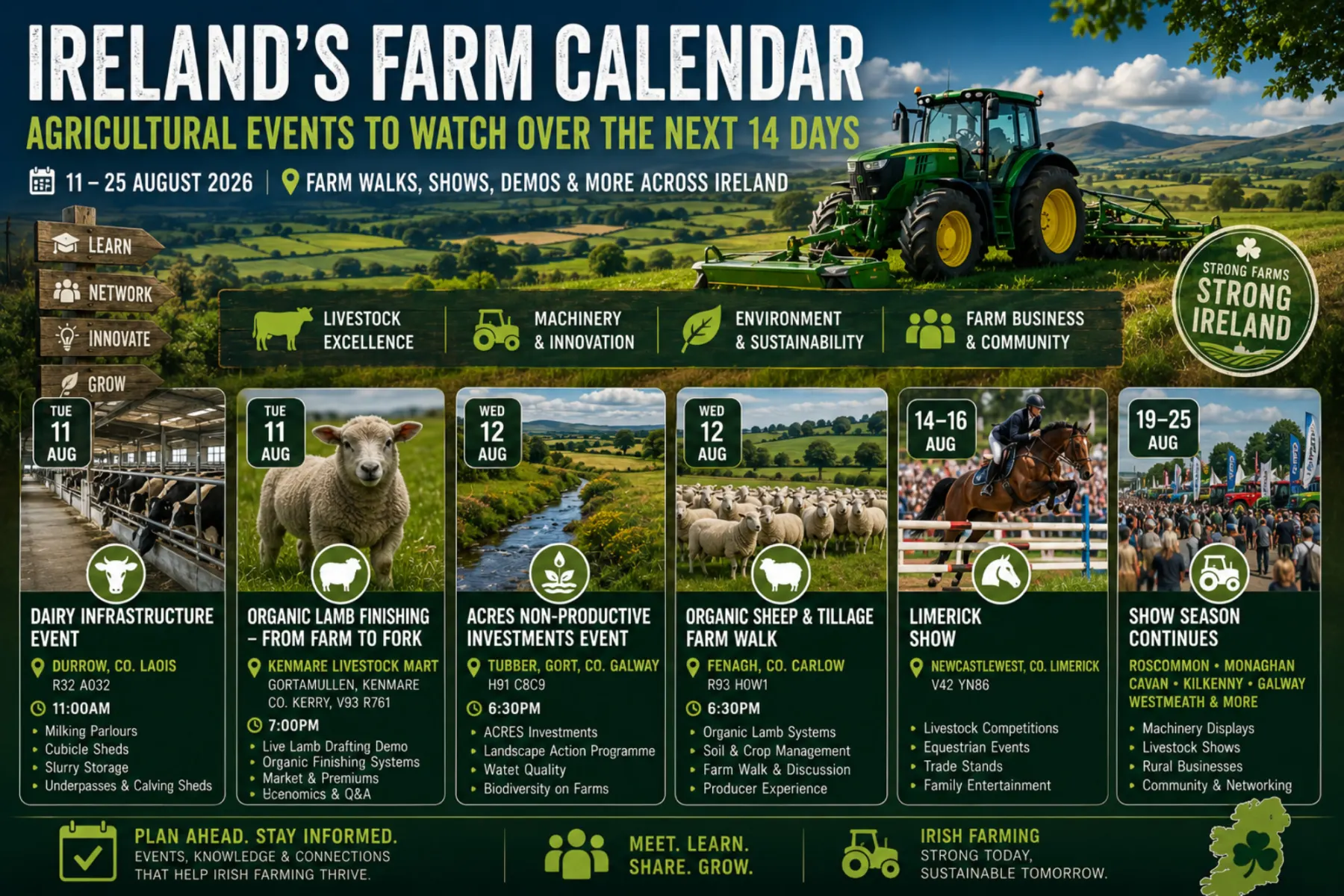
From practical dairy and sheep farm walks to some of Ireland’s best-known agricultural shows, the period from 11 to 25 August 2026 offers farmers opportunities to examine new production methods, livestock genetics, organic farming, environmental schemes, machinery and rural businesses across the country.
August is one of the busiest periods in the Irish agricultural calendar.
Silage and harvest work continue on farms, yet the same weeks also bring together farmers, breeders, advisers, machinery suppliers, food businesses and rural communities at agricultural shows and specialist technical events throughout the country.
The next fortnight is particularly varied. Teagasc is running practical events on dairy infrastructure, organic lamb finishing, ACRES environmental measures, sheep production and organic vegetables, while the agricultural-show season moves through counties including Limerick, Roscommon, Monaghan, Cavan, Kilkenny, Galway and Westmeath.
For farmers deciding where a trip might be worthwhile, the distinction matters. Some events are primarily technical learning opportunities held on working farms. Others are major agricultural shows combining livestock competition, machinery, trade stands and rural entertainment.
The following are among the most relevant confirmed events taking place between 11 and 25 August 2026.
Tuesday, 11 August: Dairy Infrastructure in Laois
The first event arrives almost immediately.
Teagasc’s Dairy Infrastructure Event takes place at 11:00am on Tuesday, 11 August on the farm of Seamus Holland in Durrow, County Laois.
Address: Farm of Seamus Holland, Durrow, Co. Laois
Eircode: R32 A032
Rather than being a general agricultural show, this is a focused technical event for dairy farmers considering investment in farm infrastructure.
The programme includes on-farm demonstrations and discussion covering milking parlours, cubicle sheds, farm underpasses, slurry storage and calving sheds.
That makes it particularly relevant to expanding dairy businesses, farmers considering building projects and those evaluating whether existing infrastructure can handle future herd and labour requirements.
Infrastructure has become a much larger strategic question for Irish dairy farming because a new building is rarely simply a building. Parlour capacity influences labour efficiency; slurry storage interacts with environmental requirements; roadways and underpasses affect cow movement; and housing design can influence both animal welfare and working time.
For farmers preparing a substantial capital investment, seeing working systems on another farm can be more informative than examining specifications alone.
Tuesday Evening: Organic Lamb Production in Kerry
Later on Tuesday, attention moves west.
Teagasc’s Organic Lamb Finishing – From Farm to Fork event begins at 7:00pm at Kenmare Livestock Mart.
Address: Kenmare Livestock Mart, Gortamullen, Kenmare, Co. Kerry
Eircode: V93 R761
The meeting is designed for both organic and conventional sheep farmers and brings together producers, researchers, processors and industry representatives.
A practical live demonstration will examine how to draft lambs and identify animals ready for slaughter. Teagasc research on organic lamb-finishing diets will also be presented, together with analysis of the economics of finishing systems and a discussion of access to premium organic markets.
For sheep farmers assessing organic conversion, that economic discussion may be just as important as production techniques. Higher-value markets can be attractive, but finishing performance, feed availability, certification requirements and market access ultimately determine whether the system works commercially.
Wednesday, 12 August: ACRES Moves From Paperwork to the Field
Environmental schemes can appear highly technical when viewed through forms and regulations. Teagasc’s Galway event on Wednesday takes a more practical approach.
The ACRES Non-Productive Investments Information Event begins at 6:30pm on 12 August.
Address: Farm of Killian and Geraldine Forde, Fiddaun, Tubber, Gort, Co. Galway
Eircode: H91 C8C9
The programme is expected to cover ACRES non-productive investments, the Landscape Action Programme, field scoring, water quality and improving biodiversity on conventionally managed farms.
This is particularly relevant for farmers trying to understand how environmental requirements translate into actual decisions around hedgerows, habitats, water protection and management of productive land.
The growing significance of such events also says something about the changing role of the Irish farmer. Modern farm management increasingly involves producing food and managing environmental outcomes simultaneously.
Wednesday Evening: A Working Organic Sheep and Tillage Farm in Carlow
Another substantial sheep event takes place on the same evening in County Carlow.
The final Organic Lamb Finishing – From Farm to Fork event begins at 6:30pm on 12 August.
Address: Farm of Joe Nolan, Fenagh, Co. Carlow
Eircode: R21 CK66
This farm provides an especially interesting case study because it combines organic sheep production with tillage.
Joe Nolan operates a 98-hectare organic enterprise incorporating cereals, protein crops, grassland, red clover, woodland and riparian areas. The system includes a 310-ewe March-lambing flock, pedigree Charollais sheep and wintered store lambs.
Crops grown on the farm are integrated into the livestock system, while cover crops provide winter grazing.
For farmers interested in mixed farming rather than simply replacing conventional inputs with organic alternatives, the event provides an opportunity to see how crops, forage and sheep can operate as one system.
Saturday, 15 August: Cappamore Celebrates Its 70th Show
The middle weekend of August brings a major shift from specialist farm walks to the traditional Irish agricultural-show circuit.
Cappamore Agricultural Show celebrates its 70th show on Saturday, 15 August 2026.
Address: Cappamore Agricultural Showfield, Ballyvoreen, Cappamore, Co. Limerick
Eircode: V94 HT32
Public gates open at 10:30am.
The organisers currently list admission at €15 for adults, €10 for students and concession visitors, with children admitted free.
Cappamore has developed into one of the established shows in the south of Ireland, bringing together livestock and equestrian competitions, agricultural exhibitors and the broader rural community.
For farmers, the attraction of events such as Cappamore extends beyond livestock judging. Show grounds also become temporary agricultural marketplaces where machinery businesses, agricultural suppliers, breeders and service companies can meet customers directly.
Saturday, 15 August: Roscommon Agricultural Show
Also on Saturday, 15 August, the 54th Roscommon Agricultural Show takes place at Hannon’s Grounds.
Address: Hannon’s Grounds, Athlone Road, Roscommon
Eircode: F42 PH33
The showgrounds open for exhibits at 8:00am, with judging beginning through the morning.
Young-horse classes start at 9:30am, horse and pony judging follows, while cattle and sheep judging is scheduled from 11:30am. A dog show begins at 1:00pm, and the programme includes the All-Ireland Final for the Irish Draught Yearling Filly.
The breadth of the classes is characteristic of traditional Irish agricultural shows: horses and ponies sit alongside cattle, sheep, crops, cookery, crafts and other rural competitions.
For livestock breeders, however, these events have a serious commercial dimension. Showing an animal provides an opportunity to compare breeding programmes, examine competitors and establish a reputation that may later influence pedigree sales.
Saturday, 15 August: Tydavnet Parish Agricultural Show
Farmers in the north-east have another option on 15 August.
The Tydavnet Parish Agricultural Show takes place at the showgrounds at Drumshevra, Scotstown, County Monaghan.
Address: Drumshevra Showgrounds, Scotstown, Co. Monaghan
The programme encompasses cattle, dairy cattle, pedigree and commercial livestock, sheep, horses and ponies, poultry, trade stands, demonstrations and vintage exhibits, alongside family activities.
Tydavnet illustrates why the agricultural show remains relevant despite enormous changes in farming.
A show is simultaneously a livestock competition, business exhibition and community gathering. That combination is difficult to reproduce online and remains particularly valuable in areas where agriculture is still closely connected with the wider local economy.
Sunday, 16 August: Mohill Agricultural Show
The show circuit continues the following day in County Leitrim.
Mohill Agricultural Show 2026 takes place on Sunday, 16 August.
Address: Reynolds Topline Sports Hub & McGowan’s Field, Cloone Road, Mohill, Co. Leitrim
Mohill is another of the important regional agricultural shows serving Ireland’s livestock-producing counties.
For farmers in Leitrim and neighbouring areas, it offers a more local alternative to travelling to one of the larger national events and keeps the traditional competition and show calendar active between major summer fixtures.
Wednesday, 19 August: Virginia Agricultural Show
The Virginia Agricultural Show in County Cavan is one of the most significant events of the fortnight.
It takes place on Wednesday, 19 August 2026.
Address: The Showgrounds, Rahardrum, Virginia, Co. Cavan
Eircode: A82 A9X2
The event is now in its 83rd edition.
Its programme includes livestock, horses, home industries, trade stands and family attractions, with the well-established Baileys dairy-cow competition among the agricultural highlights.
Virginia’s scale is notable. The show normally encompasses more than 450 classes and around 3,500 exhibits, attracting exhibitors and visitors from across Ireland and beyond.
For dairy and beef breeders in particular, Virginia is therefore much more than a local day out. It provides one of the summer’s larger meeting points for pedigree livestock, commercial farming and agricultural businesses.
Wednesday, 19 August: BETTER Sheep Farm Walk in Offaly
Farmers more interested in practical production systems than the show ring have an alternative that evening.
A BETTER Sheep Farm Walk begins at 6:30pm on the farm of Ross and Amy Jackson near Birr.
Address: Lacka, Carrig, Birr, Co. Offaly
Eircode: R42 VY98
Ross and Amy Jackson operate an organic lowland sheep farm within the BETTER Sheep programme.
The agenda includes farm performance, lamb-growth data, diets, parasite management, breeding strategy, organic farming and cereal production.
Its timing makes this one of the more technically valuable sheep events in the period. Rather than concentrating solely on demonstration animals, the discussion is built around actual production data and management decisions from a participating farm.
Saturday, 22 August: The Iverk Show Marks 200 Years
One event stands out historically.
The Iverk Show at Piltown, County Kilkenny, takes place on Saturday, 22 August and is marking its 200th anniversary in 2026.
Address: Iverk Showgrounds, Piltown, Co. Kilkenny
Eircode: E32 PD81
Founded in 1826, Iverk is regarded as Ireland’s oldest agricultural show.
Its bicentenary programme includes a particularly substantial beef-cattle component.
A €37,700 prize fund has been confirmed for the Beef Bulls of the Future Championships. For 2026 the competition has been expanded to include heifer categories, and organisers expect roughly 120 bulls and 80 heifers representing as many as ten pedigree beef breeds.
That gives this year’s Iverk Show significance beyond the normal annual show calendar.
Livestock genetics have become increasingly important to the economics and environmental performance of cattle farming. Animals are being evaluated not simply on appearance but within an industry paying greater attention to maternal characteristics, growth, feed efficiency and genetic merit.
A bicentenary livestock show built around future breeding therefore brings together two centuries of agricultural tradition with some of the most modern questions facing Irish cattle production.
Saturday, 22 August: Mountbellew Agricultural Show
Farmers in the west can instead head to Mountbellew Agricultural Show, also on Saturday, 22 August.
Address: Mountbellew Agricultural College, Mountbellew, Co. Galway
Eircode: H53 WE00
The gates are scheduled to open at 8:30am.
Horse judging begins at 10:00am, followed by cattle and sheep at 11:00am and dogs and pets at noon.
The programme also covers dairy cattle, commercial and pedigree cattle, poultry, horticulture, home produce, crafts, vintage displays, trade stands and other show classes.
The setting at an agricultural college gives Mountbellew a particularly strong farming identity, while the mix of livestock and community competitions makes it attractive both to commercial farmers and families.
Saturday, 22 August: Ballygarvan Agricultural Show
County Cork also joins the show calendar on Saturday, 22 August with the Ballygarvan Agricultural Show.
Address: Ballygarvan GAA Club, Ballyduhig South, Ballygarvan, Co. Cork
Eircode: T12 WC8V
For southern farmers who do not want to travel to Kilkenny or Galway, Ballygarvan adds another agricultural gathering during what may be the busiest weekend of the fortnight.
Sunday, 23 August: Limerick Show Combines Agriculture and AgTech
The following day brings one of the largest urban-adjacent agricultural events.
Limerick Show takes place at Limerick Racecourse on Sunday, 23 August 2026.
Address: Limerick Racecourse, Greenpark, Patrickswell, Co. Limerick
Eircode: V94 RH92
The gates open at 9:00am.
Current ticket information lists adult admission at €15, student admission at €10, concession pricing for older visitors and free admission for children under 16.
Agriculturally, the programme is wide-ranging.
Pedigree and commercial cattle, dairy cattle, sheep, horses, ponies and poultry are among the livestock categories, while the programme also includes a Sustainability & AgTech Hub, trade exhibitors and farm machinery.
That mix is significant.
Agricultural shows were historically centred predominantly around animals and produce. Increasingly, they are also becoming places where farmers encounter software, precision agriculture, environmental technology and new business models.
Limerick therefore represents both sides of modern Irish agriculture: the livestock show ring and the technology stand.
Sunday, 23 August: Moate Agricultural Show
Also on Sunday, 23 August, the 183rd Moate Agricultural Show is scheduled for County Westmeath.
Address: Browne’s Fields, Dublin Road, Moate, Co. Westmeath
Eircode: N37 W2H3
Established in 1839, Moate is one of Ireland’s older surviving agricultural shows.
Its 2026 programme includes equine, cattle, sheep and poultry classes, home industries, children’s competitions, entertainment and live music.
The event provides another reminder of the extraordinary continuity of Ireland’s show movement.
Machinery, breeding science and farm economics have changed almost beyond recognition since the nineteenth century. Yet the basic idea of bringing farmers, animals, produce and rural communities together in one field has endured.
Tuesday, 25 August: Organic Vegetable Farming in Galway
The fortnight concludes with an agricultural sector that receives less public attention than cattle or dairy farming.
Teagasc’s Growing Organics Farm Walk – Vegetables begins at 2:00pm on Tuesday, 25 August.
Address: Green Earth Organics, Caherlea, Corrandulla, Co. Galway
Eircode: H91 F9C5
The event takes place on the farm of Kenneth and Jenny Keavey, who began converting the holding to organic production more than two decades ago and subsequently developed a nationwide organic-produce business.
Around 25 acres of certified organic land are used in rotation for a diverse range of field and protected crops.
The programme will examine field and polytunnel vegetable production, machinery and equipment, and the farm’s packing facility. IASIS continuing-professional-education credits are also available, and registration is required through the organiser.
For farmers exploring diversification, this may be one of the most interesting events in the entire fortnight.
It demonstrates a model in which value does not depend solely on producing more tonnes of commodity output. Production, packing, marketing and direct-to-consumer distribution can instead be integrated into the same agricultural business.
Why These Events Matter Beyond the Show Ring
Taken individually, these events cover very different parts of agriculture.
One farmer may travel to Laois to study the design of a slurry store. Another may go to Virginia to examine dairy cattle. A sheep farmer may travel to Offaly to compare lamb-performance figures. A beef breeder may head to the bicentenary Iverk Show. An organic grower may spend an afternoon examining vegetable equipment in Galway.
Together, however, they reveal something broader about Irish agriculture in 2026.
The industry is becoming increasingly technical.
Infrastructure decisions are becoming more expensive.
Environmental policy is becoming more closely integrated with day-to-day farming.
Livestock genetics matter more.
Organic farming is moving beyond a niche discussion toward practical questions of production and profitability.
Technology companies and machinery businesses increasingly share showgrounds with cattle and sheep breeders.
And despite the enormous growth of digital information, farmers still see value in meeting other farmers and examining animals, buildings, crops and machinery in person.
A Busy Fortnight for Rural Ireland
Between 11 and 25 August 2026, Irish farmers can move from a dairy yard in Laois to an organic sheep discussion in Kerry; from environmental measures in Galway to livestock rings in Roscommon; from Virginia’s major dairy competitions to a working sheep farm in Offaly; and finally to the 200th anniversary of the Iverk Show or the agricultural grounds at Mountbellew, Moate and Limerick.
The events are not interchangeable.
Farmers considering capital investment may gain most from the Laois dairy event. Sheep producers have several highly practical options. Livestock breeders are unusually well served by the agricultural-show calendar. Farmers examining diversification may find the Galway organic-vegetable event particularly valuable.
And for anyone wanting to see Irish agriculture in its broadest form, the larger agricultural shows remain difficult to match.
For all the changes in technology, markets and regulation, Irish farming continues to depend heavily on knowledge passed between people.
For the next two weeks, much of that exchange will be taking place not in conference rooms or online meetings, but where Irish agricultural knowledge has often travelled best: on farms, beside livestock rings and across the show fields.
Source & Transparency
This article is published by Ireland Newspaper for editorial and informational purposes.
Published: 11 August 2026 · Updated: 11 August 2026

Newsroom Ireland Newspaper
Ireland Newspaper editorial team prepares daily news coverage for readers in Ireland and abroad.