
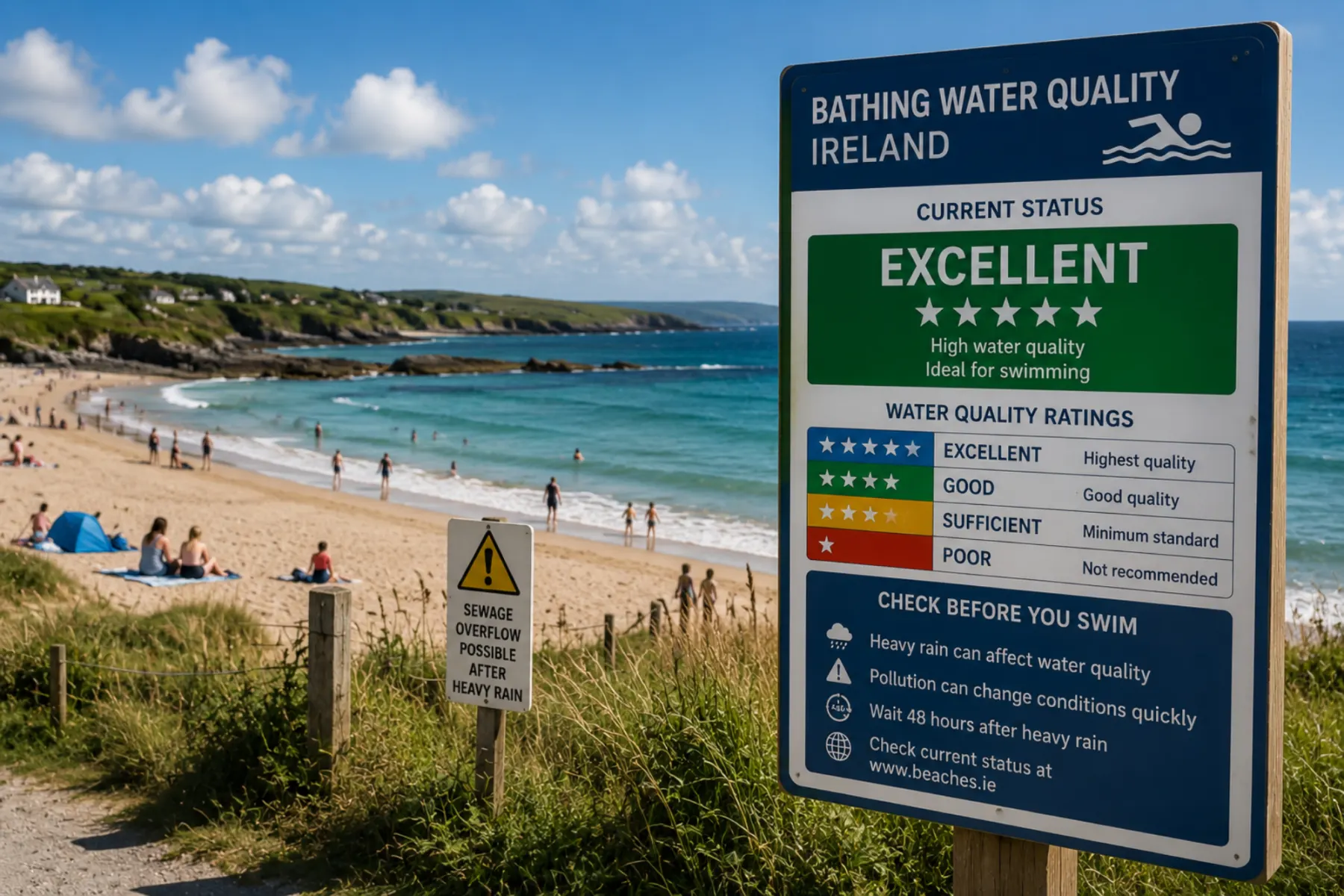
Before You Swim: What Ireland’s Beach Water Quality Ratings Really Mean in 2026
Ireland continues to have overwhelmingly high bathing-water standards, with 98 per cent of officially designated sites meeting the required standard in the latest national assessment. But an “Excellent” beach is not automatically safe every day. Heavy rain, wastewater overflows and agricultural or urban runoff can change conditions within hours — which is why understanding warnings, checking current information and following Ireland’s 48-hour rule can matter as much as the annual rating itself.
On a warm summer afternoon, an Irish beach carrying an “Excellent” water-quality classification can appear to offer all the reassurance a swimmer needs.
Most of the time, that confidence is justified.
Ireland’s latest national assessment found that 150 of the country’s 153 officially identified bathing waters — 98 per cent — met or exceeded the minimum required water-quality standard in 2025. Of those, 120 were classified as Excellent, 23 as Good and seven as Sufficient. Only one bathing water received a Poor classification, while two sites were new, changing or unclassified.
Those are strong national results.
But they come with an increasingly important qualification.
During the same year, Ireland recorded 205 bathing-water warnings, almost twice the 113 recorded in 2024, as periods of intense rainfall increased pressure on beaches. The Environmental Protection Agency received reports of 79 pollution incidents resulting in temporary bathing restrictions, compared with 34 a year earlier.
The apparent contradiction is one every swimmer should understand.
A beach can have excellent long-term water quality and still experience a short-term pollution event today.
That is why the most useful question before entering the sea is not simply:
“Is this an Excellent beach?”
It is:
“What is the water quality here right now?”
Ireland’s Bathing Water Is Generally Very Good
The broader picture is encouraging.
In 2020, 142 of 148 identified bathing waters — 96 per cent — met the minimum standard, with 111, or 75 per cent, classified as Excellent. By the 2025 assessment, compliance had reached 98 per cent and the proportion rated Excellent stood at 78 per cent.
The progression has not been perfectly linear.
In 2023, five bathing waters were classified as Poor. That number fell to two in 2024 and just one in the 2025 assessment. Sandymount Strand in Dublin and Lady’s Bay in Buncrana, Donegal, both improved from Poor to Sufficient for 2025 following management measures and improved sampling results.
This demonstrates an important point about Ireland’s system.
A Poor classification does not necessarily mean a beach is permanently lost as a swimming location.
Pollution sources can sometimes be identified.
Wastewater infrastructure can be improved.
Incorrect sewer connections can be repaired.
Runoff can be better managed.
And sustained improvement can eventually change the classification.
What Does “Bathing Water Quality” Actually Measure?
The term can sound much broader than it is.
Ireland’s official bathing-water classification is principally designed to assess microbiological risk to human health.
Local authorities take water samples before and during the bathing season and laboratories test them for two bacterial indicators:
Escherichia coli — E. coli
and
intestinal enterococci.
Both are bacteria associated with the intestines of humans and other warm-blooded animals. Their presence at elevated levels can indicate faecal contamination and therefore the possible presence of other disease-causing microorganisms.
The system does not attempt to test every litre of seawater for every possible virus, parasite or pollutant.
Instead, E. coli and intestinal enterococci are used as indicators.
If their concentrations rise, the probability that faecal pollution has entered the water also rises.
That is why they are so important for determining whether swimming may present an increased health risk.
The Four Ratings Explained
Ireland classifies identified bathing waters as Excellent, Good, Sufficient or Poor.
The words are deliberately straightforward, but their practical meaning deserves explanation.
Excellent
This is the highest classification.
It indicates that the bathing water has achieved the strongest microbiological standard over the assessment period.
For a swimmer choosing between locations, an Excellent classification is a strong indicator of consistently high historical bathing-water quality.
But it is not a guarantee about the water at this exact moment.
A pollution event may have occurred since the most recent sample was taken.
Good
A Good rating means the water generally has good microbiological quality and meets requirements comfortably, although it has not achieved the stricter Excellent classification.
For normal recreational bathing, Good is still a positive classification.
Sufficient
Sufficient means that the bathing water meets the minimum required standard under the regulations.
It should not be interpreted as meaning that swimming is automatically dangerous.
The water has passed the required standard.
But the classification indicates less consistently strong microbiological performance than Good or Excellent waters, so continued monitoring and improvement are particularly important.
Poor
Poor means the bathing water has failed to meet the minimum standard.
Beaches.ie states plainly that a Poor classification means the location is not considered safe for swimming. Local authorities must display information explaining the problem and implement measures intended to improve the bathing water to at least Sufficient quality.
For 2025, only Dún Laoghaire Baths in County Dublin was classified as Poor. The EPA reported that it would consequently have a season-long Advice Not to Swim restriction during the 2026 bathing season.
The Most Important Detail: The Rating Looks Backwards
This is perhaps the most misunderstood part of the entire system.
The annual classification shown beside a beach is not simply the result of yesterday’s water sample.
The EPA classification is based on a rolling assessment of the most recent four years of microbiological results, using E. coli and intestinal enterococci measurements.
That is actually a strength.
One unusually good sample cannot make a chronically polluted beach Excellent.
Likewise, one isolated poor sample does not necessarily destroy the classification of a location that normally has consistently clean water.
The four-year system measures long-term performance.
But that also creates its greatest limitation for somebody deciding whether to swim today.
A sign saying:
Excellent
really means:
This bathing water has demonstrated excellent microbiological quality across the official assessment period.
It does not mean:
A sample taken five minutes ago proves that the water is currently perfect.
Beaches.ie explicitly warns that an Excellent annual classification does not necessarily mean the current water quality is identical.
Why Yesterday’s Rain Can Matter More Than Last Year’s Rating
Rain is becoming one of the central challenges for Irish bathing-water management.
When heavy rain falls on a town, farm or city, it does not remain where it lands.
Water moves across roads, fields, gardens and urban surfaces.
It enters drains.
It reaches streams.
Streams flow into rivers.
Rivers reach lakes and the sea.
Along the way, runoff can carry pollution.
In urban areas, particularly intense rainfall can overwhelm combined sewer systems and wastewater networks, causing storm overflows or bypasses.
In rural catchments, rainfall can wash faecal material and other contaminants from agricultural land towards waterways.
Urban runoff can also carry contamination into surface-water systems.
The EPA identified urban wastewater as the most common cause of reported bathing-water incidents in 2025, while other sources included agricultural runoff, animals and birds, and pollution entering surface-water systems through incorrect connections or urban runoff.
The problem is often temporary.
But temporary pollution is enough to make somebody ill.
The 48-Hour Rule Every Irish Swimmer Should Know
Ireland’s EPA bathing-water team recommends a remarkably simple precaution:
After heavy rainfall, avoid recreational contact with the water for at least 48 hours.
That means more than conventional swimming.
The guidance applies to activities including paddling, surfing, canoeing and other recreational contact with the water.
The recommendation is particularly important where sewage contamination may be a risk.
And there is an important reason to follow it even if a website still displays a reassuring result.
Laboratory analysis takes time.
Beaches.ie explains that a bathing-water sample may require two to three days to analyse and process. E. coli results are generally available after roughly 21 to 24 hours, while intestinal enterococci usually require around 48 hours.
So imagine this situation.
A beach had a clean sample on Monday.
On Wednesday night, intense rainfall overwhelms local drainage.
On Thursday morning, a swimmer checks the previous laboratory result.
It still looks good.
But it cannot describe contamination that may have entered the water only hours earlier.
That is precisely why the 48-hour rule exists.
Three Different Warnings — and They Do Not Mean the Same Thing
Ireland uses several types of bathing-water notice.
Understanding the distinction can prevent unnecessary alarm while also ensuring genuine warnings are taken seriously.
Prior Warning
A Prior Warning Notice is precautionary.
Local authorities may issue one when heavy rainfall is forecast at a bathing water known to be vulnerable to short-term pollution.
It does not necessarily mean pollution has already occurred.
It means conditions are expected that could increase the risk.
Such events commonly last only a short period.
The sensible response is to follow the precautionary advice rather than assuming that clear-looking water proves everything is fine.
Advice Against Bathing
This is more serious.
An Advice Against Bathing notice means the local authority has evidence of elevated E. coli and/or intestinal enterococci indicating a potential risk to swimmers’ health.
Swimming is advised against.
The notice remains until authorities have evidence that bacterial levels have returned to acceptable levels.
The practical interpretation is simple:
do not swim there until the advice has been lifted.
Temporary Bathing Prohibition
A Bathing Prohibition represents a still higher level of concern.
It means swimming is not allowed at that bathing water because bacterial concentrations indicate a greater health risk than the level normally associated with an Advice Against Bathing notice.
The prohibition remains until sampling demonstrates that conditions have returned to acceptable levels.
If a prohibition sign is displayed, the decision has effectively already been made for the swimmer:
stay out of the water.
Why an Excellent Beach Can Temporarily Close
This is not evidence that the rating system has failed.
It shows that the two systems perform different jobs.
The annual classification measures long-term quality.
A temporary restriction responds to short-term risk.
Both pieces of information are needed.
Ireland experienced this particularly clearly in 2025.
Despite 98 per cent of designated bathing waters meeting the minimum annual standard, local authorities issued 126 prior warnings of potential pollution and the EPA recorded 79 pollution incidents resulting in temporary restrictions.
Thirty-two of those pollution incidents involved E. coli and/or intestinal enterococci detected in samples, while 47 restrictions were introduced as a precaution following sewer-network overflows.
A beach can therefore be among Ireland’s cleanest over four years and still need to close temporarily after an exceptional downpour.
Water Does Not Have to Look Dirty to Be Contaminated
People naturally use their senses to judge the sea.
Clear water looks reassuring.
An unpleasant smell or visible sewage obviously raises concern.
Unfortunately, microbiological contamination is not always visible.
E. coli cannot be reliably identified by looking from the shore.
Neither can intestinal enterococci.
Beautiful blue water can therefore contain elevated bacterial levels.
Conversely, brownish seawater is not automatically sewage; sand, sediment, peat, seaweed and natural organic material can change its appearance.
Visual assessment is useful for identifying obvious pollution.
It cannot replace monitoring.
What Can Happen If You Swim in Polluted Water?
The most common illness associated with contaminated recreational water is gastroenteritis, which can cause symptoms such as diarrhoea, vomiting and stomach upset.
Swimming in polluted water has also been associated with infections or irritation involving the eyes, ears, nose and throat, as well as skin rashes.
More serious illnesses are possible but considerably less common.
Risk also depends on exposure.
Somebody who accidentally swallows contaminated water may receive a larger dose of microorganisms than somebody whose only contact is wet feet.
Children may swallow water while playing without realising it.
Surfers and other participants repeatedly submerged by waves can also ingest water unintentionally.
This is why water-quality warnings concern more than traditional lap swimming.
Some People Should Be More Cautious
EPA guidance recommends several measures to reduce the possibility of illness after recreational bathing.
Swimmers should avoid swallowing or deliberately splashing water into the mouth.
Hands should be washed before handling food.
Swimming with an open cut or wound should be avoided.
The guidance also advises additional caution for people who are pregnant or have a weakened immune system.
For most healthy people, recreational swimming in properly monitored water is an ordinary and low-risk activity.
The purpose of these precautions is not to make people afraid of Irish beaches.
It is to recognise that the consequences of infection can be more significant for some individuals than for others.
What Should You Do Before Swimming?
A sensible beach routine takes less than a minute.
First, check the latest information for the specific bathing location on Beaches.ie.
During the 2026 season, Ireland has 153 officially identified bathing waters, monitored under the bathing-water system between at least 1 June and 15 September. Individual pages provide water-quality information alongside other useful beach details.
Then look at the noticeboard when you arrive.
Information can change after you leave home.
Check for:
Prior Warning notices
Advice Against Bathing
Bathing Prohibitions
and any local safety information.
If there has been significant heavy rainfall during the previous 48 hours, the safest approach is to follow the EPA’s 48-hour rule even when the most recently displayed laboratory sample was good.
Finally, assess the sea itself.
Water quality and water safety are separate issues.
A beach can have microbiologically Excellent water and simultaneously have dangerous waves, currents, tides or weather.
Clean water is not the same thing as safe swimming conditions.
A Blue Flag Means More Than Water Quality — but It Is Not a Live Guarantee Either
The Blue Flag is another symbol visitors frequently encounter.
It should not be confused with the EPA’s annual classification, although water quality forms a major part of the award.
To receive a Blue Flag, a beach must achieve the Excellent bathing-water standard and also meet requirements concerning environmental management, environmental education, safety, information and access.
For the 2026 season, 85 beaches in the Republic of Ireland received Blue Flags, alongside nine marinas and one tourism boat.
A Blue Flag is therefore strong evidence of a well-managed, high-standard beach.
But the same principle still applies:
a Blue Flag does not override a temporary pollution warning.
If heavy rainfall creates a short-term problem at an award-winning beach, the temporary health advice takes priority.
What About Beaches That Are Not Officially Designated?
Ireland has many beautiful coves, small strands, piers and swimming places beyond the 153 identified bathing waters.
Some are monitored by local authorities as other monitored waters.
These are often smaller or less heavily used locations and are not formally managed under the full Bathing Water Regulations in the same way as identified sites.
Monitoring may also occur less frequently.
And some informal swimming locations may have little or no routine microbiological monitoring at all.
The EPA’s advice is straightforward: swimming at identified bathing waters is recommended because those locations are monitored and managed to protect public health. Choosing an unmonitored location can involve greater uncertainty.
This does not mean every unofficial cove is polluted.
It means there may be less evidence available to tell you whether it is not.
Why Dún Laoghaire Baths Is Different in 2026
The single Poor classification from the 2025 assessment provides a useful example of how the system operates.
Dún Laoghaire Baths became an officially identified bathing water in 2025, although monitoring had taken place since 2023.
Sixteen samples were taken during 2025.
Fourteen produced Excellent results, while two were Poor.
Because classifications are determined statistically using the required microbiological dataset rather than simply counting how many samples looked good, the site received an overall Poor classification.
The EPA identified sewage overflows and dog fouling among the principal pollution pressures at the location.
Dún Laoghaire-Rathdown County Council is working with Uisce Éireann and the Dublin Bay Bathing Water Taskforce on pollution identification, overflow information and longer-term measures.
The result is a useful lesson.
Fourteen good-looking results out of sixteen did not erase the health significance of the poor episodes.
Bathing-water management is concerned not only with what happens on ordinary days, but also with protecting people when the system fails.
Sandymount and Buncrana Show That Poor Water Can Improve
There are positive examples too.
Sandymount Strand in Dublin and Lady’s Bay in Buncrana had previously been classified Poor.
Both improved to Sufficient in the 2025 assessment and their previous swimming restrictions were lifted.
At Lady’s Bay, Uisce Éireann upgraded the wastewater collection system to improve performance and provide greater storage during periods of heavy rainfall. All samples taken during the 2025 season met or exceeded the minimum quality criteria.
At Sandymount, work has included identifying domestic plumbing misconnections that can send wastewater into streams, improvements to the wastewater network and efforts to address other pollution pressures.
No Poor-quality samples were recorded there during 2025.
These cases illustrate why individual pollution sources matter.
“Bad water quality” is not one problem with one solution.
A beach can be affected by sewage infrastructure, farm runoff, urban drainage, septic tanks, animals, birds, dog fouling or incorrectly connected domestic plumbing.
Improvement depends on identifying which of those pressures actually matters at that location.
Heavy Rain Is Becoming the Central Challenge
The EPA’s concern increasingly extends beyond individual beaches to Ireland’s changing rainfall patterns.
In 2023, exceptionally wet summer conditions produced widespread bathing restrictions.
In 2024, intense rainfall particularly affected western and north-western bathing areas.
In 2025, heavy rainfall again increased wastewater overflows and runoff, contributing to almost twice as many warnings as the previous year.
The EPA says bathing-water management now needs greater climate resilience.
The challenge is straightforward to describe but difficult to solve.
Drainage and wastewater infrastructure must cope with sudden volumes of rain.
Urban runoff needs to be better controlled.
Agricultural pollution needs targeted management where catchments are contributing to bathing-water problems.
And local authorities need sufficiently rapid monitoring and warning systems to protect swimmers when a short-lived pollution event occurs.
This is likely to become increasingly important because a beach does not need to suffer chronically poor water quality for intense rainfall to produce a temporary health risk.
Why Wastewater Infrastructure Matters So Much
Urban wastewater systems were the most commonly identified source of bathing-water incidents in 2025.
In older towns and cities, some sewer networks combine domestic wastewater and storm water.
During normal conditions, the treatment system can process the flow.
During very heavy rain, the amount of water entering the network can rise dramatically.
Storm overflows exist partly to prevent wastewater backing up through homes and streets.
But when they operate, diluted untreated or partially treated wastewater can enter rivers or coastal waters.
That creates a difficult infrastructure problem.
Simply eliminating every overflow without providing alternative capacity could create flooding elsewhere.
The longer-term solution involves improving networks, storage, treatment capacity, separation of surface water from sewage where appropriate and better information about when overflows occur.
Agriculture Also Has a Role — Particularly After Rain
Ireland’s rural landscape creates another pathway.
Animal waste and other contaminants can be washed from land into drainage channels and streams.
Those streams may eventually reach popular lakes or coastal bathing waters.
The EPA therefore recommends targeted measures in catchments where local authorities have identified agricultural runoff as a significant pressure.
This should not be translated into the simplistic claim that farming causes Ireland’s bathing-water problems.
The EPA data identify multiple pressures.
At some beaches wastewater dominates.
At others agricultural runoff matters.
Elsewhere birds, dogs, septic tanks, urban drainage or plumbing misconnections may contribute.
Effective management depends on local evidence rather than national blame.
Dogs and Birds Can Affect the Results Too
One of the more surprising sources of faecal contamination is wildlife and domestic animals.
E. coli and enterococci do not reveal whether faecal material originated from a human, dog, cow or bird.
Further investigation is needed to understand the source.
At several beaches, dog fouling and large bird populations have been identified as contributors alongside infrastructure-related pollution.
That gives beach users a small but meaningful role.
Cleaning up after a dog is not merely about keeping sand pleasant for other visitors.
Faecal material left near the shore can eventually contribute to bacterial contamination, particularly when rainfall washes it towards the water.
What to Do If You See Pollution
Visible sewage, sanitary waste, unusual discharges or other obvious signs of pollution should not simply be ignored.
Beaches.ie advises the public to report suspected pollution to the bathing-water section of the relevant local authority.
Swimmers should avoid entering water where visible contamination creates concern even if no formal notice has yet appeared.
Monitoring systems are valuable.
The public can sometimes be the first to notice a new incident.
What If You Feel Ill Afterwards?
Developing stomach symptoms after swimming does not prove the beach caused them.
Gastrointestinal illness can come from many sources.
But a person who develops significant diarrhoea, vomiting, persistent illness or other concerning symptoms following recreational-water exposure should seek appropriate medical advice, particularly if symptoms are severe or the individual belongs to a medically vulnerable group.
It can be useful to tell the healthcare professional about recent swimming and where it occurred.
If several people become ill after using the same bathing location, reporting the suspected connection can also help public-health and environmental authorities identify a possible incident.
A Simple Routine Can Reduce Most of the Avoidable Risk
For the ordinary swimmer, Ireland’s entire bathing-water system can be reduced to a few practical decisions.
Check the current beach information before leaving home.
Read the signs when you arrive.
Do not assume an Excellent annual rating means conditions cannot change.
Avoid swimming for at least 48 hours after heavy rainfall.
Do not swim where Advice Against Bathing is in force.
Never enter water subject to a Bathing Prohibition.
Avoid swallowing the water and avoid swimming with open wounds.
Prefer monitored, officially identified bathing waters when possible.
And remember that bacterial water quality is only one part of beach safety.
Tides, waves, currents, cold water and weather still matter.
Ireland’s Beaches Are a Good-News Story — With an Important Warning Attached
It would be easy to focus on closures and conclude that Ireland has a widespread beach-pollution problem.
The national evidence does not support that conclusion.
The latest EPA assessment found 98 per cent of identified bathing waters meeting the required standard and 78 per cent achieving the highest Excellent classification.
That is a strong result for a country with a long coastline, significant agricultural activity, growing urban areas and an increasingly popular culture of year-round sea swimming.
But the 2025 season also produced a warning about the future.
The number of short-term bathing-water warnings almost doubled as heavy rainfall increased pressure on sewage networks and washed contamination from urban and agricultural land into waterways.
Ireland therefore faces two realities at once.
Its bathing water is generally very good.
And the conditions at individual beaches can change surprisingly quickly.
That is why the future of bathing-water management will increasingly depend not just on maintaining high annual classifications but on predicting short-term pollution, improving wastewater infrastructure, reducing runoff and communicating risks rapidly enough for swimmers to act on them.
For the public, the message is much simpler.
An Irish beach carrying an Excellent rating deserves confidence.
It does not require complacency.
Check before you swim, pay attention after heavy rain, follow local warnings — and treat the annual water-quality rating as a guide to the beach’s history rather than a guarantee about the water in front of you today.
Source & Transparency
This article is published by Ireland Newspaper for editorial and informational purposes.
Published: 12 August 2026 · Updated: 12 August 2026

Newsroom Ireland Newspaper
Ireland Newspaper editorial team prepares daily news coverage for readers in Ireland and abroad.