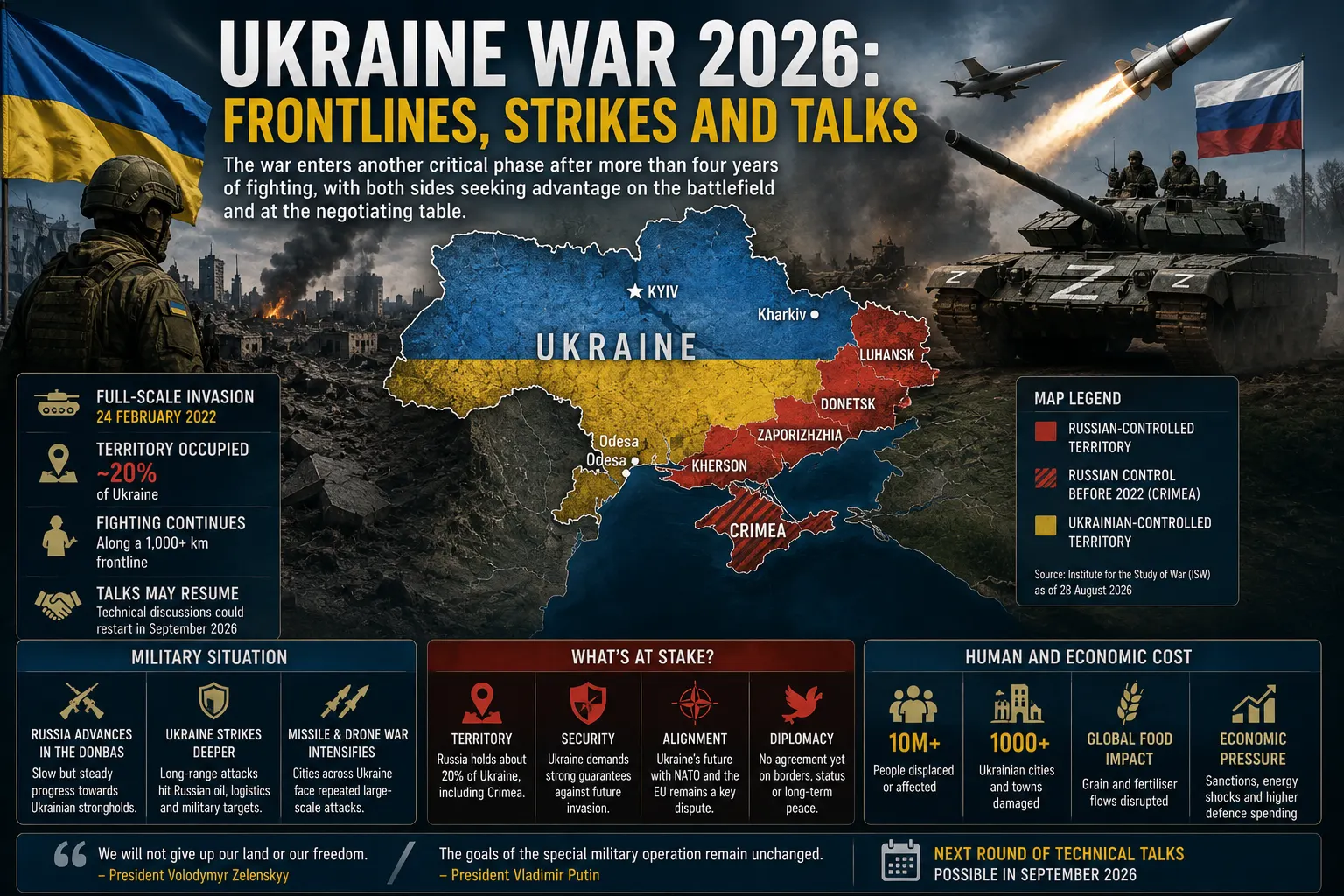
Twelve years after Russia seized Crimea and more than four and a half years after its full-scale invasion of Ukraine, the war has entered another difficult phase. Russian forces are pressing towards Ukraine’s remaining defensive strongholds in the Donbas, Ukraine has regained ground in parts of the southeast and is striking increasingly deep inside Russia, while an intensifying missile and drone campaign has brought the war repeatedly into Kyiv, Odesa and other cities far from the front. At the same time, Washington, Kyiv and European governments are again exploring negotiations that could resume in September, but the central disputes over territory, security guarantees and Ukraine’s future alignment remain unresolved.
There is therefore no simple description of the military balance in late August 2026. Russia still occupies roughly one fifth of internationally recognised Ukrainian territory, including Crimea and substantial areas of Donetsk, Luhansk, Zaporizhzhia and Kherson. Its larger population, defence industry and ability to sustain substantial troop numbers continue to provide advantages in a war of attrition. Yet more than four years of fighting have failed to deliver Moscow’s original objective of subduing Ukraine, and Ukrainian forces continue to deny Russia control of important parts of the Donbas while expanding a long-range campaign against Russian logistics, oil infrastructure and other facilities connected to the war effort.
The diplomatic picture is similarly contradictory. Negotiations have not stopped completely, and Ukrainian officials now say technical discussions involving Russia and the United States could resume in September. But neither side has accepted the concessions demanded by the other. Russia wants a settlement reflecting its territorial claims and broader security demands; Ukraine says it will not simply surrender land that Russian forces have not captured and insists that any agreement must provide credible protection against another invasion.
The War Began Before February 2022
The present conflict cannot be understood solely from the events of 24 February 2022. Its direct origins lie in the political crisis that transformed Ukraine in 2013 and 2014, when President Viktor Yanukovych suspended preparations for an association agreement with the European Union and instead sought closer economic support from Moscow. Large protests followed in Kyiv and other cities, eventually leading to Yanukovych leaving office in February 2014 after months of political confrontation and deadly violence.
Russia regarded the change of government as illegitimate and moved rapidly in Crimea. Russian forces took control of the peninsula, and Moscow subsequently annexed it following a referendum conducted under Russian military control. The United Nations General Assembly affirmed Ukraine’s territorial integrity and declared the referendum invalid for determining Crimea’s status. Most governments continue to recognise Crimea as Ukrainian territory, while Russia considers it part of the Russian Federation.
The crisis then spread to eastern Ukraine. Armed separatist movements took control of parts of Donetsk and Luhansk, backed politically and militarily by Russia. Ukraine responded with military operations, producing a conflict that continued for eight years before the full-scale invasion. The Minsk agreements of 2014 and 2015 established ceasefire arrangements and a political framework, but neither the security provisions nor the intended political settlement were fully implemented.
That period matters because it established several of the disputes that remain unresolved today: the status of occupied territory, Ukraine’s relationship with Russia and the West, the future of the Donbas and the question of what security arrangements could prevent renewed fighting. The 2022 invasion expanded those disputes into the largest conventional war in Europe in generations rather than creating them from nothing.
Major Turning Points in the Conflict
| Period | Development | Strategic Effect |
|---|---|---|
| 2014 | Russia annexes Crimea; war begins in Donbas | Territorial conflict becomes entrenched |
| 2014–2015 | Minsk agreements signed | Fighting reduced but political settlement fails |
| February 2022 | Russia launches full-scale invasion | Conflict expands across Ukraine |
| Late 2022 | Ukraine retakes large areas around Kharkiv and Kherson | Russia loses much of its initial territorial gain |
| 2023 | Ukrainian counteroffensive makes limited gains | Defensive fortifications reinforce attritional warfare |
| 2024–2025 | Russia advances in eastern Ukraine; Ukraine enters Russia’s Kursk region | Both sides seek new leverage beyond static fronts |
| 2026 | Fighting intensifies around the Donbas fortress belt | Territory and manpower remain central to negotiations |
Sources: United Nations, UK House of Commons Library and Reuters.
The 2022 Invasion Failed to Produce the Rapid Victory Moscow Sought
When Russian troops entered Ukraine from Russia, Belarus and occupied Crimea in February 2022, the offensive was geographically broad. Russian units advanced towards Kyiv from the north while operations opened simultaneously in the east and south. The scale and direction of the assault indicated an attempt to impose a decisive military and political outcome rather than merely enlarge the territory controlled by separatist forces in the Donbas.
That opening campaign failed. Ukrainian resistance, Russian logistical and operational problems and extensive Western intelligence and military support contributed to the withdrawal of Russian forces from northern Ukraine. The front subsequently shifted towards the east and south, where Russia possessed shorter supply routes and where years of previous fighting had already created established military positions.
Ukraine then regained substantial territory in two major operations during the second half of 2022. A rapid offensive in the Kharkiv region broke through Russian positions and recovered large areas in the northeast. Russian forces later withdrew from the western bank of the Dnipro at Kherson city. Those operations demonstrated that occupied territory could be recovered, but they also encouraged Russia to construct far more extensive minefields, trenches and defensive lines.
The effect became clear during Ukraine’s 2023 counteroffensive. Ukrainian forces attacked heavily prepared Russian positions in the south but were unable to achieve the large breakthrough needed to sever Russia’s land corridor towards Crimea. Dense minefields, artillery, attack helicopters, drones and layered fortifications significantly increased the cost of advancing. The war consequently moved further towards attrition, with ammunition production, manpower replacement and industrial capacity becoming as important as individual battlefield manoeuvres.
Drones Have Changed the Structure of the Battlefield
By 2026, one of the defining differences between the opening year of the invasion and the current war is the scale of unmanned warfare. Small first-person-view drones now perform missions previously associated with artillery, anti-tank weapons and reconnaissance teams. Larger long-range drones attack logistics centres, factories, energy installations and other targets hundreds of kilometres from the front. Electronic warfare, fibre-optic control systems, autonomous targeting and interceptor drones have all become increasingly important.
The result is a battlefield in which movement can be detected and attacked quickly. Supply roads near the front are sometimes covered with protective netting, vehicles operate under constant observation and both armies increasingly use unmanned ground systems to transport supplies or evacuate casualties. The concentration of thousands of drones along contested sectors has made traditional massed movement significantly more dangerous.
Ukraine has also used domestically produced long-range drones to compensate partly for limitations in its conventional long-range arsenal. Russian oil refineries, warehouses, logistics hubs and other infrastructure have been struck repeatedly. Kyiv says these attacks are intended to reduce Russia’s ability to finance and sustain the war. Moscow has responded by strengthening protection around infrastructure, and President Vladimir Putin issued a decree in August allowing temporary state control of strategically important facilities deemed insufficiently protected against drone attacks.
Russia has developed its own large-scale drone campaign at the same time. Iranian-designed Shahed-type systems and increasingly sophisticated Russian variants are used alongside cruise and ballistic missiles. Their relatively low cost allows large numbers to be launched with the additional purpose of forcing Ukraine to expend scarce air-defence interceptors.
The Air War Has Become One of Ukraine’s Most Serious Vulnerabilities
The scale of that pressure was visible again at the end of August. Russian drone attacks on Kyiv and surrounding areas continued for five consecutive days into 31 August. President Volodymyr Zelenskiy said approximately 1,500 drones had been launched over four days, more than half of them jet-powered. Strikes also affected the Odesa and Kryvyi Rih regions and damaged logistics, industrial and residential infrastructure.
A particularly destructive attack on 28 August struck an ammunition depot in the Kyiv region and caused a massive secondary explosion that killed dozens of people. Ukrainian authorities subsequently ordered investigations into the storage of ammunition near civilian areas. The incident illustrated how the consequences of a strike can depend not only on the weapon itself but also on the vulnerability of the target and surrounding infrastructure.
Ukraine’s ability to intercept ballistic missiles remains especially constrained. Zelenskiy said in August that allied deliveries of air-defence missiles during 2026 had fallen to roughly one third of the level supplied in 2025. Patriot systems remain particularly important because relatively few Western systems can reliably intercept the ballistic missiles Russia increasingly employs.
A small new delivery of Patriot interceptors improved Ukrainian interception rates during one late-August attack, but the strategic problem remains. An interceptor costing far more than a drone cannot economically be fired at every incoming target, while ballistic missiles require highly capable systems that exist only in limited numbers. Ukraine is consequently developing cheaper drone interceptors and pressing allies for additional Patriot missiles, licences and European air-defence production.
The Military Balance in Late August 2026
| Area | Russia | Ukraine |
|---|---|---|
| Territory | Controls roughly one fifth of Ukraine | Holds most of the country and key Donbas cities |
| Manpower | Larger recruitment and population base | Persistent shortages in frontline units |
| Air attacks | Large drone and missile production | Limited stocks of high-end interceptors |
| Long-range strikes | Targets Ukrainian cities, logistics and energy | Targets Russian military, logistics and energy infrastructure |
| External support | Receives material support from partners including North Korea and Iran | Relies heavily on European and other Western assistance |
Sources: Reuters, NATO, European Commission and public statements by the governments involved. Precise battlefield figures remain contested.
The Donbas Fortress Belt Has Become the Centre of the Ground War
The most consequential fighting is now concentrated in eastern Ukraine. Russia’s principal battlefield objective remains the completion of its conquest of the Donbas, particularly the Ukrainian-held part of Donetsk region. Attention has increasingly focused on a line of industrial towns and cities including Kostiantynivka, Druzhkivka, Kramatorsk and Sloviansk. Together they form what is often described as Ukraine’s fortress belt.
These cities are important for more than symbolic reasons. They contain roads, rail connections, industrial areas and defensive positions built up over years. Capturing them would require Russia to overcome interconnected Ukrainian positions rather than simply seize open countryside. On 31 August, Reuters reported Russian forces roughly 15 kilometres from Druzhkivka, while fighting and infiltration were placing increasing pressure on other parts of the defensive system.
Russian progress has nevertheless remained costly and uneven. Ukraine says its forces have regained more than 700 square kilometres in a southeastern operation during 2026, particularly around the junction of the Donetsk, Dnipropetrovsk and Zaporizhzhia regions. Open-source battlefield mapping has confirmed significant Ukrainian gains in that sector, although claims by either military about individual settlements can change quickly and are not always independently verifiable.
That mixed picture explains why descriptions of the war as either a Russian breakthrough or a stable stalemate can both be misleading. Russia possesses the initiative in important eastern sectors and continues to place Ukrainian cities under pressure. Ukraine, however, retains the ability to counterattack locally, impose substantial losses and force Russia to allocate forces to areas away from its preferred axis of advance.
Manpower May Be More Important Than Territory Alone
Behind the maps lies a more structural problem. Both countries have been fighting an industrial-scale war for years, but their demographic resources are very different. Russia has a substantially larger population and can absorb losses more easily in absolute terms, even though replacing experienced soldiers and officers remains costly. Ukraine must defend a long front while also maintaining air defence, logistics, training and rotations for exhausted units.
Ukraine has repeatedly changed recruitment and mobilisation rules as it attempts to replace casualties and maintain frontline strength. The system has been politically difficult, particularly when mobilisation practices have been perceived as arbitrary or abusive. Kyiv is also expanding the role of technology and unmanned systems partly because every task performed by a drone can potentially reduce the number of soldiers exposed to direct danger.
Russia has relied on contract soldiers, financial incentives, regional recruitment programmes and the mobilisation introduced in 2022. Ukrainian intelligence now argues that Moscow may prepare another major expansion of its forces after Russia’s September parliamentary elections. Zelenskiy has said Ukraine believes as many as 300,000 additional personnel could eventually be sought. Russian officials have not confirmed such a plan, and the claim should therefore be treated as a Ukrainian assessment rather than an established fact.
What can be established is that personnel generation remains central to Russia’s strategy. Moscow has generally preferred sustained recruitment and financial incentives to another highly visible nationwide mobilisation. Whether that system can continue supplying sufficient trained manpower at an acceptable economic and political cost will influence Russia’s ability to sustain offensive pressure.
Ukraine Is Taking the War Deeper Into Russia
The increasing reach of Ukrainian attacks represents another major change. Kyiv’s August 2024 incursion into Russia’s Kursk region was the most dramatic example. Ukrainian forces seized significant territory before Russia gradually retook it, with Moscow declaring the operation defeated in 2025. The offensive did not transform the wider war, but it demonstrated that Russia’s internationally recognised territory was no longer insulated from large-scale ground combat.
Ukraine’s current approach relies more heavily on long-range unmanned systems than on holding Russian territory. Oil refineries and fuel facilities are particularly significant because energy remains essential to Russian export earnings and military logistics. Ukrainian drones have also hit warehouses and commercial logistics facilities that Kyiv says have connections to military supply chains.
The attacks increasingly affect the Russian domestic economy. Fuel shortages and refinery disruptions have contributed to price pressures, while the government has demanded stronger protection of strategically important sites. Russia has adapted by deploying more air defences, imposing restrictions around sensitive infrastructure and shifting some commercial activity, but protecting a country of Russia’s size against inexpensive long-range drones is inherently difficult.
The strategy has risks for Ukraine as well. Russian officials argue that strikes involving Western technology deepen NATO countries’ involvement in the conflict and have threatened retaliation against military interests of countries supplying long-range weapons. Britain and France have continued supporting Ukraine’s strike capabilities while maintaining that Ukraine has the right to defend itself against Russia’s invasion.
Civilian Casualties Are Rising Again
For civilians, the technological evolution of the war has not made it less destructive. The United Nations Human Rights Monitoring Mission recorded at least 437 civilians killed and 2,610 injured in Ukraine during July 2026. That was 30 per cent more casualties than in June and 70 per cent more than in July 2025. The number of civilians killed was the highest for a single month since May 2022.
Long-range missiles and drones caused 38 per cent of the recorded civilian casualties in July, according to the UN, while aerial bombardment and short-range drones also produced large numbers of deaths and injuries. The geographical significance is important. Long-range weapons expose people hundreds of kilometres from the front to the war, while small drones have made roads and settlements close to combat zones exceptionally dangerous.
The cumulative human consequences extend far beyond casualty figures. Millions of Ukrainians have spent periods displaced internally or abroad, families have been separated by military service and migration, and communities near the front have lost housing, schools, hospitals and employment. IOM research published in August estimated that about 1.5 million Ukrainians who had previously gone abroad had returned since the beginning of the full-scale invasion, but hundreds of thousands of those returnees remained internally displaced.
Reconstruction is also becoming a generational economic challenge. The fifth joint Rapid Damage and Needs Assessment by the World Bank, Ukrainian government, European Commission and United Nations estimated direct physical damage at $195.1 billion by the end of 2025. Ten-year reconstruction and recovery needs were estimated at $587.7 billion, almost three times Ukraine’s 2025 gross domestic product.
The Civilian and Economic Scale of the War
| Measure | Latest Figure | Reference Period |
|---|---|---|
| Civilians killed | 437 | July 2026 |
| Civilians injured | 2,610 | July 2026 |
| Direct physical damage | $195.1bn | To end-2025 |
| Reconstruction needs | $587.7bn | Ten-year estimate |
| Projected Ukrainian GDP growth | 1.0–1.6% | 2026 IMF range |
Sources: UN Human Rights Monitoring Mission in Ukraine, World Bank RDNA5 and International Monetary Fund.
Ukraine’s Economy Now Depends on Military and Financial Support
Ukraine has preserved functioning state institutions, banking and essential public services despite the invasion, but this resilience is inseparable from external financing. The IMF estimated in June that economic growth would slow to between 1.0 and 1.6 per cent in 2026 as the continuing war and wider international shocks weigh on activity. Damage to energy infrastructure, labour shortages, mobilisation and uncertainty continue to constrain investment.
The military financing requirement is even larger. Ukraine’s new defence leadership said at the end of August that the country faces a defence funding shortfall of approximately $27 billion and wants part of future European financing released earlier. That gap illustrates a central fact of the present war: Ukraine can manufacture an increasing share of its drones, missiles and equipment domestically, but it cannot finance the current scale of defence entirely from its own economy.
The European Union has accordingly moved from emergency assistance towards multi-year financing. By August 2026, the EU and its member states said they had provided approximately €220 billion in overall support to Ukraine and Ukrainians since the beginning of the full-scale war, including €77 billion in military assistance. A separate €90 billion Ukraine Support Loan for 2026 and 2027 allocates approximately €60 billion to military support and €30 billion to economic and budgetary needs.
On 24 August, the European Commission approved another €6.1 billion for Ukrainian air and missile defence, ammunition, missiles and radar systems. NATO allies have separately committed to large-scale military assistance, with European allies and Canada assuming a greater share of the burden as American resources are also required in the Middle East and Indo-Pacific.
Russia Has Sustained the War Economy, but at a Growing Cost
Russia entered the conflict with advantages that proved more durable than many early sanctions forecasts suggested. Large energy exports, accumulated financial reserves, domestic arms production and continued trade with countries outside the Western sanctions system allowed the government to finance military expenditure at very high levels. Russia also adapted supply chains to acquire components and goods through alternative markets.
That does not mean sanctions have been ineffective or cost-free. Restrictions have complicated access to technology and capital, reduced some energy revenues and forced Russian companies to reorganise trade. Defence expenditure has simultaneously supported industrial production while absorbing labour and public resources that could otherwise be used elsewhere in the economy.
By 2026, growth had slowed markedly and monetary policy remained restrictive. Russia’s central bank key rate stood at 14 per cent in August, while inflation and petrol prices remained concerns. Ukrainian attacks on refineries and logistics infrastructure have added a new source of economic pressure that conventional sanctions cannot reproduce: physical disruption inside Russia itself.
Europe is meanwhile continuing to tighten financial and trade restrictions. The EU adopted its 21st sanctions package in July 2026, targeting energy, financial services, cryptocurrency activity and additional individuals and organisations. A further package is being prepared for the autumn. Sanctions alone have not forced Moscow to end the war, but they are part of a longer strategy intended to raise the financial and technological cost of sustaining it.
The War Has Rewritten Europe’s Security Policy
The consequences extend far beyond Ukraine. Finland joined NATO in 2023 and Sweden followed in 2024, ending long-standing policies of military non-alignment. NATO has strengthened forces and air defence along its eastern flank while European governments have sharply increased defence budgets and accelerated orders for artillery, missiles, drones and air-defence systems.
At the Ankara summit in July 2026, NATO allies committed to €70 billion in military equipment, assistance and training for Ukraine during the year and said comparable levels should be sustained in 2027. European allies and Canada now finance the majority of security assistance provided under NATO-related arrangements. The shift represents a structural European response rather than merely a sequence of individual aid packages.
Concern has also grown over sabotage, cyber operations, disinformation and unexplained drone incidents around European infrastructure. NATO said on 30 August that it had seen increased Russian hybrid activity but did not assess that a direct military attack on the alliance was imminent. Russia denies conducting sabotage against European countries and argues that NATO’s military expansion creates threats to Russian security.
The distinction matters. Europe is preparing more intensively for deterrence without treating a Russia-NATO war as inevitable. The objective is to make an attack less attractive while simultaneously supporting Ukraine, but greater military activity on both sides also increases the importance of communication and escalation management.
Why Negotiations Have Repeatedly Failed
Diplomacy has accompanied the fighting from the beginning. Ukrainian and Russian representatives negotiated in Belarus and Turkey during the opening months of 2022. Discussions considered Ukrainian neutrality, security guarantees and restrictions on military deployments, but they collapsed as military conditions changed and disagreements over security, territory and implementation proved too large.
Subsequent efforts have repeatedly encountered the same structural problem. Russia and Ukraine do not merely disagree about how to stop shooting; they disagree about what the political order after the shooting should look like. A ceasefire can freeze positions temporarily, but it cannot by itself determine the legal status of territory, Ukraine’s military strength, NATO relations, sanctions or the credibility of future security guarantees.
American diplomacy intensified after Donald Trump returned to the White House in January 2025. The administration sought direct engagement with both Moscow and Kyiv and at different stages pressed for ceasefire arrangements and territorial compromises. Talks continued into 2026, including difficult trilateral discussions in Geneva in February, but the sides did not resolve the territorial dispute.
The growing US-Iran conflict subsequently diverted substantial diplomatic and military attention away from Ukraine. By the summer, negotiations had largely stalled. Washington nevertheless maintained contacts with Moscow, including a visit by CIA Director John Ratcliffe in August, while Kyiv continued to work with American and European officials on possible terms for renewed negotiations.
Territory Is Still the Hardest Question
The fundamental territorial gap remains exceptionally large. Russia claims Crimea as well as the Ukrainian regions of Donetsk, Luhansk, Zaporizhzhia and Kherson as Russian territory, even though it does not fully control all four mainland regions. Moscow says a settlement must reflect the realities created by the war and has demanded that Ukraine withdraw from territory in the Donbas that remains under Ukrainian control.
Kyiv rejects that demand. It distinguishes between a ceasefire that might temporarily leave territory under Russian occupation and legally or physically surrendering additional territory that Ukrainian forces still hold. Zelenskiy has repeatedly argued that Ukraine cannot be required to hand Russia through negotiations land that Moscow has failed to capture militarily.
This is particularly significant in the Donetsk fortress belt. If Ukraine withdrew from those defensive positions as part of a peace agreement, Russia would obtain without further fighting cities that have resisted years of military pressure. From Kyiv’s perspective, doing so without credible security guarantees could make the remaining country harder to defend if war resumed. Moscow, by contrast, regards control of the Donbas as a core objective and argues that territorial realities must be reflected in any settlement.
Those positions are not impossible to bridge theoretically, but doing so would require separating de facto control from legal recognition, establishing monitoring arrangements and constructing security guarantees strong enough to survive a future political crisis. None of those questions currently has an agreed answer.
A New Proposal Is Emerging, but It Is Not Yet a Peace Plan
In late August, Zelenskiy said Ukraine had developed a one-page set of ideas together with American and European officials for presentation to Moscow. The proposals include a ceasefire and revisit an American idea for a free economic zone in part of the Donbas under some form of third-party administration. The document also addresses possible roles for the European Union and NATO.
The Kremlin has already questioned the feasibility of the economic-zone proposal, arguing that territory Moscow regards as Russian cannot simply be administered by an external third party. That response highlights how apparently technical ideas quickly return to the underlying sovereignty dispute.
Kyrylo Budanov, Zelenskiy’s chief of staff, said on 27 August that direct Ukrainian-Russian talks might be possible in September with US participation. He subsequently described likely initial contacts as technical and cautioned against expecting an immediate settlement. The last trilateral negotiations involving Russia, Ukraine and the United States took place in February.
There have also been attempts to isolate individual areas of military activity. Turkey has discussed measures intended to protect Black Sea shipping, while Ukraine has offered forms of reciprocal restraint. Russia rejected a proposed Black Sea ceasefire in August, saying it did not want partial measures that could provide Ukraine with a military respite. This demonstrates another diplomatic difficulty: arrangements that look humanitarian or economic can also alter the military balance.
The central diplomatic obstacle is sequencing. Ukraine wants a ceasefire and credible security guarantees before accepting irreversible concessions. Russia wants a settlement that incorporates territorial and strategic concessions it considers necessary to remove what it calls the conflict’s root causes. Each side fears that giving up leverage first would leave it weaker if negotiations collapse.
Security Guarantees May Matter More Than the Ceasefire Line
For Ukraine, the central lesson of the period since 2014 is that an agreement stopping one phase of fighting is not necessarily a permanent settlement. The Minsk process reduced and structured parts of the conflict but did not prevent the 2022 invasion. Kyiv consequently argues that another agreement based primarily on political promises would be insufficient.
Full NATO membership would provide the clearest formal collective-defence guarantee, but Russia has repeatedly demanded Ukrainian neutrality and strongly opposes Ukrainian membership of the alliance. That leaves negotiators examining alternatives: bilateral defence commitments, long-term weapons supplies, European forces, monitoring missions, air defence arrangements or guarantees modelled partly on NATO principles without formal membership.
Each alternative creates its own problem. A guarantee weak enough to be acceptable to Moscow might not reassure Ukraine. A guarantee strong enough to convince Ukraine that another attack would trigger foreign military involvement may be viewed by Moscow as NATO membership in another form. This is one reason territorial negotiations cannot be separated from the wider European security architecture.
Neither Side Currently Has a Cheap Route to Victory
Russia can continue its offensive in eastern Ukraine, but taking the remaining Donbas strongholds would require further costly operations against prepared defences. Even complete control of Donetsk and Luhansk would not automatically end Ukrainian resistance or resolve the status of other occupied regions. Continuing the war also exposes Russian infrastructure to deeper Ukrainian strikes and extends the economic burden of mobilisation and military spending.
Ukraine can prevent rapid Russian advances and impose significant costs, but recovering all occupied territory through conventional ground operations remains an extremely demanding objective under current conditions. Kyiv is constrained by manpower, air-defence shortages and dependence on external financing. Its strategy therefore increasingly combines defence of critical ground with technological warfare and attacks intended to degrade Russia’s ability to sustain the conflict.
This produces an uncomfortable military equilibrium. Russia possesses more resources but has repeatedly struggled to translate them into decisive territorial breakthroughs. Ukraine has prevented defeat but cannot currently impose a comprehensive military settlement of its own. Both governments therefore have reasons to explore diplomacy while simultaneously trying to improve their negotiating position through continued fighting.
What to Watch in the Coming Months
The first indicator will be the battle for the eastern fortress belt. If Russia breaks through around Kostiantynivka, Druzhkivka or the approaches to Kramatorsk and Sloviansk, the military and diplomatic balance could shift. If Ukraine stabilises those fronts while continuing to regain territory elsewhere, Moscow’s assumption that time automatically strengthens its negotiating position would become less certain.
The second is air defence. Russia is increasing the scale and technical sophistication of missile and drone attacks, while Ukraine is trying to create cheaper interception methods and secure additional Patriot ammunition. Winter will increase the importance of this contest because repeated attacks on electricity generation, heating and transmission infrastructure could have consequences far beyond the battlefield.
The third is manpower. Any confirmed Russian mobilisation after September would suggest Moscow is preparing for a substantially longer campaign. Ukraine’s ability to reform recruitment, rotate frontline forces and replace losses will be equally important. No weapons system can entirely compensate for insufficient trained personnel across a front extending for more than a thousand kilometres.
The fourth is the September diplomatic process. Technical talks would not themselves indicate that peace is close. More meaningful evidence would include agreement on sustained ceasefire monitoring, movement on prisoner and humanitarian issues, acceptance of a framework for territorial discussions and serious negotiations over enforceable security guarantees.
Finally, the durability of European and American support remains central. Europe has committed itself to increasingly large financial and military responsibilities, while the United States retains capabilities that are difficult to replace quickly, particularly in ballistic-missile defence. Ukraine’s negotiating strength therefore depends not only on what happens at the front but also on whether its partners can sustain assistance through another year of war.
A War That Has Become Harder to End as It Has Become Harder to Win
The Russia–Ukraine war has passed through several distinct phases: political crisis and territorial seizure in 2014, an eight-year Donbas conflict, the failed drive on Kyiv in 2022, Ukrainian counteroffensives, increasingly fortified front lines and now an industrialised contest dominated by drones, missiles, manpower and economic endurance. Each phase has added new disputes rather than replacing the old ones.
The current front therefore represents more than a military line. It is tied to legal claims over sovereignty, competing interpretations of European security and fundamentally different assessments of what conditions would make another war less likely. Russia seeks recognition of gains and restrictions on Ukraine’s strategic alignment. Ukraine seeks to preserve sovereignty and prevent any settlement from becoming merely an interval before another invasion.
As of 31 August 2026, neither government appears close to abandoning those core positions. Yet both are experiencing the cumulative cost of continued war, while Europe and the United States are devoting growing financial, military and diplomatic resources to managing it. That combination may eventually create space for compromise, but it can also prolong the conflict if each side believes another season of fighting will improve the terms available later.
The immediate reality is therefore less dramatic than either imminent victory or imminent peace. Russia is advancing in some sectors without achieving a decisive breakthrough. Ukraine is defending under intense pressure while demonstrating that it can still recover ground and strike deep behind Russian lines. Diplomacy is reopening without resolving the issues that caused earlier negotiations to fail. The war continues because none of those three processes has yet moved far enough to determine the outcome of the other two.
Sources
Reuters — Russian drone barrage on Kyiv, 31 August 2026
Reuters — Fighting around Ukraine’s eastern fortress belt, 31 August 2026
Reuters — Defence of eastern Ukraine and the Donbas fortress belt
Reuters — Ukrainian territorial gains in 2026
Reuters — Ukraine’s air-defence interceptor shortage
Reuters — Current US, European and Ukrainian peace proposals
Reuters — Prospects for renewed technical negotiations
UN Human Rights Monitoring Mission in Ukraine — Civilian casualties, July 2026
World Bank — Fifth Rapid Damage and Needs Assessment for Ukraine
International Monetary Fund — Ukraine 2026 economic assessment
European Commission — EU assistance to Ukraine
European Commission — €6.1 billion defence procurement support, August 2026
Council of the European Union — 21st sanctions package against Russia
NATO — Ankara Summit Declaration, July 2026
UK House of Commons Library — Russia–Ukraine conflict timeline, 2022 to present
UK House of Commons Library — Ukraine conflict timeline, 2014 to the 2022 invasion
United Nations — General Assembly Resolution on the Territorial Integrity of Ukraine, 2014
Source & Transparency
This article is published by Ireland Newspaper for editorial and informational purposes.
Published: 31 August 2026 · Updated: 31 August 2026

Newsroom Ireland Newspaper
Ireland Newspaper editorial team prepares daily news coverage for readers in Ireland and abroad.