Six months after US and Israeli forces launched attacks on Iran on 28 February 2026, the conflict is neither over nor moving steadily towards peace. A month-long lull in major American strikes ended on 30 August when US forces attacked Iranian launchers on Larak Island in the Strait of Hormuz, followed by Iranian retaliation against US positions in Jordan and a new drone incident near the United Arab Emirates. What began as an attempt to curb Iran’s nuclear and missile capabilities has developed into a wider contest over military deterrence, oil exports, sanctions, maritime access and the political endurance of both sides.
The renewed exchange is important because it exposes the central weakness of the diplomatic process that temporarily reduced the fighting earlier in the year. Washington has demonstrated that it can strike targets across Iran and severely damage Iranian military infrastructure, but Tehran has retained enough missile, drone and maritime capability to threaten US forces, regional states and international shipping. Iran, meanwhile, has shown that it can impose significant economic costs by disrupting the Strait of Hormuz, but it has not been able to force the United States to abandon its blockade or sanctions campaign.
The result is an unusual form of war. It is not a conventional ground conflict with a continuous front line, nor is it simply a diplomatic crisis punctuated by occasional incidents. Air strikes, missiles, drones, naval operations, economic sanctions and pressure on shipping have become different parts of the same confrontation. Periods of relative calm can therefore coexist with the possibility of rapid escalation.
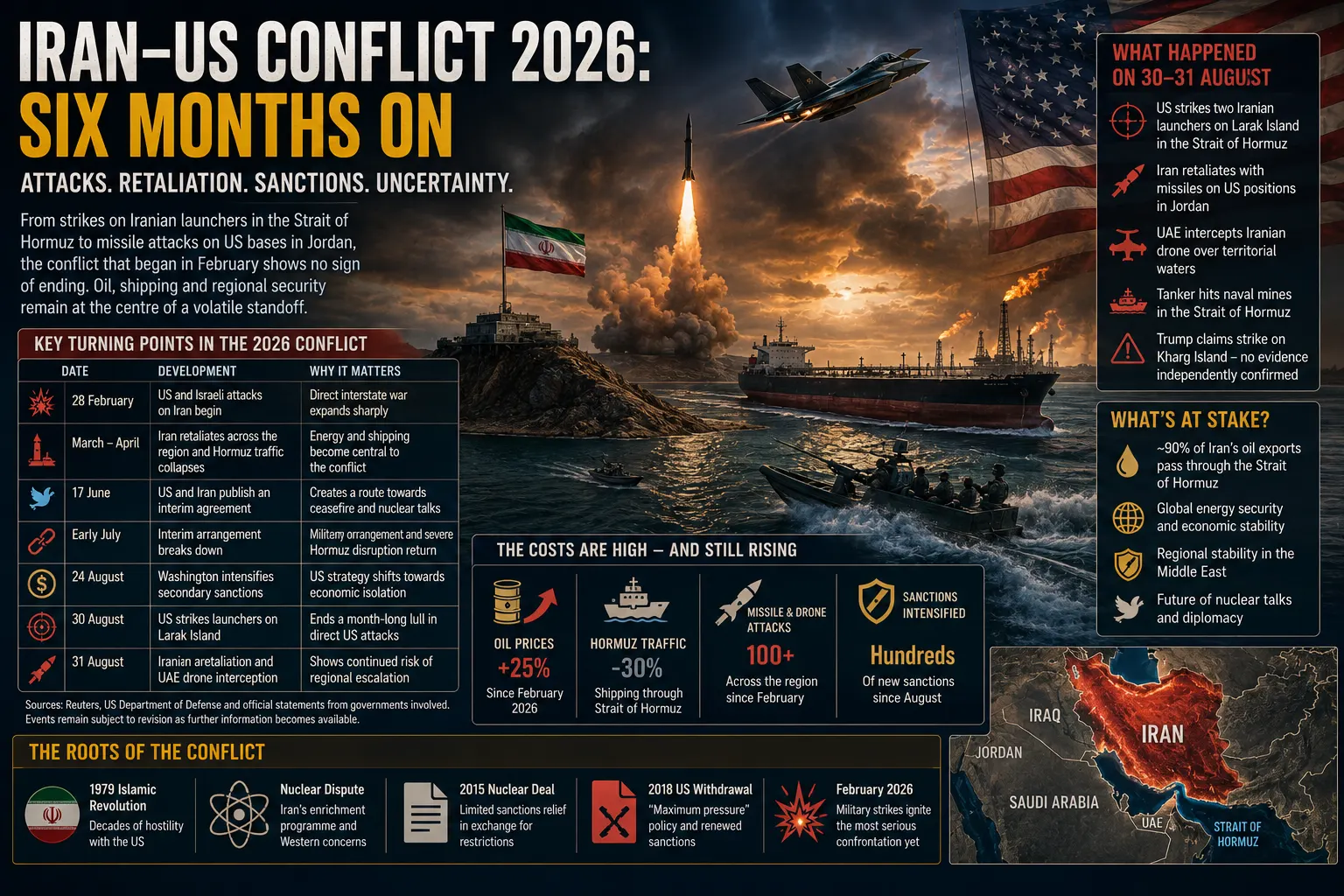
What Happened on 30 and 31 August
The immediate escalation began when US forces struck two Iranian launchers on Larak Island, strategically located in the Strait of Hormuz. US Central Command said Revolutionary Guard personnel had been preparing rockets and naval mines that presented an imminent danger to shipping. Iranian authorities reported deaths and injuries among fighters and civilians, although a verified casualty total was not immediately available.
Iran subsequently launched ballistic missiles towards US positions in Jordan. Jordanian and US defences intercepted the attack and no major damage was initially reported. The United Arab Emirates also said its air force had intercepted an Iranian drone over territorial waters on 31 August. Separately, Iran’s Revolutionary Guards said a supertanker had struck naval mines in the Strait of Hormuz, although important details about the vessel and circumstances remained unclear.
President Donald Trump also posted a message claiming that Kharg Island, the centre of much of Iran’s oil-export infrastructure, was being destroyed. The accompanying video was identified by Reuters as apparently AI-generated, and there was no independent evidence by Monday morning that Kharg had been attacked. Iranian officials rejected the claim. The distinction is significant: a confirmed large-scale attack on Kharg would represent a major escalation because the island handled around 90 per cent of Iranian oil exports before the current war.
Key Turning Points in the 2026 Conflict
| Date | Development | Why It Matters |
|---|---|---|
| 28 February | US and Israeli attacks on Iran begin | Direct interstate war expands sharply |
| March–April | Iran retaliates across the region and Hormuz traffic collapses | Energy and shipping become central to the conflict |
| 17 June | US and Iran publish an interim agreement | Creates a route towards ceasefire and nuclear talks |
| Early July | Interim arrangement breaks down | Military operations and severe Hormuz disruption return |
| 24 August | Washington intensifies secondary sanctions | US strategy shifts towards economic isolation |
| 30 August | US strikes launchers on Larak Island | Ends a month-long lull in direct US attacks |
| 31 August | Iranian retaliation and UAE drone interception | Shows continued risk of regional escalation |
Sources: Reuters, US Department of Defense and official statements from governments involved. Events remain subject to revision as further information becomes available.
The War Did Not Begin With a Single Dispute
The immediate war began in February, but the confrontation behind it is much older. Relations between Washington and Tehran have been hostile for most of the period since Iran’s 1979 Islamic Revolution. The nuclear dispute subsequently became one of the most important sources of tension, particularly as Iran developed increasingly advanced uranium-enrichment capabilities while insisting that its nuclear programme was intended for peaceful purposes.
The 2015 nuclear agreement temporarily imposed extensive restrictions and monitoring arrangements in exchange for sanctions relief. The United States withdrew from that agreement in 2018 under Trump’s first administration and restored sanctions. Iran later progressively exceeded several of the agreement’s nuclear limits. By 2025, the International Atomic Energy Agency was reporting that Iran had accumulated uranium enriched to 60 per cent, a level substantially above that normally required for civilian nuclear power and relatively close, in technical terms, to weapons-grade enrichment.
Iran has consistently denied that it is seeking a nuclear weapon. Western governments and Israel have nevertheless argued that the combination of highly enriched uranium, advanced centrifuges, reduced international monitoring and Iran’s missile programme created an unacceptable proliferation risk. Military attacks on Iranian nuclear facilities during the Israel-Iran confrontation of June 2025 damaged important infrastructure, but they also disrupted the IAEA’s ability to account fully for nuclear material.
That unresolved nuclear question carried directly into 2026. Negotiations between Washington and Tehran resumed before the February attacks but did not produce an agreement. Israel said its 28 February operation was pre-emptive, while the Trump administration presented preventing an Iranian nuclear weapon and reducing Iran’s missile and military capabilities as central objectives. Iran described the attacks as aggression and asserted its right to retaliate.
Military Superiority Has Not Produced a Political Settlement
The United States and Israel possess overwhelming advantages in advanced aircraft, surveillance, precision weapons and long-range strike capability. During the first 29 days alone, the Pentagon said US forces attacked more than 11,000 targets and damaged or destroyed more than 150 Iranian naval vessels. Iran’s air-defence network, command structures, missile infrastructure and naval forces suffered extensive losses.
Iran’s political system also experienced a profound shock. Ayatollah Ali Khamenei was killed during the initial attacks, and his son Mojtaba Khamenei subsequently became supreme leader. Yet the expectation that military pressure might cause the Iranian state to collapse or rapidly accept US conditions has not materialised. The Revolutionary Guards, security organisations and civilian administration have continued operating, even while economic and military pressure has increased.
Iran has instead relied heavily on capabilities that are difficult to eliminate completely: mobile ballistic missiles, drones, naval mines, anti-ship weapons and the geographic advantage created by its position beside the Strait of Hormuz. These systems do not give Tehran conventional military superiority, but they allow it to impose costs on a much stronger opponent and on countries hosting US military facilities.
The United States is also paying a military cost. Reuters reported on 27 August that 18 US service members had been killed and more than 750 injured since the conflict began. American aircraft and drones have been lost, large quantities of air-defence interceptors and precision weapons have been consumed, and warships and aircraft have been redeployed from Europe and the Indo-Pacific region. The consequence is not that US military superiority has disappeared, but that sustaining the campaign carries increasing opportunity costs elsewhere.
The Strait of Hormuz Turned a Regional War Into a Global Economic Shock
No part of the conflict explains its worldwide importance more clearly than the Strait of Hormuz. Before the war, the narrow waterway between Iran and Oman carried an extraordinary share of global energy trade. US Energy Information Administration data show that an average of 20.9 million barrels a day of petroleum liquids passed through the strait during the first half of 2025, equivalent to about one fifth of global petroleum consumption and roughly one quarter of internationally traded maritime oil.
There are alternative pipelines through Saudi Arabia and the United Arab Emirates, but their available capacity is only a fraction of normal Hormuz traffic. This means even partial disruption can affect oil prices far beyond the Gulf. Tankers also face higher insurance premiums, security costs and uncertainty about whether voyages can be completed safely.
Iran recognised this vulnerability early in the conflict. Disruption of maritime traffic has effectively transformed the strait into economic leverage: actions affecting ships can impose costs on countries that are not directly participating in military operations. Washington has responded with mine-clearing operations, naval escorts and efforts to maintain shipping lanes.
Claims about the degree of US control over the waterway remain disputed. The White House said in late August that nearly 1,500 commercial vessels had travelled through under American protection and that international shipping routes had been cleared of Iranian mines. Independent vessel-tracking data have nevertheless shown traffic remaining far below pre-war conditions. The International Energy Agency reported that Gulf oil exports fell to approximately 15 million barrels a day in July, while regional production remained 8.3 million barrels a day below pre-war levels.
Why Hormuz Matters to the World Economy
| Measure | Scale | Context |
|---|---|---|
| Pre-war oil flow | 20.9m barrels/day | First half of 2025 |
| Share of global consumption | About 20% | Petroleum liquids |
| Share of maritime oil trade | About 25% | Before the 2026 conflict |
| Saudi/UAE bypass capacity | About 4.7m barrels/day | Only partial alternative to Hormuz |
| Gulf exports in July 2026 | About 15m barrels/day | IEA estimate after renewed disruption |
Sources: US Energy Information Administration and International Energy Agency.
The renewed fighting immediately affected markets. Brent crude rose above $90 a barrel on 31 August as traders assessed the Larak attack, Iranian retaliation and renewed risk to shipping. The effect extends beyond petrol stations. Oil prices feed into aviation, road haulage, manufacturing, chemicals and eventually some consumer prices, while the Gulf is also important to global petrochemical and fertiliser production.
Economic Pressure Is Becoming Washington’s Main Weapon
By August, Washington appeared increasingly reluctant to depend on repeated large-scale bombing to obtain political concessions. Instead, the administration announced a much broader campaign of financial pressure. The White House calls the programme Operation Economic Outcast and says its objective is to sever Iran’s remaining access to international banking, oil revenues and foreign financial support.
The policy relies heavily on secondary sanctions. Rather than targeting only Iranian institutions, these measures can penalise banks, companies and other organisations in third countries for transactions involving sanctioned Iranian entities. That makes China, India, Gulf financial centres and international banks particularly important to whether the strategy works.
The difficulty is that stronger enforcement also creates costs outside Iran. Aggressive sanctions against major foreign banks, shipping companies or energy buyers can create diplomatic disputes and distort trade. The administration therefore faces a structural trade-off: maximum economic pressure on Tehran requires action against some of the same countries whose cooperation Washington needs on trade, financial stability and other geopolitical issues.
Within Iran, the pressure is already severe. President Masoud Pezeshkian said in August that foreign trade had fallen by about 35 per cent, while annual inflation was running around 66 per cent. Sanctions are only one component of that deterioration. War damage, disrupted energy exports, reduced access to foreign currency, uncertainty and the naval blockade all contribute to the economic strain.
The consequences reach ordinary households through food prices, rents, employment, medicine availability and the falling purchasing power of wages and savings. Economic pain does not automatically translate into political change, however. Iran has lived under extensive sanctions for decades, and governments under external military pressure can sometimes consolidate control rather than immediately weaken.
The Nuclear Question Remains Unresolved
The most important strategic question behind the war has still not been answered: what has happened to Iran’s nuclear programme? Bombing has damaged facilities and probably increased the time Iran would need to rebuild parts of its programme, but physical destruction is not the same as verifiable nuclear disarmament.
The IAEA has been unable to account fully for approximately 440 kilograms of uranium enriched to 60 per cent since access to important Iranian facilities was interrupted following the 2025 attacks. That uncertainty matters because the material could theoretically be enriched further if Iran retained access to suitable centrifuges. Iran maintains that it does not seek nuclear weapons, but international inspectors cannot presently provide the same level of assurance that would be possible with comprehensive access.
This creates a paradox. Military operations may have damaged Iran’s ability to produce nuclear material, while simultaneously making independent verification of its remaining material more difficult. A durable settlement would therefore require more than stopping air strikes. It would almost certainly need an inspection mechanism capable of establishing where enriched uranium is located, what enrichment infrastructure survives and what limits Iran would accept in return for sanctions relief.
The central unresolved issues are now closely connected: Iran wants sanctions and the US naval blockade removed, while Washington wants reliable access through the Strait of Hormuz and restrictions on Iran’s nuclear programme. Each side is reluctant to make the first irreversible concession because it fears losing leverage before the other side complies.
The June Agreement Showed That Diplomacy Is Possible — and How Easily It Can Fail
An important diplomatic opening appeared in June. The United States and Iran announced an interim arrangement intended to stop military operations, ease restrictions on Iranian oil exports and create a 60-day period for negotiations on a permanent settlement. The framework also contemplated renewed discussion of Iran’s enriched uranium and broader economic reconstruction.
For several weeks the agreement reduced expectations of immediate escalation and helped oil prices retreat. But fundamental disagreements were deferred rather than solved. Iran wanted the blockade lifted, sanctions relief implemented and frozen assets released. Washington continued to demand nuclear restrictions and reliable passage through Hormuz. Israel was not a party to the US-Iran agreement, adding another layer of uncertainty to a regional conflict involving Lebanon and other theatres.
By early July, the arrangement had broken down and the Strait of Hormuz was effectively disrupted again. In August the Trump administration publicly ruled out simply extending the previous deal, while Iranian officials threatened a more offensive posture if Washington did not meet commitments Tehran said had already been agreed.
Qatar, Pakistan and Oman have continued mediation efforts. Their involvement is important because Gulf governments have strong incentives to avoid a prolonged confrontation. They depend on stable energy exports, international investment, aviation and trade while simultaneously maintaining security relationships with Washington and geographic proximity to Iran.
The Human Cost Is Larger Than the Military Balance Suggests
The conflict has produced extensive civilian harm even though it has largely been fought with aircraft, missiles and drones rather than large ground armies. WHO reported more than 1,400 deaths and 18,700 injuries in Iran by mid-March alone, based on Iranian health-authority figures available at the time. Later regional totals rose substantially as fighting spread to Lebanon and other parts of the Middle East.
Reliable current casualty numbers are difficult to establish while hostilities continue, and different governments and monitoring organisations use different methodologies. That makes precision especially important: early official figures demonstrate the scale of civilian harm, but they should not be presented as a complete August death toll.
Displacement has also been substantial. UNHCR estimated in March that between 600,000 and one million Iranian households had temporarily left their homes, potentially representing as many as 3.2 million people. Across the wider region, WHO said in April that more than 4.3 million people had been displaced as the conflict expanded.
Hospitals and health services have faced damage, evacuation, supply shortages and difficulty maintaining treatment for chronic conditions. Transport restrictions affecting airspace and maritime routes have also disrupted medical supply chains. These effects continue even during periods when the number of air strikes temporarily falls.
Ireland Is Far From the Battlefield but Not From the Economic Effects
For Ireland, the conflict is principally an external economic and energy shock rather than a direct security threat. The Central Statistics Office’s flash estimate published on 31 August put Irish harmonised inflation at 3.4 per cent in the year to August. Energy prices were estimated to have risen by 11.8 per cent over the same period and by 4.3 per cent in August alone.
Those figures should not be attributed entirely to the Iran war. Irish prices also reflect domestic costs, taxation, exchange rates, European energy conditions and other international factors. Nevertheless, the disruption of Middle Eastern oil supplies has become a significant part of the wider energy-price environment.
The Central Bank of Ireland had already revised its 2026 inflation forecast to 3.5 per cent in June and explicitly identified the Middle East conflict as a risk to the outlook. Ireland is particularly exposed to international oil prices through transport and home-heating fuel, meaning continued disruption can affect household budgets and business costs even when the country imports little or no oil directly from Iran.
Why Neither Side Has an Easy Route to Victory
The United States can continue damaging Iranian military facilities, but further strikes do not guarantee a political concession. Iran can disrupt shipping and attack regional military installations, but doing so risks even heavier retaliation and deeper economic isolation. This creates a classic coercive stalemate in which each side can impose pain without being able to force the other to accept its preferred settlement at an acceptable cost.
Domestic politics reinforces the problem. In Iran, accepting extensive restrictions after months of bombing could be portrayed by hardliners as surrender, while continued conflict carries enormous economic costs for the population. In the United States, the war has become increasingly unpopular. A Reuters/Ipsos poll published in August found only 31 per cent of Americans supported military action against Iran, while 83 per cent expected the conflict to continue for a long time.
There is also an unresolved constitutional debate in Washington. Congress never issued a formal declaration of war. Early attempts in the Senate and House to require an end to hostilities unless Congress specifically authorised them were defeated, largely along party lines. The administration has argued at different stages that periods of ceasefire changed the legal status of active hostilities under the War Powers framework, while opponents have disputed that interpretation. The debate has therefore continued alongside the military campaign rather than producing a definitive political settlement.
What Happens Next Depends on a Small Number of Critical Decisions
The most plausible near-term outcome is not necessarily either full peace or unlimited escalation. The conflict could remain intermittent: periods of relative calm interrupted by attacks on launchers, shipping, military installations or energy infrastructure while economic sanctions continue. That would preserve pressure on both sides but also keep global energy markets exposed to sudden shocks.
A negotiated settlement remains possible because the basic components of one are already visible. Iran would seek relief from the blockade and sanctions, restoration of oil exports and access to frozen financial assets. Washington would demand security for international shipping, renewed nuclear verification and restrictions capable of preventing rapid movement towards a nuclear weapon. The difficult question is sequencing: neither government wants to surrender its strongest leverage before receiving something substantial in return.
A more dangerous scenario would follow a major attack on Kharg Island, large-scale Iranian strikes against Gulf energy infrastructure, heavy American casualties or another serious tanker incident. Any of those events could create pressure for retaliation beyond the limited exchanges seen at the end of August. Once energy installations and regional military bases become routine targets, controlling escalation becomes considerably harder.
The most important indicators of genuine de-escalation would therefore be practical rather than rhetorical: sustained safe passage through Hormuz, an extended halt to military attacks, formal negotiations, restored IAEA access and an agreed sequence for sanctions relief and nuclear restrictions. Without those elements, announcements of progress are likely to remain vulnerable to the same mistrust that undermined earlier agreements.
A War That Has Changed Without Ending
Six months after the first attacks, neither Washington nor Tehran has achieved everything it sought. Iran’s conventional military capabilities and economy have been badly damaged, but its government remains in power and retains significant capacity to threaten regional targets and shipping. The United States has demonstrated overwhelming strike capability but has not produced Iranian capitulation, restored normal movement through Hormuz or resolved the nuclear question.
The conflict has therefore shifted rather than concluded. The opening phase was dominated by air strikes and missile exchanges. The current phase combines intermittent military action with a naval contest and an expanding economic campaign. At the centre of all three is the same unresolved question: whether enough mutual security can be created for either side to give up the leverage it still possesses.
For the rest of the world, that distinction matters. A temporary reduction in bombing can lower immediate danger, but it does not restore predictable energy supplies or eliminate the possibility of another rapid escalation. As the events of 30 and 31 August demonstrate, the distance between a military lull and renewed conflict can be measured in hours.
Sources
Reuters — US and Iran resume military attacks, 31 August 2026
Reuters — Six consequences after six months of war in Iran
Reuters — US-Iran interim agreement, 17 June 2026
Reuters — IAEA assessment of Iran’s nuclear programme
US Energy Information Administration — World Oil Transit Chokepoints
International Energy Agency — Oil Market Report, August 2026
World Health Organization — Middle East Conflict
US Department of Defense — Operation Epic Fury Fact Sheet
White House — Operation Economic Outcast
Central Statistics Office — Ireland HICP Flash Estimate, August 2026
Source & Transparency
This article is published by Ireland Newspaper for editorial and informational purposes.
Published: 31 August 2026 · Updated: 31 August 2026

Newsroom Ireland Newspaper
Ireland Newspaper editorial team prepares daily news coverage for readers in Ireland and abroad.