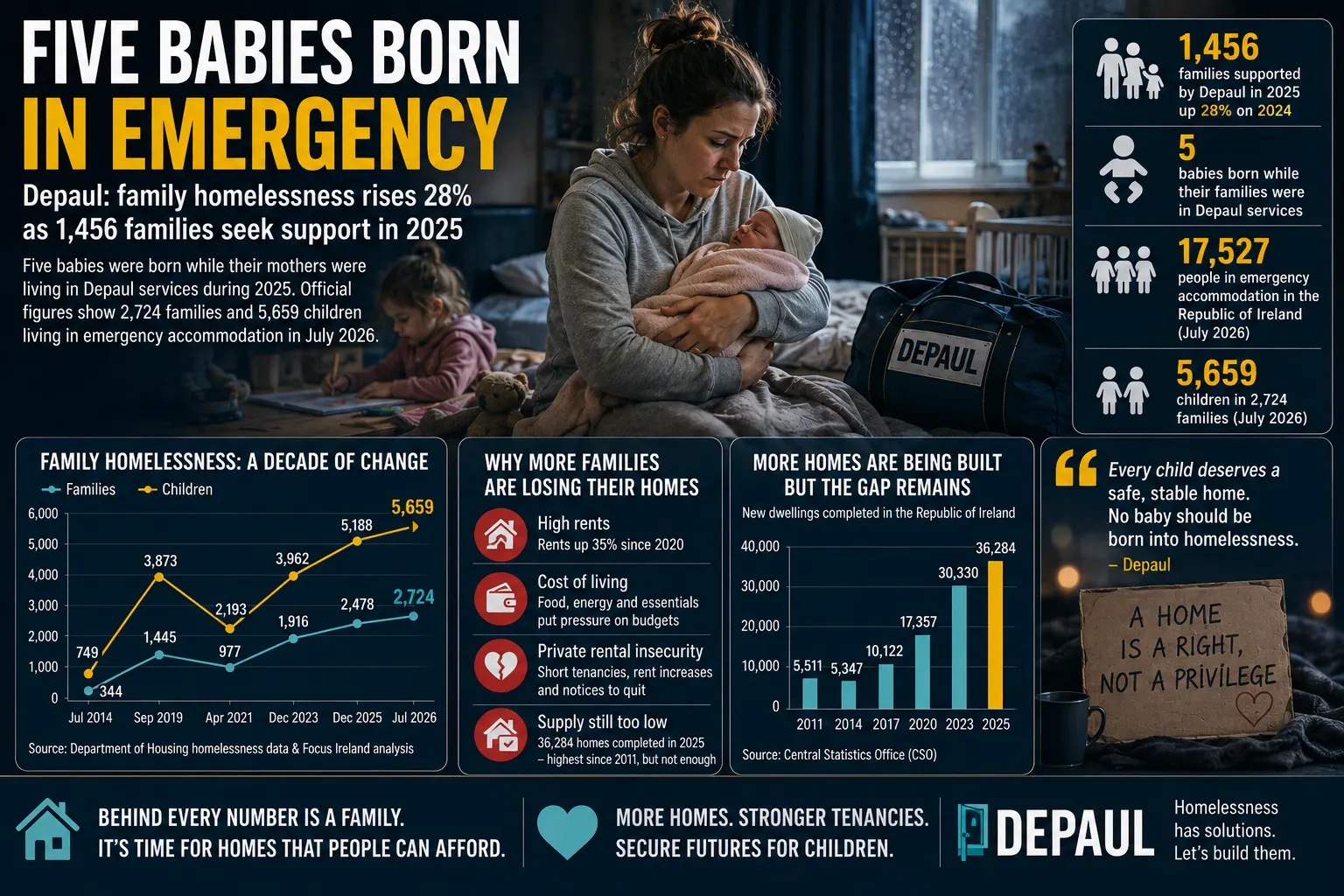
Five babies were born while their mothers were living in Depaul services during 2025. Behind that stark detail lies a much broader change in the profile of homelessness: Depaul says the number of families it supported rose by 28% in a single year to 1,456, while the Republic of Ireland’s official figures show 2,724 families and 5,659 children living in emergency accommodation in July 2026.
The numbers come from different systems and should not be treated as interchangeable. Depaul’s impact report covers its services across the island of Ireland and includes some people supported through services connected with Direct Provision who do not appear in the Republic’s official homelessness statistics. The Department of Housing’s monthly figures, by contrast, count people staying in local-authority-funded emergency accommodation in the State during a particular reference week.
Even with that distinction, both datasets point in the same direction. More families are reaching homelessness services, more children are spending part of their childhood in temporary accommodation, and the pressure is increasingly difficult to explain as a short-term fluctuation. It is the outcome of a housing system in which increased construction has not yet removed a large accumulated shortage, rents remain high and many households have little financial room to absorb the loss of a tenancy or another increase in essential costs.
Depaul in 2025: 1,456 families supported, up 28% from 1,138 in 2024.
Births in services: five babies were born while their families were in Depaul services.
Republic of Ireland, July 2026: 17,527 people were in emergency accommodation, including 5,659 children in 2,724 families.
Housing delivery: 36,284 new dwellings were completed in the State during 2025, the highest annual total in the CSO series beginning in 2011.
Family Homelessness Has Changed Scale Since 2014
When Ireland’s current monthly homelessness reporting system was established in 2014, family homelessness was a far smaller phenomenon. In July that year, 344 families containing 749 children were recorded in emergency accommodation. The numbers subsequently climbed rapidly as the economy recovered, housing demand strengthened and the supply of both new and affordable homes struggled to respond.
By September 2019, the number of children in emergency accommodation had reached 3,873. A significant reversal then occurred during the pandemic period. Temporary restrictions on tenancy terminations, rent measures and other emergency supports coincided with a decline in family homelessness, and the number of children in emergency accommodation fell to 2,193 by April 2021. The pandemic period was exceptional and cannot be treated as a controlled experiment, but it demonstrated that the flow of households into homelessness can change substantially when housing-market conditions and protections change.
The improvement did not last. By December 2023, 1,916 families and 3,962 children were in emergency accommodation. Two years later, December 2025 recorded 2,478 families and 5,188 children. The latest figures, covering the week of 20 to 26 July 2026, put the totals at 2,724 families and 5,659 children.
Selected Milestones in Family Homelessness
| Period | Families | Children |
|---|---|---|
| July 2014 | 344 | 749 |
| December 2023 | 1,916 | 3,962 |
| December 2025 | 2,478 | 5,188 |
| July 2026 | 2,724 | 5,659 |
Source: Department of Housing homelessness data and Focus Ireland analysis of official statistics.
The comparison is striking. There were almost eight times as many families in emergency accommodation in July 2026 as there had been in July 2014, while the number of children was more than seven times higher. Monthly statistics can move in both directions and December figures often show seasonal reductions, but the longer trend is unmistakable.
5,659 children were living in State-funded emergency accommodation in the Republic of Ireland during the July 2026 reference week.
Why More Housebuilding Has Not Yet Ended the Shortage
Today’s homelessness figures cannot be understood without the collapse in residential construction that followed Ireland’s financial and property crisis. According to the Central Statistics Office, an average of only about 5,500 new dwellings a year was completed between 2011 and 2014. Housing production then recovered progressively, but rebuilding an industry and replacing years of foregone supply takes considerably longer than a single construction cycle.
The recovery in output is now substantial. Ireland completed 36,284 new dwellings in 2025, 20.4% more than in 2024 and the highest annual total in the CSO series beginning in 2011. More than 12,000 of those completions were apartments. That is an important change from the exceptionally low levels of the early 2010s, but an increase in total construction does not immediately translate into an equivalent reduction in homelessness.
Part of the explanation is timing. Housing demand continued accumulating while supply was recovering, and Ireland’s population has also been expanding. The CSO estimated the State’s population at 5.526 million in April 2026, an increase of 66,900 in twelve months. Population growth is an influence on overall housing demand rather than an explanation for any individual household becoming homeless; affordability, household circumstances, tenancy security and the type and location of available housing determine who is most exposed.
There is also a question of matching. A newly completed owner-occupied house does not necessarily create an immediate route out of emergency accommodation for a low-income family. Nor does a new apartment necessarily meet the needs of a family requiring three or four bedrooms. The Government’s current housing plan itself identifies the shortage of larger homes as one reason some families remain in emergency accommodation for extended periods.
The Rental Market Is Where Housing Pressure Becomes Immediate
For households without the resources to buy a home and without access to a social tenancy, the private rented sector is often the critical part of the system. The latest published RTB/ESRI Rent Index puts the standardised average rent for a new tenancy at €1,755 a month nationally in the fourth quarter of 2025, 5% higher than a year earlier. In Dublin, the equivalent average was €2,232.
Existing tenants generally paid less: the national standardised average for an existing tenancy was €1,503, leaving a difference of €252 a month between existing and new tenancies. That gap matters when a household has to move. Losing an established tenancy can expose a family not simply to the difficulty of finding another property, but to a substantially different rent level when one becomes available.
Housing costs have continued to rise alongside other household expenses. The CSO’s Consumer Price Index for July 2026 showed overall prices 3.4% higher than a year earlier, while the broad housing, water, electricity, gas and other fuels category rose by 7.7%. Private rents in the CPI were 4.5% higher year on year. These measures describe different parts of household expenditure, but together they illustrate why families already operating with narrow budgets can become increasingly vulnerable to a financial shock.
Depaul’s frontline assessment places high rents and the wider cost of living among the pressures it sees affecting families. Those factors should not be presented as the sole causes of homelessness. Relationship breakdown, domestic violence, health problems, changes in income, the termination of a tenancy and other circumstances can all be relevant. The systemic problem is that when a household does lose stable accommodation, the shortage and cost of alternatives can make recovery far more difficult.
Tenancy Loss Matters More When There Is Nowhere Affordable to Move
Residential Tenancies Board data add another part of the picture. The RTB received 5,207 Notices of Termination in the fourth quarter of 2025, 41% more than in the same period a year earlier. Of those notices, 3,226, or 62%, were associated with a landlord intending to sell the property.
A notice of termination does not automatically result in homelessness. Many tenants obtain another home, and the number of registered private tenancies has recently increased rather than collapsed. The RTB recorded 246,477 registered private and cost-rental tenancies in the first quarter of 2026, 2.4% more than a year earlier. But in a market where suitable alternatives are scarce and new-tenancy rents are high, losing a secure rental property can present a much greater risk for households with limited income, children or requirements for a larger home.
New rental rules introduced on 1 March 2026 attempt to alter that balance. A national system of rent controls generally limits annual increases to 2% or inflation, whichever is lower, while new tenancies are subject to rolling six-year minimum-duration arrangements with specified exceptions. The reforms are significant, but they were only four months old when the July homelessness count was taken. It is consequently too early to attribute changes in homelessness levels either to their success or failure.
Getting Into Emergency Accommodation Is Only Half the Problem
The crisis is shaped not only by how many families enter homelessness but by how quickly they can leave. If permanent housing becomes harder to secure, emergency accommodation fills even when the number of new presentations does not rise dramatically. That turns what was intended as a temporary response into a prolonged living arrangement.
Analysis of Dublin data by Focus Ireland showed the extent of that problem during 2025. In the second quarter of that year, 52% of families in emergency accommodation in Dublin had been there for more than twelve months and 26% had remained for more than two years. The private rented sector, historically an important exit route, had become much less effective: the organisation’s analysis found that its share of exits from homelessness in Dublin had fallen sharply compared with 2021.
This helps explain an apparent contradiction in the current figures. Depaul says it moved 914 households and 1,452 individual service users out of homelessness during 2025, its strongest result by number of individuals. Yet demand for its services also increased. An organisation can therefore improve the number of successful exits while still becoming busier if new cases continue arriving and suitable housing remains scarce.
What Temporary Accommodation Means When the Household Includes a Baby
The birth of five babies in Depaul services gives the statistics a different dimension. Emergency accommodation provides shelter, but shelter is not equivalent to a permanent home. Families may have restricted space, limited control over cooking and daily routines, longer journeys to schools or childcare and little certainty about when they will move again. Those difficulties become particularly significant for expectant mothers, newborn babies and families with several children.
The Government has explicitly acknowledged these issues in its plans for a dedicated Child and Family Homelessness Action Plan. The consultation launched in January 2026 said the strategy would address prevention and faster exits while also considering education, nutrition, mental health and additional support for parents and expectant mothers. It was originally scheduled for publication in the second quarter of 2026; by late August, calls for publication were still being reported publicly.
The concentration of homelessness in Dublin adds another layer. Of the 17,527 people in emergency accommodation nationally in July, 12,298 were in the Dublin region, roughly seven in ten. That concentration means national totals conceal substantially different pressures across the country, although homelessness has also increased in several regions outside the capital.
Government Policy Is Moving Towards More Supply and Prevention
The State’s current response combines large-scale housing construction with more targeted measures. The Government’s Delivering Homes, Building Communities plan aims for 300,000 homes by the end of 2030, including 72,000 social homes and 90,000 affordable housing supports. More than €9 billion in housing capital funding was provided for 2026 through the State’s wider housing investment framework.
For homelessness specifically, the plan includes dedicated funding to acquire existing properties for families who have spent the longest periods in emergency accommodation, an expansion of Housing First and the development of a national homelessness prevention framework. The planned Child and Family Homelessness Action Plan is intended to sit alongside those measures.
The scale of investment matters, but delivery will ultimately be judged by outcomes rather than funding announcements or national construction totals. For family homelessness, some of the most revealing measures will be how many families enter emergency accommodation each month, how many leave for secure housing, how long children remain there and whether enough social, cost-rental and affordable homes of appropriate size become available in the areas where demand is strongest.
The Next Turning Point Will Depend on Both Supply and Access
There are reasons to believe the underlying housing picture can improve. Construction in 2025 was dramatically higher than during the post-crisis trough, registered rental tenancies have recently increased, and the State is committing considerably more capital to social and affordable housing. Those developments create capacity that did not exist a decade ago.
But the homelessness figures show why headline supply alone is not enough. If new homes remain beyond the reach of households leaving emergency accommodation, if the stock does not contain enough larger family properties, or if rents continue rising faster than the resources available to vulnerable households, the connection between construction and falling homelessness can remain weak for some time. Conversely, faster social housing delivery, effective prevention and a stronger flow of suitable rental homes could reduce both entries into homelessness and the length of time families remain there.
That distinction is central to understanding the present crisis. Ireland is no longer building homes at the exceptionally low rates seen after the financial crash, yet it is still dealing with the accumulated effects of that period while accommodating a larger population and a more expensive housing market. The result is a system that can simultaneously produce more homes and record high levels of emergency accommodation.
The five babies recorded by Depaul are therefore not merely an emotive detail in an annual report. They illustrate the stage the crisis has reached: emergency accommodation is no longer affecting only adults between permanent homes, but is becoming the first home experienced by some children. Reversing that trend will require not one intervention but a sustained combination of prevention, secure tenancies, affordable rents, appropriate social housing and enough permanent homes to make emergency accommodation temporary again.
Sources
Depaul Ireland — Impact Report 2025
Department of Housing, Local Government and Heritage — Homelessness Report July 2026
Focus Ireland — A Decade of Homelessness Data: Families and Children in Emergency Accommodation
Focus Ireland — Focus on Homelessness: Dublin
Central Statistics Office — New Dwelling Completions Q4 2025
Residential Tenancies Board — RTB/ESRI Rent Index
Central Statistics Office — Consumer Price Index July 2026
Central Statistics Office — Population and Migration Estimates, April 2026
Government of Ireland — Delivering Homes, Building Communities 2025–2030
Source & Transparency
This article is published by Ireland Newspaper for editorial and informational purposes.
Published: 2 September 2026 · Updated: 2 September 2026

Newsroom Ireland Newspaper
Ireland Newspaper editorial team prepares daily news coverage for readers in Ireland and abroad.