From Globalisation to “De-Risking”: How Europe and China Are Rewriting Their Trade Relationship — and Why Ireland Has More at Stake Than It May Seem
Europe and China have built one of the largest trading relationships on the planet. That relationship is now entering a more selective phase: trade remains enormous, but Europe is reducing strategic dependencies while continuing to sell goods and services into the Chinese market. For Ireland, the shift creates risks in supply chains — but also opportunities in pharmaceuticals, technology, financial services, food and a more diversified export economy.
Twenty-five years ago, a shipment leaving a Chinese factory for Europe was part of a rapidly expanding experiment in globalisation.
Today, it is part of the ordinary machinery of the European economy.
Chinese electronics sit in European homes. Chinese machinery enters European factories. European pharmaceutical products, vehicles, industrial equipment and specialist technologies are sold into China. Digital and financial services cross borders without appearing inside a shipping container at all.
The scale has become enormous.
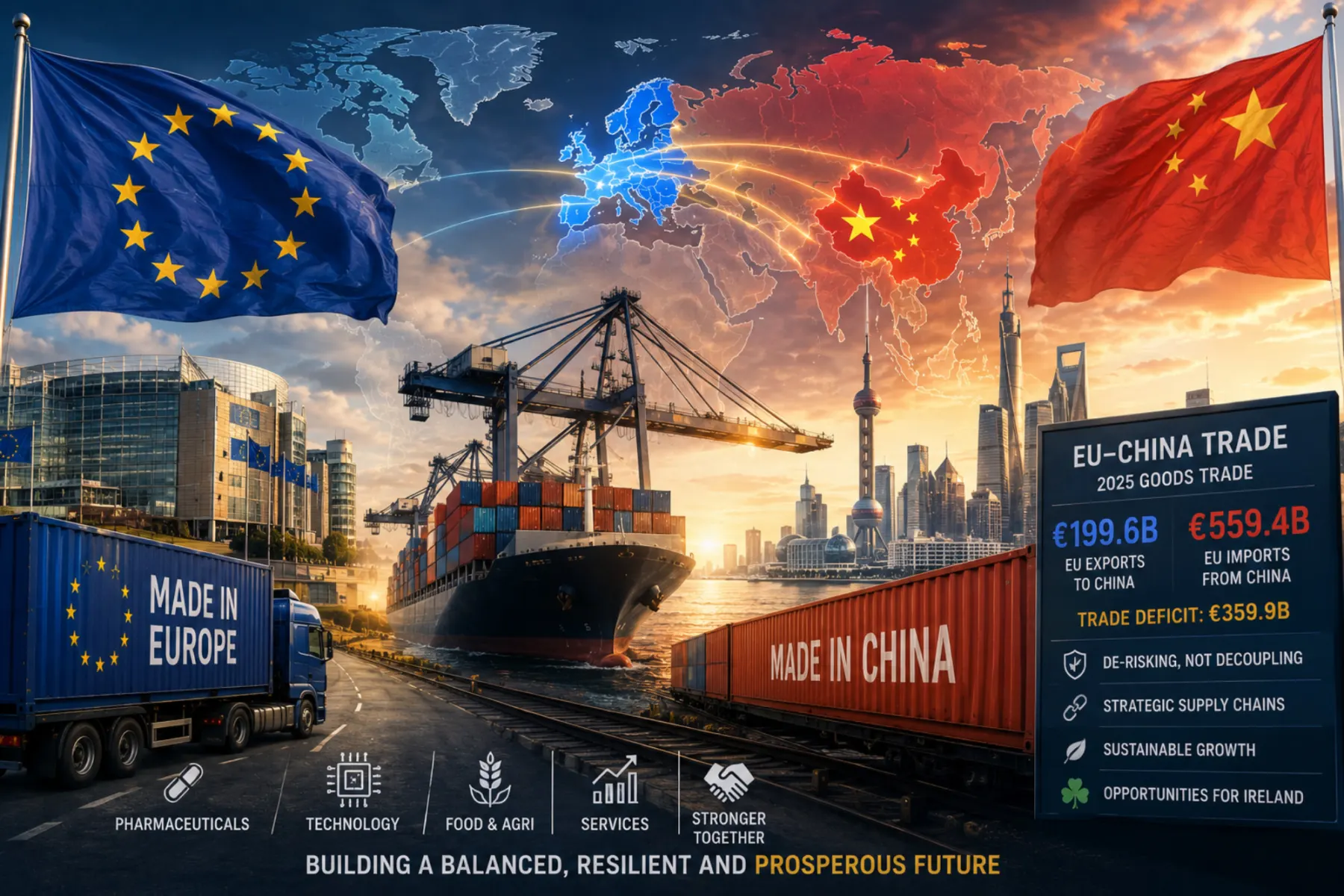
In 2025, the European Union imported €559.4 billion of goods from China and exported €199.6 billion in the opposite direction. China was the EU’s largest source of imported goods. Electrical machinery alone accounted for almost €165 billion of Chinese goods entering the Union.
The relationship is also changing.
European policy is no longer built around the idea that ever-deeper economic integration is automatically desirable. The EU now speaks explicitly about “de-risking, not decoupling”: keeping trade and investment flowing while reducing dangerous concentrations in critical raw materials, technologies and strategic supply chains.
For Ireland, this shift matters far more than the distance between Dublin and Beijing might suggest.
China was Ireland’s sixth-largest goods export market in 2024, purchasing €9.44 billion of Irish goods, and its fifth-largest source of imports, supplying €11.77 billion. Ireland also exported €12.74 billion of services to China in 2024.
China is therefore not a remote market at the edge of Irish economic policy.
It is already deeply connected to the Irish economy.
The Relationship Began Long Before China Became the Factory of the World
Formal diplomatic relations between what is now the European Union and the People’s Republic of China date back 50 years, a milestone marked at the EU-China summit in Beijing in July 2025.
But the great economic acceleration came later.
One of the most important turning points was 11 December 2001, when China became the 143rd member of the World Trade Organization.
WTO membership integrated China much more deeply into the rules and networks governing international commerce. Foreign investment expanded, global manufacturers reorganised supply chains and Chinese production became increasingly connected to consumers in Europe and North America.
The consequences were profound.
European companies gained access to a huge and rapidly developing market.
European consumers gained access to enormous quantities of increasingly sophisticated manufactured goods.
Chinese manufacturers gained access to one of the wealthiest consumer markets in the world.
And multinational companies began constructing supply chains in which a product could be designed in one country, use components from several others, be assembled in China and ultimately sold across the European single market.
For many years, the basic assumption was that deeper integration would continue.
It largely did.
Trade Grew Much Faster Than Almost Anyone Imagined
The latest Eurostat data demonstrates the scale of the transformation.
Between 2015 and 2025 alone, EU goods exports to China increased by 37.1 per cent, from €145.6 billion to €199.6 billion.
Imports grew much faster.
They rose 89 per cent, from €295.9 billion in 2015 to €559.4 billion in 2025.
That produced enormous commercial opportunities.
China became an important market for European machinery, vehicles, pharmaceuticals, medical equipment and premium consumer goods.
At the same time, Europe increasingly relied on Chinese production for electrical machinery, electronics, industrial components, chemicals, furniture, batteries and many other manufactured products.
Trade therefore did not develop as a simple exchange in which Europe produced sophisticated goods and China supplied inexpensive basic products.
China itself moved rapidly up the technological ladder.
Its companies became increasingly competitive in batteries, electric vehicles, renewable-energy equipment, electronics, telecommunications and advanced manufacturing.
That success has changed the nature of the relationship.
Europe and China are now simultaneously customers, suppliers and competitors.
The Numbers Reveal a Growing Imbalance
The most difficult part of the current relationship is visible in one number:
€359.9 billion.
That was the EU’s goods trade deficit with China in 2025.
European exports to China declined by 6.5 per cent during the year while imports from China increased by 6.4 per cent. The deficit remained below the exceptional €397.3 billion recorded in 2022, but was considerably larger than in 2024.
A trade deficit is not automatically evidence of economic failure.
Countries and regions import products because consumers and businesses want them.
European companies benefit from competitively priced Chinese inputs.
Households benefit from access to goods that might otherwise cost more.
European exporters also sell enormous quantities into China.
But persistent imbalance becomes more politically sensitive when it coincides with concerns about industrial subsidies, restricted market access and concentrated dependence on strategically important materials.
That is where EU-China trade has increasingly moved from economics into economic security.
2026 Shows That China Remains Indispensable to European Trade
Whatever the political tensions, trade is not disappearing.
In the first quarter of 2026, China supplied €145.3 billion of goods to the EU, representing 23.1 per cent of all goods imported from outside the Union.
No other country came close.
The United States accounted for €85.9 billion.
In the opposite direction, the EU exported €47.6 billion of goods to China during the quarter, making China its fourth-largest export destination.
These numbers matter because they demonstrate why complete economic separation is neither the EU’s stated policy nor a realistic short-term prospect.
European and Chinese supply chains are too deeply intertwined.
The more realistic question is:
Which parts of that relationship are commercially useful — and which dependencies have become too risky?
That is the central economic question now facing Brussels.
“De-Risking” Is Not Another Word for Breaking Up
The phrase “de-risking, not decoupling” is sometimes misunderstood.
It does not mean Europe intends to stop trading with China.
The European Commission explicitly says the objective is to reduce critical dependencies and vulnerabilities while continuing engagement and cooperation.
A simple example explains the difference.
Suppose a European company buys ordinary consumer components from several Chinese suppliers.
There may be little strategic reason to replace those relationships if prices, quality and reliability are competitive.
Now imagine a European medical-device or energy company depends on a single foreign source for a mineral without which production cannot continue.
That is a different problem.
The issue is not whether the supplier is foreign.
The issue is whether the buyer has no alternative if the supply disappears.
De-risking therefore means diversification.
More suppliers.
Alternative countries.
European production where economically viable.
Larger inventories in critical sectors.
Recycling.
And greater understanding of where strategic vulnerabilities actually exist.
For an open economy such as Ireland, that distinction is particularly important.
Rare Earths Explain Why Europe Has Become More Cautious
The modern economy depends on materials most consumers rarely think about.
Rare earth elements and specialised minerals are required in permanent magnets, electronics, wind turbines, electric vehicles, advanced medical devices, defence systems and other technologies.
China has an exceptionally powerful position in the processing of many of these materials.
The European Commission has said that China processes around 70 per cent of the world’s most important critical raw materials and around 90 per cent of rare earth elements.
That concentration became increasingly important when China introduced export controls affecting rare earths and other critical materials.
The EU raised the issue directly at the 2025 EU-China summit, warning that restrictions on rare earths and permanent magnets were affecting European companies.
But there has also been evidence that dialogue can produce progress.
At EU-China trade discussions in June 2026, the two sides noted positive results from their export-control dialogue concerning rare earth elements and other critical supply issues.
This is a good illustration of the direction the relationship may take.
Competition does not eliminate negotiation.
Strategic caution does not eliminate cooperation.
Electric Cars Became the Symbol of the New Relationship
Perhaps no industry better demonstrates the transformation than electric vehicles.
China developed an enormously competitive EV manufacturing sector supported by extensive battery and supply-chain capacity.
European policymakers became concerned that subsidised Chinese production could distort competition within the European market.
After an anti-subsidy investigation, the European Commission imposed definitive countervailing duties in October 2024 ranging from 7.8 per cent to 35.3 per cent on battery electric vehicles imported from China, depending on the producer and circumstances.
That might appear to represent straightforward confrontation.
But the story did not end there.
The Commission and Chinese authorities continued discussing WTO-compatible alternatives.
In January 2026, Brussels published guidance allowing Chinese manufacturers to submit price-undertaking proposals involving minimum import prices and potentially future investment in Europe.
The significance extends beyond cars.
Europe is attempting to develop a model in which its market remains open while trade-defence instruments are used when authorities conclude that competition has become distorted.
Whether that balance can be maintained will be one of the central questions in EU-China trade over the next decade.
Europe Is Becoming More Assertive — But Trade Continues
The shift is already visible beyond electric vehicles.
In 2026, the European Commission imposed or advanced trade-defence measures involving a range of Chinese products, including tyres, polyamide yarns and industrial chemicals.
At the same time, the EU continues to maintain high-level economic dialogue with China.
This apparently contradictory behaviour is actually the essence of the new policy.
Europe is not choosing between:
trade
or
protection.
It is attempting to maintain large-scale trade while intervening selectively where it believes subsidies, dumping, market-access restrictions or strategic dependencies create unacceptable risks.
That is a much more complicated relationship than either unrestricted globalisation or simple protectionism.
It may also prove more durable.
Services Tell a More Positive European Story
The goods deficit receives most political attention.
Services tell a different story.
The EU continued to run a services trade surplus with China of €21.3 billion in 2025.
China was the EU’s fourth-largest services trading partner after the United States, United Kingdom and Switzerland.
That distinction is particularly relevant for Ireland.
Ireland is one of the world’s most internationally integrated services economies.
Software, computer services, finance, insurance, professional services and other digitally deliverable activities occupy an unusually important position in Irish exports.
This means Ireland’s relationship with China cannot be understood simply by counting containers arriving at Irish ports.
Some of its most valuable trade never enters a port at all.
Ireland’s Trade Relationship With China Is Already Large
The latest detailed CSO annual goods data show that Ireland exported €9.44 billion of goods to China in 2024.
That made China Ireland’s sixth-largest goods export destination, accounting for approximately 5 per cent of exports in the CSO partner ranking.
Ireland imported €11.77 billion of Chinese goods, making China the country’s fifth-largest import source.
Only the United States, United Kingdom, France and Germany supplied Ireland with more goods in that ranking.
The services relationship is equally important.
Ireland exported €12.74 billion of services to China in 2024, an increase of approximately €800 million from 2023.
Services imports from China were approximately €4.67 billion.
That means Ireland’s bilateral relationship differs significantly from the wider EU picture.
In goods, Ireland imported more from China than it exported.
In services, Ireland recorded a substantial surplus.
This dual structure is one of Ireland’s greatest advantages.
China Is Ireland’s Largest Trading Partner in Asia
Ireland’s Department of Enterprise has described China as the country’s largest trading partner in Asia.
At the Ireland-China Joint Economic Commission meeting in Dublin in November 2025, the Department said bilateral trade had reached €36.7 billion in 2023, after strong expansion over the preceding decade.
The meeting covered trade and investment, agriculture and food, financial services, research and development, export controls relating to rare earths, green development and wider global trade challenges.
That breadth is revealing.
Ireland-China commerce is no longer a single-sector relationship.
It touches advanced manufacturing.
Agriculture.
Technology.
Finance.
Research.
Services.
Supply chains.
And increasingly green technologies.
For a country of Ireland’s size, diversification across that many areas can be strategically valuable.
Ireland Has Something China Wants: High-Value Production
Ireland is not trying to compete with China by becoming a low-cost mass-manufacturing economy.
That would make little economic sense.
Irish wages, land costs and industrial structures are very different.
Ireland’s comparative strength lies elsewhere.
The country has developed major clusters in pharmaceuticals, biopharmaceuticals, medical technology, digital services, financial services, advanced food production and increasingly semiconductor-related activity.
China’s enormous population, sophisticated manufacturing base and large middle-income consumer market create potential customers for many of those sectors.
This is one reason China remains a priority within Ireland’s market-diversification strategy.
The Department of Enterprise specifically identified agri-food, technology and financial services as areas with export potential during the 2025 Joint Economic Commission.
The opportunity is not to replace Ireland’s European or American markets.
It is to add another large one.
Pharmaceuticals Could Become Increasingly Important
The pharmaceutical relationship is particularly interesting.
At EU level, pharmaceutical products were already among the five largest goods categories exported to China in 2025, worth €13.6 billion. Precision, medical and surgical instruments accounted for another €15.1 billion.
Ireland has an unusually large pharmaceutical and life-sciences manufacturing base.
That does not mean every euro of future European pharmaceutical exports to China will come from Ireland.
But it does mean that expansion of Chinese demand for medicines, medical technologies and life-science products occurs in sectors where Ireland already has substantial expertise and production capacity.
China’s ageing population, healthcare development and biotech ambitions could create continuing opportunities over the long term.
At the same time, regulatory access will matter.
The EU has repeatedly pressed China for improved market access in areas including pharmaceuticals.
For Irish exporters, the size of the market is only one side of the equation.
The ability to enter it predictably is the other.
Irish Food Has a Different Opportunity
Agri-food operates under a completely different economic model.
Ireland cannot compete with China on industrial scale.
But Irish producers can compete through food safety, traceability, specialised nutrition, dairy expertise and premium positioning.
The Irish Government has therefore continued treating agriculture and food as priority areas in bilateral economic engagement with China.
The long-term opportunity is not necessarily selling enormous quantities of low-margin food.
It may lie increasingly in higher-value products:
specialised dairy nutrition,
premium food ingredients,
food technology,
agricultural expertise,
and products aimed at higher-income consumers.
This is another reason the quality of market access matters as much as headline trade volume.
A smaller amount of high-value trade can sometimes generate more Irish economic value than a much larger volume of commodity exports.
Digital Services Could Be Ireland’s Quiet Advantage
The most striking Irish trade figures may ultimately be found in services.
Ireland exported €483 billion of services globally in 2024, with computer services alone accounting for €278.7 billion.
Services exports to Asia reached €98.8 billion, including the €12.7 billion sold to China.
This means Ireland participates in EU-China trade from a very different starting point from many manufacturing-heavy European economies.
Germany may focus heavily on industrial machinery and vehicles.
Ireland has an unusually large stake in digital and service exports.
That provides opportunity — but also creates its own regulatory issues.
The EU has raised concerns about limited digital market access in China, cybersecurity rules and restrictions surrounding cross-border data flows.
For digitally intensive Irish businesses, those rules can be just as important as a customs tariff.
In the modern economy, data regulation is increasingly a form of trade policy.
Financial Services Offer Another Route
Financial services were also identified as an area of bilateral opportunity at the 2025 Ireland-China Joint Economic Commission.
Ireland has developed a substantial international financial-services sector serving global markets.
As financial connections between Europe and Asia deepen, Ireland could benefit from activities involving investment funds, insurance, aircraft leasing, asset management and other specialised cross-border services.
But again, the greatest value may come from diversification.
Ireland’s economy is unusually exposed to international conditions because trade occupies such a large share of economic activity.
A broader geographical mix of markets can reduce dependence on any single destination.
China therefore matters to Ireland not because it should replace the United States or Europe.
It matters because economic resilience improves when Irish businesses have more than one major growth market.
Chinese Imports Also Benefit Irish Consumers and Businesses
The relationship is often discussed only from the perspective of Irish exports.
Imports matter too.
Chinese products entering Ireland include machinery, electronics, consumer goods, components and industrial inputs.
In February 2026 alone, Ireland imported approximately €962 million of goods from China, representing 8.5 per cent of total Irish goods imports for the month.
Imports can reduce costs for households and companies.
A construction business buying equipment, a retailer sourcing electronics or a manufacturer purchasing components may benefit directly from globally competitive Chinese production.
Lower input prices can improve Irish competitiveness.
But this creates the same strategic question facing Europe as a whole:
When does efficient sourcing become excessive dependence?
The answer depends on the product.
Ireland does not need domestic factories producing every consumer item it imports.
It does need to understand where the absence of alternative suppliers could create serious economic disruption.
Ireland Is Particularly Exposed to Supply-Chain Shocks
Ireland is a small island economy at the western edge of Europe.
That geography makes international logistics essential.
A disruption in Asian shipping routes can affect Irish businesses even when Ireland itself is not directly involved in the political dispute that caused it.
The same applies to shortages of electronics, industrial components or critical minerals.
Irish companies are often several stages removed from the original Chinese supplier.
An Irish manufacturer may buy a component from Germany.
The German supplier may obtain a magnet from another European company.
That company may depend on rare-earth material processed in China.
The Irish company therefore has exposure to China even though its accounting system shows a German supplier.
This is why modern supply-chain analysis has become so important.
Trade dependency can be indirect.
The EU Single Market Gives Ireland Much Greater Negotiating Power
Ireland’s membership of the European Union fundamentally changes its relationship with China.
A country of roughly 5.5 million people negotiating alone with a country of more than a billion would possess limited economic leverage.
Ireland instead trades as part of the European single market and the EU’s common commercial policy.
When the European Commission negotiates trade issues, applies anti-dumping measures or challenges trade restrictions, it does so on behalf of a market of hundreds of millions of consumers.
For Irish companies, that matters.
They benefit from access to the EU market while also operating within a much larger negotiating bloc.
That is particularly valuable in a world where trade policy is becoming more geopolitical.
The Positive Side of Europe’s Tougher Approach
It would be easy to interpret every tariff or trade investigation as evidence that EU-China economic relations are deteriorating.
The reality is more complicated.
More predictable rules can sometimes make trade stronger.
European companies are more likely to invest if they believe intellectual property will be protected.
Chinese companies may be more willing to establish European production if they understand the conditions under which they can access the single market.
European governments may be more comfortable maintaining large-scale trade if they know critical dependencies are being reduced.
The ultimate objective of de-risking is therefore not necessarily less trade.
It can be more resilient trade.
That distinction offers a more positive way to understand the current transition.
2026 Is Showing Signs of Managed Competition
The relationship remains difficult.
The EU continues to raise concerns about trade imbalances, subsidies, market access and export controls.
China has its own complaints regarding European trade measures.
Yet dialogue has continued.
The June 2026 trade discussions addressed export controls and critical materials, while EU-China mechanisms remain active across trade, investment and other economic areas.
This matters because the EU and China have powerful incentives not to allow commercial disputes to overwhelm the entire relationship.
Europe remains a major market for Chinese manufacturers.
China remains a major market for European exporters.
Both sides depend on stable global trade routes.
Both have an interest in climate technologies and industrial development.
And both operate inside a global economy in which complete separation would impose enormous costs.
The most plausible future is therefore not a return to the uncomplicated globalisation of the early 2000s.
Nor is it full economic divorce.
It is managed interdependence.
What Could Happen Between Now and 2030?
Several realistic paths are possible.
The most constructive would involve continued high trade volumes accompanied by gradual correction of the largest imbalances.
China could improve access for European companies.
European manufacturers could become more competitive in green technologies.
Chinese firms could increase investment and production inside Europe.
Supply chains for critical minerals could become more diversified.
The EU and China could resolve more disputes through negotiation and WTO-compatible arrangements.
Under that scenario, the relationship would remain competitive but become more stable.
Ireland would benefit from both sides.
Irish exporters would retain access to a large Chinese market.
Irish businesses would continue purchasing competitively priced Asian products.
And greater supply-chain diversification would make Irish industry less vulnerable to shocks.
Another Scenario Is Continued Trade Friction
A more difficult possibility is that disputes over subsidies, manufacturing capacity and market access increase.
The EU could apply additional trade-defence measures.
China could respond with measures affecting European exports.
Critical-material restrictions could re-emerge as a source of tension.
Businesses might respond by moving parts of their supply chains to Southeast Asia, India, Europe or other locations.
Trade with China would probably continue, but it would become more expensive and politically complex.
For Ireland, the impact would vary by sector.
Import-dependent businesses could face higher costs.
Exporters could encounter additional barriers.
But supply-chain diversification could also create investment opportunities within Europe.
Ireland’s attraction as a location for advanced manufacturing and services might benefit if international companies decide they need more production inside the EU.
The United States Adds Another Layer of Complexity
Europe-China trade cannot be understood in isolation from the United States.
The global trading system is increasingly shaped by economic competition between Washington and Beijing.
Tariffs, technology controls and industrial policy in one market can redirect goods towards another.
Europe therefore watches not only Chinese production but where that production is likely to be sold if access to other markets becomes more difficult.
The European Commission has increasingly monitored the risk of trade diversion into the EU when international tariff measures redirect exports.
Ireland again sits in an unusual position.
Its economy has exceptionally deep commercial links with the United States while simultaneously belonging to the European Union and expanding trade with China.
That makes Ireland particularly interested in avoiding a world divided into mutually exclusive economic blocs.
A functioning rules-based trading system is therefore not an abstract diplomatic preference for Ireland.
It is an economic interest.
Ireland Could Benefit From Being a Bridge Rather Than Choosing One Market
Ireland’s strongest economic strategy is unlikely to involve choosing between America, Europe and Asia.
Its history suggests the opposite.
Ireland became prosperous largely by being unusually open to international investment and trade.
The future challenge is to preserve that openness while reducing vulnerability.
That means maintaining strong US investment relationships.
Deepening participation in the European single market.
Expanding exports to Asia.
Building stronger commercial relationships with China where opportunities exist.
And developing additional markets so that no single relationship becomes indispensable.
Ireland’s current market-diversification strategy reflects precisely that logic, with China remaining an important area of engagement.
Chinese Investment in Europe May Also Change
The direction of investment may become as important as trade itself.
The European Commission reports that Chinese investment stock in the EU stood at €79.8 billion in 2024, while EU investment stock in China was considerably larger at €239.3 billion.
Chinese investment in Europe has increasingly included greenfield projects in sectors such as automotive technology, batteries and other advanced manufacturing.
This could become part of the solution to trade tensions.
Instead of manufacturing every product in China and exporting it to Europe, Chinese companies can establish production within Europe.
That can create European employment and shorten supply chains.
But European policymakers will increasingly examine such investment through questions of technology, security, subsidies and long-term industrial value.
For Ireland, future Chinese investment could be attractive where it creates genuine employment, research capability and integration into the Irish economy.
Competition Can Also Be Productive
Europe’s encounter with rapidly advancing Chinese industry creates pressure.
But economic competition is not automatically negative.
Chinese progress in electric vehicles, batteries, solar equipment and advanced manufacturing has forced European policymakers and companies to confront questions about cost, productivity and technological scale.
That pressure could accelerate European investment.
For Ireland, stronger European industrial policy may create opportunities in areas where the country already possesses capabilities:
semiconductors,
life sciences,
digital technology,
advanced manufacturing,
energy,
research,
and high-value services.
Competition with China can therefore act as both a risk and an incentive.
The outcome depends on whether Europe responds primarily with barriers — or with investment and innovation.
The Green Transition Could Become a Major Area of Cooperation
There is another reason Europe and China are unlikely to disengage completely.
Climate change requires technologies and investment on a global scale.
China has become a dominant producer of several clean-energy technologies.
Europe is attempting to expand its own manufacturing capacity while rapidly decarbonising its economy.
The two sides therefore compete in clean technology while simultaneously sharing an interest in accelerating the global energy transition.
At the 2025 summit, the EU and China agreed to continue cooperation on climate issues and highlighted existing work on emissions trading and the circular economy.
Ireland has a direct interest in that relationship.
Its future electricity system will rely increasingly on renewable generation.
Its businesses will require batteries, power electronics, grid infrastructure and other technologies.
A competitive global clean-tech market can reduce costs.
A dangerously concentrated supply chain can increase risk.
Once again, the challenge is balance rather than isolation.
Consumers May Ultimately Feel the Relationship Through Prices
Trade policy can sound remote until it reaches the household budget.
Chinese manufacturing has helped lower the cost of many consumer goods across Europe.
If trade barriers rise substantially, some products could become more expensive.
If Chinese competition intensifies without European industry adapting, some European producers could face greater pressure.
Consumers therefore sit at the centre of the policy dilemma.
Europe wants competitively priced goods.
It also wants industrial employment.
It wants rapid access to green technology.
It also wants supply-chain security.
It wants international trade.
It also wants fair competition.
There is no policy capable of maximising all of these objectives simultaneously.
The task is to find a sustainable balance.
Ireland’s Advantage Is That It Sells Knowledge as Well as Products
This may be Ireland’s most important distinction.
The traditional image of international trade is a ship carrying physical goods.
Ireland certainly participates in that economy.
But a large part of modern Irish trade consists of intellectual property, software, financial expertise, digital services, research-intensive pharmaceuticals and other forms of high-value activity.
That makes the Chinese relationship particularly interesting.
China is moving from an economy historically associated with mass manufacturing towards one that places increasing emphasis on technology, innovation, healthcare, advanced services and higher-value consumption.
Ireland’s strongest sectors increasingly overlap with those areas.
The countries are very different in scale.
But their economies can nevertheless be complementary in selected sectors.
The Next Phase Will Be Less Simple — But Potentially More Sustainable
The great EU-China trade expansion of the early twenty-first century was built around efficiency.
Produce where costs are lowest.
Build global supply chains.
Reduce barriers.
Increase trade.
The next phase adds another set of questions.
Is the supply secure?
Are competitors operating under comparable conditions?
Can critical goods be sourced elsewhere?
Does investment create lasting local value?
Are companies able to access each other’s markets?
Can trade continue during geopolitical tensions?
Those questions make international commerce more complicated.
They may also make it more resilient.
Ireland Has More to Gain From Engagement Than Isolation
Ireland’s position is unusually clear.
It is a small, highly internationalised economy.
Its prosperity depends heavily on being able to sell goods and services beyond its domestic market.
China offers a market of enormous scale.
Europe gives Ireland negotiating power and regulatory protection.
The United States remains a critical investment and export partner.
The sensible long-term Irish interest is therefore not economic fragmentation.
It is an international system in which several large markets remain open enough to trade with one another while strategic vulnerabilities are kept within manageable limits.
That is broadly where European China policy is heading.
De-risking rather than decoupling.
From €9.4 Billion in Goods Exports to a Much Larger Opportunity
The numbers already demonstrate what is at stake.
Ireland exported €9.44 billion of goods to China in 2024 and another €12.74 billion of services.
China simultaneously supplied almost €11.8 billion of goods to Ireland.
These are not theoretical future relationships.
They already exist.
The question is how they evolve.
If Irish companies can expand in pharmaceuticals, medical technology, food, financial services and digital exports while Europe reduces dangerous supply-chain dependencies, the next phase of EU-China trade could actually strengthen Ireland’s economic resilience.
If trade disputes intensify without diversification, the same relationship could become a source of vulnerability.
The likely outcome will fall somewhere between those extremes.
A Relationship Too Important to Abandon — and Too Important Not to Reform
Europe and China have moved a long way from the optimism that surrounded China’s entry into the WTO in 2001.
The relationship is more competitive.
More political.
More strategic.
And in some sectors considerably more difficult.
Yet the economic connection has become far too large to describe only through disagreement.
EU-China goods trade runs into hundreds of billions of euro every year.
Services trade remains substantial.
Investment continues.
Companies on both sides depend on customers and suppliers in the other market.
And even during periods of political tension, technical negotiations continue.
For Ireland, that creates a rare combination of opportunity and responsibility.
The country benefits from an open world economy, but it also needs protection against excessive dependence.
It wants affordable imports, but also competitive European industry.
It wants access to China’s enormous market, while preserving strong economic relationships with Europe and the United States.
Those objectives are not necessarily contradictory.
They require diversification rather than isolation.
The future of Europe-China trade is therefore unlikely to resemble either the unrestricted globalisation of the past or the economic separation sometimes predicted today.
A more likely model is emerging:
trade where trade creates value, competition where competition drives innovation, protection where strategic vulnerabilities become dangerous, and negotiation where disagreement can still be resolved.
For Ireland, that may be a particularly favourable outcome.
A country built around international commerce does not need a world without economic competition.
It needs a world in which competition remains sufficiently predictable that businesses can continue crossing borders.
The EU-China relationship is now attempting to build exactly that balance.
If it succeeds, Ireland — with its unusually strong combination of advanced manufacturing, services, technology, food and access to the European single market — could become one of the smaller economies with disproportionately large opportunities in the next chapter of trade between Europe and Asia.
Source & Transparency
This article is published by Ireland Newspaper for editorial and informational purposes.
Published: 11 August 2026 · Updated: 11 August 2026

Newsroom Ireland Newspaper
Ireland Newspaper editorial team prepares daily news coverage for readers in Ireland and abroad.


Market data, financial news and economy content on Ireland Newspaper are provided for editorial and informational purposes only. They do not constitute financial advice, investment advice, trading advice or a recommendation to buy, sell or hold any financial product. Always verify live prices and consult a qualified professional before making financial decisions.