The First War Year: Russia’s Invasion of Ukraine, the Battles That Changed the War and the Crimes Left Behind
From the failed assault on Kyiv and the destruction of Mariupol to the killings documented in Bucha, Ukraine’s counter-offensives in Kharkiv and Kherson, and Russia’s winter campaign against energy infrastructure, the first twelve months of the full-scale invasion transformed Ukraine and Europe. UN investigations later concluded that Russian forces and authorities had committed war crimes including wilful killings, attacks on civilians, torture, rape, unlawful confinement and the unlawful transfer and deportation of children.
At dawn on 24 February 2022, millions of Ukrainians woke to explosions.
Missiles struck targets across the country. Russian troops crossed Ukraine’s borders from the north, east and south. Forces entered from Russia, from Russian-occupied Crimea and through Belarus. Kyiv, Kharkiv, Chernihiv, Sumy, Kherson, Mariupol and other cities suddenly found themselves inside a war whose scale Europe had not experienced for generations.
Russia called its assault a “special military operation”.
The United Nations General Assembly used a different term.
On 2 March 2022, by 141 votes to five, it adopted a resolution titled “Aggression against Ukraine”, demanding that Russia end its invasion and withdraw its forces.
This distinction matters.
The war did not begin because two armies accidentally collided at a disputed border. Russia made the decision to send large-scale armed forces across Ukraine’s internationally recognised frontiers.
Nor did the conflict itself begin in 2022. Russia had occupied and purported to annex Crimea in 2014, while fighting in eastern Ukraine had continued for almost eight years.
What changed on 24 February 2022 was the scale.
A regional conflict became a full-scale invasion of a sovereign state.
This is the story of its first war year — from 24 February 2022 to 24 February 2023.
It is a military history of advances and retreats, but also a civilian history: of cities under siege, millions displaced, homes destroyed and a body of evidence that international investigators would subsequently classify as war crimes.
Before the Invasion: A War That Had Already Begun in 2014
To understand February 2022, it is necessary to look briefly backwards.
Russia seized Crimea from Ukraine in 2014 and supported separatist forces in the Donbas, where fighting continued despite successive ceasefire agreements.
By late 2021 and early 2022, Russia had assembled large military forces around Ukraine.
Moscow publicly denied that an invasion was planned while demanding wider security concessions from the United States and NATO.
Then, on 21 February 2022, Russian President Vladimir Putin recognised the self-proclaimed separatist entities in Donetsk and Luhansk as independent.
Three days later, the full-scale attack began.
The objectives publicly articulated by Moscow included what Putin termed the “demilitarisation” and “denazification” of Ukraine, alongside security claims involving NATO.
Those political claims did not alter Ukraine’s status as a sovereign UN member state or create a recognised legal basis for invading it.
The UN General Assembly overwhelmingly condemned the aggression.
24 February: The Attack Begins From Several Directions
The invasion began on an enormous geographical front.
Russian forces moved south from Belarus towards Kyiv.
Others crossed into north-eastern Ukraine towards Chernihiv, Sumy and Kharkiv.
In the east, forces advanced from Russia and Russian-controlled territory in the Donbas.
From occupied Crimea, Russian troops pushed north towards Kherson, Zaporizhzhia and the Sea of Azov.
Missiles struck military installations and other targets across the country.
Russian planners appeared to be attempting something far larger than capturing additional territory in the Donbas.
The advance towards Kyiv made clear that Ukraine’s political centre itself was threatened.
The early days produced one of the first decisive battles of the war at Hostomel airport near Kyiv.
Russian airborne forces sought to establish a position from which reinforcements could potentially be flown close to the capital.
Fighting around the airfield became intense.
The plan for a rapid seizure of Kyiv did not unfold as Russia had apparently anticipated.
Kyiv Was Supposed to Fall Quickly. It Did Not.
Within days, Russian armoured columns were approaching the Ukrainian capital.
Western governments had warned before the invasion that Kyiv could face overwhelming military pressure.
Instead, Ukrainian forces resisted.
Bridges were destroyed to slow advances.
Anti-tank weapons struck armoured vehicles.
Ukrainian troops fought in suburbs and towns north and west of the city.
Civilians joined territorial defence units.
Thousands of other residents sheltered in metro stations and basements while artillery, missiles and aircraft threatened the capital and its surrounding communities. Reuters’ year-one documentation records the Russian advance on Kyiv and the unexpectedly successful Ukrainian resistance that ultimately forced Russian forces to retreat.
The battle was not fought only in Kyiv itself.
Bucha, Irpin, Hostomel and Borodianka became some of the defining places of the first phase of the war.
In Irpin, civilians attempted to escape while fighting and shelling continued nearby.
In Bucha, Russian troops established occupation.
In Borodianka, residential areas suffered extensive destruction.
By late March it had become increasingly clear that Russia had failed to secure the rapid political and military victory that the opening operation appeared designed to achieve.
Then the Russian forces north of Kyiv began withdrawing.
By early April, Ukraine had regained control of the capital region.
Militarily, it was Russia’s first major strategic failure of the invasion.
What Ukrainian forces and journalists found after the withdrawal would transform international understanding of the occupation.
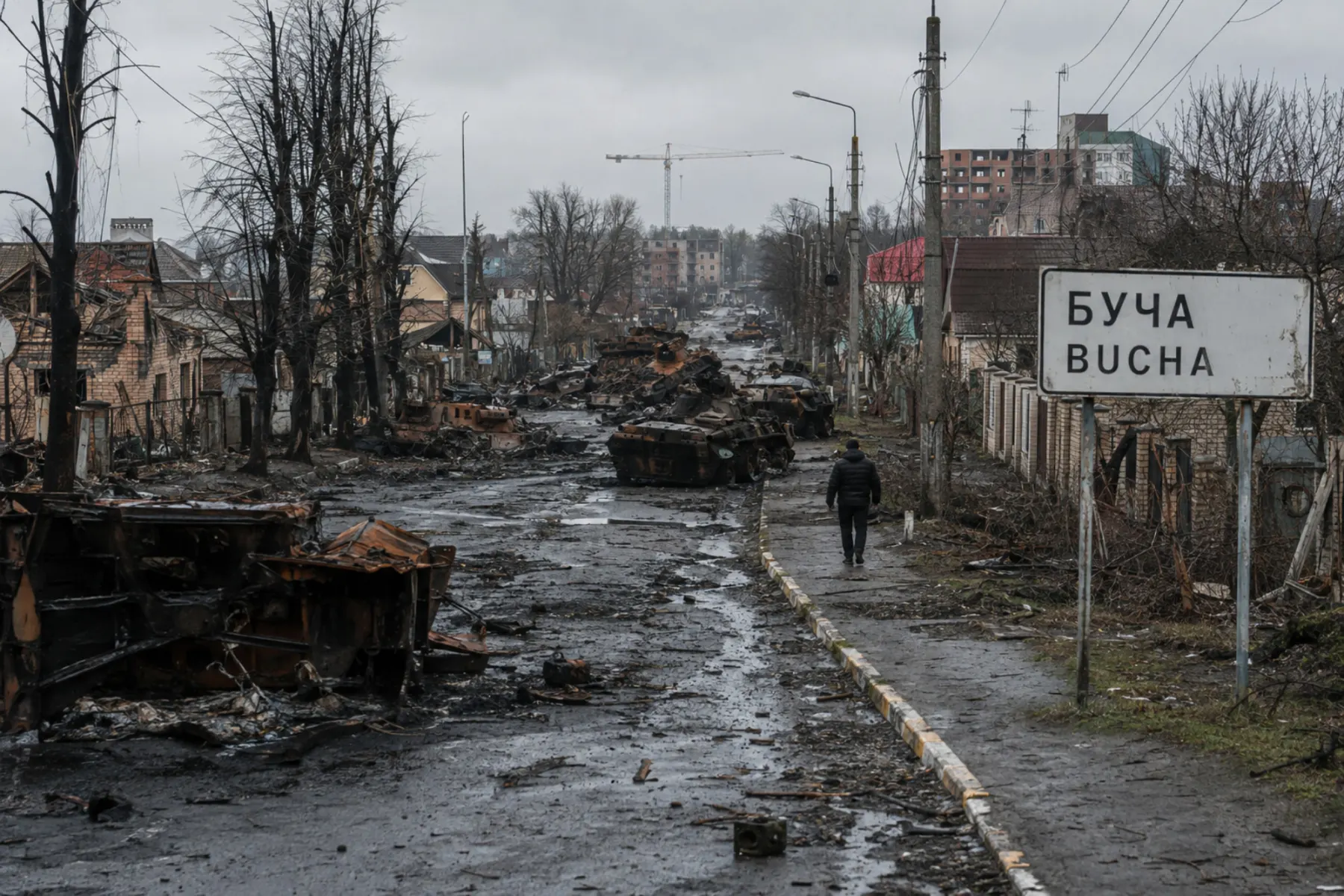
Bucha: What the Russian Withdrawal Revealed
When Ukrainian forces returned to Bucha at the beginning of April, bodies of civilians were found in streets, homes, yards and other locations.
Some victims had been restrained.
International investigators subsequently spent months interviewing witnesses, examining bodies and reconstructing events in Bucha and elsewhere in the Kyiv, Chernihiv and Sumy regions.
The UN Human Rights Monitoring Mission documented 441 violent civilian deaths in those three regions during the first six weeks of the invasion. The UN stressed that the real number was probably considerably higher.
In Bucha itself, the mission had documented the killing of 73 civilians by December 2022 and was still seeking to corroborate another 105 alleged killings.
The UN investigated 100 killings in detail.
It assessed 57 as summary executions.
Thirty victims were killed in detention; another 27 were killed shortly after coming under Russian control. Investigators documented victims found with their hands bound and gunshot wounds.
The UN concluded there were strong indications that documented summary executions could constitute the war crime of wilful killing.
Russia denied responsibility for atrocities in Bucha and claimed the evidence had been staged.
Independent UN investigation did not support that account.
The killings documented by the UN occurred in areas under Russian occupation, and investigators reconstructed cases involving Russian forces through witness testimony and physical evidence.
Bucha consequently became more than the name of a battlefield.
It became one of the central sites in the international investigation of Russian war crimes in Ukraine.
While Kyiv Resisted, Mariupol Was Being Destroyed
Hundreds of kilometres to the south-east, another battle was developing very differently.
Mariupol, a major Ukrainian port on the Sea of Azov, occupied a strategically important position between Russian-held areas of the Donbas and occupied Crimea.
Russian forces encircled the city.
For civilians, the consequences were catastrophic.
Electricity failed.
Water supplies became scarce.
Heating and communications broke down.
Food and medicine became increasingly difficult to obtain.
Residents sheltered underground while heavy fighting and bombardment devastated residential neighbourhoods.
Two attacks became international symbols of the siege.
On 9 March 2022, Mariupol’s maternity and children’s hospital was hit.
On 16 March, the city’s Drama Theatre — being used as a civilian shelter — was destroyed during the siege.
Both incidents were subsequently examined by the UN Independent International Commission of Inquiry on Ukraine as part of its investigation into attacks during the first months of the invasion.
The exact civilian death toll from the siege remains difficult to establish because of the scale of destruction, prolonged Russian control of the city and limited independent access.
That uncertainty should not be replaced with an invented precision.
What is beyond serious dispute is that Mariupol suffered enormous physical destruction and civilian loss.
Azovstal Became the Final Ukrainian Position in Mariupol
As Russian forces occupied increasingly large parts of the city, Ukrainian defenders withdrew towards the enormous Azovstal steel works.
The industrial complex became a fortress.
For weeks, Ukrainian troops remained inside its network of bunkers and underground structures while Russian forces attacked the site.
Some civilians were also trapped in the complex and were eventually evacuated.
By May, the defence had become militarily unsustainable.
The remaining Ukrainian fighters left the plant and entered Russian captivity.
Mariupol was effectively under Russian control. Reuters’ record of the first year documents the surrender and removal of Ukrainian defenders from Azovstal in May 2022.
Russia had gained a strategically important land connection through occupied southern Ukraine towards Crimea.
But it had done so after a siege that left one of Ukraine’s major cities devastated.
The War Shifts East
After the failure around Kyiv, Russia altered the concentration of its military campaign.
The main land fighting increasingly shifted towards the Donbas.
Artillery became central.
Rather than attempting to seize the Ukrainian political centre rapidly, Russian forces concentrated on grinding advances in eastern Ukraine.
The cities of Severodonetsk and Lysychansk became major objectives.
Weeks of heavy combat followed.
By summer 2022 Russia had captured both cities and controlled almost all of Luhansk region.
The fighting revealed a different type of war from the mobile opening weeks.
Large quantities of artillery ammunition were consumed.
Towns were gradually destroyed.
Positions sometimes changed only by kilometres.
Both armies suffered substantial casualties whose exact numbers remain difficult to verify independently.
The expectation of a short war had disappeared.
Europe was watching an increasingly industrial war of attrition.
Western Military Assistance Begins to Change
Ukraine had entered the invasion with its own armed forces and equipment inherited and developed through decades of independence.
As the war continued, military support from the United States, European states and other partners expanded significantly.
Early assistance concentrated heavily on anti-tank weapons, portable air-defence systems, ammunition and other defensive equipment.
Later came longer-range artillery and systems such as HIMARS.
This did not mean outside countries became combatants simply by supplying equipment.
But Western assistance materially increased Ukraine’s ability to sustain military operations against a much larger invading force.
Russian logistics sites and ammunition depots farther behind the front increasingly came within Ukrainian striking range.
By late summer, Ukraine was preparing to demonstrate how much the battlefield had changed.
September: Ukraine Breaks Through in Kharkiv
In early September 2022, Ukrainian forces launched a rapid offensive in the north-east.
Russian positions in Kharkiv region collapsed across a wide area.
Ukrainian troops retook towns including Balakliia, Kupiansk and Izium and recovered thousands of square kilometres of territory within days.
It was one of the most dramatic reversals of the first war year.
The offensive demonstrated several weaknesses in the Russian deployment.
Forces had been spread across an enormous front.
Ukrainian operations elsewhere had drawn attention towards Kherson in the south.
When the attack came in Kharkiv, Russia lacked sufficient prepared reserves to stop the breakthrough quickly.
For Ukrainians who had lived under occupation, liberation also exposed another layer of the war.
Investigators found detention sites and received accounts of torture and mistreatment.
The UN Commission would subsequently conclude that Russian authorities committed unlawful confinement and torture on a broad scale during the invasion.
Russia Responds With Mobilisation and Annexation
The Kharkiv defeat placed the Kremlin under growing military pressure.
On 21 September 2022, Putin announced what Russia called a “partial mobilisation”, bringing hundreds of thousands of additional personnel into the Russian military system.
At the same time, Russian occupation authorities organised purported referendums in occupied parts of Donetsk, Luhansk, Zaporizhzhia and Kherson.
Russia then announced the annexation of the four Ukrainian regions despite not fully controlling any of them.
The international response was overwhelming.
On 12 October, the UN General Assembly voted 143 to five to condemn Russia’s attempted annexations and reject the purported referendums.
The annexation declarations therefore did not transform occupied Ukrainian territory into internationally recognised Russian territory.
Ukraine continued fighting to recover it.
October: Russia Turns Increasing Firepower Against Ukraine’s Energy System
On 8 October, an explosion severely damaged the Kerch Strait bridge linking Russia with occupied Crimea.
Two days later, Russia began one of the most consequential new campaigns of the war.
Large waves of missiles and, increasingly, Iranian-designed Shahed drones were launched against targets across Ukraine.
Electricity generation and transmission facilities were struck repeatedly.
Cities experienced blackouts.
Water supplies and heating systems were disrupted.
Emergency repair crews raced to restore damaged networks before subsequent attacks arrived.
Kyiv and other cities entered winter with rolling power cuts and the threat of further strikes.
The UN Commission later examined Russian attacks on energy-related infrastructure and concluded more broadly that Russian armed forces had carried out attacks involving explosive weapons in populated areas in violation of international humanitarian law, with multiple acts amounting to war crimes.
The strategy changed daily life far beyond the frontline.
War now arrived through the electrical socket.
Families planned around hours of available power.
Hospitals required generators.
Water pumps failed when electricity disappeared.
Apartments became cold when heating systems stopped.
Russia had not broken the Ukrainian army.
Its military campaign increasingly imposed suffering on the civilian infrastructure supporting Ukrainian society.
November: Ukraine Retakes Kherson
While missiles were striking Ukrainian infrastructure, another major military reversal was developing in the south.
Russian forces occupying the western bank of the Dnipro around Kherson had become increasingly difficult to supply after Ukrainian attacks damaged bridges and logistics routes.
In November, Russia ordered its forces to withdraw across the river.
On 11 November 2022, Ukrainian troops entered Kherson city.
Residents emerged carrying Ukrainian flags.
For Ukraine, the victory was strategically and symbolically enormous.
Kherson had been the only regional capital seized by Russia after 24 February.
Its liberation meant Russia had lost another major prize of the initial invasion.
But the city was not restored to peace.
Russian forces remained across the Dnipro and subsequently continued shelling Kherson.
Liberation meant the end of occupation on one bank of the river, not the end of war.
Winter: Bakhmut Becomes the Centre of the Battle
By December 2022 and early 2023, the front had become more static.
The battle increasingly concentrated around Bakhmut in Donetsk region.
Russian forces, including large numbers of Wagner Group fighters, repeatedly attacked Ukrainian positions around the city.
The terrain became associated with trenches, artillery, destroyed buildings and enormous expenditure of ammunition.
Bakhmut had limited significance compared with Kyiv or Kherson as a political centre.
Its importance increasingly derived from the forces both sides had committed to fighting over it.
By the first anniversary, the battle remained unresolved.
It symbolised how radically the war had changed.
Twelve months earlier, Russian units had been racing towards Kyiv.
Now Russian and Ukrainian troops were fighting for individual settlements and defensive positions in a grinding eastern campaign.
The First Year Was Also a Record of Documented War Crimes
Military maps explain only part of the first war year.
International investigators were simultaneously building another record.
The UN Independent International Commission of Inquiry on Ukraine conducted visits, interviews, forensic assessment and documentary analysis.
Its major report on the first phase of the war was released shortly after the first anniversary, in March 2023.
The conclusion was unequivocal.
The Commission found that Russian authorities committed a wide range of violations of international human rights law and international humanitarian law, many amounting to war crimes.
The documented crimes included:
wilful killings,
attacks on civilians,
unlawful confinement,
torture,
rape and other sexual violence,
and unlawful transfers and deportations, including of children.
The term “war crime” therefore does not depend here on political rhetoric.
It reflects findings by an independent international investigative body mandated through the United Nations Human Rights Council.
Wilful Killings and Summary Executions
The evidence from northern Ukraine was among the strongest.
OHCHR documented civilians being killed while detained, during security checks, in homes and while attempting to move between settlements.
Some victims were executed shortly after being taken into Russian custody.
Others were shot while travelling on roads or attempting to escape fighting.
In the Kyiv, Chernihiv and Sumy regions alone, the UN had documented 441 violent civilian deaths from 24 February to 6 April by the end of 2022.
Of 100 cases investigated in detail, 57 were assessed as summary executions.
The UN found strong indications that these acts constituted the war crime of wilful killing.
Bucha became the best-known location.
It was not the only one.
That is important because the evidence indicated a wider pattern across Russian-occupied areas of northern Ukraine rather than a single isolated incident.
Torture and Unlawful Detention
As Ukraine recovered territory, investigators repeatedly encountered accounts of detention facilities operated under Russian occupation.
Victims described beatings, threats, electric shocks and other forms of abuse.
Some civilians had been detained because Russian personnel suspected them of assisting Ukrainian forces.
Others were local officials, activists, former members of the military or ordinary residents subjected to occupation security checks.
The UN Commission concluded that Russian authorities had committed the war crimes of torture and unlawful confinement. Its subsequent detailed investigation found that torture by Russian authorities was sufficiently widespread and systematic to raise the possibility of crimes against humanity, although that broader legal determination required its own evidentiary assessment.
The distinction matters.
A war crime may arise from an individual prohibited act connected with armed conflict.
A crime against humanity requires additional elements, including a widespread or systematic attack directed against a civilian population.
International investigators therefore apply the terms carefully rather than using them interchangeably.
Rape and Sexual Violence
The UN Commission also documented rape and other forms of sexual violence committed by Russian soldiers.
Cases occurred during occupation, including during searches of homes and in detention contexts.
Victims included women and, in the wider pattern documented by international monitors, men as well.
Sexual violence in armed conflict is not an unavoidable by-product of war.
Rape can constitute a war crime and, under particular circumstances, a crime against humanity.
The Commission included rape and sexual violence among the war crimes it found had been committed during Russia’s invasion.
The number of verified cases cannot be assumed to equal the real prevalence.
Sexual violence is notoriously underreported, particularly in occupied territory, where victims may remain inaccessible to investigators or fear retaliation and stigma.
Responsible reporting therefore requires two forms of restraint at once:
not exaggerating numbers that cannot be verified,
and not assuming that documented cases represent the full scale.
Attacks on Civilians and Civilian Objects
International humanitarian law does not prohibit every attack that harms a civilian.
War is governed by rules requiring parties to distinguish between military objectives and civilians, observe proportionality and take feasible precautions to reduce civilian harm.
The UN Commission found that Russian armed forces used explosive weapons in populated areas in attacks where those fundamental principles were violated.
It documented attacks on civilians and civilian objects among the conduct amounting to war crimes.
The first year produced repeated examples of civilians caught in bombardment.
Apartment buildings were destroyed.
People were killed while fleeing.
Hospitals and other protected or civilian facilities were damaged or destroyed.
Cities including Mariupol, Kharkiv and areas around Kyiv suffered enormous physical damage.
Determining criminal responsibility for any specific strike requires investigation of the target, weapon, intelligence available to the attacker and military circumstances.
That is why credible war-crimes documentation proceeds incident by incident.
The scale of the first-year evidence nevertheless led the UN Commission to findings that went far beyond isolated battlefield mistakes.
The Deportation and Transfer of Ukrainian Children
One of the most consequential investigations involved Ukrainian children taken from occupied territory.
Children were transferred from areas controlled by Russia to other occupied territories or to the Russian Federation.
Circumstances differed.
Some had been separated from parents during fighting.
Some came from institutions.
Others were sent to camps or other facilities.
Russian authorities described many movements as evacuation or humanitarian protection.
International investigators concluded that at least some transfers did not satisfy the requirements of international humanitarian law.
The UN Commission identified unlawful transfer and deportation of children as a war crime.
Then came an extraordinary legal development shortly after the first anniversary.
On 17 March 2023, the International Criminal Court issued arrest warrants for Russian President Vladimir Putin and Russia’s Commissioner for Children’s Rights Maria Lvova-Belova.
The judges found reasonable grounds to believe they bore responsibility in connection with the alleged war crimes of unlawful deportation and unlawful transfer of Ukrainian children from occupied areas to Russia.
The warrants were issued after the twelve-month period covered by this article, but concern conduct that began during that first war year.
They therefore became one of its most significant subsequent legal consequences.
An ICC arrest warrant is not a conviction.
The suspects retain the legal presumption applicable before trial.
But it means ICC judges concluded that the evidentiary threshold for issuing warrants had been met.
Occupation Was Not Merely a Change of Flag
Where Russian forces established control, civilians also faced a transformation of political and social life.
International monitors documented arbitrary detention, suppression of dissent, restrictions on Ukrainian identity and attempts to replace Ukrainian administrative and legal structures with Russian systems.
Later OHCHR analysis of territories occupied after February 2022 described persistent patterns of human-rights and humanitarian-law violations and the systematic dismantling of fundamental rights and freedoms under Russian occupation.
This is another reason the experience of occupation cannot be understood only by studying military maps.
For residents, occupation affected:
what could be said publicly,
which institutions governed them,
which documents were recognised,
what children were taught,
and whether people suspected of supporting Ukraine could safely remain.
Accountability Requires Individual Responsibility
There is an important distinction in documenting these crimes.
It is inaccurate to attribute criminal guilt collectively to “the Russian people”.
War-crimes investigations concern Russian military personnel, commanders, officials and authorities whose conduct can be connected to particular acts or policies.
International criminal law is built around individual responsibility.
The state-level question of Russia’s aggression is separate from determining which individuals bear criminal responsibility for particular war crimes.
That distinction does not diminish the severity of the evidence.
It makes the accusation more precise.
International Investigators Also Examined Ukrainian Conduct
Independent investigation requires examining all parties.
The UN Commission and OHCHR also documented violations involving Ukrainian personnel, including cases concerning the treatment of Russian prisoners of war and some other incidents.
Acknowledging those findings does not create a false equivalence.
The Commission’s first-year findings described a far broader range of serious violations and war crimes attributable to Russian authorities and forces, including wilful killings, torture, rape, unlawful confinement and forced transfers.
Neutral documentation means applying the same law to every party.
It does not mean pretending that every party committed violations of identical nature, frequency or scale.
Eight Million Refugees in One Year
The human consequences extended far beyond those killed or injured.
By the first anniversary, around eight million refugees from Ukraine had fled into neighbouring and other European countries, while more than 5.3 million people were internally displaced inside Ukraine.
It became one of Europe’s largest displacement crises since the Second World War.
Railway stations became evacuation centres.
Families crossed borders carrying what they could manage.
Children entered schools in Poland, Germany, Ireland, Czechia and other European countries.
Millions of people who had begun February 2022 living ordinary civilian lives spent the following winter hundreds or thousands of kilometres from home.
Others remained displaced within Ukraine, uncertain whether their homes still existed or whether their towns remained occupied.
At Least 8,006 Civilians Verified Dead Before the First Anniversary
The casualty numbers available at the end of the first year were already immense.
On 21 February 2023, the UN Human Rights Office reported that it had verified at least 8,006 civilian deaths and 13,287 civilian injuries during the preceding twelve months.
The UN repeatedly emphasised that the true figures were considerably higher.
Verification in war takes time.
Some of the most heavily damaged and occupied areas were inaccessible to independent investigators.
Mariupol was an especially important example.
Bodies may never have been recovered or individually documented.
Families disappeared during occupation.
Information from active battle zones could not always be independently confirmed.
The verified figure should therefore be understood as a minimum documented toll, not a final count.
The Human Cost Cannot Be Reduced to One Number
Casualty statistics are essential because they establish scale.
But they do not capture the entire human effect.
People lost homes without being physically injured.
Children lost months of ordinary education.
Families lived apart because some members fled while others remained.
Elderly residents stayed in frontline communities because leaving was physically or emotionally impossible.
Millions experienced air-raid alarms.
Hospitals operated under wartime conditions.
Farmers encountered mined land.
Workers lost businesses.
Entire communities became dependent on humanitarian assistance.
Cultural buildings were damaged.
Energy workers repaired infrastructure while attacks continued.
The first year altered almost every dimension of Ukrainian civilian life.
Ukraine’s Economy Was Also Rebuilt Around Survival
The invasion did not simply destroy buildings.
It disrupted an economy integrated into global agriculture, manufacturing and trade.
Ports were blocked.
Factories closed or relocated.
Agricultural land became occupied or mined.
Infrastructure was damaged.
Millions of workers became refugees or internally displaced.
Ukraine nevertheless maintained government institutions, banking operations and significant economic activity throughout the first year.
International financial assistance became crucial.
So did the Black Sea Grain Initiative, agreed in July 2022 under UN and Turkish mediation, which allowed agricultural exports to resume from certain Ukrainian Black Sea ports.
Ukraine’s agricultural exports mattered not just domestically but internationally.
The war contributed to global concern over food availability and prices, particularly in countries dependent on Black Sea grain.
The consequences of Russia’s invasion therefore travelled far beyond Europe.
The First Year Changed European Security
Before 24 February 2022, many European governments believed a major interstate war on this scale was highly unlikely.
Within months, defence policies changed.
NATO reinforced its eastern members.
European countries increased military spending.
Finland and Sweden applied to join NATO.
Germany announced a major shift in defence policy.
European states sent progressively heavier military equipment to Ukraine.
The European Union imposed successive sanctions on Russia.
Energy markets were transformed as Europe attempted to reduce its reliance on Russian fossil fuels.
A war fought primarily on Ukrainian territory was reorganising security and economic policy across the continent.
Russia’s Nuclear Threats Added Another Dimension
The first year also repeatedly produced nuclear anxiety.
President Putin made public statements invoking Russia’s nuclear capabilities.
Russia announced mobilisation while framing the confrontation increasingly as a struggle involving the wider West.
At the same time, Russian forces occupied the Zaporizhzhia Nuclear Power Plant, Europe’s largest nuclear station.
Fighting around the facility generated repeated international concern.
The International Atomic Energy Agency sought to establish measures to reduce the risk of a nuclear accident.
The situation demonstrated that modern warfare can create nuclear danger even without a nuclear weapon being used.
A power station inside a war zone is itself a global concern.
By January 2023, Western Support Was Moving Towards Heavy Armour
The winter produced another strategic change.
Ukraine argued that it needed Western tanks to recover more occupied territory.
In January 2023, Germany agreed to allow the transfer of Leopard 2 tanks, while the United States announced plans to provide M1 Abrams tanks.
Other European countries prepared additional Leopard deliveries.
A year earlier, several governments had been reluctant even to discuss supplying such equipment.
The decision illustrated how the war had repeatedly moved the boundaries of Western military support.
Each stage had been shaped by the battlefield.
The failure of Russia’s initial assault made continued Ukrainian resistance appear militarily possible.
Ukraine’s counter-offensives demonstrated that occupied territory could be recovered.
The winter stalemate created pressure for equipment capable of another offensive.
One Year Later, Russia Had Failed in Its Original Strategic Aim
On 24 February 2023, Russia had occupied substantial Ukrainian territory.
Mariupol was under Russian control.
Much of the Donbas and a land corridor towards Crimea remained occupied.
The war was nowhere near over.
But the strategic picture was radically different from the opening days.
Kyiv remained the capital of an independent Ukraine.
The Ukrainian government had survived.
Russian forces had withdrawn from the north.
Ukraine had recovered most of Kharkiv region.
Kherson city had been liberated.
The attempt to achieve a rapid collapse of the Ukrainian state had failed.
Russia had therefore entered the second year of the war controlling territory but without achieving the swift victory that appeared to underpin its opening campaign.
The International Community Again Voted on the Anniversary
On 23 February 2023, immediately before the first anniversary, the UN General Assembly adopted another resolution concerning Ukraine.
Again, 141 countries voted in favour.
The resolution called for a comprehensive, just and lasting peace consistent with the UN Charter and reaffirmed the demand that Russia withdraw its military forces from Ukraine.
The vote demonstrated something important after twelve months of war.
International disagreement existed over sanctions, weapons supplies and how negotiations should proceed.
But the core principle — that territory should not be acquired through military invasion — continued to receive overwhelming support in the General Assembly.
The First Year Had Four Distinct Military Phases
Viewed from the distance of history, the first twelve months can be divided into four broad periods.
The first was the attempt at rapid conquest.
Russian forces attacked from multiple directions, threatened Kyiv and occupied substantial territory in the south and east.
The second was Russia’s retreat from northern Ukraine and concentration on the Donbas, combined with the final destruction and capture of Mariupol.
The third was Ukraine’s counter-offensive period, culminating in the rapid recovery of territory in Kharkiv and the liberation of Kherson.
The fourth was the winter war of attrition, dominated by missile and drone attacks against infrastructure and intense ground fighting around Bakhmut.
Each phase altered expectations.
The war began with widespread fear that Ukraine might collapse.
By the first anniversary, the central question was no longer whether Ukraine would continue to exist.
It was how much occupied territory either side could hold or recover — and how long the war would continue.
The Crimes Were Not Separate From the War’s History
There is a temptation when documenting wars to place military events in one category and atrocities in another.
In Ukraine’s first war year, they repeatedly intersected.
The battle for Kyiv created the occupations in which the Bucha killings occurred.
The siege of Mariupol created conditions in which civilians were trapped amid catastrophic destruction.
Occupation generated detention systems in which torture was documented.
Territorial conquest created the circumstances in which Ukrainian children were transferred and deported.
The retreat from occupied areas revealed evidence that could previously not be investigated independently.
Military history and human-rights history are therefore not two parallel stories.
They are parts of the same one.
What Was Known After One Year — and What Was Still Being Investigated
By 24 February 2023, the evidence of serious violations was already enormous.
But international criminal justice moves far more slowly than warfare.
Investigators have to determine:
what happened,
who was present,
which military unit was involved,
who issued orders,
whether an object was military or civilian,
what commanders knew,
and whether conduct was accidental, reckless or deliberate.
That work continued after the first anniversary.
The UN Commission’s major report documenting first-year war crimes appeared in March 2023.
The ICC warrants concerning the deportation and transfer of children followed on 17 March.
Further investigations in subsequent years would produce additional findings.
That does not mean the crimes began later.
It means evidence gathered during and after the first year was gradually converted into formal legal findings.
A War That Did Not End After Its First Year
The phrase “first war year” is important.
24 February 2023 did not mark the conclusion of Russia’s war against Ukraine.
It marked the end of its first twelve months.
There had been no peace agreement.
Large areas of Ukraine remained occupied.
Russian and Ukrainian soldiers were still fighting along a vast front.
Missile attacks continued.
Civilians continued dying.
Millions remained displaced.
And the international investigations into crimes committed during occupation had only begun to establish the full record.
What the first year did provide was enough evidence to reject several assumptions that had existed on 24 February 2022.
Ukraine had not collapsed.
Kyiv had not fallen.
Russia had not achieved a rapid victory.
Western political support for Ukraine had not disappeared after several months.
And atrocities reported from occupied areas were not merely allegations circulating in wartime information campaigns: independent international investigators had documented wilful killings, torture, rape, unlawful detention and forced transfers that met the legal threshold of war crimes.
The First War Year: What History Must Remember
The first year of Russia’s full-scale invasion can be measured in territory.
Russian forces advanced rapidly.
They were stopped at Kyiv.
They captured Mariupol.
They gained ground in the Donbas.
Ukraine broke through in Kharkiv.
Russia withdrew from Kherson.
By February 2023, the frontline had hardened into a long war of attrition.
But territory alone cannot describe what happened.
The first year also left at least 8,006 civilians verified dead and more than 13,000 injured by the UN, with the real toll believed to be substantially higher.
It forced around eight million Ukrainians to seek refuge abroad and displaced millions more inside their own country.
It destroyed neighbourhoods and infrastructure.
It divided families.
It transformed European security.
And it produced a documented record of grave crimes committed by Russian forces and authorities against Ukrainian civilians and other protected persons.
The names Bucha and Mariupol became internationally recognised not because they were simply points on a military map, but because they came to represent what occupation and siege had meant for the people living there.
The first war year therefore cannot be remembered only as a contest between armies.
It was also a struggle over whether an independent country could be conquered by force, whether civilians in occupied territory remained protected by law, and whether those responsible for atrocities could ultimately be identified and held accountable.
Ukraine survived that first year as a sovereign state.
Its people paid an immense price for doing so.
And when 24 February 2023 arrived, the most important fact was also the most difficult one:
the first year was over — but the war was not.
Source & Transparency
This article is published by Ireland Newspaper for editorial and informational purposes.
Published: 11 August 2026 · Updated: 11 August 2026

Newsroom Ireland Newspaper
Ireland Newspaper editorial team prepares daily news coverage for readers in Ireland and abroad.