Five Years of Climate Extremes: How Australia Is Changing — and What the Next Three Years Could Bring
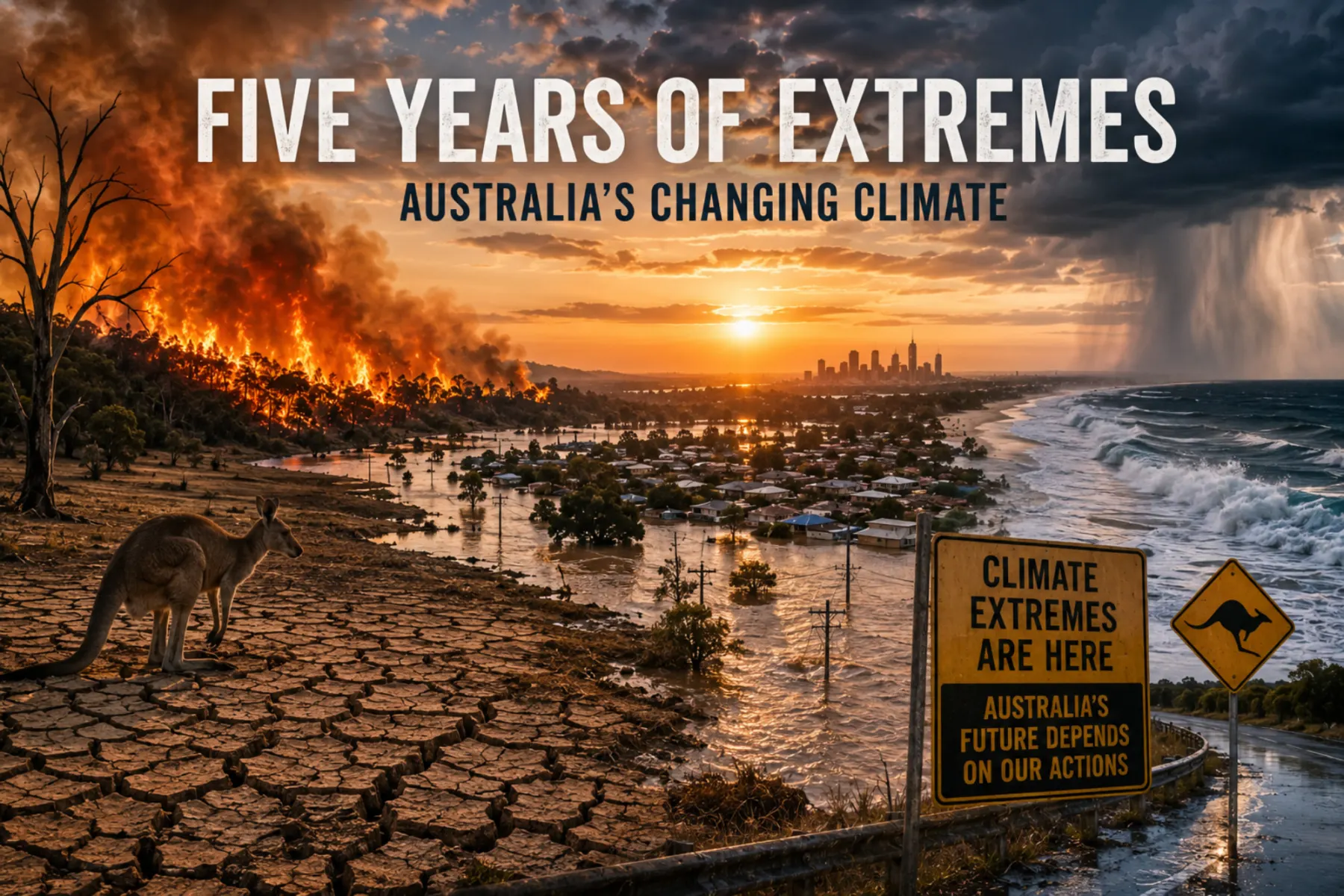
From successive La Niña floods to record-warm seas, coral bleaching, drought, bushfires and Tropical Cyclone Alfred, Australia’s climate story since 2021 has been defined not by one type of disaster but by increasingly costly swings between extremes. As a strong El Niño develops in 2026, the scientific outlook points towards a hotter Australia with greater heat stress, more dangerous fire weather, heavier downpours and rising coastal risks — even though no one can reliably predict the precise weather of 2027, 2028 or 2029.
Australia has always been a continent of climatic extremes.
Drought can persist for years and then end in floods. Tropical cyclones strike the north while southern states struggle with water shortages. Bushfires follow wet periods because rain creates vegetation that can later become fuel. El Niño and La Niña can transform rainfall patterns across enormous distances.
That natural variability has not disappeared.
What has changed is the background climate on which those cycles now operate.
The Bureau of Meteorology and CSIRO calculate that Australia has warmed by approximately 1.51 ± 0.23°C since national temperature records began in 1910. Extreme heat has become more frequent, dangerous fire-weather days have increased across large parts of the country, southern Australia has experienced declining cool-season rainfall, heavy rainfall events are becoming more intense, surrounding oceans are warming and sea levels are rising.
The past five years demonstrate why this distinction matters.
Australia has not simply become “drier”.
Nor has it simply become “wetter”.
It has experienced both.
The emerging climate problem is increasingly one of greater heat combined with more damaging extremes at both ends of the water cycle.
2021: La Niña Turns the Focus From Fire to Flood
The period began under very different conditions from the devastating Black Summer bushfires of 2019–20.
La Niña helped bring wetter conditions across much of eastern Australia during 2021.
Heavy rain in March caused significant coastal and inland flooding across New South Wales and south-eastern Queensland. Some areas experienced their worst floods in more than three decades. Another period of widespread rain and flooding arrived in November.
There was an important benefit.
Water storages recovered.
Soil moisture improved.
Reservoirs within the Murray–Darling Basin filled substantially after years in which drought had dominated national attention.
But the same water that restored reservoirs also demonstrated the other side of Australia’s climate system.
Too little rain creates drought.
Too much rain falling rapidly produces flood.
For many communities along rivers and coastal catchments, 2021 became the beginning of several years in which repeated flooding would replace drought as the immediate danger.
2022: Australia Experiences One of Its Wettest Years
If 2021 marked the transition, 2022 intensified it dramatically.
Australia’s nationally averaged rainfall reached 587.8 millimetres — 26 per cent above the 1961–1990 average — making 2022 the ninth-wettest year in the national record.
Eastern Australia experienced repeated flooding.
New South Wales and Queensland were particularly badly affected, and the 2021–22 financial year was described by the Bureau as being marked by numerous flood periods across those states.
The prolonged wet conditions were associated with an unusually persistent period of La Niña influence.
But climate change and La Niña should not be confused.
Climate change did not create La Niña.
El Niño and La Niña are natural parts of the tropical Pacific climate system and have influenced Australia for centuries.
What warming changes is the environment in which those natural events occur.
A warmer atmosphere can contain more moisture. The Bureau notes that atmospheric moisture capacity increases by roughly 7 per cent for each degree of warming, all else being equal, increasing the potential intensity of heavy rainfall when meteorological conditions favour it.
That means a warming Australia can simultaneously face greater drought risk in some regions and more intense rainfall when storms occur.
Flooding Became an Economic Problem, Not Only a Weather Story
The repeated floods of 2022 damaged homes, businesses, farms, roads and infrastructure across eastern Australia.
They also exposed a growing financial consequence of climate-related natural hazards: insurance.
Industry estimates put insured losses associated with Australia’s major extreme-weather events in 2022 at almost A$7 billion.
The significance extends beyond the year in which a flood occurs.
Insurers calculate premiums partly from expected future losses.
If homes repeatedly face greater flood, cyclone, fire or storm risk, insurance can become progressively more expensive.
Australia’s financial regulator APRA now treats this as a systemic question. Its 2026 climate vulnerability assessment warned that climate-driven pressures could significantly widen the home-insurance protection gap. APRA estimated that about one in seven Australian houses is currently uninsured, with that proportion potentially rising under long-term climate stress scenarios.
The cost of climate extremes therefore increasingly appears not only after disaster.
It can arrive every year through the insurance bill.
2023: Wet Years Leave Behind Fuel for Fire
Australia’s climate shifted again during 2023.
The year was the country’s equal eighth-warmest on record, with the national mean temperature 0.98°C above the 1961–1990 average. Australia moved from prolonged La Niña conditions towards El Niño during the year.
The remarkable feature was what the preceding wet years had left behind.
Rain encourages vegetation growth.
Across grasslands and savanna regions, 2022 and early 2023 produced large amounts of plant material.
When that vegetation subsequently dried, it became fuel.
CSIRO and the Bureau describe 2023 as one of Australia’s largest bushfire seasons in terms of area burned, particularly because the preceding rainfall had created enormous fuel loads across northern regions.
This demonstrates why the relationship between climate and fire is more complicated than the phrase “hotter weather means more fires”.
Fire requires ignition.
Rain can initially reduce fire risk.
But rain can also create vegetation.
If heat and dry weather then arrive, the additional vegetation can become combustible fuel.
Climate risk can therefore develop through a sequence of events rather than one event alone.
Australia’s Fire Season Is Changing Over the Longer Term
The historical trend is clearer in southern Australia.
CSIRO and the Bureau report an increase in extreme fire weather and in the length of the fire season across large parts of Australia since the 1950s, with dangerous fire-weather days becoming more frequent in many regions.
Temperature is only one component.
Humidity matters.
Wind matters.
Fuel moisture matters.
Previous rainfall matters.
Vegetation matters.
Ignition matters.
That is why scientists do not attribute every individual bushfire simply to climate change.
The stronger conclusion is that climate change is altering several of the conditions that determine how readily fires can spread and how severe they can become.
For fire services and communities, the distinction is academically important but operationally straightforward: the number of occasions on which extremely dangerous fire conditions can develop is increasing in many parts of the country.
2024: The Heat Moves Into the Ocean
The climate story changed again in 2024.
Australia recorded its second-warmest year since national observations began in 1910, with the national average temperature 1.46°C above the 1961–1990 reference period.
Yet perhaps the most important record was offshore.
Sea-surface temperatures around Australia were the warmest recorded to that point, averaging 0.89°C above the 1961–1990 level.
Ocean warming is sometimes less visible to the public than a 40°C afternoon in a city.
Economically and ecologically, however, it can be equally important.
Australia’s oceans influence rainfall, tropical systems, fisheries, coastal ecosystems and tourism.
Marine heatwaves can damage kelp forests and coral reefs.
Warmer seas can also contain more energy and moisture, affecting the behaviour of storms and rainfall systems when atmospheric conditions are favourable.
Nowhere is that connection more internationally visible than the Great Barrier Reef.
The Great Barrier Reef Became a Climate Indicator
In 2024 the Great Barrier Reef experienced another major mass coral-bleaching event.
AIMS later found that the event became the primary source of coral mortality measured during subsequent surveys, although cyclones, flooding and crown-of-thorns starfish also contributed.
The impact became measurable in 2025.
Across the three Great Barrier Reef regions, hard-coral cover declined by between 14 and 30 per cent relative to 2024 levels, with some individual reefs suffering much larger losses.
The ecological significance is obvious.
The economic significance is substantial too.
The Great Barrier Reef Marine Park Authority cites recent research estimating that the Reef contributes around A$9 billion annually to Australia’s economy and supports roughly 77,000 full-time jobs, with tourism providing the largest share.
Climate stress affecting the Reef is therefore simultaneously:
an ecological problem,
a tourism problem,
a regional employment problem,
and an economic problem.
2025: Another Exceptionally Warm Year
The warming did not end with 2024.
2025 became Australia’s fourth-warmest year on record, with the national annual temperature 1.23°C above the 1961–1990 average. Summer 2024–25 was the country’s second-warmest on record, while March 2025 was Australia’s warmest March.
The ocean set another record.
Australian-region sea-surface temperatures averaged 0.93°C above the historical reference period, surpassing the record established only one year earlier.
That meant Australia had experienced two consecutive years of record-warm surrounding seas.
At the same time, rainfall once again demonstrated that national averages can conceal completely different regional realities.
Australia as a whole received about 8 per cent more rainfall than average in 2025.
But most of Victoria, Tasmania and South Australia, much of inland New South Wales and large areas of southern Western Australia were drier than average.
Queensland, by contrast, received 31 per cent more rain than average.
One Australia was dealing with too little water.
Another was dealing with too much.
Southern Australia’s Drying Trend Is Becoming Increasingly Important
The longer-term regional pattern is significant.
CSIRO and the Bureau report that cool-season rainfall in south-western Australia has declined by around 16 per cent since 1970.
In south-eastern Australia, April-to-October rainfall has declined by around 9 per cent since 1994.
These are not forecasts.
They are observed historical changes.
During 2025, southern Australia’s cool-season rainfall was 12 per cent below the 1961–1990 average, marking the third consecutive year in which the region’s April-to-October rainfall was below that benchmark.
This matters enormously for agriculture because southern Australia’s winter rainfall supports major grain, livestock and horticultural regions.
A national rainfall figure can therefore be deceptive.
Rain falling in tropical Queensland cannot simply replace rain that does not fall on farmland in Victoria, South Australia or south-western Western Australia.
Water has geography.
Western Australia Experienced Another Form of Climate Stress
Off Western Australia, a marine heatwave that began in late 2024 continued through early 2025.
The Bureau described it as the longest, largest and most intense marine heatwave on record for Western Australia, with waters near the coast remaining 2°C to 4°C above average for extended periods and widespread coral bleaching resulting.
This expanded the coral story beyond the Great Barrier Reef.
Ningaloo and other Western Australian marine ecosystems are also exposed to extreme ocean heat.
For fishing communities and tourism operators, the consequences of marine climate change can therefore arrive even where rainfall on land appears relatively normal.
Australia’s climate boundary does not end at the beach.
Then Came Tropical Cyclone Alfred
March 2025 demonstrated another type of vulnerability.
Tropical Cyclone Alfred moved towards south-east Queensland and crossed the coast after weakening, becoming the first tropical cyclone to cross within 100 kilometres of Brisbane since 1974.
It brought damaging winds, heavy rainfall, flooding, large waves and severe coastal erosion across south-east Queensland and north-east New South Wales. Five-day rainfall exceeded 600 millimetres in some areas, with more than 1,100 millimetres recorded at Upper Springbrook.
It would be scientifically wrong to state that climate change “caused” Alfred.
Tropical cyclones occurred long before modern global warming.
The relevant projection is more nuanced.
CSIRO and the Bureau expect the total number of tropical cyclones around Australia to decrease on average in a warmer climate, but a greater proportion of those that do occur is projected to reach high intensity. Their rainfall is also expected to become more intense, while rising sea levels increase the damage potential of storm surges.
Climate change can therefore increase risk even if the total number of storms does not rise.
2025 Also Demonstrated the Financial Cost of Extreme Weather
Cyclone Alfred was only one of several damaging events during 2025.
North Queensland floods, Mid North Coast flooding and severe hailstorms added to the insurance bill.
By April 2026, the Insurance Council of Australia estimated A$4.8 billion in insured losses from declared extreme-weather events during 2025, with broader economic costs estimated above A$8.6 billion.
Those costs should not all be attributed exclusively to climate change.
Australia has more buildings, more valuable infrastructure and more people living in hazard-exposed locations than in previous decades. Construction costs, development patterns and insurance conditions also affect the financial damage produced by a disaster.
Climate therefore interacts with exposure.
A cyclone crossing an empty coastline produces a very different economic loss from the same cyclone crossing a growing urban region.
Risk is created by both the hazard and what society places in its path.
2026: Australia Is Wet Nationally — and Dry in Important Places
The latest data illustrate the same paradox.
During the 2025–26 financial year, Australia received 590.4 millimetres of area-averaged rainfall, 27 per cent above average, making it the tenth-wettest July-to-June period since records began.
Yet many southern catchments remained under pressure.
Streamflow was below average at significant numbers of monitoring sites in southern Australia, and major storages across parts of Victoria, the southern Murray–Darling Basin and other regions remained relatively low.
The national temperature remained elevated too.
The 2025–26 financial year was Australia’s ninth-warmest on record, with the national mean temperature 1.02°C above the 1961–1990 average. Every month of the financial year was warmer than average nationally.
Then July 2026 continued the pattern.
Australia’s mean temperature was 1.14°C above average, while rainfall across the country was nearly 40 per cent below the July average.
The year is therefore developing from an already warm baseline.
A Strong El Niño Is Now Firmly Established
As of the week ending 9 August 2026, the Bureau of Meteorology reported that El Niño was firmly established, with oceanic and atmospheric indicators consistent with a strong event.
The relative Niño 3.4 index had reached +2.20°C, substantially above the Bureau’s El Niño threshold.
The Bureau expects El Niño conditions to persist well into the latter half of 2026.
For Australia, El Niño often increases the probability of drier conditions across parts of the east and south and raises the likelihood of unusually warm conditions.
But “increases the probability” is the critical phrase.
El Niño is not a guarantee of drought.
Every event develops differently, and Australian weather also depends on the Indian Ocean, Southern Ocean, local sea temperatures and individual weather systems.
Nevertheless, the immediate outlook deserves attention.
The Bureau’s 6 August forecast for September to November 2026 favours below-average rainfall across parts of southern and eastern Australia, while daytime temperatures are likely to be above average south of the tropics and nights warmer than average across most of the country.
The Reef Has Provided One Encouraging Development in 2026
Not every new climate indicator is negative.
On 11 August 2026, the Australian Institute of Marine Science reported early signs of recovery across the Great Barrier Reef following recent bleaching damage.
Hard-coral cover increased in the northern region from 30.0 per cent in 2025 to 35.1 per cent in 2026, while the central region also increased and the southern region remained broadly stable. Across the 121 reefs surveyed, 28 per cent increased in coral cover and 56 per cent showed no net change.
A late monsoon provided critical cooling during early 2026, limiting the severity of an emerging bleaching episode and giving parts of the Reef an opportunity to recover.
This is an important reminder that ecosystems possess resilience.
But recovery does not mean the underlying threat has disappeared.
AIMS notes that bleaching events are occurring increasingly frequently, reducing the recovery time available between episodes of extreme ocean heat.
The Reef can recover.
The question is how often it will be given enough time to do so.
Five Years Reveal the Real Climate Pattern
Looking only at individual years can produce contradictory conclusions.
2021 was wet.
2022 was extremely wet.
2023 became hotter and brought extensive fire.
2024 was exceptionally warm and produced record ocean temperatures.
2025 combined record-warm seas and heat with drought in the south and flooding in Queensland.
2026 has so far combined above-average national rainfall over the financial year with continuing regional water stress and the emergence of a strong El Niño.
That is not evidence against climate change.
It is the form climate change takes in a naturally variable continent.
The underlying temperature is rising while the weather continues oscillating between wet and dry phases.
The result is not monotony.
It is increasingly consequential variability on a warmer baseline.
Heat May Be Australia’s Most Underestimated Climate Risk
Bushfires and cyclones produce dramatic images.
Heat often does not.
Yet CSIRO and the Bureau identify extreme heat as the natural hazard responsible for more deaths in Australia than any other.
Higher temperatures affect far more than comfort.
They increase health risks for older people, infants and people with cardiovascular or respiratory conditions.
They can reduce productivity among construction workers, agricultural labourers and others working outdoors.
They increase electricity demand for cooling.
They place additional stress on power infrastructure.
They increase water consumption.
They can affect railways, roads and other infrastructure designed around historical temperature ranges.
And warm nights matter as much as hot afternoons because the human body receives less opportunity to recover from daytime heat.
Australia is already experiencing very warm monthly maximum temperatures about six times as frequently as it did during 1960–1989, while very warm nights occur around five times as frequently.
This is one of the clearest measurable changes in the Australian climate.
Agriculture Faces a More Complicated Future Than Simply “More Drought”
Australia’s farmers are accustomed to climate variability.
The future difficulty is that several risks can intensify simultaneously.
In southern farming regions, declining cool-season rainfall increases drought and water-security pressure.
Higher temperatures increase evaporation from soils and reservoirs.
Livestock suffer during extreme heat.
Some crops mature faster under high temperatures, reducing yields.
Irrigation demand can increase precisely when water availability falls.
At the same time, warmer air can produce more intense rainfall events capable of damaging crops, eroding soil and flooding farmland. CSIRO projects both longer drought conditions in parts of the south and east and more intense short-duration rainfall across Australia.
That combination is economically difficult.
Agricultural infrastructure must increasingly be capable of dealing with too little water and too much water.
Sometimes within the same region and only months apart.
Water Security Will Become More Regional
Australia’s national water-storage figures can appear reassuring.
They are less reassuring when examined catchment by catchment.
At the end of the 2025–26 financial year, total surface-water storage stood at approximately 65 per cent of available capacity nationally. But the Murray–Darling Basin and several southern regions contained many individual storages at considerably lower levels.
Climate projections suggest southern Australia will continue experiencing declining cool-season rainfall in many areas and longer average drought duration.
This raises difficult questions about:
urban water supply,
irrigated agriculture,
environmental river flows,
hydroelectric production,
industrial water use,
and competition between users.
Australia possesses considerable experience managing drought.
The challenge is designing water systems for a climate in which historical rainfall averages become less reliable guides to future conditions.
Coastal Australia Faces a Slow-Moving Problem
Many of Australia’s largest cities and most valuable infrastructure lie near the coast.
Sea-level rise does not need to submerge a city permanently to become expensive.
A relatively small increase in average sea level allows storm surges and high tides to reach farther inland.
Coastal erosion can accelerate.
Drainage systems can become less effective.
Roads, homes, ports and utilities can experience flooding more frequently.
CSIRO projects continuing sea-level rise around Australia and increasingly frequent extreme sea levels and coastal inundation.
Australia’s first National Climate Risk Assessment estimates that sea-level rise could place an additional 1.5 million people in high-risk coastal areas by 2050.
2050 may sound distant.
Property, transport and drainage infrastructure built today may still be operating then.
Coastal adaptation is therefore already a planning question rather than merely a future environmental issue.
Insurance Could Become One of the Most Visible Household Consequences
Climate change can affect families without a fire or flood ever reaching their own home.
Insurance pricing provides the mechanism.
APRA’s climate assessment warns that changing physical risks can increase insurance costs and widen the number of households for whom adequate cover becomes unaffordable.
This creates a difficult chain.
Higher hazard risk raises expected losses.
Higher losses place upward pressure on premiums.
Some households reduce coverage or leave altogether.
If disaster then strikes, a larger proportion of the financial loss falls directly on households, lenders or government assistance systems.
Climate adaptation therefore increasingly has a financial value.
Flood barriers, cyclone-resistant roofs, bushfire-resilient construction, improved drainage and better land-use planning do not merely reduce physical damage.
If risk falls sufficiently and insurers can recognise that reduction, resilience investment can also improve the economics of insurance. Australia’s Treasury has explicitly linked disaster-risk mitigation with efforts to improve long-term insurance affordability.
Climate Risk Is Becoming a Productivity Question
Australia’s National Climate Risk Assessment reaches beyond individual disasters.
It concludes that climate change is expected to increase costs, reduce productivity and worsen existing inequalities, while risks can cascade through infrastructure, supply chains, health, agriculture and financial systems.
Consider one extreme heatwave.
Construction productivity falls because employees cannot safely maintain the same pace of work.
Electricity demand rises.
Transmission equipment experiences greater stress.
Hospitals treat more heat-related illness.
Agricultural animals require additional cooling and water.
Businesses spend more on air conditioning.
Bushfire danger may rise simultaneously.
Transport infrastructure can be affected.
The event therefore does not have one economic cost.
It creates a network of costs.
This is why Australia’s climate debate is gradually moving from the price of disaster recovery towards the economics of resilience.
The Next Three Years Cannot Be Forecast Like Next Week’s Weather
Any responsible outlook for 2027, 2028 and 2029 must begin with a limitation.
Meteorologists cannot reliably say today whether Sydney will experience a major flood in February 2028 or whether Victoria will suffer a severe bushfire season in 2029.
The Bureau itself emphasises that its seasonal forecasts are most reliable only several months ahead.
Climate projections work differently.
They do not predict individual storms or fire seasons years in advance.
They describe how the probability distribution is changing.
And on that question, the signal is much clearer.
CSIRO and the Bureau expect Australia to continue warming, experience more extremely hot days, longer fire seasons in much of the south and east, more dangerous fire-weather days, declining cool-season rainfall in many southern regions, more intense short-duration heavy rainfall, continued sea-level rise and increasingly frequent marine heatwaves.
Those are the scientifically defensible expectations for the next three years.
2027 Could Become an Especially Warm Global Year
The World Meteorological Organization’s latest annual-to-decadal outlook says global temperatures are expected to remain at or near record levels through 2030.
It gives an 86 per cent probability that at least one year between 2026 and 2030 will surpass 2024 as the world’s warmest year on record, and a 91 per cent probability that at least one year will temporarily exceed 1.5°C above the pre-industrial baseline.
The WMO also identifies El Niño conditions as a factor that could increase the possibility of 2027 becoming exceptionally warm globally.
This does not mean 2027 is guaranteed to become Australia’s warmest year.
Regional conditions can differ substantially from the global average.
But a very warm global climate combined with Australia entering the period from an already elevated temperature baseline increases the possibility of further Australian heat records.
2027: The Immediate Question Is What Follows the 2026 El Niño
The first part of the three-year outlook will depend heavily on the evolution of the current El Niño.
El Niño events normally weaken after reaching their mature phase, but their timing and intensity vary.
If the current event continues producing dry conditions over key parts of southern and eastern Australia through late 2026, soil moisture, water storage and vegetation conditions entering 2027 could become especially important.
A dry landscape followed by extreme heat could increase fire danger.
A rapid return to wetter conditions could instead reduce some fire risks while potentially increasing flood risk.
The important variable is therefore not simply whether 2027 is “wet” or “dry”.
It is the sequence in which heat and rainfall occur.
Australia’s recent history shows how quickly risk can change when wet years build vegetation and subsequent dry weather turns that growth into fuel.
2028: Natural Variability Will Still Matter
By 2028, forecasts of El Niño, La Niña and the Indian Ocean Dipole become too uncertain today to support confident claims about exact Australian rainfall.
That uncertainty should not be disguised.
What is more secure is the underlying temperature trend.
CSIRO states that the average temperature over Australia’s next two decades is virtually certain to be warmer than the average of the preceding two decades. It also notes that annual variability will continue, meaning not every year will be warmer than the year before.
A cooler 2028 relative to 2027 would therefore not represent a reversal of climate change.
Likewise, a very wet year would not mean the long-term drying trend in parts of southern Australia had disappeared.
Climate is measured over decades.
Weather still varies from year to year.
2029: The Economic Test May Matter More Than the Temperature Record
By 2029, the most important measure of Australia’s climate resilience may not be whether another national temperature record has been broken.
It may be how successfully communities have adapted.
Are new houses being built for the hazards they will experience during their lifetime?
Are high-risk flood zones being developed differently?
Can insurance remain affordable?
Can power networks handle hotter summers?
Can farmers increase water efficiency?
Are towns protected against fire?
Can emergency services respond when floods, fires and heat occur simultaneously in different regions?
Can coral reefs recover between marine heatwaves?
The National Climate Risk Assessment explicitly warns that multiple hazards can compound and cascade through Australian society and the economy.
The real test of the coming three years is therefore institutional as much as meteorological.
Australia Is Beginning to Treat Adaptation as National Policy
A significant change has already taken place.
In 2025, Australia published its first comprehensive National Climate Risk Assessment and a National Adaptation Plan designed to coordinate responses across government and society.
The risk assessment examines threats to communities, infrastructure, health, the economy, primary industries, water, supply chains, coastal areas and the natural environment.
This is an important shift.
Climate policy traditionally concentrated heavily on reducing greenhouse-gas emissions.
That remains essential because the long-term severity of warming depends on global emissions.
But mitigation alone cannot remove the warming and sea-level rise already built into the climate system.
Australia therefore needs two strategies operating simultaneously:
reduce future warming,
and
adapt to the warming that can no longer be avoided.
Australia’s Emissions Policy Has Also Shifted
Australia retains its legislated commitment to reach net-zero greenhouse-gas emissions by 2050.
Its 2030 target calls for emissions to fall 43 per cent below 2005 levels, while the government has now set a 2035 target of 62 to 70 per cent below 2005 levels.
Whether those targets are achieved will depend on developments across electricity generation, industry, transport, buildings, agriculture and land use.
The economic transformation is already visible in electricity.
Renewable energy now provides more than 40 per cent of electricity across Australia’s two largest grids, according to the government’s 2025 climate statement.
The opportunity is significant because Australia possesses extraordinary solar, wind and mineral resources.
But the transition also requires transmission lines, storage, new generation and industrial investment.
Climate policy is therefore becoming simultaneously an environmental, infrastructure and economic-development strategy.
Climate Change Will Not Make Australia Uninhabitable in the Next Three Years
The scale of climate discussion can sometimes produce exaggerated conclusions.
Australia is not expected to become uninhabitable by 2029.
Its agricultural sector will continue producing food.
Its cities will continue functioning.
Tourism will continue.
The Great Barrier Reef will still exist.
Bushfires, floods and cyclones will not occur everywhere simultaneously.
There will continue to be mild seasons, successful harvests and years in which particular regions receive favourable rainfall.
Those statements do not contradict the science.
Climate risk is about changing probability and severity.
A country does not need to become physically uninhabitable for climate change to impose enormous costs.
A few additional extreme days can matter.
A modest rise in sea level can multiply flood frequency.
A small reduction in winter rainfall can affect reservoirs.
A marine heatwave lasting several additional weeks can transform coral survival.
A severe flood can destroy thousands of homes even if most of the country remains dry.
Australia’s Geography Means There Will Never Be One Climate Story
Perhaps the most important lesson is geographical.
Northern Australia has become wetter on average over recent decades.
Southern Australia has experienced declining cool-season rainfall.
The interior tends to warm more strongly than coastal regions.
Eastern Australia remains heavily influenced by El Niño and La Niña.
Western Australia faces significant drying in the south-west while its northern and western reefs experience marine heatwaves.
Queensland simultaneously faces tropical cyclones, extreme rainfall, heat and reef stress.
Tasmania faces its own combination of changing rainfall, fire weather and marine warming.
Coastal cities must plan for rising sea levels.
No single description can accurately represent all of Australia.
That is why climate adaptation cannot be entirely national in design.
Different regions require different solutions.
The Positive Story Is Australia’s Capacity to Adapt
There is another side to the outlook.
Australia is not confronting climate change without resources.
It possesses world-class climate science.
Sophisticated weather forecasting.
Experienced emergency services.
A large agricultural research sector.
Highly developed insurance and financial systems.
Exceptional renewable-energy resources.
Strong universities.
Advanced engineering.
And communities with generations of experience managing drought, fire, flood and cyclone risk.
The Great Barrier Reef’s latest results provide a small but meaningful example of natural resilience.
After the severe losses associated with the 2024 bleaching event, coral cover has begun recovering in parts of the Reef during 2026.
Recovery remains vulnerable to future heat.
But resilience is real.
The same principle applies to human systems.
Risk can increase while vulnerability decreases — if societies prepare quickly enough.
The Next Three Years Will Be About the Race Between Risk and Resilience
Australia’s recent climate history has been extraordinary precisely because the hazards have changed so quickly.
Flood after drought.
Fire after flood.
Record heat alongside record rain.
Marine heatwaves surrounding a continent with wet inland regions.
Drought in the south while tropical Australia experiences exceptional rainfall.
The common thread is not one weather condition.
It is increasing stress on systems designed around the climate of the past.
Between now and 2029, Australia is highly likely to remain warmer than the climate experienced by previous generations. Extreme heat will remain one of its clearest growing risks. Heavy rainfall will continue becoming more intense in a warmer atmosphere. Southern drought risk will remain significant. Dangerous fire weather will continue increasing over the longer term. Oceans will keep warming, marine heatwaves will remain a threat to coral ecosystems and sea levels will continue rising.
But precisely which year brings the next catastrophic fire, flood, cyclone or marine heatwave cannot responsibly be predicted today.
That uncertainty is not a weakness in climate science.
It is the distinction between climate and weather.
Australia’s Climate Future Is Already Beginning
Five years ago, Australia entered another La Niña period and watched reservoirs refill while rivers flooded.
Since then it has experienced one of its wettest years, widespread flooding, enormous grass fires, its second-warmest year, consecutive records for surrounding ocean temperatures, repeated coral bleaching, drought across important southern agricultural regions, Tropical Cyclone Alfred and another sequence of heatwaves.
Now, in August 2026, a strong El Niño is established and the coming spring is expected to be warmer than average across much of the country, with parts of the south and east facing increased odds of below-average rainfall.
Meanwhile, the Great Barrier Reef has just offered a reminder that recovery remains possible when environmental conditions provide enough relief.
That contrast may be the most accurate description of Australia’s climate future.
It is not a story in which every year becomes uniformly worse.
It is a story in which the baseline continues moving, extreme events operate on top of that changing baseline and the cost increasingly depends on how successfully Australia prepares.
The next three years may bring drought.
They may bring another major flood.
They may bring both.
There will almost certainly be new heat records somewhere on the continent, but there will also be cooler periods and regional recoveries.
The scientific evidence does not allow every event to be predicted.
It does allow the direction of the underlying risk to be understood.
Australia is becoming hotter. Its southern dry periods are becoming more consequential. Heavy rainfall is becoming more intense. Fire seasons are lengthening in many regions. The surrounding ocean is warming. And the coast is gradually becoming more exposed to rising seas.
The question facing Australia between 2027 and 2029 is therefore no longer whether the climate is changing.
The measurements have answered that.
The more important question is whether infrastructure, agriculture, insurance, emergency planning, ecosystems and communities can adapt quickly enough to a climate whose extremes are increasingly capable of arriving one after another — and sometimes at the same time.
Source & Transparency
This article is published by Ireland Newspaper for editorial and informational purposes.
Published: 11 August 2026 · Updated: 11 August 2026

Newsroom Ireland Newspaper
Ireland Newspaper editorial team prepares daily news coverage for readers in Ireland and abroad.