
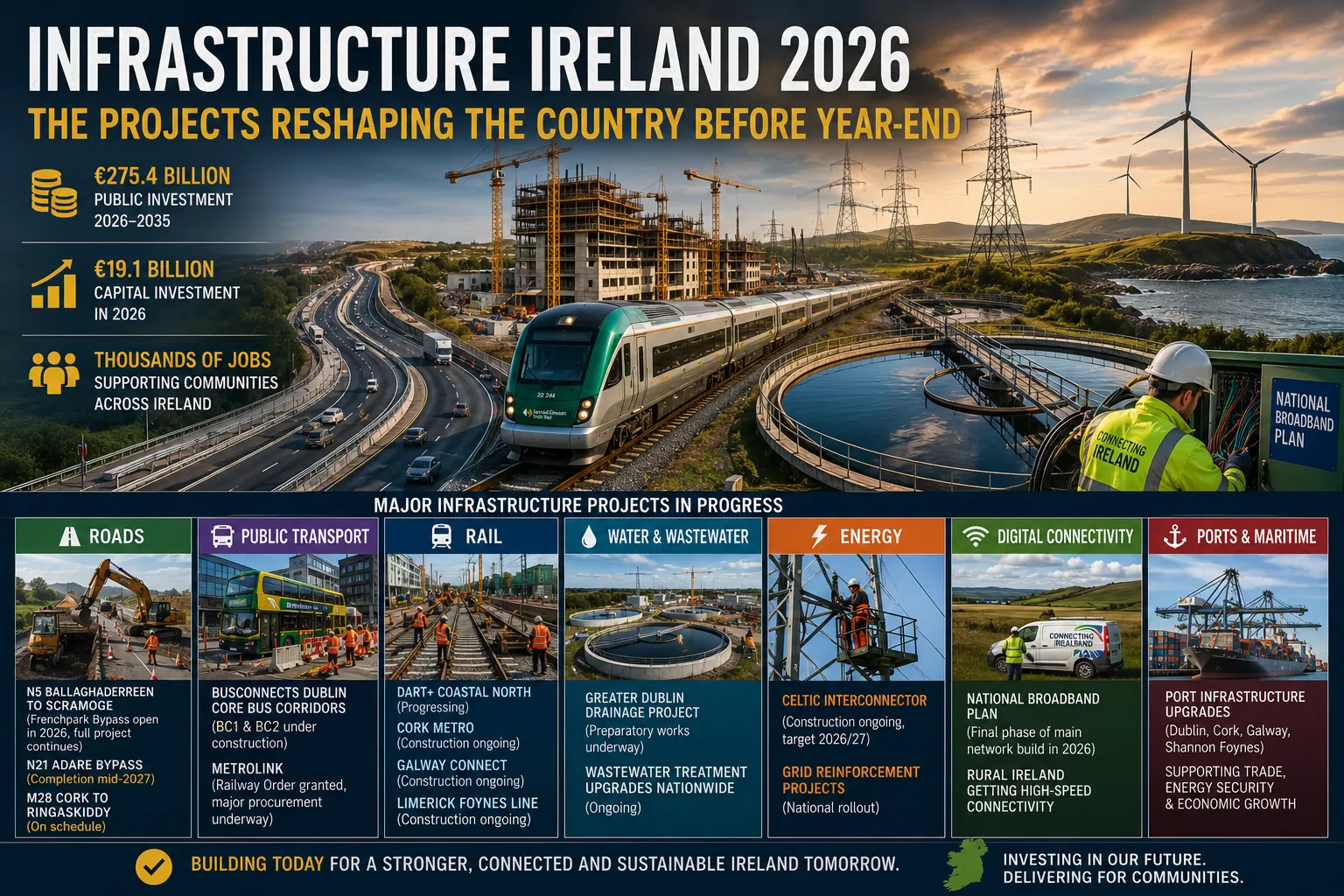
Ireland is building for a country considerably larger, busier and more economically demanding than the one for which much of its existing infrastructure was designed. Housing construction requires water and wastewater capacity. New industries and electrified transport require a stronger electricity grid. Population growth places additional pressure on roads and public transport. Rural businesses increasingly depend on high-capacity digital connections. Ports are becoming more important for freight, energy and Ireland’s links with continental Europe. Against that background, infrastructure has moved towards the centre of Ireland’s economic strategy. The revised National Development Plan provides for €275.4 billion of public capital investment between 2026 and 2035
, while Budget 2026 allocated €19.1 billion for capital investment this year alone , €2 billion more than in 2025. Transport has its own €24.3 billion sectoral investment programme covering 2026–2030. Yet the most important feature of 2026 is not simply the amount of money being allocated. It is the number of projects reaching different stages at the same time. Some are opening. Some are approaching completion. Others are entering construction. Several of Ireland’s largest future schemes are still in procurement, planning or preliminary works and will remain construction sites well beyond December. Understanding Ireland’s infrastructure programme therefore requires distinguishing between what will actually be completed in 2026 and what is merely taking an important step forward this year
.
2026 is increasingly a year of delivery rather than announcement
For years, much of Ireland’s infrastructure debate centred on projects that were planned, reconsidered, redesigned, delayed by approval processes or awaiting funding. That remains part of the picture, but 2026 looks different. Three major national road projects are under construction. Two of Dublin’s BusConnects Core Bus Corridors are now being built. MetroLink has moved into large-scale procurement after receiving its Railway Order. Major rail projects are under construction in Cork, Galway, Dublin and the west. Preparatory work is under way on the Greater Dublin Drainage Project. The Celtic Interconnector is deep into construction. The National Broadband Plan is approaching the end of its main network build. The result is a national infrastructure programme that is increasingly visible on the ground. But it is also becoming more interconnected. A housing development can depend on wastewater capacity. An electrified rail system needs grid capacity. New data centres, manufacturing facilities and homes place demands on the same electricity network. Transport construction competes for engineering and construction capacity with water, housing and energy projects. Infrastructure is therefore no longer simply a collection of individual schemes. It is becoming part of a larger question: can Ireland expand the basic systems supporting its population and economy quickly enough to match growth?
Roads: three major national projects are under construction
Ireland entered 2026 with three particularly significant national road schemes in construction: the N5 Ballaghaderreen to Scramoge project , the N21 Adare Bypass and the M28 Cork to Ringaskiddy . Transport Infrastructure Ireland told the Oireachtas Transport Committee in May that all three were on schedule.
N5 Ballaghaderreen to Scramoge
The N5 project in counties Roscommon and Mayo is one of the largest road developments currently under construction in the west. An important section opened during 2026 with the new bypass of Frenchpark, but the opening should not be confused with completion of the entire Ballaghaderreen-to-Scramoge scheme. The wider project continues in construction and is expected to be substantially completed after 2026. Its significance extends beyond journey times. Projects such as the N5 can change the role of the older road through towns and villages by moving a considerable share of through-traffic — particularly heavy goods vehicles — onto purpose-built national road infrastructure.
N21 Adare Bypass
Construction is also advancing on the N21 Adare Bypass in County Limerick . The project is particularly prominent because of Adare’s location on the principal route between Limerick and Kerry and because the village experiences substantial through-traffic. It will not, however, be finished this year. TII’s current programme gives July 2027 as the expected completion date. For the remainder of 2026, Adare will therefore remain a major construction project rather than become a newly completed road.
M28 Cork to Ringaskiddy
The third large national road construction project is the M28 Cork to Ringaskiddy . This is strategically important because Ringaskiddy is one of Ireland’s major port and industrial locations. Improving the connection between the N40 Cork South Ring Road and the port area is consequently not simply a commuter-road project: it concerns freight, industrial access and the longer-term development of Cork Harbour. TII confirmed in May that the M28 remained one of the country’s three major national road schemes under active construction. No responsible assessment of Ireland’s infrastructure programme should present all three road projects as 2026 completions. The more accurate description is that 2026 is a major construction year for all three
, while completion dates differ. Beyond the headline schemes, more than €1.5 billion in Exchequer funding was allocated to national, regional and local roads for 2026 , representing a 13 per cent increase on 2025. Much of this expenditure is less visible nationally but matters locally through resurfacing, rehabilitation, bridge work, safety improvements and regional-road upgrades.
Galway City Ring Road moves into a new phase
One of the most closely watched infrastructure proposals outside Dublin is the N6 Galway City Ring Road . An Coimisiún Pleanála approved the project in April 2026. In July, the Government designated both the Galway City Ring Road and MetroLink as Critical Infrastructure , a status intended to support more coordinated and accelerated delivery of strategically important projects. That is a significant development, but it does not mean the Galway ring road will be completed — or that the entire project necessarily enters main construction — before the end of 2026. Its 2026 significance is primarily that a project which spent years in the planning and legal process has moved further towards potential delivery. Elsewhere, TII expects projects including the N4 Carrick-on-Shannon Bypass, N21 Newcastle West Bypass and N72 Mallow Relief Road
to progress through earlier approval stages during 2026, while the planning application for the major Donegal TEN-T road improvement project was published in May. These are important pipeline projects, but they belong in a different category from roads already being built.
MetroLink: 2026 is the procurement year
Few infrastructure projects symbolise the changing scale of Dublin as clearly as MetroLink . The proposed high-capacity automated railway will connect Swords and Dublin Airport with the city, including underground sections through central Dublin. A decisive milestone arrived in January 2026 when the Railway Order became operative, giving the scheme its principal planning approval. Since then, MetroLink has moved into procurement for its major infrastructure packages. Heavy civil-engineering packages were launched first, followed by procurement covering railway systems, trains, depot infrastructure, station fit-out and long-term operation. Additional enabling and utilities packages have also entered the market during 2026. TII has acquired property required for the project and has continued preparations for works around locations including Dublin Airport. This makes MetroLink one of Ireland’s biggest infrastructure stories of 2026 — but an important distinction is necessary. 2026 is not the year MetroLink opens, nor should it be described as the year the entire main construction programme is completed.
Instead, it is the year in which the project is moving from planning approval towards contracting and delivery. The present programme places the start of major construction activity in the following phase rather than presenting 2026 as the project’s completion year. That transition matters. Infrastructure projects often attract the most public attention when tunnelling machines or major structures appear, but procurement, land acquisition, utility diversion, archaeology and enabling works determine whether those later stages can happen.
BusConnects is now becoming visible on Dublin’s streets
MetroLink may be the largest single public-transport project in the capital, but BusConnects is likely to affect a larger number of streets. All 12 planned Dublin Core Bus Corridor schemes have secured planning permission , and construction is under way on two: Liffey Valley to City Centre and Ballymun/Finglas to City Centre . The National Transport Authority said in July that procurement for a third corridor was expected to begin in the coming months. The eventual Dublin programme is intended to provide around 230 kilometres of bus-priority infrastructure and roughly 200 kilometres of cycling infrastructure across the capital. The Liffey Valley corridor was the first to enter construction. It extends for approximately 9.2 kilometres towards the city centre, with works expected to continue over several years rather than conclude in 2026. This illustrates an important reality of Ireland’s present infrastructure cycle: a project being “under construction in 2026” does not mean a resident should expect the finished network by Christmas
. For Dublin commuters, the remainder of 2026 is likely to mean a mixture of new infrastructure, altered traffic arrangements and construction disruption as BusConnects gradually changes from a planning programme into a physical network.
Rail: some of the clearest 2026 completions are outside Dublin
Ireland’s railway investment programme contains a mixture of relatively immediate projects and much larger schemes whose benefits will arrive later. One of the most visible achievements of the year has already occurred. On 10 August 2026 , the new Woodbrook DART Station opened between Bray and Shankill, serving the developing Woodbrook and Shanganagh areas. It became the 147th station on the Iarnród Éireann network. But some of the most consequential railway work taking place in 2026 is concentrated in Cork, Limerick and Galway.
Cork’s commuter railway is being rebuilt for higher capacity
The Cork Area Commuter Rail programme is one of the country’s largest regional public-transport investments. Its first phase combines the new Platform 6 at Kent Station — already completed — with double-tracking between Glounthaune and Midleton and a major signalling and communications upgrade across the Cork commuter network. The second track covers approximately 10 kilometres between Glounthaune and Midleton . Construction began in 2024 and the twin-tracking element is expected to be completed in late 2026. That is one of the more important pieces of infrastructure genuinely expected to reach completion this year. The entire first phase, however, will continue into 2027 because signalling works remain part of the broader programme. The distinction is important: the second track can be finished in 2026 without every element of the Cork rail transformation being complete.
Meanwhile, Cork is already preparing the next stage. Phase Two includes electrification, a new fleet depot and additional stations. Following public consultation during 2026, Iarnród Éireann expects to submit a Railway Order application for the next package by the end of the year. Planning has also progressed separately for stations at Blackpool and Dunkettle. For Cork, 2026 therefore combines something relatively unusual in Irish infrastructure: construction of today’s network and planning of tomorrow’s network happening simultaneously.
Limerick to Foynes: freight rail returns
Another strategically important project is the reopening of the Limerick-to-Foynes railway for freight . The line forms part of Ireland’s attempt to move more freight by rail and improve the connection between the national rail network and Shannon Foynes Port. Iarnród Éireann lists 2026 as the planned completion year for the railway project. Its importance is greater than the passenger numbers normally associated with rail investment because this is fundamentally a logistics project. Ports, roads and railways form one system for exporters. A functioning freight connection to Foynes could provide an alternative to moving every container or bulk load by road and may become more valuable if port activity expands in future.
Galway Ceannt Station heads towards completion
In Galway, the redevelopment of Ceannt Station is expected to be substantially complete in the fourth quarter of 2026 . The project increases the station from two platforms to five and provides a new southern entrance, improved passenger facilities, upgraded track and signalling infrastructure and better integration between rail and bus services. This is particularly significant in a city where improving public transport capacity has become closely connected with wider questions of housing, development and congestion. Work is also progressing at Oranmore Station , where a second platform, a passing loop and associated infrastructure are being delivered. That project is planned for completion in 2027 rather than by the end of this year.
DART+ is advancing — but the first new battery trains are now a 2027 story
The DART+ programme remains one of Ireland’s largest long-term transport investments, intended to expand electrified and battery-electric suburban rail far beyond today’s traditional DART area. During the remainder of 2026, Iarnród Éireann is carrying out charging-infrastructure work at Drogheda and enabling works on the Maynooth and M3 Parkway routes , alongside wider DART+ procurement and construction preparations. There is, however, an important timetable change for readers following the programme. Earlier schedules had suggested new battery-electric DART trains could enter passenger service sooner. The latest official position is that the new fleet will begin entering service in the first half of 2027
, with the first 65 battery-electric carriages expected from 2027 subject to testing and regulatory approval. That makes 2026 a testing, infrastructure and preparation year for the new trains rather than their principal passenger-service launch.
Active travel is becoming infrastructure in its own right
Irish infrastructure policy is also moving beyond the older idea that transport investment primarily means roads and railways. The 2026–2030 transport programme envisages substantial investment in walking, cycling and greenways. Major schemes identified for activity during 2026 include the Sustainable Transport Bridge in Waterford, Glanmire Urban Greenway in Cork City and the Ballybane and Castlepark cycle network in Galway . In March, another section of the Grand Canal Greenway between 12th Lock and Hazelhatch officially opened in South Dublin. Individually, these schemes are smaller than MetroLink or a motorway. Collectively, however, they reflect a structural change in how transport infrastructure is being planned: walking and cycling routes are increasingly being designed as parts of transport networks rather than primarily as recreational amenities.
Water infrastructure may be less visible — but it could determine where Ireland can grow
Some of Ireland’s most consequential infrastructure is underground. Housing construction can only expand where sufficient drinking-water supply, wastewater treatment and network capacity are available. For that reason, the national water programme is increasingly linked directly with housing policy. In July 2026, the Government approved a mechanism for €2 billion in additional capital investment in Uisce Éireann , explicitly linked to infrastructure required to support the planned delivery of 300,000 homes by 2030. One of the largest individual projects is the Greater Dublin Drainage Project
. Preparatory work is already taking place. Uisce Éireann says preliminary construction is scheduled to begin before the end of 2026 , with the main construction programme expected from 2028 and accelerated completion targeted for 2031. The project includes a new regional wastewater treatment facility at Clonshaugh, a major orbital sewer network, pumping infrastructure and a marine outfall. Its purpose is to provide additional wastewater capacity for north Dublin and adjoining growth areas. This is a useful example of why infrastructure announcements can easily be misunderstood. By December 2026, the Greater Dublin Drainage Project will not be a completed treatment system. But if its preliminary construction starts as scheduled, the year will still represent an important transition from years of planning and approval towards physical delivery. In Limerick, the Government also approved a major upgrade to the city’s wastewater treatment plant in January 2026, adding another substantial project to the national water-investment pipeline.
Electricity: Ireland is preparing the grid for a very different economy
Electricity infrastructure may become one of the defining constraints on Irish development over the next decade. More homes, electric vehicles, heat pumps, rail electrification, industrial facilities, data centres and renewable generation all place new demands on the system. EirGrid’s new strategy to 2030 provides an indication of the scale involved. Following an allocation of €18.9 billion for electricity-grid investment , the transmission operator says its programme contains 381 transmission projects . It expects electricity demand to more than double by 2050. Not every one of those projects is a giant new power line. The programme ranges from substations and reinforcement schemes to underground cables, renewable connections and international interconnection.
The Celtic Interconnector
The Celtic Interconnector between Ireland and France is the most internationally significant electricity project currently under construction. The approximately 575-kilometre connection , around 500 kilometres of it subsea, will allow up to 700 MW of electricity to move between the Irish and French systems — capacity equivalent to the electricity demand of roughly 450,000 homes. Construction has progressed substantially in east Cork. By June 2026, the final onshore cable installation at the landfall had been completed and cable testing had taken place, while offshore protection and burial work continued in Irish waters. The onshore programme is scheduled to make further substantial progress during 2026. But another distinction is essential: the Celtic Interconnector will not begin commercial operation this year
. Subsea cable manufacturing and installation delays have changed the schedule. EirGrid’s current project page gives Q4 2028 as the expected commissioning period. The project therefore demonstrates both the scale and the uncertainty inherent in modern infrastructure. Significant sections can be physically complete while another highly specialised component determines the overall opening date.
Powering Up Dublin
Dublin’s own grid is undergoing a major reinforcement programme under Powering Up Dublin . The wider programme involves approximately 50 kilometres of high-voltage underground cables , upgrades to substations and additional transmission infrastructure intended to reinforce electricity supply across the capital. During 2026, planning and survey work has continued on several sections. The Carrickmines-to-Poolbeg connection, for example, includes a proposed route partly across Dublin Bay; EirGrid was preparing a planning application for its onshore section during the summer while marine surveys continued. Again, this is not a single project scheduled to be finished by Christmas. It is a multi-year programme whose importance lies in increasing the electricity capacity available to a city simultaneously adding housing, transport electrification and commercial demand.
National Broadband Plan: one of the largest 2026 finish lines
If there is one national infrastructure programme particularly associated with an end-of-2026 target, it is the National Broadband Plan . By 29 July 2026 , National Broadband Ireland reported that more than 500,000 homes, farms and businesses had been passed by the new fibre network , while more than 183,000 premises were already connected to services. NBI expects the main infrastructure build — covering an Intervention Area that has grown to around 566,000 premises — to be completed by the end of 2026. Six counties had already reached their main-build completion milestones by late July: Kilkenny, Longford, Meath, Tipperary, Waterford and Westmeath. NBI expected another 11 counties to reach that stage by the end of October, with the remainder of the rollout continuing towards the national year-end target. There is an important distinction between a premises being passed
by fibre and being connected . Completing the main network means the infrastructure has reached the area and qualifying premises can order service. It does not mean every household or business will automatically become a broadband subscriber. Nevertheless, if the main rollout reaches completion as planned, it would make the National Broadband Plan one of the most substantial nationwide infrastructure programmes to cross its principal construction finish line in 2026. For rural Ireland in particular, its significance goes beyond faster streaming. High-capacity broadband increasingly affects remote work, farming technology, tourism, education, small businesses and the ability to locate economic activity outside the largest urban centres.
Ports: Rosslare enters another construction phase
Ireland’s infrastructure strategy is also shaped by its geography as an island. At Rosslare Europort , major works on the Berth 3 Upgrade , part of the Green Drift programme supporting the Rosslare–Dunkirk route, are expected to begin in the fourth quarter of 2026 . The wider Green Drift project is valued at €38.5 million and is co-funded by the European Union. Completion of the Rosslare works is expected in 2028. This means Rosslare becomes another example of a project for which late 2026 represents the beginning of major physical works rather than completion. Together with the reopening of the railway to Foynes, such investment also demonstrates how Ireland’s transport strategy increasingly connects roads and passenger transport with freight corridors and ports.
What Ireland should actually have by the end of 2026
If current programmes remain broadly on schedule, the infrastructure picture on 31 December 2026 should be noticeably different from the one at the beginning of the year. The clearest expected outcomes include the completion of the main National Broadband Plan network build , the completion or near-completion of the Glounthaune–Midleton second railway track , the planned completion of the Limerick–Foynes freight-rail project , and substantial completion of Galway Ceannt Station . Woodbrook DART Station has already opened. At the same time, construction should still be continuing on major road projects including the N5, N21 Adare Bypass and M28, while BusConnects construction advances through Dublin. MetroLink should be considerably further through procurement and enabling preparations, rather than physically finished. DART+ infrastructure work should be preparing the railway for battery-electric trains entering service from 2027. The Greater Dublin Drainage Project is scheduled to have entered preliminary construction, while major grid projects will remain in different stages of planning and construction. Rosslare’s Berth 3 upgrade is expected to have entered its major works phase. The result is not one dramatic national opening day. It is a much broader shift from planning towards simultaneous delivery across several infrastructure systems
.
Why building everything at once is difficult
Ireland’s infrastructure challenge is not simply to allocate more money. Large projects require engineers, construction workers, specialist equipment, planning capacity, land, utility coordination, environmental assessment, procurement expertise and functioning supply chains. Energy infrastructure must be coordinated with housing and industrial development. Rail construction often has to take place while trains continue to operate. Urban projects have to be built while roads, businesses and neighbourhoods remain accessible. Some schemes also require years between political approval and practical completion. MetroLink is an obvious example. Receiving planning approval does not immediately produce a railway. Contractors must be selected, land assembled, utilities diverted, sites prepared and tunnelling and station construction undertaken before railway systems can be installed and tested. The Celtic Interconnector demonstrates another form of risk: specialised marine engineering can determine the timetable of an international project even when substantial onshore works are progressing well. Water infrastructure presents similar dependencies. A treatment plant may unlock housing capacity, but the treatment facility, trunk network, pumping stations and local connections all have to work together. This is why measuring infrastructure policy simply by the number of announcements can be misleading. The more useful questions are: Has planning been secured? Has funding been committed? Has procurement begun? Is a contractor on site? What component will be operational, and when?
The regional picture is beginning to matter more
One of the more notable characteristics of the 2026 programme is that it is not exclusively a Dublin story. The capital dominates projects such as MetroLink, DART+, BusConnects, Greater Dublin Drainage and Powering Up Dublin because Dublin contains the country’s largest concentration of population and employment. But important infrastructure is simultaneously emerging elsewhere. Cork has the M28, commuter-rail double tracking, future rail electrification, active-travel investment and major energy infrastructure associated with the Celtic Interconnector. Limerick has the Adare Bypass, the Foynes freight railway and wastewater investment. Galway has Ceannt Station, Oranmore works, active-travel projects and the Galway City Ring Road moving through another significant stage. Waterford is seeing transport and rail-related investment, while the National Broadband Plan has a particularly strong impact on rural counties. The pattern is therefore increasingly one of different infrastructure priorities in different regions
, rather than simply reproducing the same investment model everywhere.
Infrastructure is becoming part of the housing equation
Perhaps the most important change in the Irish infrastructure debate is that infrastructure and housing can no longer realistically be considered separately. A planning permission for thousands of homes has limited practical value if there is insufficient wastewater capacity. Development land is less useful if the electricity grid cannot provide connections. Large residential areas become more difficult to sustain if transport capacity is added only after the population arrives. The Government’s decision to link additional Uisce Éireann investment directly to the ambition of delivering 300,000 homes by 2030 illustrates that changing approach. The same logic applies to MetroLink, DART+, BusConnects and regional rail investment. Transport infrastructure can influence where higher-density development becomes practical, while housing growth can in turn determine the economic case for expanding public transport. That relationship is likely to become even more important over the next decade.
What comes after 2026
Many of the projects dominating Ireland’s infrastructure landscape today will still be under construction long after this year ends. The Adare Bypass is scheduled into 2027. New battery-electric DART trains begin entering service in 2027. Cork’s wider commuter-rail programme continues beyond the completion of the Midleton second track. The Greater Dublin Drainage Project has main construction scheduled from 2028. Rosslare’s current berth upgrade runs towards 2028. The Celtic Interconnector is now expected to be commissioned in 2028. MetroLink is an even longer-term undertaking. Meanwhile, another generation of projects — Luas extensions, additional Cork stations, further DART+ electrification, new grid connections and regional road schemes — is progressing through the development pipeline. That makes 2026 less an endpoint than a transition.
Ireland’s infrastructure test is moving from ambition to execution
For much of the past decade, Ireland’s economic and population growth exposed a widening gap between demand and the capacity of infrastructure originally built for a smaller country. The response now taking shape is substantial. A €275.4 billion National Development Plan does not guarantee that every project will arrive on time, on budget or exactly as originally designed. Nor can expenditure alone solve bottlenecks created by planning, engineering complexity, construction capacity or coordination between different networks. But by the end of 2026, the most meaningful measure of progress will not be the size of another announcement. It will be what has physically changed. Fibre should have reached the final phase of the National Broadband Plan. Cork should have substantially more railway infrastructure. Freight rail should be returning to Foynes. Galway should have a transformed central station. BusConnects should be increasingly visible on Dublin streets. Major roads should be further advanced. MetroLink should have moved deeper into procurement. Water and electricity projects that will determine where Ireland can build and grow in the 2030s should be moving closer to construction or already on site. Ireland is unlikely to finish its infrastructure challenge in 2026. What this year may ultimately represent is something more important: the point at which a growing number of projects stopped being principally plans for Ireland’s future and began becoming the physical infrastructure on which that future will depend.
Source & Transparency
This article is published by Ireland Newspaper for editorial and informational purposes.
Published: 12 August 2026 · Updated: 14 August 2026

Newsroom Ireland Newspaper
Ireland Newspaper editorial team prepares daily news coverage for readers in Ireland and abroad.