
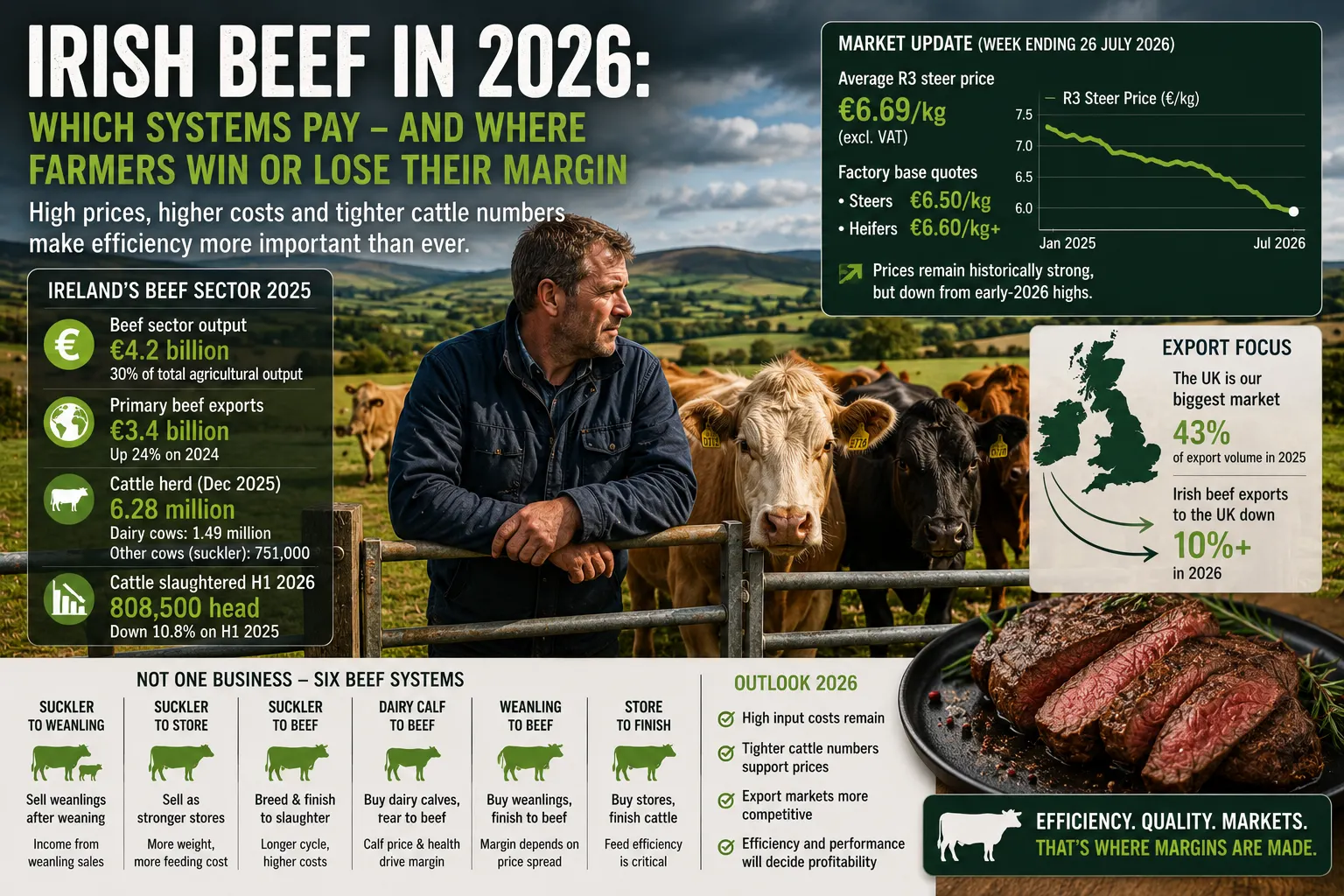
Ireland’s beef sector enters the second half of 2026 in an unusual position. Beef has rarely been worth more at farm gate, yet few experienced farmers would describe the business as straightforwardly easy. Irish agricultural output from the beef sector was worth approximately €4.2 billion in 2025 , representing around 30% of total agricultural output, while more than 90% of production is export-oriented. Primary beef exports exceeded €3.4 billion in 2025 , up 24% in value from the previous year. But 2025’s exceptional prices have not continued unchanged. Irish cattle prices rose by an average of 39% during 2025 before coming under considerable pressure in the first half of 2026. Teagasc reported in July that prices had fallen by almost €0.70/kg from the beginning of the year and by more than €1/kg compared with the previous summer. More recently, Bord Bia’s latest published weekly market data available in August showed the average
R3 steer price at €6.69/kg excluding VAT for the week ending 26 July. Factory base quotes were around €6.50/kg for steers and starting around €6.60/kg for heifers. These remain historically high prices. Yet profitability is determined not by the selling price alone. It is the difference between
what an animal costs to produce or buy and what it ultimately returns . And that calculation differs enormously between beef systems.
Ireland’s beef herd is changing
The structure of Irish beef production has gradually shifted. Ireland had 6.28 million cattle in December 2025 . Dairy cow numbers stood at around 1.49 million, while the number of other cows — predominantly the suckler breeding herd — had fallen to approximately 751,000. The consequences are increasingly visible at the factory. Dairy-bred cattle now account for the majority of Irish beef production. Teagasc estimates that
62% of cattle processed for beef in 2025 came from the dairy herd , leaving suckler-bred cattle accounting for approximately 38% of prime beef production. At the same time, cattle availability has tightened. CSO figures show 808,500 cattle slaughtered during the first six months of 2026 , 10.8% fewer than during the corresponding period in 2025. Tighter cattle numbers provide some support to prices. But Ireland is also exposed to international markets. In 2025, the UK accounted for 43% of Irish beef export volume. During 2026 Irish beef exports to Britain have fallen by more than 10%, with increased competition from countries including Australia and New Zealand affecting parts of the British market. That combination — limited cattle supply at home but more competitive export markets abroad — helps explain why 2026 has produced both historically good prices and considerable volatility.
Beef farming is actually several businesses
Before comparing profitability, the terminology matters.
Irish Beef Production Systems at a Glance
| Beef system | What the farmer does | Main income event | Principal financial risk |
|---|---|---|---|
| Suckler-to-weanling | Keeps breeding cows, produces calves and sells them after weaning | Sale of weanling | Fertility, calf performance and weanling price |
| Suckler-to-store | Retains calves beyond weaning before selling as stronger stores | Sale of store cattle | Additional winter/grass cost versus extra sale value |
| Suckler-to-beef | Breeds calves and retains them through to slaughter | Factory sale | Long capital cycle, feed cost and beef price |
| Dairy calf-to-beef | Buys dairy-bred calves and rears them to slaughter | Factory sale | Calf quality, mortality/health, purchase price and long cash cycle |
| Weanling-to-beef | Buys weanlings and finishes them | Factory sale | Purchase price versus future beef price |
| Store-to-finish | Buys older cattle close to finishing | Factory sale | Very sensitive to purchase price, feed cost and short-term factory price |
| Young bull beef | Finishes males intensively, commonly under 16 months | Factory sale | Concentrate price and processor specifications |
| Steer beef | Finishes castrated males, commonly using more grazing | Factory sale | Longer production period and wintering costs |
| Heifer beef | Finishes females not retained for breeding | Factory sale | Generally lighter carcasses and purchase/genetic quality |
No one system is automatically the most profitable. The answer depends on land quality, grass production, housing capacity, labour, borrowing requirements, technical skill and the price at which cattle enter and leave the farm.
The broader profitability picture in 2026
The extraordinary improvement in cattle prices transformed farm incomes in 2025. Teagasc’s National Farm Survey found that average Cattle Rearing family farm income — the category dominated by suckler enterprises — increased 74% to €24,061 in 2025 . Average income on Cattle Other farms , which include store and finishing enterprises, increased 81% to €32,798 . The latest 2026 outlook is considerably more cautious. Teagasc now forecasts:
2025 Beef Farm Income and the 2026 Forecast
| Farm category | 2025 average family farm income | 2026 forecast | Change |
|---|---|---|---|
| Cattle Rearing / mainly suckler | €24,061 | €19,000 | −21% |
| Cattle Other / mainly store & finishing | €32,798 | €21,000 | −36% |
These income figures include support payments , an important qualification when assessing the commercial profitability of beef production itself. The forecast also demonstrates how quickly conditions have changed. Teagasc expects average finished-cattle prices across 2026 to be around 8% below 2025 and average weanling prices around 10% lower, while production costs are increasing. The industry has therefore moved from the exceptional profitability of 2025 into a still relatively valuable but much less forgiving market.
1. Suckler-to-weanling: produce the calf and let someone else finish it
The suckler-to-weanling system is conceptually simple. The farmer maintains a breeding cow, produces one calf, rears it through the grazing season and sells it after weaning. The farmer does not carry that calf through another one or two winters to slaughter. That reduces exposure to future factory prices and limits the amount of additional capital locked into finishing stock. But keeping the cow is expensive. Teagasc’s 2026 modelling estimates the annual cost of maintaining a suckler cow-and-calf unit in a calf-to-weaning system at approximately
€995 , excluding land and labour. Of that: €525 is feed, €219 fixed costs, €135 depreciation, and €116 veterinary and breeding costs. That means a cow that fails to produce a valuable calf is extraordinarily expensive. A productive suckler cow is therefore not merely an animal that becomes pregnant. She needs to calve regularly, calve without excessive intervention, rear a heavy calf, remain fertile and do so from a relatively modest feed requirement.
The economics of selling weanlings
Under Teagasc’s 2026 model assumptions, a calf-to-weanling system generated a net margin of €1,344 per hectare , excluding land and labour charges. Where the farmer achieved a weanling price corresponding to the top 25% of the assumed market, the modeled margin increased to €1,606/ha . Data from actual Future Beef demonstration farms tell a broadly similar story. In 2025, farms selling calves as weanlings or stores recorded an average net margin of €1,066/ha excluding direct payments . The attraction of the system is therefore clear when weanling prices are strong. The farmer sells the animal before incurring the cost of another winter and before taking the risk of what factory prices may be 12 or 18 months later.
The weakness
A suckler cow consumes resources for an entire year to produce essentially one marketable calf. Poor fertility is consequently devastating to profitability. A farmer with 50 cows but only 42 saleable calves does not have the economics of a genuine 50-cow productive herd. Age at first calving matters for the same reason. Teagasc calculates that delaying a replacement heifer’s first calving beyond two years can cost approximately
€54 per heifer for every additional month she remains unproductive in a typical 50-cow herd scenario. For suckler farming, reproduction is not separate from economics. Reproductive efficiency is economics.
2. Suckler-to-beef: capturing the full value of the animal
The alternative is to retain the calf all the way to slaughter. The obvious advantage is that the farmer captures the value created after weaning rather than handing that stage of production to somebody else. The disadvantage is equally obvious. The animal continues consuming grass, silage, housing, veterinary resources and working capital. A spring-born steer may remain on the farm for two years or more. The farmer who could have received cash for a weanling this autumn instead waits another year or longer for the final cheque.
Is finishing your own suckler calves more profitable?
Not necessarily. Teagasc modeled three suckler steer systems finishing males at approximately 20, 23 and 27 months, with heifers finished at 19 months. The resulting net margins per hectare were remarkably similar:
Modelled Net Margins Across Selected Suckler Systems
| Suckler system | Modelled net margin |
|---|---|
| Sell weanlings | €1,344/ha |
| 20-month steer | €1,152/ha |
| 23-month steer | €1,140/ha |
| 27-month steer | €1,141/ha |
Under those particular price and production assumptions, selling the weanling was more profitable per hectare than finishing the steer . Actual Future Beef monitoring in 2025 also showed an average net margin of €606/ha excluding direct payments among farms finishing their male progeny as steers, compared with €1,066 for the weanling/store group. That does not establish that selling weanlings will always beat finishing. It demonstrates something more useful: the extra sale value of a finished animal is not profit unless it exceeds the entire additional cost of retaining that animal.
3. Under-16-month bull beef: potentially high output — and high sensitivity
Young bull production changes the calculation. Rather than castrating the male and producing a steer over a longer grass-based cycle, the farmer exploits the bull’s growth potential and finishes at a younger age. Under Teagasc’s current model, the 16-month bull system produced a net margin of €1,509/ha , higher than the three modeled steer systems. Future Beef farms producing young bulls recorded an average €1,068/ha net margin excluding direct payments in 2025 . On paper, the attraction is obvious. More growth is achieved in less time and expensive farm resources are not tied up in the animal for as long. But bull beef carries an important trade-off.
Bulls eat considerably more concentrate
Teagasc estimates that an under-16-month bull can consume approximately 1.8 to 2 tonnes of concentrate . That makes the system extremely sensitive to meal prices. Its April 2026 analysis estimated that a €20–€40/t increase in concentrate price would require approximately another 16–18 cent/kg in beef price to compensate in an under-16-month bull system. The farmer is effectively substituting expensive concentrate for time. When concentrate is relatively cheap and beef prices are strong, that can work extremely well. When meal prices rise or factory prices fall, the margin can disappear quickly.
Market access also matters
Teagasc specifically advises farmers considering young bull production to have an arrangement with the processor because factory demand and specifications for bulls can differ from those applying to steers and heifers. This is therefore not simply an animal-performance decision. It is a production-and-marketing system .
4. Dairy calf-to-beef: increasingly central to Ireland’s beef industry
The largest structural change in Irish beef production has come from the dairy herd. Dairy-beef animals now account for approximately 62% of cattle processed , reflecting the expansion of the dairy herd and the number of dairy and beef-cross calves available for beef production. For the beef farmer, the dairy calf-to-beef system eliminates the cost of maintaining a breeding cow. Instead, the farmer purchases a calf — often at three to six weeks of age — and assumes responsibility for rearing and finishing it. Economically, that is an enormous difference. The farmer buys the raw material rather than maintaining the mother that produces it.
The potential returns can be very strong
The 2025 results from Teagasc’s DairyBeef 500 demonstration farms were exceptional. Average net margin reached:
and importantly, that figure excluded subsidies and direct payments . The top third of farms achieved €2,246/ha , while even the bottom third achieved €666/ha. But these are high-performing demonstration farms, not a forecast that every Irish dairy-beef enterprise will earn €1,465/ha. The gap between the top and bottom groups is itself the more important lesson. Top-performing farms produced more output per livestock unit, carried greater stocking rates and generated liveweight at a lower variable cost. Their variable cost was €1.38/kg of liveweight produced compared with €1.62/kg in the bottom group. Management created a difference of
€1,580 per hectare between the top and bottom thirds. That is larger than many changes in cattle price.
The problem with dairy-beef: the calf can be cheap for a reason
A low calf purchase price does not necessarily mean a cheap animal. A poorly bred calf may ultimately: grow more slowly, finish later, produce a lighter carcass, grade worse, consume feed for longer, or fail to meet processor specifications. The true purchase price is therefore not the amount paid in the mart. It is the amount paid plus the economic consequences of the genetics purchased . This is one of the areas where Irish beef production has changed most significantly.
Angus, Hereford or Continental? Breed alone no longer tells enough
Beef cattle from the dairy herd broadly include early-maturing traditional breeds such as Angus and Hereford , continental breeds such as Charolais, Limousin, Belgian Blue, Aubrac and Simmental , and straight dairy-bred animals. The traditional and continental groups have different biological characteristics. Recent ICBF analysis of more than 87,000 dairy-beef cattle confirmed that Angus-sired animals tend to finish earlier , while continental-sired animals generally produce heavier carcasses with better conformation . That sounds like a simple breed decision. It is not. There can be enormous variation
within the same breed .
Commercial Beef Value may matter more than the breed name
ICBF’s Commercial Beef Value, or CBV , estimates the expected beef profitability of an individual animal based on its genetics. In a 2026 analysis of 87,323 spring-born dairy-beef steers and heifers, five-star CBV cattle produced carcasses worth €113 more than one-star cattle and were finished 13 days earlier . They also produced carcasses averaging 14kg heavier and were more likely to meet factory weight and conformation specifications. The finding applied across the main sire breeds. That leads to an increasingly important purchasing rule for dairy-beef farmers:
Do not buy an Angus merely because it is Angus, or a Limousin merely because it is Limousin. Buy the right animal within the breed. A high-CBV Angus can be economically very different from a low-CBV Angus. The same applies to Hereford, Limousin, Charolais and the other breeds.
Traditional breeds: Angus and Hereford
Angus and Hereford have several features attractive to pasture-based finishing systems. They tend to mature earlier, making it possible for suitable animals to finish relatively young and with good fat cover. Teagasc has shown that a proportion of early-maturing animals can be slaughtered at the end of their second grazing season. Breed-specific processor bonuses can also be available through qualifying schemes, though the amount and conditions depend on the buyer and market programme and should never be assumed when purchasing cattle. The trade-off is carcass size. Poorer-genetic early-maturing animals, particularly heifers, can produce relatively light carcasses. For a farmer buying calves, that creates a simple danger:
paying a large breed premium for an animal that never grows enough beef to repay it. High CBV helps distinguish animals carrying better carcass potential from those carrying little more than a breed label.
Continental cattle: Charolais, Limousin, Belgian Blue and others
Continental cattle generally offer greater carcass growth and conformation potential. That makes them attractive where the farm has sufficient grass, feed and management to convert that genetic potential into saleable carcass weight. ICBF’s large 2026 dataset found continental-sired dairy-beef cattle generally achieved heavier and better-conformed carcasses than traditional breeds. For suckler herds, continental breeding remains particularly important because the cow itself can supply milk and maternal performance while terminal sires add growth and carcass characteristics. But a bigger animal is not automatically a more profitable animal. If the farmer has to feed expensive concentrates for several additional months to create the extra carcass weight, the financial advantage can narrow substantially. The correct question is therefore:
How much extra carcass value does the animal produce for every additional euro of feed and time?
5. Weanling-to-beef: potentially very profitable, but highly exposed to the buying price
A specialist finisher avoids the cost of keeping suckler cows and the labour of rearing very young calves. Instead, cattle are purchased as weanlings and retained to slaughter. The system can generate high output per hectare. But it has one major weakness: the farmer buys today’s cattle price and sells into tomorrow’s beef price.
No farmer knows that future price with certainty. Teagasc modelled the impact using high and low weanling and beef prices observed during the highly volatile 2024–2026 period. The results are striking. For one of the modeled weanling-to-beef systems, net margin ranged from:
+€3,678/ha
when beef was expensive and weanlings relatively cheap, to:
−€2,141/ha
when weanlings were expensive and beef was cheap. Other weanling-to-beef models also moved from margins above €2,000/ha to losses exceeding €1,000/ha depending on the relationship between purchase and sale prices. The animal did not necessarily perform badly. The farmer may simply have paid too much for it . This is perhaps the single most important concept in cattle finishing. A good animal can still be a bad investment at the wrong price.
6. Store-to-finish: shorter cycle, but the buying decision becomes even more important
A store finisher buys older cattle, often relatively close to slaughter. This reduces the length of time capital is tied up. The farm does not carry a breeding cow. It does not rear the calf. And it may capture liveweight relatively cheaply from a grazing season before finishing. But because a forward store is already valuable when purchased, the initial cheque can be substantial. The margin may therefore depend on only a few hundred euro between purchase and slaughter. If the animal is bought too dear, there is relatively little biological growth remaining with which to repair the mistake. The key calculation should be made
before the animal is purchased : expected purchase price
- grazing cost
- winter feed
- concentrate
- veterinary costs
- transport and mart costs
- fixed cost allocation
- financing cost
= total expected cost
That total should then be compared with the expected sale value, based on realistic carcass weight and factory price:
- likely bonuses
= expected sale value
If the required beef price to generate a margin appears unrealistic, the cattle are too expensive for that system. Teagasc now publishes dedicated beef budgets precisely for this purpose, including forward-store steer and heifer, continental weanling, dairy runner and young-bull systems.
The most important feed on an Irish beef farm costs the least
Much of Ireland’s comparative advantage in beef comes from one resource: grass. Teagasc’s 2026 calculations estimate feed costs at approximately:
Estimated 2026 Feed Costs
| Feed | Estimated 2026 cost per kg dry matter |
|---|---|
| Grazed grass | €0.12 |
| Grass silage | €0.20 |
| Concentrates | €0.41 |
That table explains much of beef-farm profitability in three numbers. A kilogram of dry matter supplied as concentrates costs more than three times as much as a kilogram supplied from grazed grass under those estimates. Teagasc calculates that feed provision accounts for approximately 75% of direct beef production costs . The farmer who can grow and utilise more high-quality grass therefore has a structural advantage. This is why paddock systems, soil fertility, grazing infrastructure, drainage, clover and an extended grazing season are not simply agronomic interests. They directly affect the cost of producing each kilogram of beef.
Cheap grass is valuable only if the cattle grow
Putting cattle into a field does not automatically create low-cost production. The grass has to be of sufficient quality, the stocking rate appropriate and animal growth monitored. A farm carrying animals cheaply but failing to achieve target liveweight gain can lose more through delayed finishing than it saves on purchased feed. In 2025, the national average finishing age for prime beef cattle was approximately 26.5 months . Ireland’s wider policy direction is to reduce average finishing age by around three months relative to 2018 by 2030. Earlier finishing has a financial logic as well as an environmental one. Every additional month means: another month of maintenance feed, another month of housing or grazing capacity, another month of capital tied up, and another month during which the animal can become sick, injured or exposed to market changes. But finishing too early with an underweight carcass can also destroy value. The target is not simply “young cattle”. It is
cattle reaching an economically valuable carcass specification at a younger age .
Steer, heifer or bull: the finishing system changes the economics
Steers remain the dominant Irish prime-beef category. In 2025, approximately: 51% of prime cattle were steers, 40% were heifers, and 9% were young bulls. Each has a different economic role.
Steers
Steers suit Ireland’s grass-based system well. They can utilise multiple grazing seasons and are accepted widely by processors. The cost is time. A later-finished steer can require an additional winter compared with more intensive systems.
Heifers
Heifers generally reach physiological maturity and adequate fat cover earlier than steers. That can make them suitable for earlier finishing. But carcasses are usually lighter, meaning genetics and purchase price remain critical.
Young bulls
Young bulls can achieve exceptional growth and high carcass output quickly. They potentially create the highest margin per hectare in efficient systems. But they require considerably more concentrate and tighter marketing arrangements. A useful way to think about the systems is: Steers trade time for grass. Bulls trade concentrate for time. Heifers trade carcass weight for earlier maturity.
The most profitable option depends on which of those resources is cheapest and most available on the individual farm.
A 10 cent movement in beef price matters more than it sounds
Current beef prices are expressed per kilogram, which can make market movements sound small. They are not. At Bord Bia’s latest reported average R3 steer price of €6.69/kg , a 350kg carcass is worth approximately:
A movement of only 10 cent/kg changes the value by €35 per animal. A 30 cent movement changes it by €105. Across 100 finished cattle, the difference becomes €10,500 . Teagasc’s analysis of winter finishing produces a similar result: in a steer system, a 10 cent/kg reduction in beef price can reduce the return by around €40/head or more . This is why beef finishing can move from attractive to unprofitable without any dramatic change occurring on the farm itself. The farmer may grow exactly the same amount of grass and produce exactly the same carcass. The market price simply changes.
Direct payments remain economically important
Beef profitability also cannot be assessed accurately without recognising farm-support payments. Teagasc’s latest 2026 family farm income forecasts explicitly include support payments. For suckler farmers, the Suckler Carbon Efficiency Programme provides €150 per eligible cow on the first 22 cows and €120 on subsequent eligible cows, subject to programme requirements. Dairy-beef farmers can also access targeted measures. The CAP Dairy Beef Welfare Scheme provides
€20 per eligible calf up to 50 calves for qualifying active participants, while the 2026 National Dairy Beef Weighing Scheme provides €20 per eligible calf where its conditions are met. Farmers may additionally receive broader CAP payments depending on eligibility and farm circumstances. These payments matter particularly in drystock systems because historically the commercial margin from cattle alone has often been modest. That makes it important to separate three figures when comparing farms: gross margin, net enterprise margin, and total family farm income including direct payments.
They are not interchangeable.
Why apparently similar farms make completely different profits
The national averages conceal enormous differences between farms. In Teagasc’s analysis of 2025 performance, the top third of suckler farms achieved €1,579/ha , while the bottom third returned only €223/ha. For other beef farms, the top third achieved €1,132/ha , while the bottom third recorded a loss of €80/ha . All of these farmers operated during the same exceptionally strong cattle-price year. The market was not enough to make every farm profitable. The differences came from factors such as: stocking rate, animal performance, purchase price, grass utilisation, feed cost, fertility, carcass output, fixed costs, finishing age, and timing of sale. This is perhaps the most useful conclusion from the 2025 boom.
High beef prices reward efficiency. They do not replace it.
Which system is economically strongest?
There is no honest national ranking from first to last because the answer changes with the farm. But the current evidence allows some broad conclusions.
Which Beef Systems May Fit Different Farm Situations
| Farm situation | System with potential fit | Why | Main danger |
|---|---|---|---|
| Strong suckler genetics, good breeding management | Suckler-to-weanling | Captures strong calf value without finishing risk | Keeping an expensive cow that fails to produce a high-value calf |
| Productive grassland and strong suckler herd | Suckler-to-beef | Captures full animal value | Long capital cycle and extra winter/feed costs |
| Excellent grassland, calf-rearing skills and high stocking capacity | Dairy calf-to-beef | High potential output and margin per hectare | Calf quality, health and expensive purchase prices |
| Farmer with market discipline and working capital | Weanling/store finishing | No breeding-cow overhead and flexible cattle numbers | Paying too much for cattle |
| Strong housing/feed system and processor relationship | Under-16-month bull beef | High output and early finish | Concentrate and beef-price volatility |
| Lower-input grass-focused finishing farm | Steer system | Maximises use of grazed pasture | Carrying animals too long and through extra winters |
| Farms seeking earlier turnover | Heifer finishing | Earlier maturity | Insufficient carcass weight/value |
These are not prescriptions. A system only works if it matches the physical and financial resources of the farm.
The strongest current case: dairy-beef — with an important warning
If profitability is measured strictly in euros per hectare , the results from highly efficient DairyBeef 500 farms are difficult to ignore. An average net margin of €1,465/ha excluding direct payments in 2025 demonstrates what well-managed dairy-beef can achieve. But it would be dangerous to conclude from this that every suckler farmer should sell their cows and buy dairy calves. Dairy-beef requires: high grass utilisation, sufficient stocking capacity, excellent calf health management, reliable sources of genetically suitable calves, working capital, and the ability to carry cattle for a long period before they generate income. The system also faces a specific 2026 problem:
calves became more expensive following the exceptional beef market of 2025 . Teagasc has identified higher calf purchase prices as one of the main concerns for dairy-beef producers in 2026. Today’s expensive calf has to be sold into tomorrow’s unknown beef market. Exactly the same price-spread risk that affects a store finisher begins at a much younger age.
The strongest risk-adjusted case may sometimes be selling the weanling
Teagasc’s price-volatility modelling produced another interesting result. Weanling-to-beef systems generated the highest potential margins , but also enormous potential losses when expensive weanlings were followed by lower beef prices. The suckler-to-weanling system produced a lower maximum return, but its margin varied much less across the modeled market combinations. That distinction is important. The economically “best” enterprise is not necessarily the one capable of generating the highest profit during ideal conditions. A farmer may rationally prefer: a slightly lower expected return, less borrowed working capital, lower price exposure, less housing demand, and more predictable annual cash flow. Profitability must therefore be considered alongside
risk .
Labour must also be counted
A particularly important cost is often absent from farm profit discussions: the farmer’s own time. Teagasc’s beef-system models frequently specify that land and family labour charges are excluded. That is necessary for technical comparison, but a farmer making a real-life business decision cannot ignore either. A system generating €800/ha while requiring substantial daily labour may provide a poorer return on the farmer’s time than another enterprise producing €600/ha with far fewer working hours. This matters increasingly because off-farm employment is common. A Teagasc survey conducted among beef farmers in May 2026 found 63% of respondents had an off-farm job. Teagasc notes that national rates are lower but still substantial — approximately 47% among suckler farmers and 55% among non-suckler beef farmers. For a part-time farmer, the most profitable theoretical system may therefore be impossible to operate well. A slightly less intensive system that can be managed consistently may ultimately produce more real household income.
What farmers should calculate before changing system
The strongest lesson from the current market is that a beef enterprise should be budgeted before cattle are bought, cows are bred or additional stock numbers are committed . The farmer needs to know: Cost per cow: What does maintaining each suckler cow actually cost? Calves per cow: How many genuinely saleable calves are produced per 100 cows? Purchase price: What is being paid for each calf, weanling or store?
Grass output: How much low-cost grazed grass can the farm actually utilise? Winter cost: Will the system require one winter or two? Concentrate requirement: Is extra performance being purchased with expensive meal? Finishing age: How long is capital tied up?
Carcass weight: What does the animal realistically produce rather than what its breed theoretically can produce? Factory specification: Is there a reliable market for that animal? Break-even beef price: What €/kg is required simply to recover costs? Labour: How many hours does the system consume?
Working capital: Can the business finance the animals until the eventual sale? Those numbers identify the correct production system more reliably than tradition.
What the market is telling farmers in August 2026
Ireland’s beef market remains valuable, but 2026 has delivered a reminder of how quickly conditions can change. Record 2025 prices encouraged higher valuations throughout the cattle chain. Weanlings became expensive. Calves became expensive. Stores became expensive. Then finished beef prices fell. That combination particularly affects the farmer who bought expensive cattle in expectation that extremely high factory prices would continue. The latest Bord Bia figures do show some strengthening from the weaker levels seen in late spring, with average R3 steer prices reaching €6.69/kg by the week ending 26 July. Irish R3 steer prices were then €0.37/kg above the comparable EU benchmark but still €0.45/kg below the UK price. Meanwhile, cattle supplies remain tight and the European herd continues to contract, providing an important element of support to the medium-term market. But international competition, consumer demand and input costs mean that no farmer can safely budget on another 2025-style price surge.
The future of Irish beef is likely to be more technically demanding
The direction of the industry is becoming clearer. There will probably be fewer cattle available than during the peak years of the national herd. A greater proportion of beef will come from dairy-bred animals. Genetic information such as Commercial Beef Value will become increasingly important when cattle are purchased. Finishing age will come under greater economic and environmental scrutiny. And farms capable of converting grazed grass efficiently into carcass weight should retain a strong competitive advantage. The economics increasingly favour
measurement rather than assumption . Weigh cattle. Calculate daily liveweight gain. Know silage quality. Know feed cost. Know purchase cost. Know break-even factory price. Know whether a cow is producing enough calf weight to justify remaining in the herd. And know what a purchased calf is genetically capable of producing before paying a premium for it.
Irish beef can be profitable — but the margin is made long before slaughter
The most important misconception about beef farming is that profitability is decided when the factory announces its weekly quote. By that stage, most of the economic decisions have already been made. The cow was selected years earlier. The bull was chosen months before the calf was born. The calf was either bred or purchased. The weanling was bought at a particular price. Grass was either utilised or wasted. Silage was made well or badly. The animal was either kept growing or allowed to stall. Concentrate was fed efficiently or unnecessarily. And the farmer decided how long the animal would occupy land, housing and capital. The factory price determines how much those decisions are ultimately worth. It does not create the underlying efficiency. For Irish farmers in 2026, that distinction matters more than ever.
Suckler-to-weanling can provide relatively resilient margins where reproductive performance and calf quality are strong. Suckler-to-beef captures additional value but requires more time and feed. Dairy-beef can generate exceptional output per hectare on efficient farms, but calf selection and purchase price are critical. Store finishing provides flexibility but exposes the farmer directly to the price spread between buying and selling. Young bulls can produce high margins and rapid turnover, but concentrate costs and processor access make the system particularly sensitive.
There is therefore no single “most profitable Irish beef animal”. There is only an animal purchased or produced at the right cost, grown efficiently on the resources available to the farm and sold into the right market at the right time. In a sector where a movement of only 10 cent per kilogram can shift tens of euro per animal — and where differences in management can alter net margin by more than €1,000 per hectare — profit is increasingly being determined not by how many cattle a farmer owns, but by how efficiently every hectare, every tonne of feed and every day of an animal’s life is converted into saleable beef.
Source & Transparency
This article is published by Ireland Newspaper for editorial and informational purposes.
Published: 13 August 2026 · Updated: 14 August 2026

Newsroom Ireland Newspaper
Ireland Newspaper editorial team prepares daily news coverage for readers in Ireland and abroad.