Insurance Guide Ireland 2026: Which Policies You Really Need — and Which Ones You May Be Able to Do Without
Irish consumers can insure almost everything from a house and car to a mobile phone, pet or holiday. But buying every available policy is neither necessary nor financially sensible. The better approach is to protect the risks that could seriously damage a household’s finances, understand which insurance is legally or contractually required, and avoid paying twice for cover already provided elsewhere.
Insurance works best when it protects against a loss that would be difficult or impossible for a household to absorb from ordinary savings. A broken €300 phone is inconvenient. A €300,000 house fire, the death of a family’s main earner or several years without employment income can fundamentally change a household’s financial position.
That distinction is the starting point for a sensible insurance strategy. Irish consumers do not need every policy offered to them, and most personal insurance products are voluntary. Motor insurance is different: anyone driving in Ireland must have at least third-party cover. Mortgage holders also face particular requirements around mortgage protection and buildings insurance. Beyond those areas, the question is usually not whether insurance is compulsory, but whether the financial risk is large enough to justify paying a premium to transfer it to an insurer.
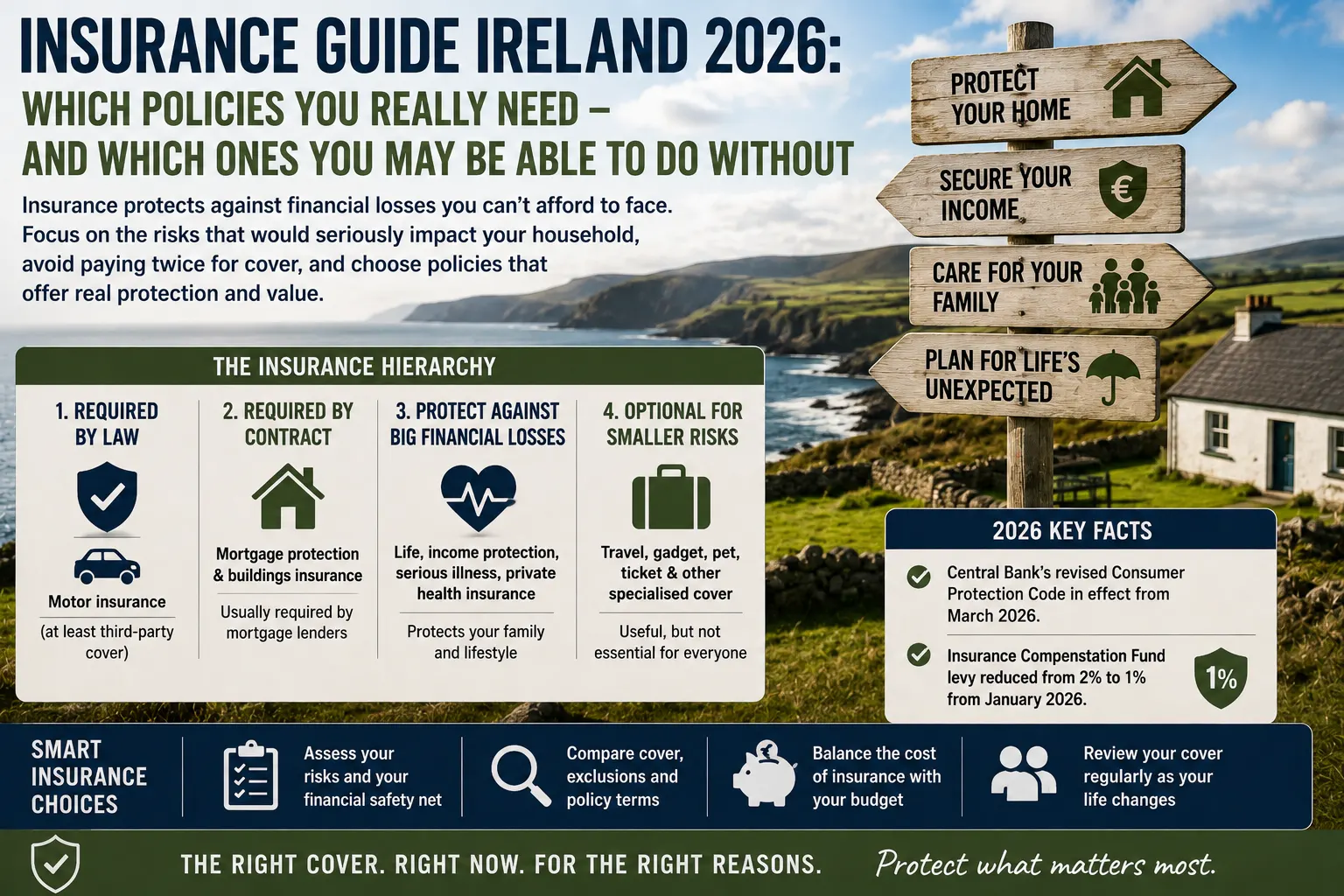
Ireland’s insurance environment has also changed in 2026. The Central Bank’s revised Consumer Protection Code took effect in March, strengthening the framework governing regulated financial service providers. At the same time, the Insurance Compensation Fund levy applying to many non-life policies was reduced from 2% to 1% from the beginning of 2026.
The Insurance Hierarchy: What Matters Most
A useful way to approach insurance is to separate products into four groups: cover required by law, cover normally required because of a mortgage or other contract, protection against potentially catastrophic household losses, and optional insurance for smaller or more specialised risks.
| Insurance | Compulsory? | Who Should Consider It? | Main Purpose |
|---|---|---|---|
| Motor insurance | Yes, if driving | Every motorist | Protects against liability for injury or damage; higher cover levels can protect your own car |
| Mortgage protection | Generally required for a home mortgage, with exceptions | Most mortgage borrowers | Clears or reduces mortgage debt if an insured borrower dies |
| Buildings insurance | Not generally required by law, but normally required by mortgage lenders | Homeowners | Protects the structure against major insured damage |
| Contents insurance | No | Homeowners and renters | Protects furniture, electronics, clothing and other possessions |
| Income protection | No | Workers relying heavily on employment income | Replaces part of income during qualifying long-term illness or disability |
| Life insurance | No | People with financially dependent partners, children or relatives | Provides money to dependants after death |
| Private health insurance | No | Consumers wanting additional private healthcare access | Helps fund private hospital and other healthcare costs |
| Serious illness insurance | No | Households vulnerable to the financial effects of a major diagnosis | Pays a lump sum for specified illnesses covered by the policy |
| Travel insurance | No | Most people travelling abroad | Covers selected medical, cancellation, repatriation and travel risks |
| Pet insurance | No | Owners concerned about large veterinary bills | Helps meet eligible veterinary costs |
| Gadget insurance | No | Owners of expensive devices not adequately covered elsewhere | Can cover theft, accidental damage or loss, depending on the policy |
| Payment protection insurance | No | Selected borrowers | Can help meet repayments following specified events |
This should not be read as a recommendation that every household needs the same insurance package. A 25-year-old renter with no car, no dependants and substantial savings has very different needs from a couple with two children, two cars and a large mortgage.
Motor Insurance: The Cover Every Driver Must Have
Motor insurance is the clearest case because drivers in Ireland must have at least third-party insurance. Third-party cover protects against claims from other people for injuries or damage caused by the insured driver, but it does not normally pay for accidental damage to the policyholder’s own vehicle. Third-party fire and theft adds protection against those risks, while comprehensive insurance normally provides wider protection including accidental damage to the insured car.
The legal minimum and the financially sensible level of cover are therefore not necessarily the same. Someone driving an old car worth €1,500 may reasonably decide that protecting the vehicle itself is less important. A household with a €35,000 car financed through borrowing faces a very different potential loss if that vehicle is written off without adequate own-damage cover.
Consumers should compare more than the headline premium. Excesses, windscreen protection, breakdown assistance, courtesy cars, no-claims protection and exclusions can make two apparently similar policies materially different. Renewal time should therefore be treated as an opportunity to compare the market rather than automatically accepting the first price offered.
Buildings Insurance: Protecting the Household’s Largest Asset
For most homeowners, the house is the largest asset they will ever own. Buildings insurance is not generally compulsory simply because a person owns a property outright, but mortgage lenders normally require adequate cover as part of the lending arrangement.
Buildings policies typically protect the structure against specified events such as fire, storm, certain forms of water damage and other insured risks. Exact cover varies significantly, and consumers should pay particular attention to exclusions for flooding, subsidence, gradual deterioration and ordinary wear and tear.
One of the most important issues is the amount insured. A property’s market value is not the same as its rebuilding cost. A home worth €500,000 because of its location may not cost €500,000 to reconstruct, while a cheaper house can have a surprisingly high rebuilding cost once demolition, construction and professional fees are included.
Underinsurance can create a serious financial problem. If a home would cost €300,000 to rebuild but is insured for substantially less, a major claim can leave the homeowner facing a considerable shortfall. Buildings cover should therefore be reviewed periodically rather than left unchanged for many years.
For most homeowners, the central question is straightforward: could the household afford to rebuild the property using its own money after a major fire or another catastrophic insured event? For most people, the answer is no.
Mortgage Protection: Protecting the Loan Is Not the Same as Protecting the Family
Mortgage protection is frequently confused with ordinary life insurance, but the two products have different purposes. Mortgage protection is primarily designed to repay the outstanding home loan if an insured borrower dies during the mortgage term.
Irish mortgage borrowers are generally required to have mortgage protection for their principal home, although particular exceptions can apply. The most common type is reducing-term cover, where the amount insured falls broadly alongside the outstanding mortgage balance.
The important point is that mortgage protection does not necessarily provide the surviving family with significant additional money after the mortgage has been cleared. If a couple owes €250,000 and the mortgage-protection policy repays that €250,000, the surviving household may own the home without debt but could still have lost a salary of €50,000 or €70,000 a year.
For households with dependent children, mortgage protection therefore does not automatically remove the need to consider separate life insurance.
Life Insurance: Most Important Where Someone Depends on Your Income
Life insurance is fundamentally about the financial consequences of a person’s death. Someone who is single, has no financially dependent relatives, little debt and adequate savings may have relatively little need for substantial additional life cover.
The position is very different for a parent supporting young children or a partner whose household depends heavily on one income. In that situation, the death of the insured person could remove decades of future earnings.
The correct question is therefore not simply, “How much life insurance should I buy?” It is, “What financial gap would my death create?”
Consider a household where mortgage protection would clear the home loan but one parent earns €60,000 per year and there are two young children. Housing debt may disappear after a death, but childcare, food, utilities, transport, education and ordinary living costs remain.
Separate life insurance can provide money for those wider household needs.
The need may also change over time. Once children become financially independent, debts fall and retirement assets increase, the requirement for substantial term-life insurance can decline considerably.
Income Protection: Insuring the Asset That Pays for Everything Else
Many households insure their car and home while overlooking the asset that pays for both: their future income.
A 40-year-old earning €60,000 a year with another 25 years until retirement has potential future gross earnings of €1.5 million even before future wage growth is considered. Losing the ability to work for several years can therefore be financially more serious than losing a vehicle or having possessions stolen.
Income protection insurance can provide a regular benefit where a policyholder is unable to work because of qualifying illness, injury or disability. Policies normally cover only part of previous earnings, and payments generally begin after a selected waiting or deferred period.
The product deserves particular attention from self-employed people, workers with limited occupational sick pay, single-income households and families whose mortgage and normal expenses depend heavily on one salary.
Before buying private cover, consumers should check what they already receive through employment. Employer sick pay, pension benefits, workplace income protection and State supports can all affect how much additional private protection is necessary.
For many working households, income protection arguably deserves a higher priority than relatively minor policies such as gadget insurance because the financial loss it protects against can be vastly greater.
Private Health Insurance: Optional, but Widely Used
Private health insurance is not compulsory in Ireland. People ordinarily resident in the country have access to the public healthcare system, while private insurance offers additional access and benefits according to the plan selected.
At the end of 2025, approximately 2.55 million people, close to 46% of the population, held inpatient private health insurance. This makes health insurance a major component of Irish household spending even though it is voluntary.
Cost has become increasingly important. By the end of 2025, the weighted average adult premium was around €1,900 after the relevant tax treatment, although individual plans can cost considerably more or less.
For a couple, this can easily represent several thousand euro per year, making annual comparison particularly important. Health insurance should not simply be renewed because a household has held the same plan for many years.
Timing also matters. Under Lifetime Community Rating, people who first purchase inpatient health insurance after the age threshold can face age-related premium loadings under the rules of the scheme. New customers can also face waiting periods for certain illnesses and benefits.
Private health insurance is therefore not essential for every household, but it is a product that should be considered strategically rather than only when medical treatment is suddenly required.
Serious Illness Cover: A Lump Sum for Specific Diagnoses
Serious illness insurance, often known as critical illness cover, generally provides a lump-sum payment if the insured person is diagnosed with one of the specific illnesses covered by the policy and satisfies the policy definition.
The word “specific” is important. A severe medical condition does not automatically result in payment. The illness and its severity normally have to meet the conditions stated in the contract.
Where a claim is accepted, the lump sum can be used for mortgage repayments, childcare, home alterations, treatment-related expenditure or general living costs.
Serious illness cover is not the same as income protection. Serious illness insurance normally provides a one-off payment after a qualifying diagnosis, while income protection may provide recurring payments where a person cannot work because of a broader range of covered illnesses or disabilities.
The right product therefore depends on the risk a household is trying to address.
Contents Insurance: Not Just for Homeowners
Tenants usually do not need to insure the structure of the building because that responsibility belongs to the property owner. Their own possessions are a different matter.
Contents insurance can cover furniture, clothing, televisions, computers and other household belongings against specified insured events. The best way to assess the need is to imagine the property completely empty after a major fire and calculate what replacing everything would cost.
Beds, sofas, wardrobes, clothing, kitchen equipment, laptops, televisions and children’s possessions can collectively be worth tens of thousands of euro even where no individual object appears particularly expensive.
Consumers should also check whether belongings taken outside the home are protected. Jewellery, mobile phones, laptops and bicycles may require additional personal-possession or all-risks cover rather than ordinary contents insurance alone.
Travel Insurance: Medical Risk Matters More Than Lost Luggage
Travel insurance is voluntary, but for international travel it can protect against potentially very large and unpredictable costs. Depending on the policy, protection may include emergency medical treatment, repatriation, trip cancellation, baggage, personal liability and disruption.
For travel within Europe, an eligible Irish resident may also use the European Health Insurance Card for necessary public healthcare under applicable arrangements. The EHIC, however, is not a substitute for comprehensive travel insurance and does not provide the same cancellation, baggage or repatriation protection.
Medical repatriation is one of the strongest reasons to consider travel cover. A serious accident or illness abroad can require specialist transportation and generate expenses far beyond the value of the holiday itself.
Pre-existing medical conditions require particular attention because exclusions may apply unless the condition is properly disclosed and accepted. Activities such as skiing, diving or certain adventure sports may also require additional protection.
A €200 domestic weekend and a €7,000 family holiday abroad do not represent the same financial risk. Insurance should reflect the scale of the potential loss.
Pet Insurance: Insurance or Your Own Emergency Fund?
Pet insurance is not compulsory. Its main purpose is to protect owners from unexpectedly large veterinary bills following eligible illness or injury.
For a household that would struggle to find several thousand euro for emergency veterinary treatment, pet insurance can provide valuable financial predictability. Someone with substantial savings may instead choose to self-insure by keeping a dedicated pet emergency fund.
Policy conditions matter greatly. Consumers should examine excesses, annual limits, age restrictions and exclusions for pre-existing conditions. Buying insurance only after an animal becomes ill may be too late because existing conditions are frequently excluded.
Gadget Insurance: Check Whether You Are Already Covered
Phones, tablets and laptops can be expensive, but separate gadget insurance should generally rank below protection against major household risks.
Before purchasing another policy, check home or contents insurance to see whether the device is already covered. Some bank accounts, credit cards or other services can also include forms of device protection.
The economics should be considered carefully. Paying a significant annual premium to insure a relatively old €400 phone while accepting a substantial excess may provide poor value.
Insurance is most useful where the potential loss would create genuine financial difficulty rather than ordinary inconvenience.
Payment Protection Insurance: Understand Exactly What Triggers a Claim
Payment protection insurance can help meet repayments on loans, mortgages or other credit following specified events such as illness, accident, unemployment or death, depending on the contract.
The value depends heavily on existing household protection. Someone with extensive employer sick pay, income protection and strong emergency savings may gain relatively little from an additional payment-protection policy.
Consumers should therefore identify the specific gap being insured rather than automatically purchasing cover alongside a loan.
Why Savings Can Be Better Than Insurance for Smaller Losses
Not every risk should be transferred to an insurance company.
Suppose a household could comfortably replace a €300 phone, pay for a €500 appliance repair or absorb a €700 unexpected expense. Purchasing separate insurance for every relatively small financial risk can eventually cost more than maintaining a healthy emergency fund.
Insurance is particularly valuable for low-frequency, high-cost events: circumstances that may be unlikely but could seriously damage a household’s finances.
Savings are often better suited to smaller and more frequent risks.
This creates a useful principle: protect the house before the phone, protect the income before the extended warranty, and protect financially dependent family members before paying for cover that merely replaces an inexpensive object.
A Family Example: Which Policies Should Come First?
Consider a couple in their late thirties with two young children. They own a €400,000 home with a €280,000 mortgage, have two cars and depend on combined employment income of €95,000.
Their first layer of protection is relatively straightforward. Both cars require motor insurance. The property requires adequate buildings insurance under the mortgage arrangements, and mortgage protection deals with the outstanding home loan if an insured borrower dies.
The next major question is what happens if one parent dies or becomes unable to work for several years. Separate life insurance and income protection may therefore be considerably more important than insuring phones or other relatively inexpensive possessions.
Contents insurance can protect against having to replace an entire household after a severe insured event. Private health insurance becomes a healthcare-access and budget decision, while serious illness cover can add a lump-sum layer of protection.
Only after those major financial exposures are addressed does it make sense to consider lower-priority policies.
Single People Often Need a Different Insurance Package
A single person with no dependants does not automatically need substantial life insurance. If nobody depends on that person’s income and debts are limited, there may be relatively little financial loss for another person to insure against following death.
Income protection can be much more important. A single person has no second household salary to rely upon if illness prevents them from working. Rent, mortgage repayments, utilities and normal living expenses continue.
That individual could therefore rationally have comprehensive motor insurance, appropriate home or contents cover and income protection while holding little additional life insurance.
Insurance planning should follow the actual financial risk rather than a standard package.
Self-Employed Workers Need to Look Closely at Income Risk
Self-employed people have a particularly distinctive risk profile because they may not receive the same occupational sick-pay or employee benefits available to some salaried workers.
A plumber, consultant, tradesperson, farmer or small-business owner may have several months of savings but still be unable to finance a prolonged period without income.
For these households, protecting the person’s earning capacity can be more financially important than insuring many physical possessions.
Occupation also matters. Higher-risk jobs can make income-protection cover more expensive or restrict what insurers are willing to offer.
Retired Households Should Review Old Policies
Insurance requirements change as households age.
A retired couple with a mortgage-free home, financially independent children and substantial savings may no longer need the level of term-life insurance that made sense when the children were young.
Their priorities may shift towards buildings and contents insurance, health insurance if desired, and travel insurance for foreign trips.
Older policies should therefore be reviewed rather than automatically retained simply because they have existed for many years. Insurance that was highly valuable at age 35 may no longer solve an important financial problem at age 70.
Beware of Paying Twice for the Same Protection
Insurance can become unnecessarily expensive because households sometimes buy overlapping cover without realising it.
A phone may be protected under home insurance and a separate gadget policy. Travel insurance may already be included with a bank account or payment card. An employee can have workplace death-in-service benefits alongside private life insurance, while employer-funded income protection may overlap with personal cover.
Before purchasing a new policy, consumers should therefore carry out a simple insurance inventory. Check employment benefits, pension benefits, mortgage protection, home insurance extensions, bank-account packages and credit-card benefits before identifying genuine gaps.
Paying twice for substantially the same risk rarely represents good value.
Excesses Matter Almost as Much as Premiums
A low-premium policy can provide less protection than expected if the excess is high.
The excess is the amount of a qualifying claim that remains the policyholder’s responsibility. If the loss is €700 and the excess is €500, the insurer may pay only €200, depending on the exact policy terms.
Choosing a larger excess can lower the premium and may make sense for households with sufficient savings. The policyholder is effectively choosing to self-insure the first part of each loss while using the insurer for larger financial events.
That can be an efficient approach: maintain an emergency fund for smaller problems and use insurance to protect against losses that could seriously damage the household balance sheet.
The Cheapest Policy Is Not Always the Best Value
Consumers naturally compare price, but the lowest premium may provide poor value if important cover has been removed.
Two home-insurance policies can differ in accidental damage, alternative accommodation, valuables limits, flood protection and excesses. Comprehensive motor policies can differ in breakdown assistance, windscreen protection, replacement-car arrangements and no-claims protection. Health-insurance plans can vary considerably in hospital access and benefits.
The correct comparison is therefore not simply the annual premium.
It is:
premium + cover + exclusions + excesses + claim limits
A slightly more expensive policy can represent better financial protection if it responds more effectively to the risks that actually matter to the household.
Claims Are When the Policy Becomes Real
Many consumers spend time comparing insurance when they buy it and then barely look at the policy until something goes wrong. In reality, the contract becomes most important at claim stage.
Policyholders should understand notification requirements, exclusions, excesses and documentation rules. Receipts, photographs, valuations and other records for important possessions can make claims easier to substantiate.
Major home improvements should trigger a review of the buildings sum insured. Changes in circumstances should also be disclosed when they are relevant to questions asked by the insurer.
Insurance is effective only where the policy genuinely matches the risk.
Ireland’s Insurance Market Is Changing
The regulatory framework for Irish insurance consumers has continued to evolve. The Central Bank’s revised Consumer Protection Code took effect in 2026, with a stronger emphasis on firms acting in customers’ interests and providing information that supports informed financial decisions.
The Insurance Compensation Fund levy applying to many non-life insurance policies also fell from 2% to 1% at the beginning of 2026. For an individual household this represents only a modest saving, but it reduces one component of eligible motor and home insurance costs.
Health insurance has been moving in the opposite direction, with premiums rising significantly in recent years. That makes regular comparison increasingly important, especially because many consumers remain with the same health plan for long periods even when more appropriate alternatives may exist.
Climate Risk Could Make Property Insurance More Complicated
Flooding and other property-related environmental risks are likely to become increasingly important when homeowners consider insurance.
A property can be affordable to purchase but difficult or expensive to insure if its location presents elevated flood, subsidence or other risks. Buyers should therefore investigate insurance availability before purchasing a property in a location where significant environmental risks may affect cover.
Climate change is also becoming an increasingly important consideration for the wider insurance industry. The precise effect on individual household premiums cannot be predicted with certainty, but the relationship between property location, risk assessment and insurance availability is likely to become more important over time.
What Does a Sensible Insurance Portfolio Look Like?
For many households, the most important insurance policies can be ranked by the severity of the financial loss they protect against.
A driver requires motor insurance.
A homeowner should protect the structure of the property.
A mortgage borrower needs to understand mortgage-protection requirements.
A household whose children or partner depend on one or both incomes should consider life insurance.
A worker whose household could not survive years without salary should examine income protection carefully.
Contents insurance becomes important where replacing everything in the home would exhaust available savings.
Private health insurance is primarily a decision about healthcare access, benefits and affordability.
Travel insurance can be particularly valuable abroad because emergency medical and repatriation costs can become extremely large.
Serious illness, pet, gadget and payment-protection policies then depend much more heavily on individual circumstances and available savings.
The Best Insurance Strategy Is Not to Insure Everything
Insurance companies can create policies for almost every imaginable financial inconvenience. A sensible household does not need to buy all of them.
The purpose of insurance is not to prevent every unexpected expense. It is to stop an unexpected event from becoming a financial catastrophe.
That leads to one simple principle:
Insure what you cannot afford to lose. Save for what you can afford to replace.
For one household, that may mean comprehensive motor insurance, buildings and contents cover, mortgage protection, substantial life insurance and income protection. For another, it may mean no life insurance at all but strong protection for income, home and travel.
There is no single correct insurance package for every person in Ireland. The right combination depends on income, debts, savings, dependants, employment benefits, property ownership, health priorities and the household’s ability to absorb financial shocks.
The most effective insurance strategy is therefore not the one with the greatest number of policies. It is the one that identifies the few events capable of seriously damaging a household’s financial future — and makes sure those risks are properly protected.
Source & Transparency
This article is published by Ireland Newspaper for editorial and informational purposes.
Published: 13 August 2026 · Updated: 13 August 2026

Newsroom Ireland Newspaper
Ireland Newspaper editorial team prepares daily news coverage for readers in Ireland and abroad.