
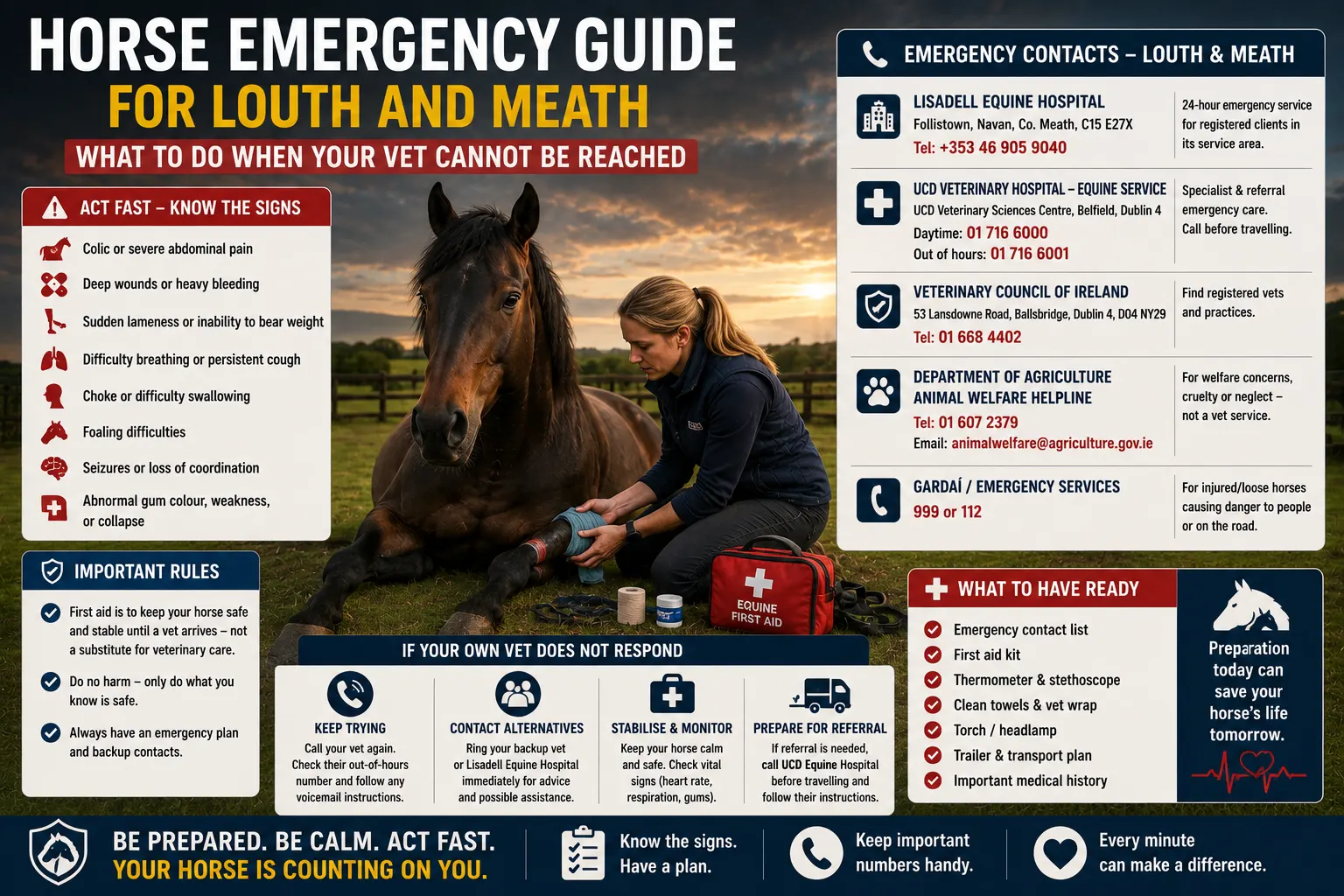
Horse Emergency Guide for Louth and Meath: What to Do When Your Vet Cannot Be Reached
Colic in the middle of the night, a deep wound in a field, sudden severe lameness or a horse struggling to breathe can leave an owner facing difficult decisions before a veterinarian arrives. For horse owners in County Louth and County Meath, preparation is as important as first aid: know which emergencies cannot wait, keep alternative veterinary contacts ready and understand the few safe actions that can protect a horse without making its condition worse.
A horse that was apparently healthy an hour ago can become critically ill very quickly. Colic, serious wounds, fractures, choke, eye injuries, respiratory distress and neurological problems are among the conditions that can require urgent veterinary assessment. Severe bleeding, loss of appetite accompanied by pain, abnormal gum colour, sudden inability to bear weight, seizures, loss of coordination and foaling difficulties should also be treated seriously.
For owners in Louth and Meath, the most important rule is simple: first aid is intended to keep the horse safe and stable until professional veterinary treatment becomes available. It is not a substitute for veterinary diagnosis or treatment.
The second rule is equally important. Do not rely on having only one veterinary telephone number stored in a mobile phone. Some equine practices provide out-of-hours services primarily to registered clients, and referral hospitals can require advance arrangements before a horse is transported. An emergency plan should therefore be organised before it is ever needed.
Emergency Contacts for Horse Owners in Louth and Meath
Horse owners should keep their normal veterinary practice at the top of their emergency contact list, followed by at least one alternative equine practice and the details of an appropriate referral hospital. The following contacts are particularly relevant for owners in County Louth and County Meath.
| Service | Contact Details | When It May Be Needed |
|---|---|---|
| Lisadell Equine Hospital | Follistown, Navan, Co. Meath, C15 E27X. Tel: +353 46 905 9040 | Equine veterinary emergencies in its service area. Its 24-hour emergency service is available to registered clients |
| UCD Veterinary Hospital – Equine Service | UCD Veterinary Sciences Centre, Belfield, Dublin 4. Daytime: 01 716 6000. Out of hours: 01 716 6001 | Specialist or referral emergencies requiring hospital-level equine care. Advance arrangements are required |
| Veterinary Council of Ireland | 53 Lansdowne Road, Ballsbridge, Dublin 4, D04 NY29. Tel: 01 668 4402 | The official veterinary register can help identify registered veterinary practitioners and practices |
| Department of Agriculture Animal Welfare Helpline | Tel: 01 607 2379. Email: animalwelfare@agriculture.gov.ie | For reports of serious animal-welfare concerns, cruelty or neglect; not a substitute for an emergency veterinarian |
| Gardaí / Emergency Services | 999 or 112 | Where an injured, trapped or loose horse creates an immediate danger to people or road users, or another public-safety emergency exists |
Lisadell Equine Hospital in Navan provides equine services across County Meath and much of County Louth. Owners should be aware that its published 24-hour ambulatory emergency service is intended for registered clients, which is an important reason to establish a relationship with a practice before an emergency occurs.
UCD Veterinary Hospital provides specialist equine hospital and emergency care. A horse should not simply be loaded into a trailer and taken there without prior arrangements. In an emergency requiring referral, the receiving hospital should be contacted in advance and its instructions followed.
The Veterinary Council of Ireland is the regulator for veterinary practitioners and practices rather than an emergency treatment service. Its register can nevertheless be useful if an owner urgently needs to identify another registered veterinary practice after being unable to contact the usual vet.
The Department of Agriculture Animal Welfare Helpline is primarily for concerns involving animal neglect, cruelty or wider welfare issues. It is not an alternative to emergency clinical treatment for a sick or injured privately owned horse.
If Your Own Vet Does Not Answer
An unanswered call should not turn into hours of waiting when a horse is showing signs of a genuine emergency. Call the normal practice again and listen carefully to the recorded message, because many veterinary practices provide an out-of-hours number or automatically redirect emergency callers.
If the horse appears seriously ill or injured and no response is available, contact another equine veterinary practice immediately. Explain at the beginning of the call that the horse is experiencing an emergency and that the normal veterinary practice cannot currently be reached.
Do not spend a long period repeatedly phoning only one number while the horse deteriorates. The objective is to establish professional veterinary contact as quickly as possible.
If the case may require surgery, intensive treatment, imaging or advanced diagnostics, the attending veterinarian may recommend referral to a specialist equine hospital. In such circumstances, transport should normally be coordinated with the veterinarian and receiving hospital.
Have the Right Information Ready Before Calling
A veterinarian can make better decisions when the owner provides precise information rather than simply saying that the horse “doesn’t look right”. Have the exact location and Eircode ready, along with the horse’s age, sex, approximate weight if known, medical history and any medicines currently being given.
Explain when the problem began and whether the horse is improving, stable or deteriorating. Tell the veterinarian whether the horse can stand and walk, whether it is eating and drinking, whether manure and urine are being produced and whether there is bleeding, sweating, swelling, abnormal breathing, rolling or unusual behaviour.
If it can be done safely and without delaying the emergency telephone call, measure the horse’s temperature, pulse and respiratory rate. A healthy resting adult horse commonly has a temperature of approximately 37.2°C to 38.1°C, a resting pulse of roughly 32 to 44 beats per minute and a respiratory rate around 8 to 16 breaths per minute. Age, exercise, pain, stress and environmental conditions can alter these values.
These figures are useful information for the veterinarian, not a substitute for clinical judgement. A horse with heavy bleeding, severe abdominal pain, respiratory difficulty or a suspected fracture requires veterinary help even if the owner has not been able to record all of its vital signs.
Colic: Call Early Rather Than Waiting
Colic means abdominal pain rather than one particular disease. Signs can include pawing, repeatedly looking at the flank, kicking at the abdomen, stretching, lying down, rolling, sweating, refusing food or producing unusually little manure.
Some episodes are relatively mild, while others can involve intestinal displacement, obstruction or another condition requiring urgent surgery. An owner cannot reliably distinguish between those possibilities simply by observing the horse.
If colic is suspected, call a veterinarian promptly and remove access to feed. Unless the veterinarian instructs otherwise, access to water can generally remain available. Keep the horse in an environment where it cannot easily injure itself and observe it closely.
Do not administer painkillers, sedatives, mineral oil or other medicines simply because they were used during a previous episode. Medication can alter clinical signs and may be inappropriate for the current problem. Tell the veterinarian what medicines are available and follow the instructions given.
Owners sometimes believe that every horse with colic must be walked continuously. That is not always appropriate. The purpose of movement is not to exhaust the horse. Follow veterinary advice and prioritise the safety of both horse and handler.
Severe pain, violent rolling, collapse, repeated recurrence after temporary improvement or rapid deterioration should be reported immediately because they can indicate a more serious condition.
Heavy Bleeding: Control the Blood Loss First
A large wound can be frightening, but the first priority in significant external bleeding is usually to control blood loss. Apply firm, continuous pressure with a clean absorbent dressing, gauze pad or folded clean cloth where it is safe to do so.
Do not repeatedly remove the first dressing simply to check whether the bleeding has stopped. Disturbing an emerging clot can restart bleeding. If blood soaks through the first layer, additional clean padding can be placed over it while pressure is maintained.
Once bleeding is controlled, veterinary assessment is still important. The outward appearance of a wound does not always reveal how much damage has occurred beneath the skin.
Puncture wounds, heavily contaminated wounds, injuries involving the eye, chest or abdomen and wounds close to joints, tendon sheaths or exposed bone deserve particular urgency. A small puncture near a joint can sometimes be more serious than a much larger superficial cut elsewhere because infection of a joint or tendon sheath can threaten the horse’s future soundness.
Suspected Fracture or Sudden Non-Weight-Bearing Lameness
A horse that suddenly refuses to place any weight on a limb requires urgent assessment, particularly following a fall, kick, collision or other accident.
A suspected fracture is one of the situations in which trying to help can unintentionally make the damage worse. Movement can convert a relatively stable fracture into a much more severe injury.
Keep the horse as quiet as possible and telephone the veterinarian immediately. Do not force the horse to walk simply to test the limb, and do not automatically attempt to load it into a trailer.
Tell the veterinarian which leg is affected, whether the limb appears deformed, whether bone is visible, whether a wound is present and whether the horse can place any weight on the foot.
Correct splinting depends on the precise location of an injury. An incorrectly positioned splint can potentially worsen the situation, so complicated splinting should not be improvised unless a veterinarian is directing the process or the handler has appropriate training.
Transport should be decided in consultation with the veterinarian.
Eye Injuries Cannot Safely Wait
A horse holding one eye closed, squinting, tearing excessively or developing sudden swelling, cloudiness, bleeding or visible trauma should be examined promptly.
Eye conditions can deteriorate rapidly, and apparently similar symptoms can arise from very different problems, including corneal ulcers, foreign bodies, eyelid wounds and deeper injuries. Some can threaten vision if treatment is delayed.
Keep the horse in a quiet place and prevent it from rubbing the eye as far as this can safely be achieved. Do not place old prescription eye medication into the eye without veterinary instruction. Some medicines that are appropriate for one eye condition can be harmful in another.
An eye problem is one of the situations where “waiting until tomorrow to see if it improves” can create unnecessary risk.
Choke: Remove Feed and Water
Equine choke is an obstruction of the oesophagus rather than the type of airway obstruction usually meant when referring to choking in people. A horse can still breathe but may cough, repeatedly attempt to swallow, stretch its neck, salivate excessively or produce saliva, water and feed material from the nostrils.
Remove both feed and water and contact a veterinarian. Continuing to swallow can worsen the obstruction and increase the possibility of material entering the lungs.
Do not force water, food, mineral oil or any other substance into the horse’s mouth. Trying to wash the obstruction down without veterinary equipment can create serious complications.
Even if the obstruction appears to clear spontaneously, veterinary advice is sensible because irritation of the oesophagus and aspiration of material into the lungs can produce complications later.
Difficulty Breathing Is an Immediate Emergency
A horse showing marked respiratory distress, struggling for breath, making unusual respiratory noises, collapsing or developing abnormal gum colour requires urgent veterinary attention.
Keep the animal calm and minimise unnecessary movement. Do not exercise the horse to test whether the breathing problem improves.
Tell the veterinarian about any swelling around the head or throat, nasal discharge, recent injury, possible allergic reaction, fever or sudden onset of symptoms.
A horse with serious breathing difficulty may need stabilisation before transport. Loading it immediately into a horsebox and beginning a long journey without professional guidance can add stress and potentially worsen the condition.
Fever, Cough and Nasal Discharge: Protect the Other Horses
Not every emergency begins with an injury. Fever, coughing, nasal discharge, diarrhoea or neurological signs can indicate an infectious disease.
Where infection is possible, separate the affected horse from others if this can be done safely. Use separate feed and water buckets and avoid sharing grooming equipment, tack or other items between animals.
Limit movement between the sick horse and the rest of the yard, particularly where several people care for different horses. Basic hygiene such as handwashing and changing contaminated clothing or footwear can also reduce the risk of spreading infection.
Tell the veterinarian immediately if more than one horse has developed similar symptoms.
Do not transport a horse suspected of having an infectious disease to another yard or hospital without first discussing the situation with the receiving veterinarian.
A Horse That Is Down Can Be Extremely Dangerous
A horse unable to stand, suffering seizures or showing marked loss of coordination requires emergency veterinary assessment.
Human safety becomes particularly important. A frightened, painful or neurological horse weighing several hundred kilograms can move suddenly and unpredictably. Keep unnecessary people, children and dogs away from the area and remain clear of the legs.
Remove nearby hazards only where this can be done safely. Do not put yourself between a struggling horse and a wall, fence or solid object.
Improvised attempts to drag a horse with a car, tractor or other vehicle can cause severe additional injuries to both the horse and the people involved. Recovery of a recumbent animal can require veterinary supervision and specialist equipment.
If a horse is down on a public road or another location where the incident creates an immediate danger to people, contact 999 or 112 as well as the veterinarian.
Do Not Automatically Transport an Injured Horse
Having access to a horsebox does not mean transport is always the safest first action.
A horse with a suspected fracture may require stabilisation before movement. Severe colic may need assessment before referral. A horse with neurological disease can be extremely dangerous to load, while a potentially infectious horse may require special arrangements at the receiving facility.
Before loading, speak to the veterinarian or receiving hospital. Confirm where the horse is being taken, whether the facility is ready to accept the patient and whether any special transport instructions apply.
Keep the horse’s passport accessible. Emergency situations become more difficult when identification documents are locked away or nobody knows where they are stored.
The trailer or horsebox should also be roadworthy and immediately usable. Discovering flat tyres, electrical problems or a missing towing vehicle during a veterinary emergency can waste valuable time.
What Should Be in an Equine First-Aid Kit?
Every stable or yard should have a clearly marked first-aid kit stored somewhere that more than one person can access. It does not need to contain complicated veterinary equipment.
A sensible kit can include a digital thermometer, disposable gloves, sterile saline, sterile gauze, clean absorbent dressings, non-stick wound pads, cotton padding, suitable bandages, clean towels, blunt-ended scissors and a head torch or flashlight. Emergency telephone numbers and the yard Eircode should also be kept with the kit.
The kit should be checked periodically. Sterile dressings become damaged, saline containers expire and equipment can disappear after minor injuries without being replaced.
Prescription medicines require additional care. Keep them stored correctly and clearly labelled, but do not assume that medication previously prescribed for another condition can automatically be given during a new emergency.
The Best Emergency Plan Is Made Before the Emergency
The most effective equine emergency planning happens when every horse is healthy.
Save the normal veterinarian’s number and the practice’s out-of-hours procedure. Register with an equine practice that covers the horse’s actual location. Identify an alternative registered practice and know where an appropriate referral hospital is located.
Establish who can transport the horse if the owner is unavailable. Keep the horsebox maintained, and make sure someone else knows where the keys and towing equipment are kept.
Keep each horse’s passport accessible and make sure another responsible person knows where emergency supplies are stored. If family members, neighbours, yard staff or other people sometimes care for the horses, leave written emergency information containing the owner’s contact details, veterinary practice, backup number, Eircode and any relevant medical history.
For owners using practices whose out-of-hours service is limited to registered clients, registration should be completed before an emergency ever occurs.
A Simple Emergency Checklist
When something suddenly goes wrong, stress can make even experienced owners forget basic steps. A simple sequence can help.
| Step | What to Do |
|---|---|
| 1. Protect people | Keep handlers, children, bystanders and other animals away from danger |
| 2. Assess the horse | Check whether it is standing, breathing normally, bleeding, in severe pain or neurologically abnormal |
| 3. Call the veterinarian | Explain immediately that it is an emergency and give the exact location |
| 4. Use the backup plan if necessary | If the usual vet cannot be reached, contact another equine practice without unnecessary delay |
| 5. Perform only basic first aid | Control severe bleeding, remove feed where appropriate and keep the horse quiet |
| 6. Do not improvise treatment | Avoid unapproved medication, force-feeding, complicated splints or dangerous recovery attempts |
| 7. Discuss transport | Do not automatically load a severely injured horse before speaking to a vet |
| 8. Prepare documents and access | Have the passport, Eircode, gate access and transport arrangements ready |
| 9. Monitor continuously | Tell the veterinarian immediately if the horse deteriorates |
The checklist is deliberately simple because emergencies are not the moment for complicated home treatment. The most valuable actions are often the least dramatic: making the correct phone call, preventing additional injury and giving the veterinarian accurate information.
When in Doubt, Treat a Sudden Change Seriously
Horse owners usually know the normal behaviour of their own animals remarkably well. A horse that suddenly refuses food, repeatedly lies down, becomes severely lame, begins sweating without exercise or behaves very differently deserves attention even before dramatic clinical signs appear.
The purpose of an emergency guide is not to turn owners into veterinarians. It is to help them recognise when waiting is the wrong decision.
For horse owners in County Louth and County Meath, the safest sequence is straightforward: protect people first, contact a veterinarian early, describe the problem accurately, perform only simple first aid that is unlikely to worsen the condition and establish a safe plan before transporting the horse.
Firm pressure can help control serious bleeding. Removing feed can protect a horse while colic is being assessed. Removing both feed and water is appropriate when choke is suspected. Isolation can reduce the spread of a potentially infectious illness, while keeping a horse still can help prevent additional damage when a fracture is possible.
None of those measures replaces veterinary care, but they can protect something exceptionally valuable during an equine emergency: time.
The worst moment to begin searching for an emergency veterinarian is when a critically ill horse is already standing — or lying — in front of you. The best preparation is therefore made long before that moment: a primary veterinary contact, a backup option, a known out-of-hours procedure, safe transport arrangements, an accessible passport and a properly stocked first-aid kit ready at the yard.
Source & Transparency
This article is published by Ireland Newspaper for editorial and informational purposes.
Published: 13 August 2026 · Updated: 13 August 2026

Newsroom Ireland Newspaper
Ireland Newspaper editorial team prepares daily news coverage for readers in Ireland and abroad.